|
|
(chronological by film title) Introduction | Picture Guide | 1941 | 1944 | 1945 | 1946-1 | 1946-2 | 1947-1 | 1947-2 1948 | 1949 | 1950-1952 | 1953 | 1954-1956 | 1957-1959 |

|
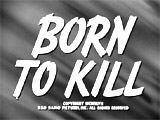
Born to Kill (1947)
Robert Wise's dark, racy, cynical, amoral and noirish crime melodrama was based on James Gunn's novel Deadlier Than the Male, with themes of rampant criminal behavior, jealousy, deceit, selfish social-striving, greed, temptation, and infidelity. Forces of censorship at the time (the Breen Commission) were upset by the film's story - "a story of gross lust and shocking brutality, and ruthlessness." One of the film's taglines described the two despicable and unredeemable main characters - a homicidal maniac and a promiscuous, danger-loving female:
The morbid story opened in Reno, Nevada, with the just-announced divorce of wealthy, worldly and beautiful socialite Helen Brent (Claire Trevor). She was renting a room from Mrs. Kraft (Esther Howard), the elderly, card-cheating, alcoholic landlady of the establishment, owned by young Laury Palmer (Isabel Jewell).
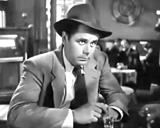
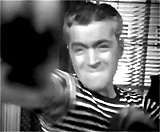
Laury bragged to Mrs. Kraft and Helen about her new "young squirt" dating prospect Danny Jaden (Tony Barrett) on the side. She was dating him only to make her regular boyfriend Sam Wilde (Lawrence Tierney) jealous. She described Sam as a brute: "He's the quiet sort, and yet you get a feeling if you stepped out of line, he'd kick your teeth down your throat...He knows he's got me all wrapped up. So I've got to start him worryin'. It's a bore but that's the way you got to handle men." (Later, feeling humiliated and manipulated, Sam mentioned that Laury was "makin' a monkey outta me...I never let anybody cut in on me on anything!") On her last night in Reno at the Northern Club casino, Helen flirted unknowingly with another craps-dice table customer (Sam Wilde) while betting. Helen greeted Laury and her date Danny, within view of Sam. Upon Laury and Danny's return to the boarding house, Danny was alone in the kitchen where he was awaited and confronted by jealously-enraged bad guy Sam with a hair-trigger temper - they engaged in a brief fistfight before Sam bludgeoned Danny to death. When Laury walked in on the scene, she was also murdered.
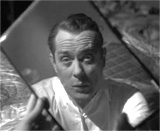
Later upon her return home (Sam watched her from the bushes), Helen discovered the cold-blooded, double-murder - the two bodies on the kitchen floor. The self-centered Helen remained calm and although she considered calling the police to report her grisly discovery, she instead called the railroad station - she had immediate plans to travel to San Francisco to marry wealthy fiancee Fred Grover (Phillip Terry). Meanwhile, Sam returned to his apartment and admitted his crimes to his close-friend and understanding confidante Marty Waterman (Elisha Cook, Jr.), who immediately questioned his sanity:
When Helen and Sam fled town separately, they found themselves on the same night-time train and became reacquainted in the closed club-car. He knowingly told her: "I know what I want when I see it." She complimented him on his straight-forward manliness: "You're not a turnip, are you?" On the Berkeley ferry shuttling across the Bay to the city, she was intrigued by his comment about their common destination:
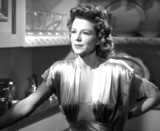
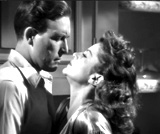
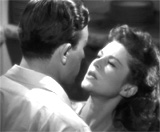
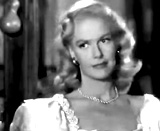
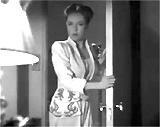
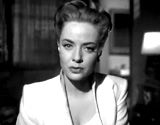
In San Francisco, Helen joined up with her wealthy fiancee Fred Grover (Phillip Terry) (of the Grover Steel Co.) and her pretty half/foster-sister Georgia Staples (Audrey Long), an affluent newspaper heiress. Sam located Helen in Georgia's mansion, and became acquainted with Georgia. Knowing that Helen was already 'taken' (although she was acting coy and playing a continual game of cat-and-mouse with him), and that single and available Georgia also had wealth and status, he flirted with her and after a few weeks of courtship, they were married. Still, Helen craved Sam's attention and was strangely drawn to and thrilled by the repellent Sam - she engaged in an illicit relationship with him (never fully sexually portrayed on-screen due to censorship guidelines), while jealously resenting him for marrying her sister. She allowed herself to be kissed by Sam immediately after the wedding. Meanwhile, seedy and corrupt, portly Bible-quoting private detective Matthew Arnett (Walter Slezak) had been hired by Mrs. Kraft in Reno to find Laury's killer. Arnett trailed Marty to SF, and posed as a hungry vagrant at Georgia's home before being thrown out by Helen for asking too many questions about Mr. Wilde. Sam and Georgia's honeymoon was cut short by one week when they argued about Sam's intentions to manage the newspaper that Georgia had inherited from her father. In one repellent scene late the night after Sam's aborted honeymoon, Helen and Sam met together in the kitchen, when he called her his lustful and passionate "soulmate." He insightfully noted: "Your roots are down where mine are!" before embracing and kissing her. She mentioned that she loved Fred, mostly for his money, peacefulness and security: ("All my life, I've lived on other people's money. Now I want some of my own. But there's another kind of security that Fred can give me. Without him, I'm afraid of the things I'll do. Afraid of what I might become. Fred is goodness and safety"). And then she complimented Sam's darker nature:
As Sam gleefully reminisced about the murder scene in Reno and complimented her for her calm reaction to the two deaths: ("You had guts then, you didn't yell or faint...Blood all over the place and you didn't yell!"), she suddenly realized to her revulsion that he was the double-murderer. [Note: The film's tagline described their relationship: "The coldest killer a woman ever loved."] Helen tried to notify PI Arnett by phone - while Sam eavesdropped on a different extension. He began to suspect that Helen was entrapping him with her seductive charm ("I don't get her at all...Maybe she is against me, I don't know. She puts herself in my arms and tries to trap me. She feels, digs, and looks inside of me"). Later in person, Helen vaguely told Arnett about her suspicions about Sam. However, to protect Sam and suppress Arnett's search for justice, she tried to buy off (or blackmail) Arnett for $5,000, but he tripled his demands to $15,000 to keep silent. When she refused, he said he would continue to pursue his investigation: "In that case, I shall have to forge ahead with my inquiry. And may I remind you that Nevada courts have rather puritanical views. Why some of our more impassioned juries even insist that a man who commits murder pay with his life." Helen claimed her motive to protect Sam was because he was her sister's husband, but Arnett surmised that Helen as Sam's sister-in-law had also succumbed to Sam's attractive "charms." When she returned home, Sam confronted Helen about her contact with Arnett, but was able to persuade him that she was on Sam's side. Circumstances became more complex when Sam became unreasonably jealous of his close friend Marty's interest in Helen. He noticed them in her bedroom while they were innocently plotting to kill visiting Mrs. Kraft (who had hired Arnett to pursue Laury's murder), and suspected that they were having an affair. That evening, Mrs. Kraft was directed to a remote sandy beach-side location to meet up with Marty - his intent was to eliminate her. He pulled out a switchblade and threatened her: "The moral is, don't hire detectives." As Mrs. Kraft fought back and fled for her life, Sam appeared, grabbed his long-time pal, held the knife to his throat, and then stabbed him to death in the chest. The next morning when questioned by the police, Helen continued to cover for Sam by perjurying herself with a false alibi (she affirmed she had played cards with Sam until midnight). After the police left, Helen prophetically expressed her intense dislike for Sam's 'thick-headed' homicidal tendencies: "You who let every mad whim that enters your brain whip you around. I'd bet you'd even kill me if I made a move that didn't meet with your approval." Afterwards, Helen met alone with Mrs. Kraft and was able to intimidate her into abandoning her investigation of Sam for any reason - claiming that she feared for the old lady's life:
Although Helen was convincing, Mrs. Kraft precisely described how ice-cold Helen had become: "You're the coldest iceberg of a woman I ever saw, and the rottenest inside. I've seen plenty, too. I wouldn't trade places with you if they sliced me into little pieces." As Helen left, Mrs. Kraft spit on her shoulder and warned: "You carry your own curse inside of ya!" Helen had often confided in Sam that she was "doing it all" for him (and for the two of them) in order "to patch up (his) bungling." But she finally realized Sam's destructive influence when her fiancee Fred suddenly broke off her engagement because of her increasingly-heartless and cold behavior: ("I feel that our getting married would be a mistake...the point is Helen, you don't love me...You told me once a long time ago that you'd always land on your feet, no matter what happened. You won't always, Helen"). Her needy pleadings for forgiveness yielded no change of heart: ("I'm afraid I can't help you...You've changed so, particularly since Sam came into this house"). By phone, Arnett told Helen that he wouldn't give up his investigation, even though Mrs. Kraft had dropped him. He quoted a revealing Bible verse (Ecclesiastes 7:26) to Helen:
After her break-up and loss of financial security with Fred, Helen schemed to warn Georgia about Sam's true criminal identity, to break up their marriage: ("Sam's going to be arrested. He killed Mart. He killed those people I found in Reno...Sam's a murderer, a maniac. How can you stand the thought of even looking at him again?"). She lied that she had known about Sam's evil deeds for only a few days, causing Georgia to suspect Helen's devious motivations for her sudden remorse: ("You won't get another nickel from me as long as I live...You're through, washed up as far as I'm concerned...All you're crazy about is money and yourself!"). To prove her assertion that Sam didn't love Georgia, Helen passionately kissed Sam when he came into the room and didn't notice Helen sitting there. She made plans to run away with Sam herself at midnight ("Things are piling up on us, Sam...I'm afraid for you. Let's go away together, you and I....Tonight, right now!"). After Georgia revealed herself in the room, Helen spitefully criticized and threatened her own sister:
An enraged Sam - who heard the police breaking into the house - suspiciously believed that it was Helen who was back-stabbing and double-crossing him. As Helen fled up the stairs to hide behind her locked bedroom door, Sam pursued her. Helen screamed back at him: "Sam, you're out of your head. I should have known that long ago!" He fatally shot her through the door with multiple gunshots, just as police confronted him and shot him dead with gunfire.
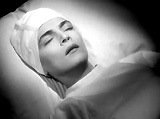
Before she died of her abdomen wounds, she offered a final thought about how her fiancee Fred had confirmed for her that she couldn't save herself from being irresistibly drawn to Sam, her own married brother-in-law:
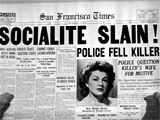
The film ended with the headlines from the SF Times: "SOCIALITE SLAIN!" |
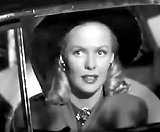
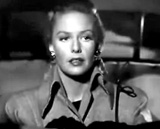
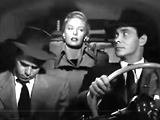
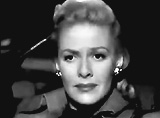
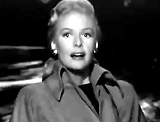
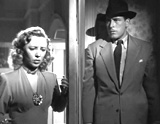 Laury Palmer Noticing Danny Dead on Kitchen Floor (with Sam in Shadows) 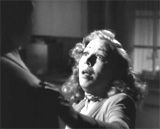 Laury About to Be Murdered by Sam 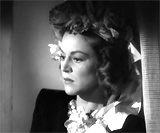 Helen's Calm Reaction in Kitchen to Double-Murder 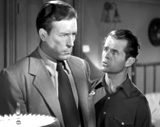 Sam Confessing His Crime to Friend Marty "Mart" Waterman (Elisha Cook, Jr.) 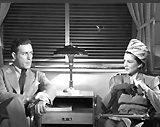 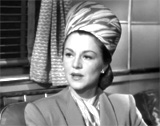 Sam and Helen on the Train to SF 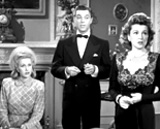 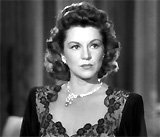 (l to r): Georgia Staples, Fred Grover, and Helen 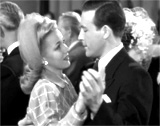 Georgia Dancing with Sam 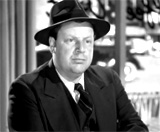 Reno PI Matthew Arnett (Walter Slezak) 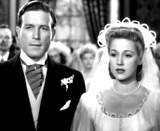 Sam and Georgia's Wedding 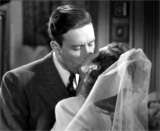 Sam Kissing Helen After His Wedding 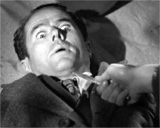 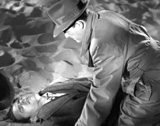 Sam Holding a Knife to Marty's Throat Before Killing Him 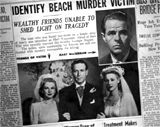 Newspaper Headlines of Marty's Murder 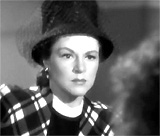 Helen Scaring Mrs. Kraft Into Dropping Case Against Sam 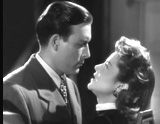 Helen - Still in Love With Sam, and Covering Up For Him 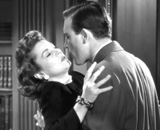 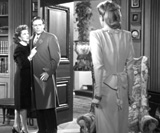 The Tell-Tale Kiss Between Sam and Helen - Witnessed by Georgia |
|||||||||||||||||||||||||||||
|
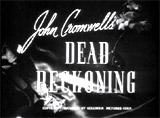
Dead Reckoning (1947)
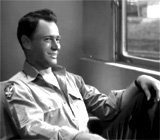
This overly complex and rambling who-dun-it film noir from Columbia Pictures and director John Cromwell was about doomed romance, blackmail, intrigue, conspiracy, duplicity and betrayal. There were many similarities in the film to two other Bogey films: The Maltese Falcon (1941) and The Big Sleep (1946). In the film's opening set in the southern town of Gulf City in the year 1946, an injured fugitive named Capt. Warren 'Rip' Murdock (Humphrey Bogart), a returning WWII military paratrooper veteran, fled to a church confessional where he spoke to Father Logan (James Bell), an ex-paratrooper ("the jumping padre"). He told about recent events in his tumultuous life - related in flashback. At the end of WWII, 'Rip' described how he and his army buddy Sgt. Johnny Drake (William Prince) were to be decorated with the Congressional Medal of Honor to Drake and the Distinguished Service Cross to 'Rip.' They were enroute by plane from a Paris hospital to NYC and then to Washington DC by train to receive their war service honors.
Drake told 'Rip' that he was haunted by a blonde in his past, and was advised:
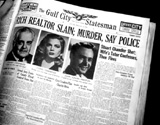
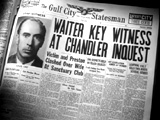
Mysteriously, camera-shy Drake ran off and jumped onto another departing train in Philadelphia when photographers and news-reporters appeared to take photos on the platform during a five-minute stop. 'Rip' suspected Johnny's fears of being uncovered as a fraud: "I got it alright why Johnny had taken a powder. He'd faked a birth certificate to enlist. John Joseph Preston, eh? The Yale pin said so." 'Rip' went AWOL to try and trace Drake's whereabouts. He was led to Drake's sultry southern Gulf City hometown (on the Gulf of Mexico) where he rented a room in the Hotel Southern - he was surprised that his visit was expected (Johnny had already made a reservation for him). A cryptic front desk phone message awaited him that he would be contacted later by Drake, signed by the paratrooper code-name "Mr. Geronimo" ("a paratrooper's jump call"). 'Rip' was impatient for contact: "What to do in a hot wind, smelling of night-blooming jasmine except wait and sweat, and prime the body to sweat more?" While waiting for contact from Drake over a two-day period, 'Rip' dug through Drake's past (or John Joseph Preston's past) via old Gulf City Statesman newspapers. He learned that Drake (or John Preston) - about a month before he had enlisted in October of 1943 - had confessed and been charged with the murder of Stuart Chandler. The victim was the wealthy and elderly husband (and real estate magnate) of night-club singer Mrs. Coral 'Dusty' Chandler, Drake's own love interest (and Coral's "English tutor" - English professor actually), when he became involved in a deadly love-triangle. The murder had been witnessed by a waiter named Louis Ord (George Chandler) at the Sanctuary Club, Coral's place of employment, where "Victim and Preston Clashed Over Wife." To escape prosecution during a manhunt, John Preston had fled to join the Army with a fake name - Drake.
'Rip' was confused by the allegations: "How could Johnny be a murderer? Why come back here where he was even hotter than the weather? And why? Why not another word from him since that first call?" Then, 'Rip' heard on a late night police-band radio station about a just-discovered fiery car accident that had occurred two days earlier and an unidentified charred body at the County Morgue. 'Rip' met with homicide officer Lt. Kincaid (Charles Cane), and realized the corpse ("as crisp as bacon") belonged to Johnny. A melted blob of Drake's Yale University 1940 senior society gold graduation pin (with his alias name John Joseph Preston) near the body confirmed the identity of the victim. 'Rip' vowed that he would seek Drake's killer and exonerate his buddy ("But I knew all at once I had a job. They don't give out the Congressional Medal to dead guys wanted for murder but he was gonna get it, even if he got it on his grave. I was going after whoever tried to gyp him out of it. Why should anybody kill Johnny? Because he knew too much? Because he hadn't shot Chandler and maybe knew who did?"). A continuing search led 'Rip' to the Sanctuary Club and the nervous club waiter-bartender Louis Ord, the "star witness" at the Chandler inquest. The club was owned by slick and crooked mobster Martinelli (Morris Carnovsky). Louis told 'Rip' that Drake had been hiding out in his apartment (up until two days earlier), and that Drake had given him a letter (written in code) to give to 'Rip' that might hold vital clues. Next to him at the club's bar, 'Rip' also met up with another female guest - Drake's enigmatic, blonde ex-lover - Mrs. Coral 'Dusty' Chandler (Lizabeth Scott), the widow of deceased husband Stuart Chandler. (Allegedly, Drake had killed Chandler before he joined the Army.) Coral was an ex-cabaret lounge singer at the Sanctuary Club. In her memorable entrance sequence, the camera (from his POV) panned up Coral's long legs and evening gown as she prepared to smoke a cigarette - 'Rip' held out a match to the alluring femme fatale. He described her as "Cinderella with a husky voice." In voice-over, Rip reflected about Drake, after thinking about how he had been enamoured by one of her songs when she used to work at the club:
While sharing a table with 'Rip,' Coral guest-performed the song: "Either It's Love or It Isn't" (dubbed by Trudy Stevens). After dancing with her, he shared news of Drake's morbid death, and he described her reaction in voice-over: "Her whole body had gone soft as custard when I slugged her with it. But I kept thinking, she has to know something." Early on, 'Rip' felt uneasy about Coral:
Early the next morning after finding himself deliberately drugged in Martinelli's office after gambling in the casino, 'Rip' awoke from a stupor in his hotel room ("Coming out of it was like after being tapped on the button. Everything foggy - fur in my throat, an anchor on my head, and ringing in my ears"). He found Louis dead with a broken neck on the second bed in the room - presumably he had been killed by Martinelli to acquire Drake's letter, and planted there to frame 'Rip' for Louis' murder. After dumping Louis' body into a large laundry basket, 'Rip' was met by Lt. Kincaid (who had been given an anonymous tip), but was able to avoid incriminating himself. When he met with Coral later that afternoon in his hotel lobby (and cleverly avoided Lt. Kincaid's tail on him), they drove out of town for lunch at the Dixie in Flamingo Beach for privacy. As she was driving, 'Rip' described his misogynistic philosophy regarding women - one of the film's most oft-quoted dialogues:
Over lunch, 'Rip' confided in Coral, telling her: "I don't think Johnny killed your husband." She admitted (information that she hadn't told the coroner) that she had witnessed the fight between Johnny and her husband Stuart before he was murdered, and that Johnny had taken the blame for the accidental shooting:
'Rip' was skeptical of her story, but remained uncertain. In an effort to still acquire the coded letter that Drake had written to him, presumably now in Martinelli's safe, Rip's efforts to hire a safecracker in town named McGee (Wallace Ford) failed, so he decided to obtain it himself. He found the safe already open in Martinelli's office, caught a menacing whiff of jasmine perfume (Coral's favorite), and then was knocked unconscious. 'Rip' regained consciousness during threats from Martinelli's sadistic, psychopathic bodyguard Krause (Marvin Miller) to beat him up unless he turned over the missing letter. 'Rip' tricked Krause and Martinelli into believing he had an incriminating letter to turn over to police about their complicity in causing Johnny's fatal car crash. Upon his return to his hotel with Krause to supposedly retrieve the letter, 'Rip' was able to escape in the chaos (when Lt. Kincaid appeared at the front entrance). He fled to the local church where he met up with Father Logan - the film's opening. He offered his suspicions about Coral to the Father:
To find out what had actually happened (to discover who was responsible for the recent killings and to find the original killer of Coral's husband), 'Rip' visited Coral at her apartment, where he expressed how he felt betrayed. He suspected that she had knocked him out in the office, and had possibly stolen Johnny's coded letter. She vowed that she was innocent and added: "I ought to hate you for thinking a thing like that." Her tears didn't move him to believe her: "I'm not the type that tears do anything to. I'm the brass-knucks-in-the-teeth to- dance-time type." However, she was tricked into admitting that she convinced Johnny to take the murder 'rap' when she was the one who had committed her husband's murder: "You killed him, why lie?...It was in your hands, not Johnny's, when it went off." She basically confessed that 'Rip's' suspicions was accurate. Afterwards, she said that she had given the murder weapon to Martinelli to get rid of, but Martinelli began to blackmail her (to acquire her inherited money). 'Rip' found himself falling in love with the alluring but treacherous and duplicitous Coral, while still ambivalent. When she made a call to the police to admit her guilt and clear Johnny's name, it was enough to prove her honesty to him - and they kissed. She vowed to go anywhere with him ("little trip to paradise") - and he agreed: "Anything you want, any way you want to go. The two of us." Duped and in love with her, he proposed that they run away together, but first he insisted on reclaiming the missing murder weapon (with her fingerprints) from Martinelli. As 'Rip' (at gunpoint) demanded the weapon from Martinelli in his nightclub office while Coral waited outside in the car ("Keep the motor running and the headlights on"), Martinelli gave him an entirely different story - Coral had been misleading and deceiving 'Rip' all along, and she was the one who had blackjacked him:
'Rip' tossed some unstable war souvenir hand grenades at Martinelli to convince him to give up the gun, setting the building on fire. Krause jumped out a window to escape, as both Martinelli and 'Rip' fled from the burning building. As they emerged out the front door, the double-crossing Coral shot and killed Martinelli, thinking it was 'Rip.' As 'Rip' drove Coral to police headquarters to turn her in (with the murder weapon), and to tell the whole story of her duplicity, he threatened her: "You tried to kill me just now. You expected me to be the first one out of that room...You're going to fry, Dusty...when a guy's pal is killed, he ought to do something about it." As he was driving, she held a gun on his mid-section, and demanded the murder weapon. He accelerated to 80 mph and warned: "If you shoot, baby, you'll smear us all over the highway," but she fired anyway - leading to a loss of control and a violent car crash into a tree. 'Rip' survived the crash with injuries, and was able to clear his pal Johnny's name (and have him awarded his Medal of Honor posthumously).
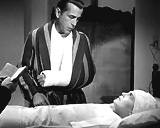
Subsequently, Coral died from her injuries (he was at her bedside, held her hand, and called her by a masculine nickname). He urged her to enter death as if jumping from a plane: "Like going out the jump door. Hold your breath and just let go, Mike. Don't fight it. Remember all the guys who've done it before you. You'll have plenty of company, Mike. High-class company. Geronimo, Mike." |
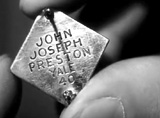 Clue to Johnny Drake's Real Name - His Gold 1940 Yale Graduation Pin 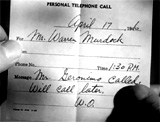 Note to 'Rip' From Drake in Gulf City 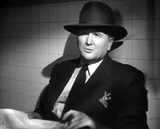 Lt. Kincaid (Charles Cane) at Morgue 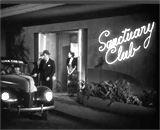 Sanctuary Club 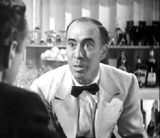 Waiter/Bartender Louis Ord (George Chandler)   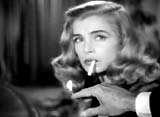 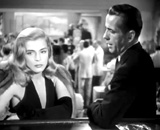 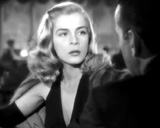 Memorable (POV) Entrance Scene of Coral Chandler (Lizabeth Scott) in Sanctuary Club at the Bar 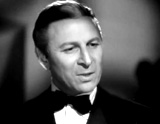 Club Owner Martinelli (Morris Carnovsky) 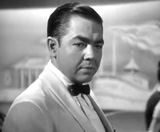 Bodyguard Krause (Marvin Miller) 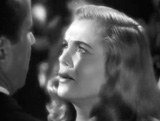 Coral's Reaction to News from 'Rip' of Johnny's Death 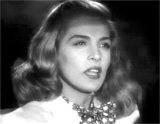 On the Drive to Flamingo Beach 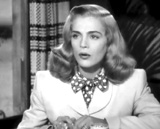 Coral's Confession That She Was Present With Johnny When Her Husband Was Killed 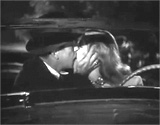 'Rip' Falling in Love with the Femme Fatale 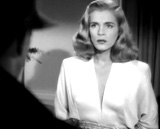  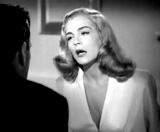 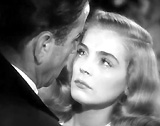 Confronting Coral in Her Apartment about Her Husband's Death 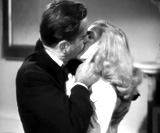 A Kiss from 'Rip' to Affirm His Love For Coral 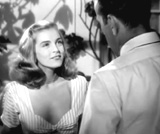 Planning "A Little Trip to Paradise" Together 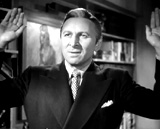 Martinelli's Revelation About Coral's Deceptiveness 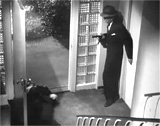 Martinelli Shot by Coral at the Front Door 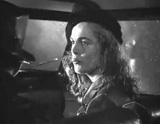 The Concluding Drive to the Police Station 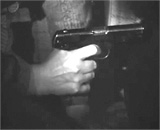 Coral Holding a Gun on 'Rip' - and then Firing |
|||||||||||||||||||||||||||||
|
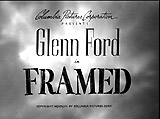
Framed (1947)
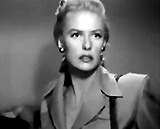
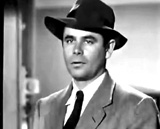
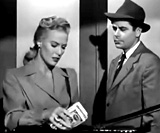
Director Richard Wallace's low-budget, noirish crime thriller from Columbia Pictures involved greed, larceny, betrayal, and a duplicitous, nasty and seductive femme fatale. Soon after desperate and down-and-out WWII vet and mining engineer Michael Lambert (Glenn Ford) took a temporary job as a Tri-City truck driver, he lost control of his runaway truck (with faulty brakes) on a steep highway, steered it into a small California town, and crashed it into the parked pickup truck of a miner named Jeff Cunningham (Edgar Buchanan). He was paid $15 for his truck run, and gave some of the money to Jeff to pay for the damages himself.
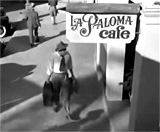
Michael went across the street to La Paloma Cafe and bar for a stiff whiskey drink, and noticed the well-dressed, narcissistic, blonde bar-maid/waitress Paula Craig (Janis Carter) staring at him and appearing interested. After a few moments, police arrived and Michael was arrested for reckless driving and for having an expired license. Before a judge, he was sentenced to either a $50 fine or ten days in jail. The waitress had followed him to the court and strangely offered to pay his $50 fine and bail him out, in order to release him immediately. Michael followed Paula back to her place of work and drank until he blacked out at one of the tables at closing time. He muttered to himself, vowing: "I'm gonna make good." Paula entered the dining area after quitting her job, citing that she was "tired." Her boss noted her concern for Michael: "When a girl like you wants something, she gonna get it." She took the soused Michael to a hotel and rented a $3 room for him (and left him a $5 dollar bill in his wallet) before leaving at about 12:15 am. Afterwards, she walked to her Park Court apartment, changed into a different outfit and put on a monogrammed coat, proceeded in the middle of the night to the bank, and met up with her lover in his parked car - married Empire Trust & Savings Bank VP Stephen Price (Barry Sullivan). The well-dressed Paula hopped in the car and immediately told him: "I found him." She added that the man, presumably Michael, had the same height and body build as Stephen. At his luxurious mountainous "shack" hideout, it was revealed that she had chosen to work at La Paloma for the last 5 weeks for the sole purpose of identifying a fall guy for their ultimate criminal scheme of embezzling $250,000, and now she proclaimed: "We're ready." The couple had been having an affair for two years, after he met the ex-model (being photographed in furs) in Chicago ("Like an angel in furs"). She replied covetously: "Someone else's furs."
Their ulterior motive was to set up a safety deposit box at the bank in Paula's name, where he would deposit stolen $250,000 of embezzled funds (from his wife's account) within a week. She assured him: "I'm sure it will work." Stephen dropped her off and then returned to his home early in the morning and found his betrayed and suspicious wife Beth (Karen Morley) awake, since he had been gone all night - once again. He proposed that she was imagining his infidelity after nine years of marriage. The well-mannered, intelligent, and opportunist husband had acquired his prestigious bank job through Beth's father. She slapped him across the face for admitting that he had married her for her riches and respectability: "That's for telling me what I bought and paid for." The next day, the hung-over Michael, who couldn't remember anything about the previous evening, was filled in by the hotel desk clerk. Paula had left him a note with her name and phone number. He visited the J.B. Smith Assay Office for work and the clerk Sandy (Paul Burns) mentioned that a lucky "old codger" prospector had just struck a rich vein in an old abandoned and remote silver mine 50 miles away, and might hire him. In a few moments, Jeff, the same man whose truck Michael had hit, entered and discovered his find was valuable ("Maybe I struck 'er!"). Still in the office, Michael was recommended by the clerk for employment due to his background as a college-graduated mining engineer. The kindly Jeff offered Michael employment with a 10% cut. While Jeff was negotiating at the bank for a loan, Michael was visited by Paula in his hotel room. He told her about his drinking problem: "Don't count on anything I said last night. Liquor blanks me out....I told you I never remember what I do after I've had a couple of drinks." She was surprised to learn that he was planning to leave town for a mining job - it would disrupt her nefarious plan. She claimed that he was running away, because he was afraid of her - and then he grabbed her and gave her a forceful kiss to show her otherwise: ("That's to show you how wrong you are, lady"). After she learned about Jeff's loan deal ("It takes dough to get that silver out"), she left swiftly and immediately phoned Stephen at the bank (with her caller code-name Helen Bailey) to cut off the $30,000 funding. Now that Michael was forced to remain in town for awhile longer, he attempted to begin a relationship with Paula: ("I can see several good reasons why I should stay"). Meanwhile, Stephen told Paula that the $250,000 was already in her safe deposit box, but that bank examiners would be arriving at the bank for two weeks. In the meantime, they needed to plot the second part of their scheme - to orchestrate Michael's 'accidental' death the next evening. The conniving killer-couple drove to a pre-selected cliffside location (at a dangerous curve), where Paula (in the backseat) rehearsed striking passenger Michael in the head with a monkey wrench, before sending the car over the side and causing a fiery crash. Because Michael and Stephen's body types were similar, Michael's body would be mistaken for Stephen's and there would be no need for a police investigation: ("There will be nothing left to identify. And Lambert becomes Price...A just end for an embezzler").
That evening, Michael watched from the shadows as Paula was dropped off by her lover. He angrily went to her apartment and paid back all his debts owed to her, and threatened to leave her. When she called him "insulting," he answered: "Oh, I couldn't insult you. That wouldn't be possible." He was very suspicious of her strange behavior toward him:
He jealously explained how he had seen her other rich boyfriend - whom she identified as Stephen Price, the VP of the Empire Bank. She claimed she had spoken to Price for his sake in order to have Price "reconsider the [Cunningham] loan. He's going with us tomorrow and look at Cunningham's property. Do you understand Mike, you've got the deal." Michael asked: "What did you do to persuade him?" She stressed her love for Michael: "I wanted you to get the job. I couldn't let you drift away." She also boasted of her ability to get what she wanted as a La Paloma waitress - including information on Price's rich wife:
He decided to remain for the evening at her place. The next day, the threesome drove to visit the Cunningham mine site. On their return, they stopped at Stephen's mountain "shack" for a celebratory drink. While washing his hands, Michael was startled when he noticed Paula's prominently embroidered name on her white bathrobe hanging in the bathroom. Upon his return downstairs, he began drinking heavily and both of them noticed a turn in his behavior. Lambert noted to Paula: "He's in love with you." They encouraged him to continue drinking and by 9:20 pm, Michael passed out. Paula spontaneously decided to alter their previous plan as they approached the dangerous curve in the road and parked - as she held up the monkey wrench and looked at both men in front of her, she decided to double-cross Stephen. She bludgeoned him in the head and killed him instead of Michael. She pulled a drunken and unconscious Michael from the passenger seat, removed the bank deposit key from Stephen's pocket, released the brake, and then sent the car off the cliffside. A half-smile came to her face as she heard the fiery crash.
After somehow returning to Paula's apartment and awakening the next morning on her couch, Michael had no recollection of what had happened. Out on the street early in the morning, Paula saw the headlines in the newspaper: "BANKER DEAD IN ACCIDENT - Stephen Price Killed in Auto Crash" - she rushed to the bank, but it was closed due to the death. When she returned to Michael, she was assured that he had remembered nothing. The false-hearted Paula confessed to Michael that she had lied about Stephen, and then after showing him the newspaper, convinced Michael that he had accidentally killed Stephen during a drunken rage: ("You killed him, Mike. Don't you remember?...I tried to stop you. You were drunk. You accused him of making advances. When he called off the deal, you got angry and hit him. He fell against the fireplace, hitting his head"). She implied that she had staged the 'accident' to cover for him, and urged him to not go to the police and confess - "If you go to the police, you'll hang....I'll hang too. I helped to cover for you, to make it look like an accident." She entreated him to pack his bags and leave town with her the next day. He was upset with her: "I'm back where I started - nowhere." The next day's headlines reversed the original reports: "AUTO ACCIDENT PROVED MURDER." The newspaper described how the revised autopsy report stated that Price had died from a blow to the back of the head with a blunt instrument, causing a cerebral hemorrhage, rather than from the car crash. Another stunning twist was that Jeff Cunningham had been arrested for the murder - his possible vengeful motive was that he had admitted quarreling with Price over his denied loan. Some of his laundry was also found in the trunk of the car. In the local jail, Michael spoke to Jeff who was in a "tough spot" and claimed his innocence. He had no alibi to prove his whereabouts. When Jeff mentioned a phone call that interrupted the loan discussion with Price, Michael suspected that Paula had made the call ("I think I have an idea who might have done it, but what I don't know is why") and had also killed Stephen. He mused to Jeff: "I was the last man with Price...That's when I may have killed him." Both thought something was fishy about Price who kept changing his mind about the loan deal. Posing as a reporter, Michael spoke to Price's bank secretary Miss/Mrs. Jane Woodworth (Barbara Woodell) that evening at her home since the bank was closed. He learned that the phone call to Price - from a Helen Bailey, Paula's code-name - had abruptly ended the loan negotiations with Jeff. Realizing that Michael was an imposter, the wife's suspicious husband Jack (Jim Bannon) phoned the police, and Michael was forced to punch him out before fleeing the home in the dark and hiding in a garbage dump. The next morning, Michael arrived at Paula's place with his suitcase. She kissed him and assured him: "We've got to think of us." She had a sudden look of apprehension when he asked if she knew a "Helen Bailey." He realized that she had been in cahoots with Stephen from her startled reaction. In the kitchen, Paula reached for poison and mixed it in Michael's cup of coffee, but then when he went to drink from it, she distracted him with a kiss and overturned the cup.
She proceeded to the bank for its early morning opening - in order to retrieve the stashed and ill-gotten $250,000 dollars in her safe deposit box. After she entered the secured area, retrieved the box, and went to a private viewing booth to stuff her purse with the wads of cash, Michael confronted her there about her motives and duplicity:
As she was about to leave the bank, she was confronted by police officers and bank guards ready to arrest her. She pleaded with Mike and hugged him: "Oh, Mike. Help me, I'm scared, Mike. They're out there." He looked at her coldly as she became accusatory: "You told them!" As she was driven away outside the bank, he calmly lit his cigarette as a bank guard told him: "You'll get a big reward for this," but he declined: "You keep it." |
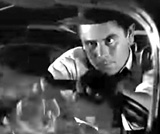 Michael Lambert (Glenn Ford) at Wheel of Runaway Truck 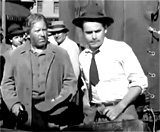 Michael with Truck Owner Jeff Cunningham (Edgar Buchanan) 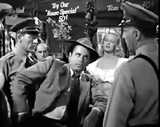 Michael Arrested at Bar by Police 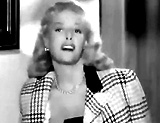 Paula Offered to Pay $50 Fine Ordered by Judge 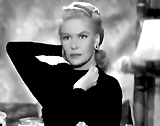 Paula Changing Into A Different Outfit 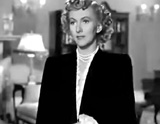 Beth Price (Karen Morley) - Stephen's Betrayed Wife 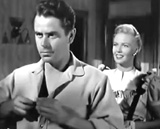  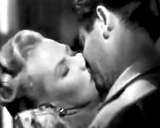 Paula Learning That Michael Was Leaving Town - Michael's Kiss  Paula Convincing Michael That She Was Using Stephen Price to Help Him  On the Drive to the Cunningham Mining Site 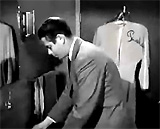 Paula's Embroidered Bathrobe Hanging in the Bathroom of Stephen's 'Shack' 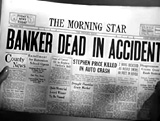 Headlines About 'Accident'  Paula to Michael: "You killed him, Mike. Don't you remember?"  Paula: "I'll hang too." 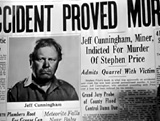 Revised Headlines: AUTO ACCIDENT PROVED MURDER 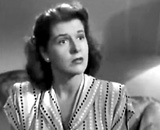 Miss (or Mrs.) Woodworth (Barbara Woodell) 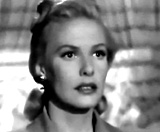 Paula's Reaction to Michael's Question: "Do you know a woman named Helen Bailey?" 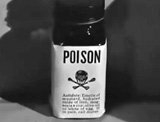 Paula's Idea to Poison Michael's Coffee 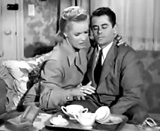 The Overturned Cup of Coffee 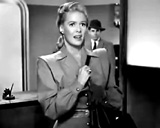 Paula About to be Arrested by Police in the Bank 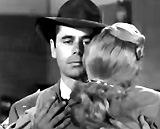 A Final Hug with Michael 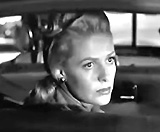 Paula's Last Look at Michael Before Being Driven Away by Police 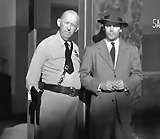 Last Lines of Dialogue with Bank Guard |
|||||||||||||||||||||||||||||
|
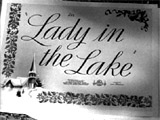
Lady in the Lake (1947)
Robert Montgomery both directed (his directorial debut film) and starred in this Christmas-themed classic crime noir, adapted from Raymond Chandler's 1944 novel of the same name by Chandler himself. It featured a unique gimmick - an experimental and revolutionary subjective (or first-person) camera technique, meaning that the main protagonist was off-camera for most of the film, although sometimes viewed in mirrors. The mystery plot was very convoluted and twisting - difficult to follow at times. It basically involved a search for a missing, promiscuous wife who had allegedly run off to Mexico with a handsome, gigolo boyfriend named Chris Lavery. The quest for the missing woman ("Chrystal Kingsby") was instigated by a gold-digging femme fatale who had ulterior motives to marry Chrystal's rich husband - her own boss Derace Kingsby.
The detective's search discovered that the wife might be responsible for the murder of a mysterious "lady in the lake" found near a summer cabin near Little Fawn Lake owned by Kingsby. The victim was initially identified as 'Muriel Chess' - the wife of Kingsby's cabin caretaker Bill Chess, and he was charged with the crime. A key discovery was that Muriel had another name - Mildred Havelend. Soon after, Lavery's suspicious landlord 'Mrs. Falbrook' was seen just before Lavery's shower murder. It was up to Marlowe to fit the pieces together and discover who was behind the murders (involving switched identities, a deadly love triangle and a double-cross) - and to discover the deadly motives of 'Mrs. Falbrook' (with her many aliases). After the title credits (with a choir singing 'Jingle Bells'), in the film's opening prologue set in private detective Phillip Marlowe's (Robert Montgomery) office in 1940s Hollywood, he spoke directly to the audience - smashing the 4th wall. Fed up with his low-paying profession as a PI, he decided he wanted to write and publish his own script for a murder story. It was titled "If I Should Die Before I Live" - the story was "based on an authentic case" that he had investigated, in retrospect. He planned to sell it for a profit to a lurid, horror-story pulp magazine:
And then he cautioned and also challenged the viewing audience to look for clues, and to try and solve the who-dun-it, step-by-step:
In an attempt to sell his story, Marlowe was summoned to the Kingsby Publishing Office to meet Kingsby's tough-girl, manipulative, witchy and kittenish editor-assistant and career woman Adrienne Fromsett (Audrey Totter) - the film's femme fatale. She had contacted him on false pretenses - she was less interested in his manuscript than in hiring him to investigate a case of a missing wife - the wife of her own boss - "without his knowing you're looking for her."
Adrienne viciously pre-judged Chrystal: "She's run off with another man. She's a vicious woman. A liar, a cheat, and a thief. She may even end up in the hands of the police." [Note: Early on, Marlowe considered Adrienne "cold-blooded." He suspected that the self-interested, gold-digging Adrienne had her own romantic sights set on marrying the wealthy Kingsby: "I have an allergy against getting mixed up with tricky females who want to knock off the boss's wife and marry him for themselves."] However, the well-known detective Marlowe accepted her second offer of $500 for his "authentic" manuscript that Adrienne described as "so full of life and vigor and heart." She invited him to her apartment to discuss the matter further:
At her place, Marlowe found an obviously well-displayed copy of a recent telegram from Chrystal to Derace (her husband) declaring that she had run off to Juarez, Mexico with muscle-bound gigolo boyfriend Chris Lavery (Dick Simmons), in order to divorce Derace and marry Lavery. Adrienne declared the telegram on her desk as a "phony" - and Marlowe agreed. She claimed she had recently spoken to Lavery who denied the accusation: "I ran into Chris Lavery last week and he said he hadn't seen Chrystal Kingsby for two months." Marlowe immediately went to speak to Lavery in his Bay City house, where he denied any accusations of wrong-doing: "I haven't seen her in a month of Sundays....I don't hanker for any part of her. Not for all the money in the world." Feeling insulted by Marlowe's attitude and questioning, Lavery abruptly punched him in the face - rendering him unconscious.
Marlowe awoke in a police jail cell with a black right eye, and was briefly questioned by two Bay City police detectives: tough and belligerent Lieutenant DeGarmot (Lloyd Nolan) and Captain Fergus K. Kane (Tom Tully). He was charged with being found drunk in his car (a DUI) that had run over the curb (Lavery's set-up), before his release by Capt. Kane. Marlowe again spoke to Adriennne in her office, who gave him a tip to visit Kingsby's summer retreat cabin near Little Fawn Lake (in the mountains beyond Arrowhead), where Chrystal was last seen. Before leaving for the lake, the case became even more complicated when Marlowe and Adrienne learned that a female's drowned body was found in the lake ('the lady in the lake'). The corpse was suspected to belong to Muriel Chess, the wife of Kingsby's caretaker Bill Chess. Chess was charged with murdering his wife Muriel. Adrienne immediately suspected that the caretaker's wife was murdered by Kingsby's wife Chrystal (who hated Muriel). Adrienne urged Marlowe during his visit to the lake to investigate and find "murderess" Chrystal either dead or alive - so that she could be prosecuted for murder. Adrienne was eager for Kingsby to begin divorce proceedings against Chrystal so that she could marry her rich boss. After visiting the summer resort area, Marlowe reported back to Adrienne at four in the morning in her apartment. He told her that the body (submerged for almost a month) was not Chrystal's. His main find was that the victim Muriel Chess had another name - Mildred Havelend. She had recently married Bill Chess because she was a fugitive from unknown circumstances involving a "tough cop ("She married Chess because she wanted a place to hide. It seems that a tough cop was after her") - was the "tough cop" DeGarmot? Marlowe also surmised that Mildred/Muriel had squabbled with Chrystal over Chris Lavery's affections, and that Lavery was a key figure in their disappearances: ("That ties him up with two missing women, Chrystal and Muriel"). As Marlowe left, Adrienne warned him: "You'd be crazy to fall in love with me, Marlowe." Marlowe again went to speak to Chris Lavery in his unlocked house, where he found Lavery's alleged, fast-talking 'landlady' Mrs. Fallbrook (Jayne Meadows) coming down the stairs and holding a gun in her hand (she said she found it on the stairs). She claimed she was there to collect the overdue three months rent check. After Mrs. Fallbrook left, upstairs, Marlowe searched and discovered a handkerchief with Adrienne's monogram: "AF", running water in Lavery's bathroom sink, bullet holes in the shower door glass, and Lavery's corpse slumped on the shower floor (the killer was presumably Mrs. Fallbrook who had come in through the upstairs porch and surprised him). A private Christmas-Eve gift party was in progress in the publishing office when Marlowe barged in to speak privately to Adrienne, and informed her that Lavery was shot dead with a gun that he produced. He was suspicious that Adrienne's handkerchief was found on Lavery's dresser. When Mr. Kingsby interrupted their conversation, he denounced Adrienne for scheming and meddling in his private affairs regarding Chrystal, and for using Marlowe to find her: "You had no right to meddle. Chrystal is to be left alone to do what she wants to do....I won't have you prying into my private affairs." He believed his wife was innocent regarding Lavery's death, and wanted Adrienne to quit interfering: ("If you think you're going to harm Chrystal, you're very much mistaken"). He promised to keep his relationship with Adrienne strictly business-related in the future. Angered, the failed gold-digger Adrienne fired Marlowe: ("You're off the case. There isn't any case anymore"). However, on the way out, Marlowe was re-hired by Kingsby to find his wife and exonerate her from any murder charges: ("I'd like to keep my wife out of it"). He stressed his continuing love for his wife, with no plans for divorce: "But the one thing I know is, I love my wife intensely." Marlowe returned to the scene of Lavery's death with the gun; Lieutenant DeGarmot, one of the Bay City cops, had been called to the scene. Marlowe suspected that he was the "tough cop" who had been asking questions about Mildred/Muriel a few weeks earlier at the lake: ("There was a fellow there a few weeks ago looking for Mildred Havelend. He acted like a cop, I was told. A tough cop with bad manners, like you...She and Muriel Chess were the same girl. She changed her name because she was hiding out from this tough cop. Does it add up?...I think this female had a shady past, and you knew something about it"). Marlowe was extremely suspicious of DeGarmot, who knew both Mildred and Lavery - and both were now dead. After a brief scuffle with DeGarmot, the cops unsuccessfully attempted to charge Marlowe with Lavery's murder. Marlowe was brought downtown by Capt. Kane, but was soon dismissed.
Later that evening, Adrienne visited Marlowe's hotel room, hoping to encourage him to see her more positively ("I thought you liked me"), although he was sarcastic toward her: "The girl I like won't be editing a string of crime magazines, or looking for a quick million bucks, or trying to hang a murder on another woman." He dismissed her when he received a phone call from an LA Chronicle reporter with damaging information about Mildred's/Muriel's background. Marlowe sought further information from some victim's parents, the Graysons (Morris Ankrum and Kathleen Lockhart), in Bay City:
As Marlowe was driving off from the Graysons' home, DeGarmot pursued him and ran Marlowe's car off the road, and he was knocked unconscious. Although drenched in alcohol to appear DUI, Marlowe was able to stagger to a gas station phone booth to call Adrienne to rescue him and help him recover. She gladly cared for the injured Marlowe in her apartment, when she admitted her love for him (with the camera on her for a lengthy time) - on Christmas Day. She vowed to abandon her evil ways to show her romantic affection for the private detective:
A frantic Kingsby arrived to find Marlowe. He reported on an alleged demand by Chrystal (a telegram from Bay City) asking for money. Although he suspected a trap, Marlowe volunteered to deliver the $500 cash funds to her near a cocktail bar called The Peacock Room. A dark-haired woman led Marlowe to her apartment - to his surprise, she was the 'landlady' Mrs. Fallbrook - or Mildred, holding a gun on him. Marlowe explained his reasoning about how Mildred had been involved in murdering Florence Almore, the wife of her previous employer (a Bay City doctor) by asphyxiation in her car. And that the missing Chrystal Kingsby was the corpse in the lake.
Mildred had made it look like the corpse in the lake was her alter-ego Muriel Chess. Marlowe believed that Mildred/Muriel and Chrystal had jealously fought over handsome male Chris Lavery. This rivalry was clearly Mildred's motive to kill Chrystal and make it look like Muriel was the dead body in the lake, so she could run away with Lavery. After Chrystal's drowning/murder, Mildred fled and ran away to El Paso - and Lavery "was the only one who knew the real identity of the lady in the lake" - the reason that Mildred also eliminated him and killed him in the shower. Marlowe also knew about love-struck Lieutenant DeGarmot's romantic involvement with Mildred. Earlier, the cop had partnered with Mildred to hide and cover up the murder of Florence Almore. His covered-up investigation ruled that Almore's death was a suicide. After the case closed, Mildred fled. She "double-crossed" DeGarmot by abandoning him and changing her name to Muriel Chess (after marrying Bill Chess, Kingsby's caretaker) with the intent to hide and get away from the "tough cop." The final resolution came when Lieut. DeGarmot unexpectedly arrived and knocked Marlowe to the floor. He described his feelings of double-cross and betrayal by Mildred after he had helped her to cover up the Almore murder. DeGarmot had relentlessly tracked her down - and he now was finally able to confront her face-to-face in her apartment. DeGarmot chastized her: ("People aren't safe with a woman like you in the world and people have to be protected. I never expected to find you here tonight. I thought you were dead. I wish you were, because you're a murderess. And this time, dead's the way I'm gonna leave you....Yes, I was out of my mind the night that Florence Almore died (and) you made a sucker out of me. Even after you ran away, I still loved you. You made a clown outta me, a bad cop. But tonight's the end of it, and of you.") Marlowe attempted to dissuade DeGarmot: ("The Almore case won't come up. They'll convict her for Chrystal's murder or Lavery's. You'll be clear"), but DeGarmot's intention was to kill both Marlowe and the deceitful Mildred with her gun and stage it to look like she and Marlowe had shot each other, in order to frame them for the other murders. She begged for her life, but to no avail:
DeGarmot shot her multiple times - point-blank - in view of Marlowe. The crooked cop DeGarmot was then gunned down by Kane and another officer through a window, before he could kill Marlowe. At the end of the film after the case was solved, Adrienne and Marlowe left NYC together to begin a serious romance. |
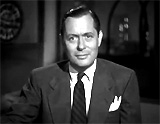 Phillip Marlowe (Robert Montgomery) 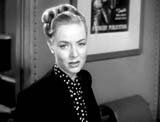 Adrienne Fromsett (Audrey Totter) in the Publishing Office 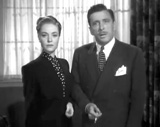 Adrienne with Her Boss Derace Kingsby (Leon Ames) 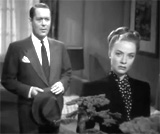 Adrienne Speaking to Marlowe in the Publishing Office (Mirror Reflection) 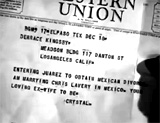 Fake Telegram in Chrystal's Apartment - About Chrystal's Divorce, and Her Planned Marriage in Mexico to Chris Lavery  Lt. DeGarmot (Lloyd Nolan) 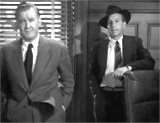 (l to r): Capt. Kane (Tom Tully) and Lt. DeGarmot 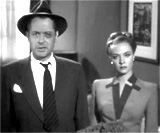 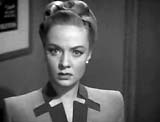 Adrienne in Her Office - During a 2nd Visit From Marlowe 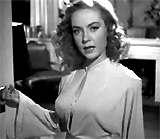 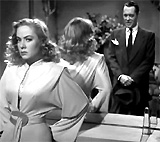 Marlowe
Visiting Adrienne at Her Apartment After a Trip to Little Fawn Lake to
Report on His Discoveries Marlowe
Visiting Adrienne at Her Apartment After a Trip to Little Fawn Lake to
Report on His Discoveries 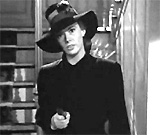 Landlady 'Mrs. Fallbrook' (Jayne Meadows) (aka Mildred Havelend, or Muriel Chess) - Who Was Eventually Unmasked as the Killer of Both Chrystal and Chris Lavery 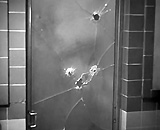 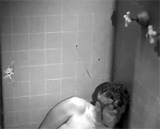 Lavery Shot Dead in Shower 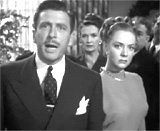 Private Christmas Party - Marlowe Confronted by Adrienne and Mr. Kingsby 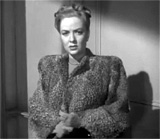 Adrienne in Marlowe's Hotel Room 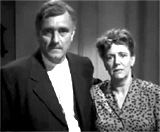 Marlowe's Conversation With The Graysons - A Crucial Piece of the Puzzle 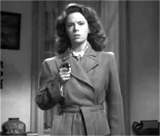 The Lady Demanding $500 Was Not Chrystal, but Mildred! (aka Mrs. Falbrook) 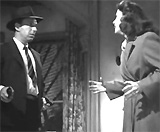 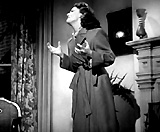 Mildred Confronted and Shot Dead by Lieutenant DeGarmot 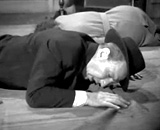 Lt. DeGarmot Shot Dead by Officer Kane 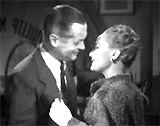 Marlowe and Adrienne Together in the Conclusion |
|||||||||||||||||||||||||||||