|
|
(chronological by film title) Introduction | Picture Guide | 1941 | 1944 | 1945 | 1946-1 | 1946-2 | 1947-1 | 1947-2 1948 | 1949 | 1950-1952 | 1953 | 1954-1956 | 1957-1959 |

|
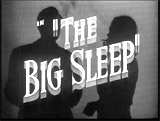
The Big
Sleep (1946)
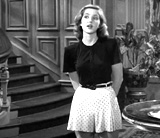
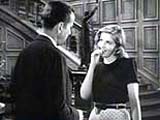
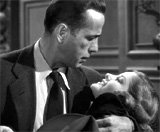
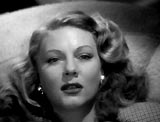
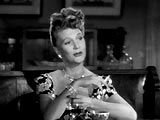
Humphrey Bogart, who was teamed with real-life wife Lauren Bacall, played the role of private detective Philip Marlowe in this confusing, classic who-dun-it, noirish detective film, involving blackmail, pornography, and murder in Los Angeles. It was a complex yet faithful adaptation of Raymond Chandler's novel with a very tangled plot. In the opening, Marlowe was called to the mansion of a new client - dying millionaire General Sternwood (Charles Waldron), where he was first confronted with the General's flirtatious, seductive younger daughter - she was the troubled, errant, spoiled, sexually-perverse, thumb-biting/sucking, frequently doped-up nymphomaniacal heiress Carmen (Martha Vickers). Wearing a short polka-dotted skirt, she threw herself at him in the hallway by first taunting him: "You're not very tall, are you?" As she bit on a lock of her own hair, she asked for his name, and he replied: "Reilly. Doghouse Reilly" and then called himself a "shamus" to her amusement: ("That's a funny kind of name. What are you, a prize fighter?"). She called Marlowe "not bad looking" and "cute" after falling backwards into his arms.
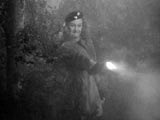
Later, during his hothouse talk with General Sternwood, Marlow described his meeting with Carmen: "She tried to sit in my lap while I was standing up." Marlowe was asked and then commissioned by Sternwood to break up a troublesome blackmail ring that threatened Sternwood to pay legally-uncollectible gambling debts. Marlowe was called upon to investigate Carmen's ostensible blackmailer - suspicious porno "rare book" dealer Arthur Gwynn Geiger (Theodore von Eltz) with a store on North Sunset, who was blackmailing Sternwood over "gambling debts" incurred by his youngest daughter. [Note: the exact nature of the blackmail was not clear, though it was likely that it wasn't just gambling debts, but might also be drug-related, or the more obvious fact that Geiger had illicit, nude, incriminating or obscene photographs of Carmen and threatened to circulate them. A fourth more important factor emerged later.] Marlowe also was told about Sternwood's favored missing friend and confidant, Sean Regan, who suddenly disappeared a month earlier under mysterious circumstances. He was thought to possibly be in the company of Mrs. Mona Mars (Peggy Knudsen), a mobster's wife. She disappeared about the same time as Regan so that it would be surmised that she had run away with the missing Sean Regan. (That would take the heat off any suspicion that Regan was killed.) On the way out, Marlowe also met Carmen's older, feisty sister Vivian Rutledge (Lauren Bacall) who at first suspiciously cross-examined him due to her protectiveness for her sister: "So you're a private detective. I didn't know they existed, except in books. Or else they were greasy little men snooping around hotel corridors. My, you're a mess, aren't you?"; Marlowe quipped: "I'm not very tall either. Next time, I'll come on stilts, wear a white tie and carry a tennis racket"; she retorted: "I doubt if even that would help"; later, when she insulted his manners, he snapped back: "I don't mind if you don't like my manners. I don't like them myself. They're pretty bad. I grieve over them long winter evenings. And I don't mind your ritzing me, or drinking your lunch out of a bottle, but don't waste your time trying to cross-examine me." Within a short while, Marlowe staked out Geiger's home. After a few hours, Marlowe saw the flash of a flashbulb, heard a female scream (Carmen's scream) and three gun shots. Two cars zoomed away in quick succession from the scene of the crime. Inside, he found an incoherent, stupefied, drugged-up, Chinese-dress wearing Carmen sitting idly nearby the dead blackmailer - "rare book" dealer named Arthur Gwynn Geiger in his rented home, who had presumably been the one extorting Sternwood. He might have been involved in the taking candid, nude or pornographic pictures of Carmen when he was shot dead. Marlowe discovered evidence - a spent flash bulb, a hidden camera in a hollow, stone statue's head-mask (minus the film negatives or roll of film), and a "blackmailing" code book with the name Sternwood on one of the pages.
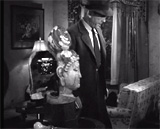
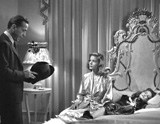
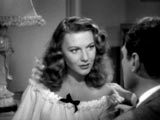
Marlowe slapped Carmen across the face to snap her out of her daze. Before the police arrived, Marlowe took the drugged-up, dozing Carmen back to the Sternwood mansion (in her car). He carried her into Vivian's bedroom and put her to sleep on the bed, to deposit her there and remove her from any association with the Geiger murder scene. After returning Carmen, Marlowe again spoke to Vivian, and began to piece together what had happened - Carmen loved Sean Regan, but he didn't reciprocate her love. She became jealous - and then killed Regan, thereby causing all the nefarious blackmailing schemes against herself. After Regan's murder, Vivian had hired gangster and head racketeer Eddie Mars (Joe Ridgely) to bury the incriminating evidence against her sister Carmen. Vivian accused Marlowe of duping her to reveal information: "You go too far, Marlowe," since she wanted Marlowe off the case. She feared that he might find her suspicious involvement, namely, gangster Eddie Mars' additional blackmailing scheme against Vivian regarding her sister. The 'real' blackmailer that rich General Sternwood (and Marlowe) needed to eliminate was not Geiger or a previous blackmailer named Joe Brody but racketeer Mars, who was behind the blackmailing of both sisters - he knew that Carmen killed Regan and was using that knowledge against Vivian. Soon, however, Vivian began to warm up to Marlowe. Vivian engaged in a famous, slyly flirtatious, innuendo-laden, metaphoric sexy horse-race conversation with Marlowe, over drinks.
At the end of their conversation, she provided an answer to the question: "What makes me run?" -- "I'll give you a little hint. Sugar won't work. It's been tried." Marlowe remained suspicious of Vivian and her connection with Eddie Mars - and why he was being 'sugared' off the case. Later, after Marlowe visited gangster Eddie Mars' casino and found the alluring Vivian there, he drove away with her. They had an opportunity to stop by the side of the road, where she made a direct request for kisses amidst the dark intrigue:
Marlowe continued with his detective-questioning: "...Kissing is all right. It's nice. I'd like to do more of it. But first, I want to find out what Eddie Mars has on you." She became angered by his line of questioning.
High-class blackmailer Mars forced an overly-protective, well-intentioned Vivian to part with her gambling winnings (acquired through cheating at his casino) and possibly offer sexual favors. And to keep police from learning the truth and investigating, he went even further by hiding his wife Mrs. Mars at Huck's Garage, to make it look like she had run away with Regan during their entirely conceivable affair. Soon after, Vivian joined forces to rescue tied-up Marlowe from certain death by Mars' henchman Canino, and help eliminate the hit-man. She admitted her motivation to Marlowe: "I guess I'm in love with you," and he likewise also admitted to her why he was helping her: "I guess I'm in love with you." The uncovering of the web of secrets led to a final shoot-out at Geiger's place - the murder of kingpin racketeer Eddie Mars by his own henchmen. Their combined efforts ended the blackmail scheme, and acquired treatment for her sick sister Carmen. Mars' death allowed Marlowe to protect Carmen (who was sent "away" to an institution) and Vivian by pinning the murder of Regan on Mars - and Marlowe was able to end up with Vivian. As the film ended, Marlowe and Vivian were together in the darkened parlor of Geiger's house and awaiting the police's arrival after Mars' death. After everything had been resolved and the police were being summoned, Vivian appraised the situation and noticed that there was still some unfinished business to take care of with Marlowe.
|
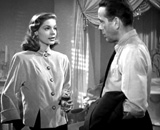 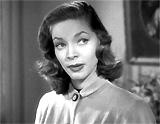 Marlowe's First Meeting with an Insulting and Skeptical Vivian (Lauren Bacall) 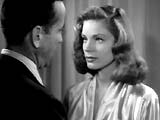 Confronting Vivian About The Link Between Carmen and Sean Regan (Vivian: "You go too far, Marlowe") 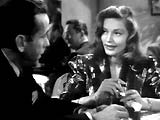 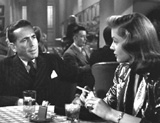 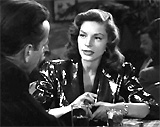 Marlowe and Vivian: Horse-Racing Dialogue 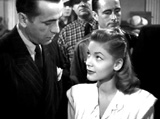 Marlowe and Vivian at Mars' Casino 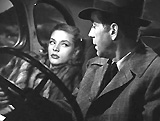 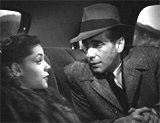  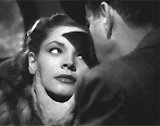 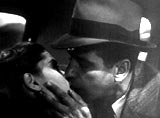 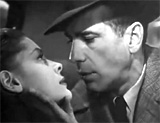 After Leaving Mars' Casino, Vivian Kissed Marlowe: "I like that -- I'd like more...That's even better" 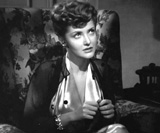 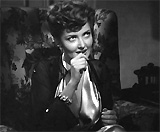 Thumb-Biting Carmen Still Flirtatious with Marlowe in His Apartment 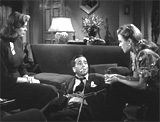 Marlowe Tied Up at Huck's Ranch House, Between Vivian (l) and Mrs. Mona Mars (r) 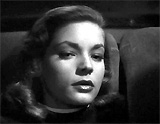 Vivian to Marlowe After Saving His Life: "I guess I'm in love with you" - He Reciprocated With the Same Words 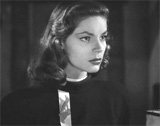 Vivian with Marlowe Before Final Shoot-Out with Mars at Geiger's House 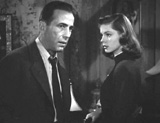 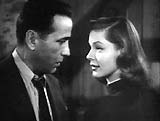 Vivian to Marlowe: "You've forgotten one thing. Me" Marlowe: "What's wrong with you?" Vivian: "Nothing you can't fix" |
|||||||||
|
The Blue Dahlia (1946)
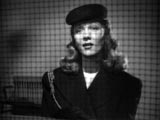
With an Oscar-nominated screenplay by Raymond Chandler, this noirish, hard-boiled, Alan Ladd/Veronica Lake noirish post-war mystery-crime film told about a returning veteran who was forced to prove that he didn't kill his cheating wife. Director George Marshall combined various elements to produce a well-made noir, about a hard-nosed GI soldier returning from service who became entangled with a mysterious blonde when they were both faced with unraveling a murder. It was the third of four screen pairings between Alan Ladd and Veronica Lake. Its tagline was: "Tamed by a brunette - framed by a blonde - blamed by the cops!" The who-dun-it screenplay had a different conclusion than the one offered in the film regarding the identity of the murderer. The murderer was changed by demands from the military - from a soldier returning from service who was suffering from blackouts, to a less politically-sensitive killer. Returning 28 year-old WWII veteran and naval flier Lt. Cmdr. Johnny Morrison (Alan Ladd) was one of three soldiers discharged from service and in Southern California. His buddies included Buzz Wanchek (William Bendix) (with a serious mental health disability) and George Copeland (Hugh Beaumont). Johnny soon discovered that his boozing, unfaithful estranged wife Helen (Doris Dowling) had been promiscuous with LA's The Blue Dahlia nightclub owner Eddie Harwood (Howard Da Silva) during his absence. Trampish Helen was surprised by Johnny's unannounced return to her Wilshire Boulevard Cavendish Court Hotel and Bungalow (# 93), in the midst of a wild house party. When he confronted the couple kissing as Eddie was leaving by the front door, he quipped to Harwood before punching him in the chin:
Clad in a slinky trouser suit and drunk, she seemed unapologetic to Johnny, mentioning to the other guests as she dismissed them: "He probably wants to beat me up." Helen asserted her promiscuous independence from him: ("Don't start preaching. I take all the drinks I like, any time, any place. I go where I want to with anybody I want. I just happen to be that kind of a girl"), and then hinted that Johnny might now be violent after serving in the military when he tried to get her to stop drinking:
She then laughingly admitted to him that their young son Dickie had been killed in a DUI car-crash accident while she was driving - drunk. He had earlier been led to believe that Dickie had died of diptheria: ("I was drunk. I was in a car smash. Dickey was killed. I wrote you he died of diphtheria because I was afraid to tell you the truth"). The news caused him to angrily pull out his gun on her (he hinted: "That's what I oughta do, but you're not worth it"), but then he walked out on her while throwing his gun into an armchair before leaving the bungalow. In the Blue Dahlia club, Harwood was informed that his wife had just separated from him for a few days, presumably because of his on-going affair with Helen (Harwood: "If you think my wife left me because of another woman, it was something else entirely"), and also because of his criminal ties and past. [Note: Much later, Harwood was revealed to be using a fake name. His real name was Bauer - and he was a wanted fugitive-murderer in Passaic, New Jersey fifteen years earlier for killing a bank messenger.] Feeling miffed and rejected, Helen called Harwood and used pressure and blackmail to prevent him from ending their affair: "Supposing I don't want to call it a day? Two walkouts in one evening would be just a little too much for me, Eddie. Ever think of that? And if I don't want to call it a day, I'm quite sure you won't for a very good reason." Meanwhile, Johnny was hitchhiking with his suitcase and picked up in the rain by Harwood's wife, long blonde-haired wife Joyce (Veronica Lake). He hesitated at first but was convinced by her good humor: "Well, you could get wetter if you lay down in the gutter." Remaining anonymous to each other but realizing they were both running away from something, the two strangers shared a drive up the coast to Malibu and beyond, and after parting were not aware until the next morning that they both spent the night at the beachfront motel, the Royal Beach Inn (in separate rooms). The next morning, a maid found Helen murdered on the sofa in her bungalow, with Johnny's gun on the floor. There came news on the radio in the motel lobby that Helen had been murdered (it wasn't ruled a suicide after autopsy tests), and that Johnny was a prime suspect. He returned by bus back to Los Angeles, took an assumed name (Jimmy Moore) and rented a cheap hotel, while trying to clear his name (with some assistance from Joyce). Meddlesome bungalow motel house detective "Dad" Newell (Will Wright) was questioned by police and testified that he had heard Johnny fighting with Helen, and that he had witnessed Harwood enter her bungalow. Johnny was accused of the crime of Helen's murder, along with other suspects:
In the conclusion, most of the suspects were assembled in the Blue Dahlia nightclub as the police authorities pressured Buzz to confess. But as it turned out, all of the suspects were eliminated one-by-one. The surprise killer was revealed to be disgruntled house detective 'Dad' Newell. He had attempted to blackmail Helen about her affair with Eddie, but when she refused to comply, he killed her. Captain Hendrickson (Tom Powers) questioned him to the breaking point:
When Newell pulled out a gun after incriminating himself, he was startled when a door opened behind him, and he was shot by Hendrickson. The film concluded as Johnny suggested continuing his relationship with Joyce, even though he neglected to tell her that her husband was dead or critically wounded:
|
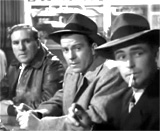 Returning Veterans (l to r): Buzz, George, Johnny  Johnny's Arrival in His Home to Greet His Wife Helen (Doris Dowling)  Johnny Threatening Helen with a Gun ("You're not worth it!")   Joyce Harwood (Veronica Lake) - Picking up Hitchhiker Johnny in Rain  Helen - Found Murdered in Bungalow, with Johnny's Gun on Floor  Joyce With Estranged Husband Eddie Harwood   Joyce - She Aided Johnny and Believed He Was Innocent - Before Revealing She Was Eddie's Wife 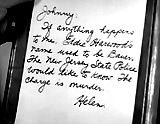 Incriminating Clue About Harwood's Criminal Past, Written by Helen 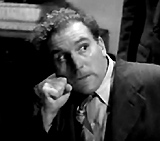 Buzz Wanchek (William Bendix) - Remembering the Night With Helen When He Ran Off   The Killer: House Detective 'Dad' Newell (Will Wright) - Confessing His Guilt 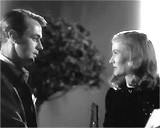 Johnny and Joyce Finding Each Other |
|||||||||
|
Decoy (1946)
Director Jack Bernhard's little-known cult B-film noir from Monogram featured one of the most ruthless, greedy, mean and hard-hearted, deceitful and manipulative femmes fatales in noir history. Social-climbing seductress Margot Shelby (British actress Jean Gillie) was capable of using whatever means necessary to reach her selfish and devious ends. It trumpeted sensational taglines:
This little-known, low-budget, cult B-film noir opened with betrayed and seriously-wounded Dr. Lloyd Craig (Herbert Rudley) in a disheveled suit washing his soiled and bloody hands and face in a grimy washroom sink (with broken mirror) at a gas station. After hitchhiking to San Francisco 75 miles away, he proceeded, zombie- or Frankenstein-like, to the 6th floor posh suite apartment of the glamorous Margot Shelby (who was preparing to flee town). There, he vengefully shot her and then dropped dead.
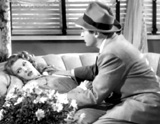
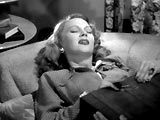
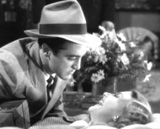
Hard-nosed, tough-guy, and snappily-dressed detective Sgt. Joseph "Jo Jo" Portugal (Sheldon Leonard) had been following a related robbery-case, but arrived too late at Margot's apartment, just as Dr. Craig collapsed in front of him. He found Margot seriously wounded and dying, and carried her over to the sofa. She frantically begged for a money chest dropped on the floor to be brought to her: ("Give it to me. I want it...It's mine. It's all mine now"). She explained that the money chest held the $400,000 proceeds from her boyfriend Frankie Olins' bank robbery. She described what had happened in a lengthy flashback, beginning with:
At the Watchaprague State Prison, ex-gun moll Margot visited convicted robber Frankie Olins (Robert Armstrong). He told her why he had stolen the money - it was for his own possessive reasons related to her alone: ("You're the only thing I care about. That's all that money means to me, you! Clothes for you, pretty things for you. That's why I did it, that's why I took the chance, even on a murder rap, because I want you to be beautiful for me. For me. Not for anybody else, just me").But he also asserted that he wouldn't reveal the location of the $400,000 until someone broke him out of jail ("The secret of where that money is doesn't walk out of here unless I walk out with it"). Margot systematically schemed, seduced and cooperated with two individuals (both of whom were romantically interested in her) to somehow get their hands on the cash - she called it a "long-shot" plan:
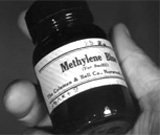
Her scheme was to have the prison doctor inject Frankie's fresh corpse (after he had expired in the prison's gas chamber from hydrocyanic gas) with Methylene Blue as an antidote within one hour and revive him, in order to learn the treasure's whereabouts.
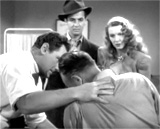
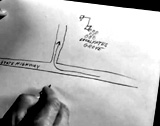
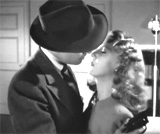
To carry out the plan, Dr. Craig declined a customary autopsy at the prison and injected Frankie's fresh corpse with Methylene Blue before it was loaded into a coffin bound for the morgue (and cremation). The morgue truck was hijacked, and one of Vincent's nasty gunmen Tommy (Philip Van Zandt) killed the paid-off morgue driver Pete (Kenneth Patterson) with a stiletto. The body was delivered to Dr. Craig's office where Olins was miraculously resurrected (Lazarus-like). After he was convinced that his rescuers needed the dough for expenses and for Olins' necessary cosmetic surgery (to create a new face), Frankie agreed to a deal, just in case he didn't pull through. He drew a map of the dough's location - he kept one-half of the crude map, and gave the other half to Margot ("I'll give Margot a map showing the place where I hid the dough"). When Olins tried to give Margot a "little welcome back kiss," revealing that he was still enamoured by her ("My little Margot, who doesn't have to worry anymore about what's going to happen to her after I die"), Vincent shot him dead from behind - and then kissed Margot. Their kiss was witnessed by Dr. Craig, who realized that he had been swindled, was implicated in the crime, and was professionally ruined. Margot reminded him of his complicity:
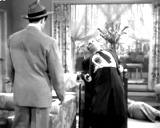
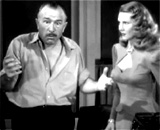
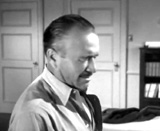
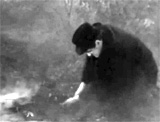
Back at her apartment, Margot was confronted by suspicious detective Sgt. Portugal who was following clues in the case of the hijacked morgue truck (and Frankie's lack of an autopsy report) - he told her, in a classic line: "People who use pretty faces like you use yours don't live very long, anyway," to which she replied: "How do you think I should use my face...?" It was evident that Margot would soon be double-crossing her remaining male compatriots. In the middle of the night, Margot ("I've got money singing in my brain") and Vincent (now with the two parts of the map) took Dr. Craig as their hostage. He was forced to drive his car to the treasure's location (a quarter of a mile off the State Highway, and ten feet from a eucalyptus tree). After they changed drivers, the unrepentant Margot deliberately ran over Vincent fixing their flat tire (the duplicitous female had deliberately let the air out). She then stole his gun and his half of the map. Sadistically, she then backed up and ran him over twice more to make sure he was dead. [Note: this sequence was often excised in various prints.] She also calmly handed her pistol over to Dr. Craig who had told her about his desire to kill her, but he didn't have the nerve to shoot her. She then had Dr. Craig do the dirty work by digging up the treasure box in a eucalyptus grove (he again had the opportunity to strike her with a shovel, but lacked courage). After telling Dr Craig: "All our hopes, all our plans...," she exorted him with sexually-laced language: "Quickly, Lloyd, quickly! Dig for it! Deeper! Faster!", and explained how guilty they all were:
Then, she gleefully shot him twice, laughing hysterically and maniacally as he lay on the ground. She ran off with the strong box in her arms, cackling: "It's mine. It's all mine now!" The film ended with a return to the present where Dr. Craig had followed Margo to her apartment - and lethally shot her. She was still speaking the words: "Mine. It's all mine now." Margot asked Sgt. Portugal to lower himself down to her (for a kiss?): "Jo Jo, please, just this once, come down to my level," but as he bent down, she laughed in his face. Before she died, her last words were: "Simple arithmetic. That's all it was." The treasure box was opened by Sgt. Portugal above her body after she expired on her apartment's couch - where it was revealed as a decoy - with only $1 and a note from Frankie. The $1 bill floated down onto her corpse:
|
|
|||||||||