|
|
(chronological by film title) Introduction | Picture Guide | 1941 | 1944 | 1945 | 1946-1 | 1946-2 | 1947-1 | 1947-2 1948 | 1949 | 1950-1952 | 1953 | 1954-1956 | 1957-1959 |

|
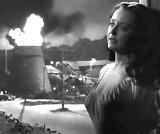
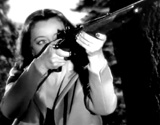
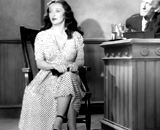
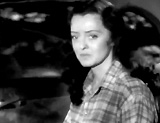
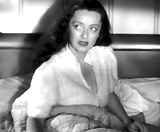
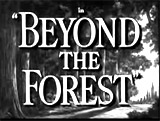
This was a melodramatic, far-fetched, high-camp classic - and also a fine example of film noir from director King Vidor, with an impressive bombastic, Oscar-nominated musical score by Max Steiner. The film's opening scrolling title card introduced the film's themes: "This is the story of evil. Evil is headstrong - is puffed up. For our soul's sake, it is salutory for us to view it in all its ugly nakedness once in a while. Thus may we know how those who deliver themselves over to it end up like the Scorpion, in a mad frenzy stinging themselves to eternal death." The film's narrator (Olan Soule) delivered a voice-over as he introduced the empty, mostly deserted small lumber saw-mill town of Loyalton, Wisconsin, where everyone was in the courthouse for the coroner's inquest involving trampy dark-haired Rosa Moline (Bette Davis), the unhappy wife of the town's only doctor, Lewis Moline (Joseph Cotten). She was charged with manslaughter for the 'accidental' death of a man five months earlier. Rosa was introduced as she rose up in court and shouted: "Why should I kill him? Someone tell me that! Why should I want to?" The film flashbacked to the past (before the murder) to tell about the events that led up to Rosa's murder inquest, the context for her "evil" reputation, and everything that occurred before the murder. The film opened with Rosa, her husband Dr. Moline, and family friend Moose Lawson (Minor Watson) on a weekend fishing trip. They were housed at Moose's smaller cabin on the grounds of the spacious Latimer Lodge (a luxurious hunting lodge-cabin with 20 rooms and 18 baths) where Moose was the caretaker. Rosa faked an ankle injury to allow her to stay longer, while her doctor-husband had to unexpectedly attend to an emergency - a pregnant patient named Mrs. Sorren (Sarah Selby) back in town. She complained to Moose about her longings for the excitement of big-city life and wealth and the boredom and life in the small-town: "Life in Loyalton is like sitting in a funeral parlor and waiting for the funeral to begin. No, not sitting. Lying in a coffin, and waiting for them to carry you out!" After Rosa was able to get family friend and lodge caretaker Moose drunk and unconscious that evening, she raced over to the gorgeous main lodge before its owner arrived (by private plane) - wealthy Chicago industrialist/millionaire and tycoon Neil Latimer (David Brian). She had been engaged in an illicit and erotic, yet adulterous love affair with him for about a year. She awaited him lying on her back on a pillow - eager to be pulled up into his arms for a kiss.
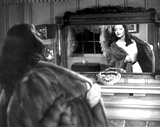
Rosa implied that her affair with Latimer was ongoing whenever he visited: "Here today and gone tomorrow." Her plan was to escape from Loyalton with him to Chicago, but he deflected her obvious demands to be married to him (even though she was a "married woman") - when he already had the select pick of any Chicago society girl. He rejected her request, although was ready to receive a hard and passionate kiss from her. Once Rosa and Lewis met up in their home after the weekend, the trampy Rosa exclaimed with the film's most famous line: "What a dump!" (immortal words later imitated by Elizabeth Taylor in Who's Afraid of Virginia Woolf? (1966)). She despised her life, her home, and her surroundings, and felt out of place everywhere: "I don't want people to like me. Nothing pleases me more than when they don't like me. It means I don't belong." The next day, Rosa sauntered over to the train station and happened to speak a few words to an unknown disembarking passenger - later revealed as Moose's well-to-do daughter Carol Lawson (Ruth Roman) who was visiting from Chicago. Rosa longingly gazed at Carol's luxurious fur coat and her monogrammed luggage. At the post office, Rosa snidely told Mrs. Sorren who was cradling her newborn and surrounded by her large gaggle of children: "You certainly go in for mass production, don't you?" After a few harsh racist words at home to her slatternly and insolent young Indian maid Jenny (Mexican-American actress Dona Drake): "No red Indian's gonna talk to me like that in my own house," Rosa stood on her outdoor porch in view of the lumber mill factory spewing fire and smoke and prophetically exclaimed: "If I don't get out of here, I'll die. If I don't get out of here, I hope I die. And burn!" Later, when Moose and Carol arrived at the house with Lewis for dinner, Rosa realized Carol's identity. She had arrived to reestablish her relationship with her estranged father, who had abandoned the family during her childhood. After the evening meal when her do-gooder husband had described his vocation as an old-fashioned family doctor, Rosa looked longingly at Carol's fur coat, caressed its rich softness with her hand and face, and secretly tried it on while viewing herself in a mirror.
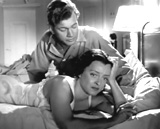
In the middle of the night, Rosa began complaining to Lewis about their bedroom window (with only a cheap shade) that faced the nearby factory's belching fire and smoke. She again demonstrated how much she despised her middle-class way of life, and demanded that Lewis lend her some money so that she could "get away for awhile" to Chicago - "to buy some decent clothes and have some fun." When he protested, she complained about his practice of not demanding payment of debts by his indigent patients, and agreed to accept a lesser amount of $200 dollars. She went through his Accounts-Receivable book and billed all of his poorest in-debt patients. When he learned that she went behind his back, he threw her recently-collected money at her and angrily threatened: "Here's the money you went begging for. If you take it, don't come back!" Rosa arrived in Chicago dressed to the hilt in a handmade suit, but was delayed in meeting up with Latimer (he seemed to be avoiding her) until 7:30 pm when he picked her up in his chauffeured limousine in front of her Lakewater Hotel. He broke her the news that he had fallen in love and was recently engaged to a pretty and young society woman. After being rejected, Rosa begged: "I can't go back, Neil! If you turn me down I got nothing left, nothing!" Latimer explained how he had always been upfront with her: "The time we spent together, I wasn't double-crossing anyone. And I didn't break up your home or break up your marriage, so don't pin that on me." As she exited the car, she expressed how she thought she wasn't good enough for him: "And you don't want me, I'm not good enough! You taught me my place, all right." Rosa was forced to return home to Loyalton, thoroughly discouraged and downtrodden by her dashed hopes to escape. Her husband accepted her back, and was soon told the unexpected news: "I'm going to have a baby." During a birthday and dinner party for Moose (hosted by his daughter Carol) at the Latimer Lodge, Latimer was in attendance and in private revealed to Rosa that he had broken off his engagement and wanted her to come with him to Chicago and marry him. She immediately agreed to the plan. The next day before an early-morning hunting party, Latimer whispered to Rosa that she should prepare to leave with him in about an hour to fly back to Chicago. Moose was aware of Rosa's ongoing affair and threatened to reveal her pregnancy to Latimer if she left her husband. To silence him shortly later, Rosa shot Moose dead - in order to further her plan to escape her marriage and her despised town.
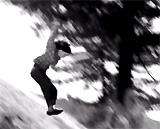
The flashback ended, and five months later during Rosa's inquest, she claimed the shooting death was accidental, and was ultimately found not guilty of manslaughter. Latimer proposed that their plan to marry needed to be postponed for at least a month or two, although Rosa was already scheming to end her pregnancy and escape as soon as possible. She confessed to her husband two damaging admissions about herself - in order to convince him to end her pregnancy: (1) her long ongoing affair with Latimer, and (2) her premeditated, non-accidental murder of Moose. He adamantly refused to accede to her wishes: "I don't want to hear any more! All I care about is my baby and you're going to go through with it....You can go where you please and you can do what you like! After you've had the baby!" Behind the stairway railing looking imprisoned, Rosa vowed: "I'll kill myself first!" Lewis followed Rosa (who was disguised in her maid's clothes) to a neighboring town to seek a medical abortion (from an attorney!?), and drove her back home. During the return trip, Rosa asked Lewis to stop the car - and then she threw herself down a steep hillside into a ravine to cause an injury and a miscarriage (a self-induced abortion) of her unwanted pregnancy.
She was impatient (about going to Chicago) even though she was very sick, and accused Lewis of causing her serious illness and a high fever - evidence of blood poisoning (or peritonitis) - to cause a delay in her departure. She deliberately broke her medicine bottle, forcing Lewis to drive to the nearby hospital to obtain more medicine for her. Meanwhile, Rosa dragged herself from her bed, and in a half-crazed, fever-induced madness, she frantically and hysterically attempted to dress up to escape from her environment, with help from Jenny. Before her bedroom mirror, she smeared herself with lipstick and mascara - and viewed her grotesque image in a mirror - before adjusting her disheveled clothing, feebly descending the stairs, and leaving the house for the nearby train station. In a memorable death sequence, as the Chicago train pulled away, it revealed that Rosa had fallen and collapsed and died in the roadway as she neared the boarding platform of the train station. Lewis (who had been alerted by a phone call from Jenny) arrived to find her deceased body in his car's headlights - as the camera pulled up and away. |
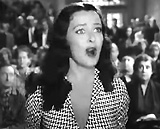 Rosa Moline (Bette Davis) - In the Inquest Courtroom 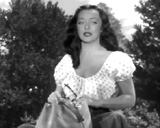 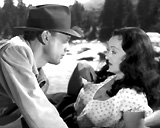 Rosa on Fishing Trip with Husband Lewis to Latimer Lodge  Rosa Complaining About Life in Loyalton 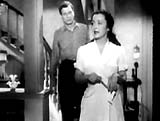 Rosa with Husband Dr. Lewis Moline in Her House: "What a dump!" 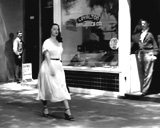 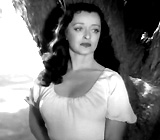 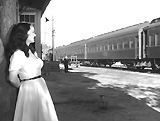 Rosa Swaggering Into Town to the Train Station 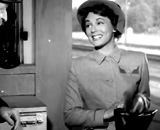 Carol Lawson (Ruth Roman) - Moose's Well-to-Do Daughter From Chicago 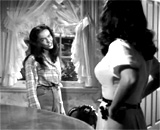 Rosa's Slatternly Young Maid-Servant Jenny (Dona Drake) 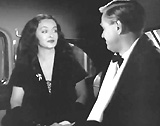  Rosa with Latimer in Chicago - Rejected Because He Was Engaged 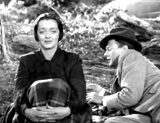 Breaking the News of Her Unexpected Pregnancy to Her Husband 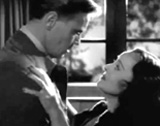 Latimer's Change of Heart - "It's you and me now, Rosa. That's the way it's gonna be" 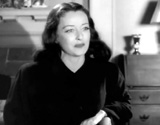 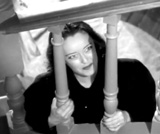 Rosa's Two Damaging Confessions to Her Husband 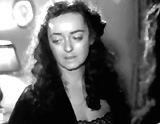 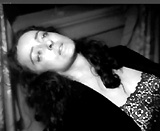 Rosa Feverish and Delusional Due to Her Miscarriage 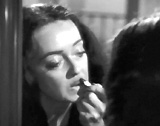 Rosa Smearing on Mascara and Lipstick 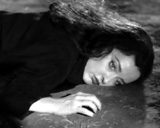 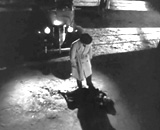 Rosa's Death Before Reaching the 10 O'Clock Train to Chicago |
||||||||||||||||||||||||||||||||

|
Criss Cross (1949)
This under-rated, fatalistic film noir featured unreliable characters, tenuous relationships, a diabolical and fatal love triangle marked by obsessive and doomed love, betrayal, and twisting plots. It was told with flashbacks and a self-deluding voice-over narration. Its tagline referred to the film's double double-cross: "When you Double-Cross a Double-Crosser...IT'S A CRISS-CROSS!" Under the title credits, the film opened with a striking aerial panoramic view of nighttime Los Angeles before the camera swooped down to a parking lot in the northern part of downtown LA where a doomed couple's trysting embrace was revealed by glaring headlights, near the Round-Up Bar. They were speaking about meeting up at a Palos Verdes cottage after a daring, unspecified plot that would unfold the next day. She promised him that they would finally be together again and could make a new start:
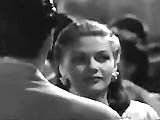
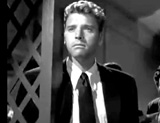
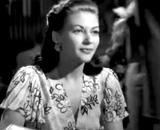
Love-sick, still-obsessed and infatuated ex-husband Steve Thompson (Burt Lancaster) was hooking up and plotting with calculating, trampish femme fatale Anna Dundee (Yvonne DeCarlo), his newly-married ex-wife after a 7-month marriage to him, followed by divorce. After their clandestine rendezvous, Steve stealthily entered the Round-Up nightclub-bar separately from Anna. A going-away party was being planned for Anna's abusive, bickering, crooked gangster husband Slim Dundee (Dan Duryea) - he owned the nightclub. He was leaving the next day for Detroit. Predictably, Steve engaged in a brief fist-fight in a back-room with Slim - broken up by Steve's old friend, LAPD Lt. Pete Ramirez (Stephen McNally), after Slim pulled out a knife. It was revealed that the brawl ("a friendly argument") was staged for the officer, to have him believe they were antagonistic towards each other. They were actually in the midst of coordinating an armored truck robbery to occur the next morning, to net "six figures." Steve, who worked for the armored car company, was the inside driver who had instigated the heist with Slim (and Anna). He had arranged it so there was only one other partner in the truck - his co-worker and family friend Pop (Griff Barnett), on the 40 minute drive to San Rafelo with the Bliss Company payroll. As he drove on, he recalled Anna's promising words to him in the parking lot. START OF FLASHBACK:
Steve initially returned home to LA to see his family, after being a drifter for two years. He jumped off a trolley-streetcar and walked up a hill to his mother's (Edna Holland) house. The love-lorn drifter, still carrying a torch for Anna but believing that she was out of his system, didn't expect to become ensnared again into her manipulative web, but he was fated to do so:
His first day back, he hoped to run into his divorced ex-wife Anna in his old "hang-out," the Round-Up dance-hall, but no luck. That evening in his home, he fatefully brooded about her (in voice-over):
He returned to the Round-Up that evening and was mesmerized when he happened to see her dancing the rhumba (to the tune "Jungle Fantasy") with an unnamed gigolo partner (an unbilled Tony Curtis in his screen debut). When she was surprised to see him and asked why he didn't respond to her letter, he non-chalantly lied to her about being back for a week, and was just "passing by."
They spoke briefly about the good ol' times when they were young and in love and how they frequently fought ("like cats and dogs"), but then "we'd make up" - referring to post-brawling sex: "Those were times, weren't they, Steve? That was the best part, I think. The making up part." Steve also met her current boyfriend, Slim Dundee. He took his old job back - driving for Horten's Armored Car Service. The company boasted its recent stellar record of protecting its cash transports: "Nobody ever got away with a heist on an armored truck in 28 years. As a matter of fact, they don't even try anymore." Anna called him from a nearby drugstore counter to become reacquainted and "get together again" (with the possibility of maybe even getting married again), but he was "sore" that she was dating the brutish Slim. They partially agreed that their relationship wouldn't work: "Every time we get together, there's nothin' but trouble." However, they made a date to take an early Saturday morning swim at Zuma Beach (past Malibu). Steve was warned to stay away from the temptress by his mother: ("Out of all the girls in Los Angeles, why did you have to pick on her?"), who thought Anna was quite manipulative: "Some ways she knows more than Einstein." Shortly later, when Steve went to the club to meet Anna for a date, he was told that she suddenly eloped to Yuma, AZ, to marry Slim. At first, he dismissed the news: "Of course. He had all the dough, and that's all she ever wanted," and felt it might be a good thing, but then admitted he was hopelessly addicted to her:
Steve happened to meet up with Anna at Union Station, and they continued to engage in a clandestine affair, although he was very bitter about her marriage to Slim who persistently lavished her with diamonds. He degraded Anna with names: "Tramp. Cheap, little no-good tramp!" Steve learned that she felt his family was against her, and that LAPD Lt. Ramirez had pressured Anna to leave town and not see Steve ("He was afraid I was poison"). He threatened to frame her and send her to Tehachapi Prison for Women. And then she shockingly admitted that the controlling and abusive Slim and his gang were ominously threatening: "I'm scared. They'd kill us. Kill us!" She showed him bruises on her back where Slim had beaten her. Caught in a dilemma, Steve began to drink heavily. Lt. Ramirez confirmed to Steve that he had put a scare into Anna (due to a request from Steve's mother), and he warned that Steve was asking for trouble from Slim: "You saw her. You're going to keep on seeing her....I tell ya, I know it when I see a bad one....But leave that girl alone....Dundee. He'll get ya. He'll throw a knife into you." The obstinate Steve insisted on continuing to see Anna: ("I'm gonna do anything I please, and you and Dundee and nobody else is gonna tell me what to do"). After being seen together, Anna rushed to Steve's side to warn him that Slim knew of their affair: ("He found out. He must've. The crazy chances we took being seen together") - and he was planning on retaliation. Although she wasn't worried about her own safety, she knew Steve was in jeopardy: "You don't know the people he's got around him. He'll kill you. He's got ways." As they contemplated running away together, they were caught alone. Steve was confronted by Slim and his thug-gang downstairs. Steve cleverly tried to deflect attention regarding their relationship. Ad-libbing, he claimed they were working on a plan (or "job") to share with Slim. It was a daytime payroll heist plan of his own armored car service - presumably easy to accomplish because he was an "inside man." Slim and his crooks were convinced to participate
in the robbery. Meticulous planning went into effect. Part of the plan
was to let everyone know that Slim was leaving for Detroit on the same
day as the proposed robbery, and that he would celebrate with a going-away
party at the Round-Up the night before. Steve also conspired with Anna
to meet him at the Palos Verdes after the heist, to double-cross Slim:
"Go up to the house and wait for me." They planned to run off together
with the stolen money. The robbery went horribly wrong. In the chaos after tear-gas explosions went off inside the gates of the delivery location at the Bliss plant, Slim double-crossed Steve by killing his partner Pop. Steve retaliated by returning fire and was attacked by Slim. Steve shot Slim in the leg, but then was badly wounded himself. The gang fled with the money.
Afterwards while he recovered in a hospital, Steve was viewed as a hero: ("You fought them off, you saved half the payroll. Look. It's in the papers. "QUARTER MILLION ARMORED CAR HOLDUP" And here's your picture. You're a hero. "Steve Thompson, now in the Angel of Mercy Hospital, saves half of payroll, foils perfect crime." Three bandits were killed, while guard Pop was killed. Steve was visited by Lt. Ramirez who was certain that Steve was the "inside man" and had been used by Slim and Anna to hijack the armored truck: ("How did they ever get you in on this deal? What did she do, make you promises? Were you gonna run away together?...Didn't they work you for the prize sucker of all time?"). Ramirez warned that if he was conspiring with Anna to run away, Slim (who survived the holdup) would retaliate: "If she double-crossed Slim, if she's really waiting for you somewhere, then he'll get you." In the film's dark, fatalistic and morbid finale, the still-recuperating Steve was taken from his hospital room in the middle of the night and driven to meet with Slim: "Slim wants to see you. Wants to find out where the money is, where Anna is. Come on." For $10,000, Steve bribed the driver Mr. Nelson (Robert Osterloh) to take him to Anna's location (and then flee). He was reassured by seeing Anna again: ("I knew all the time everything would be all right"). He described how he suspected that he'd be double-crossed during the heist by Slim: "I knew they'd double-cross me, Slim and the rest of them. But I didn't care, Anna. It meant nothing to me so long as I knew I could count on you." He also told her about Lt. Ramirez' suspicions about her: "Pete said you were part of it, that you were in on it with Slim from the start. That dumb cop." Anna became fearful that the paid-off driver Nelson would immediately report back to Slim: "He's on his way back to Slim. He'll tell Slim where I am right this minute." She decided to pack and run off without Steve when she realized how weak he was: ("How far could I get with you?"), and how she wasn't tough enough to stand up to Slim. She was aggravated with Steve for spoiling their getaway: "Why did you have to come here in the first place? Why? Why?", and now was only thinking of her own survival - she planned to quickly pack up and desert him: "You have to watch out for yourself. That's the way it is, I'm sorry." Steve was regretful that their relationship never seemed to work out: "I never wanted the money. I just wanted you." She ran out the door with her suitcase, but then fled back inside when she heard a car drive up.
Slim had traced them to their seaside Palos Verdes rendezvous. He entered the dark doorway, limping with a cane. He threatened them: "I figured you'd bribe Nelson to take you to Anna. You always wanted her, didn't you, Thompson? You really loved her. You know, I did too. But you won out, Thompson. You've got her. She's all yours now." He pulled out a gun and ordered: "Hold her. Hold her tight!" Then, he mercilessly gunned down both Anna and Steve with three gunshots, turned, and heard police sirens in the distance. |
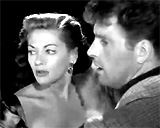 Anna (Yvonne DeCarlo) and Steve (Burt Lancaster) - Caught in Glare of Headlights in Nightclub Parking Lot 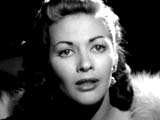 Anna to Steve: "It'll be just you and me"  Anna's Husband - Slick Gangster Slim Dundee (Dan Duryea) 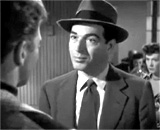 Lt. Pete Ramirez (Stephen McNally) with Old Friend Steve in Bar  Driver Steve with "Pop" in Armored Truck Just Before Robbery Heist FLASHBACK 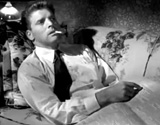 Steve - Brooding About His Ex-Wife Anna  Anna with Steve - At Corner Drugstore  Steve's Stunned Reaction to Anna's Marriage to Slim 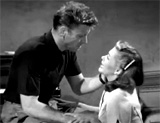 Anna's Fear of Her Own Husband Slim - "They'd kill us!" 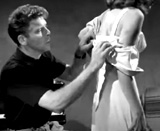 Anna's Bruises on Her Back 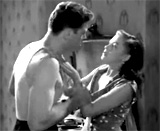 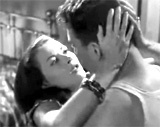 Anna Warning Steve About Her Husband Slim's Retaliation 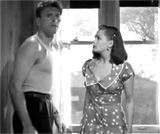 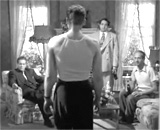 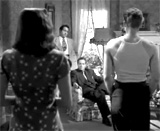 Caught Secretly Meeting by Slim and His Gang 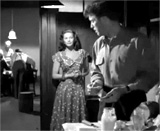 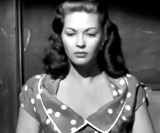 Steve Conspiring With Anna During Planning END OF FLASHBACK 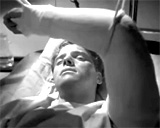  Hospitalized Steve Regarded as Hero After Heist 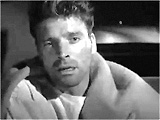 Kidnapped From Hospital Bed 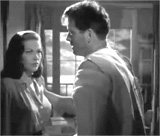 Meeting Up with Anna at Palos Verdes Cottage 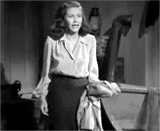 Anna: "You always have to do what's best for yourself" |
||||||||||||||||||||||||||||||||
|
Gun Crazy
(1949/1950) (aka
Deadly is the Female)
This was a quintessential, super-charged, tabloid romantic/crime B-movie melodrama and low-budget film noir - it was another amour fou 'Bonnie and Clyde' crime spree tale about two sharpshooters - including a dominant femme fatale, and a couple's erotic love and obsession with guns that turned into a life of crime. In the opening scene (in the pouring rain) set in Cashville, 14 year-old Bart Tare (Rusty Tamblyn) broke a hardware store display window to steal a pearl-handled gun and ammunition from inside. Then, he tripped and fell down in a mud puddle at the feet of local Sheriff Boston (Trevor Bardette). In his troubled life, Bart was being raised by his older sister Ruby (Anabel Shaw). She claimed that although Bart was "gun-crazy," he had a strong aversion to killing things ("He wouldn't kill anything").
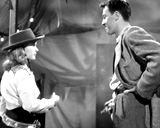
Bart was sent to reform school for four years because of his "dangerous mania" and then served in the Army, remaining gun-fixated. With his two boyhood pals, Deputy Clyde Boston (Harry Lewis) and newspaper reporter Dave (Nedrick Young), broad-smiling Bart (John Dall) attended Packett's Carnival, passing by fire-eaters and belly dancers in the busy sideshows. They encountered "a great star act," featuring blonde, English sharpshooter Annie Laurie Starr (Peggy Cummins) - headlined by the seedy carnival owner/manager Packett (Barry Kroeger) (Annie's lover) as a hyped-up entertainer with a flamboyant past - she was introduced to the audience as an English 'Annie Oakley':
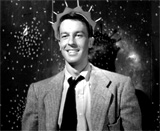
The entertaining star trick markswoman [a typical femme fatale seductress in film noir], filmed from below to make her appear more imposing, appeared on stage dressed as a Western cowgirl (with cowboy hat and shirt, gun holster, and hip-hugging black pants) and fired into the air with her smoking guns blazing in both hands. Bart leaned forward intently for a closer look at his dream-girl/soul-mate come true, captivated and fixated on her domineering, gun-toting abilities that made her as good as any man. She lowered one of her guns and fired directly at her admiring, glazed-eyed customer, almost picking him out of the crowd. He reacted by flinching slightly - bewitchingly, she flashed a radiant, smiling grin back at him, revealing to everyone that she was using blanks in the potentially-potent gun. The audience applauded wildly for her attention-getting poses and presence. He was even more stimulated when she further demonstrated her dangerous feline talent and prowess by bending over and firing between her legs. When Bart volunteered for the audience challenge to win $500, a William Tell-like contest/duel, markswoman Laurie circled around behind him like a wild animal, sizing him up and eyeing him from head to toe - he glanced back at her - reciprocating the combative yet attractive gazes like dogs in heat. Each one shot at matches stuck in a crown worn on the other's head.
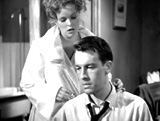
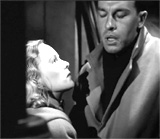
After outshooting her and winning the contest, Bart was easily recruited for the gun act as her erotic partner. However, friction developed when he learned that the overly-possessive Packett was blackmailing her about a murder she committed during a robbery in St. Louis with him, and when Bart began to romantically steal Laurie away. They were both fired from the carnival, and immediately, the two amoral lovers sought out a justice of the peace to get married. Laurie thought about how it might improve her life: "Bart, I've never been much good, at least up to now I haven't. You aren't getting any bargain....But I've got a funny feeling that I want to be good. I don't know, maybe I can't. But I'm gonna try...I'll try hard, Bart...I'll try." They celebrated an idyllic honeymoon period, but soon found themselves in an impoverished state after a visit to Las Vegas. In their drab, cheap hotel room, during a domestic squabble brewing between the couple, she emerged from the bathroom behind him, wearing a white, terry-clothed robe (and naked underneath). Annie Laurie was complaining and dis-satisfied with her unexciting life. As he cleaned his gun barrel by thrusting (phallically) a brush within it, she pulled on her nylons and rejected his proposal of a traditional forty-dollars a week job at Remington - her intention was to strike it rich fast: ("I want to do a little living.....not 40 bucks a week...If I don't get it one way, I'll get it the other"). She admitted that she was "no good. I didn't kid you, did I? Well now you know. Bart, I've been kicked around all my life and from now on, I'm gonna start kicking back." She asked the exasperated Bart: "When are you going to begin to live?" Annie Laurie seductively tempted Bart to pursue more crime with her - and commit armed robbery to match her style of living. When he suggested hocking his guns to "make another start," she countered first by asserting:
When he objected: ("Look! I don't wanna look in that mirror and see nothing but a stickup man staring back at me"), she hinted that he couldn't deliver and suggested: "You better kiss me goodbye, Bart, because I won't be here when you get back. Come on, Bart, let's finish it the way we started it, on the level." She threatened to walk out on Bart unless they both engaged in a life of crime. She dropped onto the bed and reclined back. Agonizing over what to do (his dangling hand opened and closed at his side), he finally succumbed to her wily, fearless, and ruthless ultimatum. He was goaded to illicitly pursue happiness and acquire "things."
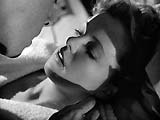
The blackmail scene ended with his sexual acquiescence and gratification, his decision to remain, and a close-up of his mouth inching towards hers for a passionate kiss, as the image blurred and blackened. The kiss dissolved into the gunshot blast of a gumball bowl during a holdup at a Travelers Aid hotel desk - it was an orgasmic, erotic/violent beginning of their crime rampage as gun-toting 'wild animals'. She was able to get him to agree to more holdups - portrayed as a series of exciting, small cross-country stick-ups and robberies - a liquor store, another store clerk, and a gas station; Annie Laurie pretended to be a hitchhiker to hold up a kindly driver who picked her up - they then stole his car for their next major heist. The film's most noted sequence was an unedited, virtuoso, single-shot uninterrupted (long take) robbery scene of a Hampton Bank (Illinois) by the two bank robbers, dressed in their Western showbiz cowboy-cowgirl outfits with guns. The unnerving scene was cleverly filmed from the back-seat of their robbery car (a stolen Cadillac). The scene extended from the time of their drive into town and up to the bank, including getaway driver Laurie's distraction of a cop (Robert Osterloh) on the sidewalk during the robbery. When Bart emerged with an alarm bell ringing, Laurie karate-chopped the policeman in the neck to knock him down and render him unconscious, and the two escaped with Bart driving - while the camera was still filming the long-take in the backseat from behind their shoulders inside the getaway car! Afterwards, she was excitedly in love with her bank-robbing partner: "I love you more than anything else in the world." During their next robbery's getaway at the Rangers and Growers Exchange, as they were pursued by a siren-screaming police car giving chase, the cold-blooded Laurie insisted that Bart (in the back seat) shoot back: "Shoot. Why don't you shoot? Shoot! Shoot, do you hear me?" - unable to kill, he lied to her about eliminating their pursuer (he only shot out one of the car's tires), although a grin slowly widened across her mouth.
The two killers were identified by vengeful carnival owner Packett who reported that Annie Laurie and Bart were his former employees. A full-scale manhunt across state lines was undertaken by the authorities. Bart was beginning to feel regret for his criminal lifestyle with the cold-hearted killer Annie Laurie: "It's just that everything's going so fast. It's all in such high gear that sometimes it doesn't feel like me." He thought he was living a nightmare, and asked to end their rampage: "Laurie, I'm not a killer. I don't want to be a killer. I don't like this kind of life. I've had enough." He was compelled to agree with her request for "one more job"; according to her calculated plan, they could be rich for life and leave the country, but would first have to split for awhile so they wouldn't be recognized and caught - she promised: "Bart, we'll grow old together." For one last, carefully-planned payroll office heist at the Armour Meat Company Plant in Albuquerque, NM where they both had taken jobs (with fake names), the robbery turned deadly when Annie Laurie was forced to shoot and kill her supervisor, office manager Miss Augustine Sifert (Anne O'Neal) when she activated a burglar alarm, and a company security guard during their flight. Although their plan was to escape in separate cars, they were so exhilarated by their success that they decided to remain together. Due to an intensive manhunt and dragnet and even involvement by the FBI, they were forced to flee to Southern California. During their escape, Bart read in the newspapers that two people were killed during the Armour payroll heist, and was astounded by the news: "Why? Why did you do it? Why do you have to murder people? Why can't you let them live?" She responded: "Because I had to. Because I was afraid. Because they would've killed you. Because you're the only thing I've got in the whole world. Because I love you." Even though she proposed leaving him, Bart thought that was unlikely:
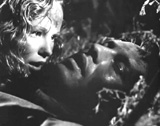
The hunt for them tightened when their spending of twenty dollar bills in the area was traced back to the Armour plant. Returning to Bart's rural hometown in a freight car, the two were discovered in Ruby's house the next day and forced to flee again by car into the San Lorenzo Mountains and Madera National Park. After their car crashed and malfunctioned, they fled on foot into a marshy and foggy swamp and then into a mountainous area with bloodhounds on their trail. In the moonlight, they came to the edge of a marshy swamp, with towering reeds and chirping crickets. Finding themselves at an impasse, they slowly turned their heads back towards their invisible trackers. After crossing another shallow pond, they collapsed into each other's arms on the ground to rest and await dawn. By morning, a thick, hellish, shroud of fog blanketed the area and trapped them in the swamp - anticipating the final showdown. With the camera firmly positioned on their apprehensive faces and trying to define their shapes through the mist, they heard - through the smoky clouds - ominous footsteps and the voices of Bart's boyhood pals Deputy Clyde and Dave announcing their approach. In their last few moments of life and knowing that they were surrounded, Bart faithfully declared his love for Annie Laurie and gave her one final kiss. As the two came closer and Annie Laurie saw their figures in the fog, she vowed with an insane homicidal look on her face: "One more step and I'll kill you. I'll kill you. I'll kill you!"; Bart was compelled to turn on Annie Laurie and shoot his insane, aggressive lover as a mercy killing - the only murder he committed in the entire film, in an act that adopted her own violent modus operandi. By killing her partly out of love, he silenced her lethal ability to kill any further, and protected the lives of his friends. Mistakenly believing that Bart had fired on them, a barrage of police gunfire abruptly cut Bart down. With poetic justice, he fell next to her. Their bodies lay united together - with Bart on his back and Annie Laurie on her side.
The film's sad theme song mournfully played one last time, as the two representatives of the law looked down at their fallen bodies in the heavenly shroud, and the camera pulled back and then up above their soggy, yet romantic grave. The final words of film dialogue were:
|
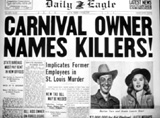
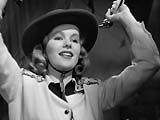 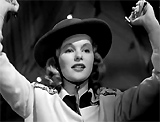 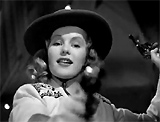 Sharpshooter Annie Laurie Starr (Peggy Cummins) in Packett's Carnival  Bart (John Dall) - Mesmerized by Annie   After Being Fired From the Carnival, On Their Way to the Justice of the Peace  After the Honeymoon, A Bad Streak 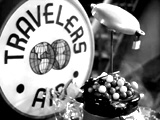  Kiss Dissolved Into Blasted Gumball Globe at a Travelers Aid Hotel Desk 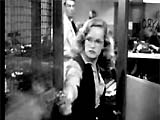 Robbery Spree 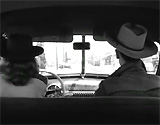 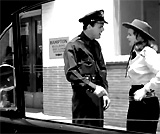 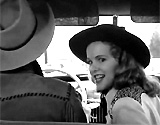 Uninterrupted Take During Hampton Bank Robbery 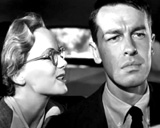 Vow of Love for Bart After Bank Robbery 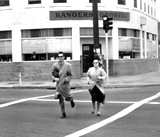 Rangers & Growers Robbery 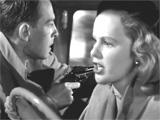 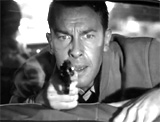 During the Getaway - Bart's Reluctance to Shoot 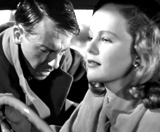 A Smile on Annie Laurie's Face 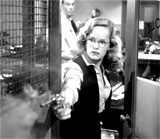 Murder During Armour Payroll Office Heist 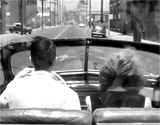 Escape In Open Convertible From Armour Plant 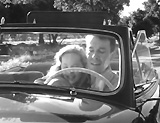 Exhilarated by Heist, They Decided to Remain Together 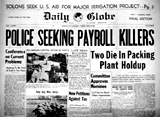 Headlines: Manhunt for Killers After Payroll Office Heist 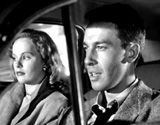 In-Flight 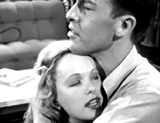 Desperately Clinging to Each Other 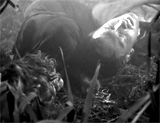 Lying Together - Dead |
||||||||||||||||||||||||||||||||
|
The Third
Man (1949)
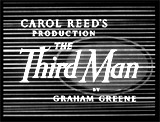
This film-noirish, visually-stylish thriller opened in a depressed, shattered, rotting and crumbling, 20th century occupied Vienna following World War II - a devastated city racked with crime. Its tale of social, economic, and moral corruption told of a love triangle with nightmarish suspense, treachery, betrayal, guilt and disillusionment. The classic drama of geopolitical intrigue was enhanced by the haunting zither music soundtrack by Anton Karas, and featured the tagline:
The three main characters were:
The film opened with a graveyard scene as Harry Lime was buried - with his American unemployed pulp novelist friend Holly Martins and Harry's mistress lover Anna in attendance. She walked home by herself down a long tree-lined avenue.
After the ceremony, cynical British military police officer Major Calloway (Trevor Howard) from the British sector revealed Lime's suspected occupation to Martins - he was a post-war black marketeer, involved in the theft of penicillin from the military hospitals, dilution to make it go further, and the watered-down drug's sale to patients (including children) through the black market for a profit:
Holly looked up Anna following the funeral and found her working as an actress on stage at the Josefstadt Theatre. She looked shattered by the sudden death of her onetime lover. When Holly asked if Anna was in love with Harry, she answered: "I don't know. How can you know a thing like that afterwards? I don't know anything more except I want to be dead too." The two visited Harry's old apartment and while Holly asked questions about Harry's strange lethal accident, she wandered into the adjoining bedroom that she knew intimately. She combed her hair in front of the mirror and looked at an old photograph of herself. When Anna returned home, she discovered that Calloway had ordered a search of her apartment, and confiscated her faked passport (presumably forged by Harry) and Harry's love letters to her; she was taken to be detained at the international police station for questioning before being released. Holly visited Anna in her apartment where he found her disturbed by loneliness and the passing of Harry - she asked for Holly to speak about his childhood with Harry: "I've been alone, without friends and money. But I've never known anything like this. Please talk. Tell me about him." After a short while when he was ready to go, she vowed to never fall in love again - and then encouraged Holly: "You know, you ought to find yourself a girl." Later that night, he drunkenly returned to revisit Anna, bringing her flowers; she was mournfully lying in bed in the shadows, and wearing Harry Lime's striped, monogrammed pajamas (HL on the left front). He drunkenly called out to Anna's cat, but the cat ignored him and jumped out the window - and was seen out on the street nuzzling up to a stranger's shoe in the shadows. Anna claimed Harry was the only person the cat liked. Although she couldn't bear criticism of Harry, after learning from Holly that Harry was a ruthless black marketeer, Anna now believed that Harry was "better dead. I knew he was mixed up, but not like that." Holly was bitter that his good friend was engaged in a deadly racket. By this time, the doltish hack writer had hopelessly fallen in unrequited love with the melancholy Anna but she was unresponsive to his clumsy advances. He offered himself to her: ("I'd make comic faces and stand on my head and grin at you between my legs and learn all sorts of jokes. Wouldn't stand a chance would I? Hmmm? Well, you did tell me I ought to find myself a girl"); a tear fell from her eye, but she was completely uninterested.
Outside Anna's apartment, as the dejected Holly walked off, he became aware of a figure in a doorway on the opposite side of the street when he saw Anna's cat in the shadows, snuggling next to a person's black shoes in a doorway. The cat was licking itself, and tipping off the presence of a silent and motionless person there. The figure's big shoes were illuminated - was it one of Calloway's men, underworld thugs or an intelligence agent? Holly abusively, drunkenly, and defiantly shouted out to the figure. A light from an irritated neighbor's upstairs window briefly illuminated the figure's face - shining straight across the street.
In the famous scene, Holly momentarily and suddenly saw Harry Lime - the 'third man' himself, the amoral blackmarketer. Amazed to see Harry still alive, Holly was startled by the flirtatious, mocking sight of the smiling, smug face of his friend staring back at him, with a raised eyebrow. The light was quickly extinguished, and before Holly could reach his friend, a car approached and blocked his path by coming between them. The figure made off and vanished to the sound of retreating footsteps in the dark. Holly's suspicions that Lime was still alive were confirmed when his coffin was dug up and the body was found to be that of police informant Joseph Harbin, the medical orderly who had acted as a police informer against Lime. Anna was visibly stunned and gratified by the news given to her by Calloway, although she also regretted it: "Poor Harry. I wish he was dead. He would be safe from all of you then." A legendary gripping encounter then occurred between Lime and Martins at the top of the Prater Ferris wheel high above a Viennese fairground. Lime first explained how he didn't want to be a hero:
Lime also contemptuously looked down from the ferris wheel at the scuttling mortals below, cheerfully calling the people unrecognizable "dots" from the height of the ride: "Look down there. Would you really feel any pity if one of those dots stopped moving forever?" Then, once they had descended, Lime delivered a callous, perverse "cuckoo clock" monologue about Switzerland and cuckoo clocks, arguing that there was greater productivity in a warring, strife-ridden culture and civilization than in a peaceful one; the corruptible Lime cynically justified his black market criminal activities, and equated the corrupt political intrigues of the Borgias to the artistic triumphs of Michelangelo and da Vinci:
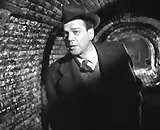
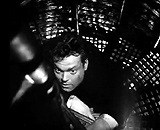
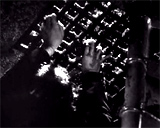
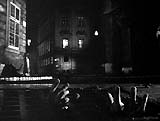
Ultimately, Holly decided to set up Lime in exchange for Anna's freedom from deportation to the Russians (because of her forged passport) after Calloway asked him to name his "price." In the Vienna Railway Station cafe, where Anna was about to board a train to take her away to be saved, she learned that Holly was betraying their mutual friend to the police in return for helping to get her out of Vienna safely - and she was furious. She vowed to remain faithful to Harry no matter what she knew about him, even if her own freedom was at stake. Out of ignorance and her dedication to her role as the doomed man's mistress, Anna didn't want to betray or sell out Harry, because she loved him for what he was: "I don't want him anymore. I don't want to see him, hear him. But he's still a part of me, that's a fact. I couldn't do a thing to harm him.... If you want to sell your services, I'm not willing to be the price. I loved him. You loved him. What good have we done him? Love! Look at yourself. They have a name for faces like that?" She ripped up her new passport and departed with her belongings from the train. The concluding sequence was prefaced by the presence of guards and police searching for Lime in the city. Holly agreed to be a decoy and arranged to meet Lime at Cafe Marc Aurel with police staked out to arrest the black marketeer. Anna arrived and denounced Holly: "Honest, sensible, sober, harmless Holly Martins. Holly - what a silly name. You must feel very proud to be a police informer" just before Harry entered the cafe - she was able to warn him of the danger he faced ("Harry, get away, the police are outside - Quick!"), and he fled. The film ended with fugitive Harry Lime being sought by authorities, led by British Army police official, Major Calloway; there was a thrilling, extraordinary chase sequence, first through bomb-sites and down an open manhole, and then into the passageways of subterranean dark sewers and tunnels under Vienna that still linked all the occupied sections of the city; the climactic scenes were sharply edited for greater impact; the sewers were the dark, unobserved haunt of wounded black marketeer Harry Lime where his 'underground' evil-doings had permeated through the borders of the city's zones; in the manhunt by an international police force composed of police from all four nations, the filming captured the dark shadows on the ancient tunnel walls and the cobblestone surfaces. After a long pursuit sequence, Harry shot Sergeant Paine (Bernard Lee) dead with the gunshots echoing off the tunnel walls. Lime was shot and wounded by Major Calloway as he scrambled away. As fugitive Harry made another break to escape, he was caught and cornered like a rat in the bowels of Vienna; he crawled up a circular iron stairway to reach a grill-covered man-hole - his fingers clutched, curled, strained and poked through the sewer grill grating (filmed from the street level) as he desperately and vainly tried to push it up, but he had been weakened by his gunshot wound from Calloway and was unable to move the solidly-jammed grill cover and flee into the street.
Martins noticed Harry at the top of the iron stairway beneath the grating, and found his old friend struggling there, in great pain and fear; Calloway shouted out from a distance: "Be careful, Martins. Don't take any chances, if you see him, shoot." Harry looked down and saw Holly looking up at him; he wordlessly appealed to his friend Holly, making a wink-like gesture or nod, to shoot; ironically, it had been left to Holly to kill his oldest friend; a gunshot sounded off-screen - and Calloway halted; Holly's silhouette appeared at the end of the smoky tunnel - he had pulled the trigger and shot his friend dead - an ending typical of a Western tale; he had treacherously murdered and betrayed his oldest, closest and trusted friend. In the famed ending after Harry's second funeral and burial in the same cemetery that opened the film (it was a second funeral ceremony for Lime), an exquisite closing sequence, Holly attempted to say goodbye to Anna. Leaving the graveyard in Calloway's vehicle, he asked to be let out; he awaited her approach toward him down the tree-lined, empty cemetery avenue, but she deliberately walked by and stoically ignored him and continued on, passing by the awaiting Holly without paying any attention. |
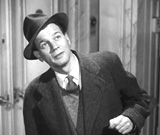 Holly Martins' Arrival in Vienna  Major Calloway with Holly Martins  Anna as Actress in Local Theater  Anna Combing Hair in Harry's Apartment  Calloway Searching Anna's Apartment and Taking Harry's Love Letters 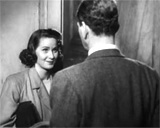 Anna to Holly: "You ought to find yourself a girl" 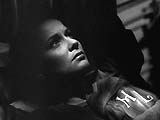 Anna's Pajamas with Harry's Monogram 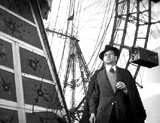 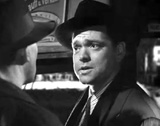 Lime's Ferris Wheel Encounter 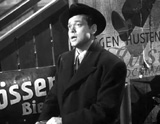 Lime's "Cuckoo Clock" Speech 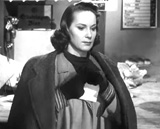 At Train Station - Anna: "I'm not going!" - She Ripped Up Her Passport 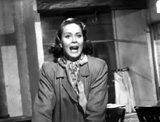 Anna Warning Harry at Cafe: "Harry, get away, the police are outside - Quick!" 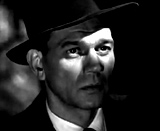 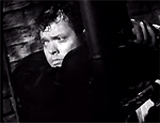 Holly Looking Up at the Cornered Harry Lime and Being Given Permission to Kill 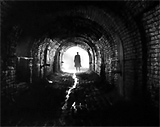 Holly At the End of the Tunnel 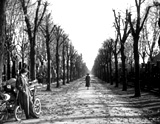 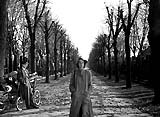 Anna's Exit After Harry's 2nd Funeral |
||||||||||||||||||||||||||||||||
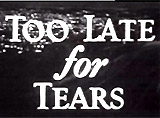 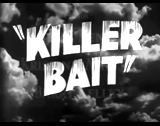 |
Too Late For Tears (1949) (aka
Killer Bait)
This great noir from director Byron Haskin featured a ruthless femme fatale: a crafty, manipulative, evil, and vicious pathological, cash-crazed woman whose only goal was to get and stay rich. The deadly female was portrayed by popular, husky-voiced femme fatale actress Lizabeth Scott. The film's tagline described her:
The film opened in the late 1940s as housewife Jane Palmer (Lizabeth Scott) was on a night-time drive at about 8:30 pm to a Hollywood Hills party with her husband Alan (Arthur Kennedy). She complained that the guests would only be stuffy and obnoxious, and begged Alan to turn around and return home. When there was a brief struggle for the ignition keys, their car's headlights were inadvertently blinked. As he did so, a leather bag of 'dirty money' was suddenly thrown into their open convertible by a passing car. They were briefly pursued by the supposed recipient of the bag, but lost him. Alan wanted to do the right thing and turn in the "poison" money ("It's a bag of dynamite. That was a payoff - probably blackmail") to the police, as he urged her:
However, Jane felt this was a once-in-a-lifetime opportunity ("The money was literally thrown in our laps. No one in the world knows we have it!"). She was bitter about continuing to be poor and told Alan after dumping the contents of the satchel onto their bed: "You've given me a dozen down payments and installments for the rest of our lives." [Note: There was a brief introduction to Alan's sister, Kathy Palmer (Kristine Miller), who lived directly across the hall.]
Alan wanted to keep the bag for a week, so the next morning, he stashed the leather satchel in the Parcel Check at Union Station while retaining the claim check stub in his coat pocket. Jane continued to desire to keep the illicit $60,000 and went on a shopping binge. She started to lavishly spend the funds on furs and run up their bills, and was determined to keep the money from its rightful recipient and her husband, by using whatever means possible (including lying and murder). While Alan was out, sneering, unlikeable hood Danny Fuller (Dan Duryea), insinuating that he was a private detective from the Detective Bureau, arrived at the Palmer's place (Chateau Michel, an upper middle class apartment in Hollywood) for a "routine check." With her husband at work, Jane lied and claimed that they had already turned it over to the police. He searched her place, after slyly telling her: "You haven't anything to hide, have you?" After finding her furs purchase in the kitchen, he became very skeptical and asked: "Where's my dough?" On the sofa, he slapped her across the face a few times to rough her up. Danny vowed to return if he didn't read about the return of the cash in the newspaper: ("I'm going to buy an evening paper, and there'd better be something in it about money, or I'll be around again. An' I'm afraid I'll be awfully peeved at ya, honey!"). That evening, Alan and Jane resumed their argument, and he complained about her lavish purchases of almost $800 dollars: (Alan: "The money won't buy you anything. It will only make you miserable and unhappy...What's happening to us? What's happening? The money sits down there in an old leather bag, and yet it's tearing us apart. It's poison, Jane. It's changing both of us"). She described her lowly upbringing and her greedy desire for money for her entire life:
Jane mentioned her previous "unhappy" marriage to Bob Blanchard (ending in Bob's suicide), and admitted she had married him for his money because she was poor. The two agreed that at the end of a week, they would turn the bag and money over to the DA. The couple proposed going on a date together (dinner and a boat outing) the next evening, just like old times. The next day, when Danny returned to again taunt and harrass her: ("Just where did you stash my cash?"), Jane used her seductive wiles and sexual teasing to keep him at bay. She was determined to keep the money rather than give it up to authorities (her husband's wishes). She hinted that she could evenly split the dirty money with him - she even allowed him to kiss her - and then eagerly kissed him a second time. He was still wary however: ("For your sake, beautiful, I hope you're not trying to soft-soap me. I wouldn't take kindly to it"). As he left, he forcefully pushed or tweaked her chin and added: "That's just to remind you honey, You're in a tough racket now." They conspired to contact each other later - and to meet up at 9 pm in a neutral place - next to a palm tree by the lake in Westlake Park (near downtown LA). In preparation for the evening, she packed her husband's gun in her purse. During a boat ride on the lake in Westlake Park with her husband that same evening, they squabbled in the boat over Alan's gun that fell out of Jane's purse, and Alan was accidentally shot and killed. Knowing that she faced manslaughter charges, she then met Danny at the palm tree next to the lake, as planned - she threatened him at gunpoint with blackmail into cooperating: "If you move, I'll shoot you and tell them you killed my husband." She had him switch his coat and hat with the corpse, and had Danny help her weigh down Alan's body with an anchor and sink it to the bottom of the lake. Then, to make it look like she had returned from the boat ride with Alan, she had Danny impersonate her husband, both at the boat dock and in her apartment's parking garage. With Alan's sister Kathy in her apartment late that night, Jane kept up the illusion that her husband was missing. Kathy had already become worried and suspicious of Jane. Jane preposterously claimed that Alan, with whom she said she had often fought, had run off with another woman: ("I've known it for a long time. Alan doesn't love me anymore. He's beginning to get tired of me...We've been quarrelling a lot lately about little unimportant things"). Kathy didn't believe her dubious story. Jane also kept stringing Danny along, and attempting to find different ways to eliminate him, and to keep him off the path of acquiring the money. Danny was realizing that Jane was more cold and heartless than he was:
She drove up into Coldwater Canyon with Danny, claiming she had buried the cash there, but her plan was botched after a near-accident. He became wary and fled from the car: "Not this time, Tiger. You didn't bury that dough, and I know it. I'll see ya sometime in the daylight with a million people around." And then her car was stolen when she abandoned it by parking it by the ocean, and was later located 12 miles south of San Diego near the Mexican-US border - lending credence to Jane's fabricated story that Alan was cheating on her and had fled to Mexico.
Into the mix came Don Blake (Don DeFore), mysteriously claiming that he was an old war buddy of Alan's, and happened to be on vacation in Hollywood. He conferred with Alan's sister Kathy about Alan's strange disappearance - and both became very suspicious of Jane. Don knew of Jane's deadly past: ("I never met Jane, but I never liked her either. You know her first husband killed himself?"). The two began to work together to discover the real circumstances of Alan's disappearance. Jane became extremely nervous when Lt. Breach (Barry Kelley) of the Homicide Division questioned her about Alan's possible dalliance with another unidentified woman. Kathy suspected that Jane was covering up and concocting an alibi about the other woman: "Jane, you never told me, why?...I know Alan wasn't seeing another woman, and so do you....Your description of this other woman, Jane, it sounded very much like you." To keep her hopes alive for the bag of money, Jane begged Danny to help her to get rid of Kathy, who was snooping around and becoming a threat. She also suspected that Don was an imposter. Jane was able to convince the reluctant Danny to buy poison for her so that she could kill Kathy: ("We've got to help each other...Kathy, my sister-in-law, she's getting suspicious. She's beginning to figure the whole thing out...You're going to help me again, Danny...You've got no other choice. We can't just wait and let her kill us. I didn't mean to kill Alan, but it's done and now it's our lives against hers"). Then, Jane could claim that her sister-in-law was "despondent" over Alan's disappearance. Danny agreed but felt trapped: "You are a tiger. You got me in so deep, I can't get out. I'll get the stuff for you. But, like you say, you gotta do the rest. Every bit of it." Don and Kathy were beginning to show some romantic interest in each other - and were also committed to seeking the truth about Alan and Jane: (Don: "There's something going on here, Kathy, and it's not very pretty. Don't ask me what it is or why I think so, but, bear with me, Kate, will you?"). Later, before they could leave for dinner and a stop at Union Station with the claim ticket, Don and Kathy were intercepted by Jane and invited into her apartment. Forever scheming and confirming that Don was an imposter, Jane held Don and Kathy at gunpoint, demanded the claim ticket, and knocked Don out. Kathy was able to flee back to her apartment unharmed, where she phoned the Hollywood police. Afterwards, Jane claimed the case of money for herself from Union Station's Parcel Check. (She asked a male bystander pick up the bag for her to avoid suspicion. She noticed a note on the bag with Alan's instructions to the claims agent to notify the police if a woman claimed the bag.) Then, to eliminate Danny, Jane went to his house. He was suffering from a hangover, but was still very wary of her plan to escape with him to Mexico with the money:
To celebrate their newfound treasure, he proposed a drink, but first she wanted to know if the money could be safely used and spent. He explained that he had acquired blackmail payoff money due to him from an insurance agent's racket-scam that collected premiums. Then, she found the opportunity to poison him (with the poison he had acquired for Jane to kill Kathy!), after he toasted: "Here's to crime, it pays and pays!" He collapsed dead to the floor. Authorities pondered whether it was murder or suicide. The duplicitous Jane fled with the unmarked cash in the bag to Mexico City via her convertible. Although her excuse was to find her husband Alan there, she really intended to lead a life of luxury in a ritzy hotel penthouse (the Hotel Reforma) as Miss Jane Petrie. Don (and Kathy) trailed Jane to Mexico, where Don confronted her in her hotel suite with the truth about Alan's murder and the fact that she had the bag with $60,000. When she allegedly reached for her lipstick, he assumed she was reaching for a weapon: "Colt? Or Smith & Wesson?" After she bargained and desperately offered to share one-half of her loot with him, he only took a small portion (to pay for dragging the small lake at Westlake Park to locate Jane's missing husband) as part of his "vendetta." She then discovered that he was the brother of Jane's earlier, first husband Bob Blanchard. Don said that he never believed the report that his brother was suicidal, but had always suspected Jane of murdering him. Like Alan, Bob had also died under mysterious circumstances. According to Jane, she said that when Bob found out that she didn't love him, he committed suicide ("I swear I didn't kill him!"). Don surmised, however, that she might have easily driven him to kill himself:
He threatened her with an end to her murder spree - of both Alan and Danny: "You're all through killing now, Jane." When the Mexican police authorities broke into the room, an armed Jane backed up, tripped on the bag, and fatefully fell from the second floor balcony to her death on the stone driveway below - with some of the loot next to her outstretched hand.
In the final epilogue, Don and Kathy met in the hotel lobby - to return home from a short honeymoon: ("Well, it was a short honeymoon, Kathy. We're going home now"). Kathy solemnly asked: "Jane?" and he responded: "Yeah," as they walked off. |
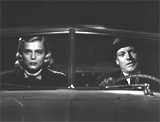 Jane and Alan Palmer (Lizabeth Scott and Arthur Kennedy) 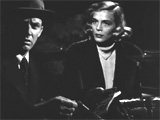 Discovery of Bag of Cash in Back Seat 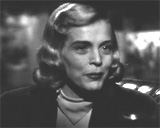 Jane: "No one in the world knows we have it!" 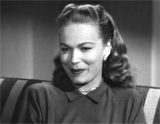 Kathy Palmer (Kristine Miller) 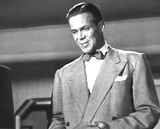 Danny Fuller (Dan Duryea) 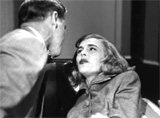 Jane Lying to Danny and Being Slapped Around   Conspiring with Danny - Sealed with a Kiss  Accidental Shooting - Death of Alan in Boat  The Claim Ticket to the Bag of Money in Alan's Dresser Drawer   Kathy with Don Blake (Don DeFore)  Jane Becoming Nervous When Questioned by Lt. Breach  Jane Conspiring with Danny to Kill Kathy, Her Sister-in-Law 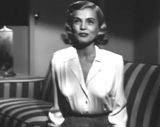 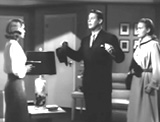 Jane - Realizing That Don Was An Imposter, And Demanding the Claim Ticket 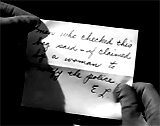 Alan's Note on Bag of Money 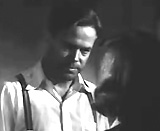 Danny to Jane: "Don't ever change, tiger. I don't think I'd like you with a heart" 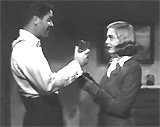 Jane and Danny Toasting With a Poisoned Drink: "Here's to crime. It pays and pays" 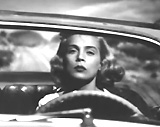 Jane's Flight to Mexico With the Cash 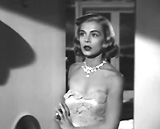 Jane's Shock at Finding Don at Her Hotel Door 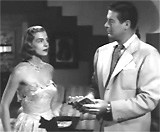 Jane Offering to Share Half of the Money with Don |
||||||||||||||||||||||||||||||||