|
|

| A (continued) | ||
|
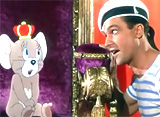
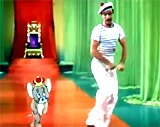
Anchors Aweigh (1945) This quintessential musical sequence, the delightful highlight of this film, featured "Pomeranian sailor" Joseph Brady's (Gene Kelly) live-action magical dance with animated mouse Jerry - the character from MGM's "Tom and Jerry" cartoons, during The King Who Couldn't Dance (The Worry Song) (pictured) number. (Note: Jerry spoke and sang, and although cat Tom appeared as the valet for Mouse King Jerry, he didn't dance or talk). |
|
|
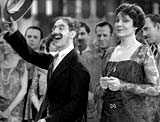
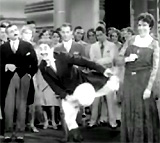
In the start of this Marx Brothers comedy film, when Captain Spaulding's (Groucho Marx) entourage arrived, the excited guests broke into song in the trademark production number Hooray for Captain Spaulding (pictured) to honor the fearless explorer from Africa. At one point, Spaulding lept about, spun around, and hopped - rotating like a corkscrew with one leg in a strange wild dance. Almost immediately, after showing contempt for his elaborate welcome, Spaulding sang that he was leaving: I Must Be Going (pictured). [Note: Hooray for Captain Spaulding became Groucho Marx's theme song, and its music was used for his hosted TV game show You Bet Your Life.] |
|

|
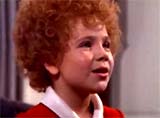
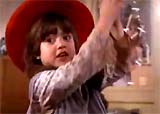
Annie (1982) Ten year old orphan Annie Bennett (Aileen Quinn) belted out this sentimental film's anthem Tomorrow (pictured) ("Tomorrow! Tomorrow! I love ya, tomorrow! You're only a day away!") more than once. Also included in the film was:
|
|
|
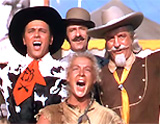
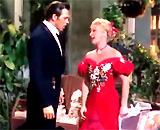
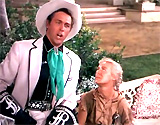
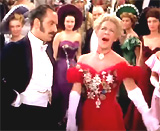
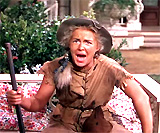
Annie Get Your Gun (1950) This entertaining, romanticized, and fictionalized MGM film became one of the Freed Unit's most successful (profitable) pictures, and won the Oscar for Best Musical Score. It was based upon Irving Berlin's 1946 Broadway hit about the 19th century sharpshooter of the title, Annie Oakley (blonde Betty Hutton). There were five show-stopping Irving Berlin songs:
|
|
|
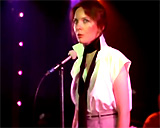
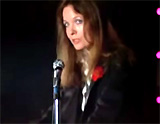
This Woody Allen-directed romantic comedy, a Best Picture winner, contained the scene of the title character - aspiring but timid singer Annie Hall (Diane Keaton) - performing a Saturday nightclub audition with an unsteady, shaky rendition of It Had To Be You (pictured). She was forced to perform in a distracting and noisy environment - with microphone feedback, the loud crash of dropped plates, a ringing telephone, uninterested oblivious patrons, and other audience distractions which made it an awful debut experience. Later, she performed more self-assuredly with a captivating rendition of Seems Like Old Times (pictured). The popular song (with music and lyrics by Carmen Lombardo and John Jacob Loeb) was originally released in 1945. |
|
|
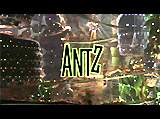
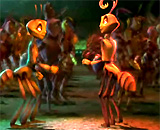
Antz (1998) This DreamWorks computer-animated film contained the robotic Guantanamera dance sequence at the Chub Club, in which Princess Bala (voice of Sharon Stone) urged her antz girlfriends: "Let's take a walk on the wild side. Step back, ladies. I'm gonna ask one of these workers to dance with me." She overheard worker ant Z-4195 (voice of Woody Allen) complaining to himself about everyone dancing in unison: "What a bunch of losers. Mindless zombies capitulating to an oppressive system." She asked: "Hi. Wanna dance?" and then was astonished when he broke from the monotonous dancing of the group and improvised: "What on earth are you doing?" He explained why he was doing a modified Batusi (from the Batman TV series): "To tell you the truth, I'm sort of making it up." He added: "Why does everybody have to dance the same way? You know, that's completely boring! You know, it's monotonous. No fun." Afterwards, the musical film also included Z's joyful, love-struck, infatuated singing of the Lerner and Loewe classic Almost Like Being In Love (pictured) ("...There's a smile on my face, for the whole insect race / It's almost like being in love!..."). The ant colony also serenaded with Give Z a Chance - ("All we are saying, is give Z a chance") a variation of the famous John Lennon song Give Peace a Chance. |
|
|
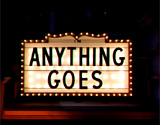
Anything Goes (1936) (aka Tops is the Limit)
(TV title) This archetypal Paramount film musical by director Lewis Milestone (the 1936 adaptation of the 1934 stage play) retained four classic Cole Porter songs from the original stage musical:
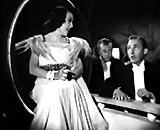
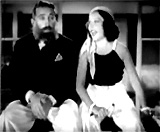
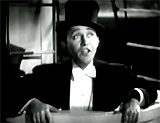
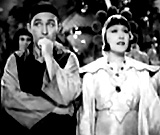
The 1936 version starred Bing Crosby (as Billy Crocker), Ethel Merman (as Reno Sweeney), Charles Ruggles (as Rev. Dr. Moon), Arthur Treacher (as Sir Evelyn Oakleigh) and Ida Lupino (as Hope Harcourt). The plot told of the romantic endeavors between various passengers on a luxury ocean liner voyaging from New York to Southampton. In the 1936 film, Crosby also sang Sailor Beware (pictured), and joined Merman for the finale: Shanghai-Dee-Ho (pictured). In the second 1956 Paramount version (in VistaVision color) by director Robert Lewis, the stars were Bing Crosby (reprising his role, but renamed as Bill Benson), Donald O'Connor (as Ted Adams), Jeanmaire (as Gaby Duval), and Mitzi Gaynor (as Patsy Blair). |
|
|
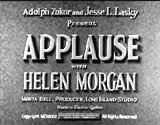
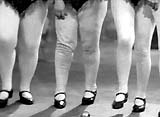
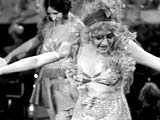
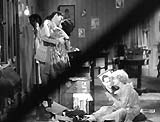
Applause (1929) This landmark musical drama with innovative sound techniques from director Rouben Mamoulian (his first sound film) provided a more realistic and cynical look at seamy backstage life. The chorus line of burlesque dancers in the Zenith Opera House in the film was composed of unattractive, pudgy and washed-up chorines rather than conventional cute blondes. The film featured real-life torch singer Helen Morgan as fading, "washed-up" burlesque star Kitty Darling - the ailing self-sacrificing mother of convent-bred daughter April Darling (Joan Peers). In one early scene, Kitty sang the plaintive What Wouldn't I Do For That Man (pictured) to a photograph of her unscrupulous, predatory, unfaithful and brutish "Bad Boy" lover Hitch Nelson (Fuller Mellish, Jr.) while he was down the hall (in a triangulated, split-screen view) kissing another chorine. There was also a disturbing end scene in which April forced herself to dance sordid burlesque in front of leering, middle-aged men in place of her ailing mother who was dying from self-poisoning in the dressing room. |
|
|
Arthur (1981)
Writer/director Steve Gordon's (his sole feature film) romantic comedy told about alcoholic, spoiled millionaire playboy womanizer Arthur Bach (Dudley Moore). He was tended to by faithful, wise, and loyal but sarcastic valet Hobson (Oscar-winning John Gielgud) - a father-figure, and was often chauffeured in a Rolls-Royce through NYC by driver Bitterman (Ted Ross). A sequel followed Arthur 2: On the Rocks (1988), along with an unsuccessful remake, Arthur (2011) starring Russell Brand. In the film's story, Arthur fell in an unlikely romantic relationship with lower-class working girl from Queens - Linda Morolla (Liza Minnelli), first seen shoplifting. The film's musical score (except for the Best Song) was composed by Burt Bacharach. The comedy received a total of four Academy Award nominations (with two wins):
The title song Arthur's Theme (Best That You Can Do), first heard under the opening credits (and then during the closing credits) (pictured twice), was co-written by Christopher Cross, Burt Bacharach, Carole Bayer Sager and Peter Allen, and performed on the film's soundtrack by Christopher Cross.
|
|
|
At Long Last Love (1975) Homage to musicals of the 30s was attempted by director Peter Bogdanovich in this innovative and original musical romantic comedy from Fox, although it was a disaster at the box-office due to its lack of sparkle, dull screenplay and miscasting. It contained over a dozen witty Cole Porter songs, including:
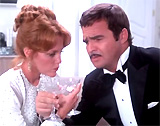
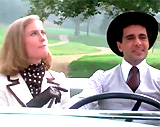
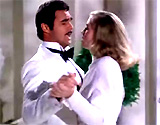
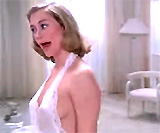
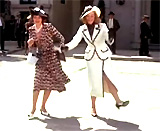
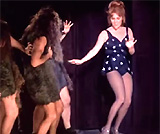
There were virtuoso performances, not from the leads (miscast Burt Reynolds as bored playboy Michael Oliver Pritchard III and Cybill Shepherd as debutante-heiress Brooke Carter), but from supporting players Madeline Kahn (as Broadway diva-stage star Kitty O'Kelly), Duilio Del Prete (as Italian gambler Johnny Spanish), Eileen Brennan (as Brooke's maid-companion Elizabeth), Mildred Natwick (as Mabel Pritchard), and John Hillerman (as valet Rodney James). However, Shepherd undressed while preparing for a battub soaking, as she was singing Which (Is the Right Life) (pictured), and she performed a soft-shoe dance/song on the street with Elizabeth titled Etiquette (pictured). On stage, Madeline Kahn sang the memorable Primitive Man (pictured). |
|
(alphabetical by film title) Introduction | A-1 | A-2 | B-1 | B-2 | B-3 | C-1 | C-2 | D-1 | D-2 | E | F-1 | F-2 | G-1 | G-2 H-1 | H-2 | I-J | K | L-1 | L-2 | M-1 | M-2 | N-O | P-1 | P-2 | R-1 | R-2 | S-1 | S-2 | S-3 | T | U-V | W | X-Z |




 #
90 "Seems Like Old Times"
#
90 "Seems Like Old Times" 
 Best
Original Song: Arthur's Theme (Best That You Can Do)
Best
Original Song: Arthur's Theme (Best That You Can Do)