|
Musical Moments and Scenes F - 2 |

| F (continued) | ||||||||
|
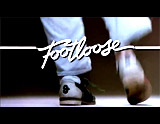
Footloose (1984)
In this top-grossing, MTV-inspired pop musical melodrama from Paramount Studios and director/choreographer Herbert Ross with a great soundtrack (and six Top 40 singles), free-spirited teen Ren McCormick (Kevin Bacon) rebelled against a puritanical small Midwestern town's ban on rock-and-roll and dancing, led by fundamentalist minister Reverend Shaw Moore (John Lithgow). Ren was challenged and dared to play a game of chicken involving two tractors (against Chuck Cranston (Jim Youngs), the abusive boyfriend of Ren's love interest Ariel Moore (Lori Singer)), to the background music of Bonnie Tyler's Holding Out For a Hero (pictured):
The film included the sweet tutorial scene in which Ren taught two-left-footed Willard Hewitt (Chris Penn) to dance to the tune of Deniece Williams' chart-topping Let's Hear it For the Boy (pictured). There was also the over-choreographed Flashdance (1983)-inspired breakdancing session (a solo performance by Ren) in a warehouse, to the tune of the song Never (pictured), performed by Moving Pictures. The climax was the senior prom in a grain mill outside of town, during Kenny Loggins' title pop tune Footloose (pictured twice), with Ren delivering the film's last lines before everyone hit the dance floor:
[Note: Kenny Wormald and Julianne Hough co-starred in the updated remake Footloose (2011).] |
 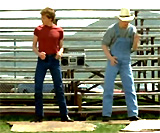 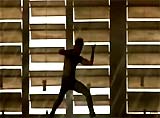 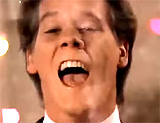 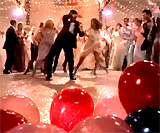
|
||||||
|
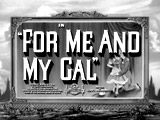
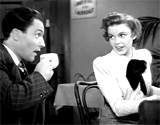
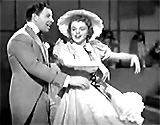
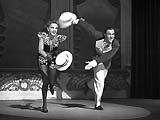
For Me and My Gal (1942) This nostalgic MGM film directed by Busby Berkeley featured hoofer Gene Kelly's film debut and Kelly's (as ambitious song man and dancer Harry Palmer) first teaming with 19 year-old Judy Garland (as aspiring vaudeville singer Jo Hayden). There were these familiar numbers:
|
|
||||||

|
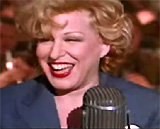
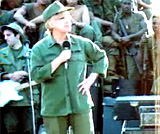
For the Boys (1991) Director Mark Rydell's film told the story of 1940s, Martha Raye-inspired actress/USO singer Dixie Leonard (Oscar-nominated Bette Midler) who teamed with Bob Hope-inspired entertainer Eddie Sparks (James Caan) to perform for the Armed Forces over a 50 year period. Dixie's exuberant and bawdy performances for WWII troops included:
Dixie and Eddie's signature tune I Remember You closed their show - their last song and dance together. |
|
||||||
|
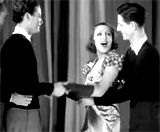
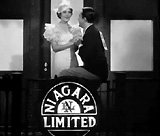
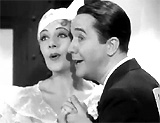
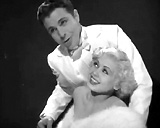
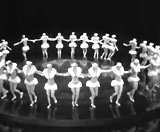
Talented Broadway dance director Busby Berkeley's highly-regarded choreography in this wildly-successful Warners' production (produced by studio chief Darryl Zanuck) included landmark, spectacular designs, scores of chorus girls, large extravagant and escapist musical 'production numbers', sumptuous art deco sets, surrealistic imagery, optical effects, zoom lenses, fast-paced timing and rhythmic editing, and wise-cracking bawdy dialogue. This classic 'backstage' musical film about putting on a show told the story of how a chorine understudy (Ruby Keeler in her film debut as Peggy Sawyer) became a star at the last minute to replace ailing chanteuse Dorothy Brock (Bebe Daniels) - the same plot had already been used in the studio's first all-color sound feature On With the Show! (1929). This film featured penned tunes of composer Harry Warren (and co-writer lyricist Al Dubin), who contributed:
|
|
||||||
|
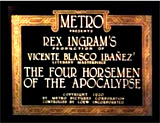
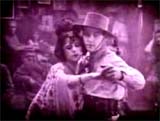
The Four Horsemen of the Apocalypse (1921) One of the first memorable dance scenes in this silent film was Latin lover Rudolph Valentino's sensuous tango (pictured) performed in a smoky cantina while dressed in an Argentinian gaucho costume, and playing the role of "youthful libertine" Julio Desnoyers. |
|
||||||
|
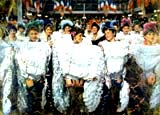
French Cancan (1954/1955, Fr.) (aka French Can Can) In this Technicolored backstage musical romantic comedy, director Jean Renoir recreated and colorfully chronicled the revival of Paris' most notorious dance, the CanCan, at the Moulin Rouge nightclub in 1880. The final twenty minutes of the film included the great dance sequence of opening night at the Moulin Rouge. |
|
||||||
|
Frozen (2013)
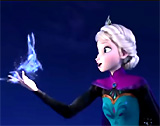
Walt Disney's 3-D magical musical fantasy, the Oscar winner for Best Animated Feature Film, was loosely inspired by the Hans Christian Andersen fairy tale The Snow Queen. It became a major box-office triumph at the time - as the highest-grossing animated film of all-time (at $1.287 billion, domestic). Its second Oscar (from its two nominations) was Best Original Song for Let It Go (sung by Idina Menzel as older blonde sister Queen Elsa), with music and lyrics by the husband-wife team of Kristen Anderson-Lopez and Robert Lopez. The cursed Snow Queen of the Nordic Kingdom of Arendelle had been ostracized after the public learned of her powerful occult ability to create and control ice and snow (she had lost control and had caused eternal or perpetual winter), something she had tried to suppress and keep a secret for many years. While in solitude, she realized that she could 'let go' and feel free. While joyously singing (and discarding her glove which held back her powers), she created a living snowman named Olaf and an ice castle to live in. A more popular version of the song was performed by actress/singer Demi Lovato during the film's closing credits. |
|
||||||
|
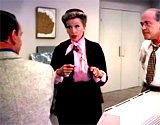
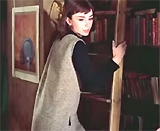
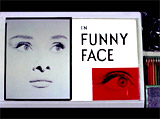
Funny Face (1957) Stanley Donen directed this glamorous and colorful romantic musical comedy from Paramount with George Gershwin music, derived from the Gershwin's 1927 Broadway musical of the same name, and somewhat considered a redo of An American in Paris (1951). It starred Fred Astaire (as carefree fashion photographer Dick Avery) and Audrey Hepburn (as Jo Stockton, a fashion model transformed from a beatnik type clerk in a Greenwich Village NYC bookshop). Avery promoted Jo to his magazine associates, Maggie Prescott (Kay Thompson) (representing Harper's Bazaar editor Diana Vreeland) and Dovitch (Alex Gerry), that Jo was the new "Quality Woman", although Maggie was very reluctant - and held her magnifying glass up to an enlarged picture of Jo:
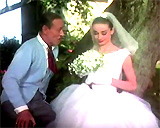
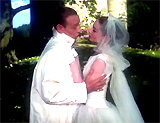
Jo and Avery were paired together in one of the loveliest song-and-dance numbers ever performed in film - He Loves and She Loves (pictured) - filmed in soft-focus and danced in the green countryside at the Chantilly churchyard near Paris (with Hepburn in a white wedding dress). A similar song and setting was S' Wonderful (pictured) that ended the film.
Other memorable numbers included:
|
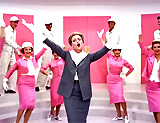 "Think Pink" 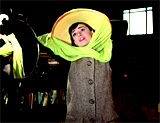 "How Long Has This Been Going On?" 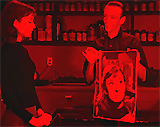 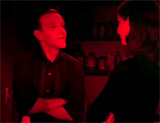 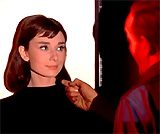 "Funny Face" 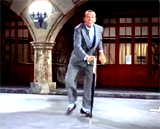 "Let's Kiss and Make Up" - Astaire With Umbrella 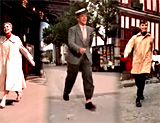 "Bonjour, Paris!" (Split-Screen) |
||||||

|
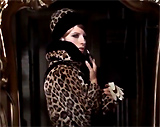
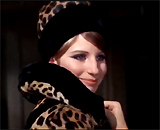
Funny Girl (1968)
Director William Wyler's first musical film, a Columbia Pictures adaptation of the Jule Style-Isobel Lennart-Bob Merrill stage musical that starred singer Barbra Streisand (reprising her 1964 Broadway role), was a biopic about comedienne-entertainer Fanny Brice. Of its eight Oscar nominations, it only won one award: Streisand's Best Actress Oscar - sharing the award with Katharine Hepburn. The other nominations were for: Best Picture, Best Film Editing, Best Cinematography, Best Sound, Best Supporting Actress (Kay Medford), Best Song ("Funny Girl", with music by Jule Styne and lyrics by Bob Merrill), and Best Score. It opened with Fanny Brice n the first scene telling her mirror reflection: "Hello, gorgeous!", before the film's lengthy flashback.
Her most memorable songs included:
|
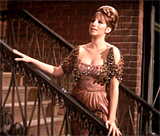 "People" 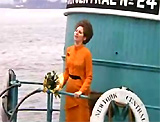 "Don't Rain on My Parade" 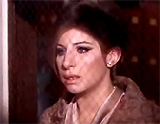 "Funny Girl" 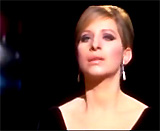 "My Man" |
||||||
|
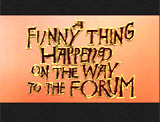
A Funny Thing Happened on the Way to the Forum (1966) Director Richard Lester's romp-filled adaptation of the successful Broadway musical comedy (with compositions by Stephen Sondheim) was set in Ancient Rome. The musical won an Oscar for Best Music, Scoring of Music, Adaptation or Treatment. It included the following numbers:
|
 "Comedy Tonight" 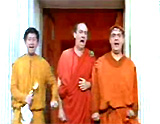 "Everybody Ought to Have a Maid" 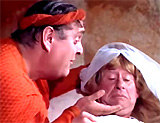
"Lovely" |
||||||
(alphabetical by film title) Introduction | A-1 | A-2 | B-1 | B-2 | B-3 | C-1 | C-2 | D-1 | D-2 | E | F-1 | F-2 | G-1 | G-2 H-1 | H-2 | I-J | K | L-1 | L-2 | M-1 | M-2 | N-O | P-1 | P-2 | R-1 | R-2 | S-1 | S-2 | S-3 | T | U-V | W | X-Z |




 #
96 "Footloose"
#
96 "Footloose" 
 Best
Original Song: Let It Go
Best
Original Song: Let It Go