|
|

| B (continued) | ||||||||
|
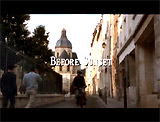
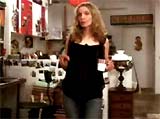
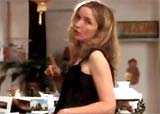
Before Sunset (2004) In this sequel to the first film Before Sunrise (1995), two lovers Jesse (Ethan Hawke) and Celine (Julie Delpy) met again nine years later, with only a short time before Jesse's flight left Paris. At the end of their time together, they went to her apartment to have some camomile tea where she sang A Waltz For a Night (pictured) (written by Delpy herself) while playing a guitar and sitting on her bed, telling about their previous romantic encounter ("lovely one night stand"):
They also listened to a CD recording of Nina Simone singing Just in Time (pictured). Recalling a Nina Simone concert that she had attended, Celine did an impression of the singer as she stopped in the middle of a song and came to the edge of the stage, while slowly moving her hips side to side and puckering up her lips in a pout, seductively speaking:
Celine then warned Jesse: "Baby, you are gonna miss that plane." Jesse responded quietly and knowingly: "I know" as he held his left hand up and briefly twirled his wedding ring with his left thumb. The screen faded to black before the closing credits. |
|
||||||
|
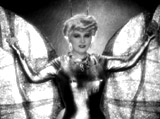
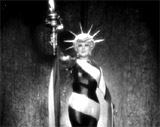
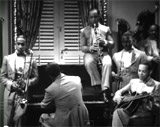
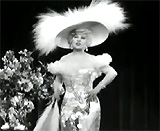
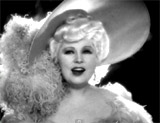
Belle of the Nineties (1934) Leo McCarey directed screenwriter Mae West, playing a seductive cabaret chanteuse entertainer named Ruby Carter, with sashaying hips and an hourglass figure who loved men and jewelry, and spewed double-entendres and innuendo in her fourth film, from Paramount. This melodrama was West's first post-Production Code film, meaning that it was heavily pressured during production for clean-up, rewrites, and retakes. The musical comedy tale (originally titled It Ain't No Sin - the title of West's original story), about a love-triangle was heavily censured by the Hays Office for its "glorification of prostitution and violent crime." The main male character who received Ruby's affection was a muscle-bound prize-fighting boxer named The Tiger Kid (Roger Pryor), whom she married by film's end, although she was romanced by wealthy Brooks Claybourne (Johnny Mack Brown) who provided her with expensive diamonds and jewelry. Ruby was the star attraction at the "Sensation House" saloon in New Orleans run by sinister Ace Lamont (John Miljan), who was jealously scheming against her. In the opening production number My American Beauty (pictured) performed on stage, Ruby ("the attraction of the evening") appeared against a theatrical stage backdrop posing as a butterfly, a bat, a rose, a spider, and as the Statue of Liberty. Duke Ellington and his orchestra were featured in the film as back-up for Ruby, and she sang honky-tonk tunes including When a St. Louis Woman Comes Down to New Orleans (pictured), W.C. Handy's Memphis Blues, and My Old Flame (pictured). Scott Joplin's Maple Leaf Rag was also heard on the soundtrack. |
|
||||||
|
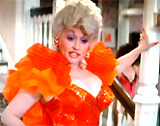
The Best Little Whorehouse in Texas (1982) This Broadway play film adaptation, a musical comedy, featured big-bosomed Dolly Parton as Madame Mona Stangley - the flamboyant, smooth-talking proprietor of a 'working girl's' establishment - wearing a red gown and sporting blonde ringlets. She sang the catchy down-home tune A Lil' Ole Bitty Pissant Country Place (pictured) to introduce her bordello to other dancing floozies and to explain the do's and don'ts of the place:
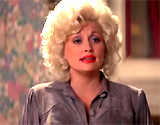
Later, she sang a classic rendition of I Will Always Love You (pictured) as she serenaded local Sheriff Ed Earl (Burt Reynolds). |
|
||||||
|
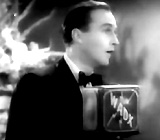
The Big Broadcast (1932) This was the first in a series of Paramount musicals regarding the new medium of radio, in which many of the new radio performers from "Radioland" were brought to the screen for the first time. In this film's score, there were three of the best-known tunes of mellow-voiced Bing Crosby (as Himself):
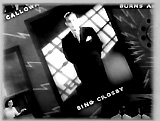
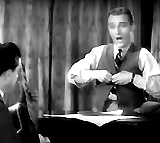
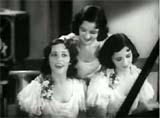
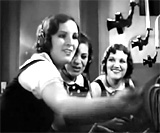
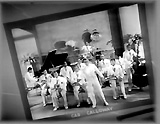
The Boswell Sisters also performed (with a piano) a rendition of the hit song Crazy People (pictured). In the film, they also appeared as three phone operators (pictured). The film also included Cab Calloway's (as Himself) famous performance of Minnie the Moocher (pictured). [Note: Cab Calloway also sang Minnie the Moocher in Fleischer's Betty Boop Talkartoons cartoon of the same name, in 1932.] |
|
||||||
|
The Big Broadcast of 1936 (1935) This basically plotless musical film contained a few memorable song/dance moments, including:
|
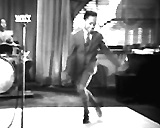 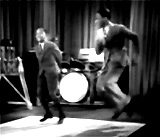 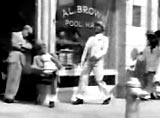 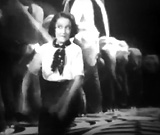
|
||||||
|
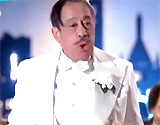
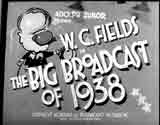
The Big Broadcast of 1938 (1938)
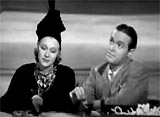
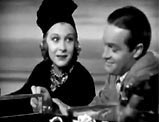
There was one very classic, touching and sentimental song in this madcap musical film - it won the Academy Award for Best Song (the film's sole nomination):
They clinked together their drink glasses as he started to sing, and they continued to alternate the lyrics:
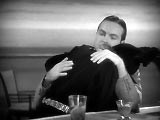
Their singing ended wistfully, as they clinked their glasses together again and sang: "Hooray for us." She asked, still singing: "Strictly entre nous, darling, how are you?" and he replied: "And how are all those little dreams that never did come true?" She responded: "Awfully glad I met you," with his response: "Cheerio, toodle-oo." She collapsed in tears in his arms when they finished. [Note: this was the song that would launch Hope's career and become his famous trademark or signature theme song.] |
|
||||||
|
The Big Chill (1983)
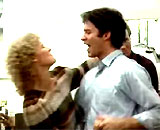
This dramatic film centered around the reunion of aging college friends from the University of Michigan at Ann Arbor, who pondered the subject of death ("the big chill") and loss of idealism during the funeral-weekend of a suicidal friend (an off-screen Kevin Costner). But in one scene, they boogied-danced to the Temptations' Ain't Too Proud to Beg (pictured) spinning on the 33 rpm record player, while cleaning up in the kitchen:
|
|
||||||
|
Blackboard Jungle (1955)
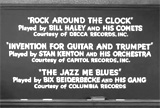
Director Richard Brooks' urban drama about juvenile delinquency was the first Hollywood film to feature a rock-'n'-roll song, Rock Around The Clock (sung by Bill Haley and His Comets during the opening credits) (pictured). The tune was also heard later in the film and during the ending. The film was inspiring to an entire generation of mid-50s teens. It was the first major Hollywood film to use R&R on its soundtrack, in other words, the first major rock and roll musical film. It inspired the next year's popular R & R film, Rock Around the Clock (1956). It was honored with four unrewarded Academy Award nominations: Best Original Screenplay (Brooks), Best Cinematography, Best Art Direction, and Best Film Editing. The gritty film opened with a long scrolling prologue (about the social problem of juvenile delinquency in the schools) accompanied by a lengthy drum solo that led into the song. The social commentary film starred Glenn Ford as Richard Dadier, an idealistic teacher in a slum, inter-racial inner-city school (North Manual Trades High School). One of his rebellious (yet musically-gifted) students was Gregory Miller (Sidney Poitier in one of his earliest roles). |
|
||||||

|
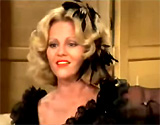
On stage at the Rock Ridge Saloon, saloon singer Lili Von Shtupp (Madeline Kahn) performed an off-key version of I'm Tired (pictured), parodying Marlene Dietrich's Falling in Love Again with a world-weary Germanic, monotoned accent and a lisp. She sang about being tired and having had her fill of sex:
The sultry singer reduced all the men in the audience to fools - in the lyrics, she asked one of the drooling cowboys: "Hello, handsome, is that a ten-gallon hat - or are you just enjoying the show?" [Her line was a variation of one of Mae West's most infamous pronouncements.] To finish her sleepy act, she yawned: "Tired, tired of playing the game. Ain't it a freakin' shame. I'm so...Let's face it. Everything below the waist is ka-put." |
|
||||||
|
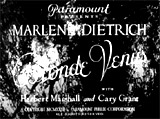
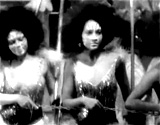
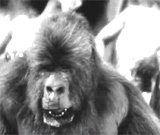
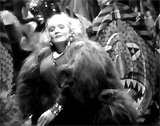
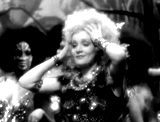
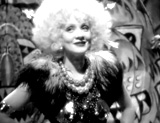
Blonde Venus (1932) Although not a musical, this film was most memorable for Marlene Dietrich's (as Helen Faraday) performance as a German night-club performer to the jazzy beat of an African drum. In the memorable entrance sequence, singer Helen opened the cabaret show by first appearing in a full-body gorilla suit as a chained ape, led into the audience by chorus girls (carrying shields and spears) adorned with war paint on their faces and wearing large black afro wigs. She revealed herself via a striptease. At first, she removed one glove to show off her human hand with bracelets, and then the second glove, followed by the removal of the gorilla head-piece. She placed a blonde Afro wig on her head before singing Hot Voodoo (pictured) in a throaty voice - as she stood with hands on her hips before the chorus line of archetypal 'native' dancers. The lyrics (in part):
|
|
||||||

|
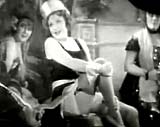
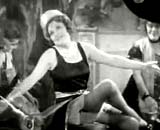
The Blue Angel (1930, Ger.) (aka Der Blaue Engel) In director Josef von Sternberg's film, the legendary Marlene Dietrich in a star-making role - portrayed a sensual, carefree, and carnal top-hatted entertainer named Lola Lola (Marlene Dietrich) at the Blue Angel Cabaret nightclub. In her most memorable scene featuring Dietrich's signature song, she sang a throaty rendition of Falling in Love Again (Can't Help It) (pictured) astride a barrel on stage. She tilted her head to the side, leaned backwards, and grasped one gartered-stockinged leg on bare thighs with her arms:
|
|
||||||
|
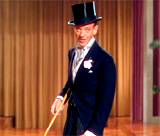
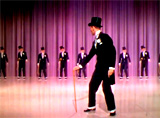
Blue Skies (1946) This Technicolored Paramount production about a love triangle featured Fred Astaire's (as radio broadcaster Jed Potter) famous virtuoso and witty rendition of Puttin' on the Ritz (pictured), with his only prop being his cane (that he used in synchronized conjunction with his rat-a-tat tapping). In one segment of the performance (pictured), he danced in counterpoint with ten miniature Astaires.
|
|
||||||
|
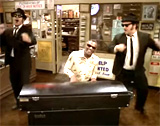
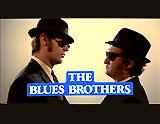
The Blues Brothers (1980) In this anarchic musical comedy, Jake and Elwood Blues (Saturday Night Live alumni John Belushi and Dan Aykroyd) performed on stage:
There were also many other show-stopping performances by R&B and soul singers:
|
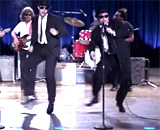 "Everybody Needs Somebody to Love" 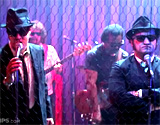 "Rawhide" 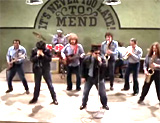 "Jailhouse Rock" |
||||||
|
The Bodyguard (1992)
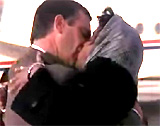
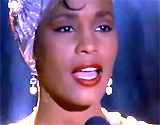
Director Mick Jackson's romantic action-drama-thriller (with a screenplay by Lawrence Kasdan) was later adapted from the film into a 2012 stage musical. There was talk at one time that Rihanna would star in the leading singing role in a film remake. The film was nominated for two Oscars, both music-related (see below). The film's soundtrack became the best-selling soundtrack of all time, selling more than 42 million copies worldwide. Although the film was quite successful at the box-office, it was savaged by critics. [Note: it received seven Golden Raspberry Award nominations (Razzies), including Worst Picture.] It told about an ex-Secret Service agent Frank Farmer (Kevin Costner) serving as a professional bodyguard to pop superstar singer Rachel Marron (Whitney Houston in her acting debut film), to protect her from violent stalkers. The popular version of I Will Always Love You was belted out with romantic feeling by Houston, and reprised in the film's concluding goodbye scene (pictured) - a rotating camera kiss shot at the airport. The film also featured I'm Every Woman and two Oscar-nominated songs (all performed by Houston):
|
|
||||||
|
Born Free (1966, UK/US)
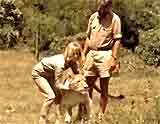
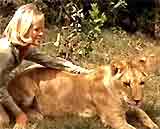
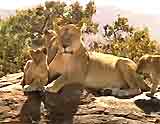
In director James Hill's quasi-documentary, a heartwarming children's/family nature film filmed in Panavision (Technicolor), two Kenyan game wardens George and Joy Adamson (husband and wife Bill Travers and Virginia McKenna) had raised an orphaned cub named Elsa, until she became an adult lion. The dramatic screenplay, written by Lester Cole, was based upon Joy Adamson's non-fiction book "Born Free" published in 1960. In the film's conclusion, Elsa was released into the wild to enjoy a free life after being tested to assure that she could feed herself and survive. The Adamsons returned to Africa a year later, and camped in the same spot, but feared they would never find Elsa again. At the end of their week's stay, they finally located and saw Elsa who approached their campsite with three cubs of her own:
The climactic ending view of Elsa was set to the strains of the Oscar-winning title song and musical score (by John Barry), with lyrics (by Don Black) sung by Matt Monro. |
|
||||||
(alphabetical by film title) Introduction | A-1 | A-2 | B-1 | B-2 | B-3 | C-1 | C-2 | D-1 | D-2 | E | F-1 | F-2 | G-1 | G-2 H-1 | H-2 | I-J | K | L-1 | L-2 | M-1 | M-2 | N-O | P-1 | P-2 | R-1 | R-2 | S-1 | S-2 | S-3 | T | U-V | W | X-Z |





 #
63 "Thanks For the Memory"
#
63 "Thanks For the Memory"  Best
Original Song: Thanks For the Memory
Best
Original Song: Thanks For the Memory