|
|

| M (continued) | ||||||||

|
Monterey Pop (1968) This was the first contemporary music (rock 'n roll concert) industry film. It was filmed at the historic Monterey International Pop Festival in California in 1967, featuring such performers as:
|
  
|
||||||
|
Monty Python and the Holy Grail (1975, UK) This second irreverent Monty Python feature film - from co-directors Terry Gilliam and Terry Jones, skewered religion, medieval epics, the Middle Ages and the Arthurian legend, Camelot and a host of other topics.
After the number was concluded, King Arthur memorably reconsidered and sighed: "Well, on second thought, let's not go to Camelot. It is a silly place." |
|
||||||
|
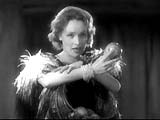
Morocco (1930) This early melodramatic romance with a love triangle featured sultry and bewitching seductress and bewitching singer Amy Jolly's (Marlene Dietrich in her American film debut) famous gender-challenging, cigarette-smoking, tuxedo-clad androgynous cabaret act in Lo Tinto's North African cabaret, set during the Second Moroccan War in the 1920s.
|
|
||||||
|
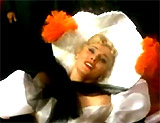
Moulin Rouge (1952) Director John Huston's fictional biopic of French post-impressionistic artist Henri de Toulouse-Lautrec (Jose Ferrer) was set in a "wild, wicked, wonderful" gay nineties Paris. Looking ravishingly and stunningly beautiful, prima donna Jane Avril (Hungarian actress Zsa Zsa Gabor, without any skill in lip-synching or dancing - her singing was dubbed by Muriel Smith) made a grand entrance as she descended a staircase, singing It's April Again (pictured) - subsequently known as The Song from Moulin Rouge (Where Is Your Heart):
|
|
||||||
|
Moulin Rouge! (2001)
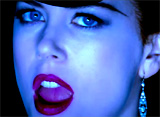
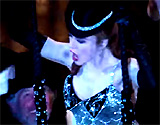
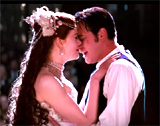
Baz Luhrmann's dazzlingly colorful, whirling and kinetic modern musical with stunning Oscar-winning costuming was set in 1900 Paris, and told a story of tragic love. It was the first Best Picture-nominated musical since Beauty and the Beast (1991) and first non-animated musical nominated since Cabaret (1972). A flashbacked scene introduced the star attraction of the Moulin Rouge cabaret with a feverishly dreamlike can-can musical performance of red-lipped chorine and tuberculosis courtesan Satine (Nicole Kidman) (pictured often)), known as "The Sparkling Diamond." She was perched on a flying trapeze-like swing above an audience of top-hatted gentlemen in cool-blue light and singing a Marilyn-to-Madonna Sparkling Diamonds medley (pictured twice): ("Diamonds Are A Girl's Best Friend" and "Material Girl") while being lowered into the mass of adoring fans. Other songs sung by penniless but lovelorn writer/poet Christian (Ewan McGregor) and Satine included:
There were many other popular rock and soul songs performed by actors and singers, such as:
|
|
||||||

|
Mulan (1998) With only one Oscar nomination for Best Original Musical Score (with five songs integrated into the film from composer Matthew Wilder, lyricist David Zippel, and an orchestral score by Jerry Goldsmith), this Disney animation adventure was derived from a centuries-old Chinese legend about the title character Mulan (voice of Ming Na-Wen, with singing voice of Lea Salonga). She joined the Emperor's army in place of her sick father (voice of Soon-Tek Oh) to fight the invading Huns, by disguising herself as a male with short hair and masculine tendencies. It was noted as having the first Asian female protagonist in an animated feature. Other characters included an ancestral protector - a mini-dragon known as Mushu (voice of Eddie Murphy) and lucky cricket sidekick Cri-Kee. One of the five songs included the rousing anthem:
|

|
||||||
|
The Muppet Movie (1979) and subsequent Muppet films
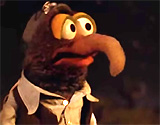
In the opening crane shot of this great children's film during the opening credits, it showed the astonishing and enchanting image of Kermit the Frog (voice of Jim Henson) and told about his origin story. Kermit was found to be sitting on a log in a Mississippi swamp, strumming a banjo and singing the Oscar-nominated The Rainbow Connection (pictured) (with music and lyrics written by Paul Williams and Kenneth Ascher). The song was also reprised by the whole cast of Muppets at the end of the movie. [Note: Williams and Ascher were also nominated for the film's Best Score - both nominations lost.]:
Other highlights included:
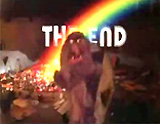
In the climactic Magic Show culminating in a hole being blasted through the roof of the studio set to allow a rainbow to cascade in, the cast reprised The Rainbow Connection (pictured):
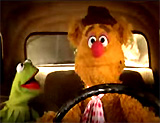
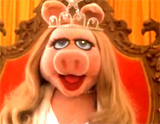
All of the subsequent Muppet films would feature catchy original tunes, such as:
|
|
||||||
|
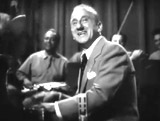
Music for Millions (1944) Billed as a tearjerking "romantic drama of young love," this Henry Koster-directed WWII-era MGM musical featured big-nosed Jimmy Durante (as piano player Andrews). While playing the piano, he led a rousing rendition of Umbriago (pictured twice) for an audience of soldiers. The film ended with real-life conductor and pianist Jose Iturbi's orchestra playing Handel's Messiah (pictured) with the "Hallelujah" chorus. |
 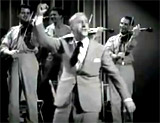 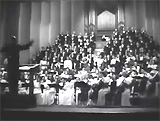
|
||||||
|
The Music Man (1962) Warners' adapted composer Meredith Willson's story/score and the spirited 1957 stage musical into this popular and cheerful production set in 1912 in River City, Iowa, with well-known songs sung mostly by infamous con-man "Professor" Harold Hill (Robert Preston reprising his stage role). Songs and individual/ensemble musical productions included:
|
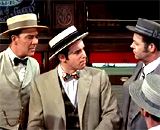 "Rock Island" 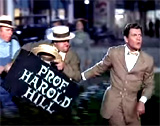 "Ya Got Trouble" 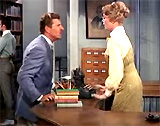 "Marian the Librarian"  "Gary, Indiana" 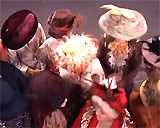 "Pick-a-Little, Talk-a-Little"  "Goodnight, Ladies" |
||||||
|
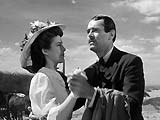
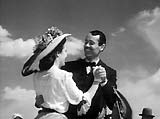
Although this was a John Ford western, it contained one memorable dance sequence in the town of Tombstone to celebrate the half-erected construction of a church a delightful open-air dance. Marshall Wyatt Earp (Henry Fonda) asked schoolmarm Clementine Carter (Cathy Downs): "Oblige me ma'am?" She accepted and as they made their way up to the raised dance floor, everyone was told to part deferentially around them and make way:
Wyatt gracefully whirled her around in a rigid mechanical waltz step, as everyone clapped from an outer circle. |
|
||||||
|
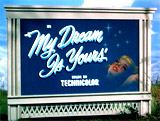
My Dream is Yours (1949) In this Michael Curtiz-directed Warner Bros. musical comedy (a Technicolored remake of the pre-code musical comedy Twenty Million Sweethearts (1934) starring Dick Powell and Ginger Rogers), a young mid-20s Doris Day (in her second film as war widow and aspiring radio singer/star Martha Gibson) starred with Jack Carson (as hot-shot promoter Doug Blake). Doris Day sang the film's highlighted hit (You May Not Be an Angel, But) I'll String Along With You (pictured) to her young blonde-haired son before bedtime, to lull him to sleep. The song was played during the opening credits and often heard throughout the picture. In a nightclub scene, Day also joined in the singing of the title song My Dream Is Yours (pictured twice) with Gary Mitchell (Lee Bowman dubbed by Hal Derwin), and she sang it during a radio appearance (also pictured). Day also sang the delightful songs Someone Like You and Tic, Tic, Tic (pictured) - she referred to the latter song as "that geiger counter song." This film was most notable for its animated dream sequence (directed by Friz Freleng) using Franz Liszt's "Hungarian Rhapsody" as the basis for the Freddy Get Ready sequence (pictured) that combined live action (Day and Carson in rabbit costumes) with an animated Bugs Bunny and Tweety (voice of Mel Blanc). |
 Twenty Million Sweethearts (1934) 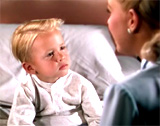  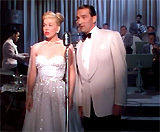 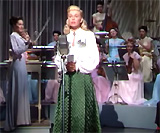 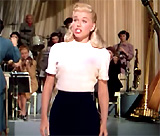 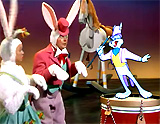
|
||||||

|
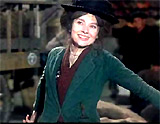
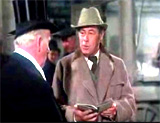
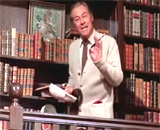
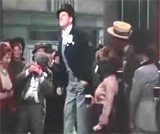
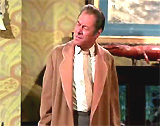
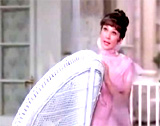
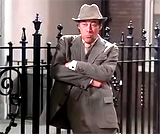
Best Director George Cukor's and Warners' Best Picture-winning screen musical came eight years after the amazing success of the Alan Jay Lerner & Frederick Loewe Broadway play of George Bernard Shaw's Pygmalion. Filmed in 70mm Super Panavision, it told the rags-to-riches story of an incorrigible phonetics instructor - Professor Henry Higgins (Oscar-winning Rex Harrison who performed the Broadway stage show in 1956) - and his bet that he could pass off a street urchin flower seller - Eliza Doolittle (Audrey Hepburn replacing the stage's Julie Andrews, with singing dubbed by Marni Nixon) - as a lady. The many memorable songs set in an idealized Edwardian London included:
Toward the middle of the film, Eliza expressed her bitter, spiteful and vengeful fantasies toward Higgins in Just You Wait (pictured):
One of the musical's best-known songs was Freddy Eynsford-Hill's (Jeremy Brett) ode to Eliza titled On the Street Where You Live (pictured). Eliza also sang back to Freddy the demanding Show Me (pictured):
She also sang the beautifully romantic I Could Have Danced All Night (pictured). A baffled and confused Higgins queried with the misogynistic Why Can't a Woman Be More Like a Man! (pictured), while Eliza claimed she no longer needed Henry and could be independent in her rendition of Without You (pictured), while he sat in a white wicker chair:
One of the loveliest songs in the soundtrack was toward the film's conclusion when Higgins sang I've Grown Accustomed to Her Face (pictured) when he finally (and regretfully) realized his true love for Eliza. |
      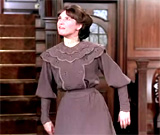 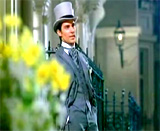 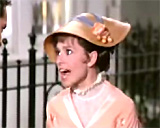 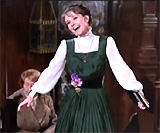   
|
||||||
|
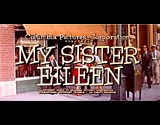
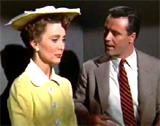
My Sister Eileen (1955) Director Richard Quine's romantic, light-hearted, and witty widescreen Hollywood musical (co-scripted by Quine and Blake Edwards, and with choreography by Bob Fosse) was a remake of the non-musical, black and white comedy My Sister Eileen (1942), starring Rosalind Russell, Janet Blair and Brian Aherne - and both were based upon the Broadway stage hit from 1940. The under-rated and often forgotten musical was surprisingly entertaining. The story was about two sisters from Columbus, Ohio who arrived in NYC's Greenwich Village, rented a brick-wall basement studio apartment (near underground subway blastings that often shook the foundations) - a "concrete catacomb" - and the two planned to seek opportunities:
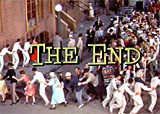
In an extremely inventive musical number "As Soon as They See Eileen," as the sisters changed into pajamas, Ruth felt dejected about life and the lack of attention and dates from men, unlike her sister. Eileen seemed to send men head-over-heels for her. As Ruth made faces in a mirror and applied cold cream, she sang about how Eileen would always turn heads, while others wouldn't pay attention to her: "I'm over twenty with plenty of knowledge, I and my college degree, But I'm frankly annoyed; tell me Dr. Freud, what is the matter with me?" Ruth sought work from Mad Hatter publishing house-magazine editor Robert "Bob" Baker (Jack Lemmon), Ruth's former boss' college roommate. At first, Bob called her stories tragic and unrealistic, and hinted that she was a "frustrated old maid." Meanwhile, Eileen met dreamy-eyed Walgreens soda fountain jerk-manager Frank Lippincott (Bob Fosse) and received emotional support from him after failing at three auditions (and being propositioned on the casting couch). And in "Alley Dance," Frank and newspaperman-reporter Chick Clark (Tommy Rall) performed acrobatically and competitively in the challenge dance outside of a burlesque theatre - as they both vied for Eileen's attention while she was inside. They played tricks with their hats, shuffled their feet, did splits and jumps, leaps and backflips, and kept their steps in synch when dancing together. Chick also executed a perfect triple spin jump! Ruth began to feel dejected that Eileen had lots of male attention (from Chick and Frank), while she was left with no one. To cheer Ruth up, Eileen sang: "There's Nothing Like Love" - extolling love's virtues. Then, she donned a football helmet, a gentleman's jacket and shoes, and promised that Ruth would fall in love with a heroic man. Dressed as a man, she asked Ruth for a dance, and persuaded her that she was attractive too. In the film's best number "Give Me a Band and My Baby" set in an outdoor, empty bandstand, the foursome of Eileen, Ruth, Chick, and Frank pantomimed playing musical instruments, danced and sang. Robert began to romance Ruth when he thought that her mis-adventures and love story escapades about 'My Sister Eileen' were actually about herself. During a dinner date with her at his place, when he gave her a drink, complimented her, and tried to seduce and kiss her, he also sang the musical number: "It's Bigger Than You and Me." She was taken aback and told him to "Slow down, you've got the wrong idea about Eileen." Around the same time in a pleasant love sequence that evening, Eileen found Frank declaring his love for her (he was speaking to her hat perched on a tree branch) - he was outside her apartment in a patio courtyard. In a marvelous dance-and-song love duet, they performed together to a reprise of the song: "There's Nothing Like Love." And in the rollicking conclusion, there was a scene at the dock where wild, white-uniformed Brazilian naval cadets chased after Ruth all the way back to the apartment, where Eileen and Ruth engaged them in dancing the Conga - the commotion caused the police to arrive and put them all in jail. It ended up that Bob was happily united with Ruth (to her great surprise), and Frank with Eileen. The End title screen was seen above a Conga line - the Brazilian navy had arrived to apologize, and the film ended with a crazy dance party enjoyed by everyone. |
|
||||||
(alphabetical by film title) Introduction | A-1 | A-2 | B-1 | B-2 | B-3 | C-1 | C-2 | D-1 | D-2 | E | F-1 | F-2 | G-1 | G-2 H-1 | H-2 | I-J | K | L-1 | L-2 | M-1 | M-2 | N-O | P-1 | P-2 | R-1 | R-2 | S-1 | S-2 | S-3 | T | U-V | W | X-Z |





 #
85 "Come What May"
#
85 "Come What May"