|
of Robots in the Movies Early Years to 1939 |

First Robots - in Literature
|
||||||||
The Mechanical Statue and the Ingenious Servant (1907)
(Survival status unknown, although a Vitagraph paper print extract or fragment is reported to exist) This very early, Vitagraph one-reel (or half-reel) film from director J. Stuart Blackton, was the first American film with 'robot' predecessors - called mechanical men (also known as automatons). In the slapstick comedic story, a sculptor had hand-built a "mechanical statue" which danced when wound up. It was bought by a customer who took it home. There, a house-servant started it up, but the statue ran away. The "ingenious" servant was able to deceive the master of the house, pretending to be the 'mechanical' robot. |
||||||||
|
The Fairylogue and Radio-Plays (1908)
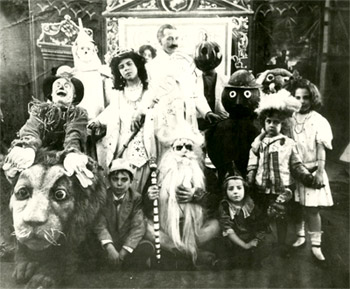
Tik-Tok first appeared in film in The Fairylogue and Radio-Plays (1908), presented in Baum's live travelogue stage presentation (with Tik-Tok - The Machine Man, portrayed by Wallace Illington). The multi-media presentation was a mix of live-action, hand-tinted 'magic lantern' slides, film, and Baum's own narration.
|
|||||||
 Homunculus (1916, Germ.) (in six parts) 
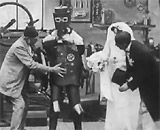
A Clever Dummy (1917) |
Early 'Robot' Films in the Silent Era In many cases in these early 'robot' films, the automatons (or automated thinking machines, often functioning as robots or servants) could prove to be dangerous or deadly after running amok, as in Frankenstein (1931). Early depictions of "mechanical men" included these short films (often comedies and usually one-reel) - sometimes reflecting the encroachment of machinery and the increasing fear of industrialization:
|
 The Automatic Motorist (1911, UK) 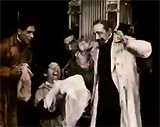 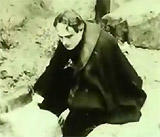 Homunculus (1916, Ger.) 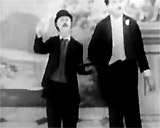 A Clever Dummy (1917) |
||||||
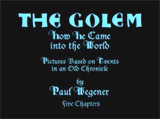 The Golem (1920, Germ.) (aka Der Golem, wie er in die Welt kam) 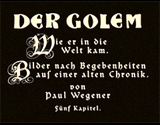 Der Golem (1920, Germ.) (aka wie er in die Welt kam) |
The Golem (1920, Ger.) (aka Der Golem)
Paul Wegener directed three influential adaptations of the Golem legend by Gustav Meyrinck:
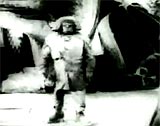
The first expressionistic film was based upon Central European myths and influenced later 'Frankenstein' monster films in the early 1930s with themes of a creator losing control of his creation. The Golem, played by Wegener himself, was an ancient clay figure from Hebrew mythology that was brought to life by Rabbi Loew's magic amulet to defend and save the Jews in 16th century Prague from a pogrom threatened by Rudolf II of Habsburg. The giant man-made, clay creature roamed and lumbered through the Jewish ghetto of medieval Prague to protect it from persecution. |
|
||||||
|
The Master Mystery (1919 or 1920) (aka The Houdini Serial, and Le Maitre du Mystere)
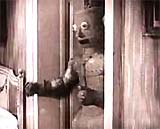
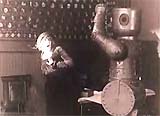
Director Burton King's and Harry Grossman's independently-produced serial (with 15 episodes, some of which are lost) was made by Studio Pathe in France. It starred magician and trick escapist artist Harry Houdini as heroic Justice Department/secret service agent Quentin Locke who battled a threatening and criminal international cartel/corporation (the Patent Company). The serial featured a huge, mechanical, evil robot named Q or The Automaton (Floyd Buckley), the cartel's protective robot-servant. The criminal mastermind had a goofy-looking face and a barrel-shaped pelvis. Houdini exposed the robot as a human in disguise. This film had one of the earliest (if not the first) on-screen theatrical representation of a traditional robot. |
|
||||||
|
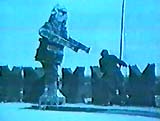
The Mechanical Man (1921, It.) (aka L’Uomo Meccanico)
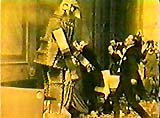
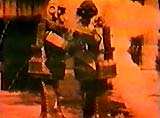
Writer/director Andre Deed's short silent film (only parts of which survive, in a fragmented form - in total, about a third of the original 80 minutes in length) featured a giant, super-powered, 9-10 foot-tall, colossal evil "mechanical" robot, designed to commit robberies and create mayhem. It was programmed and remotely-controlled by evil villainess adventuress Mado (Valentina Frascaroli) to cause severe damage with its fiery, acetylene blow-torch hands and its massive bulk. The lumbering robot had headlights for eyes, and had the capability of running at high speed. The film's finale featured a climactic battle at a masked ball in the Opera House between the first monstrous robot and a second mechanical robot, specifically created (with similar specifications) to destroy the first one. |
|
||||||
|
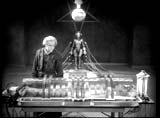
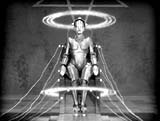
This future dystopic silent film from director Fritz Lang featured one of the earliest robots (and also female!), a great iconic image. At the time, most robots were either asexual or male. The story was set in the year 2026 in the city of Metropolis. The luxurious, futuristic, Art Deco city - an industrial world with skyscrapers and bridges, was divided or stratified into an upper, elite, privileged class of powerful industrialists and a subterranean, nameless, oppressed and exploited, ant-like worker/slave class. An elite, privileged ruling technocracy, led by Joh Fredersen (Alfred Abel), was run on the back-breaking labor of underground masses of toiling workers who ran the machines. The children were cared for by the beautiful heroine Maria (Brigitte Helm), who brought them to a forbidden artificial grotto of the ruling class. There, her beauty overwhelmed Freder (Gustav Frohlich), the son of the ruler of Metropolis, and he fell in love with her. When he went searching for her, he became appalled by the horrors of the working world and the waste of life. After discovering the workers' clandestine meeting led by Maria, Freder's controlling, glacial father conspired with archetypal mad scientist Rotwang (Rudolf Klein-Rogge) to create an evil, robotic Maria look-alike duplicate (explicitly created to replace a specific human), in order to manipulate his workers and preach riot and rebellion. The Art Deco-styled female robot (also Brigitte Helm) was constructed and brought to life by Rotwang as a metal android (later inspiring Star Wars' C-3PO). It was supposed to resemble the dead wife of the city’s ruler. Rotwang had kidnapped the virtuous and compassionate union leader heroine Maria, and created an evil doppelganger of her in his laboratory - in a stunning transformation scene in which he copied Maria's face and body onto the metal surface of the robot. She was to deceptively become an evil, seductive and sadistic version of Maria. The robot had a fully-armored head, with slits for eyes and mouth, sculpted shoulders, as well as a mechanically-jointed body with armor-like coverings on the legs and feet. The android was created in order to discredit the real Maria by - among other things, performing lascivious, erotic dances to a frenzied male audience to incite them to riot (as part of the aristocracy's plan to brutally subdue them). |
|
||||||

|
Der Herr Der Welt (1934, Germ.) (aka Master of the World)
Prolific director Harry Piel's fourth science-fiction film (of a quartet of science fiction films) was a tale about robots created to take the place of human labor, but also posing a potential threat of taking over the world. Robot inventor, machine manufacturer and scientist Dr. Erich Heller (Walter Janssen) and handsome mining engineer Werner Baumann (Siegfried Schürenberg) discussed a futuristic world where robotic machines would liberate mankind from hard labor or dangerous occupations (such as mining). In his work, Heller was assisted by Professor Wolf (Walter Franck), a demented and crazed colleague who had completed work on a giant robot (equipped with death rays) in Heller's long absence. While confronting Wolf with overstepping his authority, Heller ordered the entire project to be dismantled, and was 'accidentally' killed by the robot under Wolf's control. Soon after, Wolf's evil plan was to displace mine workers with a vast army of killer robots, thus leaving the laborers unemployed. In fact, the robots were attacking the mine workers who tried to get their jobs back. Baumann had warned Wolf that the workers would revolt if they lost their jobs, although Wolf's evil plan was to crush any revolts with his 'war machines' and achieve world domination ("master of the world"). In a climactic scene in the laboratory, there was a stand-off between Baumann, now in love with Vilma (Sybille Schmitz) - the widow of Dr. Heller and rightful owner of her dead husband's company, and Wolf, who ordered his giant robot to attack Baumann. Wolf was assaulted and killed by his own machine when he was caught in the cross-fire of death rays (looking like static electricity bolts). The lab and the robot were destroyed in an explosion. |
Giant Robot |
||||||
|
Flash Gordon (1936) (aka Space Soldiers)
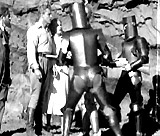
In this popular 13-part serial, blonde polo player Flash Gordon (Larry 'Buster' Crabbe) and Dale Arden (Jean Rogers) joined up with Dr. Zarkov (Frank Shannon) on his home-made rocketship and went to the planet Mongo. There, they confronted the evil ruling emperor, Ming the Merciless (Charles Middleton), with pretty daughter Princess Aura (Priscilla Lawson). At the time, the planet Mongo was on a collision course with Earth. Zarkov was able to persuade Ming to stop Mongo's destructive path, although the tyrannical Ming then decided to take over Earth himself - and abduct Dale for himself. In the first chapter, Flash, Dale, and Zarkov were taken prisoner by Officer Torch and two helmeted, mechanized robotic guards, known as "Annihilants". Ming's deadly army was composed of these mechanical robotic soldiers with scientifically-advanced rifles. When they went outside, the guards appeared to be wearing some kind of undergarment under their armored suits.
|
Armor-Suited Robots 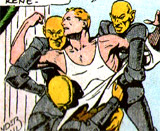
|
||||||
|
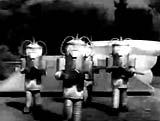
Undersea Kingdom (1936)
This early action-packed Republic Pictures serial (with twelve episodes or chapters) was produced in haste to compete with Universal's Flash Gordon (1936) serials. It starred naval action hero Lt. Ray "Crash" Corrigan (Ray Corrigan) and featured the lost city of Atlantis at the bottom of the sea. Trash can-like robot soldiers with zap rays guns (Atomguns) called Volkites were commanded by warlord Unga Khan (Monte Blue), the evil tyrannical ruler of the Black Robes and remote-controlled by his equally-evil henchman Captain Hakur (Lon Chaney, Jr.). The Volkites were used to attack the sacred city of Atlantis. |
|
||||||
|
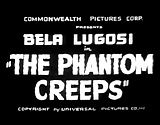
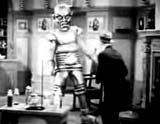
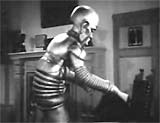
The Phantom Creeps (1939)
Universal's 12-part serial titled The Phantom Creeps, was advertised as having: 12 Spine-Shivering Action Chapters. This was the last serial for Bela Lugosi who starred as mad scientist Dr. Alex Zorka intent on taking over the world. He invented a fearsome, slow-moving 8-foot golem-like iron monster or robot that he referred to as "his iron man" (played by 7'4" tall stuntman Ed Wolff), featuring a sculpted round human-like head. The super-strong robot was remote-controlled, designed to "crush all opposition and make me the most powerful man in the world" - according to Dr. Zorka. |
|
||||||
|
In this beloved musical fantasy film, the Tin Man (Jack Haley) (aka The Tin Woodman in L. Frank Baum's original book) was one of the fanciful characters in the Wonderful Land of Oz. In fact in the novel, however, the Tin Woodman was originally born human as Nick Chopper, but because of many accidents with his own axe, he was forced to replace all of his body parts and limbs with tin - becoming a cyborg! He was a silver-faced, funnel-capped robot who joined Dorothy (Judy Garland) on her journey to Oz' Wizard in the Emerald City to request a heart to fill his hollow chest ("The tinsmith forgot to give me a heart" and "If I only had a heart..."). He was first found rusted immobile from moisture and needed to be oiled to begin moving again. Others who played the Tin Man in film include:
|
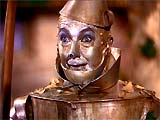
The Tin Woodman (Jack Haley) |
||||||




 The
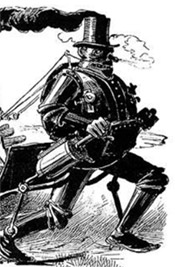
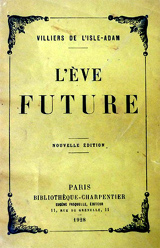
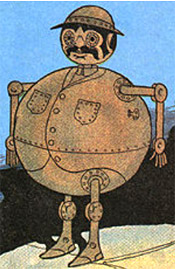
Steam Man, Hadaly, and Tik-Tok
The
Steam Man, Hadaly, and Tik-Tok