|
A Complete Illustrated History of Robots in the Movies 1940 to 1955 |

|
Mysterious Doctor Satan (1940) (aka Doctor Satan's Robot)
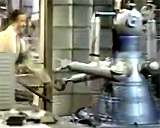
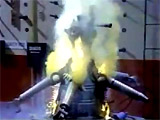
Director William Witney's sci-fi thriller, a Republic Pictures serial of 15 episodes, featured a steel "killer" robot (Tom Steele). It was the creation of mad, megalomaniac scientist Doctor Satan (Edward Cianelli). His desire was to rule the world with an army of deadly killer robots. Doctor Satan was opposed by a masked man known as The Copperhead (actually Bob Wayne (Robert Wilcox)), who was seeking revenge for the death of his step-father. The mechanical humanoid was a boxy and bulky robot that lumbered around - basically an elongated tin can (or hot water boiler) with arms extending off square-cut shoulders. The Republic Pictures serial was later re-released in full-length as a TV film in 1966, and renamed Doctor Satan's Robot. [Note: These robots were recycled and
updated from Undersea
Kingdom (1936) |
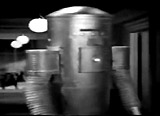 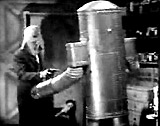
"Killer" Robot |
||||||

|
Man Made Monster (1941) (aka The Atomic Monster)
This little-known and obscure low-budget Universal horror (and sci-fi) film from writer/director George Waggner was about a man tragically turned into a monster - reminiscent of the cycle of Frankenstein films. Affable and naive blue collar worker Dan McCormick (Lon Chaney, Jr., in his first horror film, pre-The Wolf Man (1941)) was the sole survivor of a passenger bus crash that electrocuted all of the other passengers when it plowed into an electrical tower. Dan was a sideshow performer known as "Dynamo Dan, the Electric Man" in a local carnival where he pretended to 'absorb' electricity. Kind-hearted, ethical scientist Dr. John Lawrence (Samuel Hinds) and his disturbed mad partner Dr. Paul Rigas (Lionel Atwill) were intrigued that Dan survived a potentially fatal electrocution, presumably due to his immunity or built-up resistance to electricity. Rigas believed that he could test his theories in human electro-biology on Dan. During bizarre experiments to harness electricity's power in Lawrence's lab in his Gothic estate complex known as The Moors, Rigas ran higher and higher doses of electricity through Dan's body to increase his strength - temporarily. The effect was like a powerful drug - Dan's tolerance was increased and made him into an addicted 'electric junkie.' To make the effect even more permanent, Rigas increased the dosage of electricity - but transformed Dan into an electro-biological man-creature hybrid - an electrical zombie or superman requiring constant bolts of electricity to survive. Dan had also become a mindless and brutish creature without free will - a servant to do Rigas' murderous bidding. A rubber suit (with gloves) was constructed for Dan to wear when fully charged, to conserve and stop electrical leakage, insulate him and retain his strength, and to prevent Dan from accidentally touching someone and electrocuting them. Rigas’ crazed egotistical idea and motive behind it all was to create a new race of supercharged electro-zombies or cyborgs controlled and enslaved to him ("There you are, not Dan McCormick, but something I created, obeying my will! I can give you life, or take it from you...Look, there he stands, the shell of a man electrically alive. Every impulse controlled by me"). Rigas admitted to Lawrence that he was indeed "mad" and had "conquered destiny." He boasted about his marvelous discovery, although it had taken the life away from McCormick:
Threatened when colleague Dr. Lawrence threatened to call the police and report that Rigas had "destroyed a human being", Rigas ordered Dan to kill his partner ("Stop him!"). Dan was ordered to confess to the homicide, and subsequently, Dan was subjected to the electric chair (which didn't harm him, but only supercharged him). Dan then murdered the prison warden and the guards and escaped into the countryside to terrorize the local population. In the film's conclusion, Dan rescued Lawrence's heroine daughter June (Anne Nagel) from Rigas, then killed his own creator, and lost his own life when his rubber suit became entangled in barbed wire, and the electricity leaked out into the steel wires and instantly killed him. |
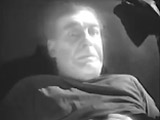 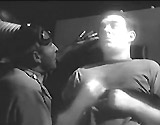 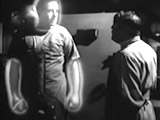 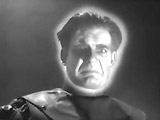 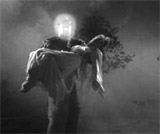 "Dynamo Dan" |
||||||
|
"The Mechanical Monsters" (1941) (Superman short animated cartoon)
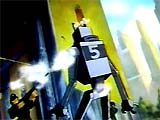
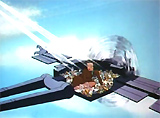
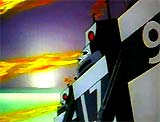
The Fleischer Brothers created this 10 minute-long animated short film (for Paramount Studios), titled "The Mechanical Monsters." It was the second of seventeen Technicolored Superman cartoons released in the early 1940s. It told about a group of giant robots (created by a mad scientist) with flamethrowers in their heads that were attacking the metropolis of Gotham City. They were equipped with a propeller and were able to fly, and the body of the robot was big enough to hold a man (seen with Superman's X-ray vision). After robbing a bank and a jewelry exhibit (with $50 million dollars worth of the "world's rarest gems"), one of the robots abducted Lois Lane (voice of Joan Alexander) - forcing Clark Kent/Superman (voice of Bud Collyer) to come to the rescue. Superman entered the lair of the mustached villain, where he was confronted by the army of multiple robots who attacked with their flamethrowers and beat him down. He counter-attacked, smashed the mechanical monsters, saved Lois from being splashed by molten metal, and brought the villain to justice. The headlines and story (by Lois Lane) in the Daily Planet read: "Superman Destroys Mechanical Monsters - Inventor Jailed, Millions in Stolen Jewels Recovered." |
|
||||||

|
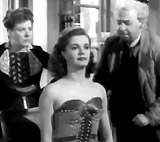
The Perfect Woman (1949, UK)
This amusing, sometimes humorous, politically-incorrect British farce (based on a 1948 play by Wallace Geoffrey and Basil Mitchell) was directed by Bernard Knowles. The sci-fi romantic comedy (a strange hybrid) was a version of American 'screwball' comedy, about the ultimate remote-controlled 'perfect robot' - and robot impersonation. Dotty old inventor, absent-minded Professor Ernest Belman (Miles Malleson) had created a "perfect woman" robot, named Olga (Pamela Devis), made to resemble his pretty young niece Penelope (Patricia Roc). A panel on the back of the synthetic robot opened to reveal gears, circuitry, and inner workings. He boasted about his unique, synthetic robot to housekeeper Mrs. Butters (Irene Handl), comparing the robot favorably to Penelope - who was only one of millions of flesh-and-blood females:
He demonstrated how the robot promptly responded to his explicit direct commands: "Head right, head left, head up."
At one point, Penelope asked her uncle about being the model for the robot:
Penniless aging playboy Roger Cavendish (Nigel Patrick) and his valet Ramshead (Stanley Holloway) were hired by the inventor to escort Olga, the "perfect woman" robot, for a night on the town - as a test run, before he presented Olga to a group of scientists. Roger had asked why Belman called Olga the 'perfect' woman, and was told: "Well, she does exactly what she's told. She can't talk. She can't eat. And you can leave her switched off under a dust sheet for weeks at a time." It turned out during the evening that playful Penelope - to amuse herself - was actually secretly impersonating the artificial woman Olga. The group ended up in the bridal suite at the fashionable Hotel Splendide. False rumors that Roger was getting married soon reached his aunt, Lady Mary (Philippa Gill), who returned immediately from Paris to stop the proceedings. The farce escalated to the point where Roger and Penelope realized that they loved each other. Their mutual declaration sent Olga crazy - (she was programmed to go haywire if she heard the word 'love') and she self-destructively blew up - destroying part of the hotel and herself. |
 Penelope Belman (Patricia Roc) 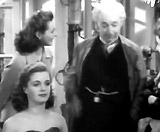 (l to r): Olga, Penelope, Professor Belman |
||||||
 
|
The Day The Earth Stood Still
(1951)
Director Robert Wise's seminal science fiction film in motion picture history contained an anti-nuclear war message during the Cold War. It featured a giant, nine-foot tall, all-powerful, mighty, menacing and massive metallic robot companion-protector named Gort (Lock Martin), with a featureless face dissected by an opening visor, smooth metallic surface, straight legs (without knee joints), boots for shoes, and fixed mitten-styled hands (without joints or fingers). The robot did not talk. Gort was a prototypical Terminator and Robocop character and similar to the Tin Woodsman in The Wizard of Oz (1939). Gort's origin was as a green robot named Gnut in Harry Bates' 1940 short story Farewell to the Master - unlike the film, in the short story, Gnut was "the master." After a huge flying saucer landed on the Ellipse (President's Park) in Washington, DC in 1951, a benevolent, humanoid, interplanetary alien visitor named Klaatu (Michael Rennie) who was seeking peace emerged down a ramp, followed to everyone's amazement by silent, killer bodyguard Gort - who had the ability to zap (vaporize or melt) weapons or tanks with a lethal, disintegration laser beam heat-ray behind his sliding visor. The robot, an interstellar guardian - a member of a police force, had the power to destroy worlds such as Earth, whose inhabitants were intent on destruction, aggression, and hostility. However, his main objective was to warn Earth to establish peace - and to demonstrate his power, he shut down the world's power supply (hence, the film's title "The Day the Earth Stood Still"). One of the most famous 3-word phrases in science fiction history was recited by single mother/widow Helen Benson (Patricia Neal) to stop Gort's destructive rampage when Klaatu was killed: "Gort, Klaatu barada nikto." The film ended with the alien visitor's resurrection and a warning-proclamation as an ultimatum for disarmament:
In the film's 2008 remake with Keanu Reeves (as Klaatu) and Jennifer Connelly (as Helen Benson), the spaceship landed in New York's Central Park, with the theme of ecological damage rather than nuclear war. Gort was portrayed with the magic of CGI, and was about 28 feet tall, with five-fingered hands (but feet without digits). He was without a visor, but still possessed the trademark eye-beam that could project destructive forces. Gort's composition was of microscopic insect-like devices ('nano-machines') or bugs that could swarm around an object and completely disintegrate it. |
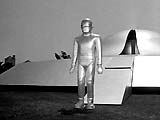 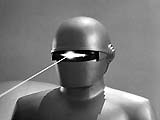 Gort 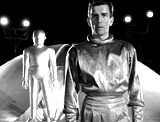 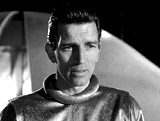 Klaatu  The 2008 Remake |
||||||
|
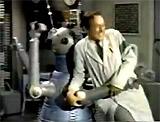
Mother Riley Meets the Vampire (1952, UK) (aka My Son, the Vampire, and Vampire Over London)
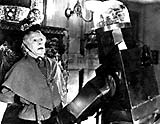
In this awful B-movie vampire satire and horror comedy (the last in a long-running series of Mother Riley films), Central European mad scientist Von Housen (Bela Lugosi), known as the "Vampire" and intent on world domination, created a uranium-powered, 6 foot-tall slave robot named Mark 1. Robot Mark 1 was ordered to kidnap Irish grocery store owner and washerwoman Mother Riley (Arthur Lucan in drag costume) and bring her to Von Housen's mansion. Von Housen's intent was to build an army of 50,000 robots, but he had only completed one robot due to the scarcity of uranium to power them. In one of the film's more memorable scenes, Mother Riley wrestled the robot and dismantled it, to come to the rescue. |
|
||||||
|
Robot Monster (1953)
Although this was one of the worst, poorly-edited, and incompetent evil robot, sci-fi B films ever made (and available in 3-D), the awful film also had an old-fashioned, endearing quality to it. It was released at the same time as Invaders From Mars (1953), with similar plot points. In this alien-invasion film, evil Moon robot, Ro-Man Extension XJ-2 (George Barrows, voice of John Brown) - a seven foot tall, alien race robot, resembled a man wearing a gorilla suit/outfit with an antique diving helmet. He was equipped with a deadly weapon called a Calcinator Death Ray and was sent to Earth from the Moon. He was being directed by his creator and alien leader The Great Guidance (George Barrows again) to destroy Earth's inhabitants. After committing mass genocide of the entire human race, there were only eight surviving humans who were immune to the ray due to an antibiotic serum. They included:
Ro-Man began to kill off the survivors. He first killed the two pilots, then strangled Carla, and threw Roy (newly married to Alice) off a cliff to his death. But he had fallen - illogically - in love with Alice and tried to abduct her. Ro-Man wanted to be Hu-Man, and his desires for Alice caused conflict with The Great Guidance who had other plans: "Fact: You have captured the girl and not destroyed her. Fact: You have delayed accepting the surrender of the others. This verges on failure." Thinking for himself (like humans) and rejecting the original plan, Ro-Man suggested his own plan as he complained: "Yes, to be like the Hu-Man, to laugh, feel, want, why are these things not in the plan?" Disobedient servant Ro-Man, who would not destroy the girl or the family, was killed by zapping, after which the Great Guidance teleported to Earth to finish the job with deadly Q-rays. The Great Guidance released prehistoric reptiles (to devour any remains of life) and a massive earthquake that split the Earth open (mostly recycled footage from One Million B.C. (1940)). But then it was all revealed that Johnny had suffered a forehead concussion, and the entire story was his fever-dream or nightmare ("Boy, was that a dream, or was it?"). Alice told Johnny that he should stop overdoing it with his belief in space-robots: "You're overdoing this space-man act. There simply aren't any such things." But as they left the cave opening, the "dream" started again (reminiscent of the plotline of the similar Invaders From Mars (1953)). Electrical flashes revealed the ghostly apparition of Ro-Man, who lumbered menacingly out of a cave towards the camera -- repeated three times! |
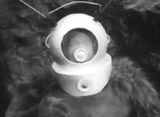 Ro-Man 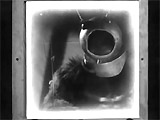 Great Guidance 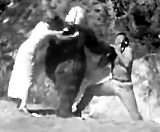 Death of Roy 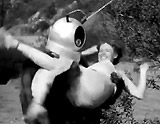 Ro-Man Kidnapping Alice 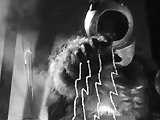 Great Guidance Zapping Ro-Man 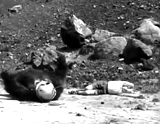 Ro-Man Zapped, With Johnny on Ground 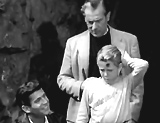 Johnny: "Boy, was that a dream or was it?" 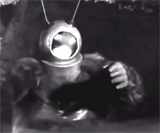 Ro-Man's Triple Appearance at End |
||||||

|
Devil Girl From Mars (1954, UK)
David MacDonald's low-budget, campy sci-fi alien invader film was taglined: "Invasion from Outer Space!...Sights too weird to imagine! Destruction too monstrous to escape!" The robot in this film was obviously an imitation of Gort from The Day the Earth Stood Still (1951), with alien companion Nyah easily comparable to Gort's partner Klaatu. A cross-section of various stock characters were assembled at The Bonnie Charlie inn in the remote Scottish Highlands or moors:
The film's action began with the landing of a spinning and glowing Martian spaceship outside the inn. Emerging from the flying saucer were:
The haughty and statuesque Nyah announced to the 'puny earthlings' that she was there to search for male breeding stock, since Mars (after a battle of the sexes) was depleted of males. She warned: "Around this house, I've drawn an invisible wall, through which no one may pass." Nyah selected Michael Carter as the perfect specimen to return with her to her male-deprived home planet. In a self-sacrificial decision, however, Justin volunteered to be the one male to accompany Nyah back to Mars - although his plan was to sabotage Nyah's flying saucer after take-off to save the others. The clumsy robot was remote-controlled and was able to vaporize-destroy a tree, old truck, and barn shed with its disintegrating death ray-beam. |
 Martian Spacecraft   Nyah (Patricia Laffan)  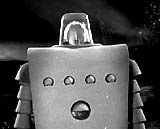 Chani |
||||||
|
Gog (1954) (aka GOG)
This Ivan Tors-produced Cold War-era B-movie was designed for Saturday matinees and released in wide-screen color and 3-D. It differed from many 50's era sci-fi films in that it was grounded in scientific fact. However, the film's sensationalized tagline described the mechanical robots, resembling Daleks:
In a top-secret underground space research base in the New Mexico desert, Dr. Van Ness (Herbert Marshall) was leading a group studying induced space-travel hibernation, in competition with the Soviet Union. When there were unexplained lethal malfunctions, an agent from the DC Office of Scientific Investigation (OSI), Dr. David Sheppard (Richard Egan) was sent in to investigate, working with another undercover agent Joanna Merritt (Constance Dowling), the project director's aide. It appeared that the facility's super-computer, known as "The Brain" and dubbed NOVAC, or Nuclear Operated Variable Automatic Computer, was being sabotaged and test subjects and scientists were dying (victims were locked and frozen in an experimental cryogenics chamber, and sped at lethal speeds in a rotating centrifuge). One of the suspicious scientists (the film's red-herring) was Dr. Zeitman (John Wengraf), a German expatriate who designed NOVAC and spent five years assembling it in Switzerland. During the study of the case, Sheppard determined that NOVAC (equipped during its construction with a powerful radio transmitter and receiver, similar to spyware) was being compromised and controlled by enemy agents through high-frequency radio waves beamed down by a strange, circling-overhead spy plane (an enemy robotic plane controlled by the Soviets?).
In addition, two twin six-armed experimental, mobile robots (with gripping tools on their arms) under the control of the murderous NOVAC, with Biblical names Gog and Magog, had run amok. The robots had been reprogrammed to kill. Sheppard prevented Magog from initiating a nuclear chain reaction by burning it with a flamethrower, although Gog arrived to further the attack, just as the Air Force neutralized the spy plane by shooting it out of the sky. Gog's arms flailed for a few seconds before it went dead. |
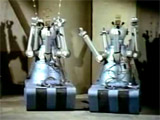 Gog and Magog 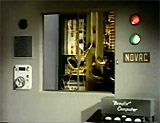 NOVAC Super-Computer |
||||||

|
Target Earth (1954)
The plot of this alien-invasion B-movie was based on the 1953 science fiction short story "Deadly City" by Paul W. Fairman. Its tagline promoted the film's horror: "You'll be paralyzed with fear!" Although it was supposedly about an alien invading 'robot army' that had targeted Earth, there was only one robot visible in the entire film. A few survivors woke to find themselves in a suddenly-deserted and evacuated Chicago (the trailer described that they were "alone with death in a strangely deserted city"). They included:
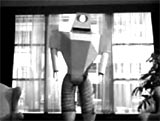
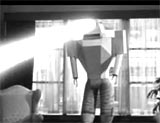
All of them had been overlooked and left behind during a massive evacuation. And then about 30 minutes into the film, they discovered the unknown threat that had caused their dilemma - a report of an invading 'Mystery Army' of robotic aliens from the planet of Venus. They encountered one of the clunky Venutian robots (an uncredited Steve Calvert), described as a mechanical creature made of surgical steel. It had a slimming triangular body, flexible tube legs, metal boots, pincers on a pair of solid tube arms, and a trapezoidal head (with a CRT screen). It was capable of blasting a whitish beam or death ray from its single eye. Reportedly, the Venutians had established a beachhead north of the city to prepare for an invasion. Scientists and military officials planned on capturing one of the robots in order to analyze it and understand its weaknesses. |
  Venutian Robot |
||||||
|
Tobor the Great (1954)
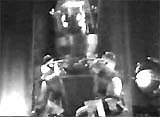
Originally, Tobor was a fictional robotic character that appeared semi-regularly on the science-fiction TV series Captain Video and His Video Rangers (1949-1955). Tobor was 9 feet tall - with a stenciled "Robot 1" sign on his chest - backwards it read: "I Tobor." Tobor was Robot spelled backwards. Due to the way the robot moved, it soon became a parody of the Frankenstein monster. This typical 50's sci-fi adventure B-movie from Republic Pictures, designed for young audiences, was about enemy Iron-Curtain Communist agents with a dastardly plan to steal a robot (already befriended by a young boy) and use it for their own evil purposes against the US. Tobor (uncredited Lew Smith) was a clunky, lumbering, nine-foot tall robot spaceman. The robot was designed to be a space astronaut to function as a substitute for human astronauts exploring deep space. Tobor had elevated boots for shoes, pointed lighted eyes, a glassy enclosed head, and a Tin-Man like body. Tobor could sense and be controlled by telepathic human brain-waves (ESP) as well as by a remote-control device, and possessed a complex brain and artificial personality (and was endowed with emotions). The imposing robot was invented by space agency scientist Professor Arnold Nordstrom (Taylor Holmes), assisted by Dr. Ralph Harrison (Charles Drake), who worked in an underground lab in Los Angeles. Nordstrom was the genial grandfather of 11 year-old grandson - boy genius Brian "Gadge" Robertson (Billy Chapin). After the secret plans for Tobor were intercepted by a foreign (Communist) spy-chief (Steven Geray) during a press conference, both the boy and Nordstrom were kidnapped. Fortunately, Tobor was mind-linked to his creator (via a fountain-pen transmitter) and could not be easily reprogrammed. Tobor came to their rescue, and in the process, stole a military Jeep! |
 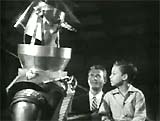 Tobor the Great 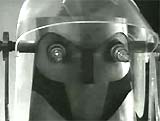 Tobor's Head 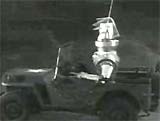
Tobor in a Jeep! |
||||||




 "Killer"
Robot
"Killer"
Robot