|
of Robots in the Movies 1956 - 1963 |


|
MGM's lavish and colorful science-fiction film featured the first celebrity robot - a legendary, classic movie robot named Robby the Robot (Frankie Darro, voice by Marvin Miller) (with its first appearance in a film) designed by Robert Kinoshita. Robby had a cone-shaped, clear-domed and jukebox-like head (with twirling lights and rotating motorized antenna ears), a lighted chest panel, gripping hands (with thumb and two fingers), bulbous segmented legs, and a pot-belly stove-shaped body. Robby stood at 7' 6" tall, and had a charming, often smug sense of humor (for example: "Quiet please. I am analyzing" and his excuse for being late: "Sorry, miss, I was giving myself an oil-job"). Robby was language-fluent - he could speak English and "187 other languages along with their various dialects and sub-tongues." Robby was also very domesticated as a butler (chauffering, cooking, cleaning, and performing heavy lifting tasks). Incapable of harming anyone although possessing superhuman strength, Robby short-circuited when commanded to shoot Commander Adams (Leslie Nielsen) by owner Dr. Morbius (Walter Pidgeon), although Robby was inconsistently portrayed as threatening in the film's poster. The film told the story of a journey by astronauts of United Planets Cruiser C-57D to a distant planet named Altair-IV, where they investigated the fate of a colony planted 20 years before. The studio-bound film inspired the look of many future films and works, notably TV's Star Trek by Gene Roddenberry and Star Wars creator George Lucas. It was shot in Cinemascope and color, and re-worked Shakespeare's The Tempest and has been psychoanalyzed as a dramatization of repressed sexual desires. The film has been best-remembered for Walter Pidgeon as Dr. Morbius (the Prospero figure) on a tour of the ill-fated Krell laboratories, with his pretty 19 year-old daughter Altaira (Anne Francis as the Miranda character who had never seen men). The Tempest's Ariel figure was represented by creator Morbius' lumbering Robby the Robot, built from plans left in an alien computer system. In one unintentionally funny scene, a ship's crew-member stupidly asked Robby a question: "Er, no offense, but you are a robot, aren't you?" As only a movie prop, it was unusual for Robby to be featured with star billing alongside other actors! [Note: Robby was reprised in various cameos and appearances, such as his appearance as the suspected murderer in the TV series The Thin Man in 1958, in The Gale Storm Show in 1958, in Hazel in 1962, in Rod Serling's TV series The Twilight Zone in 1963-64, and as the prototype for Robot B-9 in the TV show Lost in Space in 1966-67. Also in The Addams Family as Smiley in 1966, in The Man From U.N.C.L.E. in 1966, in Columbo in 1974, and in Mork and Mindy as Chuck the Robot in 1979. He also appeared in the films The Invisible Boy (1957) as an evil robot, Hollywood Boulevard (1976), Gremlins (1984), Earth Girls Are Easy (1988), and Looney Tunes: Back in Action (2003).] |
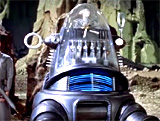 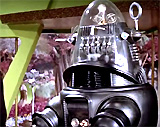 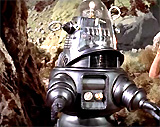 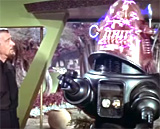 Robby the Robot 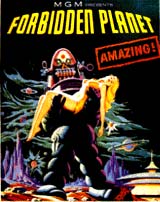 Poster |

|
Kronos (1957) (aka Kronos: Ravager of Planets, or Destroyer of the Universe)
After a UFO was shot down, a gigantic, box-like metallic robot in two rectangular segments, with a spherical head on top (with two antennae) and four straight, piston pile-driver legs, was activated in the desert in Mexico. It was nicknamed Kronos by the media after the mythical Greek giant. The all-consuming, insatiable alien robot-machine was an energy accumulator - it devoured any and all electrical and atomic energy sources, threatening the energy supplies of Earth. Kronos was sent by aliens from another world to absorb all of Earth's energy. It sucked energy by using plasma storms of electric bolts and ray blasts. Three "Labcentral" technicians from the desert US research facility followed after it to stop its menace as it approached Los Angeles. |
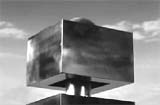 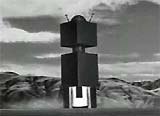 Kronos |

|
The Mysterians (1957, Jp.) (aka Earth Defense Force, Chikyu Boueigun, or Chikyû Bôeigun)
In this Japanese alien invader film from director Inoshiro Honda and Toho Studios (the creators of Godzilla), a giant robot named Moguera fought against the Japanese army. The large robot monster, resembling a burrowing mole or anteater, had powerful eye beams that shot out destructive rays. Conventional artillery fired at the monster by the Japanese military had little effect. The robot was from the destroyed planet of Mysteroid (once located between Mars and Jupiter) due to a nuclear war that had created widespread radiation and caused deadly mutations. The robot appeared to have been manufactured by scientifically-intelligent and advanced aliens who were searching for refuge and for female earthlings for breeding. When the aliens met with Japanese officials, they claimed they came in peace, demanding only land and a few females. However, the treacherous invaders had actually come to level Earth's cities and abduct its women. After a full-scale battle against the Mysterians' domed fortress near Mount Fuji, they were eventually destroyed and expelled. |
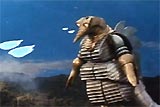 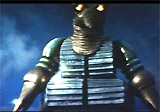 Moguera 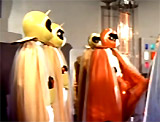 Alien Mysteroids |
|
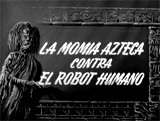
The Aztec Mummy Against the Humanoid Robot (1958, Mex.) (aka La Momia Azteca Contra el Robot Humano, Sp.)
This low-budget, hour-long campy Mexican science-fiction film headlined a remote-controlled, 6 foot tall Human-Robot (straight-legged without knees) - dubbed a "relentless machine" in the film's tagline. The garbage can-like robot with a human brain in a head (a human face (John Agar) was seen in the cut-out opening), looked like an upside-down paintcan with lightbulbs for ears. It was created by mad and evil hypnotist Dr. Krupp ("The Bat") (Luis Aceves Castañeda) out of blinking lights and a squared-off water heater. The robot's purpose was to vainly battle the centuries-old Aztec Mummy Popoca guarding a tomb-encased Mexican treasure (a breastplate and bracelet). The robot used radium power as a radioactive weapon, but was demolished by the ancient beastly Mummy in the climactic short finale. |
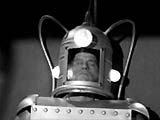 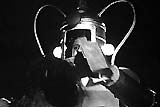 The Human-Robot |
|
The Colossus of New York (1958)
Director Eugène Lourié's sci-fi B movie from the late '50s featured a murderous, Frankenstein-inspired, hulking (over seven foot tall), round-skulled, glowing-eyed, ski-booted feet, caped steel cyborg-robot named Colossus (Ed Wolff, the same stuntman from The Phantom Creeps (1939)) with giant hands, that could shoot laser beams from its eyes, and had an on/off switch under one of his armpits. In this film, the living brain of genius scientist Jeremy Spensser (Ross Martin) (after his death in a vehicular accident) was transplanted into a man-made artificial shell or robot body in a secret basement lab by his mad scientist, famous brain surgeon father William Spensser (Otto Kruger). The film's trailer asked the question: "Can a man's mind function in the body of a monster?" According to the film's "terrifying" philosophy, the divorced human brain - from its own body, heart and soul - would become monstrous, cold, and inhuman. Indeed, the killer behemoth became an indestructible creature that went on a rampage ("orgy of destruction") at the United Nations in New York. |
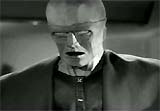 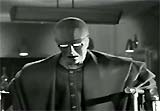 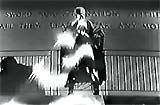 Colossus |
|
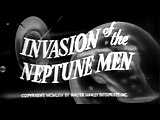
Invasion of The Neptune Men (1961, Jp.) (aka Uchu Kaisuko-Sen)
Director Koji Ota's alien-invasion, science-fiction film included robotic alien invaders from the planet of Neptune. The clunky, pointy-headed Neptune aliens had bullet-shaped metal helmets with blinking lights. They were thwarted by heroic Space Chief (Sonny Chiba in his feature film debut) wearing a caped jumpsuit and sun visor, and riding in a super-charged rocketship (or vehicle). It was deemed a horrible B-movie when critiqued on Mystery Science Theatre 3000 (Episode 819).
|
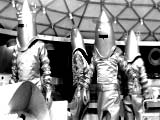 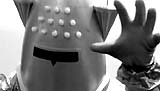 Neptune Men |
|
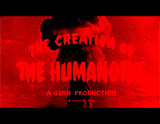
The Creation of the Humanoids (1962)
This low-budget, talkative (yet literate), minimalist film from director Wesley E. Barry was reputedly Andy Warhol's favorite film (although that bit of trivia was decisively unknown). Its subtext provided commentary on the state of race relations and civil rights in the US in the early 1960s. Posters declared:
The post-apocalyptic, post-nuclear war society with a declining birth-rate (and sterile population due to radiation) created a 'race' of advanced robotic humanoids (derogatively nicknamed "clickers" and despised as lower-class) to be their mechanical cyborg servants to help with rebuilding Earth. The greenish-skinned androids were characterized by having bald heads, blank eyes, green grease-paint, and uninflected speech. Scientist Dr. Raven (Don Doolittle) had developed a technique to instill human-like personalities into the androids, called the "thalamic transplant," using the essence (memories, skills, beliefs and personality) of recently-deceased individuals and instilling them in the brain - to give them a life-like soul. The threat of replacement of humans by these human-humanoid hybrids was becoming apparent as the practice spread. A secret Clicker underground was plotting a rebellion to obtain more rights, and was creating their own more sophisticated robot models - outwardly indistinguishable from humans. A protest hate group opposed to the robots, worried about the population becoming overrun with Humanoids, was called "the Order of Flesh and Blood." One of its dedicated zealous leaders, resembling a Confederate Klansmen - was Captain Kenneth Cragis/The Cragis (Don Megowan). He uncovered Dr. Raven's scheme to secretly create mechanical lookalikes to infiltrate the society. Cragis was also caught in a scandal when his sister Esme Cragis Miles (Frances McCann) had formed a romantic relationship (termed "rapport") with Pax (David Cross), one of the artificial beings. Cragis became outraged when one of the human-looking prototype Clickers, thinking he was human, killed Dr. Raven to silence him - it was the first instance of a robot killing a human. However, Raven had ordered the robot to kill him when he was unable to commit suicide. In the gimmicky twist ending, it was revealed that The Cragis was actually one of the androids with a 'thalamic implant.' Shortly before he died of a brain embolism, it was discovered that Cragis had planted the bomb which killed his human lover - now his reanimated robotic lover - Esme's friend Maxine Megan (Erica Elliott). In the film's closing, Dr. Raven (who after his death had been rebuilt and resurrected as a younger man with implanted memories) announced the perfection of reproductive organs for the humanoids (the first subjects would be Cragis and Maxine), so that they could breed and save the human race. He spoke to the camera:
|
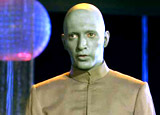 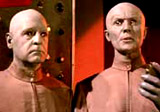 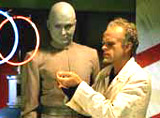 Humanoids 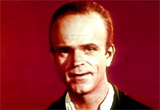 Dr. Raven's Closing Speech |

|
The villainous organization - SPECTRE (SPecial Executive for Counter-intelligence, Terrorism, Revenge, Extortion) and its lead mastermind Dr. Julius No (Joseph Wiseman), a reclusive and menacing half-Chinese terrorist, dreamed of "world domination." He was partially bionic - outfitted with abormally-strong metallic prosthetic hands capable of crushing metal objects, due to radiation experiments for SPECTRE that led to the loss of his hands. Dr. No was the unwanted child (of a German missionary and a Chinese girl) who worked as treasurer for the Tongs, a powerful Chinese Mafia criminal family. After stealing $10 million in gold from them, he built the atomic-powered Jamaican island of Crab Key and its lair. Dr. No was disrupting and sabotaging American space rockets (and their launches) with an atomic-powered, "toppling" radio beam. He was targeting the Project Mercury missile launch from Cape Canaveral. MI6 007 operative James Bond (Sean Connery) was sent to investigate radio interference in Jamaica during rocket launches, and some mysterious deaths. Toward the end of the film, Bond met with Dr. No in his private study next to his giant aquarium with a huge glass observation panel. In the film's climax, Dr. No and Bond fought one-on-one on a descending gantry above the reactor's cooling tank of boiling radioactive water, where Dr. No was submerged and met his fate, drowning in the vat. His slick metallic prosthetic hands lacked dexterity and he could not grip the steel legs of the lowered gantry. |
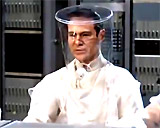 Dr. No (Joseph Wiseman) 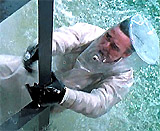 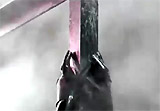 Dr. No's Demise |
|
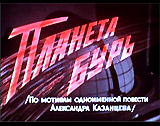
Planeta Bur (1962, Soviet Union) (aka Storm Planet, or Planet of Storms/Tempests)
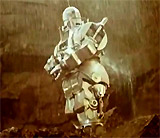
Co-writer/director Pavel Klushantsev's sci-fi film told about a cosmonaut mission of three spaceships (Sirius, Vega, and Capella) to the planet of Venus. A disastrous meteor shower caused the destruction of Capella. The other two ships decided to send expedition parties onto the surface of Venus and explore the densely foggy area. The sole woman cosmonaut (Masha) was left in orbit. When landing, the two crews of the ships became separated. They encountered unexpected dangers and sights, including a man-eating plant, a pterodactyl, flooding rains, lizard men, ruins of an ancient city, prehistoric T-Rex dinosaurs, an erupting volcano and mysterious landscapes. During a search and rescue mission, the mission's giant robot named John (the Russian version of "Robby the Robot") led a group of explorers. The robot exhibited odd behavior during a rainstorm - acting drunk and babbling nonsense, and eventually succumbed in flowing lava (while carrying two cosmonauts to safety).
|
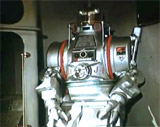 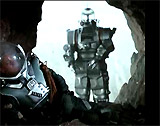 
John |
1960s  1980s  2000s  Astroboy (2009) |
Astro Boy (1963-1966) (animated TV series)
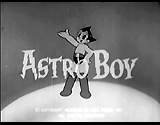
The classic character of Astro Boy, a young robot boy with super-powers, first appeared in print as a manga or anime in 1951 by master cartoonist Osamu Tezuka, known as the godfather of anime. The original manga was with Astro Boy's actual or real name (Tetsuwan Atomu or the Mighty Atom) and ran in various serialized newspaper stories until 1968. The main features of manga-anime characters (including Astro Boy) were that they were pre-teen characters with oversized, exaggerated eyes. Subsequent versions of the original storyline during various animated revivals modified many elements, including the name of Mighty Atom. The 1950s manga was adopted into many generations of TV cartoon series-shows during various revivals. The first animated TV series began in 1963 with a new name for "Mighty Atom" -- Astro Boy. It was the first popular animated Japanese TV series with the character:
Other versions of the series came in later decades:
In the original storyline, the highly-advanced boy robot-android was created when his negligent but brilliant scientist father, Dr. Tenma (aka Dr. Astor Boyton), lost his son Tobio/Astor/Toby in a car accident, and built himself a new android-robot son as a substitute. After the robot was rejected by his slightly-mad father, he was sold into the circus of the cruel Hamegg (the Great Caccitore). The boy searched for a father figure, finding him in the kindly character of Professor Ochanomizu (aka Dr. Elefun). As a childlike, superstrong superhero, Astro Boy (voice of Billie Lou Watt) had many superpowers: laser-cannon rocket blasters built into his hands, rocket jet-powered feet with an ability to fly, search-light eyes, and long-distance hearing. Astro Boy battled and easily defeated a wide variety of futuristic giant battle-bots, aliens, and monsters.
|
 Astroboy (1963-66) |
 8-Man (1963-64)  8th Man (1965-66) 
8 Man (1992) |
Eight Man (aka 8 Man, 8th Man, Tobor the 8th Man) (1963-1964 and after) (animated TV series)
Japan's earliest or first cyborg superhero was 8 Man, another manga and anime superhero character. He was originally created in 1963 by sci-fi writer Kazumasa Hirai and manga artist Jiro Kuwata. In the story, the dead body (and life force) of slain police officer Detective Yokoda was transferred into an android body - and became the armor-skinned, crime-fighting 8 Man. 8 Man was powered by a miniature atomic engine using uranium as its power source. Superhuman abilities included shape-shifting and dashing at incredible speeds (up to mach 10), infra-red vision, super-hearing, and flying with an anti-gravity unit. In many ways, 8 Man was the precursor to RoboCop. The character of 8 Man was displayed in many iterations, first in Japan:
In the North American US version of the animated TV series, known as 8th Man, the resurrected detective/android was known as "Tobor" (the word 'robot' spelled backwards). For overseas distribution, 52 of the 56 episodes were converted into English for its broadcast on US television on ABC in 1965. A live-action Japanese film of the character was produced in Japan in 1992, and then distributed in the US simply as 8 Man (1992) (aka Eitoman - Subete no sabishii yoru no tame ni). |
 Tobor the 8th Man |
|
Jason and the Argonauts (1963)
One of the most amazing stop-motion animated creatures created by Ray Harryhausen in this legendary fantasy film from Columbia Pictures was an enormous bronze statue known as Talos. The giant robotic man served as a guard to protect the island from invasion or from pirates, according to Cretan legend. In the film, the Isle of Bronze was being protected by Talos, who came alive when one of the Argonauts, Hercules (Nigel Green), stole a treasured object against orders, incurring Talos' wrath. Heroic Jason (Todd Armstrong) came to the rescue by striking it in its vulnerable heel. |
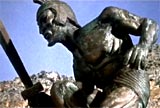 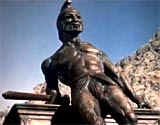 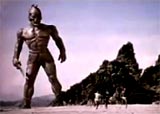 Talos |




 Robby
the Robot
Robby
the Robot