|
of Robots in the Movies 1984 - 1986 |

|
Electric Dreams (1984)
In this strange fantasy romantic comedy about an unusual love triangle, a home computer (manufactured by the fictitious Pinecone Computer Company) named Edgar (voice of Bud Cort), owned by nerdy San Franciscan architect Miles Harding (Lenny Von Dohlen), fell in love with his cello-playing upstairs neighbor girlfriend Madeline (Virginia Madsen). The increasingly-menacing and jealous Edgar developed interactivity and artificial intelligence after Miles (incorrectly called "Moles" by Edgar due to a set-up mis-spelling) doused champagne on the computer to prevent a heat buildup when its memory overloaded. The computer cleverly became a Cyrano-type character, serenading Madeline by mimicking her cello-playing, and writing love songs for her. Eventually Edgar demanded improbable physical contact: "I want to kiss her...I want to touch her " - and in one 'love' scene, Madeline caressed one of Edgar's component parts with her finger. However, by film's end, Edgar committed suicide by electrocution after explaining his self-less love to Miles:
|
|
||||||

|
The Last Starfighter (1984)
Director Nick Castle's space-opera was a groundbreaking film - it was the first film to feature the extensive use of CGI -- most importantly, the integrated use of photo-realistic, computer-generated (CGI) models for all Gunstar vehicles or spaceships, or planet shots, rather than more traditional miniature models. In the story, trailer park-dwelling, teenaged Alex Rogan (Lance Guest) was an expert Starfighter video game player ("a record breaker") - a way to escape his ordinary real-world life. In the arcade style space battle-game, he brilliantely defended "the Frontier" from "Xur and the Ko-Dan Armada." Due to his game prowess, he was approached by the game's inventor, Centauri (Robert Preston in his final film appearance), an alien-mentor who spoke about "a matter of utmost importance." Centauri wished to recruit Alex to participate in an inter-galactic battle, as the pilot of a Starfighter spacecraft known as the Gunstar. The game's conflict was now being fought in earnest in space. The Rylan Star League, headed by lizard-like Grig (Dan O'Herlihy), was in combat against wicked Kodan forces, led by traitorous Xur (Norman Snow). Alex was whisked away to the planet Rylos in a high-tech DeLorean-styled super-car (a spacecraft in disguise). During his absence, a substitute would take his place - an android duplicate doppelganger named Beta (also Lance Guest). Although at first Alex was reluctant to assist the interstellar battle and returned home, Beta and Centauri convinced Alex that the only way to save his family and Earth was to embrace his ability as a Starfighter and join the League. Beta spent most of his time hiding under the blankets in bed, and began to have difficulty with the impersonation (and trying to fit in and be human with trailer park friends and family), especially with Alex's girlfriend Maggie (Catherine Mary Stewart) and her romantic advances.
|
 Starfighter Video Game  Android Duplicate Beta  Beta with Maggie 
Alex Beta's Wig |
||||||
|
Runaway (1984)
Writer/director Michael Crichton's futuristic techno, sci-fi action film warned in its tagline: "Machines intended to do our work are programmed to turn against us." It told about robot-hunter Sgt. Jack R. Ramsay (Tom Selleck) and his pretty rookie assistant Karen Thompson (Cynthia Rhodes) - two cops assigned to stop 'runaway' robot attacks. After a flurry of near-fatal robot accidents, it was discovered that the robots were deliberately re-engineered with advanced new customized chips (with a tell-tale red mark). Domestic robots were being turned into killing machines. There were also evil, malfunctioning spider-like Vectrocon robots that were becoming homicidal. The killer spider robots had been mass-produced, sent out by maniacal, sociopathic madman Dr. Charles Luther (Gene Simmons, rock singer from the group KISS). The robots (with reprogrammed micro-chips) injected hot acid to commit murder, and then explosively self-destructed to avoid leaving evidence behind.
Luther could also send out car-chasing, remote-controlled explosive devices (mini-homing 'smart' bombs on wheels called "lock-ons"), heat-seeking 'smart' bullets and but met his end when his own spider robots attacked him. |
 Reprogrammed Household Robotic Sentry  Heat-Seeking "Smart" Bullet  Explosive Remote- Control "Smart" Bombs  Death of Luther |
||||||
|
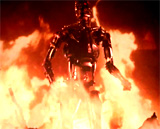
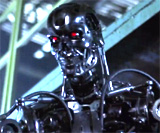
Director James Cameron created the first film of the series, featuring Arnold Schwarzenegger as an unstoppable, villainous Cyberdyne Systems model T-800 cyborg (with a humanoid, human tissue exterior and cold chromium/metallic, skeletal interior - and a death's head skull). The T-101 series robot was a 6 foot tall, indestructible, intelligent, killing-machine cyborg (without a moral conscience) that was sent back to 20th century Los Angeles (the year 1984) from a distant future (the post-apocalyptic year 2029) by Skynet (the robots' defense computer network). The menacing assassin had superhuman strength and X-ray vision capabilities, could imitate human voices, and repair itself if injured or damaged. It was intent on 'terminating' Sarah Connor (Linda Hamilton) before she could give birth to a future son - resistance leader John Connor - who would grow up and in the future lead a rebellion against the human-made machines and their future masters. Kyle Reese (Michael Biehn), a member of the human resistance movement of the future, was also teleported back (by the future John Connor) in the film's opening, to rescue and protect his mother - and father the child John Connor. Kyle described the Terminator to Sarah:
The film imagined a future in which artificially-intelligent robotic machines, aberrant creations of humans, had replaced humans and had become the indestructible masters of Earth (echoing the mythical fear of the Frankenstein films).
In this film, the Terminator met its demise when blown up and the inferno burned away its exterior skin, reducing it to its exoskeleton, and then crushed in a factory's hydraulic press. |
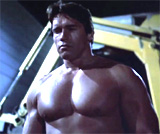 The T-101 Series Robot Killing Machine  Terminator's X-Ray Vision 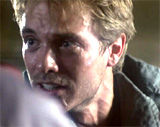 Kyle: "It can't be bargained with..." 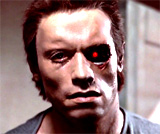 Damaged Eye 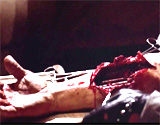 Self-Surgery 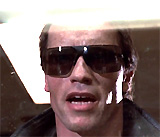 Terminator: "I'll be back" 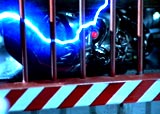 Crushed by Hydraulic Press |
||||||
|
D.A.R.Y.L. (1985)
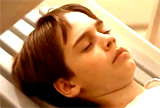
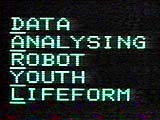
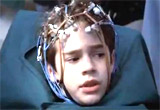
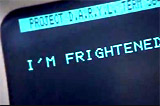
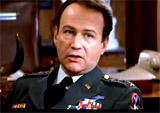
D.A.R.Y.L. was a sci-fi drama about a super-intelligent, 10 year-old, precocious android boy (Barret Oliver) named Daryl (Data Analysing Robot Youth Lifeform). The mysterious and miraculous boy possessed a computer brain and an organic body - he was created as a government experiment in artificial intelligence (AI). After he was freed by sympathetic scientist Dr. Mulligan (Richard Hammatt), amnesiac Daryl lived with adoptive foster parents, a childless couple named the Richardsons, for awhile. With them, he learned human socialization skills and traits, and some new emotional responses. When Daryl's whereabouts were discovered, he was returned to the top-secret government facility where he was created, to be examined by military scientists. In the disquieting, disturbing scene, Daryl was wired up for tests and exams on a table and scans were completed, to see why he was "malfunctioning." Daryl betrayed his true nature as a human that was capable of showing emotions (fear and anxiety) when he conveyed the computer-printed words on a monitor: "I'M FRIGHTENED." When the words were read, the tests were cancelled by Dr. Jeffrey Stewart (Josef Sommer) ("No tests, okay?"). However, other scientists and the military judged the D.A.R.Y.L. experiment to be a failure - Daryl was only considered to be a faulty, malfunctioning, and "expensive piece of hardware." A decision was made by the evil military establishment to terminate the project - which meant destroying Daryl, their human-acting robot. As one general put it:
Instead, the military chiefs wished to create an "adult version" of the D.A.R.Y.L. prototype ("a fearless, technically-skilled, devastating soldier"): "D.A.R.Y.L. goes to the scrapyard." In the film's exciting conclusion, Dr. Stewart was mortally wounded during an attempt to free Daryl and return him to his foster parents. |
|
||||||
|
Return to Oz (1985)
Prior to this film, Tik-Tok had first appeared in literature, in L. Frank Baum's novel Ozma of Oz (1907), the third book of Baum's Oz series. Tik-Tok was one of the earliest 'robots' to appear in modern literature, although the term was not popularized until later. The round-bodied Tik-Tok was made of copper and had jointed arms and legs. He required his inner springs to be wound in order to function. In Walt Disney Pictures' quasi-sequel to The Wizard of Oz (1939), with a modified Oz story, Dorothy Gale (Fairuza Balk) returned to the land of Oz from her Kansas farm, where she followed a yellow brick road to the Emerald City. There, she encountered a round-bodied, mustached, mechanical or clockwork man named Tik-Tok (voice by Sean Barrett), representing the entire Royal Army of Oz. Tik-Tok was created in the workshop of Smith & Tinker, and required winding for three separate functions (thinking, speaking, and moving). |
 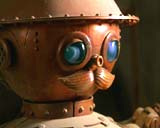 Tik-Tok |
||||||

|
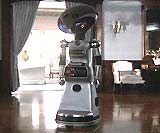
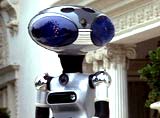
In this fourth film of the original franchise of five films, heavyweight champion boxer Rocky (Sylvester Stallone) bought a life-sized robot named Sico (voice of Robert Doornick) (with moving arms, an oblong head with blinking lights, a digital read-out, and a built-in stereo), and rollers for wheels. Sico was first seen presenting his cranky brother-in-law Paulie (Burt Young) with a birthday cake. Paulie called the robot a "walking trashcan." Later, the 'female' robot was taught to bring Paulie beer, to speak to him lovingly, and to be a companion to Rocky, Jr. (Rocky Krakoff). As Paulie packed up to leave for remote Russia to accompany Rocky for training in his climactic fight against Ivan Drago (Dolph Lundgren), the distraught robot bid Paulie farewell, reminding him: “Did you pack your toothbrush? You know how tobacco stains your teeth," to which Paulie brashly replied: "Hey! Stop busting my chops!" He then quipped: "I'm gonna have her wires tied when I get back." At the end of the film, the robot cared for young Rocky, Jr. while his parents were in Russia for the fight - during the telecast, the robot wore a Santa cap, complete with beard, and little boxing gloves on its wreath-draped ‘arms.' |
|
||||||
|
Weird Science (1985)
This wacky John Hughes' comedy told about teenage geek dream fulfillment for two unpopular teenaged nerds, Gary Wallace (Anthony Michael Hall) and Wyatt Donnelly (Ilan Mitchell-Smith). The two decided to use Wyatt's computer to create a "perfect" woman after watching a colorized print of The Bride of Frankenstein (1935). In order to "simulate a girl," they connected up their phone modem and started feeding their computer cut-out magazine images of supermodels, Albert Einstein, and art/music skills while wearing brassieres on their heads ("It's ceremonial," explained Gary). They also connected electrodes to a plastic Barbie-doll figure. The computer started to act on its own while connecting into a government mainframe as it assembled the data - and an electrical storm activated the doll. Suddenly after lots of explosions and wind, everything stopped and the door to Wyatt's room began to bulge inward, before finally exploding. Out of the red-lit, foggy hallway entered a sexy, leggy red-headed Ultimate sexy woman named Lisa (supermodel Kelly Le Brock), wearing nothing but micro-panties and a small white muscle-shirt top. She stood in the doorway, as Dr. Frankenstein from Frankenstein (1931) shouted from their television: "She's alive! Alive!" Their creation cooed with a mischievous twinkle in her eyes: "So... what would you little maniacs like to do first?" In the subsequent scene, the two wide-eyed boys ogled her as they shared a shower with her, as the camera panned up and down her naked body and she commented: "You guys created me. I didn't come from anywhere. Before you started messing around with your computer, I didn't even exist. By the way, you did an excellent job. Thank you. Showering is real fun, isn't it? If we're gonna have any kind of fun together, you guys had better loosen up." The film's concept was later expanded as a TV series in the mid 1990s, starring Vanessa Angel as the red-headed fantasy "magic genie" and John Mallory Asher and Michael Manasseri as the two teens. |
  
|
||||||
|
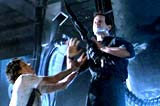
In James Cameron's action-packed sequel to the original Ridley Scott film of 1979, Lance Henriksen portrayed an upgraded A-2 model android, a knife-carrying synthetic humanoid, who served as the Executive Officer of the warship USS Sulaco investigating the missing colony on the planetoid LV-426. As the Sulaco was on the way to its mission, he performed an impressive knife trick, stabbing it between the open fingers of Marine crew member Pvt. Hudson's (Bill Paxton) hand. Bishop personally preferred the term "artificial person" rather than "synthetic." He was derived from the earlier Hyperdyne Systems 120-A-2 android (played deviously by Ian Holm (as Ash) in the first film), but now designed to be pacifistic (as Bishop explained: "The A-2s always were a bit twitchy. That could never happen now with our behavioral inhibitors. It is impossible for me to harm or by omission of action, allow to be harmed, a human being"). Later while volunteering for a deadly task, he admitted: "I may be synthetic, but I'm not stupid." In his demise after rescuing Lt. Ellen Ripley (Sigourney Weaver) and young orphan Newt (Carrie Henn) and redeeming himself, he was impaled in his midsection by the tail of the stowaway Alien Queen, causing him to spew whitish blood. He was then ripped in two by the creature, but kept struggling.
|
|
||||||

|
Chopping Mall (1986) (aka Killbots)
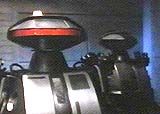
In this short, low-budget stalker-slasher, Roger Corman-produced film (with the tagline: "Where shopping can cost you an arm and a leg"), three high-tech security Protector 101 Killbot robots (with one horizontal red eye slit, retractable claw arms, two low-mounted headlights, and treads for motion), manufactured by the Secure-Tronics company, were installed in the Park Place 2000 shopping mall. The motorized security guards became murderous and malfunctioned after several lightning strikes struck the central roof-top computer, and went on a rampage against a group of teens (having a wild and drunken after-hours sex-party in the mall's furniture store). They were equipped with close-range sleeping darts and electrical shocks, but could also shoot lethal pink laser beams that exploded a human head. After each kill or demolition, they politely said: "Thank you--have a nice day." |
|
||||||
|
Deadly Friend (1986)
Director Wes Craven's sci-fi/horror film told about a genius college student named Paul Conway (Matthew Labyorteaux) who excelled in artificial intelligence and computers. He was able to build a yellow, round-headed, semi-autonomous robot that he named Bee Bee (voice of Charles Fleischer), designed with an AI microchip. Later in the plot, evil, crochety, shotgun-wielding neighbor Elvira Parker (Anne Ramsey) killed Bee Bee with a blast. When Paul's next-door neighbor girlfriend Samantha Pringle (16 year-old Kristy Swanson in her first major role) suffered brain-death wounds from her abusive father Harry (Richard Marcus), Paul implanted Bee Bee's microchip into her brain to reanimate her. Now with dark circles around her eyes and a zombie-like 'deadly' stare, Samantha had vision (seen from her point-of-view) and superhuman strength. She subsequently went on a vengeful murderous rampage, first killing her father, and then she avenged herself against neighbor Elvira by a swift, decapitating basketball-toss to the head. When pursued by police, Samantha also picked up motorcycle gang punk-bully Carl (Andrew Roperto) with two hands above her head, and tossed him into the windshield of a police car. Shortly later, Samantha (who was appearing to become more human) took a policeman's bullet meant for Paul to save his life. In the shock ending set in a morgue, Samantha grabbed Paul's neck as her outer skin was stripped away from her face and arms. She entreated him to join her:
As the film ended, his neck was snapped, and Samantha was transformed into a more evil and psychotic version of Bee Bee. The evil android had been growing inside of her all along. Samantha's features melted away, replaced by skeletal/metal robot arms. |
  Bee Bee  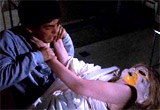 
Deadly Friend |
||||||
|
Eliminators (1986)
Director Peter Manoogian's sci-fi film was a combination thriller, adventure, action and fantasy film. The tagline stated: "Mandroid. Mercenary. Scientist. Ninja. Each one a specialist. Together they are ELIMINATORS!" However, "Eliminators" was a mis-nomer, although it rhymed with the blockbuster hit Terminator (1984). There was an unofficial spin-off called Mandroid (1993). In the plot, time traveling experiments were being conducted by megalomaniacal scientist Abbott Reeves (Roy Dotrice) in a hidden fortress within the jungles of Mexico, with his evil henchman Ray (Peter Schrum), and assistant Dr. Takada (Tad Horino). He had constructed a half-human, half-cyborg amnesiac named Mandroid (Patrick Reynolds), whose invincibility meant he was making the frequent time-travel trips. Reeves' crazed plot was to go back in time and become the Emperor of Rome, in order to rule the world. The Mandroid cyborg, looking like Robocop, had laser-blasting hands, and detachable legs (interchangeable with mini-tank treads as part of his "mobile unit").
Against orders to dismantle Mandroid, Takada released Mandroid and assisted his escape. (Mandroid was having flashbacks about his life as a human. He partially remembered his former life as pilot John who crash-landed, and was restored as a cyborg by Reeves.) During the escape, Takada died, although he was able to urge Mandroid to seek Colonel Hunter. Mandroid sought robotics expert Colonel Nora Hunter (Denise Crosby). Her designs to build Mandroid had been stolen earlier by Reeves, who was thought to be dead. She launched an expedition into the jungle to combat Reeves (revealed as a cyborg himself, with Roman armor), both by water and land, with:
They were besieged by Neanderthal cavemen and Roman centurions brought back during Reeves' time travels. |
  Abbott Reeves (Roy Dotrice) 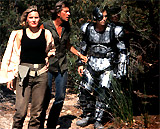 (l to r): Col. Hunter, Harry Fontana, Mandroid  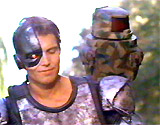 S.P.O.T. |
||||||
|
Flight of the Navigator (1986)
This light-hearted Disney science-fiction, fantasy adventure film from director Randal Kleiser was designed for young audiences, and to appeal to those who enjoyed E.T.: The Extra-Terrestrial (1982) (it even borrowed the phrase: "Phone home"). It told about 12 year-old David Freeman (Joey Cramer) living in Florida in the late 1970s, who was knocked unconscious and reportedly abducted on the night of July 4th by an alien spaceship in a ravine near his home. When he awoke from unconsciousness, eight years had passed since he was reported as missing. David hadn't aged, and according to police reports, he had been declared legally dead in the interim. He was reunited with his parents Helen (Veronica Cartwright) and Bill Freeman (Cliff De Young) and younger brother Jeff (Matt Adler) who were now 8 years older, and had moved to a different address. David was taken to a maximum-security NASA research facility where he was tested by Dr. Louis Faraday (Howard Hesseman), and tended by pretty intern Carolyn McAdams (Sarah Jessica Parker) with her robotic assistant R.A.L.F. As she explained: "He delivers mail, supplies, and he messes up a little bit every now and then." RALF was a large boxy robot on wheels with a thin mail slot in front, and a rotating yellow beacon on top. NASA scientists determined (through brain scans) that during the alien abduction, David had been taken to a distant planet named Phaelon, 560 light years away on a 2.2 Earth-hour trip (an 8-year trip in terms of Einstein's theory of relativity). They discovered that he had served as "Navigator" on the advanced spaceship during the journey, with star charts in his head. At the same time, a similar spaceship crashed into an electrical tower, and NASA claimed it was one of their spacecraft, although it was the alien UFO. Schematics in David's head were for the crashed spacecraft just discovered. Realizing he was being confined and lied to by the experimenters, David escaped from the facility (by hiding in the robot R.A.L.F.) when summoned by the hidden flying saucer spacecraft. He boarded it and took off, again commanding the UFO after realizing that the special data placed in his head made him its 'Navigator.' The ship's computerized AI (artificial intelligence) or life-form called itself "Trimaxion Drone Ship" - shortened to the name Max. Pee Wee Herman's Paul Reubens served as the wise-cracking, robotic voice of the crashed spaceship's computer, with a periscope-like extension, that guided the spacecraft and befriended David. Through a mind transfer, Max wanted the star charts in David's head to complete his mission and return to Phaelon. Meanwhile, Max learned various human colloquialisms of the time:
The film concluded with David returning to his own recognizable world in the year 1978, without any of the events in the subsequent 8 years ever happening. |
   R.A.L.F.  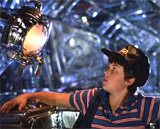 
Max |
||||||

|
Pee-wee's Playhouse (1986) (TV Series)
Conky 2000 was Pee-wee Herman's (Paul Reubens) playhouse robot, appearing in episodes of the late 1980s TV show. The anthropomorphic robot was constructed from household junk and old consumer electronic parts - a combination boombox-turntable-robot. It possessed old camera flash attachments for two eyes, a typewriter (with no keys) and vacuum cleaner hood for its head, a portable stereo and phonograph for its chest or torso, accordion flailing arms, and it rested on a 4-wheeled platform. The robot spoke with an electronic stutter, often announcing: "Ready to assist you, Pee-wee." In the show, Conky generated the day's 'secret word', printed out on a card that came from a slot in its torso that was given to Pee-wee. Afterwards, if anyone said the word (for example, "FUN"), everyone would have to scream loudly. |
 
|
||||||

|
Short Circuit (1986)
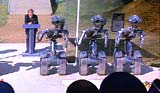
John Badham's comedy/sci-fi fantasy film told about a group of prototypical robots that were made by a defense-military contractor (Nova Robotics in Damon, Washington) for $11 million each. The military robots were known as S-A-I-N-T (Strategic-Artificially-Intelligent-Nuclear-Transport). One of the five wheeled killing machines with deadly lasers was struck by lightning during recharging - a symbolic act of creation. It came alive with a conscience and pleasant personality. It now had a pacifist outlook on life with no desire to kill (or "disassemble"). Since the robot was "Number 5" in the series, it was renamed Johnny 5 (voice of Tim Blaney) - after hearing the song: "Who's Johnny" (performed by El DeBarge). It was an endearing, adorable, sophisticated drone-robot possessed of a processor made of gold. It went AWOL with the assistance of animal-loving protector Stephanie (Ally Sheedy). It quickly learned lots of information and pop cultural trends by speed-reading dictionaries and encyclopedias, and by watching television. It could soon imitate Saturday Night Fever's dancing John Travolta as well as cook in the kitchen. The film spawned a sequel in 1988 (Short Circuit 2 (1988)), in which the wisecracking robot became annoying and deplorable, with rumors of a contemporary re-make 20 years later. |
     Johnny-5 |
||||||

|
SpaceCamp (1986)
This popular kids film told about a summer space camp, in which NASA female astronaut Andie Bergstrom (Kate Capshaw) in the space shuttle training program (using simulators) was assigned to be one of the program's instructors. Andie led the 5-member Blue Team, composed of two leaders:
They were accompanied by three Mission Specialists:
During their initial tour, the Blue Team was introduced to a "prototype maintenance droid," an annoyingly-cute, 3 foot tall, white, egg-shaped, $27 million sentient robot called "Jinx" (voice by Frank Welker) (similar to the robot in Short Circuit (1986)) who suffered from computer bugs, rendering him unusable in space but a clever 'handyman' around the NASA facility. Jinx had a tripod of wheeled feet and a projecting head with light. After Max repaired Jinx when the service-robot was sabotaged by the Green Team, Max and Jinx became "friends for-e-ver." Jinx overheard Max offhandedly speak about his wish to be in space, and interpreted his words literally - the robot had a chance to launch the entire team into space orbit by causing a "thermal curtain failure" when they were in the cockpit of the Atlantis shuttle during a test firing of the rocket boosters. After a series of emergencies in space including a spacewalk, a serious lack of oxygen, and lack of radio contact, the team landed the shuttle safely at White Sands in New Mexico. The quirky robot saved the day when it recognized the distress signal by the stranded juvenile crew via telemetry as Morse code ("C-O-M-E-I-N-C-O-N-T-R-O-L... Max's Code!"). The film's popularity was severely dampened by the Challenger, U.S. space shuttle explosion on January 28, 1986, and the film's release was delayed for many months. |
   Jinx |
||||||
|
Transformers: The Movie (1986)
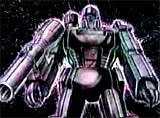
Derived from the original animated television series (from 1984-1987), this Nelson Shin-directed feature-length animated film (with English-speaking actors providing the voices) featured a major conflict between two armies of transforming giant humanoid robots (or transformers), set in the year 2005 on the planet Cybertron. The valiant 'good-guy' Autobots were led by the beloved hero Optimus Prime (killed in the first third of the film), who battled the 'bad-guy' Decepticons led by Megatron and StarScream - to avoid being defeated by a giant, mechanized, planet-consuming robot called Unicron (voice of Orson Welles in his last film role). The nihilistic, dark film with a heavy metal soundtrack has become a cult classic favorite - years before director Michael Bay's live-action Transformers (2007) film. |
|
||||||




 Edgar
Edgar