
|
of Robots in the Movies 1964 - 1967 |

|
The Earth Dies Screaming (1964, UK)
Director Terence Fisher's ultra-low-budget, slow-paced, sci-fi horror film about the end of the world, with a screenplay by Harry Spalding, opened with a scene reminiscent of the beginning of Village of the Damned (1962, UK).
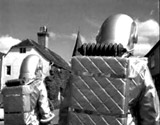
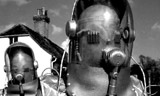
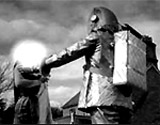
An alien gas brought about apocalpytic conditions, causing people to collapse and die. Only a few people in a small northern English village had survived. Hero Jeff Nolan (Willard Parker) a US test pilot, and a group of others hunkered down in a local hotel, including Peggy (Virginia Field), Edgar Otis (Thorley Walters) and Taggart (Dennis Price), as they discussed the problem and how to combat it. Two mechanical, lumbering servants (alien robots) were on patrol with a deadly touch. Were they controlled by unseen masters from outer space(?). And reanimated corpses (zombies distinguished by their expressionless white eyes) of those who died from the gas began to appear in the streets. |
   Alien Robots |
|
Santa Claus Conquers the Martians (1964) (aka Santa Claus Defeats the Aliens)
This low-budget, infamous Christmas-themed movie has often been voted one of the worst films ever made, but was nonetheless taglined: "Science-Fun-Fiction at its height!" To aficionados of Mystery Science Theater 3000, this 1991 episode (# 321) was one of the most popular. Ruthless Martian robot Torg (an anagram of "Gort" from the film The Day the Earth Stood Still (1951)) was a crude robot made of silver-painted cardboard with two painted-on dials in front, glued-on parts, and duct-work arms. His mission, conceived by Mars' ruler Kimar, was to lead a strike on the North Pole with other alien invaders, and kidnap Santa, so that the depressed children on Mars could recover, receive the 'Christmas spirit' - and of course, gifts. In the film, Torg attacked Santa's (John Call) toy-making workshop at Earth's North Pole, with the help of two kidnapped Earth children, Billy and Betty, although he immediately became a toy. Santa examined the basically harmless robot - and declared it was nothing more than a harmless toy, causing the robot to become suicidal. Once on Mars, Santa declared that the red planet must build its own toy factory. |
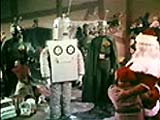  Torg |
 Tetsujin 28-gou (1963, Jp.) 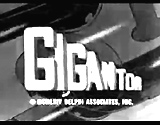 Gigantor (1964-65, US) |
Tetsujin 28-gou (1963, Jp.)
The character of Gigantor originated in a 1956 print manga (by Mitsuteru Yokoyama), which then became serialized over the next decade. The manga became the basis of a 1963 Japanese cartoon (with over 80 episodes), titled Tetsujin 28-gou (aka Iron Man #28). In the original storyline, a giant robot was commanded by 12 year-old Shotaro Kaneda, the son of the robot's chief inventor, to battle various criminals and mechanized threats. 52 of the Japanese episodes of Tetsujin 28-go were used to create the less violent, dubbed English-language animated adaptation (with edits, English translation, and amendments). It became the Gigantor series - airing for two years from 1964-1965. In the US version, the space-age terrorist-fighting robot's name was changed to Gigantor, and the year was now 2000 (not the WWII era). In the many episodes, with little character development or plot variation, the orphaned (?) boy now named Jimmy Sparks (voice of Billie Lou Watt, the same voice-actress who provided the voice for Astro Boy), lived with his uncle Dr. Bob Brilliant on a remote island. Using a box with a joystick and buttons, he controlled the peace-keeping 50-foot tall Gigantor - and they worked together to solve crimes and combat evil (megalomaniacal terrorist leaders and evil Europeans) with secret agent Dick Strong and inept Police Inspector Ignatz J. Blooper. The villains were marvelously named as well, such as Captain Spider, General Von Cueball, Mr. Ugablob, and Professor Birdbrane. |
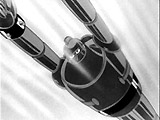 Gigantor  Jimmy Sparks with his Control Box |

|
Alphaville (1965, Fr./It.) (aka Alphaville, Une Etrange Aventure De Lemmy Caution)
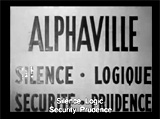
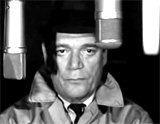
French New Wave director Jean Luc-Godard's post-apocalyptic science-fiction film (with gangster and expressionist film noir characteristics) - a recreation of the Orpheus and Eurydice myth, and also George Orwell's novel 1984, included themes of dehumanization, political and totalitarian repression and artificial intelligence. It told about chisel-faced, American trench-coated gumshoe detective Lemmy Caution (Eddie Constantine). He had traveled inter-galactically (in a white Ford Galaxie - a Ford Mustang) from the Outlands to the automated city of Alphaville - the capital of a totalitarian state on the futuristic planet. As Lemmy passed through the suburban outskirts of Alphaville, he saw the sign:
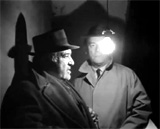
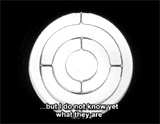
Alphaville was led by an almost-human, sentient supercomputer called Alpha-60 (with a synthetic voice provided by Godard with a dry, slow, gutteral sound). It was represented by blinking lights, and was housed behind a metal grating and whirling fan. It caused the dehumanized, tattoo-identified inhabitants to be completely complacent and apathetic, due to mind-altering drugs and the outlawing of emotions, love, crying, and conscience. The computer was described to him by fellow agent Henry Dickson (Akim Tamirof) under a bare light bulb:
The computer had a devastating effect on the people of Alphaville:
Lemmy Caution's main mission was to bring back and/or assassinate Professor Von Braun (Howard Vernon) who was responsible for creating the fascist Alpha-60 computer that ruled the state-run technocracy. In one chilling scene, when the computer was interrogating Lemmy with rotating microphones around his head, he responded: "In my opinion, in love there is no mystery." Alpha-60 accused him of lying:
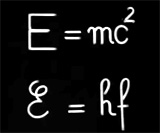
There was the often-flashing image of two equations: E = mc² and E = hf - symbols of the absolute science that served as the foundation of Alphaville, and the ever-recurring circular imagery (i.e., the staircase, Caution's hotel suite, the city of Paris itself, and Alpha-60's own quote: "Time is like a circle which turns endlessly"). |
|

|
Dr. Goldfoot and the Bikini Machine (1965)
This campy spy film was a parody of Goldfinger (1964) and other Bond or spy films of the time - and Frankie Avalon beach movies. It even featured a Supremes title-song on the soundtrack. In the farce, San Francisco mad genius scientist Dr. Goldfoot (Vincent Price), assisted by henchman Igor (Jack Mullaney), had created an army of gold, bikini-clad robots (or sexbots). One sexy example of the mass-produced babes was the lead Fembot - Robot Number 11 - or Diane (Susan Hart). The enticing female robots were programmed to seek out and seduce eligible billionaire bachelors, and charm them away from their fortunes through marriage. Their physical assets included contagious go-go-dancing. Secret Agent Craig Gamble (Frankie Avalon) opposed Goldfoot and his troupe of robotic sexbots.
|
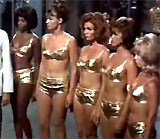 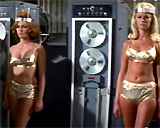 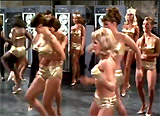 Sexbots 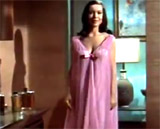 Robot # 11 - Diane (Susan Hart) |
 Dr. Who & the Daleks (1965, UK)  Daleks' Invasion Earth 2150 A.D. (1966, UK) |
Dr. Who & the Daleks
(1965, UK)
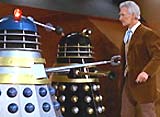
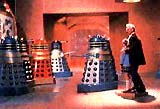
Robots known as Daleks originally debuted in the long-running BBC-TV series Doctor Who, beginning in 1963. In the mid-1960s, the series adapted for two feature films for display on the Technicolored big screen. They appeared as 5 foot tall, pepper-pot-shaped, red/blue/gold-colored robotic monsters from the planet Skaro, a desolate landscape that had suffered from the effects of an ancient nuclear war. Daleks were actually evil, genetically-modified mutants engineered by their evil creator to lack compassion or remorse. They were forced to live inside their protective machine casings due to harsh levels of radiation, with surrounding solar panels (to convert energy). Their tanklike mechanical shells could glide along and fire lethal death rays from protruding gun sticks. Their heads (with a pointing eye-stick) and upper body could rotate. The warring Daleks with metallic voices patrolled and dominated the planet from their metal city and conducted a reign of terror, as they cried out: "Exterminate!" and "You will obey!" Peter Cushing starred in the 1965 film as eccentric scientist/grandfather Dr. Who, who traveled to the planet Skaro to help the peaceful race of turquoise-skinned, persecuted Thals overcome the dreaded and oppressive Dalek threat of nuclear attack. A second Daleks film, a color sequel titled Daleks' Invasion Earth 2150 A.D. (1966, UK), was a remake of the original Doctor Who serial "The Dalek Invasion of Earth" which aired in 1964. In this sequel, Dr. Who (Peter Cushing) traveled to a futuristic England and again counteracted the Dalek plan, this time to conquer Earth and subjugate humans as helmeted slaves called "robomen." |
  Dr. Who & the Daleks (1965, UK) 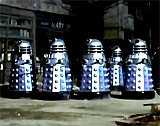 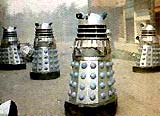 Daleks' Invasion Earth 2150 A.D. (1966, UK) |
|
Cyborg 2087 (1966)
In this low-budget anti-Communist tale (with a Terminator-like script), Michael Rennie starred as rebellious freedom fighter Cyborg Garth A7. He had been time-transferred in a time-machine capsule from the year 2087 to 1966 ("an agent from the world of the future," described as "half-human, half-machine, programmed to kill"). Behind his zippered jacket was an implanted homing device (to allow two killer cyborg tracers with deathly ray guns from the future to follow him back), and his reinforced arm/hand had the strength of five humans. Cyborg Garth's mission was to alter the oppressive, dystopic future that outlawed free thought and to save the world from a totalitarian state that was ruled by machines. His plan was to specifically prevent Professor Sigmund Marx (Eduard Franz) from revealing the secrets of his invention regarding radio telepathy. |
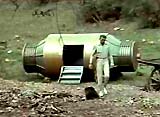  Cyborg Garth A7 |
 1940 serial |
Dr. Satan's Robot (1966) (TV movie)
Republic Pictures' remake of director William Witney's early 1940s film serial (with 15 chapters or episodes), titled The Mysterious Doctor Satan (aka Doctor Satan's Robot) (1940), was released in re-edited form to TV in the mid-1960s as this feature-length abridged film (100 minutes), retitled as Dr. Satan's Robot. The film's plot pitted the hero Bob Wayne (Robert Wilcox) (also known as the chainmail cowl-masked Copperhead, because he left small coiled coppersnakes as his calling card) against mad criminal scientist Dr. Satan (Eduardo Ciannelli) and his mechanical, square tin-canned or steel "killer" robot (Tom Steele), in his desire to take over the world.
|

|
 King Kong Escapes (1967, Jp./US) (aka Kingu Kongu no Gyakushû) |
King Kong Escapes (1967, Jp.) (aka Kingu Kongu No Gyakushû) (aka King Kong's Counterattack, or King Kong Strikes Again)
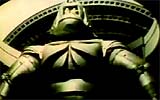
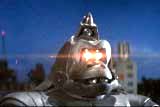
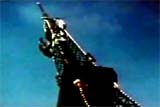
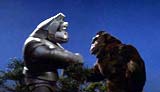
In director Ishirô Honda's Japanese-language science fiction film from Toho Studios, there was a climactic wrestling match (on the top of Tokyo Tower, instead of the Empire State Building). The battle was between:
MechaKong had a dome on the top of its head with a flashing light.
|
|
|
The Terrornauts (1967, UK)
Director Montgomery Tully's shoddy and inept sci-fi film, with a screenplay by John Brunner, was about the kidnapping of scientists by a robot on an asteroid. The story was adapted from Murray Leinster's original 1960 novel The Wailing Asteroid. The film was replete with cheap and low-tech special effects, goofy science fiction, and ridiculous space battles (with models obviously on wires) - '50s-style space opera. The tale was initially about the search for radio signals from possible extra-terrestrial aliens by astronomer Joe Burke (Simon Oates), the head of Project Star Talk for four years at a British observatory. When the project was about to be curtailed, contact signals were received from the direction of Schule's Object, an asteroid. After Burke made contact with a robot on the asteroid, a spaceship was sent to Earth to kidnap Burke and others, including:
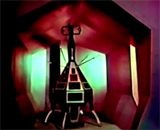
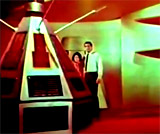
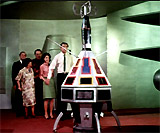
Once the entire observatory (surrounded by a force field) was teleported by a tractor beam to the asteroid, the group found themselves in a deserted, minimalist metallic corridor. Soon, they were confronted by a flimsy alien robot, a beeping, triangular body-shaped creature (made of cardboard that was spray-painted with silver), mobile on wheels with wobbling antenna hands protruding from various sides (looking like a futuristic hat stand!). They were given a labyrinthian set of tasks to test their intelligence, to determine if they could assist the aliens in fighting off a threatening hostile battle fleet in their galaxy (dubbed "terrornauts"). The group also had to contend with their brutish alien savages (wearing green body paint and swimming caps). In the film's conclusion, the scientists - now deemed knowledgeable, were outfitted with specialized alien tech-reading head-devices (skull caps with wires connected to cubes), so that they could upload their intelligence. Reportedly, Earth was in the path of an interstellar war. They would help steer the asteroid's fortress base of advanced weapons into space on a mission to defend the Earth from "terrornauts," and prevent it from the same fate which had befallen the aliens years earlier. |
Alien Robot |




 Alien
Robots, or Robo Aliens
Alien
Robots, or Robo Aliens