|
The Greatest Tearjerkers of All-Time
|
|
Title Screen
|
Movie Title/Year and Brief Tearjerker Scene Description
|
Screenshots
|
|
About Schmidt (2002)
- the final scene of widowed and retired 66 year-old actuary Warren Schmidt
(Jack Nicholson) in Omaha, Nebraska writing his last (in voice-over) despairing letter to his recently-adopted 6 year-old Childreach foster child
Ndugu Umbo in Tanzania: ("But what kind of difference have I made? What in the world is better because of me?...What difference has my life made to anyone? None that I can think
of. None at all")
- Schmidt's receipt of a letter, upon returning home
from his only daughter Jeannine's (Hope Davis) wedding in Denver,
from the African orphanage's Mother Superior, which included the
child's drawing of himself holding hands with Warren - resulting
in Warren's uncontrollable weeping of tears of joy and vindication
|
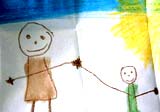
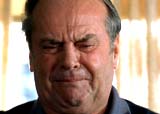
Schmidt's Weeping
|

|
The Abyss (1989)
- the emotionally-raw resuscitation
scene in which husband Virgil "Bud" Brigman (Ed Harris) valiantly
refused to accept estranged wife Lindsey's (Mary Elizabeth Mastrantonio)
death by drowning while trying to revive her: ("Goddamn it, you bitch,
you never backed away from anything in your life! Now fight! Fight! Fight!
Right now! Do it! FIGHT, GODDAMNED IT! FIGHT! FIGHT! Fiiiiiiiiiiight!")
-- and Lindsey's awakening from death
|
Resuscitation Scene
|

|
The Accidental Tourist (1988)
- the character of fastidious, withdrawn travel guide
writer Macon Leary (William Hurt) who was emotionally numbed by the
violent shooting death of his son Ethan (Seth Granger) in a fast-food
restaurant robbery - including his subsequent divorce from wife Sarah
(Kathleen Turner)
- Macon's painful flashback in
which he identified his son's body with a flat, drained confirmation: "Yes,
that is my son"
- the moving scene in which he attempted to
break off a dinner date with his wacky dog trainer and single mother
Muriel Pritchett (Geena Davis) (who was tending Macon's spunky Corgi
named Edward) by a written note - and then when he tried, awkwardly
in person, to explain his loss and his reasons for not wanting to
get close: ("I can't go to dinner with people, I can't. I can't
talk to their little boys. You have to stop asking me. I don't want
to hurt your feelings, but I'm just not up to this")
- Muriel's comforting hug followed
by a non-sexual invitation to go upstairs to her bed to sleep - and
her response of "I'm bashful" when
he asked her to remove her gown next to him
- the tearjerking
finale in Paris when Macon (on his way to DeGaulle airport) after breaking
up once and for all with Sarah and telling her that he was returning
to Muriel: ("I tried but I can't make this work...I'm beginning
to think it's not just how much you love someone. Maybe what matters
is who you are when you're with them"), and then helped into
a taxi by a blonde French-speaking boy (Gregory Gouyer) who strongly
resembled Ethan, he spotted Muriel leaving the hotel (whom he'd repeatedly
spurned while in Paris)
- the film's ending with their mutual shocked
reactions (Muriel's delighted and smiling reaction and Macon's teary-eyed
look and half-smile) when she saw him in the back seat of the taxi
that he had ordered stopped by her
|
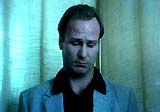
Macon Leary (William Hurt) At the Morgue
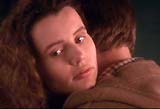
Muriel's Hug

Muriel in Paris
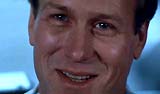
Joy at Seeing Muriel
|
|
An Affair to Remember (1957)
 #4
#4
 #61
#61
- director Leo McCarey's romantic
melodrama - a tearjerker tale of star-crossed lovers - a remake of the original shipboard romance classic Love
Affair (1939) by writer/director Leo McCarey, starring Charles
Boyer and Irene Dunne - and referenced in director Nora Ephron's Sleepless
in Seattle (1993), and in Love Affair (1994) with Warren
Beatty and Annette Bening
- after meeting during a cruise
and before docking in New York during a blossoming shipboard romance
on the Constitution,
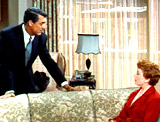
the scene of engaged, playboyish Nickie Ferrante (Cary Grant) and singer
Terry McKay (Deborah Kerr) together one final time: (Nicky: "We'd
be fools to let happiness pass us by") and vowing to reunite
at the top (102nd floor) of the Empire State Building in six months
time on July 1st at 5:00 pm - as Terry added: ("Oh yes, that's
perfect. It's the nearest thing to heaven we have in New York")
- the scene six months later when Nickie waited
at their rendezvous point (a clock chimed 5 times), but Terry didn't
appear (she was injured in an awful car accident (off-screen) on
a busy NYC street on her way rushing to meet him) and there were
ambulances heard blaring at 10 minutes after five
- in the
conclusion,
the revelation scene six months later on Christmas Day regarding the
devastating, terrible secret of why Terry couldn't keep her fateful
appointment; as
she was supine on a couch (covered with a blanket to hide that she
was paraplegic), he gave her a present of a shawl from his now-deceased
Grandmother Janou (Cathleen Nesbitt) that she used to cover her shoulders
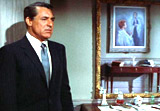
- and his ultimate discovery
that she had acquired his painting (visible in the mirror reflection
in her bedroom) and had kept her accident a secret: ("Why
didn't you tell me? If it had to happen to one of us, why did it
have to be you?") - leading
to their tearful reunion, her explanation: ("I was looking up
- it was the nearest thing to heaven. You were there")
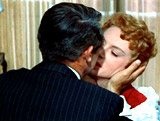
- their kiss in the conclusion when she told him:
("Don't worry, darling...if
you can paint, I can walk. Anything can happen")
|
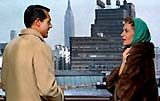
Vow to Reunite in 6 Months
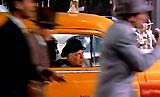
Car Accident Six Months Later
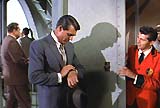
Missed Rendezvous Between Nickie and Terry
|
|
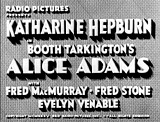
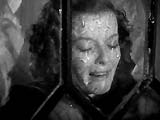
Alice Adams
(1935)
- Alice Adams (Katharine
Hepburn) weeping at her rain-spattered bedroom window after returning
home from the dance, after she discovered that her "disappearing" and
insensitive brother Walter (Frank Albertson) had been playing dice
in the cloak room, dashing her hopes of respectability
|
|
|
All Dogs Go to Heaven (1989)
- the touching, dream-like scene in
which the spirit of roguish, criminal German shepherd Charlie B. Barkin (voice of Burt Reynolds), preparing
to go to his death (he had been condemned to Hell unless he performed good deeds to earn a place in Heaven), apologized to sleepy young orphan girl Anne-Marie
(Judith Barsi): "I'm sorry. I'm so very sorry"
- Charlie - called by his name "Chaaaaarley" since
he was soon to proceed to his fate, asking for a few more moments
to offer his heartfelt goodbyes to Anne-Marie. He hopped up onto
her bed as she awakened, telling her that he was going on "a
little trip" and
asking her to take care of his best friend dachshund Itchy (voice of
Dom DeLuise) while he was gone. She told him as she hugged and kissed
him: "Oh Charlie, I'll miss you." He became choked up: "Yeah,
well, uh, I'll-I'll miss you too, Squeaker." She then asked: "Charlie,
will I ever see you again?" He replied: "Sure, sure you will,
kid. You know goodbyes aren't forever." She told him: "Then
goodbye Charlie. I love you" - with his reply: "Yeah, I love
you too"
- Charlie's calling away into heavenly clouds
rather than to Hell by a bright blue light - he had earned a place
in Heaven because of his self-sacrificial heroic actions - he had
saved Anne-Marie's life at the expense of his own: ("You gave
your life for her")
as the angelic Heavenly Whippet Annabelle (voice of gospel singer
Melba Moore) beckoned him once again: "Charlie, come home..."
|
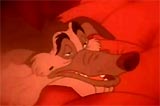
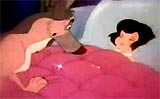
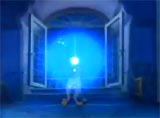
Charlie's Death Sequence
|
|
All That Heaven Allows (1955)
- fortyish widow
Cary Scott (Jane Wyman), after suspending her love affair with her
handsome gardener Ron Kirby (Rock Hudson), being presented with a
brand new TV set (adorned with red ribbons) as a Christmas present
to keep her company - she saw her reflection on the screen as the
unctuous salesman told her: ("All you have to do is turn that
dial and you have all the company you want right there on the screen
- drama, comedy, life's parade at your fingertips...")
|
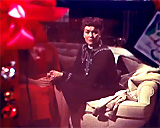
A TV Set Christmas Gift
|
|
All This, and Heaven Too (1940)
- an old-fashioned tear-jerker and costume drama about
unrequited love within a tragic romance, enhanced by a Max Steiner
musical score
- the abuse and distressing gossip that greeted new
French teacher Henriette Deluzy Desportes (Bette Davis) (aka "Mademoiselle
D")
in Miss Haines' School for Girls in New York, and her flashbacked telling
of a "true
story" to her students in her classroom regarding her unjustly
acquired international notoriety and disgrace during a famous murder
trial
- the unspoken love affair, without consummation, between
25 year-old governess Henriette and her employer, French nobleman
Duc de Praslin (Charles Boyer) in Paris in 1846, and the gossip that
surrounded their close friendship
- the close and warm relationship between Henriette
and the Duc's four children: 13 year-old Isabelle (young June Lockhart),
Louise (Virginia Weidler), 8 year-old Berthe (Ann E. Todd), and almost
4 year-old Reynald (Richard Nichols)
- Henriette's escape from reality into a snow-globe,
given to her as a gift from the Duc, who told her: "And if you looked
closely enough the whole world seemed to be obliberated and shut
out"
- the jealousy and insane hatred of the Duc's unhappy,
obsessed, neurotic ("sensitive") and unbalanced wife Duchesse
(Francis) de Praslin (Best Supporting Actress nominee Barbara O'Neil),
who accused Henriette of bringing division and evil to the house:
("No, you had to conspire to become the mistress of my household!
To steal from me everything that was mine, including the affections
of my children!...You've used them shamelessly to attract him! To
separate him from me!"); she vindictively refused to deliver a promised
letter of recommendation to Henriette when she was forced to leave
their employment - without any proof of wrong-doing or impropriety
- the smoldering yet frustrated 'love affair' and passionate
feelings expressed in glances between the Duc and Henriette, although
they never kissed - in only one solitary moment did he kiss her hand
- the period of Henriette's short detainment in prison
("conciergerie"), where she admitted to kind American minister
Rev. Henry Field (Jeffrey Lynn) that she had lost faith in life,
similar to words he had heard earlier about her resigned unhappiness
that she described to him on the deck of a steamer: ("A person
in my position must be content with picking up a few crumbs of happiness
from other people's tables"); he encouraged her: "Just a word
of faith that might be some comfort. All ministers have their faith,
and most of them preach one must endure with patience the miseries
of this world in order to earn happiness in another. But I believe
that no matter what our despair, there is a heaven on this earth
for each of us if we can only find it...You must try not to be bitter..."
- the scene of Henriette's testimony during questioning
in a courtroom when she was pressured to admit to things that she
didn't do, and was accused of a "guilty passion" with the Duc that
put him under a spell; she vowed: "It is possible to love honestly...there
has never been anything even between the Duc and myself in the past,
nor with any future evil intended. I am telling you the truth and
you must believe me"
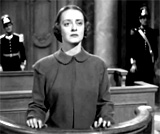
Henriette's Courtroom Testimony
|
Her Long Walk Upstairs
|
Duc's Deathbed Scene
|
- the scene of Henriette's long walk up the stairs to
the deathbed of Duc de Praslin
after he took poison, and his refusal to admit, to Henriette's face
and to the authorities, that he loved her ("Did you love this woman?")
- knowing that if he did, she would be blamed as complicit in the
Duc's own bloody murder of his wife; she also responded: "There is
nothing I need to say"
- however, he whispered his love of Henriette
into the ear of his loyal servant Pierre (Harry Davenport): "Yes,
yes, I love her with every drop of blood in me I worship her. She's
my heart. She's my lost soul I've been searching for. And I would
have sent her to her death....Yes, yes, Pierre, tell her, say the
words I could never say to her. Did she know? I think so. I think
she knew. They can never harm her now"
- the film's conclusion when the schoolgirls sympathically
accepted their new teacher with love, friendship and forgiveness,
and Henriette expressed how she had found faith again
|
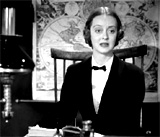
French teacher Henriette Deluzy Desportes (Bette Davis)
- Before a Lengthy Flashback

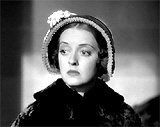

Henriette's Snow Globe
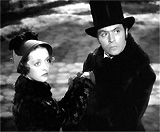
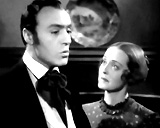
Henriette with Duc
|
|
Allegro Non Troppo (1976, It.)
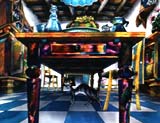
- the heart-rending and nostalgic segment called "Feline
Fantasies" -- of a lonely, emaciated, stray kitty-cat exploring the
decaying, abandoned and crumbling tenement of its former owner, now
surrounded by modern structures
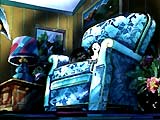
- the cat's remembrances when the house was full of
life and people, and the various pleasures it experienced, such as
clawing at a bird cage, roaming through a colorful kitchen full of
the smells of cooking food, and how it lounged on a cushy armchair
-- to the soundtrack of Jean Sibelius' mournful Valse Triste (The
Sad Waltz)
|
|
|
Remembering Former Pleasures
|
- at the film's climax, the cat realized that its
dreams of happiness would never again be realized, and it appeared
the fade away
- in the final scene, a
wrecking ball demolished what was left of the former house
|

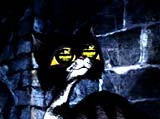
Cat Exploring an Abandoned Tenement Building
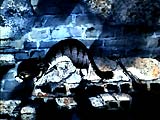
Emaciated Cat
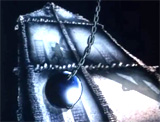
Wrecking Ball
|
|
Always (1989)
- Steven Spielberg's romantic fantasy - a remake of
the WWII-era romantic drama A Guy Named Joe (1943)
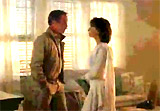
- the scene of Dorinda
Durston (Holly Hunter) fearing that her lover, forest
fire-fighting pilot Peter Sandrich (Richard Dreyfuss), would die from
his risky occupation: ("I love you, Pete, but I'm not enjoying
it. Every time you take off, every time you leave the ground, I wait
for the phone to ring. I go to bed sick and I get up scared. I don't
- I don't like being sick inside all the time. Do you think
I like being afraid that you're never gonna come back?"),
followed shortly by his explosive and tragic
death when he had just heroically saved the life of his best friend
Al Yackey (John Goodman) during a fire-fight, who prematurely exclaimed: "Oh,
that lucky son-of-a-bitch!"
- the many scenes of the ghost
of Peter and his unrequited love for his still-living lover Dorinda,
including the scene in which he agonized over watching her dance
and kiss Ted Baker (Brad Johnson), crying out to angel Hap (Audrey
Hepburn): ("Oh,
Hap! Take me out of here!")
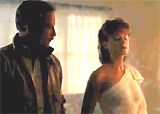
- the famous
scene in which Dorinda was dressed in the white, skin-tight "girls"
clothes he had bought her for her birthday, when he whispered a request:
("Can
I have this dance?"); they danced around her living room to
the tune of their favorite song - "Smoke
Gets In Your Eyes"
- his ghost accompanied her in perfect
synchronization without her knowing
|
|
|
Dance: "Smoke Gets In Your Eyes"
|
- Peter's tearful statement
to Hap: ("I'm
not ready to say good-bye")
- the scene of Pete's final farewell to Dorinda:
("..I love
you, Dorinda. I love you. I should have told you that a long time ago.
Any jokes, I should have said the words, because I know now, that the
love we hold back is the only pain that follows us here. And the memory
of that love shouldn't make you unhappy for the rest of your life.
I hope you can hear me, because I know this is true, from the bottom
of my heart, how good your life is, how good it will be")
- Pete's
"release"
of Dorinda after her emergency rescue plane crashed in water: ("Here's
the rest of your life, Dorinda. I want you to go to them. I'm releasing
you. I'm moving out of your heart. Go on. Go on...")
|

Pete's Death in Plane Crash During Firefight
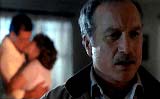
Ghost of Pete Agonizing Over Dorinda Kissing Ted
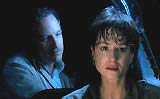
Pete's Final Farewell to Dorinda
|

|
Amelia (2009)
- the scene of the last conversation, by radio from New
Guinea, between publisher-promoter husband David Putnam (Richard Gere)
and his pioneering aviatrix, plucky wife Amelia Earhart (Hilary Swank)
in director Mira Nair's biopic, just before the last leg of her attempted
flight to circumnavigate the globe in early July, 1937. With cropped
hair and freckled skin, she promised him: "I'll be in Honolulu
on the 3rd and with you in Oakland on the Fourth of July, okay?" He
replied: "Don't keep me waiting." She responded: "I won't
dare." Putnam had a premonition of disaster, worried that her recovering-alcoholic
navigator Fred Noonan (Christopher Eccleston) wasn't up to the task: "So
what's that I hear in your voice? Is he drinking?" She assured
him: "I can handle it." He sighed and ordered: "Call
it off. Call it off now. Right now, Amelia. I mean it. Right now." She
softly repeated: "I can handle it." He then said: "After
the Fourth, we're going home." She smiled and asked: "Where
is that?" Putnam responded: "For me, anywhere you are."
- Amelia
put her hand to her mouth and tears welled up in he eyes, and then
composed herself: "I'm going to like it there. I'd better since this is
going to be my last flight." He softly responded: "If you
insist." She ended the call with: "I love you. Should I let
you go now?" He whispered back: "No, never. I'll go tell the
world you're on your way." She added: "See you - my darling." He
answered: "See you, my love."
- after Amelia's plane disappeared
without a trace on its flight to Howland Island in the Pacific, Putnam
sat and watched rough waves from a rocky shore, and gazed up into the
cloudy sky, as Amelia spoke in voice-over, and vintage photographs
were displayed: ("All the things I never said for so very long,
look up, they're in my eyes. Everyone has oceans to fly. As long
as you have the heart to do it. Is it reckless? Maybe. But what do
dreams know of boundaries? I think about the hands I have held, the
places I've seen, the vast lands whose dirt is caked on the bottom
of my shoes. The world has changed me"). No evidence of the
Electra airplane was ever found, even after a massive rescue mission.
|
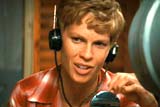
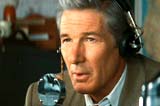
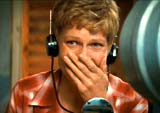
Last Conversation Between David and Amelia
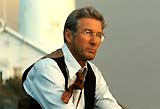
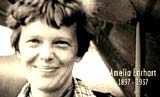
Tearjerking Ending
|
|
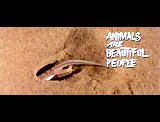
Animals Are Beautiful People
(1974, South Africa) (aka Beautiful People)
- James Uys' successful, anthropomorphic nature documentary
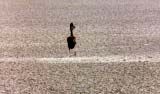
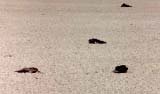
- the depressing scene in which a lake bed in the Southwest
African Namib Desert dried up under the scorching African desert
sun, forcing pelicans to abandon their chicks, who then began a fruitless
'death march' and died off one-by-one
|
|
|
Annie Hall (1977)
- in the film's conclusion, Alvy Singer's
(Woody Allen) wistful, resigned realization that his relationship with ex-girlfriend
Annie Hall (Diane Keaton) would remain just a good friendship, but also
that she would hold a special place in his heart, punctuated with a nostalgic
montage of their romance as Annie sang "Seems Like Old Times."
|
|
|
Applause (1929)
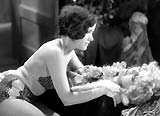
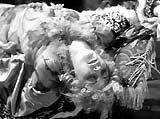
- in the heartbreaking ending, fading and "washed-up" burlesque
star Kitty Darling (Helen Morgan), the ailing, self-sacrificing
mother of convent-bred 17 year-old daughter April Darling (Joan
Peers), suicidally poisoning herself and slowly dying in her dressing
room, as April vowed to take her mother's place by forcing herself
to go out and dance sordid burlesque in front of leering, middle-aged
men. She defiantly vowed to give the crowd their 'money's worth':
("I'll
show them"), after telling her mother: ("Nothing matters
now but you, Mommy. We'll always have each other. Nothing is ever
going to separate us again")
|
Kitty's Suicide
|
|
August Rush (2007)
- the overly-sentimental, feel-good
fantasy story of a young orphaned boy and 11-year old child musical
prodigy August Rush/Evan Taylor (Freddie Highmore), who ran away
to NYC to find his long-lost birth parents: ("The music -
I thought if I could play it, they would know I was alive and fine
me")
- after miraculously receiving a scholarship to Julliard
School of Music, August was invited to conduct the New York Philharmonic
at its summer concert series in Central Park with his own Rhapsody
in C Major, but was taken away by the street-performing, Fagin-like
Wizard (Robin Williams) at the last moment; in a series of coincidences,
he was able to rush back to the concert stage in a tuxedo where
he led the orchestra -- and was reunited with his long-lost musically-gifted
parents Lyla Novacek and Louis Connelly (Keri Russell and Jonathan
Rhys Meyers)
[Note: they had conceived him during a one-night stand, but were
separated afterwards and the baby was given up for adoption.]
- in the concluding scene, the parent-couple found
themselves reunited in the audience (where they held hands), and
turned toward and were drawn to the stage where Evan conducted
- knowing that they had all found each other as the music reached
a crescendo
|
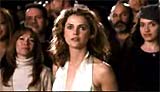
August's Mother Lyla Novacek (Keri Russell)
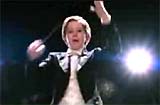
Conducting the New York Philharmonic
|
|
Awakenings (1990)
- Leonard Lowe's (Robert De Niro) "awakening"
from a sleeping sickness of 30 years following an epidemic of encephalitis
- after receiving dosages of the Parkinson's Disease experimental
drug L-Dopa
- Leonard's first meeting with his mother (Ruth Nelson)
since his recovery
- his glowing smile at taciturn neurologist Dr. Malcolm
Sayer (Robin Williams) from his bed when the other catatonic patients
were also awakened - followed by Leonard's re-discovery of the
world, zest for light and delight in simple things (i.e., brushing
his teeth) - and his slow heart-breaking relapse back into catatonia
|
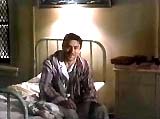
Leonard's Awakening
|