|
The Greatest Tearjerkers of All-Time
|
|
Title Screen
|
Movie Title/Year and Brief Tearjerker Scene Description
|
Screenshots
|

|
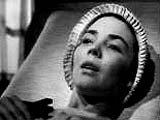
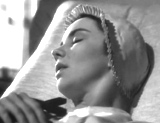
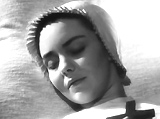
The Song of Bernadette (1943)
- Bernadette Soubirous/Mary Bernard's
(Jennifer Jones) death scene when her deathbed was surrounded by other
nuns and priests as the last rites were read. Bernadette worried that
she wouldn't ever see the Virgin Mary (Linda Darnell) again: ("Where
are you, Madame? Where are you? She's gone...I won't see her. I'll
never see her again. Never, never, I'll never see...")
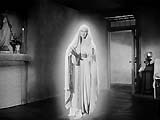
- about at the moment of death, she raised her head
from the pillow and experienced a final visitation from the Virgin
Mary who held out her arms, and smiled. Bernadette responded: ("I
love you! I love you! Holy Mary, Mother of God. Pray for me.")
- after
her death, Father Peyramale (Charles Bickford) stated:
("You are now in Heaven and on Earth. Your life begins, O Bernadette").
- superimposed bells began to peal from the church tower,
and there was a chorus of "Hallelujahs,"
as the film concluded
- her death scene was coupled with the film’s climactic
final moment when the cold hearted, atheistic local prosecutor Vital
Dutour (Vincent Price), dying of throat cancer, stood before the
grotto of the Virgin and suffered a crisis of faith
|
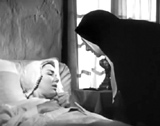
Bernadette on Her Death Bed
|

|
Sophie's Choice (1982)
 #3 #3
 #18
#18
- the flashback scene of the excruciating,
heart-rending 'choice' that Polish woman Sophie Zawistowska (Meryl
Streep) had to make in a concentration camp with a Nazi officer.
First, the officer told her that she was beautiful and he propositioned
her: "I'd like to get you in bed." He then asked: "Are
you a Polack?" She answered, trembling: ("I am a Pole!
I was born in Krakow. I am not a Jew. Neither are my children. They're not Jews.
They are racially pure. I'm a Christian. I'm a devout Catholic").
He slowly turned and asked a second time: "You're not a communist?...You're
a believer," to which she affirmed: "Yes sir, I believe
in Christ."
- after obliquely referring to one of Christ's
sayings: "Suffer the little children," he gave her a fateful
choice: "You may keep one of your children." Sophie stuttered
back: "I beg your pardon?" He repeated his order: "You
may keep one of your children. The other one must go." She
asked: "You mean, I have to choose?" He responded: "You're
a Polack, not a Yid. That gives you a privilege. A choice." She
affirmed three times: "I can't choose." He threatened: ("Choose!
Or I'll send them both over there. Make a choice!").
She begged: ("Don't make me choose! I can't!") Exasperated,
he ordered: ("Take both children away!"). She made
a heart-wrenching ultimate decision: ("Take my little girl! Take
my baby"). As her screaming daughter was taken away, Sophie's
face displayed agonizing pain
|
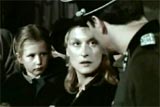
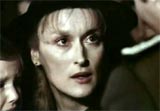
Officer: "You may keep one of your children"
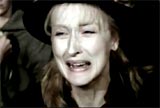
An Agonizing Choice Between Her Two Children
|

|
Sounder (1972)
#42
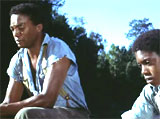
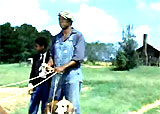
- the sentimental and authentic coming-of-age story
of eldest son David Lee Morgan (Kevin Hooks), in a sharecropper
family in Louisiana during the Depression Era of the 1930s raising
sugar-cane
- the return of injured family dog Sounder, although
wounded from a gunshot from a deputy's shotgun when defending the
family (when Nathan was taken by police to jail)
- the jail scene in which
a racist guard wrecked young David's chocolate cake, under
the premise of searching for weapons (while white visitors went unchecked).
As he poked in about 10 places into the cake with a switchblade,
he explained: ("Can't be too careful, boy, jest might be a steel
file or a hacksaw in it"). David was bringing his mother Rebecca's
(Cicely Tyson) baked cake to his jailed father Nathan Lee Morgan (Paul
Winfield), who had been convicted of "unlawful trespass and robbery" (he
was trying to provide food for his family). Nathan was on his way to
serve one year in a labor camp. David had to apologize for the cake's
appearance: ("This
was a real cake before the man outside put all these holes in it.")
Fortunately, his father didn't mind: ("Aw, that don't make no
difference. If I know your mama, a few ol' knife holes ain't goin'
destroy the soul that she gotta put in this cake. Here, now, have
a piece with your Daddy")
- David's fantasy-dream sequence of his father's return
from prison labor camp, in which he greeted his beloved, returning
father Nathan (with outstretched arms in a field)
- the long odyssey of David and Sounder journeying on
foot to the Wishbone Labor Camp to speak to his father, but they
couldn't locate him and they were chased away by guards at the gate
because it wasn't visiting day
- the overdue return home of a limping Nathan
from the prison camp (a lone figure on the road), let go early because
of his leg injury due to a dynamite blast. His return was signaled
by Sounder's barking, and he was joyfully greeted by his resolute
wife Rebecca
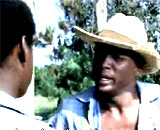
- David's worry that
soon after his father's return, he would be leaving to go to school:
("You just got home, I want
to stay home, and be with you"), after an invitation by a
dedicated black schoolteacher Miss Camille Johnson (Janet MacLachlan).
David argued with his father and insisted on staying home, although
Nathan argued otherwise: (David: "But Daddy, who's gonna help
you in the field? Your leg is hurt. You can't work like you used to.
Who's gonna help you around the house?" Nathan: "If I had
both of my legs cut off, I could do more work in that field than you
could in a hundred years")
- Rebecca reminded Nathan
of the boy's dedication: ("He missed you a grave big while you was gone. He sweated and worried
to find out just where you were, and made that long journey. You're
home, and it's only a natural thing for him to be with ya now.").
Nathan reasoned with David: ("There ain't nobody here but them bastards
that sent me..well. Son, don't get too used
to this place, because wherever you is, I'm gonna love you. Not only
me, your mama, Josie Mae and Earl, we gonna love you even more. We
gonna come and see you at that school every chance we get. I love
you, son. Don't ever think that I don't love you. Don't you think
we're gonna get to be friends?")
|
|
|
|
Decisions to be Made About David Attending
Miss Camille's School
|
- the final scene of David's departure to school with
his father and Sounder on a wagon: ("You know somethin', Daddy...I'm
gonna miss this ol' raggedy place. But I sure ain't gonna worry
'bout it!")
|
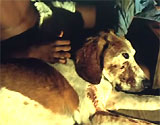
Injured Family Dog 'Sounder'
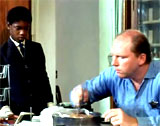
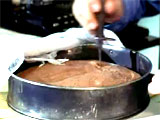
Jail Scene: Guard Destroying David's Cake For His Father
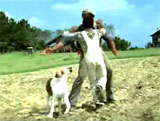
Fantasy-Dream of Father's Return
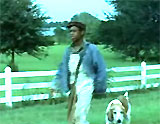
David and Sounder's Attempt to Visit Labor Camp
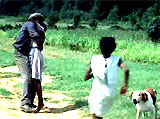
Father Nathan's Return Home
|

|
Soylent Green (1973)
- Sol Roth (Edward G. Robinson
in his final film role) had chosen to die in an assisted-suicide
facility known as the "Home" (within Madison Square Garden).
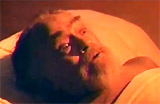
He had selected a poignant, painless and suicidal death in the euthanasia
clinic's chamber
- after his arrival, Sol answered questions from an
attendant about his favorite color (orange) and favorite music (light
classical) before being led in by another yellow-uniformed usher
(Dick Van Patten) to one of the clinic's private chambers; he was
placed on a comfortable bed in the orange-hued room amidst his choice
of light classical music playing during the assisted-suicide procedure;
he had been promised that it would last for 20 minutes
- during the moving deathbed
sequence, Detective Thorn (Charlton Heston) arrived at the "Home" and
demanded to see Sol and stop the euthanasia procedure, but he was
too late; he was restricted and only allowed to watch from a viewing
room adjacent to Sol's chamber
- Sol was put to rest (to "go
home") with orange-hued lighting, classical music playing (Tchaikovsky's "Pathetique" Symphony
No. 6, Beethoven's "Pastoral" Symphony No. 6, and segments
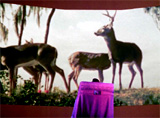
of Grieg's "Peer Gynt Suite") and projected video (of a peaceful
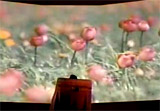
and "beautiful" green Earth ages ago when animal and plant
life thrived and there was no pollution)
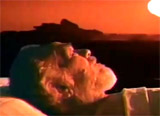
- he died
amidst the musical and visual montages with his tearful friend Thorn
(who shed real tears due to the real-life poignancy of the dying
Robinson) near him in a nearby sealed control room. Before dying,
Sol told Thorn: ("I've
lived too long.") Thorn
replied: ("I
love you, Sol.") Thorn was astounded by the images: ("How
could I know? How could I, how could I ever imagine?")
|
|
|
|
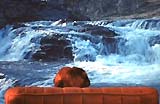
|

|
|
Death of Sol Roth in Euthanasia Center
|
- and then after the wide-screen turned off and went
black, Sol urged Thorn in his last dying words to expose the terrible
truth of what he had learned about Soylent Green and its major secret
- without describing any details; his discovery had prompted him
to choose assisted suicide with a lethal drug: "Horrible. Simonson.
Soylent. Listen to me, Thorn. Thorn, listen....You've got to prove
it, Thorn. Go to the Exchange. Please, Thorn. Prove it, Thorn. The
Exchange"
- once Sol expired, bright lights were turned back on
and the two attendants wheeled his bed out of the room on tracks
through a wall opening
|
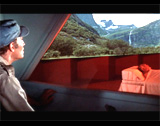
Thorn in an Adjacent Viewing Room To Witness Sol's Euthanasia
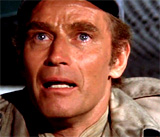
Thorn Shedding Tears Over the Gorgeous Beauty of a Past Earth, and Sol's Passing
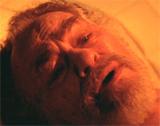
Sol's Last Dying Words to Thorn: "Please, Thorn. Prove it, Thorn. The Exchange"
Sol's Actual Death - The Orange Light Was Extinguished
|

|
Spartacus (1960)
#81
- after the quelling of the slave
revolt, the moment when Spartacus was called forth by the Romans
to reveal himself, and all of the slaves cried out to protect him: ("I'm Spartacus!")
- the duel to the death between
Antoninus (Tony Curtis) and Spartacus (Kirk Douglas) when they were
forced to fight against each other by Crassus (Laurence Olivier)
"They will fight now, for me, here, and to the death, and the victor
shall be crucified") - with Spartacus' killing of Antoninus to spare
him from crucifixion: (although Antoninus had told Spartacus repeatedly:
"I won't let them crucify you");
Antoninus delivered dying words to Spartacus: "I love
you, Spartacus, as I love my own father."
Spartacus replied: "I love you, like my son that I'll never see.
Go to sleep")
- the closing
scene in which Varinia (Jean Simmons) held up their newborn son to
a crucified Spartacus: ("This
is your son. He's free, Spartacus, free. He's free. He's free. He'll
remember you, Spartacus, because I'll tell him. I'll tell him who his
father was, and what he dreamed of").
- forced to move along, she
grasped his ankle for a few last words, begging him to die: ("Oh,
my love, my life. Please die, die. Please die, die my love. Oh, God,
why can't you die?...(Looking back) Goodbye, my love, my life. Goodbye,
good-bye")

|

|

|

|

|

|
|
Varinia to Crucified Spartacus As She Rode Off: "Goodbye,
my love, my life."
|
|

The Film's Most Famous Scene: "I'm Spartacus"

Crassus (Laurence Olivier) Ordering Spartacus to Fight Antoninus
To the Death

Before Duel to the Death, Antoninus Vowed to Spartacus: "I won't
let them crucify you..."

Antoninus' Dying Words to Spartacus ("I love you, Spartacus...")
|

|
Splendor in
the Grass (1961)
- the school scene of teenaged Wilma Dean ("Deanie")
Loomis' (Natalie Wood) interpretation of the "splendor
in the grass" - Wordsworth's 1807 poem:
What though the radiance
which was once so bright
Be now forever taken from my sight,
Though nothing can bring back the hour
Of splendor in the grass, of glory in the flower,
We will grieve not, rather find
Strength in what remains behind
(Deanie: "Well, I think
it has some...Well, when we're young, we look at things very idealistically,
I guess, and I think Wordsworth means that when we grow up, that
we have to forget the ideals of youth and find strength..."),
before she became overwhelmed, and asked to be excused from the classroom
- the
emotionally devastating sequence of Deanie's steam bath
(and her strict mother's (Audrey Christie) questioning about her being
possibly devirginized): (Mother: "Deanie, how serious
had you and Bud become? I mean, well, you know what I mean. Deanie
- had he - had anything serious happened? Did he - did he spoil you?" Deanie: "Spoil???
Did he spoil me? No. No, Mom!
I'm not spoiled! I'm not spoiled, Mom! I'm just as fresh and I'm virginal
like the day I was born, Mom!... I'm a lovely virginal creature who
wouldn't think of being spoiled! I've been a good little girl, Mom!
I've been a good little, good little, good little girl! I've always
done everything Daddy and Mommy tell me. I've obeyed every word. I
hate you, I hate you, I HATE YOU!") - she ran naked down the hallway
- the sequence of Deanie's attendance at the Bon Voyage
Grads dance (held in the school gym) in a red, slinky outfit, with
the objective of seducing and warming up her cold-hearted ex-boyfriend
Bud -- she made desperate sexual advances toward him - to consummate
her feelings for the greatest love of her life, and lustfully risked
everything when she begged him to make love to her - unfortunately,
Bud rebuffed and rejected her during the failed reunion - for not
being 'herself' ("a nice girl") and for denying her pride
(Deanie: "My
pride? MY PRIDE!!...Oh, God. I haven't any pride. I HAVEN'T ANY PRIDE!...I
haven't any pride. I just want to die. I just want to die")
- as a result of the rejection, Deanie's emotional
frailty caused suicidal thoughts and her tortured madness to resurface;
she made a drowning suicide attempt
at the waterfall when she jumped into the river while despairing
over Bud - she was rescued by onlookers, and subsequently hospitalized
in a sanitarium
- the final sequence of her bittersweet reunion
with ex-boyfriend Bud years later (who has
since married Italian immigrant waitress Angelina (Zohra Lampert)
and had an infant son) while wearing a virginal white dress outfit
and hat
- their conversation was brief and revealing when she
realized that the affection that they once had could never be recovered
- after the visit, she was calm
and newly aware, and able to put aside youthful exuberance, grieving,
and denial of love to move forward. She recollected the Wordsworth poem
(in voice-over) and its meaning after being asked by her old high
school friends in the car: ("Do
you think you still love him?"): "Though nothing can
bring back the hour of splendor in the grass, glory in the flower,
we will grieve not; rather find strength in what remains behind."
|
|
|
Reunion With Bud - And Deanie's Realization That Her
Love For Bud Had Passed
|
|
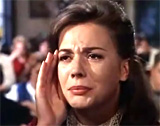
Wilma Dean's Recitation of "Spendor in the Grass" Poem
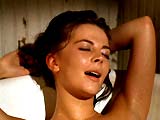
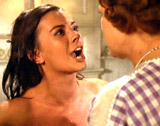
Deanie's Emotional Steam Bath
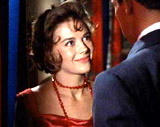
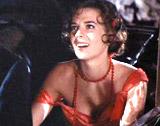
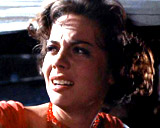
Deanie Desperate to Make Love to Bud: "I Haven't Any Pride!"
|

|
Stage Door
(1937)
- the emotional suicide scene
of depressed aspiring actress Kaye Hamilton (Andrea
Leeds) - who had ascended the staircase while hearing imaginary applause
before committing the deed
- the reaction to Kaye's suicide by rich/refined
actress friend Terry Randall (Katharine Hepburn): ("I've
got to get out of here. I'm not going on...Why didn't someone tell
me? I would have given up a thousand times rather than have this
happen. I'm going to go out there and tell them I'm not going to
go on. And I'm going to tell them why"),
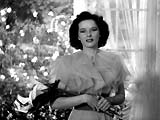
but then Terry's memorable on-stage tearful rendition of the "calla
lilies are in bloom...": ("The calla
lilies are in bloom again. Such a strange flower, suitable to any occasion.
I carried them on my wedding day, and now I place them here in memory
of something that has died...Have you gathered here to mourn, or
are you here to bring me comfort?...")
|
|
|
Terry: "The calla lilies are in bloom again"
|
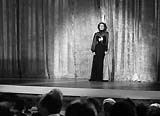
Terry's Curtain Call Speech
|
- Terry's mournful curtain
call speech: ("...I'm
not responsible for what happened on this stage tonight. The person
you should be applauding died a few hours ago...")
|
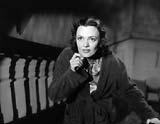
Kaye Ascending Staircase Before Committing Suicide
|
|
Stand By Me (1986)
#17
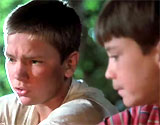
- this coming-of-age film was mostly
told in flashback, about the adventures of a quartet of young boys:
Gordie Lachance (Wil Wheaton), Chris Chambers (River Phoenix), Teddy
Duchamp (Corey Feldman), and Vern Tessio (Jerry O'Connell)
- two of four schoolboy buddies in their town of
Castle Rock in Oregon in 1959, Vern and
Teddy walked along railroad tracks as they
had a discussion about Mighty Mouse vs. Superman:
Vern: Do you think Mighty Mouse could beat up Superman?
Teddy: What are you, cracked?
Vern: Why not? I saw the other day, he was carrying five elephants
in one hand.
Teddy: Boy, you don't know nothin'. Mighty Mouse is a cartoon. Superman
is a real guy. No way a cartoon could beat up a real guy.
Vern: Yeah, maybe you're right. It would be a good fight, though
- intercut with the scene was another conversation between
the two other schoolboys walking along behind them at the same time
- tough
Chris Chambers (River Phoenix) and quiet/studious Gordon "Gordie" Lachance
(Wil Wheaton):
Chris: You could be a real writer someday, Gordie.
Gordie: F--k writing!
I don't want to be a writer. It's stupid. It's a stupid waste of time.
Chris: That's your dad talking.
Gordie: Bulls--t!
Chris: Bulltrue! I know how your dad
feels about you. He doesn't give a s--t about you. Denny was the one
he cared about, and don't try to tell me different. You're just a kid,
Gordie.
Gordie: Oh, gee, thanks dad.
Chris: Wish the hell I was your dad. You wouldn't be goin' around talking
about taking these stupid shop-courses if I was. It's like God gave you
something, man. All those stories that you can make up. An' he said:
This is what we got for you, kid, try not to lose it. But kids lose everything
unless there's someone there to look out for them. And if your
parents are too f--ked up to do it, then maybe I should.
- and later that night,
Chris explained to Gordie that he was always labeled a 'low-life'
due to his family's 'black-sheep' reputation as criminals and alcoholics.
He told a story about how he had stolen 'milk money' and was given
a "three-day vacation" when a teacher betrayed his trust
after he gave back the money: (Chris: "It's
the way the people think of my family in this town. It's the way
they think of me. I'm just one of those low-life Chambers kids...I
was the stupid one for even trying to give it back. I just never
thought, I never thought that a teacher... Who gives a f--k anyway?
I just wish that I could go some place where nobody knows me. (sobbing)
I guess I'm just a pussy, huh?")
- Gordie's last hopeful words to Chris who felt trapped,
as they said goodbye: "You can do anything you want, man";
followed by the Writer's voice-over summary of everyone's fate: "Chris
did get out. He enrolled in the college courses with me. And although
it was hard, he gutted it out like he always did. He went on to college
and eventually became a lawyer. Last week, he entered a fast-food
restaurant. Just ahead of him, two men got into an argument. One
of them pulled a knife. Chris, who had always made the best peace,
tried to break it up. He was stabbed in the throat. He died almost
instantly"
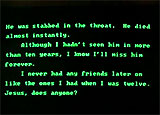
- the film's last line (accompanied by Ben E. King's
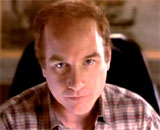
title theme song) in which the Writer (Richard
Dreyfuss) lamented as he typed: ("Although
I hadn't seen him in more than ten years, I know I'll miss him forever.
I never had any friends later on like the ones I had when I was twelve.
Jesus, does anybody?")
|
|
The Writer (Gordie) - Typing On His Computer:
"I never had any friends later on..."
|
|
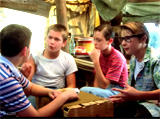
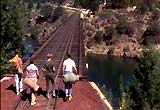
Four Boyhood Friends
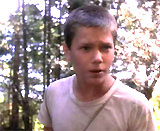
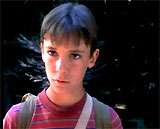
Chris to Gordie: "You could be a real writer someday, Gordie"
Chris and Gordie's "Milk Money" Talk
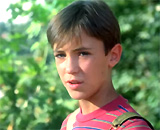
Gordie to Chris: "You can do anything you want, man"
|

|
A Star Is Born (1954)
#31
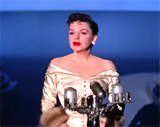
- the scene of singer Esther Blodgett/Vicki
Lester (Judy Garland) singing the first chorus of "Lose That
Long Face"
followed by her breakdown in the dressing room confessional scene with
Oliver Niles (Charles Bickford) regarding her alcoholic husband Norman
Maine (James Mason): ("What is it that makes him want to destroy
himself?...You don't know what it's like to watch somebody you love
just crumble away bit by bit, day by day, in front of your eyes, and
stand there helpless. Love isn't enough, I thought it was. I thought
I was the answer for Norman. But love isn't enough for him....Sometimes,
I hate him. I hate his promises to stop, and then the watching and
waiting to see it begin again. I hate to go home to him at nights and
listen to his lies...I hate me cause I've failed too...All he's got
left is his pride"); afterwards, she forced herself to go back
on stage to sing the song again
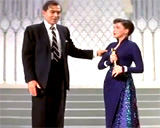
- the classic sequence at the annual Academy Awards
Banquet Ceremony - and Vicki's win and acceptance speech for receiving
the Best Actress Academy Award Oscar - and drunken Norman's intrusive
entrance and interruption of Vicki's speech with his own self-pitying
speech (while he stumbled around): "Congratulations, my dear.
I made it just in time, didn't I? May I borrow the end of your speech
to make a speech of my own? My method for gaining your attention
may seem a little uncon-unconventional, but, uh, hard times call
for harsh measures. My - I had my speech all prepared, but I - it's
gone right out of my head. Let me see - why, it's silly to be so
formal, isn't it? I-I know most of you sitting out there by your
first names, don't I? I made a lot o' money for you gentlemen in
my time through the years, didn't I? Well, I need a job now. Yeah,
that's it. That-that-that-that's the speech. That's the - I need
a job. That's what I wanted to say. I - I need a job. It's as simple
as that. I - I need a job, that's all. My talents, I may say, are
not confined to dramatic parts. I can play comedy, too" - and
then the shocking moment when he flung his arm out and accidentally
struck his wife while demanding recognition
- the
prelude to Vicki's husband Norman's suicide, when he announced that
he was going to start his changed life with a healthy regimen of
swimming ("a happy mind...a happy body") - to turn his life around.
He said he was "fit as a fiddle and ready for love." He
suggested "some changes around the house" to his unsuspecting
wife Vicki to liven it up. He suggested she prepare
hot soup and sandwiches as a meal for after his swim. When
he requested that she sing a song for him, she thought it silly,
and said she would open the kitchen windows so he could hear her
from there. He then made one final request, stopping short to take
one long look at her before she walked away out of view: ("Hey
- I just wanted to look at you again"). As
Norman walked outside onto the deck, he heard her singing from
afar: "It's a New World" - her voice
continued to be in the background for the remainder of the sequence.
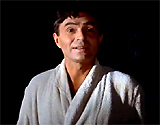
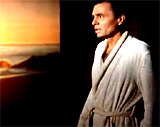
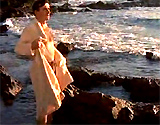
Norman began to walk toward the ocean (seen reflected in the glass
doors) and came up to the water, where he removed his outer robe. In
a long shot, he began to walk toward the setting sun on the horizon
- and committed suicide by drowning himself (off-screen). His cast-aside
robe was caught by the rising tide and washed away.
- in the film's memorable conclusion, one of the greatest
endings of any movie in the 1950s, Vicki was escorted by her studio
accompanist Danny McGuire (Tommy Noonan), to show up to sing at a
scheduled Shrine Theatre benefit; she passed by a wall with the heart
and arrow drawn in lipstick by Norman so many months before (E.B.
& N.M.); at the last minute, she was persuaded to come out of mourning
to perform; in front of the curtain, the emcee (Rex Evans) was announcing
that she would not be appearing, but after receiving a whispered
message from Danny, he then excitedly announced: "Vicki
Lester will appear tonight!"
- the unforgettable poignant ending and closing tribute
line to her husband in front of a large audience at the Shrine Theatre,
in a spotlight (as she identified herself: "Hello everybody
- this is - Mrs. Norman Maine") - there was a slight
pause and silence, and then the audience stood and burst into ecstatic
applause - the camera pulled back slowly, ending with a long shot
of Esther smiling through her tears
|
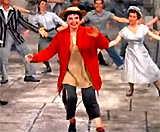
"Lose That Long Face"
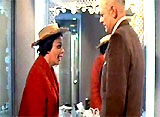
Esther's/Vicki''s Dressing Room Breakdown About Her Alcoholic
Husband to Oliver Niles
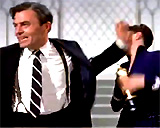
Drunken Norman's Embarrassing Appearance at Academy
Awards
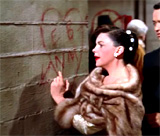
Heart Drawn on Wall
Vicki's Unexpected Appearance at the Shrine Theatre
"Hello everybody - this is - Mrs. Norman
Maine"
|

|
Star
Trek: Generations (1994)
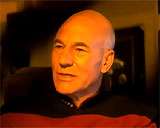
- the sentimental scene of Captain Jean-Luc Picard
(Patrick Stewart) looking at his family memories photo album, and
commenting about the death of his brother Robert and nephew Renee
in a fire, to ship's counselor Commander Deanna
Troi (Marina Sirtis), when he became choked-up and sobbed:
("These
things happen...I've been thinking about, about all the experiences
that Renee's not gonna have -- going to the Academy, reading books,
listening to music, falling
in love ... building a life. Well, it's not going to happen
now....I'd come to feel that Renee was as close as I would
get to having a child of my own....When Robert married and had
a son, I..."); she finished his sentence: ("You felt
it was no longer your responsibility to carry on the family line")
- Picard continued: ("Right. Yes. That's it
exactly. You know, Counselor, recently I've become very much aware
that there are fewer days ahead than there are behind. But I took
some comfort from the fact that the family would go on. Now, there'll
be no more Picards")
- the self-sacrificial death of
Captain James T. Kirk (William Shatner) after plunging off a blown-apart
bridge into a rocky chasm-ravine - he had just helped Captain Jean-Luc
Picard destroy a doomsday missile - designed by crazed maniac Dr.
Tolian Soran (Malcolm McDowell) - to blow up the planet Veridian
III's sun and consequently kill 230 million people; as
Kirk lay mortally-wounded under the wreckage, he was assured by Picard
that they "made
a difference." He half-whispered his final words to Picard:
("Did we do it? Did we make a difference?...(The)
least I could do ... for the Captain of the Enterprise.
It was...fun. (His eyes widened in astonishment, then he breathlessly
added before dying) - Oh, my....")
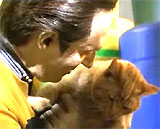
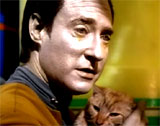
- the finale in which android Lt. Commander Data
(Brent Spiner) - embedded with an emotion chip - was reunited with
his cat Spot, when the animal was found alive and well after the U.S.S.
Enterprise had crashed. He surprised himself by crying yellow
tears: (Data: "At first I was unprepared for the unpredictable
nature of the emotions. However, having experienced two hundred and
sixty-one distinct emotional states, I believe I have learned to
control my feelings. They will no longer control me....(He discovered
Spot and was suddenly overwhelmed with emotion.) Spot! I'm very happy
to see you, Spot...I am uncertain, Counselor. I am happy to see Spot,
and yet I am crying. Perhaps the chip is malfunctioning?"
- Deanna reassured Data: "I think it's working perfectly")
- in the final scene, Picard's delivery of closing
thoughts to Cmdr. William T. Riker (Jonathan Frakes), his "Number
One",
as they surveyed the damage to the USS
Enterprise:
("Someone once told me that time is a predator that stalked us all our lives.
And I rather believe that time is a companion who goes with us on the
journey, and reminds us to cherish every moment, because they'll
never come again. What we leave behind is not as important as
how we lived. After all, Number One, we're only mortal"). Riker
replied: ("Speak for yourself, sir. I plan to live forever").
The two were beamed up to the Farragut, as Picard mused: ("Somehow
I doubt this will be the last ship to carry the name Enterprise")
|
Captain Picard's Comments About Death

Self-Sacrificing Death of Capt. Kirk
Lt. Comm. Data's Emotional Reunion With His Cat Spot
Data Crying Yellow Tears
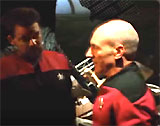
Picard's Closing Thoughts to Cmdr. Riker
|