|
The Greatest Tearjerkers of All-Time
|
|
Title Screen
|
Movie Title/Year and Brief Tearjerker Scene Description
|
Screenshots
|
|
The Fly (1986)
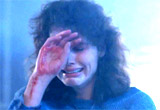
- the scene in which girlfriend/lover Veronica Quaife
(Geena Davis) felt hairs growing on the back of a slowly-degenerating
Seth Brundle (Jeff Goldblum) after he had teleported himself
- a degenerating
Seth's ear fell off in front of Veronica, and he clutched her in
fear and whispered:
"I'm scared. Help me. Please"
- Seth's "insect politics"
speech in which he begged Veronica to leave and never return for her
own safety: "You have to leave now, and never come back here.
Have you ever heard of insect politics? Neither have I. Insects don't
have politics. They're very brutal. No compassion, no compromise.
We can't trust the insect. I'd like to become the first insect politician.
You see, I'd like to, but, oh, I'm afraid, uh... I'm saying, I'm
saying, I-I'm an insect who dreamt he was a man but he loved it.
But now the dream is over and the insect is awake....I'm saying:
'I'll hurt you if you stay.'"
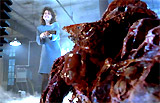
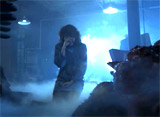
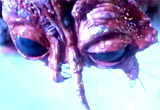
- the poignant, tearjerking concluding scene
in which an anguished Brundlefly, having turned into a piteously
deformed creature during a failed experiment to fuse with Veronica
and their unborn child, wordlessly begged her to end his monstrous
life with a shotgun, and Veronica's act of compliance - tearfully
collapsing to her knees on the floor after the merciful deed was
accomplished
|
|
|
|
Veronica's Mercy-Killing of Brundlefly
|
|
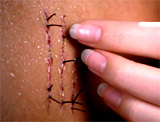
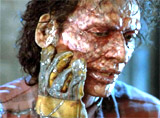
"I'm scared. Help me. Please"
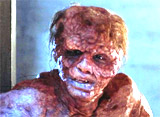
"Insect Politics"
|
|
For Whom the Bell Tolls (1943)
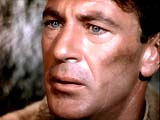
- the conclusion in which ill-fated
hero American mercenary Robert Jordan (Gary Cooper) delivered his
final soliloquy to blue-eyed, short-haired, blonde Maria (Ingrid
Bergman) when he chose to be left behind to meet his certain death
after he blew up a bridge and suffered a broken leg: ("You
go now, Maria...what I do now I do alone. I couldn't do it if you
were here...There's no good-bye, Maria, because we're not apart")
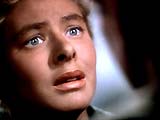
- in the dissolve ending, smoky machine-gun fire and
a bell tolled his fate
|
Robert to Maria: "You go now, Maria"
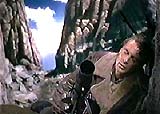
Robert's Death
|
|
Forever Young (1992)
- the contrived yet bittersweet reunion scene ending
in this romantic sci-fi tale in which test pilot Capt. Daniel McCormick
(Mel Gibson), having been cryogenically frozen for over 50 years
in a military warehouse, rapidly aged to his chronological age,
woke up in the present when freed from his cyrogenic chamber by
two mischievous kids, and rejoined his now-elderly childhood sweetheart
Helen (Isabel Glasser) - and they hugged, kissed, and walked off
as an elderly couple together after he asked her to marry him -
their love conquered all
|
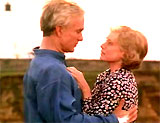
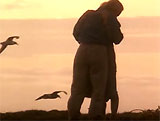
Reunion Scene Between Elderly Capt. McCormick and Helen
|

|
Forrest Gump (1994)
 #11 #11
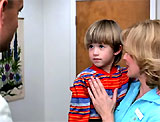
- the scene in which true love
Jenny (Robin Wright) rejected idiot
savant Forrest Gump's (Tom Hanks) proposal for marriage - and
his reply in the hallway: "I'm not a smart man, but I know what
love is"
- and then Jenny entered into his bed to spend the
night with him and make love to him ("Forrest,
I do love you") and his
quiet sadness when she left him again the next morning
- and years later, the
scene in which they met up again and she showed him her scrapbook
of his running exploits and he met young Forrest, Jr. (Haley Joel
Osment) for the first time and was told that he was the father
of Jenny's very normal child: ("You're his daddy, Forrest")
and her reassurance: ("There's nothing you need to do, ok?
You didn't do anything wrong, ok?")
and his reply: ("He's
the most beautiful thing I've ever seen"); Jenny assured Forrest:
("He's very smart. He's one of the smartest in his class")
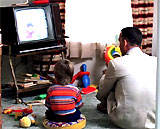
- and the scene of Forrest and his young boy
happily watching Sesame Street's Bert and Ernie on TV together
- Forrest's moving eulogy-meditation (partly in voice-over)
for his newly-wed bride Jenny at her gravesite under a tree after
she died of the AIDS virus: ("You died on a Saturday morning.
And I had you placed here under our tree. And I had that house
of your father's bulldozed to the ground. Mama always said that
dyin' was a part of life. I sure wish it wasn't. Little Forrest
is doin' just fine. About to start school again soon, and I make
his breakfast, lunch, and dinner every day. I make sure he combs
his hair and brushes his teeth every day. Teach him how to play
ping-pong. He's really good...We fish a lot. And
every night, we read a book. He's so smart, Jenny. You'd be so
proud of him. I am. He wrote you a letter. And he says I can't
read it. I'm not supposed to, so I'll just leave it here for you.
I don't know if Mama was right or if it's Lieutenant Dan. I don't
know if we each have a destiny, or if we're all just floatin' around
accidental-like on a breeze. But I-I think maybe it's both. Maybe
both is happening at the same time. But I miss you, Jenny. If there's
anything you need, I won't be far away")
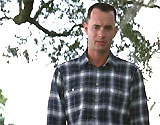
At Jenny's Gravesite
|
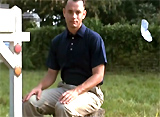
Floating Feather
|
- the final
image of a feather floating up into the sky at the school-bus stop
|
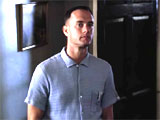
"I'm not a smart man, but I know what love is"
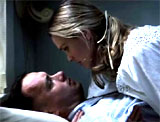
Love-Making Scene
Meeting Young Forrest, Jr.
|
|
42 Up (1998, UK) (TV)
#85
- the moving, troubling saga
of Neil Hughes (Himself) throughout Michael Apted's series of documentaries
following his life every seven years, from a charismatic 7 year-old
boy from a wealthy family to his nervous breakdown at age 28 to
homelessness at 35 - and his poignant recovery with a new close
friend at 42. (Note: He would end up as a successful politician
at age 49 in 49 Up! (2005).)
|
|
|
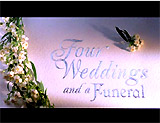
Four Weddings and a Funeral
(1994, UK)
#26
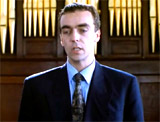
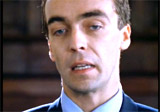
- at a moving funeral ceremony - the film's acting highlight
was Matthew's (John Hannah) words of remembrance for "jolly" and "splendid
bugger" Gareth (Simon Callow), Matthew's gay partner:
("I hope joyful
is how you will remember him. Not stuck in a box in a church"),
followed by his poignant reading of W. H. Auden's Funeral Blues at
the memorial service for: ("Stop all the clocks, cut off the
telephone, Prevent the dog from barking with a juicy bone, Silence
the pianos and with muffled drum, Bring out the coffin, let the mourners
come. Let the aeroplanes circle, moaning overhead, Scribbling on
the sky the message: He is Dead. Put crepe bows 'round the white
necks of the public doves, Let traffic policemen wear black cotton
gloves. He was my North, my South, my East and West. My working week
and my Sunday rest. My noon, my midnight, my talk, my song. I thought
that love would last forever: I was wrong. The stars are not wanted
now, put out every one. Pack up the moon and dismantle the sun. Pour
away the ocean and sweep up the wood, For nothing now can ever come
to any good.")
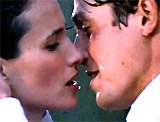
- in the final scene outside
Charles' home, after
an aborted 'fourth' wedding ceremony, American journalist Caroline "Carrie" (Andie
MacDowell) arrived in the rain to apologize for causing a disruption in Charles'
marriage; he was finally able to declare his utter and true love
for Carrie in the rain: (Charles: "There I was, standing
there in the church, and for the first time in my whole life, I realized
I totally and utterly loved one person. And it wasn't the person
standing next to me in the veil. It's the person standing opposite
me now - in the rain"; Carrie: "Is it still raining? I
hadn't noticed"); and then awkwardly, he did not ask
for her hand in marriage: ("But first, let me ask you one thing.
Do you think, after we've dried off, after we've spent lots more
time together, you might agree not to marry me? And do you
think not being married to me might maybe be something you
could consider doing for the rest of your life? Do you?") -
Carrie's response:
"I do," was accompanied by a kiss, and the camera rose into
the air to capture a lightning bolt in the sky
|
Matthew's Tribute to Gareth
Charles and Carrie in the Rain
|
|
Frankenstein
(1931)
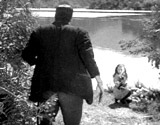
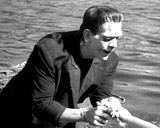
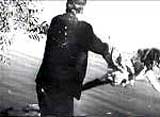
- the heart-breaking, initially-censored
scene in which the Monster (Boris Karloff) played with a little girl
named Maria (Marilyn Harris) at lakeside - she was not repelled by
his hideous appearance or fearful of him and invited him to play
and be her friend. They joined in a game of flinging flower-petals
into the lake, one-by-one, to watch them float. When the Monster's
few flower blossoms were gone, he puzzled for a moment at his empty
hands, and then innocently and ignorantly picked up Maria and tossed
her into the water - where she quickly sank and drowned
- he staggered
away from the lake - expressing some confusion, despair and remorse
- shaking and wringing his hands and possibly perceiving the horrible
thing he had just done
|
Death of Maria at Hands of Monster
|
|
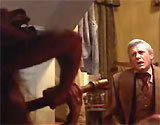
Fright Night (1985)
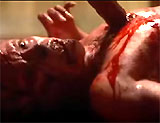
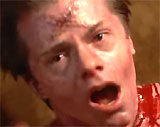
- the drawn-out, excruciating
yet poignant death of freshly-sired teenaged vampire "Evil" Ed
Thompson (Stephen Geoffreys) after being stabbed in the chest with
a wooden stake while in wolf-form, and attempting to remove the stake
from his body, all witnessed in pity and horror by washed-up B-movie
horror/vampire actor Peter Vincent (Roddy McDowall) as Ed transformed
back into his human form
|
|
|
Death and Transformation of Vampire "Evil" Ed Thompson
|
|
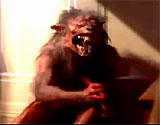
Ed's Wolf Form
|
|
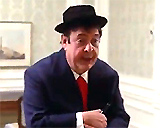
The Front (1976)
- the mentally-deteriorating, despairing
and troubled character of TV comedy actor and Grand Central host
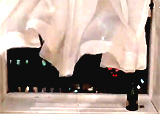
Hecky Brown (Zero Mostel) - including the scene in which he was fired for
being a suspected Communist and then committed suicide in his hotel room
by jumping from the window
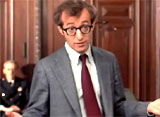
- the bittersweet finale when
cashier/bookie and 'front'-man Howard Price (Woody Allen) was testifying
before the HUAC and told the committee that he refused to give his
testimony and then left with the film's final line of dialogue: ("I
don't recognize the right of this committee to ask me these kind
of questions. And furthermore, you can all go f--k yourselves")
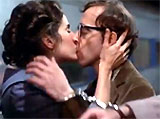
- the final sequence set at the train station, accompanied
by Frank
Sinatra's rendition of Young at Heart playing on the soundtrack,
when Howard kissed girlfriend Florence Barrett
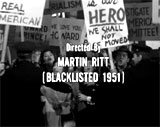
(Andrea Marcovicci) - revealing he was handcuffed to an officer and surrounded
by crowds waving signs of support ("We Won't Forget," "Free Howard
Prince!" and "Howard Prince, The Real American"), as
he boarded a train bound for federal prison - as the real-life dates
of blacklisting were posted after the director's, cast's and crew's names
|
|
|
Final Sequence at Train Station
|
|
Hecky's Suicide
"You can all go f--k yourselves"
|