|
The Greatest Tearjerkers of All-Time
|
|
Title Screen
|
Movie Title/Year and Brief Tearjerker Scene Description
|
Screenshots
|

|
Of Mice and Men (1939 and 1992)
- one of the saddest scenes of all time - the mercy-killing
of child-like brute Lennie (Lon Chaney, Jr./John Malkovich) by his
best friend and guardian George Milton (Burgess Meredith/Gary Sinise).
Lennie had accidentally killed Mae (Betty Field/Sherilyn Fenn), the
wife of the ranch boss' son Curley (Bob Steele/Casey Siemaszko),
and George was faced with killing his friend to spare him from Curley's
wrath and a lynch mob.
- before a tragic and tear-jerking mercy killing in the
film's final scene, George promised his friend that they would finally
have a place of their own - he distracted him with the retelling of
their dream of a ranch of their own, before shooting him in the back
of the head:
(1939 Version):
George: We're gonna have a little place...We're gonna have a cow,
pigs and chickens. And then down on a flat, we're gonna have
a field of alfafa.
Lennie: ...for the rabbits...and I get to tend the rabbits.
George: You tend the rabbits.
Lennie: And we could live off the fat of the land.
George: Just keep lookin' across that river. (He turned Lennie around)
Like you can really see it.
Lennie: Where?
George: Right there. Can't you almost see 'em?
Lennie: Where, George?
George: Keep lookin'. Just keep hopin'.
Lennie: Aw, I'm lookin', George. Aw, I'm lookin'.
George: It's gonna be nice, Lennie. There ain't gonna be no trouble.
No fights, there ain't gonna be nobody mean to nobody, steal from.
Things are gonna be right.
Lennie (excitedly): Yeah, I can see it. Right over there. George,
I can see it.
(1992 Version):
George: We're gonna get a little place...We're gonna have a cow,
and some pigs, and we're gonna have, maybe-maybe, a chicken. Down
in the flat, we'll have a little field of...
Lennie: Field of alfalfa for the rabbits.
George: ...for the rabbits.
Lennie: And I get to tend the rabbits...
Lennie's last pitiful words were about his oft-repeated
task.
[Note: Memorably remade in 1992 with John Malkovich
and Gary Sinise (pictured).] |
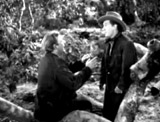
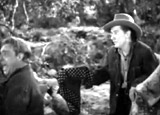
1939 Ending
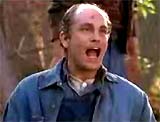
1992 Ending
|
|
An Officer and a Gentleman
(1982)
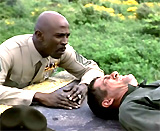
- the tough training of drill instructor Sgt. Emil Foley
(Louis Gossett, Jr.) - notably of naval candidate trainee Zack Mayo
(Richard Gere) who was powerfully determined to not quit his recruit
training: (Foley:
"I want your DOR...All right, then you can forget it! You're out!" Mayo: "I
ain't gonna quit...Don't you do it! Don't you - I got nowhere else
to go! I got nowhere else to g... I ain't got nothin' else. I got nothin'
else")
- the tragic scene of Mayo's buddy Sid Worley (David
Keith) committing suicide by hanging (in the nude in a motel bathroom)
after a failed relationship with his manipulative girlfriend Lynette
Pomeroy (Lisa Blount), a close friend of Zack's girlfriend Paula
Pokrifki (Debra Winger)
|
|
|
The Tragic Suicide of Zack's Buddy
Sid
|
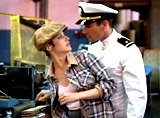
- the rousing, overly-sentimental, slightly-cheesy
tearjerking finale (a wish-fulfillment Cinderella conclusion),
in which graduate-trainee Ensign Zack Mayo (in his neatly-pressed
naval dress whites) came up to surprised paper factory worker/girlfriend
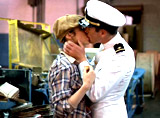
Paula at her workplace; she turned around - startled; then he planted
a second kiss on her by grabbing her face and giving her a more
intimate kiss
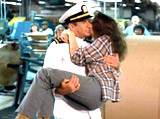
- as the scene continued, she placed her arms around
his neck during the kiss, as he hoisted her up and spun her around;
they kissed repeatedly; he grabbed her and carried her away to
the exit while she was in his arms, as co-workers applauded and
Paula's work friend Lynette Pomeroy called out: "Way to go,
Paula! Way to go!"
- the film concluded in a freeze-frame after she placed
his cap on her head, with the credits displayed to the tune of "Up
Where We Belong", performed by Joe Cocker and Jennifer Warnes
|
|
|
|
The Crowd-Pleasing 'Cinderella Story'
Ending
|
|
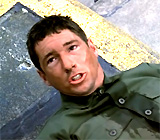
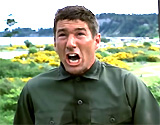
Foley: "I want your DOR!"
Zack: "I ain't gonna quit...I got nowhere else to go!"
|
|
The Old Maid (1939)
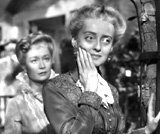
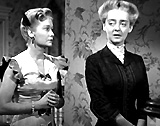
- in two dramatic scenes, unknowing, free-spirited
teenaged Clementina "Tina" (Jane Bryan), Aunt Charlotte
Lovell's (Bette Davis) love child whom she had secretly raised
out of wedlock, told her adoptive mother Delia Lovell Ralston (Miriam
Hopkins), Charlotte's cousin, disrespectful words about
how Aunt Charlotte was cruel, old-fashioned, and unfair - and
a 'ridiculous, narrow-minded old maid': "You think Mommy spoils
me but she doesn't. She understands me while you don't. Mommy knows
what it is to be young and have people fond of her. While you, you've
never been young"; in a second scene, Tina chastised her Aunt: "You've
got to know that I'm sick of your spying, fault-finding and meddling....she's
just a sour old maid who hates me because I'm young and attractive
and in love, while she's old and hideous and dried up and has never
known anything about love"
- in another classic tearjerker
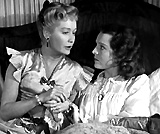
sequence: Aunt Charlotte entered Tina's bedroom on the night before
her wedding to young and handsome Lanning Halsey (William Lundigan),
and instead of divulging Tina's parentage, Charlotte was conciliatory
and kind; she offered tender words to Tina at her bedside, offering
congratulations and explaining her strict and critical love: "I
just came in to say good night and to wish you happiness. God bless
you, my child....If I've been severe with you at times, I haven't
meant it. I love you very much"
- in a rapprochement scene
between Charlotte and Delia, Charlotte accepted the fact that
both Clem (the father of Tina, who was also Delia's ex-suitor)
and Tina loved Delia more than they did her: "If
she never really belonged to me, perhaps it's because her father
never really belonged to me either. They're both yours. He loved
you and she loves you too. You're the mother she wants. Go in to
her, Delia. It's not your fault or mine. Don't feel sorry for me.
After all, she was mine when she was little"
- to assuage Charlotte, Delia informed Tina that Charlotte
had sacrificed her own happiness by refusing to marry a man who
did not want to raise Tina as his own: "She didn't marry a
man who loved her very much and who would have given her everything
she wanted...Because she wouldn't give you up. That's why she's
an old maid"
- and then Delia made a very special request of Tina
for her wedding day before leaving for her honeymoon: "You
remember and try to make her glad tomorrow of the choice she made
without letting her know I told you so...When you go away tomorrow
at the very last moment, you understand, after you've said goodbye
to me and to everybody else...just as Lanning puts you into the
carriage, lean down and give your last kiss to Aunt Charlotte,
will you?...Don't forget, the very last"
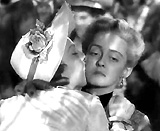
- the final scene was of the new bride's last kiss
given to her special Aunt - fulfilling the special request of Delia
- never knowing that Charlotte was her real mother; the very
satisfied Charlotte caressed the cheek that Tina had just lovingly
kissed
|
Delia's Special Request of Tina - The Last Kiss
for Aunt Charlotte After the Wedding
|
|
|
|
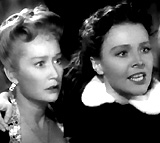
Tina's Frustration with Aunt Charlotte's Severe Criticisms
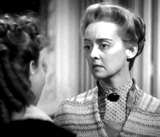
Tina's Chastisement of Charlotte For Being "Hideous
and Dried Up"
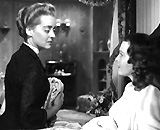
At Tina's Bedside: "If I've been severe with you
at times, I haven't meant it. I love you very much"
Charlotte to Delia: "Don't feel sorry for me. After
all, she was mine when she was little"
Delia to Tina: "That's why she's an old maid" -
And Then Delia Made A Very Special Request of Tina
|

|
Old Yeller (1957)
 #11
#11
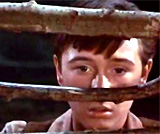
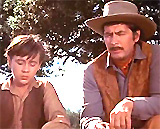
- a rabid wolf bit golden labrador retriever Old Yeller
in the neck when he intervened to protect the post-Civil War pioneering
Coates family - the vicious fight ended when teenaged Travis (Tommy
Kirk) shot the wolf dead. His mother Katie (Dorothy McGuire) feared
the worst: "It was lucky for us, son, but it weren't lucky
for Old Yeller...That wolf was mad. I'll shoot him if you can't.
But either way, we've got it to do"
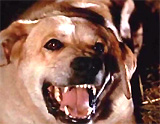
- after quarantining Old Yeller in the corn-crib for
a few weeks, Travis realized that he must pull the rifle trigger
on his dying and rabid companion when the dog growled and appeared
to be infected with rabies
|
|
|
|
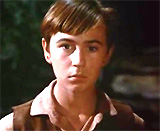
Travis Realized His Beloved Dog Had Rabies
|
- Travis reacted to his mother who
appeared with a rifle in her hands:
Travis: "No, Mama!"
Mother: "There's no hope for him now, Travis. He's suffering.
You know we've got to do it."
Travis (reluctantly): "I know Mama. He was my dog. I'll do
it."
- in a tearjerking sequence - a heart-rending euthanasia
death, faithful Old Yeller was shot off-screen by a tearful Travis
- when Travis' father Jim (Fess Parker) returned home,
he offered praise and sound advice about Travis losing his beloved
dog: "As
rough a thing as I ever heard tell of. But I'm mighty proud of
how my boy stood up to it. Couldn't ask no more of a grown man.
Thing to do now is try and forget it. Go on bein' a man...What
I'm tryin' to say is, life's like that sometimes...Well, now and
then, for no good reason a man can figure out, life will just haul
off and knock him flat. Slam him again' the ground so hard it seems
like all his insides is busted. But it's not all like that. A lot
of it's mighty fine. And you can't afford to waste the good part
frettin' about the bad. That makes it all bad. You understand what
I'm tryin' to get at?...Sayin' it's one thing, and feelin' it's
another. But I'll tell you a trick that's sometimes a big help.
You start lookin' around for somethin' good to take the place of
the bad. As a general rule, you can find it"
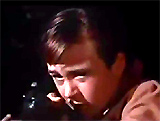
- Travis decided to replace Old Yeller with the new
puppy (Old Yeller's offspring), when he saw the "Young Yeller" with
the same penchant for stealing and dragging off some venison: "Looks
like it's about time I started learnin' this old pup to earn his
keep...He's big enough to learn if he's big enough to act like
Old Yeller" -
the theme song began again: "Young Yeller is a puppy. A little
ol' lop-eared puppy. It's plain to see he's got a family tree.
The image of his pappy. He's frisky and he's happy. And that's
how a good pup should be, frisky and happy..."
|
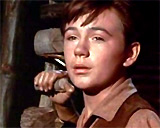
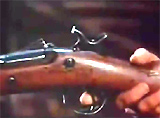
Euthanasia for Rabid Dog
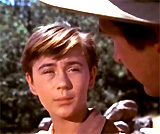
Advice From Travis' Father About Accepting A Major Loss

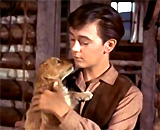
Old Yeller's Puppy Replacement: "Young Yeller"
|
|
Los Olvidados (1950, Mex.) (aka The Forgotten
Ones, or The Young and the Damned)
- the sympathetic main character - youngest gang member
Pedro (Alfonso Mejía) who was associated with a juvenile
jail-escapee and ring leader of a gang, miscreant El Jaibo (Roberto
Cobo), who committed many depraved acts of brutality and murder
- the homosexually-pedophilic advances on Pedro who
prostituted himself to survive, and was unloved by his widowed
mother (Estela Inda) with four
children (Pedro was despised for being the offspring of a rape)
- the poignant image
of a bloody-nosed, battered Pedro, after being beat up by Jaibo,
looking forlornly through a dirty window
- the brief and dark sequence of Jaibo tracking down
and vengefully killing Pedro for loudly announcing that
he had seen Jaibo kill his rival
Julian (Javier Amezcua) - earlier in the film
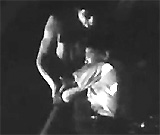
Jaibo's Vengeful Murder of Pedro
|
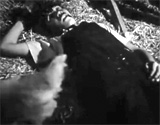
Pedro's Bloodied Corpse
|
- the heart-breaking conclusion - the graceless
disposal of Pedro's body that had been found by Meche (Alma Delia
Fuentes) and her grandfather - to avoid the police, Pedro's corpse
was put in a sack and carried out of town on a donkey, to be dumped
down a garbage-covered cliff -- while Pedro's mother passed in
the street, ironically not knowing her lost son was dead
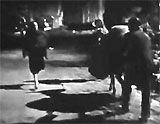
Pedro's Body in Sack on Donkey, as Pedro's Mother
Passed by
|
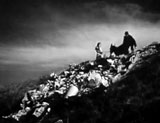
Disposal of the Sack Down Garbage-Covered Cliff
|
|
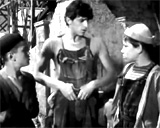
Ring-leader El Jaibo with Younger Gang Members
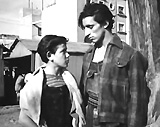
Pedro with Jaibo
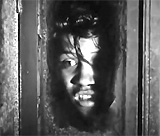
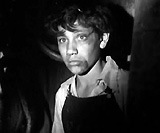
Pedro Beaten Up, Looking Through a Window
|

|
On Golden Pond (1981)
 #29 #29
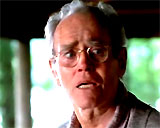
- the opening sequence when elderly "old poop" Norman
Thayer (76 year-old Henry Fonda) became momentarily lost, fearful
and distressed over his failing physical and mental health as he
walked in the woods, and spoke with relief to his wife Ethel (Katharine
Hepburn): ("You
want to know why I came back so fast? I got to the end of our lane,
I couldn't remember where the old town road was. I wandered a way
in the woods. There was nothing familiar. Not one damn tree. Scared
me half to death. That's why I came running back here to you to
see your pretty face. I could feel safe. I was still me");
she responded calmly: ("You're
safe, you old poop"); Ethel also offered comforting words:
("Listen
to me, mister, you're my knight in shining armor. Don't you forget
it. You're gonna get back on that horse and I'm gonna be right
behind you, holding on tight and away we're gonna go, go, go!")
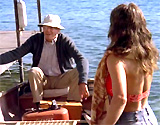
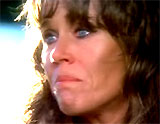
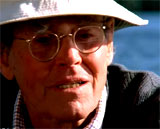
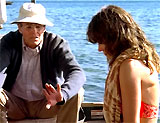
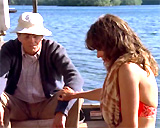
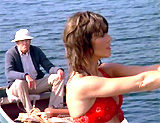
- the heart-tugging ultimate reconciliation scene
at the dock between a teary-eyed estranged daughter Chelsea Thayer
(Jane Fonda) and her father Norman: (Chelsea: "I
think that maybe you and I should have the kind of relationship
that we're supposed to have....Well, you know, like a father and
a daughter....I
don't want anything. It just seems that you and me have been mad
at each other for so long..."
Norman: "I didn't think we were mad; I thought we just didn't
like each other" - ending with Chelsea's suggestion: "I want
to be your friend"; Norman asked: "Oh. This mean you'll come
around more often? Mean a lot to your mother"
- after which she touched his arm, the scene culminated with Chelsea
eagerly showing off by doing
"a real goddamned back-flip" from the diving board for an
appreciative Norman ("She did it!")
|
Father-Daughter Reconciliation at the Dock
|
|
|
|
|
|
|
- the final scene in which
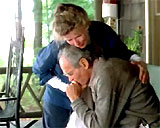
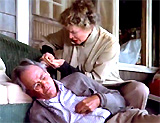
Norman's wife Ethel was worried sick when aging
husband Norman collapsed due to angina on their front porch while
carrying a heavy box of china on their last day; she first prayed:
("Dear
God, don't take him now. You don't want him. He's just an old poop").
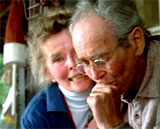
Then she spoke about death: ("This
is the first time that I've really felt that we were gonna die....When
I looked at you here on the floor, I could actually see you dead.
I could see you in your blue suit and white, starched shirt in Thomas's
funeral parlor on Bradshaw Street....You've been talking about death
ever since we met, but this is the first time I really felt it...Oh,
it feels odd. Cold, I guess. Not that bad, really. Not so frightening.
Almost comforting. Not such a bad place to go. I don't know!")
- then in a lighter moment as he stood on the porch,
he used slang he had learned from 13 year-old Billy Ray (Doug McKeon)
- he delivered a proposal to Ethel: (''Want to dance? Or would
you rather just suck
face?'')
- the film's final lines of dialogue came as they
walked to the edge of the lake and stood there, when Norman noticed
that the loons had returned - and compared themselves to the last
two remaining loons: "Ethel, listen. The loons, they've come
around to say good-bye. Just the two of them now. Their baby's
all grown up and moved to Los Angeles or somewhere"
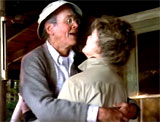
Norman to Ethel: "Want to dance? Or would you
rather just suck face?"
|
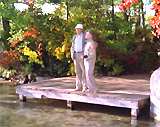
"Just the two of them now"
|
|
Ethel's Comforting Words To Lost Norman: "You're
my knight in shining armor"
Nitroglycerin Pills
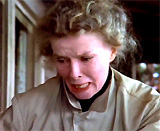
Ethel's Fearful Prayer
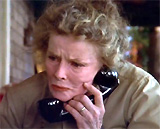
Calling Doctor
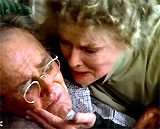
Thoughts About Death
|

|
On
Her Majesty's Secret Service (1969, UK)
#41
- the famous ending in which
just-married James Bond (George Lazenby) lost his new wife Tracy
Di Vicenzo (Diane Rigg), when Blofeld's (Telly Savalas) henchwoman
Irma Bunt (Ilse Steppat) strafed their limousine with machine-gun
fire - missing Bond but killing Tracy. Bond ducked and avoided
being hit, and shouted twice: "It's Blofeld" as
he jumped into his car, but then realized that
Tracy had been hit in the forehead by a bullet through the windshield
and instantly killed
- Bond cradled her in his arms,
and at first denied her death to a police officer on a motorcycle:
("It's alright.
It's quite alright, really. She's having a rest. We'll be going on
soon. There's no hurry, you see. We have all the time in the world").
- the heart-breaking scene and Bond's mournful words
were punctuated by Louis Armstrong's beautiful and ironic rendition
of: "We
Have All the Time In the World"
|
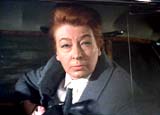
Assassin Irma Bunt
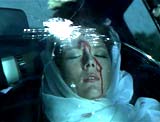
Tracy's Death
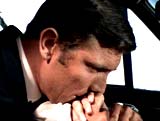
"We have all the time in the world."
|
|
On the Waterfront (1954)
- the devastating scene when dockworker and ex-boxer
Terry Malloy (Marlon Brando) found that neighborhood friend Tommy,
who used to admire and idolize him, had killed his pigeons on the
rooftop and tossed the body of a dead bird at him: "A
pigeon for a pigeon"; for testifying against the mob, Terry
was derided and ostracized as a 'canary" and all of his beloved
birds had their necks wrung
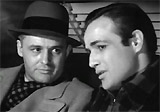
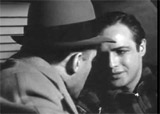
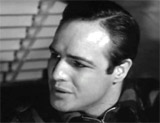
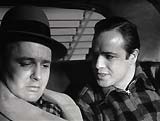
- the memorable and famous scene of Terry's emotionally-naked,
regretful New York taxi-cab dialogue, delivered in the back seat
of a taxi-cab to his mobster/lawyer older brother Charley (Rod
Steiger), who worried that Terry would testify against the mob; after
his brother drew a gun on him, Terry spoke about a rigged boxing
match that ruined his boxing career: ("It
wasn't him, Charley! It was you. You remember that night in the Garden,
you came down to my dressing room and said: 'Kid, this ain't your
night. We're going for the price on Wilson.' You remember that? 'This
ain't your night!' My night! I coulda taken Wilson apart! So what
happens? He gets the title shot outdoors in the ball park - and whadda
I get? A one-way ticket to Palookaville....You was my brother, Charley.
You shoulda looked out for me a little bit. You shoulda taken care
of me - just a little bit - so I wouldn't have to take them dives
for the short-end money....You don't understand! I coulda had class.
I coulda been a contender. I coulda been somebody, instead of a bum,
which is what I am. Let's face it (pause) ...... It was you, Charley")
|
Back of Taxi-Cab Conversation: Terry with Charley
|
|
|
|
|
- the sequence of Terry's discovery of Charley's corpse
hanging on a longshoreman's hook in a back alley, illuminated by
a truck's headlights; he was presumably murdered because it was thought
he couldn't convince Terry not to testify against the mob
|
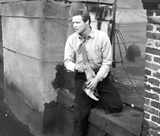
The Murder of Terry's Beloved Birds
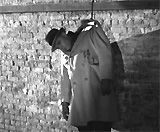
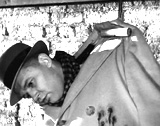
Hanging on Hook: The Death of Charley
|

|
Once Were Warriors (1994, NZ)
- Lee
Tamahori's searing melodrama about domestic abuse and alcoholism was
set in the Maori community in New Zealand
- in a realistic, brutal, difficult-to-watch
domestic abuse scene, Jake Heke (Temuera Morrison) savagely
beat his wife Beth (Rena Owen) when she refused to cook eggs
(she smashed them on the floor) - he
punched her repeatedly, slammed her against the living room wall and
mirror, kicked her, and threw her into the bedroom, and then raped
her (off-screen) (screaming: "YOU DO AS YOU ARE F--KIN' TOLD"),
as the four children, including 13 year-old writer Grace Heke (Mamaengaroa
Kerr-Bell), huddled and cowered together in a bunk bed listening to
the violence
- Grace was raped in the middle
of the night by Jake's best friend "Uncle" Bully
(Cliff Curtis) in her own bedroom, as he told her: ("It's OK,
Gracie. Uncle Bully is gonna be gentle with you, as gentle as a lamb");
he excused himself by blaming her for turning him on: ("Your
mum and dad are gonna be real angry at you turning me on like that,
coming downstairs in nothing but that flimsy little nightie. It's
our secret, hey, Gracie? You hear me, girl? Keep your mouth shut");
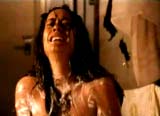
the next morning, she attempted to scrub herself clean in a bathtub,
and subsequently committed suicide by hanging herself
|
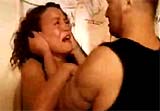
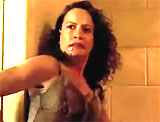
Jake's Savage Beating of His Wife Beth
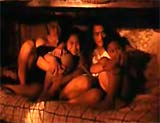
The Four Children Huddled In Bunk Bed Listening to the Violence
|

|
Ordinary People (1980)
#18
#83
- the moving scene of suicidal, guilt-ridden
high-school student Conrad "Con" Jarrett's (Timothy Hutton)
breakthrough when he admitted his feelings of blame and pain regarding
his older brother Buck's (Scott Doebler) accidental drowning (during
a sailing trip) in his late-night therapy session with the psychiatrist
Dr. Berger (Judd Hirsch); he finally acknowledged when asked: "And
what
was the one thing wrong you did?" - his answer: "I
hung on, I stayed with the boat." The therapist reassured him:
Berger: Now. You can live with that. Can't you?
Conrad:
I'm scared! I'm scared.
Berger:
Feelings are scary. And sometimes they're painful. And if you can't
feel pain, then you're not gonna feel anything else either. You know
what I'm saying?
Conrad:
I think
so.
Berger:
You're here and you're alive, and don't tell
me you don't feel that.
Conrad:
It doesn't
feel good.
Berger:
It is good. Believe me.
Conrad:
How do you know?
Berger:
Because I'm your
friend.
Conrad:
I don't know what I would've done if you hadn't been here.
You're really my friend?
Berger:
I am. Count on it.
|
Conrad's Traumatic Memories Told to Therapist
|
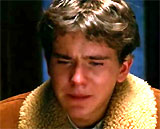
Conrad "Con" Jarrett
(Timothy Hutton)
|
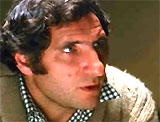
Dr. Berger (Judd Hirsch)
|
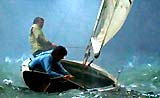
Fateful Drowning of Conrad's Older Brother Buck
|
- the climactic scene in which Conrad's compassionate
and warm-hearted father Calvin (Donald Sutherland) admitted his loss
of love for his cold and icy wife Beth (Mary Tyler Moore), who had
put all her love into her eldest son Buck: ("You are beautiful.
And you are unpredictable. But you're so cautious. You're determined,
Beth; but you know something? You're not strong.
And I don't know if you're really giving. Tell me something. Do you
love me? Do you really love me?...We would've been all right if there
hadn't been the mess.You
can't handle mess. You need everything neat and easy. I don't know.
Maybe you can't love anybody. It was so much Buck. When Buck died,
it was as if you buried all your love with him. And I don't understand
that. I just don't know. Maybe it wasn't even Buck. Maybe it was
just you. Maybe, finally, it was the best of you that you buried.
But whatever it was, I
don't know who you are. I don't know what we've been playing at.
So I was crying. Because I don't know if I love you anymore. And
I don't know what I'm going to do without that")
- in the closing scene in the Jarrett backyard before
the credits, Calvin told Conrad that a very shaken Beth had
gone away to Houston to live for awhile; predictably, Conrad blamed
himself, but was angrily dissuaded by his father: ("Don't do
that! Don't do that to yourself! It's nobody's fault! Things happen
in this world. People don't always have the answers for 'em, you
know"); as they began to re-connect again, Conrad thanked his
father for showing toughness, and also expressed admiration for him: "You
always made us feel like everything was gonna be all right. I thought
about that a lot lately. I really admire you for it" - they
reconnected as they hugged and both pledged their love for each other
in the film's final two lines: Conrad: "I love you" --
Calvin: "I
love you, too!", before the camera angle shifted and pulled
up and away
|
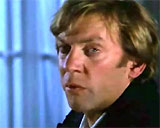
Calvin Jarrett (Donald Sutherland) Admitting Loss of Love
to His Wife Beth
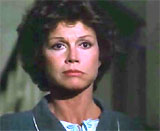
Beth (Mary Tyler Moore)
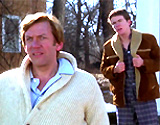
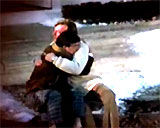
Final Backyard Scene: Father/Son Hug
|
|
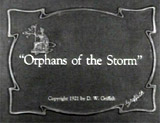
Orphans of the Storm (1921)
- D.W. Griffith's lengthy melodramatic epic - a box-office
failure - told about the French Revolution in 18th century Paris,
with its tale of two orphaned half-sisters that were separated during
the Reign of Terror
- the highly dramatic scene of Henriette Girard (Lillian
Gish) believing that she heard the singing voice of her blind, helpless,
and kidnapped half-sister Louise Girard (Dorothy Gish) in the street
below her boarding house: ("In my dreams I hear - I must be
losing my reason")
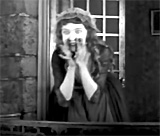
- when Henriette was convinced it was her sister, she
raced to the balcony to call out to Louise: ("Don't get excited
- wait, I'll be there"),
but before she could get to her from the balcony, she was arrested
by Count de Linieres (Frank Losee), Paris' Prefect of Police (and
now the husband of Louise's birth mother, the Countess de Linieres
(Katherine Emmet)), and detained in the Catholic "House
of Fallen Women" run
by nuns, while Louise was dragged away by Mother Frochard (Lucille
La Verne)
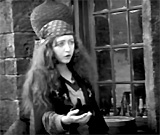
Blind Louise Singing on Street Below
|

Henriette: "Singing. Don't you hear?"
|
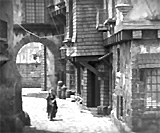
Henriette's Balcony Above Louise
|
|
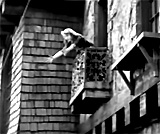
|
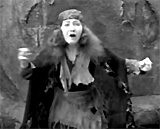
Louise's Reaction
|
|
Henriette Calling Out: "LOUISE!"
|
- in the film's conclusion, however, soon after
the re-arrest of Henriette, when she was seen embracing her lover
Chevalier de Vaudrey (in peasant garb), by the forces of Jacques-Forget-Not,
and charged with "sheltering a returned aristocrat" - they
were both brought before the Tribunal of the Reign of Terror, without
a trial; during the sentencing, Henriette spotted her blind half-sister
Louise in the audience and became overwhelmed with joy, but was not
allowed to get close to speak to her; Chevalier was charged with "oppression
and murder through countless generations" and both were condemned
to be guillotined
- the film ended with a thrilling, cross-cutting 'race-to-the-rescue'
scene (typical of director Griffith) of Henriette and Chevalier from
the guillotine by political hero Danton (Monte Blue) (with a pardon)
seen riding on a white horse (with a reverse tracking shot), climaxing
with a tearful reunion scene between the two sisters (and the miraculous
restoration of eyesight for Louise)
|
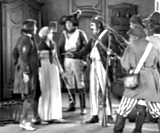
Arrest of Both Henriette and Chevalier
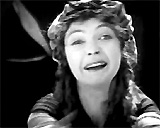
Henriette Joyful at Recognizing Louise in Audience at
Tribunal Hearing
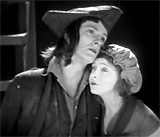
Chevalier and Henriette About to Be Guillotined
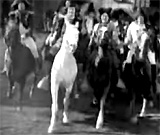
Danton on White Horse Riding to the Rescue
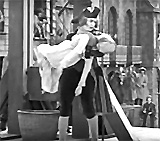
Henriette Saved by Danton From the Guillotine
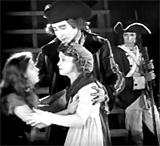
The Sisters Finally Reunited
|
|
The Ox-Bow
Incident (1943)
- in this grim western story of mob rule, a frenzied,
angry vigilante, frontier-justice posse (lynch mob) formed when
an unverified report arrived that a local rancher named Kinkaid had
been shot dead by cattle rustlers
- in the film's climactic conclusion, three accused
and suspected homesteaders were led to the base of a gnarled tree
for a hanging, where three nooses had been hanging prominently and
ominously throughout the previous sequence; after a perfunctory 'trial,' the
men were hanged; the shadows of the three men's bodies were seen swinging
on the ground; to "finish
'em," one of the posse members fired bullets from his rifle into
all three men to ensure that they were dead
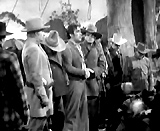 The "Trial" The "Trial"
|
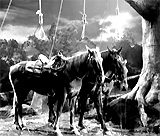
Three Hanging Ropes and Three Horses
|
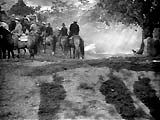
Shadows of Three Hanged Men
|
- on the way back to town, the posse met Sheriff Risley
(Willard Robertson) who was shocked to learn what they had done: "Larry
Kinkaid's not dead!"; a wounded Kinkaid was being treated by
a doctor and they "caught the fellas who shot him too";
the Sheriff condemned them with contempt in his voice: "God
better have mercy on ya. You won't get any from me"
- the heartbreaking final scene in the town's saloon,
of Gil Carter's (Henry Fonda) posthumous reading of the letter of
one of the lynched victims, Donald Martin (Dana Andrews), written
to his wife, after the three victims had been declared blameless:
"...A man just naturally can't take the law into his own hands
and hang people without hurtin' everybody in the world, 'cause then
he's just not breakin' one law, but all laws. Law is a lot more than
words you put in a book, or judges or lawyers or sheriffs you hire
to carry it out. It's everything people ever have found out about
justice and what's right and wrong. It's the very conscience of humanity.
There can't be any such thing as civilization unless people have
a conscience, because if people touch God anywhere, where is it except
through their conscience? And what is anybody's conscience except
a little piece of the conscience of all men that ever lived? I guess
that's all I've got to say except - kiss the babies for me and God
bless ya. Your husband, Donald"
- the film's last lines were spoken by Gil to his buddy
Art Croft (Harry Morgan) as they saddled up - he was determined to
deliver the letter personally:
"He said he wanted his wife to get this letter, didn't he? Said
there was nobody to look after the kids, didn't he?"
|
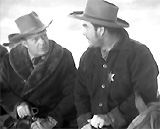
Sheriff Risley to His Deputy: "Larry Kinkaid's not
dead!"
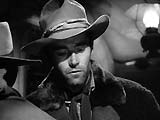
Gil Carter's Outloud Reading of Martin's Letter in the
Town's Saloon
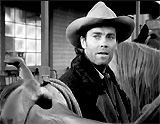
Carter's Final Lines of Dialogue
|