|
The Greatest Tearjerkers of All-Time
|
|
Title Screen
|
Movie Title/Year and Brief Tearjerker Scene Description
|
Screenshots
|

|
Fantasia
(1940)
- the segment of Schubert's poignant and "sacred" Ave
Maria sequence following after Moussorgsky's
"profane" Night on Bald Mountain, featuring a sedate
line of candle-bearing, white-hooded worshippers/pilgrims strolling
along a pastoral setting on a foggy, dew-tinged morning at dawn --
the powers of light ultimately became triumphant over darkness --
a moving, stark contrast to the disturbing Chernobog's evil
|


"Ave Maria"
|
|
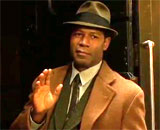
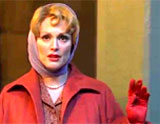
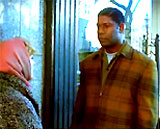
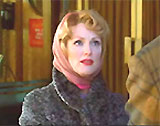
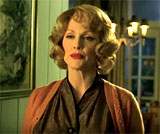
Far From Heaven (2002)
- the very poignant melodramatic scene of late 50s
'perfect world' Connecticut suburban housewife Cathy Whitaker's
(Julianne Moore) sad and awkward admission and inevitable farewell
to her handsome, well-educated black gardener Raymond Deagan (Dennis
Haysbert) that their relationship and clandestine love affair -
even as friends - wasn't workable or 'plausible': (Cathy: "I
wanted to see you in person, Raymond. I-I just, I can't...It isn't
plausible for me to be friends with you. You've been so very kind
to me and I've been perfectly reckless and foolish in return,
thinking..." Raymond: "...that
one person could reach out to another, take an interest in another
and maybe for one fleeting instant could manage to see beyond the
surface, beyond the color of things?" Cathy: "Do you
think we ever really do see beyond those things, the surface of
things?" Raymond:
"'Just beyond the fall of grace, behold that ever-shining
place.' Yes. I do. I don't really have a choice." Cathy: "I
wish I could. Good luck to you, Raymond"); Cathy's last touching
words were: "You're so beautiful"
- the scene of TV ad executive and disturbed, alcoholic
husband Frank Whitaker (Dennis Quaid) crying and confessing to
his wife Cathy
that he was in love with another man:
("Cathy, something's happened...I've fallen in love with someone
who wants to be with me. Oh, Cathy, I-I-I just, I-I never knew
what that felt. But I know that sounds so cruel, but, oh, God. Cathy,
I tried. I tried so hard to make it go away. It, it, I thought
that I could do it for you and for the kids. But I can't. I just,
I can't. I can't"); Cathy responded simply that she assumed
a divorce was the next inevitable step: ("I, um, assume then,
you'll be wanting a divorce")
- in the conclusion,
now-single Cathy's met again with Raymond, learning that he
was moving from Hartford to Baltimore due to violence against himself
and his family ("Things are pretty well finished for me
here")
- and her suggestion that maybe they could start a life together
in the future in a new place: "Perhaps sometime in the
future after you’re
settled, I could, perhaps I could come for a visit, see Baltimore.
You see, I, well, it seems as if I'm to be single again." Raymond
politely rejected the invitation: "I'm just not sure that
would be a wise idea after well, everything that's....I've learned
my lesson about mixing in other worlds. I've seen the sparks fly,
all kinds. Have a proud life, a splendid life, will you do
that? (He kissed her hand) Goodbye, Cathy"
- in the final scene, Cathy's heartfelt but silent
goodbye wave to Raymond a few weeks later, departing from the platform
of the station on a southbound train
|
|
|
Silent Goodbye Waves
|
|
Friendship Thought to be Unworkable
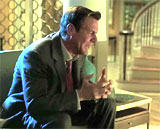
Frank's Homosexual Confession to Cathy
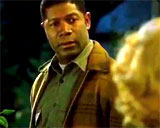
Raymond's Polite Rejection of Cathy's Invitation to Get
Together in the Future
|
|
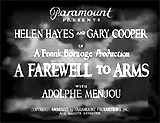
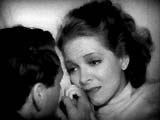
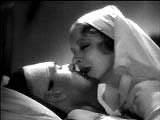
A Farewell to Arms (1932)
- the doomed romance of World War I officer and ambulance
driver Lt. Frederic Henry (Gary Cooper) and British nurse Catherine Barkley
(Helen Hayes), who fell in love and produced a love child (while he was
wounded and under her care in Milan) - with an impressive subjective camera
close-up shot of her coming around his bed and kissing him after he first
arrived in the hospital
- later, correspondence to the front (with news
of the child) was circumvented by Henry's jealous friend Major Rinaldi
(Adolphe Menjou) - leading to the film's dramatic conclusion in
a maternity ward in Switzerland; Catherine died
in her hospital bed after her baby died -- with Frederic by her side
professing his undying love ("I'll never stop loving you"); in
her prolonged tearjerking death scene ("Oh darling, I'm going to die. Don't
let me die! Take me in your arms! Hold me tight! Don't let me go...In
life and in death, we'll never be parted...I believe it and I'm
not afraid"), she expired
in his arms - the moment coincided with bells ringing to declare the
Armistice; after she died, he carried her in his arms to the window
and affirmed:
"Peace, peace" - as white doves flew into the air and the
screen faded to black
|

|
|
Catherine's Death Scene
|
|
Romance Between Frederic and Catherine
|
|
Father of
the Bride (1950)
- the many scenes of harrassed father
Stanley Banks (Spencer Tracy) who faced daughter Kay's (Elizabeth Taylor)
marriage with overbearing caterers, exorbitant costs and other nightmarish
visions of what might go wrong, ending with the tearjerking scene
of Kay's post-wedding phone call to lovingly say 'thank you' to her
father
|

Kay's Post-Wedding Phone Call
|
|
Field of
Dreams (1989)
 #10
#10
 #9
#9
- the poignant scene of the powerful "they
will come"
speech by disillusioned and reclusive 60's author Terence Mann (James
Earl Jones) to Iowa corn farmer Ray Kinsella (Kevin Costner) predicting
that people would come to the ballfield, and affirming baseball's enduring
impact on America: ("Ray. People will come, Ray. They'll come
to Iowa for reasons they can't even fathom. They'll turn up your driveway,
not even sure why they're doing it. They'll arrive at your door, as
innocent as children, longing for the past. 'Of course, we won't mind
if you look around,' you'll say. 'It's only $20 per person.' They'll
pass over the money without even thinking about it. For it is money
they have and peace they like...Then they'll walk out to the bleachers
and sit in their shirt sleeves on a perfect afternoon. They'll find
they have reserved seats somewhere along one of the baselines where
they sat when they were children, and cheered their heroes, and they'll
watch the game, and it'll be as if they'd dipped themselves in magic
waters. The memories will be so thick, they'll have to brush them away
from their faces... People will come, Ray... The one constant through
all the years, Ray, has been baseball. America has rolled by like an
army of steamrollers. It's been erased like a blackboard, rebuilt,
and erased again. But baseball has marked the time. This field,
this game, is a part of our past, Ray. It reminds us of all that once
was good, and it could be again. Ohhhh, people will come, Ray. People
will most definitely come..")
- the scene
in which young Giants ballplayer Archie "Moonlight" Graham
(Frank Whaley) sacrificed his youth as a ball player, crossed the ball-field
line, and morphed into his older self Doc Graham (Burt
Lancaster) to save Ray's daughter Karin (Gaby Hoffman), who had stopped
breathing after falling from bleachers, and was actually choking to
death on a piece of hot dog; Ray realized that Doc couldn't return
to his youth: "Oh,
my God -- you can't go back!"; Doc made
a request: "Win
one for me one day, will you boys?" as he walked past the other
younger ballplayers who congratulated him; before entering into the
cornfield, "Shoeless" Joe Jackson (Ray Liotta) praised Doc: "Hey rookie!
You were good!"
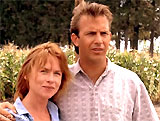 Ray with wife Annie (Amy Madigan)
|
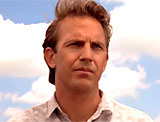
Ray Kinsella
|
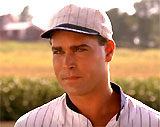
Joe "If you build it, he will come"
|
- the famous tearjerking ending
in which Ray (at first with his wife Annie (Amy Madigan) at his
side), was told by Joe: "If you build it, he will come,"
and then realizing that the Yankee catcher removing his equipment at
home plate was his dead and estranged father John Kinsella (Dwier Brown)
- after introductions and a short discussion together,
they had a final exchange in the twilight: "lt's so beautiful here. For me, well,
for me, it's like a dream come true. Can I ask you something? Is,
is this heaven?" -- "It's
Iowa" -- "Iowa?...I could
have sworn it was heaven" -- "Is there a heaven?" -- "Oh
yeah, it's the place dreams come true" -- "Maybe this is
heaven"; Ray then asked:
"Hey, Dad? Wanna have a catch?" -- "I'd like that"
-- with the long shot of the two playing catch together on the ball
diamond with the lights turned on
- the film ended with an overhead shot of a stream
of car headlights approaching from the distance
|
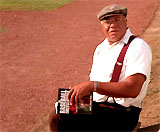
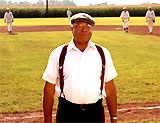
Terence Mann: "People Will Most Definitely Come"
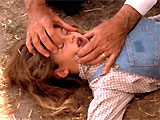
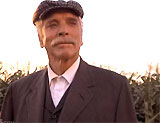
Archie "Moonlight" Graham Saving Karin
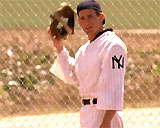
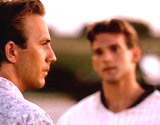
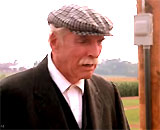
Ray's Father John Kinsella
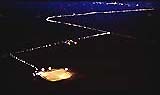
Car's Headlights Approaching Ballfield
|

|
Final Fantasy: The Spirits Within
(2001)
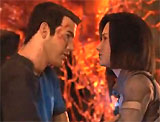
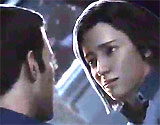
- the touching scene in which
two lovers: courageous military Capt. Gray Edwards (voice of Alec
Baldwin) and young female scientist Aki Ross (voice of Ming-Na) were
alone just after escaping New York City when Gray's entire crew was
killed - Aki was so distraught at the loss of their friends that
she couldn't speak, and Gray moaned: ("I
just - I wish I could believe they were in a better place")
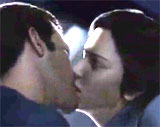
- they embraced tightly in the zero gravity environment of their
spaceship, and kissed out of need and loneliness
- later in the film's conclusion,
a dying Gray, just before his sacrifice to save humanity from phantom
spirits (by producing an energy wave that would kill the aliens without
harming the Earth) told Aki in a farewell as she begged him not
to leave her: ("You
saved my life once, now I want you to save yourself...let me do this,
Aki. Trust me...You've been trying to tell me that death isn't the
end. Don't back out on me now that I finally believe. I love
you")
- he grabbed her hand as he perished
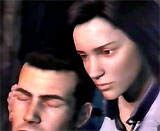
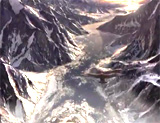
- due to Gray's sacrifice, the Earth's Gaia was returned
to normal as the Phantoms ascended into space, finally at peace;
stilling holding Gray's body, Aki was pulled from the crater as she
caught a view of the newly liberated world
|
Capt. Gray with Aki
Aki's View of the New World
|
|
Finding Neverland
(2004)
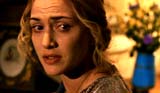
- the scene of Scottish playwright
Sir James Matthew Barrie (Johnny Depp) discussing widowed Sylvia
Llewelyn Davies' (Kate Winslet) "pretending" not to be
sick with her four young boys and her reluctance to accept her illness
and coming death: (James: "They can see it, you know. You can't
go on just pretending." Sylvia: " 'Just pretending?' You
brought pretending into this family, James. You showed us we can
change things by simply believing them to be different." James: "A
lot of things, Sylvia, not everything." Sylvia: "But the
things that matter. We've pretended for some time now that you're
a part of this family, haven't we? You've come to mean so much to
us all that now it doesn't matter if it's true. And even if it isn't
true, even if that can never be... I need to go on pretending. Until
the end. With you")
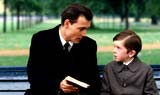
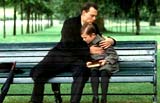
- the film's final poignant scene
set on a park bench in which James consoled young Peter (Freddie
Highmore) after his mother Sylvia died and how he encouraged the
young lad to remember his mother with the transformative power of
imagination: (Peter: "I thought she'd always be here." James: "So
did I. But, in fact... she is. (He took the play book) Because she's
on every page of your imagination. You'll always have here there,
always." Peter: "But why did she have to die?" James: "I
don't know, boy. When I think of your mother, I will always remember
how happy she looked sitting there in the parlor watching a play
about her family. About her boys that never grew up. She went to
Neverland. And you can visit her any time you like if you just go
there yourself." Peter: "How?" James: "By believing,
Peter. Just believe." Peter (whispering): "I can see her.") James
hugged the boy, and then they both slowly faded away.
|
Sylvia's "Pretending"
James' Consoling of Young Peter
|

|
Five Easy Pieces
(1970)
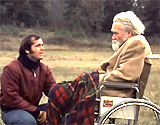
- the film's most powerful sequence - a conciliatory
apology. Bobby Dupea (Jack Nicholson) was viewed wheeling his dying,
invalid, wheelchair-bound father Nicholas (William Challee)
in the cold outdoors of Puget Sound, as the sun set. At the shoreline,
the choked up and emotional Bobby delivered a painful, one-sided, remorseful
confession - his father was unable to respond due to his medical condition.
He apologized for his abandonment of his family and talent, for giving
up on his responsibilities, and for not living up to his father's high
ideals. Unable to explain his life's failings, he broke down in tears
mid-speech, and eventually apologized: ("I
don't know if you'd be particularly interested in hearing anything
about me, my life, I mean. Most of it doesn't add up to much that I
could relate as a way of life that you'd approve of. I move around
a lot. Not because I'm looking for anything, really, but - 'cause I'm
getting away from things that get bad if I stay. Auspicious beginnings.
You know what I mean? I'm trying to imagine your,
your half of this conversation...My feeling is, I don't know, that,
uh, if you could talk, we probably wouldn't be talking. That's pretty
much the way it got to be before I left. Are you all right? I don't
know what to say. Tita suggested that we try to - I don't know. I think
that she feels - I think that she feels that we've got some understanding
to reach. She totally denies the fact that we were never that comfortable
with one another to begin with. The best that I can do is apologize.
We both know that I was never really that good at it, anyway"); he
finally admitted with sorrow: "I'm sorry it didn't
work out." He slowly bowed his head
|

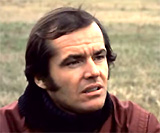
Bobby's Heartfelt Talk with Dying Father
|