|
The Greatest Tearjerkers of All-Time
|
|
Title Screen
|
Movie Title/Year and Brief Tearjerker Scene Description
|
Screenshots
|
|
Touching the Void (2003, UK/US)
 #89 #89
- in this docudrama about survival, mountain climber
Simon Yates and his broken-legged climbing partner Joe Simpson,
while returning from an unprecedented climb up the 21,000 foot
high west face of the Peruvian mountain Siula Grande in 1985, ran
into severe problems
- Joe was being lowered at the end of a rope while
being supported by Simon, but with poor visibility, Joe went
over the edge of a steep slope and was accidentally suspended
in mid-air over the side of a cliff and unable to respond; he
thought to himself: ("I think
psychologically I was beaten. 'Cause there was nothing I could
do, so I just hung on the rope and waited to die"); as Simon
held Joe by the rope, he began to lose traction and felt the situation
was becoming hopeless
- thinking
that Joe had passed away when he didn't respond to rope tugging, Simon
was forced to cut the line with a knife: ("To me, it just
seemed like the right thing to do under the circumstances...If
was an awful night. My mind was plagued with the thoughts of what
had happened to Joe")
- the rope-cutting sent Simpson deeper into a crevasse
- the moving description
of Joe "touching the void," feeling
utterly alone in the universe, as he stared death in the face: ("I
felt very, very alone. And I was very scared") - although he
survived and returned to the base camp by crawling despite his broken
leg, frost-bite, and severe dehydration
|
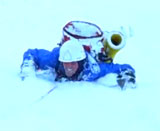
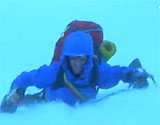
Joe and Simon Connected Only By a Piece of Rope
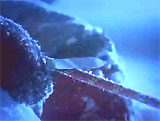
Simon Cutting Joe's Rope
|

|
Toy Story 2 (1999)
- in a flashback sequence, as Jesse the Yodeling Cowgirl
(voice of Joan Cusack) sat on a window sill, she sorrowfully began
to describe for Woody (voice of Tom Hanks) how she was neglected
by her beloved owner Emily
- in the visuals, Emily matured into
a teenager - and no longer played with her toys (but was more interested
in nail polish and makeup, parties and boyfriends) - thereby abandoning
her under her bed; years later when the toy was rediscovered, Jesse's
hopes were dashed when Emily left her in a cardboard charity donation
box on the side of the road
|
Jessie's Worry Began When Emily Started to Ignore
Her, With Girlfriends, Talking on the Phone, and Other More Grown-Up
Pursuits
|
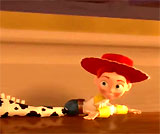
Discarded Under the Bed and Neglected
|

Jesse Ignored by Emily
|
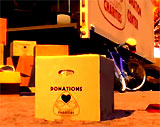
Jesse Placed Into a Donation Box
|
- she told about her worry and neglect with a touching
torch song: "When
She Loved Me" (performed by Sarah McLachlan):
"When somebody loved me Everything was beautiful Every hour we
spent together Lives within my heart And when she was sad I
was there to dry her tears And when she was happy so was I When
she loved me Through the summer and the fall We had each other. That
was all Just she and I together Like it was meant to be And
when she was lonely I was there to comfort her And I knew that She
loved me So the years went by I stayed the same But she began to
drift away I was left alone Still I waited for the day When she'd
say I will always love you Lonely and forgotten I never thought she'd
look my way..."
- Jesse ended her tale of woe by telling
Woody about her previous toy owners:
"You never forget kids like Emily or Andy. But they forget
you"
|
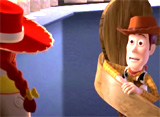

Jesse's Flashback, Described for Woody With a Song
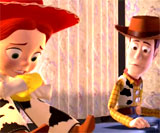
Jesse to Woody: "You never forget kids like Emily or
Andy. But they forget you"
|

|
Trois Couleurs: Bleu (1993, Fr./Pol./Switz.)
(aka Three Colors: Blue)
- the first segment of Krzysztof Kieslowski's
"Three Colors" Trilogy, symbolizing emotional liberation
- the raw, intensely emotional tale of composer-wife
Julie Vignon-de Courcy (Juliette Binoche) who unexpectedly lost
her husband Patrice de Courcy and their sole child - daughter Anna,
in a car accident that she had survived (on a foggy single lane
country road where the vehicle ran into a tree), and her inability
to cope with the tragedy - completely deadened and unable to outwardly
display any sense of loss or grief except the most subtle displays
- the scene
in a Paris hospital where a despondent and suicidal Julie was caught
trying to swallow an overdose of pills, but couldn't actually swallow
them
- at her hospital bed when Julie
watched the funeral - the dark shadow of her finger traced
the image of her daughter's small coffin on a tiny LCD TV screen
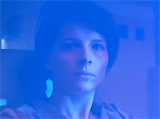
Surrounded by Bright Blue Light Filling Up the Room
|
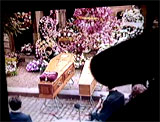
Julie Tracing Her Daughter's Small Funeral Coffin
on TV screen
|

Nighttime Swims
|
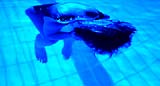
"Spiritual Suicide" Face Down in a Pool
|
- other scenes, for example, in which Julie destroyed
her late husband's last unfinished musical score composition by
throwing the rolled-up sheet music into a garbage truck; she also
put her country estate on the market and sold most of her possessions,
to dis-attach herself
- the scenes in which Julie attempted to isolate and
disconnect herself and commit "spiritual
suicide" by disassociating herself (and liberating herself)
from everything in her past in order to start over - including night-time
swims and by floating face down in the pool bathed in a blue light
to escape from everything in her life
- the scene of her frozen reaction to exotic dancer-friend
Lucille (Charlotte Véry) touching one of her
sole mementos reminding her of the past: her daughter's blue crystal
beads mobile that hung in her room (painted blue)
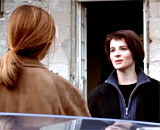
- Julie's offer of her husband's
country estate to his former mistress Sandrine (Florence Pernel),
a lawyer who was now pregnant and carrying Patrice's child, suggested
that the unborn child must have his name and house
|

|
|
Julie's Offer of Her Husband's Estate
to His Pregnant Mistress Sandrine
|
- in collaboration with Patrice's steadfast colleague
Olivier Benôit (Benoît Régent), Julie began
to work on completing her husband's symphony by creating a new
arrangement, with the possibility of saving herself as well as
establishing a relationship with him
- the final image - Julie with tearful eyes and looking
out into space - a rare sight and only the second time that she
appeared to outwardly show emotion in the entire film, an indication
that she was maybe healing
|
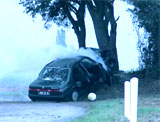
Tragic Car Accident - Killing Husband and Daughter
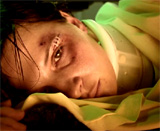
Julie Recovering in the Hospital
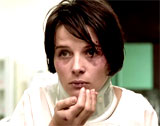
Surviving and Grieving Suicidal Wife Julie Attempting
to Overdose in the Hospital
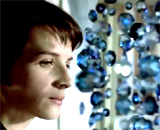
Her Daughter's Blue Crystal Beads Mobile
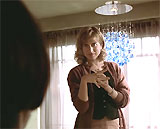
Reaction to Lucille Touching the Mobile
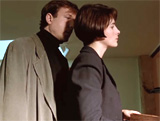
A Relationship with Olivier - A Possibility?
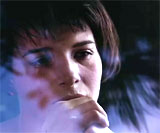
Julie Faintly Crying - A Rare Sight
|
|
Truly Madly Deeply (1990, UK)
 #44 #44
#24
- the scene in this fantasy drama in which devoted boyfriend
and cellist Jamie (Alan Rickman) returned from the dead as a 'ghost'
to join his inconsolable, bereaved lover Nina (Juliet Stevenson),
an interpreter, and speak to her
- he gave an explanation for his return:
("I
dunno, maybe I didn't die properly. Maybe that's why I can come back.
It was like standing behind a glass wall while everybody else got
on with missing me. It didn't hurt. And you know, I'm very sensitive
to pain. It really didn't hurt")
- after they kissed, he spoke
about her pain on the back porch: (Jamie: "Thank you
for missing me." Nina: "I have. I do. I did." Jamie:
"I know. But the pain, your pain, I couldn't
bear that.")
- his description of a local neighbor girl who died
- a story about how parents should lovingly embrace their children:
("There's
a little girl. I see this little girl from time to time. Alice, who's
three, three and a half. And she's great. Everybody makes a big fuss,
but she isn't spoiled. Well, she wasn't spoiled. She was knocked
over and she died. And her parents and her family and her friends
from kindergarten. Well, she used to go to this park. And she was
telling me, they made an area in the park, gave the money for swings
and little wooden animals. And there are these plaques on each of
the, on the sides of the swing, the bottom of the horse, from Alice's
mum and dad: 'In loving memory of Alice, who used to play here.'
And, of course, Alice goes back there all the time. You see parents
take their child off the swing and see the sign. And then they hold
onto their son and daughter so tightly, clinging on for dear life.
And yet the capacity to love that people have. What happens to it?")
- the scene of their lengthy proclamation of their
love for each other: (Nina: "I love you." Jamie: "I
love you." Nina: "I really love you." Jamie: "I
really, truly love you." Nina: "I really, truly, madly
love you." Jamie: "I really, truly, madly, deeply love
you." Nina: "I really, truly, madly, deeply, passionately
love you." Jamie: "I really, truly, madly, deeply, passionately,
remarkably love you." Nina: "I really, truly, madly, deeply,
passionately, remarkably, uhmm... deliciously love you." Jamie: "I
really, truly, madly, passionately, remarkably, deliciously... juicily
love you...." Nina: "Deeply! Deeply! You passed on deeply,
which was your word, which means that you couldn't have meant it!
So you're a fraud, that's it!...(They hug) You're probably a figment
of my imagination. (pause) Juicily?")
- their singing of "The Sun Ain't Gonna Shine Anymore" (accompanied
by his playing on the cello) and then their
joining together in a piano duet
- toward the end of the film, Jamie recalled
the first night that they spent together when Nina asked him to describe
it: "What did we do?" - he remembered: ("We talked...Well, talking
was the major component. You played that piano. Then I played, then
we both played. Something, duet. Something, I can't remember. And
then you danced for about three hours, until I fell asleep. But you
were fantastic. And then we had some cornflakes. And when we kissed
which was at about 11 o'clock the following morning, we were trembling
so much, we couldn't take off our clothes")
- later, he recited Pablo Neruda's
Spanish poem La
Muerta to
Nina (which she translated line by line from Spanish to English)
when she was beginning to decide that she was ready to move on
from Jamie: ("Forgive
me...If you are not living...If you, beloved, my love, if you have
died... All the leaves will fall on my breast... It will rain on
my soul all night, all day... My feet will want to march to where
you are sleeping... But I shall go on living.") Jamie then
asked Nina: "Do you want me to go?" She tightly hugged
him: "No,
never, never, never."
- however, Jamie's fellow ghosts soon after came to
him and asked if he was going to leave Nina if she was ready to move
on to a new relationship - with art therapist-psychologist Mark (Michael
Maloney). One asked: "Well?",
and Jamie responded: "I think so. Yes."
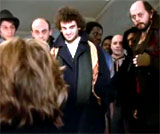
Ghosts Asking If Jamie Was Going to Leave Nina
|
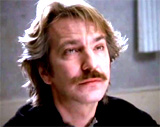
Jamie's Response to Ghosts: "I think so. Yes"
|
- in the next scene,
Nina admitted to Mark: "I think I am free. I did love someone
very much, you see. Very much. But he died. He died. And I found
it quite hard to get over it"; that night, she would be sleeping
over at Mark's house after purchasing a toothbrush at a pharmacy
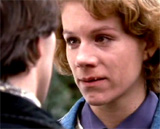
Nina to Mark: "I think I am free"
|
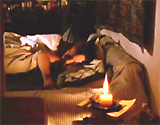
Sleeping Over at Mark's Place, With Her Toothbrush
|
- the next day, Nina cleaned up her apartment knowing
that she was moving on in life; that evening,
the
ghosts with Jamie watched from her upstairs apartment window as Nina
kissed Mark at her front gate and left for good to be with Mark from
now on
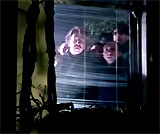
Ghostly Jamie (with Other Ghosts) Watching Nina
|
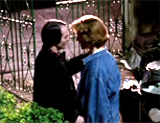
Nina Kissing Mark at Her Front Gate
|
|
|
|
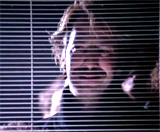
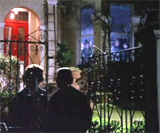
Jamie's Final Goodbye While Watching Nina and Mark
Leave
|
|
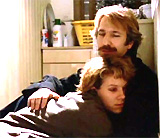
"Maybe I didn't die properly"
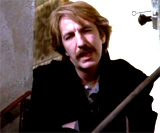
Kissing - And Then Telling Her on the Back Porch: "Your pain, I couldn't
bear that"
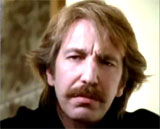
Story About Neighbor Girl Who Died
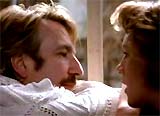
Lengthy Proclamation of Their Love
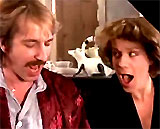
Singing "The Sun Ain't Gonna Shine Anymore"
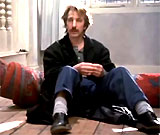
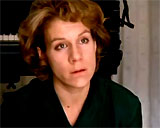
Nina Listening as Jamie Recalled Their First Night Together
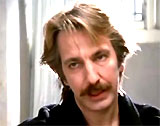
Jamie Reciting Pablo Neruda's Spanish Poem
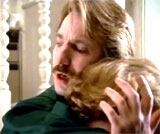
Hugging Tightly After He Asked - "Do you want me to go?"
|
|
The Truman Show (1998)
- there was a major premise in director Peter Weir's
existentialist, thought-provoking, biting social satire about reality
TV, consumerism in a dystopia, loss of privacy and media surveillance;
it was that a person - a good-natured insurance adjuster named Truman
Burbank (Jim Carrey) - could be adopted by a TV network and filmed
for his entire life 24 hours a day without his knowledge over a period
of 30 years: ("An
entire human life recorded on an intricate network of hidden cameras,
and broadcast live and unedited, 24 hours a day, 7 days a week, to
an audience around the globe"); the massive
town-film set was called Seahaven Island ("enclosed
in the largest studio ever constructed...one of only two man-made
structures visible from space")
- megalomaniac, charismatic, beret-wearing,
'world's greatest televisionary' network owner Christof (Oscar-nominated
Ed Harris) delivered an opening speech to the camera in the Lunar
Room studio (hidden in the movie set's moon) about the world being
bored by fake "phony emotions," while expounding the
virtues of TV's The Truman Show and its "nothing fake
about Truman" star: "We've become bored with
watching actors give us phony emotions. We're tired of pyrotechnics
and special effects. While the world he inhabits is, in some respects,
counterfeit, there's nothing fake about Truman himself. No scripts,
no cue cards. It isn't always Shakespeare, but it's genuine. It's
a life...We find many viewers leave him on all night for comfort"
- Truman's happy catchphrase:
"Good morning...Oh, and in case I don't see ya, good afternoon,
good evening, and good night!"
- there was a magical moment when Truman began to realize
the world revolved around his actions - he stopped traffic with
a wave of his hand
- the sheltered, reality-TV show star Truman Burbank
began to suspect that his life was being contained or manipulated,
but was unaware of the controlling machinations of Christof; Truman
made a vain attempt to escape from his world via sailboat (Santa
Maria),
but Christof summoned a torrential storm to try to prevent it
- fugitive Truman, nearly drowning
and capsizing, cried out: "Is that the best you can do? You're
gonna have to kill me." He ultimately reached the literal edge
of the fabricated, enclosed set of his make-believe world (bounded
by canvas) when the bow of his schooner-sailboat pierced the dome's
painted and clouded blue sky; he touched and
then pounded on the wall, and ascended stairs
- on an amplified sound system,
in an allegorical scene, Christof spoke to Truman with a "voice
of God" speech, identifying himself: "I am the creator
of a television show that gives hope and joy and inspiration to millions." He
claimed that Truman, the show's "star," was "real
- that's what made you so good to watch."
- in a triumphant moment, Truman rejected Christof's
plea to remain in the artificial world (where he had "nothing
to fear" - "You
belong here with me") rather than venturing into the real world
(with "the same lies, the same deceit")
- Truman smiled beatifically at the
camera, and sarcastically uttered
his cheerful catchphrase: ("In case I don't see ya, good afternoon,
good evening, and good night!"), took a deep farewell bow, and
then exited from the massive set through the stage door to freedom
from the virtual prison of Seahaven Island's massive set
and a new existence (to the sounds
of Philip Glass' stirring "The
Opening from Mishima") - as TV's Truman Show ceased
transmission
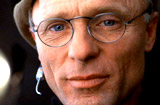
Christof: "You belong here with me"
|
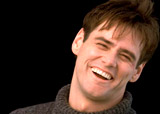
Truman's Beatific Smile
|
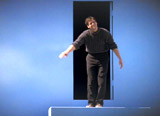
Farewell Bow
|
- after TV's Truman Show ceased transmission,
two chubby, pizza-eating security guards conversed together about
changing the channel (- "What else is on?" - "Yeah,
let's see what else is on?" - "Where's the TV Guide?")
|
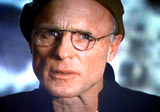
Christof (Ed Harris): The World is Bored by "Phony Emotions"
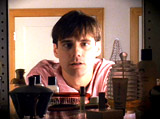
Truman Filmed 24 Hours a Day - Camera Hidden in Bathroom
Mirror
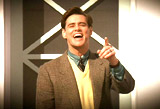
Truman's Catchphrase
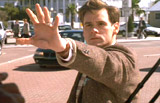
Truman's Realization That He Was the Center of His World
- Stopping Traffic


Truman's Attempt to Escape Via Sailboat
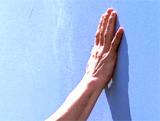
Reaching the End of the Set and of His Make Believe World
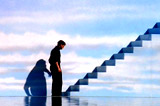
Ascending Stairs Leading to an Exit Door
Ending:
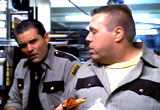
Two Security Guards: "What else is on?"
|
|
12 Monkeys (1995) (aka Twelve Monkeys)
- the story told about a time-traveling, mentally-unstable,
delusional prison convict James Cole (Bruce Willis) who was sent
back in time from the virus-plagued, post-apocalyptic world of 2035
to 1996, to observe the past and collect information - and possibly
create a better future; in exchange for being pardoned,
his mission was to obtain a pure sample of the horrible virus that
had killed 5 billion people and forced humanity to live underground
(the surface of the Earth was unliveable), so that a cure might be
found
- Cole eventually joined together in both Baltimore
and Philadelphia in 1990 and in late 1996 with psychiatrist
Dr. Kathryn Railly (Madeleine Stowe), as she began to believe
his story about a future virus plague. Planning on flying
together to a dream vacation destination - the Florida Keys, they
donned disguises. He glued on a mustache, wore a long-haired wig
and a tropical-designed shirt, and she wore a blonde wig
- at the Philadelphia airport
in the film's climactic sequence set in late 1996, they both realized
that red-haired, pony-tailed bio-terrorist and "apocalyptic
nut" Dr. Peters
(David Morse), virologist Dr. Leland Goines' (Christopher Plummer)
lab assistant, had just taken a sticker-covered carry-on
suitcase through security in front of them that contained vials of
live samples of the deadly virus - he had just exposed himself and
a security guard with the virus after being ordered to open one of
the vials
- when gun-brandishing Cole pursued the madman through
security (after Dr. Railly yelled out: "There he is! That man!
He's carrying a deadly virus. Stop him! Somebody, please stop him!"),
Cole was fatally gunned down from behind by airport police; madman
Peters got away and boarded his plane to San Francisco - with the
goal of infecting the world one city at a time
- the film's main plot twist was revealed to clearly
explain the reason for Cole's repeated dreams and memories; during
Cole's sad, long drawn-out death after being shot in the Philadelphia
airport by security guards, he was mourned over by grieving Dr. Railly;
as she mourned above him, she scanned the many bystanders surrounding
them, and knowingly noticed young Cole nearby when their eyes made
contact; it was Cole as a young boy witnessing the shooting (and
his own death) in the far future; his attempts to prevent the future
led to his death in the future
|
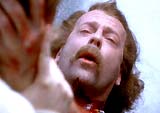
The Concluding Airport Scene: Dying James Cole (Bruce
Willis)
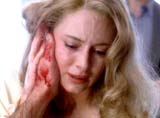
Dr. Kathryn Railly (Madeleine Stowe)
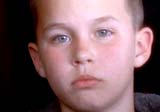
Cole as a Young Boy
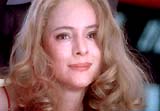
A Knowing Look
|
|
2001: A Space Odyssey (1968, UK)
- the scene in which astronaut
David Bowman (Keir Dullea) incapacitated-lobotomized the sentient
HAL-9000 computer (voice of Douglas Rain) by turning off his higher
functions
- HAL begged, pleaded and protested
with Bowman - in a programmed voice - as his 'mind' gradually decayed
and he became imbecilic and returned to infancy. HAL's poignant death
was agonizingly slow and piteous, and although the computer maintained
a calm tone - it still expressed a full range of genuine emotions
while dying. His voice eventually slowed and sounded drugged: ("Dave,
stop. Stop, will you? Stop, Dave. Will you stop, Dave? Stop, Dave.
I'm afraid. I'm afraid, Dave. Dave, my mind is going. I can feel
it. I can feel it. My mind is going. There is no question about it.
I can feel it. I can feel it. I can feel it. I'm a-fraid...")
- at the end of its suffering
lobotomizing death, HAL sang his swan song, one of the first songs
he learned - Daisy, or A Bicycle Built For Two - until the
words entirely degenerated with his voice rumbling lower and lower
into distortion. He slid into his innate tabula rasa state
- and then there was utter silence
|

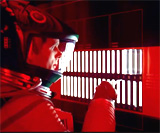
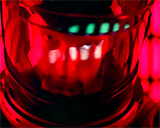
Astronaut Bowman De-Activating the HAL-9000 Computer
|

|
2010: The Year We Make Contact (1984)
- in this sequel, the film's opening prologue described
the 2001 mission report on the circumstances of the failed mission
to Jupiter by the USS Discovery One in the previous film; it was discovered that
the mission commander David Bowman (Keir Dullea) had no other option
but to disconnect the logic circuits of the malfunctioning HAL-9000
computer (voice of Douglas Rain); he also discovered the existence
of a mysterious Monolith (2 kilometers long) situated between Jupiter
and its moon Io, similar to the one found on the moon, although it
was larger (2 kilometers long)
- Bowman's last transmission after leaving Discovery on
a shuttle was: "My God, it's full of stars!"; Bowman was presumed
dead, and at the time, there seemed to be no explanation for HAL's
malfunctioning, or the meaning of Bowman's transmission
- in a joint mission to Jupiter between the US and
the Soviets to determine exactly what happened to the Discovery, it
was found that the abandoned Discovery was floating in space
(orbiting around Io) near Jupiter, as well as a giant alien Monolith;
HAL 9000's creator Dr. Chandra (Bob
Balaban) reactivated HAL onboard the Discovery
- there was a short scene in which project director
Dr. Heywood Floyd (Roy Scheider) and Dr. Walter Kurnow (John Lithgow)
discussed ball park hot dogs: ("...Yankee Stadium. September.
The hot dogs have been broiling since opening day in April. Now that's
a hot dog")
- in a scene on Earth, the ghost
of USS Discovery mission commander
David Bowman (now an incorporeal
being that existed inside the Monolith) visited
his former wife Betty Fernandez (Mary Jo Deschanel) - now remarried;
he appeared on her TV screen to check on her and say good-bye
for one last time: ("I
remember Dave Bowman and everything about him...All Dave Bowman
really was is still a part of me...Something's gonna happen and
I wanted to say goodbye...something wonderful");
he also paid a visit to his terminally-ill mother before her death
- Dr. Chandra learned that the
real reason for the sentient computer HAL-9000's
malfunctioning and its deliberate murder of the astronauts onboard
(HAL deliberately shut off their life support systems!) was because
the NSC had actually ordered HAL to conceal from the Discovery's crew
the fact that their mission was not about Jupiter, but was about the
mysterious Monolith situated near Jupiter; HAL was unable to properly
handle or process the information programmed internally ("He was
instructed to lie...he became paranoid"), and literally
had a 'mental breakdown'
- in a tearful scene, Dr. Chandra told
HAL the truth about their mission's immediate departure from Jupiter
- and their intention to sacrifice HAL on the sabotaged spaceship Discovery
One to
escape an imploding Jupiter in the midst of a strange conversion (due
to rapidly-multiplying Monoliths and a nuclear fusion reaction)
- HAL quietly and in a dignified manner accepted his
fate - and gave his thanks: ("I understand now,
Dr. Chandra...Thank you for telling me the truth"), and Chandra
responded with a farewell: ("You deserve it...Thank you, HAL")
- there was a fond, final exchange
between an ethereal David and a doomed HAL (HAL: "I'm afraid." David: "Don't
be. We'll be together"); then as the multiplying Monoliths engulfed
Jupiter, the planet imploded and was transformed into a small star,
while the Discovery
One was
destroyed in the blast
- HAL was able to transmit Dave's final "wonderful"
message to Earth, that was repeatedly broadcast: ("ALL
THESE WORLDS ARE YOURS EXCEPT EUROPA ATTEMPT NO LANDING THERE USE
THEM TOGETHER USE THEM IN PEACE")
- project director Dr. Heywood R. Floyd delivered a
final transcendent speech and transmission (a letter) to his son
Christopher (Taliesin Jaffe) while returning to Earth from Jupiter, about
the miraculous appearance of a second star in the sky (the remains
of Jupiter) and his realized dream of restoring long-lasting interplanetary
friendship and peace between the Soviets and the US: ("My
dear Christopher. This is the last time I'll be able to speak
to you for a long while. I'm trying to put into words what has happened.
Maybe that's for historians to do sometime later. They will record
that the next day, the President of the United States looked
out of the White House window and the Premier of the Soviet
Union looked out of the Kremlin window and saw the new distant
sun in the sky. They read the message, and perhaps they learned something
because they finally recalled their ships and their planes. I'm going
to sleep now. And I will dream of you and your mother. I will sleep
knowing that you are both safe, that the fear is over. We have
seen the process of life take place. Maybe this is the way it happened
on Earth millions of years ago. Maybe it's something completely different.
I still don't know really what the Monolith is. I think it's many
things. An embassy for an intelligence beyond ours, a shape of some
kind for something that has no shape. Your children will be born
in a world of two suns. They will never know a sky without them.
You can tell them that you remember when there was a pitch black
sky with no bright star, and people feared the night. You can tell
them when we were alone, when we couldn't point to the light and
say to ourselves: 'There is life out there.' Someday the children
of the new sun will meet the children of the old. I think they will
be our friends. You can tell your children of the day when everyone
looked up and realized that we were only tenants of this world. We
have been given a new lease -- and a warning -- from the landlord")
- the final evocative shots in the film were of locations
around the Earth with two suns (Washington DC, Russia, Egypt, Paris,
London, the Coast) and of the Monolith in a primordial, humid jungle
(with transformative signs of plant life emerging) on Jupiter's seemingly-barren
and icy moon Europa, as Richard Strauss' Thus
Spake Zarasthustra played - it was a sign of new intelligent
life
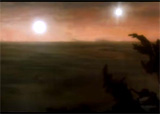
The Existence of a New Star
("A World With Two
Suns")
|
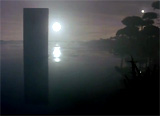
The Monolith in the Jungle of a Transformed Europa
|
|
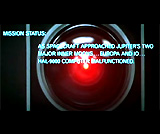
As Spacecraft USS Discovery Approached Jupiter's Two
Major Inner Moons - Europa and Io - HAL-9000 Computer Malfunctioned
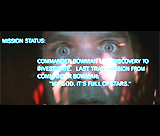
Bowman: "My God, it's full of stars"
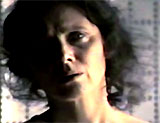
Bowman's Former Wife Betty Fernandez
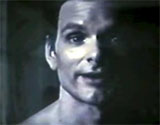
Ghost of Astronaut David Bowman Saying Goodbye
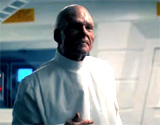
Bowman: "Something Wonderful"

The Monolith Near Jupiter
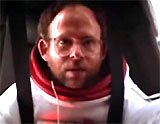
Dr. Chandra's Decision That HAL Would Be Sacrificed
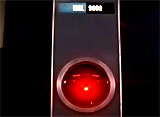
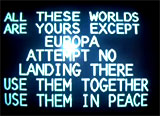
HAL's Final Transmission Before Its Destruction
|