|
1975 - 1979 |
|
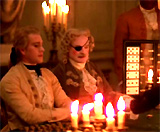
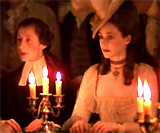
Barry Lyndon (1975, UK) Stanley Kubrick's film incorporated unique camerawork (using prototype Zeiss lenses) with numerous scenes filmed only with natural candlelight. |
|
||||||||||||
|
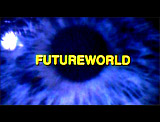
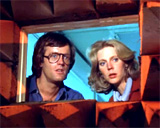
Futureworld (1976) Yul Brynner's final film and the sequel to Westworld (1973) featured the first use of 3D CGI in a live-action film. The CG graphic was created by the early computer visual effects company Triple I. The efforts of the special effects engineers were recognized with a Scientific & Engineering Academy Award in 1994. In the plot, a suspicious newspaperman Chuck Browning (Peter Fonda) received a whistle-blowing indictment of a park known as "Delos" from a murdered employee that seemed to confirm that Delos was entirely run and populated by robots. About two to three years earlier, a tragedy unfolded at Westworld, an adult entertainment resort that was run by the Delos Corporation. It had to be shut down due to malfunctining robots that killed the park's visitors. A new park was now reopening known as "Delos" - with four theme parks or sections:
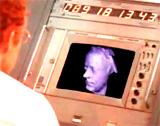
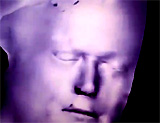
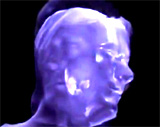
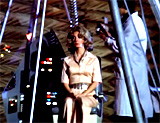
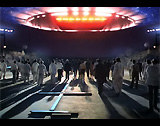
Browning and TV reporter Tracy Ballard (Blythe Danner) and other select members of the press were brought to the Delos resort. They were led by the park's representative Dr. Duffy (Arthur Hill), who claimed everything had been repaired. However, they didn't realize that the park's Control Center was filled with technicians who were filming and measuring their face and bodies. It was also revealed that mostly robots worked at Delos, to eliminate human errors. In the revolutionary visual effects segment early in the film, a very brief, computer-digitized 3D animated representation (or rendering) was made of Browning's hand and face. It was the first example of 3D CGI effects in any film. Shortly later, the press members were drugged and subjected to a thorough medical exam during which time, a clone (or doppelganger) was made of each person. Inside, doubles (or doppelgangers) were being made of each of the press members - ready to be programmed to take their places.
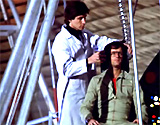
In the film's shocking reveal, it was necessary for Browning and Ballard to steal the face of a robot, in order for them to gain access to a secret area that only allowed robots to enter (using retinal scans). The stolen robot's face was placed on a welder's helmet to fool the security access viewer. Browning and Tracy were shocked to watch their cloned doubles (duplicates or replacements) appear, in a secret lab area: (Browning: "They are creating and programming duplicates of real people. That's what Frenchy's list meant about the politicians and the commissars and the generals. They've all been replaced by those things"). It was revealed that world leaders were being replaced with replicas or clones who were going to be programmed to dominate the human race. The clones were programmed to not harm Delos' interests, obey Delos fully, and destroy their originals.
Shortly later, Browning and Ballard were held at gunpoint by Dr. Duffy, who explained the reason for the cloning - to create a perfect world:
To save Browning's life, Ballard shot Dr. Duffy twice, sending sparks flying. Browning cut and peeled back Duffy's face to reveal that he was a robot. |
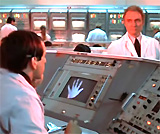 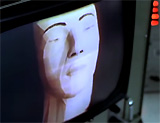 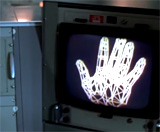 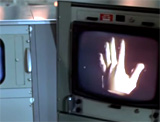 3D CGI of Scannings of Browning's Face and Hand 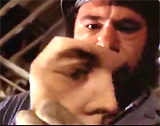 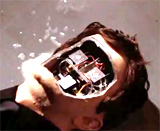 Stealing a Robot's Face 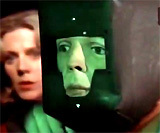 Gaining Access to Secret Test Area With Fake Robotic Face 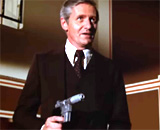 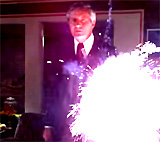 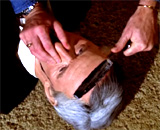 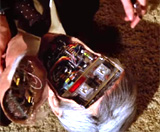 Mastermind Dr. Duffy Revealed as a Robot Himself |
||||||||||||
|
Close Encounters
of the Third Kind (1977) It was notable, after a long anticipatory buildup, for the sequence of the landing of the impressive alien mother ship - a 400 lb. fiber-glass model that was four feet high and five feet wide.
The UFO model was wired and lighted by fiber optics, incandescent bulbs, and neon tubes. |
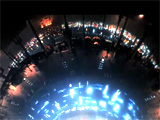 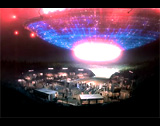 Landing of the Mother Ship |
||||||||||||
|
Sinbad and the Eye of the Tiger (1977, UK) This was the third Sinbad film, and costliest (at $7 million), made by special effects artist Ray Harryhausen for Columbia Pictures. Due to the fact that this film was released in the same year as Star Wars (1977), the special effects - in comparison - seemed archaic and 'old-school.' It featured an array of fantastic creatures in its stop-motion animated set-pieces, including:
One of the most fantastic scenes took place in Sinbad's (Patrick Wayne) tent, where evil witch/stepmother Queen Zenobia (Margaret Whiting) summoned three hideous chirping demons, stop-motion animated ghouls, to rise slowly from the campfire to battle against Sinbad. One ghoul with a burning torch was matched with the live-action filming of the torch, to create an exciting effect. |
 Chess-Playing Baboon 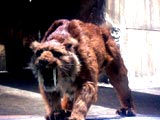 Sabre-Toothed Tiger 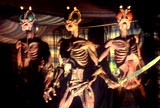 Three Stop-Motion Animated Ghouls |
||||||||||||
|
Star
Wars Episode IV: A New Hope (1977)
Parts of Luke Skywalker's (Mark Hamill) land-speeder were digitally erased in order to make it appear that it floated along at high-speed. In the film's climactic ending, the Empire's moon-sized weapon/battle station, the Death Star, was to be assaulted by Luke Skywalker and other Starfighters. Before the massive assault was a brief sequence called the Trench-Run Briefing, a training session for Rebel Alliance pilots. In the Rebel briefing room, trainees were given information by Rebel commander General Dodonna (Alex McCrindle) as they viewed a very basic, untextured and unshaded 3-D wireframe (or vector) view of the Death Star trench - read from R2D2's memory banks:
One of the pilots objected: "That's impossible! Even for a computer." The computer image they viewed was the first extensive use of animated 3-D computer animation (or CGI). This was the first major work of George Lucas' visual effects company - Industrial Light & Magic (ILM), which would become the biggest, most prestigious FX company in film history. From inside a linear trench, the space dogfighters, including Luke Skywalker, would have to fly their X-wing fighters during attack runs down into the trench, and launch proton torpedos on a thermal exhaust port. Their goal was to obliterate the Death Star with chain-reaction explosions, just as the station was prepared to target the main Rebel base on Yavin IV. This special effect of the trench was created using a 40-foot scale model covered with plastic walls and towers. A computer model of the trench was also created, using lines of light to represent the various shapes. The climactic spaceship battle scene at the conclusion of the first episode of the epic trilogy was filmed with an innovative motion-controlled camera - its first use in film history. This meant that a computer was used to control a long, complex series of camera movements. Hooked up to a computer, the Dykstraflex motion-control system (named after special-effects supervisor John Dykstra) issued a complicated series of movements to the camera, to create remarkable shots. |
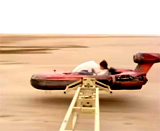 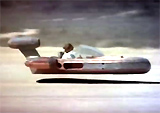 Digital Erasure 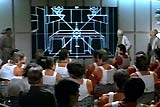 The Trench-Run Briefing Sequence - With Wire-Frame View 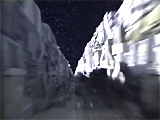 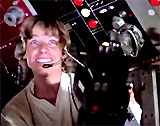 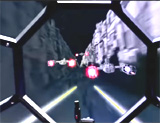 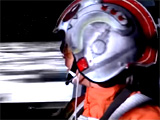 Luke Piloting X-Wing Fighter inside Trench |
||||||||||||
|
Superman:
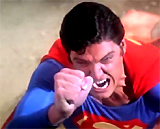
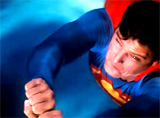
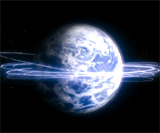
The Movie (1978) (aka Superman) It was noted for its innovative 3-D-like effects in its film title sequence. It was the first film with a computer-generated title sequence. (See also The Black Hole (1979) below). As the title sequence began, it zoomed and animated the words: "ALEXANDER SALKIND PRESENTS" and then continued with further zooms on the letters of the starring performers. The graphics also zoomed inward to present the famed S insignia for Superman. These effects were generated by what effects wizard Douglas Trumbull called "streak" photography (a close relative of his slit-scan technique used in 2001: A Space Odyssey (1968)), wherein flat artwork was extruded through a third dimension by moving the camera during the exposure of each frame of film. The motion of the camera was itself controlled by computer (in the same way a tool was controlled on a multi-axis CNC machine), but there was no CGI involved. The film also marked the first use of the Zoptic camera for the non-static flying sequences. During a massive earthquake sequence, Superman delivered an anguished primal scream howl-reaction to Lois Lane's (Margot Kidder) death (by suffocation) in her car. He angrily flew into the air to attempt to change the past with light-speed circumnavigation of the globe - to reverse time in order to bring Lois back to life.
|
 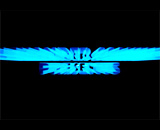 "Alfred Salkind Presents"  Opening Title Credits 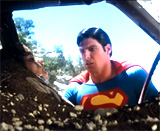 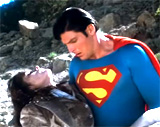 |
||||||||||||
|
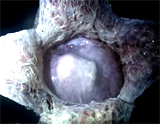
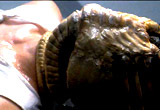
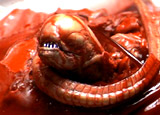
The film used a raster wireframe 3-D model rendering for the spaceship Nostromo's navigational charts on its computer monitors in the rough landing sequence on the foreign planet. The computer monitor sequence showed a terrain fly-over, rendering computer-generated mountains as wireframed images as the spacecraft slowly landed and the perspective of the terrain changed. The film was best-known for the monstrous-looking alien or xenomorph (created as a model in some shots out of plasticene, vertebrae from snakes, and cooling tubes from a Rolls-Royce). On the surface of moon LV-426, the crew of Nostromo were responding to a distress signal. The xenomorph alien creature was first viewed in its initial stage as a giant alien egg in an abandoned space vessel. They discovered rows and rows of strange pulsating eggs (sheep intestines) attached to the floor of one of the large chambers.
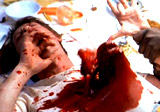
It was next seen as a small, face-hugging creature (composed of sheep kidney, fresh shellfish, and four oysters) with finger-like appendages and a tail. It was a genuinely shocking and memorable chest-bursting special effects scene in which crew member Kane (John Hurt) had his own blood and the monstrous Alien - in its new form as a chest-burster (a puppet thrust through a fake torso, spewing real cow's blood and guts) - graphically explode out of the front of his white T-shirt - the hissing, razor sharp-toothed, armless baby monster-lizard looked around and then scurried off to hide.
The trick shot involved a fiberglass chest piece (placed over the actor), tubes to squirt fake blood, a single hand puppet, and wires to help the alien race across the table. In an additional scene, crew member Ash (Ian Holm) was bludgeoned in the head, revealing that he was an android/robot. When his severed head was reactivated, he warned: "You still don't understand what you're dealing with." |
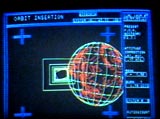 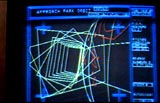 3-D Model Rendering of Navigational Charts on Computer Monitors 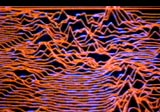 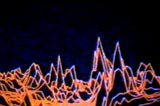 Wire-Framed Images of Planet's Mountainous Landscape 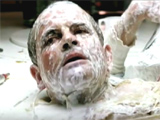 Android Ash's Head Bludgeoned Off |
||||||||||||
|
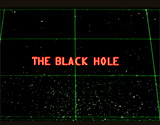
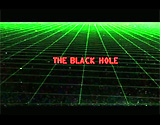
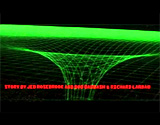
The Black Hole (1979) Similar to Superman: The Movie (1978), CGI-like film titles were also used for the opening titles in this Disney film, and for some trailers. |
  |
||||||||||||
|
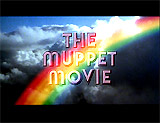
The Muppet Movie (1979) Jim Henson's muppets featured some of the trickiest and most advanced puppetry to date. In the opening title credits sequence, Kermit appeared to play a banjo in a swamp while singing "The Rainbow Connection." (Note: Jim Henson spent an entire day in a 50-gallon steel drum submerged in a pond). Another remarkable feat was the sight of Kermit riding a bicycle without any visible means of control.
|
 "The Rainbow Connection"  Kermit on Bicycle |
||||||||||||
|
Star
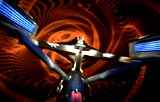
Trek: The Motion Picture (1979) The bold F/X (although rudimentary in the late 1970s) included amazing depictions of:
In the astonishing "merge" scene in the film's finale, Commander Willard Decker (Stephen Collins) and the android machine Ilia (Persis Khambatta) came together in a glowing spectacle. Realizing that the only way V'Ger would be able to find value and meaning, complete its final sequence in its transmission, and "join" with and "touch" its creator, Decker - already deeply affected by the loss of former lover Lieut. Ilia (Persis Khambatta) - sacrificed himself to become one with the machine life-form.
The merging of man ("human quality") and machine (Ilia had been abducted and replaced by V'Ger's identical-looking android probe) culminated in a dazzling explosion of white light, and the beginning of a new non-corporeal life-form ("We witnessed a birth. Possibly a next step in our evolution") from which the USS Enterprise majestically emerged, saved. |
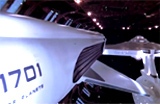 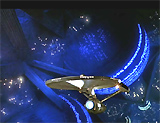 USS Enterprise 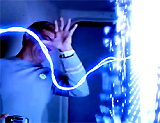 Special Effects 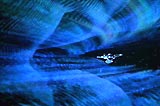 "alien cloud" |
||||||||||||




 There was
a new name for the Academy Award for FX this year - Best Achievement
in Visual Effects, won by this film. The iconic space opera Star
Wars was
competing against only one other nominee:
There was
a new name for the Academy Award for FX this year - Best Achievement
in Visual Effects, won by this film. The iconic space opera Star
Wars was
competing against only one other nominee: