|
Visual-Special Effects (F/X) Film Milestones
|
|
Title Screen
|
Film Title/Year and Description of Visual-Special Effects |
Screenshots
|
|
Fantasia (1940)
Disney's cinematic effort was the first serious, artistic-minded
animated film, correlating animation with 8 segments of classical music,
including the grim Rites of Spring featuring the life-and-death
struggle of evolution, the magical The Sorceror's Apprentice starring
Disney mascot Mickey Mouse, and Night on Bald Mountain featuring
the demonic Chernobog.
It was the first film to be released in a multichannel
stereo sound format called Fantasound - decades ahead of its
time - requiring a special system devised for playback, although it
was rarely shown that way due to the expense (and the fact that only
6 theaters were equipped to play Fantasound). |
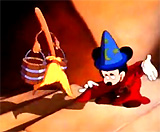
The Sorcerer's Apprentice
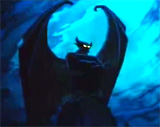
Night on Bald Mountain
|
|
Foreign
Correspondent (1940)
The most spectacular special-effects scene in this spy-thriller was aboard
a trans-oceanic clipper airplane bound for America that was diving and
about to crash. The dramatic crash itself was seen from the POV of the
cockpit (over the shoulders of the two pilots) as the plane dramatically
smashed into the surface of the water.
Thousands of gallons of water rushed into the cabin through
the cockpit windows and the cracked fuselage of the plane. Passengers
struggled for air and tried to escape as the aircraft filled with water,
and some survivors made it out to the wing. |
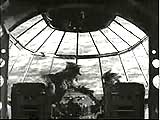
Cockpit POV of Crash
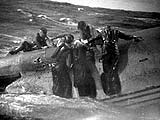
Surviving on the Fuselage
|
 |
The Thief of Bagdad (1940,
UK)
 The
Academy Award for Best Special Effects (photographic and sound)
was awarded to this film. There were 14 nominees for the honor, including Boom
Town, Dr. Cyclops, Foreign Correspondent, The Invisible Man Returns,
One Million B.C., Rebecca, The Sea Hawk, Typhoon, and Swiss
Family Robinson. It also won two other Oscars: Best Art Direction
(Color), and Best Cinematography (Color). It was notable as the first
film not nominated for Best Picture to win at least three Academy
Awards. The
Academy Award for Best Special Effects (photographic and sound)
was awarded to this film. There were 14 nominees for the honor, including Boom
Town, Dr. Cyclops, Foreign Correspondent, The Invisible Man Returns,
One Million B.C., Rebecca, The Sea Hawk, Typhoon, and Swiss
Family Robinson. It also won two other Oscars: Best Art Direction
(Color), and Best Cinematography (Color). It was notable as the first
film not nominated for Best Picture to win at least three Academy
Awards.
Associate producer William Cameron Menzies designed
some of the rich special effects for this imaginative Arabian Nights fantasy
film produced by Alexander Korda, a loose remake of the original Douglas
Fairbanks silent classic of 1924.
The effects included a flying magic carpet,
a six-armed mechanical assassin, a toy horse that could fly, poor Bagdad
thief Abu's (15 year-old Sabu) battle with a giant spider in its huge
web, and the sight of 50 foot tall genie or Djinni (Rex Ingram) released
from a tiny bottle.
|
Fanciful Elements
|
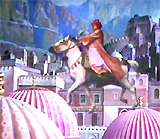 The Flying Horse
|
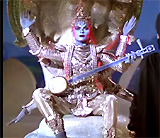 The "Silver Maid" - A Deadly, Multi-Armed
Dancing Statue
The "Silver Maid" - A Deadly, Multi-Armed
Dancing Statue
|
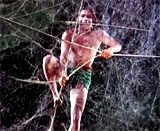 Abu Caught In Spider Web
|
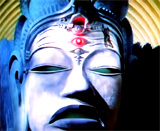 The Temple With Goddess (And an All-Seeing Eye
Jewel)
The Temple With Goddess (And an All-Seeing Eye
Jewel)
|
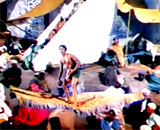 Abu Arriving to Save Everyone On Magic Flying
Carpet
Abu Arriving to Save Everyone On Magic Flying
Carpet
|
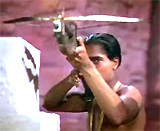 Abu's Magic Crossbow and Arrow - Death to Jafar
|
The film was notable for being the first to use the
'blue-screen' technique (the chroma-key process), created by Special
Effects director Lawrence Butler and Special Sound Effects crew member
Jack Whitney, for the scene of the Sultan's horse-borne ride over
the city. |
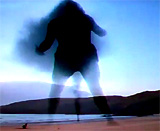
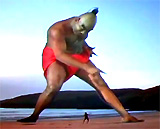
Djinn Emerging From Bottle
Jafar Shot Off the Magical Flying Horse by Abu
|
|
Citizen
Kane (1941)
This highly-rated classic masterpiece from director-star-producer
Orson Welles brought together many cinematic and narrative techniques
and experimental innovations (in photography, editing, and sound)
to reconstruct the title character like building a jigsaw puzzle.
The innovative, bold film is still an acknowledged
milestone in the development of cinematic technique, although it
'shared' some of its techniques from many earlier films. It showed
a whole new way of film-making.
However,
it was not among the nominees for the Academy Award for Best Special
Effects, won this year by the little-known aviation drama I
Wanted Wings (1941). Other nominees included: Flight Command,
The Invisible Woman, The Sea Wolf, That Hamilton Woman, Topper Returns,
A Yank in the R.A.F., and Aloma of the South Seas.
Its components
brought together the following aspects:
- use of a subjective camera
- unconventional lighting, including chiaroscuro, backlighting and high-contrast lighting, prefiguring the darkness and low-key lighting of future film noirs
- inventive use of shadows and strange camera angles, following in the tradition of German Expressionists
- deep-focus shots with incredible depth-of field and focus from extreme foreground to extreme background (also found in cinematographer Gregg Toland's earlier work in Dead End (1937), John Ford's The Long Voyage Home (1940), and Hitchcock's Rebecca (1940)) that emphasized mise-en-scene; deep-focus shots included the scene in Mrs. Kane's boarding house as young Kane played outdoors in the snow, Susan's music lesson, Kane's firing of Leland, and Susan's attempted suicide
- low-angled shots revealing ceilings in sets (a technique possibly borrowed from John Ford's Stagecoach (1939) which Welles screened numerous times)
- sparse use of revealing facial close-ups
- elaborate camera movements
- over-lapping, talk-over dialogue (exhibited earlier in Howard Hawks' His Girl Friday (1940)) and layered sound
- the sound technique termed "lightning-mix" in which a complex montage sequence was linked by related sounds
- a cast of characters that aged throughout the film
- a plot told from different perspectives
- flashbacks, flashforwards, and non-linear story-telling (used in earlier films, including another rags-to-riches tale starring Spencer Tracy titled The Power and the Glory (1933) with a screenplay by Preston Sturges, and RKO's A Man to Remember (1938) from director Garson Kanin and screenwriter Dalton Trumbo); later adopted by many films including Pulp Fiction (1994) and Memento (2000)
- the frequent use of transitionary dissolves or curtain wipes, as in the scene in which the camera ascended in the opera house into the rafters to show the workmen's disapproval of Mrs. Kane's operatic performance; also the famous 'breakfast' montage scene illustrating the disintegration of Kane's marriage in a brief time, or the dissolve when the camera passed down through the nightclub's roof coordinated with a lightning flash
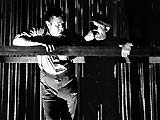
"curtain wipe"
|
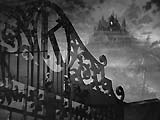
"Xanadu miniature" with dissolves, fades,
superimpositions
|
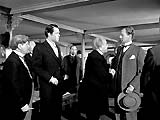
low angle with view of ceiling
|
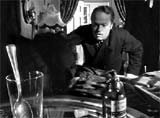
"in-camera matte shot"
with deep focus
|
- the abrupt cut between the opening scene of Kane's death, and the beginning of the "News on the March" segment
- long, uninterrupted shots or lengthy takes of sequences
- continuity editing, such as the scene of Kane's anger by Susan's departure; also montage (or discontinuity) editing, such as Susan's opening night opera performance
|
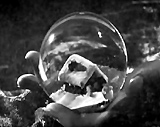
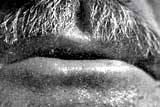
close-ups
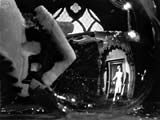
strange camera angles
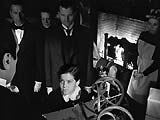
flashforward
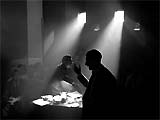
backlighting and
high contrast lighting
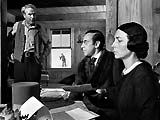
"deep focus"
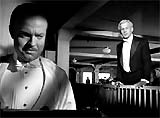
"deep focus"
using optical printer
|
|
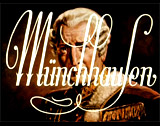
Munchhausen (1943, Ger.) (aka
The Adventures of Baron Munchausen)
This colorful (Agfacolor), visually creative and extravagant
film by director Josef von Báky ws adapted from the story
by R.E. Raspe and based on the fabulous baron nobleman of the title
who was known for telling tall tales.
The film opened in the 1940s where an alleged descendent
of a Baron, Hieronymus von Munchhausen (Hans Albers) - entertained
two guests with a tale told in flashback about the marvelous adventures
of his famous ancestor Baron Munchhausen (also Hans Albers) in the
18th century.
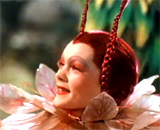
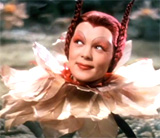
It featured marvelous special
effects, including:
- dancing coats and trousers emerging from a wooden
wardrobe (armoire)
- the Baron (Hans Albers) atop a speeding cannonball
through the clouds into the Turkish sultan’s palace
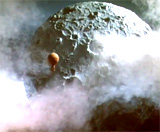
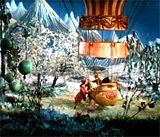
- a hot-air balloon
trip to the Moon
- a lady of the moon
- nothing more than a disembodied head growing on a plant
- a life-like oil painting that moved and blew out
a candle
|
|
|
|
|
Hot Air Balloon Landing on the Moon - With Moon
Lady
|
The film was commissioned
by the Nazi Third Reich’s Propaganda Minister Josef Goebbels to
celebrate the 25th Anniversary of Germany's UFA Studios. It was never
released in the US. He had become inspired by the colorful
fantasies of Walt Disney’s Snow White
and the Seven Dwarfs (1937),
MGM’s The Wizard of Oz (1939) (also
with a hot-air balloon sequence),
as well as the lavish production quality of Gone
with the Wind (1939) and the UK's The Thief of Bagdad
(1940), and wanted to show off Germany's movie-making prowess.
Director
Terry Gilliam's remake The Adventures of Baron Munchausen (1988) featured
the same fantastic adventures and was nominated for an Academy Award
for Best Visual Effects. |
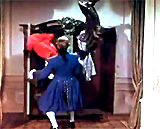
Dancing Clothes from an Armoire
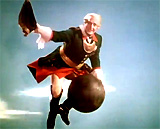
The Baron Riding on a Cannonball
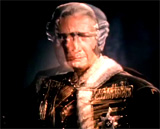
Life-Like Oil Painting
|
|
Blue Skies (1946)
This Technicolored Paramount production about a love triangle
featured Fred Astaire's (as radio broadcaster Jed Potter) famous virtuoso
and witty rendition of Puttin' on the Ritz, with his only prop
being his cane (that he used in synchronized conjunction with his rat-a-tat
tapping).
In one segment of the performance, he danced in counterpoint
with a chorus line of ten miniature Astaires. This was achieved by
filming three separate takes of Astaire (in the lead foreground and
two background performances), and reproducing them. |
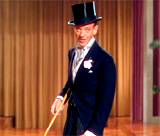
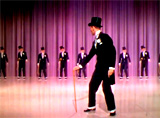
Astaire Dancing With Ten Astaires in "Puttin' On the Ritz"
|
|
A Matter of Life and Death/Stairway
to Heaven (1946, UK)
There were only two nominees in the category of Best Special
Effects this year: the winner Blithe Spirit (1945), and A
Stolen Life (1946).
UK directors Michael Powell's
and Emeric Pressburger's film was a technical
marvel with Jack Cardiff's exquisite cinematography. It included:
- the inventive transitions from Technicolor to black
and white
- an early use of the freeze-frame (of the table
tennis ball frozen in mid-air)
- the lengthy, monumental and endless
ascending staircase linking heaven and earth (the heaven sequences were filmed
in B/W) lined with statues of famous people (Lincoln, Plato, Richelieu,
Solomon)
- the startling POV shot through his huge closing eyelid
when deceased pilot Peter Carter (David Niven) was on an operating
table (facing surgery for a brain injury) and hovering between life
and death
- the panoramic view of the heavenly
court room (filled with soldiers who lost their lives in war), revealed
in a long pull-back shot as a gigantic arena - and then as the center
of a swirling galaxy in space (an effects shot combining miniatures
and artwork)
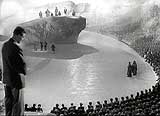
Heavenly Courtroom
|
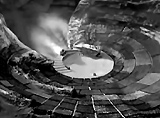
Long Pull-Back Shot
|
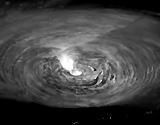
Swirling Galaxy in Space
|
|
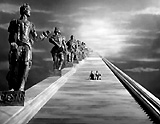
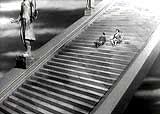
"Stairway to Heaven"
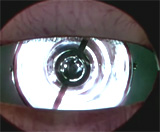
Closing Eyelid on Operating Table
|
|
Mighty Joe Young (1949)
This fantasy film
featured state of the art special effects and won the Academy Award for
Best Achievement in Special Effects. [See later for the Hollywood updated
version, Mighty Joe Young (1998).] Its only competing nominee for the Oscar
was Walter Wanger's production of the romantic drama-western Tulsa
(1949).
The legendary stop-motion master genius Willis O'Brien
of The Lost World (1925) and King
Kong (1933) fame supervised the special effects. One of the
effects technicians was a young Ray Harryhausen, who was working on
his first full-length feature film and assisting Willis O'Brien. It turned
out to be the last major animation film that O'Brien ever
made.
Although
the entire production took nine months to shoot, the animation alone
required fourteen months. It seamlessly and smoothly
composited stop-motion animation with live action and rear-projection,
including various models, props, and sets. Special effects included:
- rear-projection: a lion in a cage in one early shot,
and live African lions in the glass-enclosed dioramas in
the Los Angeles nightclub
- the expressive eye movements, and fluid body movements
of Joe, with more realistic, natural-looking 'fur'
- the building and use of six or seven stop-motion
models of the gorilla (between five and eighteen inches high), made
of cotton, foam rubber and metal and with 150 moving parts, as well
as miniature models for lions, cowboys, horses, 'Jill's' character,
and orphan children, etc.
- three different sized sets (full-sized, miniature,
etc.) for the Golden Safari nightclub
- the exciting burning orphanage sequence, with multiple
visual effects - one of best examples of stop-motion animation in
cinematic history
|
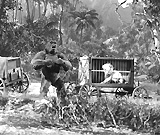
Rear Projection of Lion in Cage
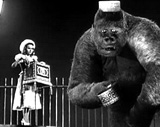
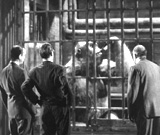
Mighty Joe - Stop-Motion Animation
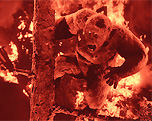
Burning Orphanage Sequence
|