|
Special Effects (F/X) - Milestones in Film 1950-1959 |
 |
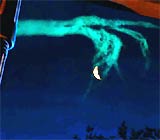
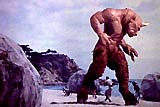
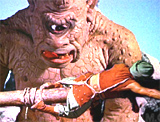
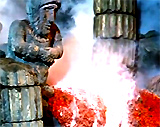
Films of Ray Harryhausen -
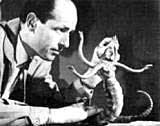
Special Effects Master and Model Animator Often partnered with Charles H. Schneer, his classic films with stop-motion animation and other special effects included:
|
  Jason and the Argonauts (1963) |
|||||||||||||||||||||||||||
|
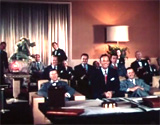
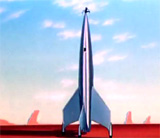
Destination Moon (1950) This film told about the efforts to launch the first manned spaceship flight to the Moon. Funds were raised from American industrialists to build in the desert a rocket using atomic engine to reach the moon. (In addition, to convince investors and show how space travel could become a reality, Woody Woodpecker was featured in an animated cartoon appearance to explain how rocket propulsion worked, using a shotgun. Woody also demonstrated how rocket propulsion could take a spacecraft to the Moon and back, using the principles of gravitational pull.)
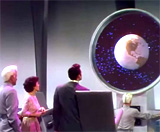
However, the publc became concerned over radiation leakage and fall-out, and the atomic-powered rocket (and spaceship named Luna) took off earlier than scheduled. After lift-off and suffering the strong effects of G-forces, each of the astronauts wore magnetic boots to counteract the weightless atmosphere inside the spacecraft. On the way to the moon, the astronauts were required to take a space-walk to repair an antenna, and maintained their contact with the spacecraft via their magnetic boots. One space explorer who had become untethered and was floating in free fall was rescued when a second astronaut was able to cleverly use a large oxygen cylinder with nozzle to propel both of them back to the ship. Although it was thought that the spacecraft was too heavy and didn't have enough fuel to return to Earth, the four space travelers were able to solve the problem and return safely. Matte paintings were predominantly used for various aspects of the film:
|
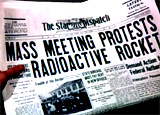 Protest Against "Radioactive Rocket" 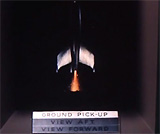 Lift-Off of Luna 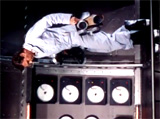 Magnetic Boots to Counteract Weightless Atmosphere 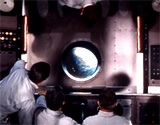 Viewing Earth 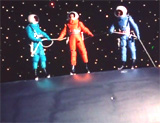 Spacewalk 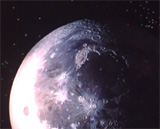 Approaching Moon 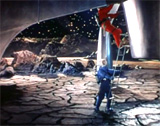 Exploring the Cracked Lunar Surface |
|||||||||||||||||||||||||||
|
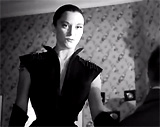
Orphée (1950, Fr.) (aka Orpheus) Jean Cocteau's visually-beautiful, eccentric, surreal, romantic fantasy drama, set in post-war 1950s Paris, was a retelling of the classic Greek Orpheus myth (about a musician's descent into the underworld to reclaim his dead wife). The avante-garde film was part of Cocteau's Orphic Trilogy: The Blood of a Poet (1930, Fr.), and Testament of Orpheus (1960, Fr.). In the story, Left Bank existentialist, middle-aged poet Orphée or Orpheus (Jean Marais) who was obsessed with Death was married to beautiful but unhappily neglected and pregnant wife Eurydice (Marie Déa). He became acquainted with two other characters - that formed the basis for a love-triangle:
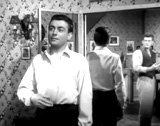
Orphee was advised by Death's chauffeur Heurtebise, a faithful guide, about how to enter the underworld through a Zone - through his bedroom mirror-portal - to reclaim Eurydice and return her to life after she had been struck down while riding her bicycle (off-screen) - she had been killed by the Princess's leather-clad motorcycle men and taken to the underworld. Heurtebise told him:
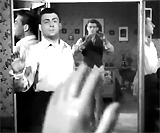
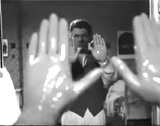
The film's trick-shot scenes (some with reversed photography) were of Orphee's crossing into the dreamy underworld to reclaim Eurydice. Orphee passed himself through a glass mirror (representing the borderline between life and the underworld). He first donned a pair of latex surgical gloves (left behind by the Princess) - that miraculously flew onto his hands - and then extended his magic gloved hands through the mirror.
|
 Orphee's Wife: Eurydice 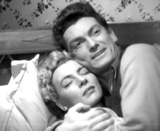 Orphee with Wife Eurydice (Maria Dea) 
 The Princess (Maria Casares) |
|||||||||||||||||||||||||||

|
The Day the Earth Stood Still
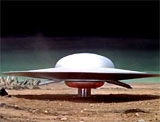
(1951) It began with the landing of a 'flying saucer' type spacecraft on the Ellipse in the early 1950s. A benevolent, interplanetary alien in humanoid form, Klaatu (Michael Rennie), caused a panic when he came with a message of good-will and peace, and then demanded to speak to all of the representatives of Earth's governments. Although the emissary warned the people of Earth to be non-violent and stop nuclear testing, in his first few moments of human contact, he was shot by a nervous soldier. His massive robotic companion Gort (Lock Martin), the first true robot, vaporized the offensive weapons with his Cyclops-like laser beam, and Klaatu was hospitalized but healed quickly. The film ended with the alien visitor Klaatu's resurrection (after being shot and killed) and a dire proclamation to Earthlings ("Your choice is simple: join us and live in peace, or pursue your present course and face obliteration. We shall be waiting for your answer") - a warning that received no proactive response from the ruling authorities. The film's most memorable character was the giant, nine-foot tall, all-powerful, mighty, menacing and massive metallic robot companion-protector named Gort, with a featureless face dissected by an opening visor, smooth metallic surface, straight legs (without knee joints), boots for shoes, and fixed mitten-styled hands (without joints or fingers). |
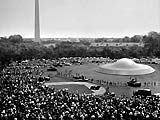 'Flying Saucer' Landing on the Ellipse in Washington DC 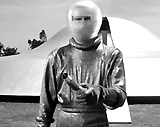 Alien Klaatu (Michael Rennie) 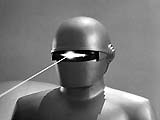 Robot Gort 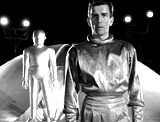 Klaatu's Farewell Address |
|||||||||||||||||||||||||||

 
|
When Worlds Collide (1951)
This sci-fi disaster film, typical of 50's apocalyptic, doomsday disaster films, was producer George Pal's follow-up film to Destination Moon (1950) - with a mediocre story that had spectacular special effects. (Films with a similar plot included Deep Impact (1998) and Melancholia (2011).) The film's prologue quoted the Book of Genesis in the Bible - specifying God's punishment upon the corrupted people of Earth by destruction ("the end of all flesh"), and the saving of the faithful Noah with an Ark. It told about the imminent destruction of the Earth (in six to eight months in the future) by a rogue star named Bellus that was on a collision-course with the planet. [Note: Since the threatening object was a 'star' - then the title was inaccurate. It wasn't a "world" that was about to collide with Earth.] The first threat was Bellus' single orbiting satellite known as Zyra that would pass close to Earth, 19 days before Bellus would crash into the planet. To save the human race from extinction, there were desperate efforts to build a space ark to transport a group of men and women to Zyra. As time ticked away and the 'day of doom' approached, Zyra as predicted came close to Earth (on Z-day) and caused massive earthquakes, volcanic eruptions, forest fires, floods and tsunamis that wreaked havoc around the world. Fires threatened to destroy the 'ark' spacecraft set to take off in a few weeks.
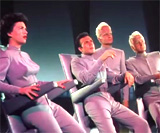
The rocket-propelled 'ark' spaceship that was built on a ramp, was stocked with food, medicine, microfilmed books, equipment, livestock and animals, and was ready to depart. In the improbable happy ending, the spaceship launched with about 45 passengers (selected by lottery) off the curved ramp, as they watched Bellus crash into the Earth on a viewing screen. The 'ark' craft safely entered Zyra's atmosphere and landed with a gliding free-fall and belly-flop since the fuel had already been depleted. When the crew disembarked into a deep snow field, they found that Zyra was habitable with fresh air, and would be greener and more lush further away at lower elevations. Some of the best examples of visual effects were a great fireball - a sun-sized body called Bellus - hurtling toward earth, the rocket-propelled spaceship built on a curved ramp, and a view of the sunrise landscape on Zyra (a color sketch/drawing).
|
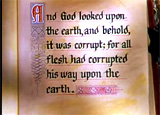 Opening Prologue 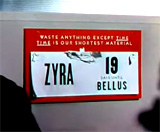 Close Passage of Zyra and Collision with Bellus - Z-Day 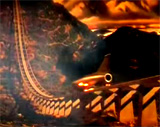 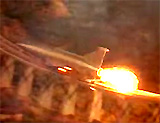 The Take-Off of the 'Ark' on Curved Ramp 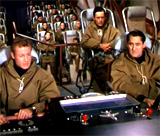 Passengers on Ark 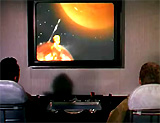 The Approach of Bellus - A Great Fireball on Viewing Screen Inside 'Ark' 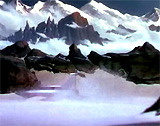 Landing on Snowy Icefield |
|||||||||||||||||||||||||||
 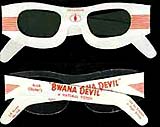 |
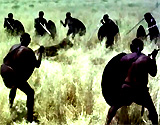
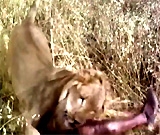
Bwana Devil (1952) Most of the action was filmed in Hollywood, but the background scenes were photographed, under director Arch Oboler’s direction, in the Belgian Congo and in British East Africa. The gimmicky 3-D effect required that the viewer wear special polarization glasses, unlike anaglyphic 3-D that required red/blue glasses to be worn. 3-D technology was employed to try to combat the encroaching competition of television on the film industry. The adventure drama, set in Kenya in 1898, featured a pair of man-eating Tsavo lions (a male and female) growling and approaching toward the camera, with spears readied to be thrown at the screen, and attack-victims being assaulted by the savage beasts. East Indian railway workers building the Uganda Railway (a railway bridge over the Tsavo River in Kenya) were being ravaged. To combat the problem, local Masai tribesmen-warriors were called in to assist in hunting the lions. The Africans were able to surround the lioness with spears and shields, but it broke loose from the circle and killed one warrior and injured others
In the film's exciting conclusion, Bob Hayward (Robert Stack) and his wife Alice (Barbara Britton) were confronted by the two lions. After the lioness attacked Alice, Bob shot it dead, but then faced the second menacing male lion. He taunted the lion: "Come for me, you devil you!" When his gun jammed, it looked as if he would be the lion's next meal, but then he was able to adjust the gun and shoot it: ("I hit ya, devil, hit ya!"), but then realized that he had only wounded the male lion, and was forced to beat it to death with his rifle as he cursed it: "You are the devil." He embraced and boasted to his wife: "Alice, I killed him" - as the film abruptly ended. |
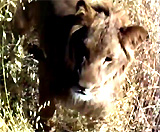 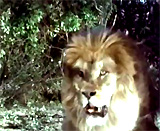 Two Man Eating Lions  Attacks on Humans 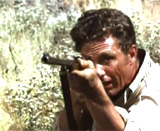 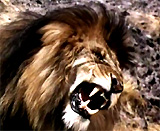 Climactic End: Jammed Gun and The Death of the Male Lion |
|||||||||||||||||||||||||||

End Title |
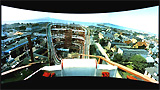
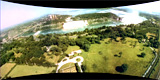
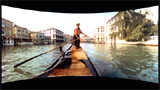
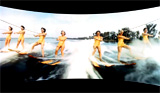
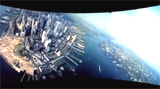
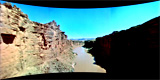
This is Cinerama (1952) Paramount's wrap-around, big-screen Cinerama debuted in 1952 - it was the first film to use the three-strip cinerama process. It was a break-through technique that required three cameras, three projectors, interlocking, semi-curved (at 146 degrees) screens, and four-track stereo sound. Although there were a few successful box-office Cinerama hits in the 1950s, the process was ultimately abandoned because its novelty wore off and the equipment and construction of special theatres was too cost-prohibitive and cumbersome. The documentary opened with its star, travel author and newscaster Lowell Thomas (as Himself) serving as the film's narrator. He was seen in B/W and in the standard TV 4:3 aspect ratio - before the film opened up to the three-screen, wrap-around view. The first Cinerama film was basically a travelogue of the world's vacation spots:
|
 Film's Opening 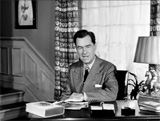 Film's Narrator: Lowell Thomas (B/W, 4:3 aspect ratio) 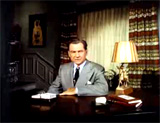 Beginning of Act Two: Lowell Thomas |
|||||||||||||||||||||||||||
|
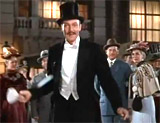
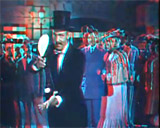
House of Wax (1953) Andre de Toth's horror film from Warner Bros. had the extra added attraction of being filmed in 3-D - and it was highly successful. It was the first 3-D color feature film released by a major American studio. It was a more expensive remake of their earlier Mystery of the Wax Museum (1933), with Vincent Price establishing himself forever after as the quintessential horror villain. Although this was a horror film, the most remembered 3-D scene in the film was the paddle-ball sequence in which a huckster (Reggie Rymal) in front of the newly-opened "House of Wax" kept swatting at a ball attached by a string to a paddle. He spoke at the theatre audience and noted:
|
|
|||||||||||||||||||||||||||
|
The Robe (1953) When Cinerama and stereoscopic 3-D died almost as soon as they were initiated, 20th Century Fox's CinemaScope became cheaper and more convenient because it used a simple anamorphic lens to create a widescreen effect. The aspect ratio (width to height) of CinemaScope was 2.35:1. The special lenses for the new process were based on a French system developed by optical designer Henri Chretian. The first film released commercially in CinemaScope was 20th Century Fox's and director Henry Koster's Biblical sword-and-sandal epic The Robe (1953). It debuted in New York at the Roxy Theater in September of 1953. Other milestones in widescreen formats included:
|
|
|||||||||||||||||||||||||||
  |
The War of the Worlds (1953) This classic and influential film adaptation of the H.G. Wells 1898 sci-fi classic (publicized by Orson Welles' infamous narrated radio play of 1938 that scared the world), has been considered the definitive Martian alien-invasion film, with a vivid depiction of the invasion of the Earth by Martians. It was made by producer George Pal, director Byron Haskin, and Paramount Studios.
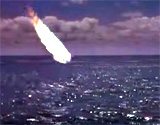
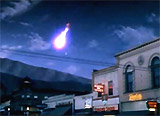
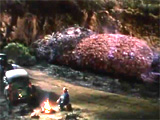
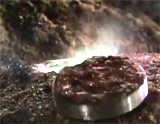
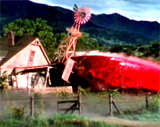
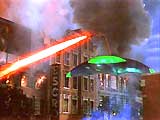
This was the first visual effects-laden "popcorn" film, featuring vibrant color special effects, and the partial destruction of various cities and landmarks, including the famous Los Angeles Courthouse Building, the Eiffel Tower in Paris, the Taj Mahal in India, etc. The film was mostly set in early 1950s Southern California (Linda Rosa, about 30 miles from L.A., and then within the city itself). At first, a very large cylindrical-shaped, other-worldly object created a fireball and crashed. It caused a minor forest fire, carved out a small crater at the site of the impact, and brought many onlookers. It was evident that the object was radioactive. Believing it was some sort of unusual meteorite, some proposed making it a tourist attraction: ("Better than a lion farm or a snake pit. We won't have to feed it. Sure. We can sell tamales and enchiladas and hot dogs, too! Yeah! Ice cream, cold drinks, souvenirs. I think we should put up a few picnic tables"). Two nearby residents were intrigued, along with many others: Sylvia Van Buren (Ann Robinson) and her uncle, Pastor Matthew Collins (Lewis Martin). While investigating the crash, USC library science instructor Sylvia became the love-interest of heroic scientist Dr. Clayton Forrester (Gene Barry) of the Pacific Institute, who was interrupted by the crash during a fishing trip nearby, and was summoned to investigate. When the hatch on the strange radioactive object unscrewed itself and opened, a Martian weapon of some kind (a long-necked, cobra-like probe with a flashing red eye) emitted a deadly heat ray that scorched and disintegrated three men guarding the site, who were holding up a white flag. Soon after, three manta-ray looking, swan-like alien war-machines emerged at each crash or impact site. They were magnetically levitating at low-altitudes and using their cobra-like probes to attack ("It's supported from the ground by rays, probably some form of magnetic flux, like invisible legs"). Barrages of artillery and missile fire were ineffective and "useless" against the force-field protected Martian war machines, as Dr. Forrester explained: "Those shells can't get through to them. They've put out some sort of electromagnetic covering, a protective blister." The probes zapped objects with green disintegration heat rays throughout the Los Angeles area (and elsewhere in the world) to attempt to destroy the city. Their weapons were capable of burning, melting, and vaporizing weapons and soldiers.
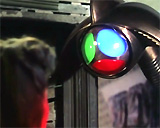
When Sylvia and Dr. Forrester crash-landed in a military plane during an escape attempt, they sought refuge in an abandoned farmhouse. As they talked, Forrester presented a foreshadowing prediction: "If they're mortal, they must have mortal weaknesses. They'll be stopped... somehow." The farmhouse were soon surrounded and buried by a nearby crash-landing of several more alien cylinders. The two hid as three floating war-machines hovered nearby, and one of them sent out a long tentacled probe - a tri-colored "electronic eye," that peered in through a window ("Like a television camera. It's looking for us").
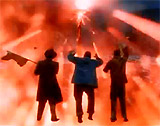
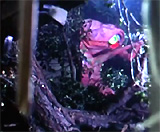
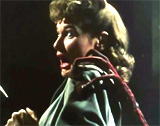
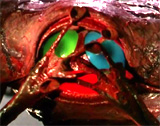
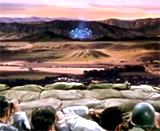
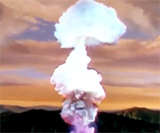
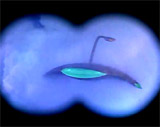
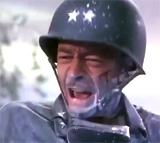
Sylvia caught a brief glimpse of one of the green-eyed, purple Martian aliens (a hideous crab-like biped) that had emerged from a war-machine and was exploring, presumably a Martian crewman. Then, she was spotted by the "electronic eye" probe - Forrester defended her by smashing it with an axe, and it withdrew its 'beheaded' tentacle. Then as they turned their backs and were removing debris blocking their exit, in a scary moment, the alien Martian placed its creepy, tentacled and fingered hand on Sylvia's left shoulder. Again, Forrester sprung into action - he blinded it with a flashlight, and it responded by trying to cover its tri-colored eye - and then he heaved his axe at it, and it fled with a scream. As they prepared to flee, Forrester grabbed the amputated eye-probe camera, and Sylvia's blood-splattered scarf, and noticed a vital Martian-blood sample; they made a run for it just before the house was incinerated by the heat-ray of a hovering war machine. It was clear that the Martians had created a nest to surround the major city of Los Angeles; military leaders felt that there was no other choice for them other than to drop a nuclear A-bomb in the LA area, 10 times stronger than anything previously used: (later, a Radio Reporter (Paul Frees) - the pre-titles Narrator dictated into a recorder: "This will decide the fate of civilization. Whether we live or die..."). However, the nuclear option was ineffective - one of the Martian flying machines with a force-field, seen in a binocular view, emerged unscathed from the mushroom cloud; Maj. General Mann (Les Tremayne) was dismayed: "It didn't stop them. Guns, tanks, bombs - they're like toys against them!" The war machines continued to zap objects with green disintegration rays to destroy 1950s Los Angeles. Soon after, Los Angelenos were evacuated as the Martians were proceeding to conquer and totally dominate the world; although the mass LA exodus began in an orderly fashion, and evacuees were led to welfare centers in the hills, mobs of people panicked as the evacuation continued.
In the conclusion, the aliens - attacking a church (where Forrester and Sylvia were reunited) - were decimated and forestalled only by simple, minute bacterial agents. One of the alien ships outside the church lost power and crashed into a neighboring building; Forrester watched as the saucer's door opened and one of the Martian creatures, with its outstretched weakened arm, tried to crawl from the door of its downed heat-ray machine; its arm flopped down as it stopped, turned gray, and expired; other attacking Martian flying ships began to collapse in the city and throughout the world, with dead aliens inside; Forrester noted: "We were all praying for a miracle" - and he looked heavenward as bells chimed. The Narrator intoned (in voice-over) that God had saved humanity "by the littlest things" --
|
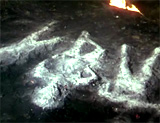
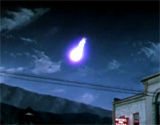 Fireball Object (A Flaming Meteor?) in the Sky 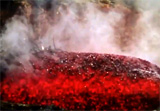 Red Hot Cylindrical Object on the Ground 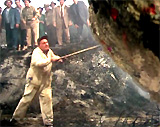 Crash Impact Site 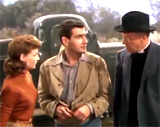 (l to r): Sylvia Van Buren (Ann Robinson), Dr. Forrester (Gene Barry), Pastor Collins (Lewis Martin) 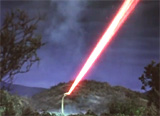 Deadly Heat Rays Emitted From Cobra-Like Probes 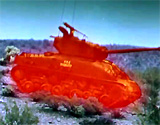 A Military War Tank Melted and Disintegrated by a Heat Ray 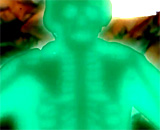 Soldier Vaporized by Deadly Heat Ray Weapon 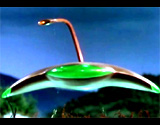 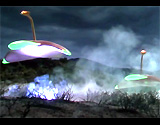 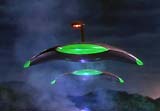 Floating Alien War-Machines Emerged From Crater Impact Sites  The Manta-Ray War Machines Were Protected by Force-Shields 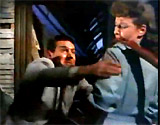 Dr. Forrester Defending Sylvia in Farmhouse  The Abandoned Farmhouse Incinerated 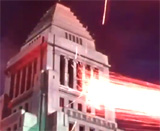 The Martians Attacking and Burning Down Los Angeles 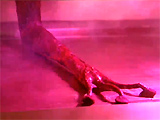 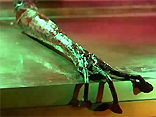 Assault on Los Angeles Suddenly Stopped - Death of Martian Creature 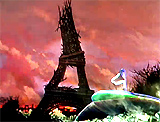 Attacks Worldwide (Such as at the Eiffel Tower) Ceased |
|||||||||||||||||||||||||||
|
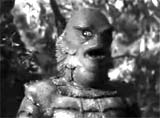
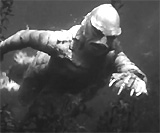
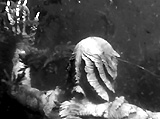
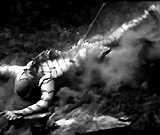
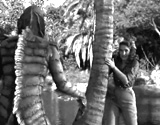
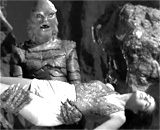
Creature from the Black Lagoon (1954) This classic Universal horror film was by director Jack Arnold - originally shot in 3-D, and was the last great prototypical classic from Universal Studios. In the pantheon of Universal Monsters, only The Creature was given the 3D treatment. Special effects effectively used a foam-latex costume suit to represent the amphibious creature called the Gill-Man - one of the most famous movie monsters ever created. Director Guillermo del Toro years later used the movie as inspiration for his Best Picture-winning The Shape of Water (2017). The campy film began with the discovery in an upper Amazonian jungle of a fossilized claw or hand (with webbed fingers) embedded in rock by Dr. Carl Maia (Antonio Moren) - it was evidence of an unusual, prehistoric, amphibious web-handed and footed humanoid-reptile. The discovery might prove that a strong, prehistoric creature existed linked sea and land animals. Not visible to the scientist, a similar-looking webbed hand emerged from the river bank and then slid back into the water after leaving claw marks.
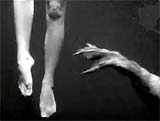
Slightly later, Dr. Maia's two assistants, Tomas (Perry Lopez) and Luis (Rodd Redwing) at their campsite were suddenly attacked by a humanoid creature (first seen as a disembodied claw reaching into their tent) - a descendant of the fossil species. Both men were grabbed by the claw in the face and killed amidst ferocious growls. It was presumed that a jaguar had attacked them with its claws. As the group surveyed the campsite, Kay stood by the water's edge as the clawed hand reached out for her legs, but was unable to grab her.
An anthropological expedition was organized by Dr. Maia and funded by Dr. Mark Williams (Richard Denning) to a Brazilian river in the Amazon on board the Rita. They were accompanied by ichthyologist Dr. David Reed (Richard Carlson) and his dark-haired girlfriend/fiancee and colleague Kay Lawrence (Julia Adams), and scientist Dr. Edwin Thompson (Whit Bissell). Others included Captain Lucas (Nestor Paiva) and two crew members Zee (Bernie Gozier) and Chico (Henry Escalante). There were two individuals who played the Creature of the film's title, and because of their differing heights, two different costumes (full-bodied monster suits and masks) were created:
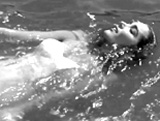
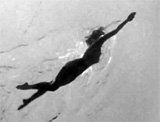
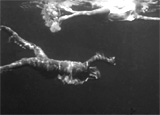
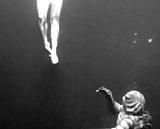
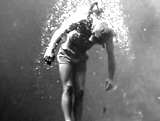
It was eventually thought that more fossil remains or a descendant of the original fossilized creature, a Gill-Man (Ben Chapman), might be living in a dark lagoon known as the "Black Lagoon." Once the Rita arrived at the Black Lagoon, two of the expedition members, Reed and Williams went scuba diving to investigate and find some samples - unaware that they were being stalked by the Gill-Man. After the divers returned, Kay took an impromptu swim by herself - in a stunning one-piece white bathing suit. In scary and superbly-photographed underwater sequences, as she swam at the surface, the creature expressed 'Beauty-and-the-Beast' love interest in bathing beauty Kay, stalking and watching her from below as she swam above him. He even appeared to mirror or mimic her movements.
After Kay's swim, the Creature was briefly caught in one of the ship's draglines, and although it escaped, it left behind a claw in the net, proving its existence. Kay expressed dismay, realized that she had possibly been swimming near the Creature. The expedition's two divers, Reed and Williams pursued the Creature and were able to spear it underwater with a fishing gun, but it escaped.
After several deadly encounters with the Gill-Man and the death of two crew members Zee and Chico, the Creature was captured and caged up onboard the Rita. When it escaped, it attacked Dr. Thompson who hit the Creature with a lantern and set it on fire, but Dr. Thompson was seriously wounded. As the group decided to leave the lagoon, they realized that their exit-way was blocked. When Dr. Williams went underwater to capture the creature, he was mauled to death as Dr. Reed watched and eventually scared the Gill-Man off.
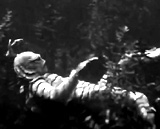
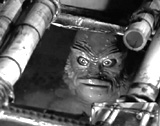
Soon after, the Creature reached in through a porthole to attack the bandaged and ailing Dr. Thompson, and Kay was grabbed and kidnapped from the boat. It dove into the water with her and took her back to its swampy cave or grotto hidden by the bank, but she was soon pursued by Dr. Reed who came to Kay's rescue. As the Creature was attacking Dr. Reed, it was shot with bullets (by Dr. Maia and the Captain) and severely injured in the chest with bullet wounds. Dr. Reed allowed the Creature to retreat back to the lagoon's beach where it swam off, disappeared, and sank lifelessly back into the deep watery depths of the lagoon. |
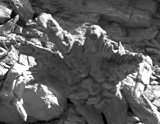 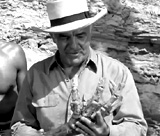 Dr. Maia's Discovery of Fossilized Claw in Rock 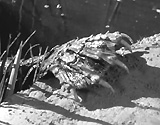 Claw That Emerged on River Bank - Similar to the Fossil 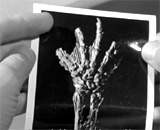 Picture of Fossil Discovery 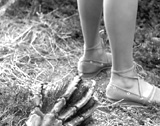 Clawed Hand Reaching Out for Kay's Legs 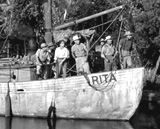 Expedition into the Black Lagoon 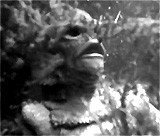 Creature Underwater - Stalking the Divers 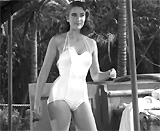 Kay Preparing to Swim in the Black Lagoon  Claw Found in Net  Kay Disturbed by the Finding 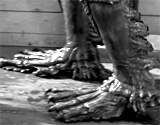  Creature Attacking Crew Member Chico on Deck of the Rita 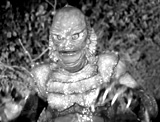 Captured in Spotlight Emerging From Water 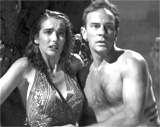 In the Grotto: Kay Rescued by Dr. Reed 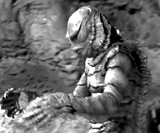 Creature Shot With Bullets 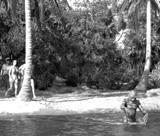 The Creature's Demise in Lagoon? |
|||||||||||||||||||||||||||

|
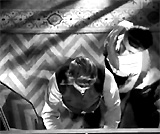
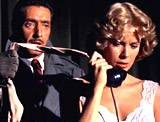
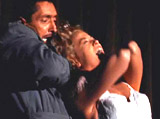
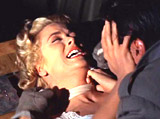
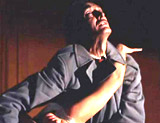
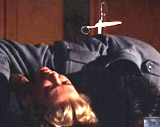
This was Hitchcock's screen version of English playwright Frederick Knott's successful stage play. It was filmed in 3-D with the technology that was available at the time, and judged as one of the greatest 3D films ever made. Hitchcock's thriller masterpiece told about a charming, sophisticated yet villainous husband - an ex-tennis pro named Tony Wendice (Ray Milland), who masterminded the murder of his unfaithful wealthy socialite wife Margot Wendice (Grace Kelly) for having an affair with American crime-mystery writer Mark Halliday (Robert Cummings), so that he could inherit her fortune. Wendice blackmailed or "influenced" C.A. Swann/Captain Lesgate (Anthony Dawson), a former classmate with a petty-criminal record, to commit her "perfect murder" for £1,000 pounds cash. During the attempted strangulation scene, the tension was ratcheted up. Tony's plan was to have his wife leave her bedroom to answer the living room phone, to enable Swann to strangle her from behind the drawn window curtains where he was hiding. In one of the most suspenseful scenes, Tony dialed his home number (dialing M for murder) from a hotel lobby's payphone, but because his watch had unexpectedly stopped, he was about eight minutes too late. Tension was intensified and his plan was botched because he was planning to call at 11:00 pm, but the call was about 11:08 pm. The assassin was frazzled and about to leave because of the delay. When the phone finally rang, the camera slowly panned to the left around Margot as she came into the living room and answered. The camera moved to view Swann's position behind the living room curtains. Reflections from the fireplace played upon the walls in the darkened room. He approached with a twisted scarf and wrapped it around her neck, but she foiled his strong attack by fighting back. There was the tremendous 3-D effect of Margot reaching back behind her - into the audience from the screen - searching for a weapon (a pair of scissors) to defend herself and kill the assassin by stabbing him in the back. When he fell to the floor onto his back, the blades of the scissors were pushed more deeply into his body.
Tony's new plan to outwit the police seemed to succeed - making it appear that Margot had an ulterior motive for killing Swann (he was blackmailing her), and she was rapidly brought to trial and convicted. However, there were anomalies in Tony's story that didn't add up, and wily Inspector Hubbard (John Williams) was on the case. In the twisting conclusion, when Tony entered (using the key under the carpet stairs) and turned, he realized that he had been found out: (The Inspector predicted Tony's downfall: "Once he opens that door, we shall know everything"). |
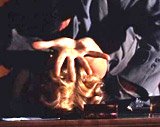 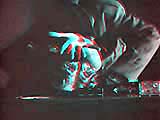 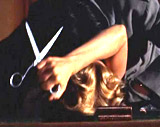 The 3-D Effect Maximized To Its Fullest Extent |
|||||||||||||||||||||||||||

|
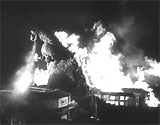
Gojira (1954, Jp.) (aka Godzilla, King of the Monsters (1956)) Japan's Gojira (1954) was inspired by Warner Bros.' science-fiction, atomic monster film The Beast from 20,000 Fathoms (1953) with stop-motion animation special effects by Ray Harryhausen. In both instances, a prehistoric monstrous creature was resurrected by an atomic bomb test. The Japanese film was considered the first "kaiju" - a name referring to the monster itself and also to a category of Japanese feature films and TV shows that featured giant monsters. Although the special effects in this film weren't exactly revolutionary, they were influential, nonetheless, in this story about a giant monster or sea creature that was awakened, irradiated and mutated by atomic or nuclear H-Bomb tests in the sea near a Southern Japanese island known as Odo Island. The effects were created by animatronic models, miniatures of the city of Tokyo, and by an actor in a 6 and 1/2 foot lizard suit (framed with wires and bamboo sticks covered in latex). The effect, known as 'suitmation', required a stunt performer to wear a lizard suit while interacting with scale-model miniature sets.
In the film's climax, an "Oxygen Destroyer" was deployed at Godzilla under the water in Tokyo Bay, to asphyxiate the monster by depriving it of oxygen.
|
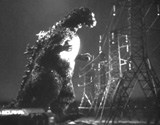 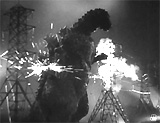 Godzilla Interacting With Electrified Fence 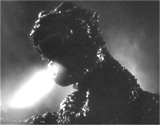 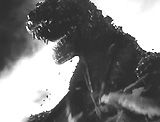 Fire-Breathing Monster |
|||||||||||||||||||||||||||
|
20,000 Leagues Under the Sea (1954)
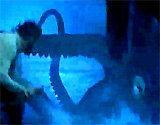
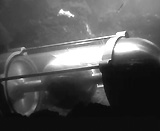
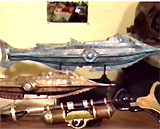
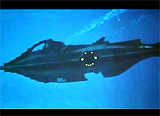
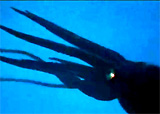
The exorbitant budget for 20,000 Leagues was $5 million (about $50 million today), several times more expensive than almost all the movies made in the same year. It was notable for its depiction of the highly-advanced, possibly nuclear-powered, 'submerging boat' known as the Nautilus. Extensive interior sets of the Nautilus were constructed, as well as a full-scale 200 foot long (and 26 foot wide) replica of the sub. There were also various sizes of miniature subs; the largest was five or six feet long. Its design has been dubbed 'steampunk' - with brass rivets and Victorian-era futuristic technology. Its design incorporated a battering-ram snout, electric "eyes" (or telescopes), metallic ridges, a rudder or tail, a diving chamber, electronic or atomic power and a lavish interior salon, equipped with a pipe organ. Another amazing feature was the giant tentacled squid fight. Also constructed to make it possible was a fully-functional, animatronic 70 foot long giant squid that weighed two tons. Each of the eight, 40-foot long tentacled arms had three puppeteers to provide the motion through wire pulleys and air hoses as it curled and uncurled. There were also two 50-foot feelers. In all, the squid required 28 crew members to control.
In the film's ending, warships awaited the Nautilus' arrival at Vulcania where they had converged after being alerted by SOS messages. Nemo went ashore in a skiff - determined to destroy his base and the evidence of his "greatest discoveries of all time" by setting a time bomb. He was lethally shot in the back on his return to the Nautilus; as the cultured, disciplined and slighty insane anti-hero Captain Nemo was dying in his grand salon at the viewing porthole, he announced that he would go down with his ship on its last dive; however, the Nautilus hit a reef and began to sink, and Nemo died during a last look at his undersea world. Vulcania was consumed as it exploded in a mushroom cloud. The last words of Nemo (in voice-over) were heard as they were remembered in an echo: "There is hope for the future. And when the world is ready for a new and better life, all this will someday come to pass, in God's good time"; in due time, Nemo's inventions and remarkable discoveries would one day be revealed. |
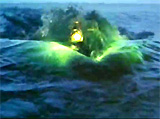 Nautilus First Thought to be a 'Monster' 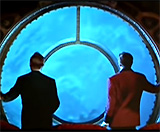 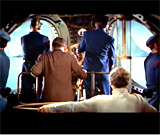 Nautilus Submarine Submerging - With Nemo Navigating Via Two Large Portholes 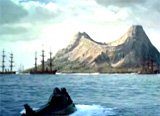 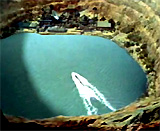 Matte Drawings of Nemo's Secret Island Base Vulcania |
|||||||||||||||||||||||||||

|
Conquest of Space (1955) This Paramount Pictures semi-documentary was FX artist George Pal's and director Byron Haskin's visionary sci-fi story about a dangerous spaceship journey to the planet of Mars, following Pal's success with Destination Moon (1950), When Worlds Collide (1951), and The War of the Worlds (1953). It was Pal's fourth sci-fi space epic. The film's science was based directly on renowned German rocket engineer-scientist Wernher von Braun's writings and designs in a 1954 article in Collier's Magazine ("Can We Get to Mars?"), and on his 1952 book The Mars Project. Braun was known for inventing the V2 rocket for the Nazis and the Saturn V for the US' NASA program.
The opening voice-over narration (in the pre-title prologue) of this Technicolored film proclaimed:
The film's tagline stated: "See How It Will Happen...In Your Lifetime." Although essentially a box-office flop with some hokey and unrealistic special effects (and regarded as the film that essentially ended Pal's career as a producer), some of the more impressive and ambitious effects included:
Set in the 1980s (and with no scenes set on Earth), the film followed the one-year training and conditioning mission on the space station by a group of astronauts who would comprise the crew for the first scheduled moon landing in a giant spaceship. However, the plans changed and they would venture to Mars ("The Red Planet") instead - the first interplanetary flight. During the mission itself, there was a near-miss with a glowing planetoid/asteroid or meteorite, and one astronaut died (and was buried in deep space). Another mishap involved the insane, rogue and mentally-unbalanced General Samuel T. Merritt (Walter Brooke) who tried to sabotage the mission by crashing the space shuttle during the Mars landing and killing the crew - due to his fanatical belief that God didn't want man to explore space. After touchdown on Mars, the planet was found to be barren and lifeless, and the crew was stranded for a year until they could return. However, the inane script called for a surprise twist - on Christmas Day, it began to snow and water supplies were replenished, and there was solid hope for returning to Earth safely. |
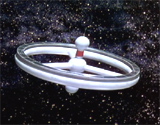 "The Wheel" Space Station 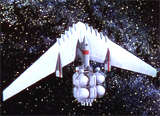 Modified V-2 Rocket 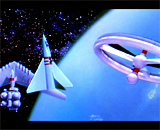 Interstellar Vehicles 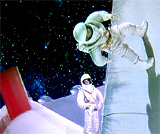 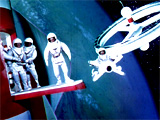 Space Walks 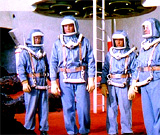 Landing on Mars |
|||||||||||||||||||||||||||

|
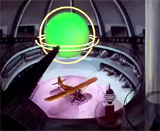
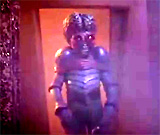
This Island Earth (1955) This cerebral 1950's science-fiction film by director Joseph M. Newman required various costly and impressive optical special effects. Visual and special effects were created with models, props, and special optical camera techniques. It also necessitated alien costumes and makeup for the big-headed Mut-Ant, and futuristic set designs:
|
|
|||||||||||||||||||||||||||

|
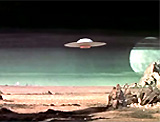
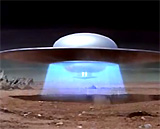
One of the landmark science-fiction films of the 50s was this classic space adventure film from director Fred Wilcox - an adaptation of Shakespeare's The Tempest. It was the first science-fiction film in color and CinemaScope. Its Oscar-nominated Special Effects included miniatures (e.g., the flying saucer spaceship), and innovative set and art decoration (with cyclorama scenic matte paintings) to create the alien environment of Altair-IV. The film also featured an all-electronic music score. It opened with a flying saucer-shaped United Planets space cruiser C-57D journeying to a distant planet-star named Altair-IV with green skies, to investigate the fate of a colony planted 20 years before.
It introduced a famed friendly servant prop (probably the most expensive, intricately-wired film prop ever constructed at the time (at $125,000)) -- Robby the Robot, also used as a prop in MGM's The Invisible Boy (1957) a year later. The friendly Robby (voice by Marvin Miller) (who influenced and was the progenitor of many other future robotic creations), functioned as both a house servant and guard, and provided comic relief: ("Sorry miss, I was giving myself an oil job!"). One of the best remembered segments were the night attacks (using hand-drawn cel animation in the third instance) of the sinister ID monster on the flying saucer spaceship and its crew. It was a living, giant biped monster with sloth-like claws that killed some of the crew at the perimeter of a force field fence. Reclusive philologist Dr. Edward Morbius (Walter Pidgeon), who lived with his lovely doe-eyed and very naive 19 year-old daughter Altaira (Anne Francis) on the planet, offered names for the invisible Id monster: ("The beast. The mindless primitive! Even the Krell must have evolved from that beginning").
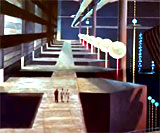
Earlier, Morbius had described how the Krell were a mighty race of beings who had created a huge network of underground rooms, laboratories, deep shafts (composed of "78 hundred levels"), and cranium head-set devices that were reportedly the remains of their advanced technological and sophisticated civilization from 2,000 centuries earlier. He gave the space explorers an extensive tour of the Krell wonders on the planet. A shuttle car ride took the group deeper into the underground to view more Krell technology - beginning with the vast and intricate Krell ventilation system.
Morbius eventually began to realize that the Krell ("My poor Krell"), from 2,000 centuries earlier, didn't realize the power that was destroying them from within - when inner subconscious thoughts could be instantly realized. Morbius was reluctant to face the conclusion that he himself was "the living monster" when Commander Adams (Leslie Nielsen) became accusatory about him being the awakened monster:
With a startling confession, Morbius admitted that the Id was his own projected or externalized sub-conscious. Morbius explained that he was the source of the monstrous creature, after the Krell had built a machine able to release his inner beast. Morbius was forced to realize that he was unable to control his subconscious desires ("Guilty! Guilty! My evil self is at that door, and I have no power to stop it!"). In actuality, Dr. Morbius' own projected sub-conscious reflected, in part, his incestuous feelings for his own daughter. The concluding sequence was of Morbius' dying words, with instructions to explosively destroy the 'forbidden planet' of Altair (after triggering the machine's self-destruct mechanism, and due to detonate in 24 hours) to prevent its terrible technology from ever being used again. |
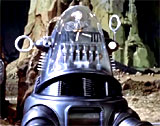 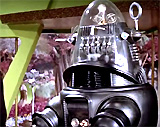 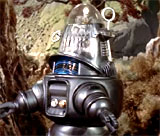 Robby the Robot   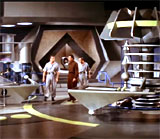 Morbius' Tour of the Underground Krell Labs 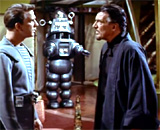 Adam's Confrontation with Morbius, Who Eventually Admitted He was The Id Monster 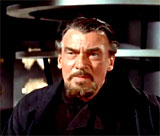 Morbius: "Yes, I must be guilty" 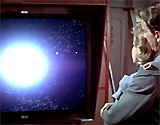 The Destruction of the 'Forbidden Planet' of Altair-IV |
|||||||||||||||||||||||||||

|
The Girl Can't Help It (1956) Director Frank Tashlin, a former cartoonist, created a satirical mid-50s film that was most memorable for the role played by buxom blonde bombshell Jayne Mansfield, with a shapely hourglass figure. However, it was also known for its unique opening or preamble, in which one of the film's stars, a bow-tied Tom Ewell, opened the film by walking out onto a open stage to speak to the camera (and break the fourth wall) and to introduce the feature. The background was an abstract landscape with musical instruments floating in space. Annoyed with the small sized B/W picture, he astonished audiences by literally stretching the black edges of the boxy black and white picture - opening the viewable picture up into the wider, rectangular Cinemascope aspect ratio. And then he commanded that the picture change from B/W to Technicolor - "gorgeous life-like color by DeLuxe."
He then stated the purpose of the picture: "Our story is about music, not the music of long ago but the music that expresses the culture, the refinement and the polite grace of the present day" -- rock 'n' roll; next to him, a juke-box played the title song: "The Girl Can't Help It" - drowning out his further words. The film ended with a similar cartoonish bit by the other major male star Fats Murdock (Edmond O'Brien), who like the cartoon Porky Pig ("That's all folks!") stepped through the enclosing frame of the final shot, walked forward through the black, now-empty space to directly address the audience:
Then, he grabbed a cigar from somewhere, as the title song began to play.
|
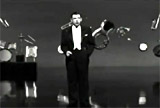 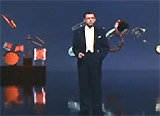
Film's Unique Opening 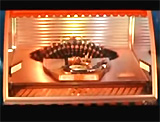 The Jukebox |
|||||||||||||||||||||||||||

|
The Ten
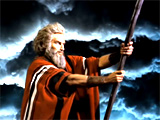
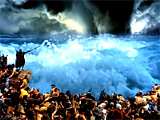
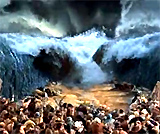
Commandments (1956) The scene (before the days of digital effects) was prefaced by Moses' (Charlton Heston) statement before gathering and churning dark clouds: "The Lord of Hosts will do battle for us. Behold his mighty hand." It involved the use of miniatures, pyrotechnics, traveling matte paintings, rear-projection, and a 32-foot high dam or water tank producing the waterfall. The effect of the sea's parting was created by pouring 300,000 gallons of water into a tank and then playing the shot backward.
Other special effects scenes included the Burning Bush on Mt. Sinai, Moses' sceptre turned into a serpent before the Pharaoh (Yul Brynner) to demonstrate the power of God, and the various plagues. In the massive Exodus sequence, compositing was used to multiply the number of extras in the crowd.
|
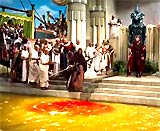
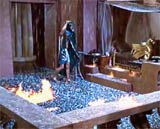
 The Burning Bush on Mt. Sinai 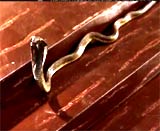 Moses' Sceptre Turned Into a Serpent 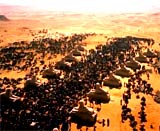 The Exodus Crowds 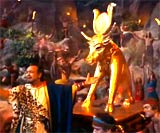 Worship of Golden Calf 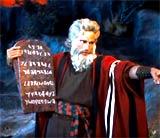 Moses' Condemnation 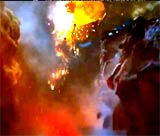 Idol Worshippers Falling Into Pit |
|||||||||||||||||||||||||||
|
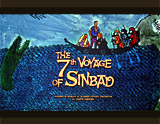
The 7th Voyage of Sinbad (1958) Director Nathan Juran's classic fantasy film (with stop-motion special effects by Ray Harryhausen) wasn't even a nominee in the awards category of Best Special Effects. It was the first film using stop-motion special effects to be shot in full color. In this year, the winner was George Pal's family-fantasy musical Tom Thumb (1958) (the famed producer's first directorial effort for a feature film). There was only one other competing Oscar nominee - director Joseph Pevney's submarine war drama Torpedo Run (1958). Amazing sequences (mostly on the monster-filled island of Colossa) included:
|
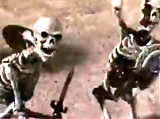
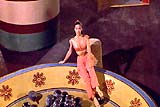 Shrunken Princess Parisa 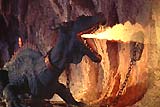 Fire-Breathing Dragon 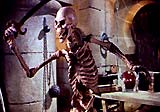 Living Skeleton During Sword Fight |
|||||||||||||||||||||||||||

|
Director William Wyler's Ben-Hur won a record-breaking 11 Academy Awards, including Best Picture and Best Special Effects. It was filmed in Italy at Rome's Cinecitta Studios, and in other locales. The monumental film was photographed in the "new" MGM Camera 65 (65mm), MGM's single-strip answer to the widescreen craze of Cinerama, later known as Ultra Panavision 70. More than 300 sets were constructed over almost 150 acres, with the most elaborate one being the arena (the largest single movie set ever built) for the 9-minute chariot race sequence, with four 30-foot high statues in the center. The race segments took five weeks to film (extended over a three month period), with several thousand extras used for spectators. Another of the more spectacular sequences was the great naval battle, pitting a Roman galley against its enemy. It was filmed using 40 miniatures in a huge tank on the back lot at MGM Studios in Culver City, California, and there were also two life-sized Roman galleys built for the production that were combined with the miniatures by process shots and traveling mattes. |
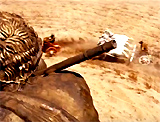 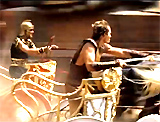 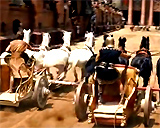 Thrilling Chariot Race Sequence 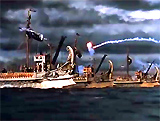
Naval Battle |
|||||||||||||||||||||||||||

|
Journey to the Center of the Earth (1959) Based on Jules Verne's 1864 science-fiction novel, this Henry Levin-directed fun adventure-fantasy film had fake looking (and now dated) special effects, although they were still effective. It was remade as Journey to the Center of the Earth (1993), starring Brendan Fraser. It was a tale of explorers entering an Icelandic volcano, and finding themselves at the 'center of the earth' - the earth's core. There they encountered:
The 'dinosaurs' were nothing more than enlarged reptiles. Some of the underground sequences for the film were at Carlsbad Caverns National Park, and other exotic locales, although nowadays, matte paintings and other CGI enhancements would have substituted. |
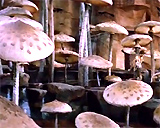  Giant Mushroom Forest 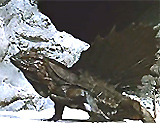 Dimetrodon 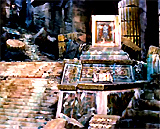 Lost City of Atlantis 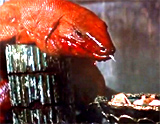 Giant Chameleon |
|||||||||||||||||||||||||||

|
Darby O'Gill and the Little People (1959) In-camera effects in this live-action fantasy, a Walt Disney production directed by Robert Stevenson, included the 'trick' of forced perspective depth effects. This was at a time in cinematic history when Disney Studios maintained its own in-house special effects department. Full-sized Darby O'Gill (Albert Sharpe) appeared to be walking and conversing with live leprechauns (two feet high), although in actuality, it was a magical movie-camera trick. Darby was positioned closer to the camera in the foreground, to make him appear larger, while the 'little people' were placed at a distance in relation to him, to appear smaller. This special-effects technique required an increased depth of field, and intense lighting to be effective. The effect eliminated post-production optical patching, and grainy images and matte lines were not evident as well. The most spectacular scene was one in which hundreds of leprechauns danced and raced on white ponies around Darby. Also notable were the scenes of the banshee (a ghostly luminous figure) and the death coach with the headless horseman.
|
 Darby O'Gill With Smaller Live Leprechauns 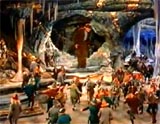 Leprechauns Dancing Around Darby 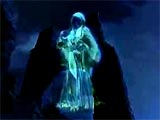 The Banshee 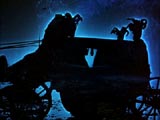 The Death Coach With a Headless Horseman |
|||||||||||||||||||||||||||




 The pioneering
science-fiction adventure film was the winner of the Best Achievement
in Special Effects Academy Award, with an ingenious use of models
(i.e., a realistic moonscape), by producer George Pal. This was
Pal's second full-length live-action feature. Later
Pal films included: When Worlds Collide (1951), The War of the Worlds
(1953), and The
Time Machine (1960), featuring time-lapse photography.
The pioneering
science-fiction adventure film was the winner of the Best Achievement
in Special Effects Academy Award, with an ingenious use of models
(i.e., a realistic moonscape), by producer George Pal. This was
Pal's second full-length live-action feature. Later
Pal films included: When Worlds Collide (1951), The War of the Worlds
(1953), and The
Time Machine (1960), featuring time-lapse photography.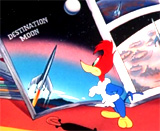



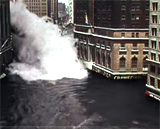
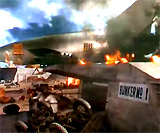

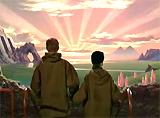
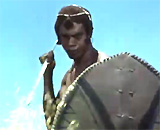




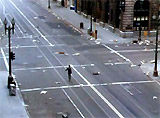 Los Angeles Evacuated and Deserted, With Looters
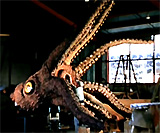
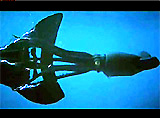 Squid Attacking Tail or Rudder of Nautilus