|
Special Effects (F/X) - Milestones in Film 1983-1985 |

|
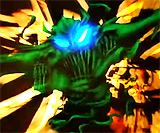
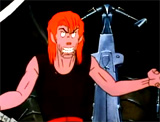
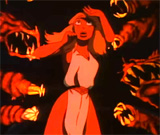
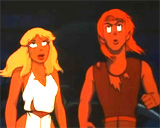
Rock & Rule (1983, Canada) Director Clive A. Smith's work was a feature-length cel-animated film about mutated humanoids. Overall, it was a post-apocalyptic, off-beat, adult-oriented rock & roll fantasy about a world with mutated animals (dogs, cats, and rats) due to nuclear radiation. Unfortunately, the film reached only limited theatrical audiences and was a major flop. Most of its viewings were on late-night Canadian television. Its rock 'n' roll score included performances from artists such as Debbie Harry, Cheap Trick, Iggy Pop, Lou Reed and Earth, Wind and Fire. It had two taglines:
It was the first English-speaking animated feature film ever made entirely in Canada, and noted for its bright colors, pop soundtrack, suggestively-drawn female characters, story of good vs. evil, and dazzling effects. The animation used a variety of special effects, from models to paintings to very basic but impressive CGI. It marked the first animated film to use computer graphics, although it was only used in a limited way for just a few of the film's images. In the film's opening, a prologue described the futuristic, dystopic setting (after WW3 between the US and Soviet Union) with animal-human hybrids, where a malevolent, retired, decadent and obsessed rocker named MOK (voice of Don Francks) wished to unlock a doorway to a hellish dimension - but only needed one more element to unleash a powerful, demonic creature behind a doorway to another dimension - the voice could help him crack the ancient code and unlock the portal:
The story was about MOK's world-destroying efforts to kidnap Angel (voice of Susan Roman), a young singer in a struggling band - the one with a 'very special voice.' He heard her singing a romantic ballad "Angel's Song" in a nightclub ("Now I have revealed exactly why I'm here / I'll be your angel if you want to see / How perfect sharing love with an angel can be") and knew she was the one. Seated in the dark, MOK's magical ring began blinking, signaling that he had found what he was looking for - her voice.
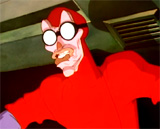
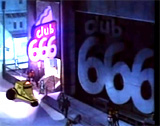
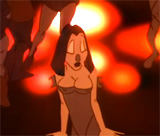
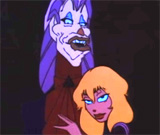
MOK (a caricature of Mick Jagger and David Bowie) invited Angel to his palatial mansion-estate, where she arrived with her three male bandmates - hot-headed lover-boyfriend and lead singer Omar (voice of Gregory Salata), Dizzy (voice of Dan Hennessey) and Stretch (voice of Greg Duffell). They met MOK's three oafish, bumbling goons-assistants, known as the "Rollerskating Schlepper Brothers" (Toad, Sleazy and Zip). In his garden with Angel after hypnotizing her band members (with glowing, magical "Edison Balls"), MOK tried to convince her to join him, but she refused to abandon her band. He had no choice but to drug Angel (with a scented rose), kidnap her and transport her in his personal dirigible-blimp to Nuke York. His demonic plan was to open the otherworldly portal during Angel's performance at a concert. Angel's trio of bandmates followed after her in a stolen police car, but were detained at the border by a guard and placed under arrest. Meanwhile, Angel had briefly escaped with the unintended help of Cindy (voice of Catherine Gallant), the busty blond-haired sister of one of MOK's goons. Through a ventilation system, Angel overheard MOK talking to his computer (CPU). She heard about the unleashing of the demon through her singing of a particular series of notes: ("The vibrations of her voice will create a doorway through which the being will enter this dimension") and learned there was a force that could send the demon being back --- with the magic of "One voice, One heart, One song" - but the computer added that "No One can send it back." MOK gloated: "Then the beast is mine!" At the zero-gravity dance club, Club 666, Angel was recaptured by MOK, and then he also captured the band members, tortured them inside a giant "Edison Ball", and brainwashed them with mind-games to enable Angel to agree with his demands.
However, the first efforts of MOK to release the demon did not succeed - the Nuke York concert at CARNAGE HALL was a disaster because the energy source was insufficient (the demon only partially appeared) and there was a complete blackout ("Carnegie Concert 'A Blast'"). A second concert needed to be held in Ohmtown which had a stronger power plant - where MOK demanded that the reluctant Angel sing. She was wearing a white robe over her naked body, and her wrists and legs were bound. There was another overload and power surge on the power grid as the massive demonic creature was summoned - Angel's band members attempted to rescue and free her, but they were too late.
The demonic figure attacked Omar, while Angel attempted to sing to force the demon back through the portal, but failed until Omar joined her in harmony to sing the power duet Send Love Through - it took two singers (not just one voice) to produce a counter-spell. MOK's dominance ended when he was thrown down through the pentagonal dimensional portal into the depths by a vengeful Toad after his self-sacrificing, heroic brother Zip died in his arms. Mok screamed back in anger:
Mok managed to climb to the side of the portal, where he confessed that he had misinterpreted the Satanic computer prophecy (voice of Samantha Langevin) about how the demon could be sent back:
The now-sunny Ohmtown had a new superstar band with two vocalist singers. |
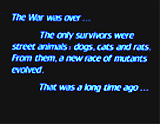 Prologue 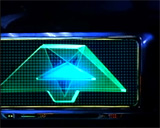 MOK's Computer - "A Very Special Voice" Was Needed to Open Another Dimension to Unleash the Demon 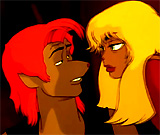 Omar and Angel - Bandmembers 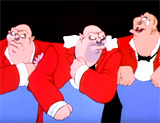 MOK's Three Assistants - The Schlepper Brothers: Toad, Sleazy and Zip 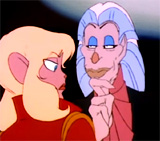 MOK (a caricature of Mick Jagger) with Angel 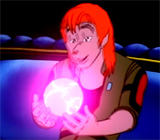 Omar Hypnotized with Edison Ball 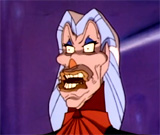 The Menacing MOK 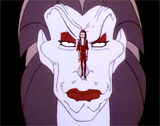 Song: "My Name is MOK" 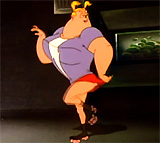 Cindy - Helped Angel to Escape 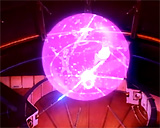
Bandmembers Captured Inside Edison Ball 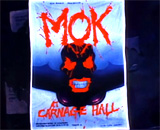 Concert at Carnage Hall in Nuke York - A Failure 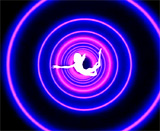 Amazing Animations 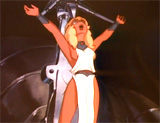 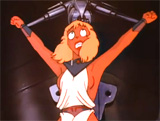 Angel During Ohmtown's Concert - Bound By Wrists and Legs and Forced to Sing 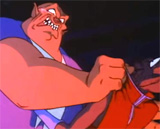 Toad Threw Mok Into Portal with the Demon 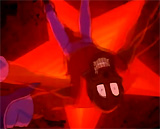 MOK Hurled Into the Demon's Portal |
|||||||||||||||||||||
|
Star Wars Episode VI: Return of the Jedi (1983), and Re-releases
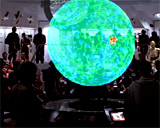
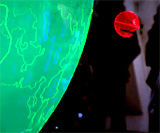
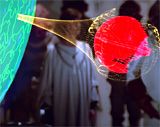
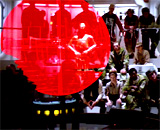
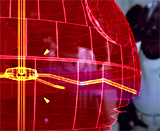
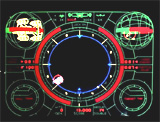
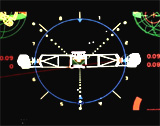
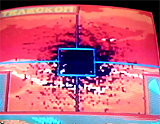
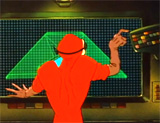
The main computer-generated animation sequence was in the scene of a Rebel briefing held in the Headquarters Frigate. A planned Rebel attack on the second Death Star space station was discussed, using computer models. Mon Montha (Caroline Blakiston) announced an important new directive: "The Emperor has made a critical error and the time for our attack has come." She turned everyone's attention to the center of the room, to view three graphical elements:
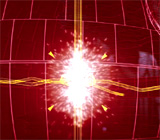
She continued: "The data brought to us by the Bothan spies pinpoints the exact location of the Emperor's new battle station. We also know that the weapon systems of this Death Star are not yet operational. With the Imperial Fleet spread throughout the galaxy in a vain effort to engage us, it is relatively unprotected." Admiral Ackbar (Tim Rose) added details about the Death Star's protective energy shield that had to be penetrated to reach and detonate the superstructure's main reactor: "The shield must be deactivated if any attack is to be attempted. Once the shield is down, our cruisers will create a perimeter, while the fighters fly into the superstructure and attempt to knock out the main reactor."
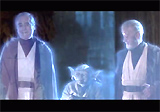
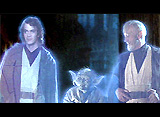
The Death Star (still under construction) was eventually shown to explode - simulating the Rebels' attack upon the Emperor's battle station and its internal main reactor. George Lucas continued to alter his original trilogy with lots of 'enhancements' and changes. What was most outrageous to fans regarded the changes made for the 2004 DVD re-release of Return of the Jedi:
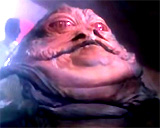
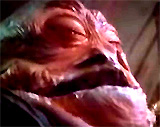
Another artificial creation was Jabba the Hutt, the Tatooine crime boss seen as an immense, slug-like creature. If CGI had been advanced enough, Jabba would have been computer-generated, but as it was, Jabba was a life-sized, one-ton puppet that took three months and half a million dollars to construct, and was controlled by four individuals. |
  Jabba the Hutt |
|||||||||||||||||||||
|
Superman
III (1983)
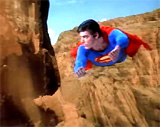
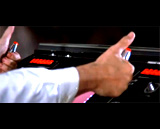
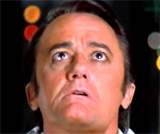
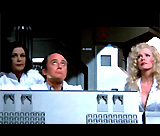
The videogame and actual game (played simultaneously) commenced as Superman flew into a Grand Canyon gorge where the villain's headquarters and huge supercomputer ("The Ultimate Computer") were located inside a cave. Webster was accompanied by two female assistants: Vera Webster (Annie Ross) - his sister, and blonde bombshell girlfriend Lorelei Ambrosia (Pamela Stephenson). Webster's Atari-type game screen displayed the "Score" and the number of rockets remaining, as he fired at Superman. [Note: The noises used for the supercomputer game were from the Atari 2600 version of Pac-Man.] Although the official game ended ("GAME OVER"), one giant final missile detonated and sent Superman rolling end over end into a solid rock formation, where he briefly lost consciousness. The sequence was created, one frame at a time, by video game company Atari, Inc. in cooperation with Warner Brothers. It took 3 1/2 months and cost $125,000 dollars to create. They had planned to base an Atari 5200 video game tie-in on the sequence, but it never happened.
|
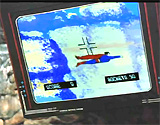 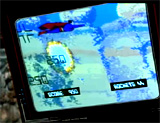 Webster's Atari-Type Game Screen 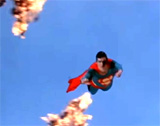 Superman Dodging Real Missile Explosions 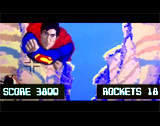 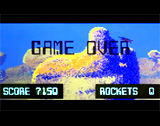 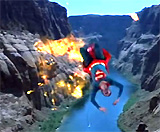 Superman Struck with Massive Missile |
|||||||||||||||||||||

|
Zelig (1983)
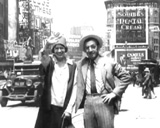
In addition, the Narrator's (Patrick Horgan) authentic BBC documentary-style narration, as well as the commentary (by radio or through interviews) of Zelig's friends, relatives, and associates, including literary personages, such as Susan Sontag, added to the film's believability. There were also movie reenactments of events in Leonard Zelig's life, including the biopic The Changing Man (1935), by Warner Bros. Chameleon-like Leonard Zelig (Woody Allen) in the Jazz Era of the 1920s (and extending into the 1930s) became known as an individual who appeared to take on the characteristics of those he associated with - known as "the Zelig phenomenon":
|
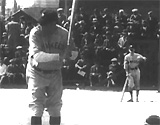 In the Next-at-Bat Circle with Babe Ruth 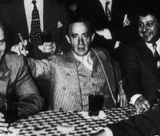 As Gangster in Speakeasy 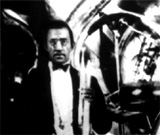 As Colored Trumpeter  Zelig Subjected to Physical and Psychological Tests by Doctors 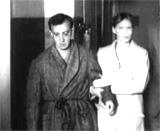 Treated and Studied by Dr. Eudora Fletcher (Mia Farrow) 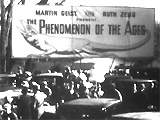 Zelig as a "Human Chameleon" Tourist Attraction 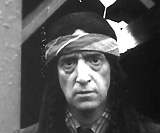 Zelig as a Native-American 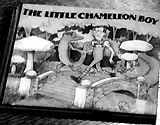 Books ("The Little Chameleon Boy") and Zelig-Related Toys 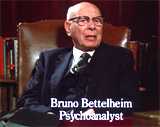 Bruno Bettelheim - Psychoanalyst 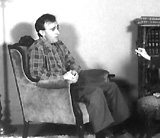 White Room Sessions: Leonard Insisted He Was the Doctor  Dr. Fletcher's Frustration with Zelig  Dr. Fletcher and Zelig Falling in Love 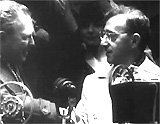 Leonard Presented With Key to NYC 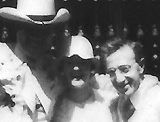 Zelig at San Simeon with western actor Tom Mix  Susan Sontag - Commentary on Zelig 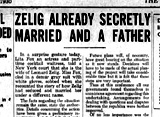 Zelig Scandal 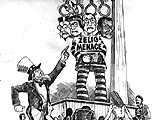 "Zelig Menace" - The Return of His Condition  Zelig in Adolf Hitler's Presence in Berlin, Germany 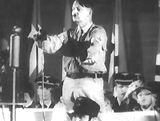 Zelig Behind Hitler at Munich Nazi Rally |
|||||||||||||||||||||

|
The Adventures of André & Wally B. (1984) Ex-Disney John Lasseter directed this all CGI-animated short, from Lucasfilm Computer Graphics Project (later Pixar). This was the first CGI animation with motion blur effects (using the principles of 'squash and stretch' from traditional animation) to produce more fluid and realistic movement in characters. |
 
|
|||||||||||||||||||||

|
Indiana Jones and the Temple of Doom (1984)
It had two Academy Award nominations, and won for Best Visual Effects, defeating its two competitors in the category:
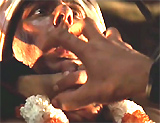
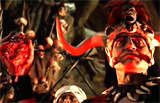
It was, in many respects, responsible for the creation of the MPAA's PG-13 rating. This was due to the controversial sacrifice scene in the underground Temple of Doom. In a subterranean Temple of Doom, a Thuggee religious cult was conducting ritualistic worship ceremonies to appease the Hindu goddess Kali. The ritual was led by demonic and crazed high priest Mola Ram (Amrish Puri). A large statue of the bloodthirsty goddess Kali held three glowing sacred Sankara Hindu stones in its altar (within the eye sockets and nose of a giant skull). The Thuggees believed that the three magical stones (there were five stones total) gave them immense control over the minds of other people, and even the Maharajah.
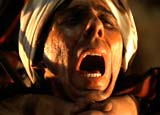
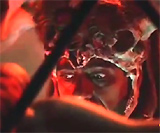
The human sacrifice victim (Nizwar Karanj) was led in, and shackled inside a large iron cage. Then Mola Ram recited some spiritual phrases, clenched his right hand and plunged it into the victim's chest - and ripped out the man's still-beating heart and held it up in his right hand. The screaming victim remained alive and was lowered in a large cage into a red-hot magma pit where he was incinerated, while the other worshippers worked themselves into a frenzy. When the victim's body burst into flames, the heart still in Mola Ram's hand also caught fire. |
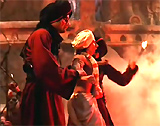 Victim Led In and Placed in Wire Cage 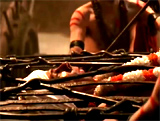  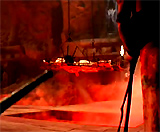 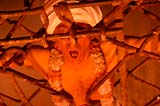 After the Heart Extraction, The Sacrificial Victim Was Lowered into a Magma Pit 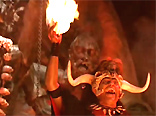
The Flaming Heart Ignited in Mola Ram's Hand |
|||||||||||||||||||||

|
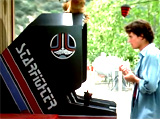
The Last Starfighter (1984) The skilled teenaged player of the arcade game who broke the record, Alex Rogan (Lance Guest), living in a trailer park, was whisked away in a high-tech space-car vehicle to a faraway planet called Rylos by a space alien who called himself Centauri (Robert Preston in his last theatrical performance). Centauri was the game's inventor, who had recruited Alex because of his skill at the game. While absent, Alex was replaced by an android (also Lance Guest) who spent most of his time hiding away in bed, or fending off the romantic advances of Alex's girlfriend Maggie Gordon (Catherine Mary Stewart).
There on Rylos, Alex learned that the arcade game's conflict was actually being fought for real in this new universe, pitting two opponents against each other:
Alex was recruited to pilot an actual Starfighter spacecraft called the Gunstar, and although he declined and returned to Earth, he was compelled to soon return to Rylos when he learned that all the Starfighters had been killed during an attack on Rylos' base. He piloted a Gunstar fighter as the "Last Starfighter" (with a new weapon called the Death Blossom), to battle the Ko-Dan Armada - in the film's climactic space battle. Alex's weapons onboard his Gunstar included Lasers, Photon missiles, and Particle Beams.
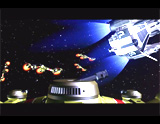
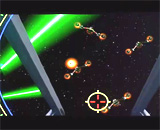
This was a groundbreaking film - it was the first film to feature the extensive use of CGI -- most importantly, the integrated use of photo-realistic, computer-generated (CGI) models for all Gunstar vehicles or spaceships, for planet shots, and for high-tech hardware, rather than more traditional miniature models (as in 2001: A Space Odyssey (1968) or Star Wars (1977)). This was called 'digital scene simulation' or 'integrated CGI' - the special effects were actually representing real-world objects, and the CG was fully integrated with the live-action.
A multi-million dollar CRAY XMP-2 super-computer over a period of more than two years was used to create and animate the photorealistic computer graphic images - resulting in about 25 minutes worth of CG effects. An ATARI 2600 video-game (promising to be ATARI's first 3D arcade game) was planned but never released, due in part to the crash of the video-game industry in the mid-1980s. Digital-graphic pioneers John Whitney, Jr., and Gary Demos, who contributed to the CG work in the film (and for Tron (1982)), received the Scientific and Technical Academy Award in 1984 “for the practical simulation of motion-picture photography by means of computer-generated images." |
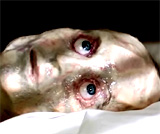 Alex's Android Substitute 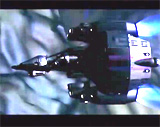 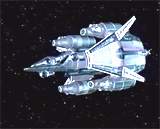 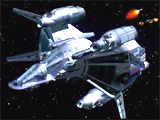 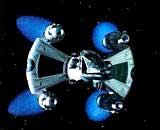 Alex's Gunstar Starfighter 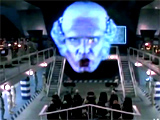 A Holographic Projection of Xur - Threatening an Armada Invasion of Rylos |
|||||||||||||||||||||
|
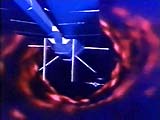
Lensman (1984, Jp.) (aka SF Shinseiki Lensman) This was the first anime film to use CGI - to supplement its traditional animation. It mixed high-tech computer-graphic animation with more traditional animation. In fact, 2D hand-drawn animation still made up the majority of Japanese anime. Anime with 3D CGI character animation remained rare, although computers were often used for computer coloring (or digital paint). |
|
|||||||||||||||||||||
|
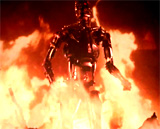
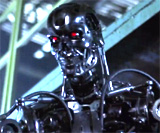
Director James Cameron's movie was the first of four science-fiction action-thriller films - it has often been considered by most film reviewers to be a better-crafted film than its popular sequels, with fewer special-effects and pretentiousness. It was set in post-apocalyptic 2029 Los Angeles, when an indestructible, invincible, inhuman cyborg Terminator T-800 (Arnold Schwarzenegger) was sent back from the future year 2029 to 1984 to eliminate Sarah Connor (Linda Hamilton), who would one day be the mother of a son (an off-screen John Connor) who was to lead a human Resistance movement-rebellion against the evil cyborg leaders of Earth's future. Stan Winston's special Terminator and visual effects, created by Fantasy II Film Effects, vividly and effectively presented a film-noirish environment and realistic stop-motion animation as the Terminator was transformed into a mechanical, red-eyed exo-skeleton when his flesh and blood were stripped away in the course of his unstoppable pursuit.
However, two of the most effective F/X sequences were the Terminator's two surgeries upon himself (on his damaged left eye and his right forearm) - the result of a shootout, and the crash his stolen police vehicle. |
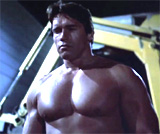 The Terminator T-800 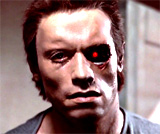 Terminator's Damaged Eye After Shootout 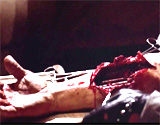 Self-Surgery |
|||||||||||||||||||||

|
2010: The Year We Make Contact (1984) In Peter Hyam's sequel to Kubrick's science-fiction classic, the visual effects involved combining computational fluid dynamics with CGI, for the first time, to create the planet Jupiter. In the story, a joint mission to Jupiter between the US and the Soviets was undertaken to determine exactly what happened to the Discovery One. It was found that the abandoned Discovery was floating in space (orbiting around Io) near Jupiter, as well as a giant alien Monolith. Super-computer HAL 9000's creator Dr. Chandra (Bob Balaban) reactivated HAL onboard the Discovery One. The film's main reveal was that HAL had been programmed by the NSC to conceal from the Discovery One's crew the fact that their mission was not about Jupiter, but was about the mysterious Monolith situated near Jupiter. HAL was unable to properly handle or process the information programmed internally ("He was instructed to lie...he became paranoid"), and literally had a 'mental breakdown' in the previous film. Now, HAL was to be sacrificed on the sabotaged spaceship Discovery One near an imploding Jupiter in the midst of the planet's strange conversion (due to rapidly-multiplying Monoliths and a nuclear fusion reaction). HAL worried that the countdown to the "ignition" of the blast should be terminated (but was overruled). As the multiplying Monoliths engulfed Jupiter, the planet imploded and was transformed into a small star. [Note: The impressive 'replication' sequence used CGI to create thousands of monoliths.]
Discovery One (and HAL-9000 onboard) were destroyed in the incinerating blast, due to the planet's nuclear fusion implosion - and Jupiter was transformed into a small star. Meanwhile, the launch craft the Leonov that had separated from Discovery was boosted away toward Earth, and barely survived the reverberations of the imploding planet. |
 The Discovery of a Monolith Near Jupiter  The Planet Jupiter 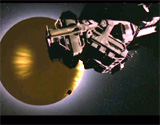 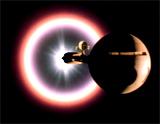 The Separation of the Leonov From Discovery Just Before Jupiter Imploded |
|||||||||||||||||||||
|
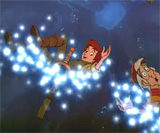
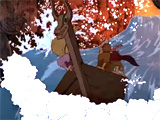
The Black Cauldron (1985) It was the studio’s first animated feature shot in 70mm wide-screen film since Sleeping Beauty (1959), and was one of the first to be recorded in stereo surround sound. The Black Cauldron took over twelve years to make, and five years of actual production time. Its main tagline referred to the "black cauldron":
The magical adventure-quest film was based upon Lloyd Alexander's 5-volume series of children's fantasy novels in the 1960s, titled "The Chronicles of Prydain." Its extravagant budget of $44 million (making it one of the most expensive animated features ever made) only grossed $21.2 million, making it a box-office failure. In the main plot, the film's villain was the evil Horned King, desiring world domination, who wished to obtain an ancient magical object known as The Black Cauldron to obtain his objective. The film opened with a pre-title credits prologue (voice of John Huston) to explain the setting:
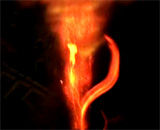
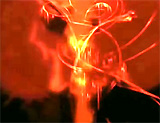
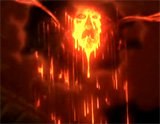
The production notes stated that there were three scenes of computer animation in the film - and involving these objects:
The film induced Disney animator Tim Burton to leave the studio and turn to live-action films, but he would later return with the use of innovative stop-motion animation for The Nightmare Before Christmas (1993). |
    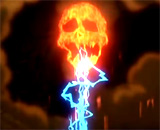 The Black Cauldron Brought Forth the Army of the Dead 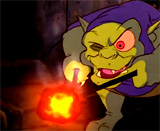 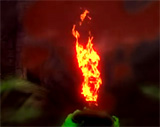 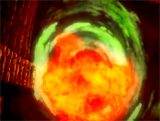 Flames (Digital Fire) |
|||||||||||||||||||||

|
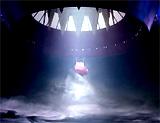
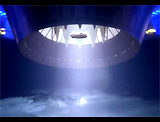
Cocoon (1985)
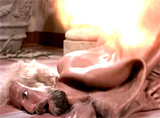
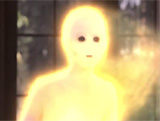
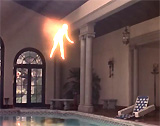
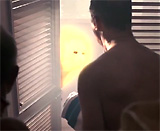
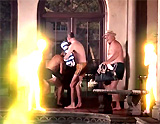
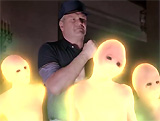
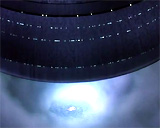
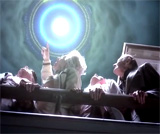
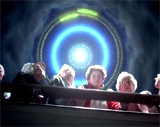
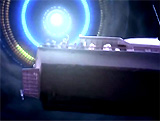
It was remarkable for Industrial Light and Magic's (ILM) depiction of the friendly, energy-light emitting alien lifeforms and their alien spaceship. The aliens from Antarea were almost-transparent beings with their bright golden light radiating from their spirit-like bodies. The story about the 'fountain of youth' myth told about how a small group of Anterean aliens in human form, led by Walter (Brian Dennehy), chartered a boat from struggling, young local charter boat captain Jack Bonner (Steve Guttenberg) - their mission in 27 days, off the coast of Florida, was to retrieve 20 enormous, weird, oyster-shelled or rock-like cocoons on the Atlantic ocean floor, to be stored in the luxurious indoor swimming pool of an empty, locally-rented property in St. Petersburg. In one of its scenes, Kitty (Tahnee Welch, Raquel Welch's daughter in her first US film) was spied upon by Jack Bonner as she undressed in the boat cabin. To his amazement, she removed her human skin mask - revealing that she was an alien from the planet Antarean. He was aghast: "She's not normal. There's something very abnormal about her!" Shortly later, the old guys at the pool watched from hiding as the group of aliens removed their skin masks, revealing golden glowing bodies underneath that could move unhindered through the air. The sight of the golden creatures scared the elderly men who fled in horror.
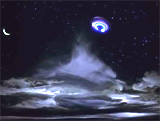
In a later sexy scene in the swimming pool, the naked Kitty demonstrated to charter boat operator Jack Bonner how alien Antareans expressed their affection. When he approached her, she ordered him back: ("Don't touch me...Go to the other side of the pool"); he complained: ("I hope you're not gonna take your skin off, because I really like skin on a woman"); a golden burst of light energy (or orgasmic force) from her zapped around the room until it targeted Jack - collided with him, and caused him to light up, without physical touch. He exclaimed: "If this is foreplay, I'm a dead man." The scene immediately cut away before answering the question if it was just foreplay. The climactic arrival of the dazzling alien spaceship in the life-affirming conclusion came during a fog-shrouded electrical storm. It was there to pick up an ascending boatload (the entire boat!) of retirement home residents who were promised eternal life on the faraway planet.
In the final image, the spaceship appeared to be approaching its destination, the glowing Antarean planet. |
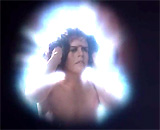 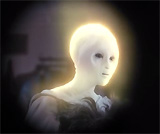 Kitty's (Tahnee Welch) Removal of Skin-Like Mask 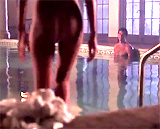   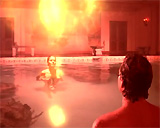 Antarean Alien Kitty - Exuding 'Sexual' Lifeform Energy in Pool 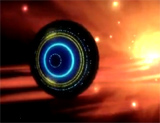 The Alien Spaceship Approaching the Glowing Antarean Planet |
|||||||||||||||||||||
|
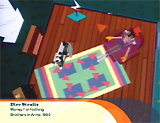
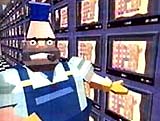
"Money for Nothing" (1985) by Dire Straits The first computer-generated, classic rock music video - "Money For Nothing" by Dire Straits, featured crudely-animated, box-shaped CGI characters with stiff-limbs. |
|
|||||||||||||||||||||
We Are Born of Stars (1985) This documentary was the first Anaglyph single projector 3D film created for IMAX/IMAX Dome projection, in Tskuba Science City, Japan. Using computer graphics, the film traced the development of life from the formation of atomic nuclei in stars to the molecular structure of water and DNA, zooming the audience through the five-billion-year evolution of our solar system - in stereovision. |
|||||||||||||||||||||||

|
Young Sherlock Holmes (1985) It was noted for two milestones:
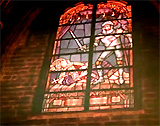
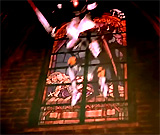
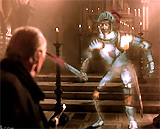
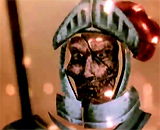
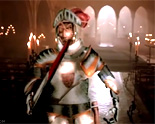
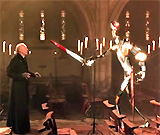
This film was the first to composite computer-generated animation with a live-action background. The Pixar group at Lucasfilm used new motion blur technology and its 32-bit RGBA paint system to create the effect. In the film's plot, there were a number of unexplained attacks. A mysterious figure with a dark hood and armed with a blowpipe loaded with thorns (dipped in a hallucinogenic substance) was assaulting various other characters. He shot prominent and wealthy Britisher Mr. Bentley Bobster (Patrick Newell) in the neck, who then began to suffer frightening hallucinations in a restaurant and scared the patrons. The roasted bird or chicken on his plate came alive and attacked him. Embarrassed, he fled from the restaurant to his home, where he suffered a disorienting, delusionary death when objects in his bedroom came alive, attacked, and imaginary flames threatened to consume him. He suicidally hurled himself through his upstairs window and died on the cobblestone street below. The most incredible effect was a 30 second on-screen sequence that took 6 months to accomplish, during a 2nd attack. A CGI computer-animated character in the film was known as "the stained-glass man" - a knight composed of shards of stained-glass that came to life. In the scene set in the school's chapel, after hearing a faint jingling and feeling a sharp pain in his neck from a blowpipe thorn, the Reverend Duncan Nesbitt (Donald Eccles) imagined a stained-glass figure (a knight) coming to life from a stained-glass window with his sword raised. He jumped from the window to the floor below, raising a half-bloodied sword. He marched forward toward the frightened Reverend, and walked past him, revealing that he was just a flattened figure that could be viewed from both the front and the back. He engaged in sword play and scared the Reverend literally to death. In a crazed and insane panic, the man fled into the street and was run over by a carriage.
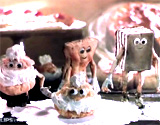
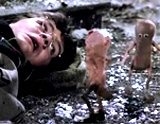
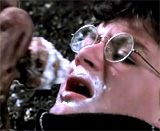
Another murderous incident involved retired inventor and Professor Rupert T. Waxflatter (Nigel Stock), Holmes' (Nicholas Rowe) mentor, who was also shot by a tainted blowpipe thorn. In a London antique shop, he went mad and suffered a suicidal death by stabbing himself in the chest with a knife while fighting off imaginary bat-like gargoyle creatures that flew at him and attempted to get under his coat. He provided a clue to Holmes when he died -- a whispered: "Eh-tar, Holmes, Eh-tar." There was also another stop-motion animated scene in which young John Watson (Alan Cox) was assaulted by a variety of cakes and dessert pastries in a cake shop that came to life in front of him, attacked him, and tried to stuff themselves down his throat.
|
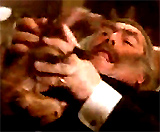 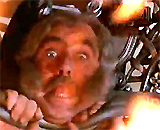  Attacks on Victim Mr. Bobster at a Restaurant and in His Home - And His Death On Cobblestone Street 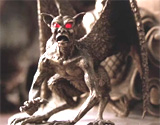 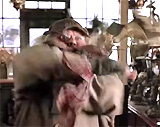  Professor Waxflatter Attacked by Imagined Bat-Like Gargoyles - He Stabbed Himself to Death, and Provided a Clue: "Eh-tar" |
|||||||||||||||||||||








 The
original Return of the Jedi featured over 900 visual effects
shots, the most in movie history up to that time.
The
original Return of the Jedi featured over 900 visual effects
shots, the most in movie history up to that time.