|
|

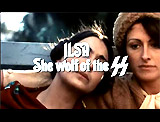 Ilsa: She Wolf of the SS (1975)  Ilsa: Harem Keeper of the Oil Sheiks (1976)  Ilsa: The Wicked Warden (1977)  Ilsa: The Tigress of Siberia (1977) |
Ilsa: She Wolf of the SS
(1975, Canada)
This 1975 Canadian production (from David F. Friedman) - a cult classic, was the original film in a series of infamous, violent and shocking B-films, exploitational films, all with the title of Ilsa. The series was reportedly based upon the real-life actual Nazi Ilse Koch known as the "Bitch of Buchenwald," and upon actual tortures and atrocities committed by the merciless Nazi murderess during the Holocaust. The subtitle advertised that Ilsa herself was: "The Most Dreaded Nazi of Them All." Although dedicated to the victims of the Holocaust, the film was banned in Germany. Ilsa: She Wolf of the SS - sick, degenerate and semi-pornographic with abundant gratuitous full-frontal female nudity and gruesome incidents (such as flesh-eating maggots), was shot on the set used for the Hogan's Heroes TV show after it was cancelled in the early 70s. It was part of the era's trend to exhibit women-in-prison (WIP) films and add Nazi-exploitation to the mix, after the tremendous success of Love Camp 7 (1969). There were three low-budget sequels that followed:
Ilsa (Las Vegas showgirl Dyanne Thorne) was featured as the camp's nymphomaniacal, dominatrix, big-busted, blonde, over-the-top, sadistic commandant of the camp (stalag). In the opening scene, Ilsa was forcing herself on a male prisoner, and threatened him with castration if he couldn't hold out long enough to satisfy her. Obviously, he didn't, because she had to satisfy herself with a shower head. (Soon after, there was a male castration - mostly off-screen but still gruesome.)
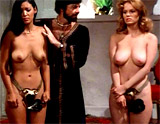
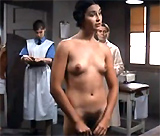
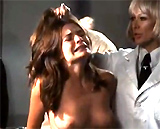
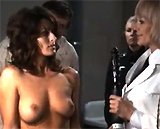
Ilsa also personally inspected stripped female prisoners (including many female cult starlets). She decided which would be 'retrained' to serve the soldiers of the Third Reich, or be subject to torturous medical or "scientific" experiments (including the use of huge electrified black dildos, and electrodes or nipple clamps attached to sensitive areas) - private research designed to prove that females could take more pain than males. When one prisoner refused to have her genital area shaved, she was held by the hair on her head and threatened: "I will shave her so close, the blood will run." One torture victim (Uschi Digard) was strung up in a pressurized chamber, and female prisoner (Sharon Kelly) was hung upside down outdoors. Another prisoner (Peggy Sipots) was gagged, hung by her neck with a noose and standing on a melting ice block (at the end of a dinner table during a party held for other German commandants). After the dinner, the drunken and aroused Commandant invited Ilsa to urinate on his face as he laid down on the floor in front of her. One of the American prisoners, Wolfe (Gregory Knoph), satisfied Ilsa's unsatiable appetite for sex - and ultimately led a prisoner uprising. In the conclusion, Wolfe was able to convince Ilsa to be tied up on her bed (for S&M bondage sex games) before he gagged her and let a mutilated Anna approach to stab her (but she fell limp and died? before killing her). Ilsa's busty blonde, half-naked henchwomen were also dragged out into the compound and shot for revenge. Just before the Allies arrived, the Reich had ordered the camp to be destroyed (and everyone killed) by the Nazis themselves. Ilsa's brains were blown out while she was still tied up on her bed (and then there were three sequels to this film?) The leader of the massive cover-up to eliminate evidence and witnesses radioed into his headquarters:
From a hillside, it was revealed that there were two who could testify as survivors of the horrific prison camp: Wolfe and Rosette. |
  Commandant Ilsa (Dyanne Thorne) 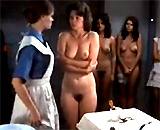 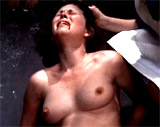 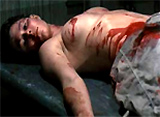 Prisoner (Donna Young) 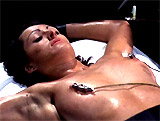 Anna (Maria Marx) 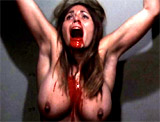 Pressurized Chamber Victim (Uschi Digard) 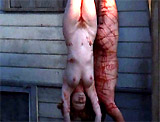 Red Headed Prisoner (Colleen Brennan) 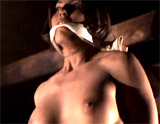 Prisoner on Ice Block (Peggy Sipots) 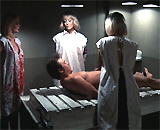 Male Castration 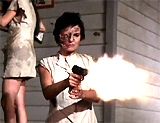 Revenge 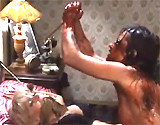 Avenging Anna 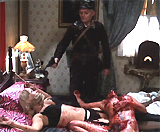 Ilsa's Death |
||||||||||||||||||||||||
|
Salo (1975, It./Fr.) (aka The
120 Days of Sodom, or Salò o Le 120 Giornate
di Sodoma)
Salò was directed by the notorious Italian poet, novelist, painter and film-maker Pier Paolo Pasolini, who was murdered before it was released. The art house film was based on a work 120 Days of Sodom by the notorious Marquis de Sade - to depict the short-lived, lakeside republic of Salo in Nazi-controlled N. Italy at the close of WWII. There, four ruling fascist officials in a secluded chateau near Marzabotto totally controlled, abused, tortured, enslaved and victimized an anonymous group of about 30 young and attractive peasant teenagers (both male and female) who were rounded up. Salo aroused outrage and disgust when it was released. It was prosecuted by various film certification boards and banned outright in numerous countries. The nihilistic film's many contested scenes immediately ran into censorship problems and utter disgust. Its four chapters clearly delineated the reason for the aroused outrage:
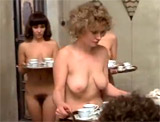
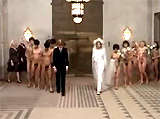
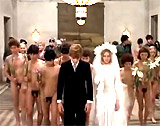
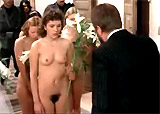
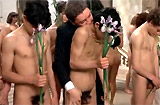
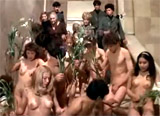
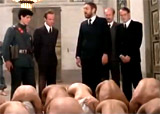
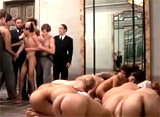
The film began with perverted acts of degradation, carnal debaucheries, and atrocities -- the male and female youths who were seized in the town were stripped and inspected ("A delicious little ass. Never seen one firmer. A pair of little breasts, to revive a dying man") and then driven to the secluded chateau. The group of four fascist officials (with four similar females) subjected them to sexual and physical tortures, psychological humiliation and violence over a period of a few days. They were instructed that every day would include these acts: "intermingling, entwining and copulating incestuously, committing adultery and sodomy." This extreme exercise and abuse of power was supposed to symbolize the evil of fascism itself. The acts of perversion were justified and exalted by the philosophy of libertinism. The imprisoned youth ("Weak, chained creatures, destined for our pleasure") were warned they were "beyond the reach of any legality." One girl committed suicide by slashing her own throat to escape the humiliations. Breakfast in the dining hall was served by naked girls - one of whom was tripped and raped from behind, after which another male was penetrated anally. Soon after, the entire group engaged in a mock "wedding feast." A couple (hapless blonde Renata and Sergio), accompanied by dozens of naked flower-bearing bridesmaids and bridesmen, participated in a ring ceremony, often interrupted by unprovoked gropings of the nudes. The two were first encouraged to fondle each other and show their affection, but denied consummation, and then were anally raped by the libertines (and in addition, there was an instance of three-way intercourse from behind).
In one scene, the youths were stripped, collared, leashed, and forced to act like dogs begging for pieces of meat (one girl bit into a piece of food laced with nails) and then followed by whippings for disobedience. Male masturbation was practiced with a life-sized dummy. A contest was held to judge the "loveliest ass in the villa" - the youths were arranged in a circle on the floor in the dark, bent over with their behinds facing upwards and inspected by flashlight during the judging, as the men commented: "The differences between boys and girls are enormous...let's try to be objective."
In "Circle of Shit" (a segment obsessed with anal bodily functions), Renata - a hapless grieving blonde girl, was forced to eat human excrement (a metaphor for capitalistic consumerism and junk food) as she was urged on by a man after he freshly defecated on the floor:
The other girls were forced to eat their own excrement deposited in bed pans. A second mock "wedding feast" served platters of cooked excrement for the guests as an "intoxicating dish." Another young girl was commanded to stand above a man and urinate into his open mouth. "Circle of Blood" began with a group wedding ceremony in which the three cross-dressed older men were coupled with a male youth and then engaged in homosexual kissing and sodomy in the bedroom, in a master/slave relationship. As punishment for breaking the rules, male youth Ezio was executed, along with his black maid partner, for illegally making normal love together. The teens were further tortured for their "misdeeds" - bound by their wrists and sitting in a tub of excrement, as one girl cried out: "God, why did you abandon us?" In the conclusion, further tortures in the outdoor courtyard, viewed voyeuristically through binoculars, included penis and breast nipple-burning, tongue-extraction and cutting, strangulation by hanging, eye-gouging, scalping, whippings, and male nipple branding! |
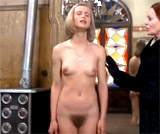 "A pair of little breasts, to revive a dead man." 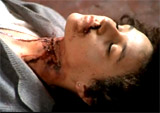 Suicide 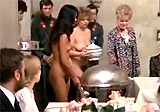 Serving of Excrement 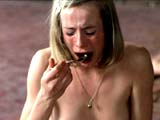 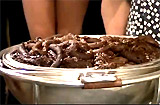 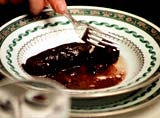 Consumption of Feces 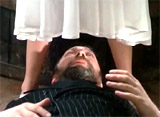 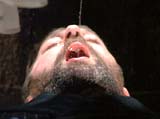 Urination Into Man's Mouth 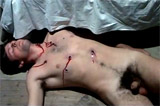 Rebellious Ezio Executed 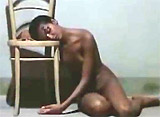 Ezio's Black Maid Partner Also Executed Torture in the Courtyard, Voyeuristically Viewed Through Binoculars (below) 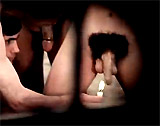 Genital Burning 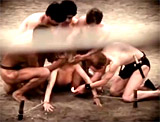 Nipple Scalding 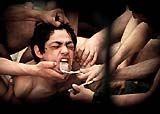
Tongue Cutting 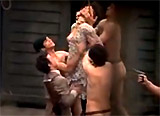 Hanging 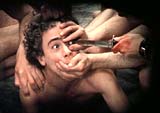 Eye Gouging 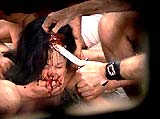 Scalping 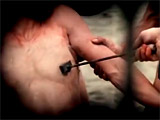 Nipple Branding |
||||||||||||||||||||||||
 The
100+ Most Controversial Films of All-Time The
100+ Most Controversial Films of All-Time(chronologically, by film title) Intro | Silents-1930s | 1940s-1950s | 1960-1961 | 1962-1967 | 1968-1969 1970-1971 | 1972 | 1973-1974 | 1975 | 1976-1977 | 1978 | 1979 1980-1982 | 1983-1986 | 1987-1989 | 1990-1992 | 1993-1995 | 1996-1999 2000-2002 | 2003-2005 | 2006-2009 | 2010-present |




 Inspired
both by art-house sensation The Night Porter (1974) and
real-life "Bitch
of Buchenwald" Ilse Koch, this sex/torture movie spawned a
wave of "nasty Nazi" movies.
Inspired
both by art-house sensation The Night Porter (1974) and
real-life "Bitch
of Buchenwald" Ilse Koch, this sex/torture movie spawned a
wave of "nasty Nazi" movies.