|
Films of All-Time 1973-1974 |

|
The Exorcist (1973)
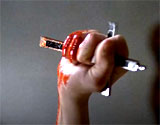
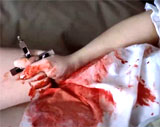
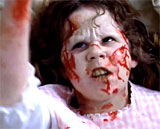
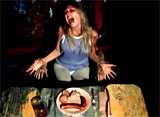
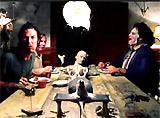
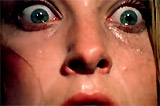
Friedkin adapted William Peter Blatty's best-selling, 1971 blockbuster book about Satanic demon possession (based on a true-story of a 13 year-old Maryland boy in 1949), and created one of the most disturbing, frightening, shocking, and exploitative films ever made. The notorious movie, well-made and sobering, was about a young 12 year-old girl entering puberty and womanhood, who also happened to become possessed. The horror film masterpiece, the first major horror blockbuster, was one of the most opposed and talked-about films, especially during its pre-release time period. Viewers and the studio took note that there were accompanying ominous events, including the deaths of nine persons associated with the production (including Jack MacGowran and von Sydow's brother) - and a request was made to exorcise the set. The film was enormously popular with moviegoers at Christmas-time of 1973, but some portions of the viewing audience fled from theaters due to nausea, convulsions, fainting or sheer fright/anger (Headlines proclaimed: "The Exorcist nearly killed me!"), and it was reported that one patron in San Francisco literally attacked the screen in an attempt to kill the demon. Mass hysteria led to paramedics being called to some theatres, and others were picketed in protest. The film's showings also led to a reported increase in temporary spiritual possessions or psychoses by individuals, and an increase in requests for priests to exorcise everything from loved ones and pets to houses, neighborhoods and appliances. Evangelist Reverend Billy Graham stated that he "felt the power of evil buried within the celluloid of the film itself". The film was also banned on video in the UK for fifteen years. Its controversial content, sensational, nauseating, and horrendous special effects (360 degree head-rotations, self-mutilation/masturbation with a crucifix, the projectile spewing of green puke, a mixture of split-pea soup and oatmeal, etc.), for its depictions of desecrations, vivid representations of evil, and for its intense scenes of exorcism (accompanied by blasphemies, obscenities and graphic physical shocks). In fact, one of the other most objectionable and blasphemous scenes was an early scene of the sight on the Georgetown University campus of a white marble statue of the Virgin Mary. It had been desecrated with red paint and other materials, and taken on the appearance of a harlot. The defiled statue had long red-tipped breasts, red color on both hands, and an elongated, erect yet sagging penis-shaped clay protuberance also daubed in red. One of the other most controversial scenes was the long sequence of invasive medical testing performed on the hapless patient - criticized as medical pornography. A sweet pre-teenaged girl Regan MacNeil (Linda Blair) became possessed by a malevolent evil spirit - and after urinating on the carpet in public and experiencing a shaking bed, was soon transformed and disfigured into a head-rotating, levitating, green vomit-spewing, obscenity-shouting creature. The film's most horrifying scene was the notorious crucifix-masturbation scene, symbolically simulating the loss of virginity for the young teenager. The camera registered the horror on the face of Regan's mother Chris (Ellen Burstyn) as she saw her daughter's sacrilegious self-abuse. In an obscene gesture simulating masturbation, a horribly-disfigured Regan repeatedly thrust her bloodied hand clutching the crucifix into her vagina under her blood-splattered nightgown, as she bellowed obscenities in the Devil's voice: "Let Jesus f--k you, let Jesus f--k you! Let him f--k you!" [The demon's voice was enhanced with various animal noises and other grotesque sounds.]
There was a struggle to get the cross out of Regan's super-strong arm and her mother tussled with her for control of the offending object. Regan held her mother's head down into her crotch and repeated: "Lick me!" - covering her mother's face in blood. Regan then punched her mother with a violent blow, sending her backwards across the bedroom floor. As a bloody-faced Regan sat on her bed, she spun her head backwards 180 degrees, threatening in a deep malevolent voice as she imitated the British accent of a dead family friend to taunt Chris about his murder: "Do you know what she did? Your c--ting daughter?" Later, when Father Damien Karras (Jason Miller) was summoned to Regan's bedroom, awful sounds emanated from her bedroom as they climbed the stairs. When Karras entered, the girl was strapped to a padded four-poster bed. Her face was cut, her hair matted, her eyes wild-looking, and she had a plastic tube taped to one nostril. The grotesque girl spoke with a disgusting, low-pitched growl coming straight from hell. As he approached closer, in the grossest scene of the film, Regan lurched forward on the bed and spewed bilious, pea-green soup vomit from her mouth in a single projectile stream directly into his face. The thick green slime stuck to his face and clothing. Bits of vomit and bile acid also dribbled down onto Regan's nightgown. Her divorced, film-star mother was at wit's end, until she called on a dedicated, faith-questioning Jesuit priest Father Damien Karras to exorcise the malevolent devil from her daughter's body. An elderly priest Father Merrin (Max von Sydow), whose archaeology project released the Satanic being, also risked his life (and died of heart failure) to administer rites of exorcism with incantations and holy water. In the dramatic finale, the two priests entered Regan's ice-cold bedroom, prepared to do spiritual battle. Garbed in priestly outfits, they also brought weapons of the spirit for exorcism - holy water, holy texts, and a crucifix. The devil's voice emanated from the demonic, staring, fixed-eyes visage of Regan. It cursed at Father Merrin as he recited holy scripture, with the foulest epithet in the film: "Stick your c--k up her ass, you mother-f--king worthless c--ks--ker." Merrin splashed her body with holy water and yelled back: "Be silent!" Regan screamed and squirmed away, twisting in pain as if burned by the sanctified water. Regan shouted insults at Father Karras: ("Your mother sucks c--ks in hell, Karras"), followed by her 360-degree spinning head as she sat up in bed. Father Damien Karras met his demise when he dared the devil to enter his body: ("Take me. Come into me. God damn you. Take me. Take me") - and he threw himself through Regan's bedroom window to his death in the street below; he gave his own life to save Regan's spirit and life, with the promise of being reborn.
In a supremely self-sacrificial act during the cathartic finale of the horror film, the formerly-rebellious priest Father Karras taunted the demon inside the possessed devil-girl Regan as he wrestled against her. He provoked and welcomed the demon to leave her body and come into his own so that he could destroy the Evil. He hurled himself toward the bedroom window - his body was thrown through the glass and he fell to his death on the steep concrete steps below. |
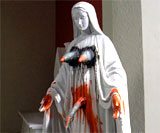 Desecrated Virgin Mary Statue in University Chapel  Regan's Public Urination on the Rug at Her Mother's Party 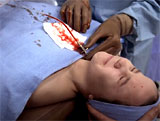 The Hospital Medical Examination Sequence 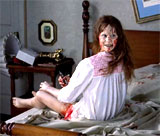 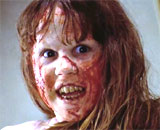 Head Rotation 180 degrees - While Spewing Obscenities: "Do you know what she did?..." 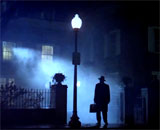 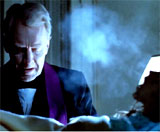 The Arrival of Father Merrin (Max von Sydow) For an Attempted Exorcism 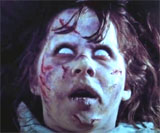 Demonic Eye-Rolling 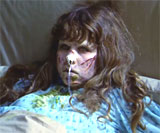 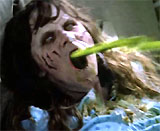 Vomit-Spewing 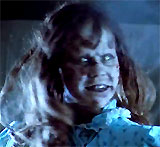 360 Degree Spinning Head 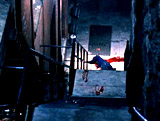 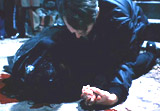 Karras Hurled to His Death |
|||||||||||||||||||||||||||
|
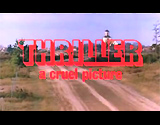
Thriller: A Cruel Picture
(aka They Call Her One Eye, Hooker's Revenge, or Thriller - En
Grym Film) (1973, Swe.)
This notorious and controversial Swedish violent revenge sexploitation film from writer/director Bo Arne Vibenius was advertised with the tagline:
Other exploitational rape-revenge films during the same era that sensationalized brutal revenge by wronged women included The Last House on the Left (1972) and I Spit On Your Grave (1978). Thriller: A Cruel Picture was repeatedly edited (from 107 minutes original length to an excised 82 minutes), censored and banned in its own country (and elsewhere) for its rape and revenge themes and hard-core sex. It was reported to be one of the first totally-banned films by the Swedish censorship board. Allegedly - crude and explicit inserts of a body-double being penetrated vaginally and anally and closeups of female genitalia were added to the film, to further validate the reasons for the hooker's vengeful actions.
The main character was completely mute Frigga (23 year-old Christina Lindberg) (Madeleine in the English version) whose life was forever traumatized after a molestation-rape at a young age (Pamela Pethö-Galantai as young girl) by a derelict elderly man in a wooded area in the opening scene. Fifteen years later, after missing her bus (to her therapist's office) one day, Madeleine was given a ride from her farm to the city by smooth-talking pimp Tony Dill (Heinz Hopf). He took her to dinner and his apartment, where he drugged her. He saw her as a new prospect: "A new prospect, 110 pounds, a real beginner....In ten days, I'll have a fine new chick ready." He told her: "I like women who don't talk too much, but you set a new record." He hooked her on heroin (two shots a day) as a junkie and then forced her into the abusive profession of prostitution. Her existence became overshadowed by sexual abuse, heroin addiction, and forced prostitution.
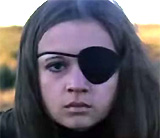
In the film's most infamous POV scene, Tony sliced her left eyeball with a scalpel - reminiscent of Truffaut's Un Chien Andalou (1929) (the mutilation was performed on a fresh cadaver) shown in graphic close-up detail, when she refused to service her first john (an accountant) and clawed his face. She was forced to wear an eyepatch that changed color (from pink to red to black, to match her mood) as the film progressed. She was abused numerous times - including by a twisted photographer, a male demanding sex (including X-rated, hard-core inserts of sexual intercourse), and a domineering lipstick lesbian (Despina Tomazani).
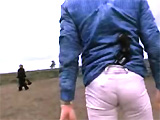
She was stunned to learn that her parents committed suicide on account of her (after reading a faked and hateful letter that she was forced to sign, that claimed that she hatefully deserted them). She saw their caskets carried from the farm in a funeral march. She turned (during her time-off on Mondays) to training herself for self-defensive revenge (buying weapons, taking driving lessons, and firearms and martial arts training, etc.). Her determination to seek revenge became intensified when she was told another sex worker named Sally (Solveig Andersson) had left for another job in Beirut, but then discovered bloody evidence that suggested Sally had been murdered in her bed because she was making plans to escape. Completely wordless, she resorted to graphic and violent blood-letting retaliation (mostly filmed in slow-motion) as long, dark leather coat-wearing "One Eye" (against her vile male clients and the lesbian trick) with a sawed-off shotgun. Tony learned of her retaliation and hired two thugs to eliminate her: "Madeleine shot two of her customers. Set a trap for her and then take her for a drive. She is not to be found again." Madeleine was ready for their ambush and shot and killed the two hitmen in a harbor warehouse, and then assaulted the two policemen called to the scene. She stole their police car and drove off to pursue Tony, but lost him when the roadway was blocked. She decided to mail Tony a letter - he reacted angrily to her suggested duel-challenge after receiving it: "She's challenged me to a duel. I get to choose the weapons. She should be in a nuthouse. Now she's gonna get what's coming to her. I'll get her once and for all." Madeleine drove to a windswept deserted field outside of the city and awaited Tony's arrival. When he appeared, he exited from his car, sporting a semi-automatic gun stuffed into the back of his pants. He entreated her:
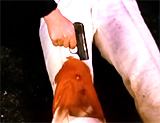
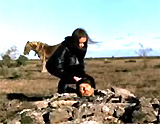
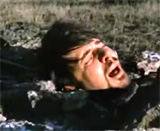
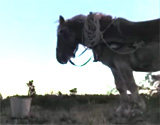
When she laid down her shotgun and ammunition bag, he reached for his concealed gun and threatened her: "You f--king whore! Thought you could fool me, huh? Damn slut. Which knee should I blow away first? F--king whore!" With a trip wire, she activated an explosive roman candle that she had positioned earlier in a nearby wall, in order to distract him. At the same time, she reached for her pistol, shot him once in the leg, and then approached and shot him again in the same leg two more times. She tied a rope around his waist that was attached to a draft horse that she led down the dirt road, dragging Tony behind. Tony was buried up to his head in a rock pile, where she placed a noose around his neck that was tied to the horse. She calmly watched from a distance as the horse (moving toward a bucket of apples) slowly decapitated and pulled off Tony's head (off-screen). She returned to the stolen police car and drove away.
|
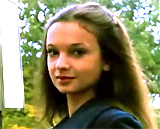 Young Frigga/Madeleine Accepting Ride From Tony 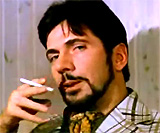 Pimp - Tony Dill (Heinz Hopf) 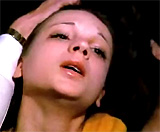 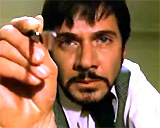 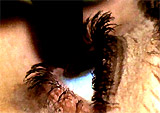 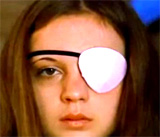 Eye Mutilation - Punishment for Disobedience 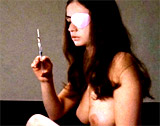 Heroin Addicted 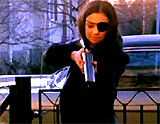 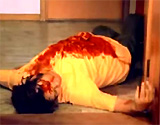 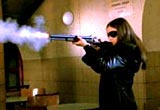 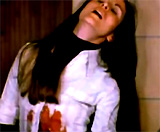 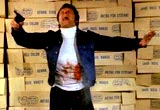 Revenge of "One Eye" - Death to Her Abusers and Hit-Men |
|||||||||||||||||||||||||||
 The Texas Chain Saw Massacre (1974)  The Texas Chainsaw Massacre 2 (1986)  Leatherface: Texas Chainsaw Massacre III (1990)  Texas Chainsaw Massacre: The Next Generation (1994)  The Texas Chainsaw Massacre (2003)  The Texas Chainsaw Massacre: The Beginning (2006)  Texas Chainsaw 3-D (2013) |
The Texas Chain Saw Massacre (1974)
Director Tobe Hooper's low-budget, seminal exploitation horror film (with a quasi-documentary feel) was made on a budget of $300,000 - and became highly profitable (approximately $31 million) through its advertising campaign ("Who will survive - and what will be left of them?"). Surprisingly, there were no close-ups of the fatal blows and more foreboding than real violence, although it became the 70's most controversial cult horror film and the precursor of later slasher films. The horror flick deeply divided critics - some praised it for its depiction of deprived, 'off-the-main-highway' rural America and the social effects upon its people. Others deplored it for its effective yet mindless slasher mentality. It was banned twice in France for potentially inciting violence, and for 25 years in the UK. There were numerous sequels to the original 1974 Texas Chainsaw Massacre film, stretching over almost 40 years!
The original film's unpleasant storyline was loosely based on the real-life Wisconsin serial killer and skin-fetishist Ed Gein - as was Hitchcock's Psycho (1960) and Jonathan Demme's The Silence of the Lambs (1991). The skillfully-directed film (Hooper's directorial debut) told about a family trio of unsympathetic, cannibalistic, homicidal, ex-slaughterhouse workers/fiends:
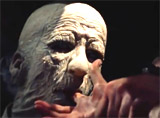
They slaughtered college-aged kids (and anyone else) who happened to trespass in their area - and then intended to eat their human flesh and sell the remains as 'sausage'. Leatherface wore a bloody butcher's apron and a mask stitched out of human skin - and wielded a roaring chain saw. The R-rated, painful-to-watch, nightmarish film opened with a sober narration about a crime spree - vandals had been desecrating graveyards in a remote section of Texas. A visit to Grandfather Hardesty's grave to check on the reports of grave robbing and vandalism was made by five individuals:
After visiting the gravesite, while on their way to the Hardesty homestead, they picked up a scary-looking hitchhiker (Edwin Neal), later revealed as Leatherface's brother, who cut himself with a pocket-knife, and also slashed Franklin on his arm with a straight-edged razor. They stumbled upon a nearby, run-down deserted farm house while awaiting a delivery of gasoline at the local service station, where the slaughter was about to begin. The film's most indelible image was of a sliding door that opened and took battered, innocent teenagers into the lair of the chainsaw-wielding Leatherface, wearing a butcher's apron and a stitched, human-skin mask.
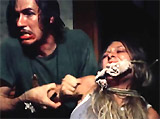
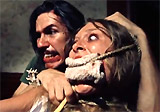
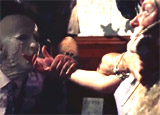
Running in terror and escaping, Sally unfortunately fled to the gas station, where the proprietor bound and gagged her and brought her back to Leatherface's house, where she was soon held captive in the infamous dinner scene (and had her finger cut as a blood-appetizer for the weakened, withered, vampiric and patriarchal Grandfather (John Dugan)). As she watched in horror while being restrained, she saw the Grandfather suck on her wounded finger. She was about to serve as the "dinner" main course for the deranged clan of captors. The Grandfather was given a hammer to strike at Sally ("Hit that bitch!"), who was forced to kneel in front of him with her head over a large metal bucket, but he was too weak to do any harm.
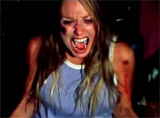
During the film's chaotic and climactic scene set at dawn, a bloody and deranged-looking Sally again escaped by plunging through a window and frantically running down the farmhouse road, while being chased by the hitchhiker (Leatherface's brother) and Leatherface himself (dressed as a woman). The former was gruesomely run over by a passing semi-trailer truck. With a bloodied face, Sally screamed at the horrific sight as the body was crushed by the huge truck tires. She was able to climb into the red cab of the semi, as Leatherface approached with his churning chainsaw. Sally fled again out the other side of the cab with the frantic driver, and hailed down a passing pickup truck. She jumped into the back, and with a bloody and deranged-look, she laughed as the spinning Leatherface - in the golden dawn - swung his buzzing chainsaw through the air in a frustrating, exaltant dance. |
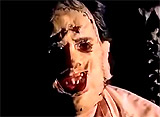 Leatherface (Gunnar Hansen) 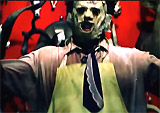 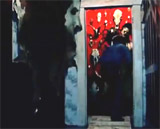 Kirk's Bludgeoning by Leatherface 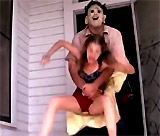 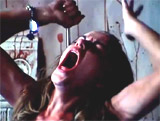 Pam's Snatching and Meat Hook Hanging 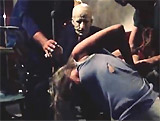 Jerry Sledge-Hammered 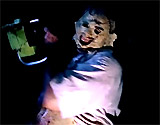 Franklin Sliced in Stomach 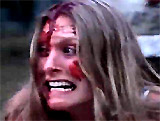 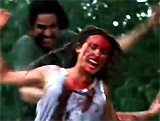 Sally Taking Flight From House 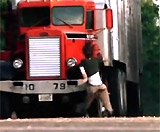 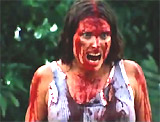 Leatherface's Brother Run Over by Truck - and Sally's Reaction 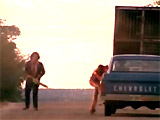 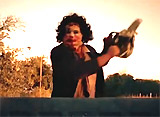 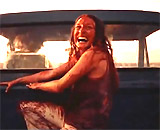 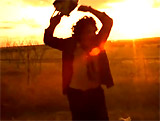 Sally's Escape - The Only Survivor |
|||||||||||||||||||||||||||
 The
100+ Most Controversial Films of All-Time The
100+ Most Controversial Films of All-Time(chronologically, by film title) Intro | Silents-1930s | 1940s-1950s | 1960-1961 | 1962-1967 | 1968-1969 1970-1971 | 1972 | 1973-1974 | 1975 | 1976-1977 | 1978 | 1979 1980-1982 | 1983-1986 | 1987-1989 | 1990-1992 | 1993-1995 | 1996-1999 2000-2002 | 2003-2005 | 2006-2009 | 2010-present |




 The
sight of 13-year-old Linda Blair vomiting, swearing and abusing
herself with a crucifix horrified a broad swath of moviegoers and
critics.
The
sight of 13-year-old Linda Blair vomiting, swearing and abusing
herself with a crucifix horrified a broad swath of moviegoers and
critics.