|
Films of All-Time 1976-1977 |


|
Blood Sucking Freaks (1976) (aka
The Incredible Torture Show and Sardu: Master of
the Screaming Virgins)
This unredeeming, questionable, misogynistic and depraved grindhouse horror/sex exploitation film from Troma Entertainment was originally unrated, due to its controversial and violent nature, but later reduced to an R-rating when cuts were administered. In some ways, this repugnant film set the stage for modern-day 'torture porn' films, such as Hostel (2005) and Wolf Creek (2005). Its poster tagline exclaimed:
Voted one of the worst films ever, the mean-spirited film was also targeted by the feminist group Women Against Pornography for its depictions of violence against women, although it was counter-argued that the gore was for comedic effect. It was reminiscent of Herschell Gordon Lewis's earlier film The Wizard of Gore (1970). Another poster tagline emphasized:
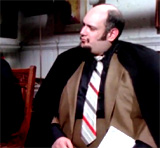
This low-budget nauseating film, originally titled The Incredible Torture Show (T.I.T.S.!) and renamed as Bloodsucking Freaks for its 1980 re-release, told about a macabre Grand Guignol-type theatre in downtown New York (the Soho district) that held off-Broadway performances mostly of humiliation, degradation, gruesome torture and murder. It was conducted by:
Emcee Sardu introduced himself in the opening sequence:
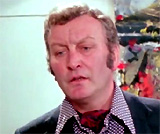
Guests in the audience included: famous blonde Estonia ballerina Natasha Di Natalie (Viju Krem) at Lincoln Center, her hunky pro-football star boyfriend Tom Maverick (Niles McMaster) (modeled after Joe Namath), and a smug theater critic Creasy Silo (Alan Dellay) who called Sardu's program a "third-rate magic show" and mocked its pretension as art:
As the ballerina left after the show ended, she begged Tom: "Will you please get me out of here before I throw up?"
Real victims were used for his demented shows - but were the tortures faked? The staged torture acts in the horror film's opening performance included:
It was also discovered that Sardu kept in confinement many feral-acting, female kidnap victims, who were held naked in a locked prison cage below stage in the basement. They were fed raw meat (or body parts?) by Ralphus in the middle of the night. Those unfortunate ones were sold into white slavery for cash by a Middle Eastern-connected mobster (Alphonso De Noble), and packed in large cardboard boxes - marked FRAGILE.
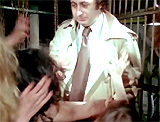
A naked woman kneeling in front of Sardu was used as a dinner table. He considered her moans as "after-dinner music." Famous critic Creasy Silo who had criticized the Theatre of the Macabre, was kidnapped in an art gallery by Ralphus. A woman distracted him by opening her trenchcoat to reveal she was naked with a dildo tied to her waist. He was brought before Sardu, strung up, and pressured through mild torture to apologize and write a positive review. He was also subjected to witness more atrocities, such as electro-shock to a nude female's (Janis Beaver) nipples, and another victim ridden bare-back by Ralphus while being whipped. Sardu described his philosophy of his new show, combining two art forms: sadism and dance "because the public cannot digest eroticism alone" - it was a perfect synopsis of the film:
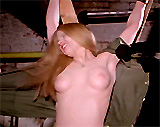
Sardu promised the resistant Creasy that he would be "front-row center" in a new show that would acquire "critical acclaim." Sardu turned and told the enslaved woman being ridden like a horse by Ralphus that her mouth "will make an interesting urinal." Sardu also ordered Ralphus to kidnap ballerina Natasha from the locker room in the NY State Theater City Center before practice, so she could perform unwillingly in his next theatre show to give it more legitimacy. She was brought to the basement and restrained where her leotard was cut off her body, and then she was strung up by her wrists. A depraved, mother-obsessed and sadistic doctor (Ernie Pysher) who had attended to the near-dead Natasha, was promised anything he wanted. In the cellar, he performed a ghastly 'operation' on one nude female victim (Lynette Sheldon, credited as Doctor's Compensation):
The doctor was eliminated "permanently" when fed to the ravenous, cannibalistic feral females in the basement who disemboweled him, tore out his heart and chomped on body parts. One of the females rubbed his bloody beating heart over her breasts. Following the doctor's death, Sardu and Ralphus celebrated by drinking beer and playing with a human dart-board (a woman's (Joann Friedman) backend was painted with a bulls-eye). Meanwhile, Natasha's boyfriend contacted the NYPD and was assisted by corrupt and dishonest Police Sgt. John Tucci (Dan Fauci), who demanded $10,000 to conduct an investigation into Natasha's mysterious disappearance.
Natasha - who still resisted performing for Sardu - was forced to watch other displays of torture aided by his two leather-corseted slave girls (Helen Thompson and Ellen Faison) (while Ralphus snacked on a bag of popcorn):
Ralphus and Sardu played a frenzied game of backgammon using freshly-severed fingers (from two naked females sitting nearby) using a meat cleaver. The game ended when all fingers on their hands were used up. Natasha was also forced to watch as a dancer named Maya (Rita Montone) was mutilated:
There were a few instances in the film when Sardu subjected himself to doses of S&M himself. "Tied up" (or busy), he was pleasurably whipped by one of his slave girls, after convincing Natasha to perform in his show's opening.
Natasha publically announced her decision in Variety Magazine, and Sgt. Tucci declared that the case was solved. Practice commenced for Sardu's new show opening soon, although Ralphus insisted on higher billing, as Sardu reprimanded him: "I thought you gave all that up when you left the William Morris Agency." Natasha reassured her boyfriend that her upcoming appearance for Sardu's S&M show was on the up-and-up: "I mean, Lincoln Center, it is just so boring. You know, one night Giselle act or the other, that would be the only thing that I would have to look forward to. Believe me, Sardu is a genius. This is where it's all at, right here in Soho....It's not S&M, this is art." After Tom left, although he still remained skeptical, it was revealed that Natasha was under Sardu's hypnotic spell - she kissed and licked his boot. The sleazy Sgt. Tucci privately confronted Sardu and demanded $100,000 in extortion money (before the show opened that evening) to keep quiet about his lucrative white slavery trade behind the scenes. Just before the show, Sgt. Tucci received Sardu's payment, then divulged to Tom that Sardu was actually engaged in 'white slavery' and that Natasha was being held "prisoner." The show was about to begin, with Sardu gloating: "The Schubert's already inquiring about moving our show up to Broadway, and then Hollywood!" Sardu announced the new show with his star ballerina: "The Artist: Seduction and Death of a Critic." Natasha opened the show, dancing topless before a bound-up Creasy Silo, the critic - repeatedly kicking him in the face until he died. After the show, Sgt. Tucci conducted a two-person raid (with Tom) against Sardu, to acquire his fortune ("Sardu's treasure. He's got a fortune stashed away down there"). As they entered the backstage area, they discovered Maya (with stumps for feet) crawling on the floor and a decapitated skull (Tucci: "What's the matter, kid? Never got a little head before?"). At the same time, Ralphus was seasoning and frying up a panful of eyeballs. Ralphus and one of Sardu's assistants were subdued, and a drugged-up Natasha was rescued. After Sardu was found in bed committing necrophilia with Creasy, he was mounted on his own X-Cross torture mechanism, where he begged to be hit by Sgt. Tucci.
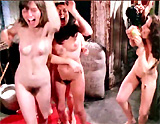
Sgt. Tucci unwisely opened up the cage door to liberate the feral 'white slavery' females, and was mauled to death by the ravenous captives. Tom heard the death screams of Tucci and wished to flee, but Natasha was concerned about Sardu: ("My master! You hurt my master"). He dragged her away as Sardu laughed maniacally, but she refused to join him: ("I must get back to my master"). She axed Tom in the head from behind - and then licked his blood, as Tucci was heard being devoured nearby. The film ended with Natasha fleeing back naked to Sardu - after stripping off her trenchcoat. The feral women danced in celebration of their victory and liberation. They passed around a hot-dog (phallic) sandwich (with lettuce), while the camera panned over the decapitated heads of their dead captors: Sardu, Ralphus, and his two assistants. THE END appeared over one of the women biting into the sandwich.
|
 Sardu's 'Performance' Theatre  On-Stage Emcee Sardu (Seamus O'Brien)  Thumb Screw and Iron Skull Vice Administered by Ralphus (Luis De Jesus)  Dismemberment  Eyeball Gouging  Naked Backside - Dinner Table  Kidnapping Distraction for Creasy in Art Gallery  Electro-Shock to Nipples  Doctor's Multiple Teeth Extractions 'Operation'  Evidence and Tools of Doctor's Torture  Doctor Drilling into Victim's Shaved Skull 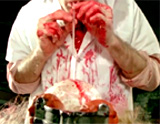 Doctor Drinking Cranial Fluid From Straw  The Doctor Cannibalized by Feral Females in Basement  Doctor's Heart Rubbed Over Breasts 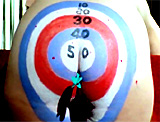 Female Dart Board 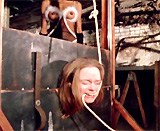 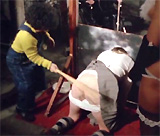  Buttocks' Caning and Decapitation  Severed Fingers Game of Backgammon  Maya's Chain-Sawed Feet Sardu's New Show Starring Natasha  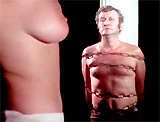 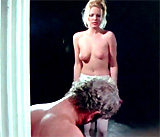  Natasha's On-Stage Murder of Creasy  Sardu's Necrophilia with Creasy 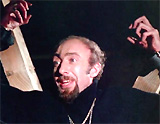  Sardu Held on X-Cross - Maniacally Laughing 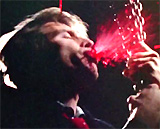 Tom Bashed in Head With Axe |
||||||||||||||||||||||||||||||
|
In the Realm of the Senses (1976,
Jp./Fr.) (aka Ai No Corrida, or L'Empire Des Sens)
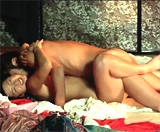
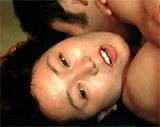
This erotic Japanese masterpiece from writer/director Nagisa Oshima about painful passion told the story of a torrid, increasingly intense and dangerous, true-to-life, almost non-stop sexual affair between two individuals in mid-1930s. This sexually adventurous, lurid arthouse film about unadulterated desire included an orgy scene, sexual violence, sexual games, and frequent shots of an erect penis and fellatio. It deliberately broke the taboo in Japanese cinema against showing female pubic hair and sex organs. The film, produced in France, reflected the tradition of erotic Japanese wood-block prints, the shunga, in which the faces were stylized, but the sexual organs (especially the phallus) were shown aroused, enlarged and delineated with almost topographical detail and care. The shocking and intense film of extreme, all-consuming sexual obsession, deadly madness, destruction of the servant-master dichotomy, and complete immersion, bordering on pornography in its uncut version, was seized and banned by US Customs and postponed in its censored release. It caused a sensation - and lively discussion - at the Melbourne Film Festival in 1976 when first released. This erotic Japanese masterpiece about painful passion in 1936 Japan told the story of a torrid, increasingly intense and dangerous, true-to-life, almost non-stop sexual affair between:
After spying on Kichizo and Toku having sex, Sada developed a crush on Kichizo.
In the scenes between submissive Kichizo and a dominating Sada Abe, there were explicit shots of:
Almost penis-fixated, she innocently stated: "Isn't it natural for a woman to love the sex of the man she loves?" Eventually, when Sada grew jealous of her partner's continuing sexual relations with his wife Toku and wielded a knife at her, she also threatened to destructively cut off Kichizo's penis - an eventuality that came true. The most controversial and infamous sequence in the film was the depiction of the violent and disturbing practice of auto-erotic asphyxiation to aid their sexual excitement - first with her bare hands, and then with a red scarf. The film climaxed with his bloody genital dismemberment/castration after murderous strangulation so that she could keep his member inside of her. She also carved in his chest - in blood: "Sada Kichi the two of us forever."
Afterwards, the empowered female carried around her master-lover's severed genitals in a handkerchief for four days - an enactment of her proprietary feelings about his member - until she was arrested. |
 Sexual Touching During Menstruation 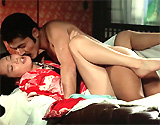 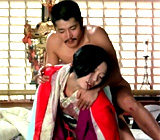 Kichizo and Sada: Intercourse 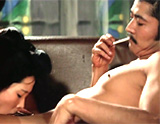  Kichizo and Sada: Oral Sex     Kichizo with Sada  Caught in the Act  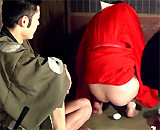 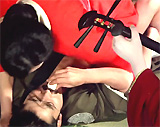 Insertion of Egg - and Then Consumed |
||||||||||||||||||||||||||||||
|
The Message (1976, 1977) (aka Mohammed,
Messenger of God)
Taglined as "The Story of Islam," this epic-length 178 minute dramatic biopic was the debut feature film of Islamic, Syrian-born producer/director Moustapha Akkad (who later produced John Carpenter's successful horror film Halloween (1978)). It starred Mexican-born actor Anthony Quinn (Abdallah Geith in the 198 minute Arabic version) - following his success in the desert epic Lawrence of Arabia (1962) -- as Mohammed's desert-dwelling warrior uncle Hamza. It was set in 7th century Mecca and documented the beginnings of Islam and the life and teachings of the prophet. The film's script - written by Irishman H.A.L. (Harry) Craig - took two years of research and writing before its readiness for filming, due in part to the restriction that Muslim authorities had to approve the finished screenplay before filming could commence. Problems began almost immediately when it was unfoundly rumored that Peter O'Toole, and then American star Charlton Heston, would star in the lead role, causing two days of bloody riots in Karachi, Pakistan. This caused a stir because it was feared that the film would violate the strict Muslim belief (forbidden by Shari'a, Islamic holy law formed after Mohammed's death) that any representation of the Diety Allah or His Prophet Mohammed (and his immediate family including wives, daughters, and sons-in-law) could not be depicted on screen nor could his voice be heard. However, the politically-correct film represented him either off-screen, as the camera's point-of-view, or with occasional symbolic appearances (i.e., his camel-riding stick, his tent, and his holy camel). Nonetheless, endless protests, riots and death threats (by telephone) accompanied the film's production and making (totaling seven years). In its troubled production history, the film was forced to move from Saudi Arabia to Morocco for filming, where Akkad promised that he would construct a $100 million film production studio, as well as recreate the city of Mecca (and a model of the town's sacred holy shrine, the Kaaba, at a cost of $400,000), and hire thousands of extras. [The film was originally backed for up to $60 million by Saudi monarch King Faisal, until he pulled out of the project while disallowing filming on location in Mecca and Medina. Later, Faisal denounced the infidel filmmakers in Morocco and caused the dismantlement of the whole film operation, resulting in relocation costs of more than $2 million.] Akkad was forced to move and find financial backing and sponsorship from terrorist-friendly Libyan leader Colonel Muammar al-Qaddafi. Ultimately, The Message was shot in two versions with different cast members, a Western version in English and a special Arabic version (entitled Al-Ris-Alah), adding to the costs. The film faced a dilemma regarding its marketing for US audiences, for its emphasis on a non-Western religious leader who didn't even appear in the film. Eventually, it was decided to use the tagline: "In four decades only four... "The Robe" "The Ten Commandments" "Ben-Hur" and now... For the first time...the vast, spectacular drama that changed the world!" Difficulties with the film's title forced it to be changed to The Message for its world premiere in London in late July, 1976. Various religious groups called the film 'sacrilegious' and 'an insult to Islam' and it was banned from showings in much of the Arab world. Without all the surrounding controversies whirling about, the film was still viewed as a bland, compromising film that was overlong. There was further controversy when the film was scheduled to premiere in the U.S. in Washington, DC, in March, 1977. The Hanafi Black Muslim extremist group led by Hamas Abdul Khaalis staged a heavily-armed siege against the local Jewish chapter of the B'nai B'rith (its national headquarters) under the mistaken belief (without having seen the film) that Anthony Quinn played Mohammed in the film. During the two-day crisis, they took nearly 150 people hostage, and threatened to blow up the building while demanding the film opening's cancellation. Future DC mayor Marion Barry was shot when the terrorists overran the District Building, and many others were injured. The hostage situation was eventually defused by the FBI and Muslim ambassadors, and the theater chain that had booked the film cancelled the showing. This disastrous opening unfortunately ruined US box-office for the controversial film, as various moviehouses were forced to cancel their showings due to political pressures and further fears of violence. Ironically, in late 2005, Akkad died from injuries sustained during terrorist attacks in Jordan. |
 Abdallah Beith (Anthony Quinn) |
||||||||||||||||||||||||||||||
| A Real Young Girl (1976, Fr.)
(aka Une Vraie Jeune Fille)
Writer/director Catherine Breillat's feature debut was this erotic drama with strong and shocking sexual content - it was made in 1975, but not released until 25 years later due to financial problems with Breillat's production company and controversy surrounding this sensational, raw and strange film. This film was promptly banned upon its initial release in France in 1976, and was not released to theaters until the year 2000. One tagline was:
Breillat would later become famous for the similarly-explicit Romance (1999, Fr.) and Fat Girl (2001, Fr.) which were also preoccupied with the representation of female sexuality. The self-reflective film was not considered pornographic by many, but rather a serious attempt to represent the disruptive awakening and tumultuous sexuality of the psyche of a pubescent young female, who was all too-ready to transgress taboos of society. The frank film showed various close-ups of her genitalia, her crude and realistic fascination with messy, tactile, and visceral emitted fluids (mostly from her body) and mysterious smells (including vomit, urine, a broken egg yolk, tree sap, blood from a beheaded chicken, her own ear-wax, sperm (in a fantasy sequence) and candle-wax - often shown in closeup), and also, her rampant sexual fantasies and infatuations. For example, during the female protagonist's first night at home, she flopped backwards onto her bed in her two-piece pajamas; seemingly depressed, she then vomited onto herself; she spoke in voice-over: "I sat up cautiously, liberated by the vomit's warmth, by the sweetish smell it gave off. Disgust makes me lucid. It was at that very moment that I decided to write my diary because I couldn't sleep." She recalled a night at school when she wrote out her name on a mirror with vaginal secretions, and went to a toilet stall to smoke a cigarette and urinate, while locking out her best friend Martine (Alexandra Gouveia). This original, unapologetic and bold coming-of-age film charted the budding sexuality and self-exploration of one teenager in the summer of 1963 in France:
The provocative film opened with Alice riding on a train returning home for the summer to Southwestern France (the Landes Forest area of Gascony) with her contemptuous, intolerant voice-over (voice by Marie-Hélène Breillat) and feelings of oppression:
When she arrived at her home train station, a sugar-sweet pop tune played about a young female's insecurities: "Suis-je une petite fille" (Lyrics: "I'm a little girl. I don't know, no, I don't know. How big a girl I am. Only you can tell. Please, please tell me, tell me now. Please, please tell me what you like about me"). There were a number of incidents involving her sexual awakening
However, in one surreal, graphically-explicit and shocking fantasy dream sequence involving the hired worker Jim, Alice was lying naked spread-eagled on her back on the ground - her hands were tied back with barbed wire. He dangled a live and wiggling earthworm (a symbol of a flaccid, small-sized male genitals) over her full-screen genitals, then tried to insert it into her vagina. When unsuccessful, he pulled apart the worm with his fingers into segmented pieces, and sprinkled the remains on top of her pubic hair. She looked up as he stood towering above her, and he snickered at her.
In a second imaginary fantasy sequence with Jim, she walked to the sawmill and came upon Jim urinating with his back to her ("He was shaking it"). She attracted Jim's attention by removing her panties and urinating in front of him. He walked off, again disinterested. She ran after him to the beach, and crawled in front of him (with chicken feathers protruding from her rear), as he opened his pants in front of her. She told him: "Cluck, cluck, I'm a chicken too." He grabbed one of the feathers with his teeth, and they shared a 'feather-kiss.' He placed flowers in her hair. They both rolled onto their backs and side-by-side, they masturbated next to and in front of each other. Afterwards, he wiped his sperm onto her blouse ("I watched his cock flopping like a dead fish"). She was disgusted and as she departed, she yelled out: "Get lost!" In the film's conclusion, it was revealed that Alice's philandering father was involved in an on-going affair. Alice listened as her parents quarreled about their disintegrating marriage, although her father pledged: "I don't think I want to lose you."
As some form of ironic punishment for sneaking over to Alice's place in the dark for their "first date," Jim (who had just been fired by her father after demanding overtime) was shot and killed by a trap that Alice's father had set up to keep wild boar out of his corn field. Alice's mother reacted with hysteria: "My God, we're ruined...How are we going to pay for this?" Alice watched the crime scene from inside the house as she packed to return to school. There were a few closing or end credits followed by a black screen accompanied by music on the soundtrack. |
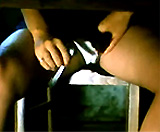 Alice Touching Herself Underneath Table with Tea Spoon 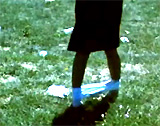 Alice With Her Panties Down to Ankles in Field 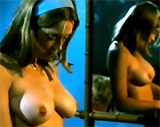 Alice In Front of Her Bathroom Mirror: "I'm well-developed for my age" 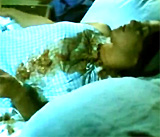 Alice Vomiting Onto Herself  Alice Urinating in School Toilet Stall 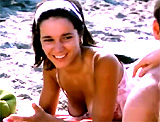 With Her Girlfriend Martine at the Beach 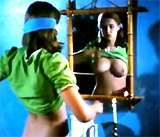 Alice Touching Herself with Red Paste 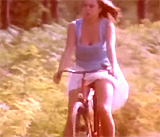 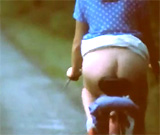 Riding Her Bike Showing Her Panties or Bare-Assed 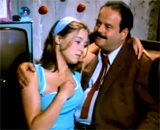 Her Unnatural Relationship with Her Father 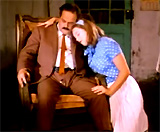 Alice Imagining Seeing Her Father's Genitals 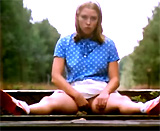 Alice Spread-Eagled and Masturbating on Railroad Tracks  Alice Buggering Herself    Alice's 2nd Fantasy Sequence with Jim  Alice's Cheating Father  Non-Fantasy Sex with Jim  Last Image of Alice |
||||||||||||||||||||||||||||||

|
Snuff (1976, Argentina/USA)
This disturbing and infamous film (one of the first 'snuff' films, but only according to urban legend) by two grindhouse directors was eventually revealed to be a publically-marketed scam and hoax. The exploitational, semi-documentary film's real-life murder at the end of the film was promoted as real when it fact it wasn't.
The video cover asked:
The husband-wife team of the Findlays (Michael and Roberta) had become known by a few of their 1960's grindhouse era sexploitational "roughies" films: (i.e., Body of a Female (1964), Satan's Bed (1965) (with Yoko Ono!), Take Me Naked (1966), the Her Flesh Trilogy (1967-1969), A Thousand Pleasures (1968), and The Ultimate Degenerate (1969)). In 1971, they had released the crudely-made, low-budget ($30,000) exploitation film The Slaughter (1971) made in Argentina that did very poorly.
The Slaughter (1971) was based loosely on the Charles Manson ‘family’ murders committed in 1969. The low-budget film was purchased by producter/distributor Allan Shackleton's Monarch Releasing Corporation shortly afterwards, and then shelved for four to five years. Shackleton decided to re-release the 74 minute film with the new title "Snuff." He also removed the credits from the previous film, inserted new credits, and gave it the new tagline --
It was composed of The Slaughter footage (perceived as 'new') plus an additional tacked-on 6 minute epilogue containing a "snuff murder" - filmed by director Simon Nuchtern. The snuff killing was the film's most outrageous footage of all - the disembowelment and murder of a female crew member. Shackleton's own promotional campaign included releasing fake newspaper clippings that documented the outrage of non-existent moral conservatives (a group known as Citizens For Decency). Actual protests regarding the film (by Women Against Pornography) only added to its notoriety and fueled audience attendance when it was reported by various media outlets. The film opened with the brutal wounding and torture of a disobedient gang member named Ana (Ana Carro) by members of a murderous hippie-lesbian, biker gang/cult headed by Satan – pronounced S’Taan (Enrique Larratelli). (The musical soundtrack had a suspiciously-similar tune to Steppenwolf's Born to Be Wild, found in the biker film Easy Rider (1969)). Some of the other cult members included Susanna (Liliana Fernández Blanco) and Carmela (Roberta Findlay - voice). Then, in the restroom of a Buenos Aires airport, an unidentified male (Jack Bravman) had his neck sliced by a disguised female cult member. Producer-director Maximillian 'Max' Marsh (Aldo Mayo) arrived by plane in Buenos Aires with his star-girlfriend Terry London (Mirtha Massa) to make a sex film with a film crew.
Actress Terry was also involved in an on-going affair with Argentinian Horst Frank (George Vilaneuva), a spoiled-rich playboy living at his wealthy German businessman father's (Alfredo Iglesias) villa. She had earlier met Horst in Long Island where they struck up an acquaintance. When Terry arrived, Horst was romantically involved with Angelica (Margarita Amuchastegui), a member of S'Taan's cult - who happened to be S'Taan's favorite. The goal of the cultish group was to seek bloody sacrifices by murdering the decadent rich in the Buenos Aires area. One of S'Taan's immediate plans was to infiltrate Horst's house with Angelica who was poised to become pregnant by Horst in order to provide a baby to be sacrificed as the first victim in S'Taan's war against the wealthy.
However, things took a turn when Terry announced that she was pregnant (by Horst) from their earlier rendezvous in New York. Horst was forced to dismiss Angelica from his house. Angelica chose her next target by seducing Max during Carnivale to distract him from Terry. Wearing a disguise, she stabbed Max to death (simultaneously, Terry was orgasming from oral sex with Horst). After the murder, Terry was questioned by a detective (director Michael Findlay) before being invited to move in with Horst at his father's villa. An aborted robbery of a local grocery store by the cult led to the cold-blooded gun-shot murder of two family members (a daughter and her mother), and another male customer (killed by a knife thrown into his back) who grabbed the gun and shot dead two of the female cult members. Two other cult members threatened to execute the elderly store proprietor, the only witness to the crimes, and ultimately Angelica pulled the trigger on the shop-keeper. During a side-plot flashback, young Angelica was repeatedly sexually abused and violated by Luis, the cruel and powerful owner of the farm where she lived. She grew up with constant abuse and exploitation and had become "a regular whore" by the age of 17 ("he both fascinated and repulsed me"). When her father caught her in bed naked with the farm owner, she watched as her father was shot dead. The next day, her father's disembodied hands were hung in front of the farm. Angelica's brother sought vengeance by strangling and drowning Luis in the jungle. In the film's climax about six-seven months later, S'Taan announced to his girls: "The time has come for SLAUGHTER" - he ordered a series of gory and gruesome murders. Angelica and Ana first gained access to Horst's gated villa, where Ana stabbed Jaime - one of the servants. They were soon joined by Susanna and Carmela. Two visiting house party guests were murdered, and then Horst was taken captive and tied to a tree, whipped, and castrated (off-screen) out in the yard. In an upstairs bedroom, Horst's father was shot in the heart, and his pregnant actress-mistress Terry London (the Sharon Tate-like character), was stabbed in the belly by Angelica while reclining in bed. In the film's 'live' cinema verite coda or epilogue (a film within a film), the camera cut to reveal the set of the film during its making - the bedroom where the murders had just been filmed. Following filming, the 'director', who was wearing a blue T-shirt proclaiming: "Vida Es Muerte," turned to a blonde female (the production assistant?), telling her that he had been sexually-aroused by the murder sequence ("That was dynamite! That was a gory scene that really turned me on"). Then, he suddenly proposed getting on the second bed and making out - she was reluctant because so many people would be watching - in any case, they began to be filmed by the crew. He laid her backwards on the bed, fondled her right breast, and then straddled her, as she resisted ("Let me go!"). He held her down (with help in restraining her from another smiling brunette female dressed in black named June). Shockingly ("to get a good scene"), he cut into her left shoulder with a large-bladed knife. When she squirmed and screamed loudly, he cut off a few of her left hand's fingers (including her ring finger) with scissors. Another male helped to hold her down as her entire right hand was cut off with an electric jigsaw. As the crew kept filming, he used the knife to disembowel her (he reached inside the opening), after which he held up her bloody intestinal entrails or viscera, and screamed triumphantly.
Then, the camera appeared to run out of film as the screen turned white (and then black), and two male crew members were heard saying to each other before the film abruptly ended:
|
 Biker/Cult Gang   Manson-Like Leader S'Taan (Enrique Larratelli) 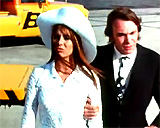 Max Marsh and Terry London Arriving in Argentina  Director Max Marsh  Horst Frank (George Vilaneuva)  Terry London (Mirtha Massa) 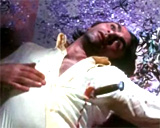 Max Stabbed to Death by Angelica Deaths at the Villa  Stabbing of Servant Jaime by Ana  Horst Tied to Tree, Whipped, and Castrated  Horst's Father Shot in the Heart 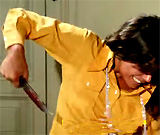 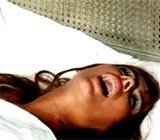 Pregnant Terry Stabbed in Belly by Angelica    First Few Frames of Added Epilogue |
||||||||||||||||||||||||||||||
 The
100+ Most Controversial Films of All-Time The
100+ Most Controversial Films of All-Time(chronologically, by film title) Intro | Silents-1930s | 1940s-1950s | 1960-1961 | 1962-1967 | 1968-1969 1970-1971 | 1972 | 1973-1974 | 1975 | 1976-1977 | 1978 | 1979 1980-1982 | 1983-1986 | 1987-1989 | 1990-1992 | 1993-1995 | 1996-1999 2000-2002 | 2003-2005 | 2006-2009 | 2010-present |




 Women
Against Pornography unwittingly raised this ugly horror movie's
profile by denouncing its relentless, misogynistic violence.
Women
Against Pornography unwittingly raised this ugly horror movie's
profile by denouncing its relentless, misogynistic violence.