|
Films of All-Time Silents-1930s |

|
The Kiss (1896) (aka The May Irwin Kiss, The Rice-Irwin
Kiss and The Widow Jones)
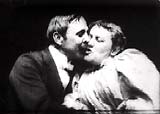
This most popular short film - 26 seconds in length - (an Edison Vitascope film made in Edison's Black Maria Studio) was thought to be scandalizing. It was the first filming of a couple's kiss that was recreated from the two well-known stage actors' (May Irwin and John Rice) performance in the hit Broadway play The Widow Jones. The Edison catalogue advertised it thus:
Many disapproved and considered it inappropriate to view two physically-unattractive people magnified on the screen during an extended kiss. As one contemporary critic wrote: "The spectacle of the prolonged pasturing on each other's lips was beastly enough in life size on the stage but magnified to gargantuan proportions and repeated three times over it is absolutely disgusting." |
|
||||||||||||||||
|
The Birth Of A Nation (1915)
This groundbreaking, landmark American film masterpiece about two families during the Civil War and Reconstruction periods was also extremely controversial and explicitly racist. It was based on former North Carolina Baptist minister Rev. Thomas Dixon Jr.'s anti-black, 1905 bigoted play, The Clansman, the second volume in a trilogy. The film was thoroughly renounced as "the meanest vilification of the Negro race" and for its depiction of blacks as childlike, conniving, and sexually animalistic. Riots broke out in major cities (Boston, Philadelphia, among others), and it was denied release in many other places (Chicago, Ohio, Denver, Pittsburgh, St. Louis, and Minneapolis, eight states in total). Subsequent lawsuits and picketing tailed the film for years when it was re-released (in 1924, 1931, and 1938). Ironically, although the film was advertised as authentic and accurate, the film's major black roles in the film -- including the Senator's mulatto mistress, the mulatto politican brought to power in the South, and faithful freed slaves -- were stereotypically played and filled by white actors - in blackface. [The real blacks in the film only played in minor roles.] Its release set up a major censorship battle over its extremist depiction of African Americans, although Griffith naively claimed that he wasn't racist at the time. Unbelievably, the film is still used today as a recruitment piece for Klan membership - and in fact, the organization experienced a revival and membership peak in the decade immediately following its initial release. And the film stirred new controversy when it was voted into the National Film Registry in 1993, and when it was voted one of the "Top 100 American Films" (at # 44) by the American Film Institute in 1998. The subject matter of the film caused immediate criticism by the newly-created National Association for the Advancement of Colored People (NAACP) for its racist and "vicious" portrayal of blacks, its proclamation of miscegenation, its pro-Klan stance, and its endorsement of enslavement. As a result, two scenes were cut (a love scene between Reconstructionist Senator and his mulatto mistress, and a fight scene). In the scenes that remained, one recreated the first historic session of the legislature during Reconstruction, in which freed negro legislators were luridly and angrily portrayed as mocking the ideals of the Old South and shown as power-crazy, shiftless, lazy, idiotic, sitting shoeless (sprawled with bare feet upon their desks) and drinking in their legislature seats. In another, mulatto leader Silas Lynch (George Siegmann), lusting for power and miscegenation, attempted to force marriage upon Elsie Stoneman (Lillian Gish) - by force if necessary. During the most famous sequence in the film, excitement was heightened by shots of the Klan alternating with shots of the endangered Elsie - the film exhibited masterful parallel editing. Along a country road, the Klansman rode to their appointed mission - to first rescue Elsie, and then to rescue the entire Cameron family along with one of the Stoneman boys. In a diagonally-angled shot, a long line of KKK riders came into view from the distance. |
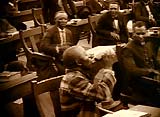 Reconstruction Legislature 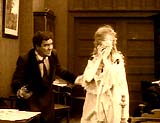 Silas Lynch Lusting After Elsie Stoneman 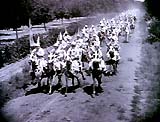 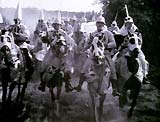
The KKK Ride |
||||||||||||||||
|
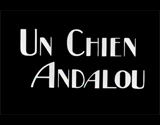
Un Chien Andalou (1929, Fr.) (aka
An Andalusian Dog) (short)
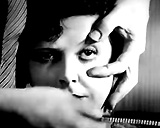
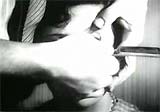
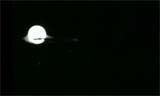
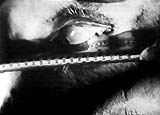
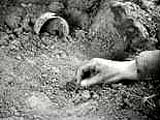
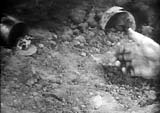
Spanish director Luis Bunuel's low-budget, short surrealistic silent film of unexplained imagery ("Once upon a time") was created in collaboration with artist Salvador Dali. This shocking, dreamy and provocative surrealistic film of the 1920s avant-garde movement, only 17 minutes long and with a non-sensical title (it literally meant "An Andalusian Dog"), was filled with irrational, freely-associated and shocking images juxtaposed without any sense of logical continuity or narrative, to produce powerful effects due to the editing. It was banned in various countries, mostly for its infamous, shocking, and disturbing eyeball razor-slashing scene in the opening. After an ominous title card reading: "Once upon a time," a middle-aged "husband" (Luis Buñuel) - on a balcony viewing a cloud sliver horizontally moving across a full moon - sharpened his razor and then sliced a woman's (Simone Mareuil) wide-opened eye in half (in extreme closeup, it was actually a calf's eye) with a sharp-edged straight razor. [Note: a dead calf's eye was cut in the scene.] The sequence was intercut with the shot of the full moon as it was sliced or bisected by clouds moving from right to left.
Later in the film, there were other striking images presented in an unlinked series, including:
|
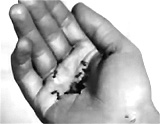 Ants on a Severed Hand 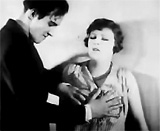 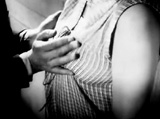 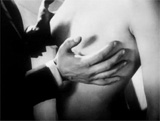 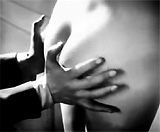 Hands Touching Breasts and Buttocks 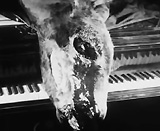 Rotting Donkey on Piano 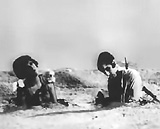 Dead Couple Half-Buried in Beach Sand |
||||||||||||||||
|
L'Age D'Or (1930, Fr.) (aka
The Age of Gold, or The Golden Age)
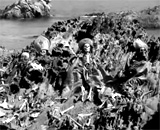
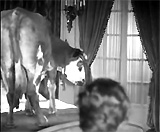
Buñuel's follow-up surrealistic feature film (his first) to the previous year's short Un Chien Andalou (1929) was a disjointed historically-significant film (co-scripted by Salvador Dali) that was denounced by the Roman Catholic Church (for a blasphemous castle orgy scene involving a Jesus Christ look-alike rapist in the film's ending). It was censored or banned by a few governments, impounded in some cases, sparked riots in theaters, and was considered controversial (pornographic and offensive). In the plot, two passionate yet frustrated lovers, a Man (Gaston Modot), a Goodwill Society delegate, and Young Girl (Lya Lys), a high-society heiress, were being kept from one another and repressed by the pious bourgeois establishment for fear of them having sex together. After an opening documentary sequence on scorpions and their habits, there were the indelible images of the lovers in mud attempting to have sex with each other during a cornerstone ceremony to celebrate the founding of Imperial Rome, the two lovers expressing their erotic impulses by sucking each other's hands, and the sight of the sexually-frustrated young woman performing fellatio on the toes of a religious marble statue in a garden. Other surrealistic images included: mitred, chanting arch-bishops perched on coastal rocks who turned skeletal, a milking cow in a young woman's bed, an ox-cart driven by a horse through an elegant drawing room by two drunken peasants, some acts of violence:
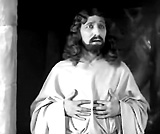
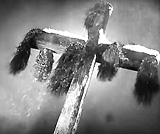
In the heretical ending, bearded and robed Duke of Blangis (Lionel Salem), a Jesus look-alike, raped a young woman in a castle during 120 days of debauchery, then emerged (without his beard) near a crucifix adorned with five female scalps blowing in the wind.
|
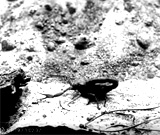 Scorpion Documentary 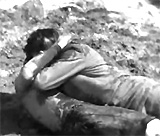 Lovers in Mud 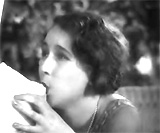 Sucking Statue's Toes |
||||||||||||||||
|
All
Quiet on the Western Front (1930)
The Best Picture winning film was the first major anti-war film of the sound era, faithfully based upon the timeless, best-selling 1929 novel by Erich Maria Remarque (who had experienced the war first-hand as a young German soldier). The film was made only a dozen years following the end of the Great War, and the memories of the war were still fresh. It was advertised with the brooding face of one of the young German recruits sent into World War I. The film included a series of vignettes and scenes that portrayed the senselessness and futility of war from the sympathetic point of view of the young German soldiers in the trenches in the Great War who found no glory on the battlefield, meeting only death and disillusionment.
It was a critical and financial success, and probably the greatest of pacifist, anti-war films - the grainy black and white film is still not dated and the film hasn't lost its initial impact. The episodic film is still one of the few early sound films that modern audiences watch. However, it was criticized as being propagandistic and anti-militaristic. For its perceived anti-German message, it was denounced by the Nazi government in Berlin of the 30s and subsequently banned. The film was told in a logical, chronological fashion, and divided into four distinct parts:
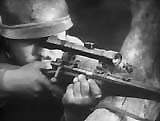
In realistic battle sequences of World War I, rows of infantrymen instantaneously were mowed down by machine gun fire as the camera moved sideways across them and showed the remains of one unfortunate soldier (his hands grabbed barbed wire). Soldier Paul (Lew Ayres) stabbed a Frenchman in a panic and became trapped in the bomb crater with the slowly dying man. He attempted to give him water to drink. Paul returned to his school to tell the students of his disillusionment with war. Paul's death was accompanied by the sound of the whine of a French sniper's bullet as his hand reached out to touch a beautiful butterfly from the shell-hole trench.
In the film's final image, ghostly soldiers marched away, while superimposed over a dark, battle-scarred hillside covered with a sea of white crosses. |
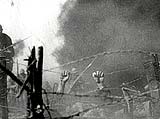 Hands Grabbing Barbed Wire 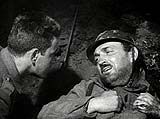 Slow Death of Frenchman in Trench After Stabbing 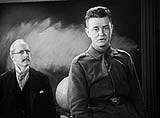 Paul's School Speech About His Disillusionment 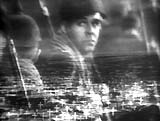 Film's Final Image |
||||||||||||||||
|
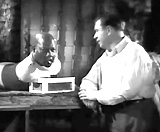
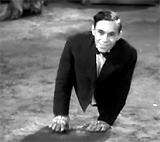
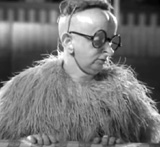
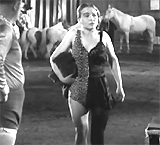
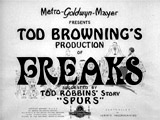
Freaks (1932)
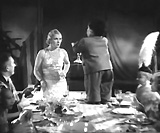
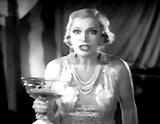
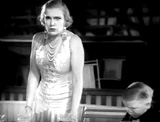
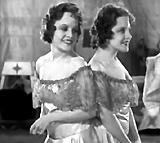
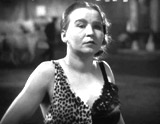
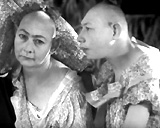
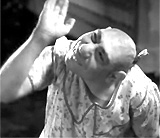
This MGM horror production suffered criticism and controversy from the very beginning. The film was released officially (five months after disastrous preview showings when people fled from the theatres) and found to be exploitative, abhorrent and "loathsome" with "unwholesome shockery," although it also portrayed the 'abnormal and the unwanted' as resilient and adaptable human beings with complete compassion and understanding. Overall, it made audiences uncomfortable and engendered fright, uneasiness and animosity. After initial preview screenings, MGM ordered director Browning to edit the almost-90 minute film. He removed the alarming film's most "offensive" segments (approximately 26 minutes), including the original closing scene of an emasculated Hercules singing falsetto (after castration) in "Tetrallini's Freaks and Music Hall." A "Special Message" was added to the film's beginning to remind viewers of "misshapen misfits" from past stories. And a final epilogue was tacked on with a 'happy ending' between Hans and Frieda to lessen the shock of the film's original ending -- the sight of Cleopatra ("the peacock of the air") turned into a legless human chicken with one eye blinded. However, the changes in the film did not improve the film's box-office business and it was a major financial failure. Tod Browning's career, which was booming after directing Dracula (1931), was destroyed. MGM pulled the film from distribution a month after its next release, and in 1947, exhibition rights were sold to exploitation filmmaker/distributor Dwain Esper for the next 25 years. It was toured for an adults-only roadshow with alternative titles (i.e., Forbidden Love, The Monster Show, and Nature's Mistakes), exploitative taglines, such as: "Do Siamese Twins Make Love?" and "Can a Full Grown Woman Truly Love a Midget?" The film was banned outright in England for 31 years (until the early 1960s). It was an out-of-the-ordinary picture not easily forgotten, causing both revulsion and fascination, since it starred real-life circus side-show performers - a cornucopia of 'human oddities', including:
In the opening sequence: a carnival barker (Murray Kinnell) enticed customers to enter his sideshow, and explained the freaks' code of honor: "We didn't lie to ya, folks. We told you we had living, breathing monstrosities. You laughed at them, shuddered at them and yet, but for the accident of birth, you might be even as they are. They did not ask to be brought into the world, but into the world they came. Their code is a law unto themselves. Offend one - and you offend them all."
The barker introduced the customers to an off-screen creature penned up in an enclosure, causing one of the women to scream at the sight of the hideous human monstrosity: And now, folks, if you'll just step this way. You are about to witness the most amazing, the most astounding living monstrosity of all time. (woman's scream) Friends - she was once a beautiful woman. A royal prince shot himself for love of her. She was known as the Peacock of the Air..." --- the sight of the creature was postponed until the film's conclusion. The main characters were two midgets Hans (Harry Earles) and devoted Frieda (Daisy Earles). High-wire trapeze artist Cleopatra (Olga Baclanova) married gullible midget circus announcer Hans who was due to claim an inheritance. Cleopatra's dastardly intention, plotted with her strong-man lover Hercules (Henry Victor), was simply to poison Hans to death for his money.
During the film's centerpiece, the "Wedding Feast" sequence, Cleopatra delivered a memorable speech to the 'freaks' - when she incurred the wrath of the tightly knit, loyal group of "nature's aberrations." after being offered the loving cup, she rose stiffly from her chair, became extremely revolted by them, and exclaimed: "You dirty, slimy FREAKS! Freaks, freaks! Get out of here!"
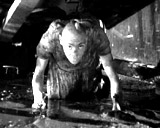
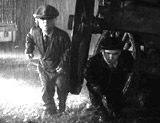
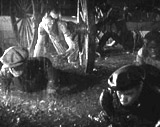
In the final stormy night sequence, a terrorizing and shocking climax, the freaks made good on their threats as they crawled through the mud (some with knives in their mouths) to murder or emasculate muscleman Hercules (the film's dialogue and action were unclear on this point due to studio editing), and then pursue gold-digging Cleopatra to exact a horrible revenge on account of her treatment of Hans. They were both pursued in parallel by the grotesque 'freaks' with knives during a stormy night, crawling through mud in vengeful pursuit of their victims. In the conclusion came the sight of the sexy and tall, transformed Cleopatra as a legless, feathered mutant chicken with a scarred and bruised face, drooping and squawking mouth. The barker introduced her:
|
|
||||||||||||||||
|
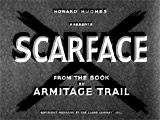
Scarface (1932) (aka Scarface: The Shame of the Nation)
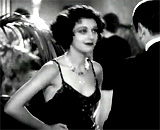
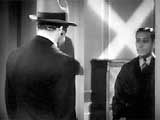
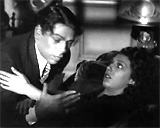
Before this film, pre-Code gangster films Little Caesar (1931) and The Public Enemy (1931) disturbed audiences. Then, one of the boldest, most potent, raw and violently-brutal gangster-crime films ever made was released by United Artists. This sensational production chronicled the predictable but tragic rise and fall of a notorious gangster figure. The controversial film was in the planning stages in 1930 - to be produced by versatile co-producer/director Howard Hawks and co-producer Howard Hughes. The screenplay for the violent, action-packed, visually expressionistic film was written in eleven days by Chicago native Ben Hecht using his Chicago newspaper experiences. A working script was readied by January 1931, and after about three months of filming, it was completed later in the year. Although the film was scheduled for release in January 1932, its opening was delayed for a few more months due to Hawks' and Hughes' continuing squabbles with industry censors over its sensationalism and glorification of the gangster menace, and issues regarding the film's retitling. The film was heralded as an example of the kind of protection the Hollywood Production Code of Ethics could provide to the movie-going public when implemented in 1934. One of its subtexts, incestuous attachment, was portrayed by muted hints of an unnatural bond between the two main characters:
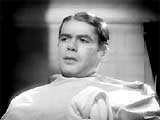
This film's sub-themes supposedly went uncontested - possibly, because some the most obvious references to incest were removed by Hawks himself. Throughout the film, Scarface expressed extreme jealousy over Cesca's dating of other fellas. In one sequence, he engaged in a raging argument with Cesca: "Yeah, runnin' around with the fellas, huh? Lettin' 'em hold ya like that. Lettin' 'em look at you. Dressin' up like that for the fellas to see, huh?" (He ripped her spaghetti shoulder strap, baring her bra and slip); Cesca screamed back: "What I do with fellas is MY business!" (He slapped her repeatedly). The misguided Tony was led to cold-bloodedly murder his right hand man Guino (George Raft) at his apartment building's doorway, and then Cesca revealed their recent secret marriage - she cursed her brother for being a "murderer" and a "butcher" in the fratricidal killing: "Tony, it's my Guino. I love him. We were married yesterday, Tony...We were going to surprise you - weren't we, Guino? Oh, God. He's dead. He's dead. He loved me, really loved me. (She pushed Tony away.) Don't touch me. Don't come near me. (He staggered toward her.) Stay away from me. You're not my brother. Don't you think I know? Murderer! He kills people. He kills everybody. He kills everything. He's a butcher. That's what you are. You're a butcher. You're a butcher." Although the character was inspired by the exploits of Chicago's Depression-Era underworld vice lord/gangster Alfonso Capone (nicknamed "Scarface"), he bore little resemblance to the finished film.
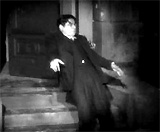
To give the violent, tragi-comedy film respectability, to de-glamorize the folk-hero nature of the gangster, and to appease the forces of censorship, a number of restrictions or changes were imposed before the film could be released with the MPAA seal of approval. For example, an added sub-title was required [its original title was simply Scarface, and the first suggested retitle was The Menace] to illustrate that the film was not a glorification, but an indictment of gangsterism, and an apologetic, moral statement was tacked to the beginning of the film. One of the major changes was in the ending - an alternative, moralistic, sermonizing (and emasculated) second ending (substituted for a shootout) was created to condemn the gangster as cowardly and show his sentencing and retributory punishment (hanging) by an effective justice system. During the film's final shootout scene, Cesca was the first to be mortally-wounded when hit by a stray bullet in the mid-section: (Tony reacted: "I'll be here all alone. You can't leave me here all alone...Cesca! You're all I've got left...I'm no good without you, Cesca. I'm no good by myself. Cesca!"). Tony stumbled and staggered down the stairs to the front door where he made a cowardly plea for his life ("Gimme a break, will ya? Don't shoot. You got me covered. I can't do nothin'"), but many police guns opened fire and riddled his body with hundreds of bullets when he made a break for it, and he died in the street's filthy gutter. In the film's final ironic image, the camera moved up and away from Tony's sprawled body toward the flashing electric sign that promised Tony the world: "THE WORLD IS YOURS." Due to squabbles over the film's release and the hue and cry over its depiction of the world of gangsterism, the film ultimately didn't do well at the box office. It was banned in several states, versions varied from state to state (due to varying boards of censors) and showings were delayed over a year in Chicago. Foreign sales were also limited, and Nazi Germany permanently prohibited the film's showing. After Hughes withdrew it from circulation, it was rarely seen in the United States for almost fifty years, and wasn't widely available until it was reissued by Universal Studios in 1979.
|
|
||||||||||||||||
|
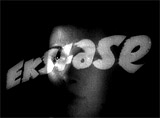
Ecstasy (1933, Czech.) (aka Exstase)
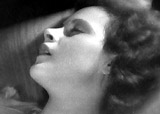
This early, scandalous Czechoslovakian foreign erotic/romantic drama by Czech filmmaker Gustav Machaty was once notorious, earth-shattering, and scandalous. The foreign import was confiscated by the Treasury Department (US Customs) when it was brought into the US in 1935 - the first film to be blocked for obscenity or censorship purposes. The U.S. Treasury Department upheld a Commissioner of Customs decision to prohibit the import, although it was later imported in a censored version (without a Hays Code seal) at some independent theatres. Hitler banned the film, and Pope Pius XII denounced it. Either it was completely banned, partially censored (with various cuts), or played with restrictions. Even until only recently, versions were revised with the nudity removed. It was the first theatrically-released film (non-pornographic) in which the sex act was depicted (although off-screen). It was unusual at its time for depicting obvious female sexual pleasure (ecstasy) during orgasm (simulated) from the effects of oral sex. It told the story of a sexually-frustrated child-bride named Eva Hermann (Vienna-born 19 year-old Hedwig Kiesler, or later known as Hollywood glamour queen Hedy Lamarr in her fifth film) who was newly-married to middle-aged, uncaring and impotent Emile (Zvonimir Rogoz). They did not consummate their love with sexual relations. She fled in dismay to her widowed father's estate where she was closer to nature. It was censored for its two shocking scenes - in a naturalistic locale reminiscent of the Garden of Eden:
|
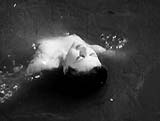 Skinny-Dipping 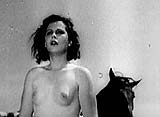 With Her Horse 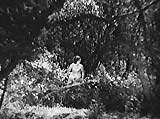  In the Forest |
||||||||||||||||
|
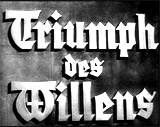
Triumph of the Will (1935,
Germ.) (aka Triumph Des Willens)
Nazi Fuhrer leader Adolf Hitler commissioned dancer/actress-turned filmmaker Leni Riefenstahl to make this notorious documentary to record and celebrate the sixth Nazi Reich Party Congress held in September 1934 in Nuremberg. This spectacular propagandistic film glorified and praised the might of the unjust and evil Nazi regime and state with masterful images, rapid cuts, a Wagnerian score, and ingenious camera angles and compositions. The influential yet infamous propagandistic documentary film glorified Hitler and his regime over a four day period in Nuremberg, Germany in 1934. Director Riefenstahl was imprisoned by the Allies for four years after the war, although she continued to protest by insisting that her work was purely historical and an example of cinema verite, rather than the repellent work which it was criticized and accused of being. Protests greeted Riefenstahl at a 1974 Telluride Film Festival tribute, and the Anti-Defamation League decried a 1975 screening in Atlanta as ''morally insensitive.'' Riefenstahl herself never shook her Nazi-tainted past, and repeatedly claimed the film was more imagery than ideological. This infamous, extravagant two-hour film is still considered the most powerful propaganda film ever made, with:
|
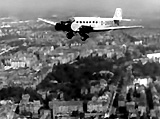 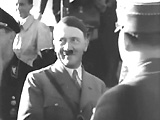 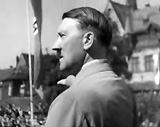 Hitler's Arrival by Plane and Heroic Entrance 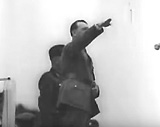 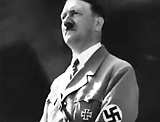 The Exalted Leader Hitler 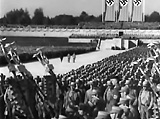 Marching Through StormTroopers 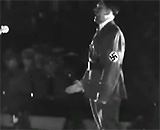 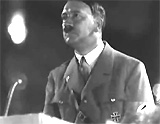 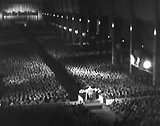 Hitler's Night-time Address to the Masses 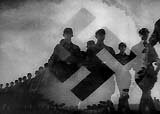 Swastika Banner Fluttering 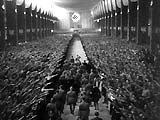 Column of Marching Soldiers |
||||||||||||||||
|
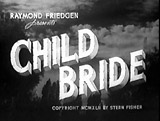
Child Bride (1938) (aka
Child Bride of the Ozarks, Child Brides, or Dust
to Dust)
The film's exploitational taglines: "A throbbing drama of shackled youth!" and "Where Lust was called Just!" hinted at its 'educational' plot contents designed to circumvent the Production Code restrictions with a story that warned against underage marriage. This independent film was 'road-showed' by legendary roadshowman Kroger Babb, although it was banned in many locations due to its infamous underage nudity. The film supposedly had a positive purpose: "...if our story will help to abolish Child Marriage - it will have served its purpose." It told about the door-to-door moral crusade of schoolteacher Miss Carol (Diana Durrell) to rid the Ozark rural community of Thunderhead Mountain of hillbillies (especially Warner Richmond as Jake Bolby) courting and marrying underage girls. The film's most notorious and gratuitous sequence was at the 30 minute mark -- a 4 minute undressing and nude skinny-dip in a pond surrounded with woods by nubile young 12 year-old actress Shirley Mills (not Miles) in her screen debut (as Jennie Colton), accompanied by young friend Freddie Nulty (Bob Bollinger). As she disrobed, she told him not to undress but to stay onshore and be a lookout, and they discussed how their physical differences were beginning to show:
At the end of her long and playful swim, she was leered at by Jake from a nearby ridge, and an old women startled the voyeuristic Jake by asking: "Pretty, ain't she?" When Freddie noticed, he alerted Jennie and she swam for cover. |
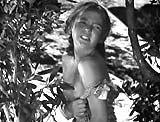 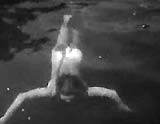 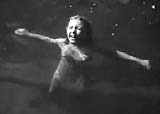 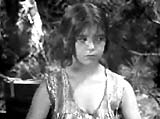 Jennie (Shirley Mills) |
||||||||||||||||
 The
100+ Most Controversial Films of All-Time The
100+ Most Controversial Films of All-Time(chronologically, by film title) Intro | Silents-1930s | 1940s-1950s | 1960-1961 | 1962-1967 | 1968-1969 1970-1971 | 1972 | 1973-1974 | 1975 | 1976-1977 | 1978 | 1979 1980-1982 | 1983-1986 | 1987-1989 | 1990-1992 | 1993-1995 | 1996-1999 2000-2002 | 2003-2005 | 2006-2009 | 2010-present |




 When
Broadway sensations May Irwin and John Rice's notorious lip lock was
immortalized on film, people were shocked!
When
Broadway sensations May Irwin and John Rice's notorious lip lock was
immortalized on film, people were shocked!