|
Films of All-Time 1990-1992 |

|
Henry & June (1990)
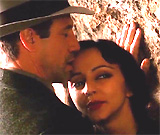
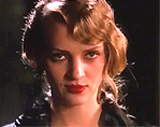
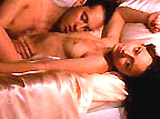
Director Philip Kaufman's frank and bold treatment of sex was based on the unedited diaries of poetry and memories by author Anais Nin - published post-humously in 1986. It was the first major studio feature film to be released with the new and revised NC-17 rating by the MPAA (due to an explicit yet simulated scene of lesbian oral sex) - a rating designed to distinguish erotic-and-serious adult films from pure hard-core X-rated pornography. The biopic had the second highest box-office (domestic) gross of all-time at $11.7 million, about half of the #1 NC-17 film of all time, Showgirls (1995) at $20.4 million. For awhile, it was banned in South Africa. The sexually-provocative biodrama with themes of voyeurism, partner-swapping, three-way sex, and both hetero- and homo-sexuality told about a love triangle between three individuals in early 1930s Bohemian Paris:
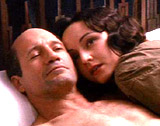
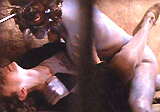
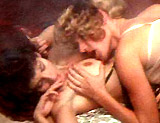
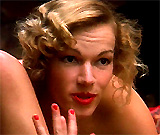
The controversial film included these visually-striking scenes:
In another scene, Anais described an hallucinatory "nightmare" dream-fantasy of sex with June (and Henry's blonde whore) in an upper loft, experiencing 'abnormal pleasures' ("I begged her to undress. I asked her to let me see between her legs. As she lay over me, I felt a penis touching me..."). Anais also had a climactic love-making scene with Henry after he had finished his novel 'Tropic of Cancer' - while Hugo was downstairs. [Note: "Tropic of Cancer" was published in 1934, and banned in all English-speaking countries for 27 years.] In the concluding scene, Anais and June got together for love-making (while Henry was asleep in another room of the house) after which an accusatory June confronted Anais about her sexual awakening, and her manipulative and self-serving affair with Henry, her husband:
Anais broke off her relationship with both Henry & June and returned to her husband Hugo, although she had been changed forever. As she drove away with Hugo, she lamented (in voice-over) her lost loves, although Henry and Anais remained "life-long friends and supporters":
|
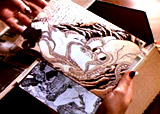 Erotic Japanese Woodblock Print  Henry and Anais' Love Affair: Oral Sex  Author Henry Miller & Bi-Sexual Wife June  In a Brothel, Henry's Blonde Whore (Brigitte Lahaie)  Anais' & June's Dance-kiss    Anais' Dream-Fantasy with Henry's Whore   Anais With Henry 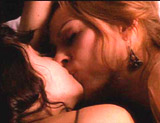 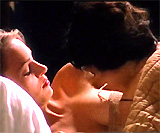 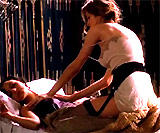 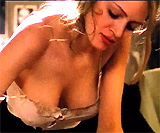    Concluding Scene - Love-Making: Anais with June |
|||||||||||||||||||||||||||||||||||||||||||||||||||

|
JFK (1991)
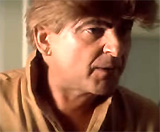
Director/co-writer Oliver Stone's complex, provocative docu-film thriller was a controversial, speculatively revisionistic, historical epic surrounding one-time New Orleans, LA DA Jim Garrison's (Kevin Costner) investigation of the John F. Kennedy assassination on November 22, 1963 in Dallas' Dealey Plaza. The doggedly-skeptical and obsessed Louisiana DA became the centerpiece of an intriguing interpretation, based on the well-publicized and alleged conspiracy theories about the mystery of the death, and on the testimony of a number of unreliable witnesses. The film masterfully assembled and merged, like a jigsaw puzzle, various sources of material (newsreels, photos, black and white, color, 8 mm, 16 mm, etc., miniature models, and re-enactments) into one film to create a semblance of truth, but not necessarily real history. However, Stone was attacked and dismissed by the American media, CBS, The New York Times, Time, Newsweek and The Washington Post, for deliberately combining factual and historical footage with hypothetical footage to make it appear to be one seamless, objective and truthful record of events. In response, Stone released the screenplay, annotated with its factual sources. The film's key quote was about the possibility of an overwhelming and mysterious conspiracy, spoken to New Orleans District Attorney Jim Garrison (Kevin Costner) - voiced by crazed and edgy David Ferrie (Joe Pesci), one of the possible conspirators:
During Garrison's detailed investigation - there was a re-enactment of the rifle shooting with Lou Ivon (Jay O. Sanders) inside the Texas School Book Depository in Dealey Plaza - to see if they could verify the Zapruder film: ("The Zapruder film establishes three shots in 5.6 seconds"). Ivon came to the conclusion that Oswald, acting alone, couldn't have possibly shot President Kennedy three times:
One of the key scenes was the secret rendezvous of Jim Garrison with "Mr. X" (Donald Sutherland) who delivered a spellbinding, 15-minute long monologue to encourage Garrison to continue to pursue his investigation of the JFK assassination:
The final third of the film was a major courtroom trial sequence with three very memorable segments to disprove the idea that assassin Lee Harvey Oswald (Gary Oldman) acted alone: Garrison first scornfully debunked the single or "Magic Bullet Theory" (the 'official' Warren Commission version of events):
He gave a detailed examination of the famous Zapruder film (shot near the grassy knoll) that was subpoened by Garrison's office, but unseen by the American public ("a picture speaks a thousand words, doesn't it?"). He also provided a walk-through - using diagrams of the highly-unlikely or impossible zig-zag path of the bullet, and the use of a scale model of the Plaza area to bolster his arguments. He discussed the improbability of the Warren Commission's official report and their open and shut case of "three bullets, one assassin" - to disprove the report's conclusion that assassin Oswald had acted alone: ("The time frame of 5.6 seconds established by the Zapruder film left no possibility of a fourth shot"). Garrison called junior counselor Arlen Spector to give a theoretical description of the 'Magic Bullet Theory' as "one of the grossest lies ever forced on the American people." Garrison delivered an impassioned, patriotic closing argument - his final summing up of the case was a damnation of the entire US military-industrial complex and the possibility of a massive conspiracy and coverup (allegedly aided by Clay Shaw (Tommy Lee Jones)).
He finished by staring directly into the camera and addressing the jury (and viewing) audience: "It's up to you." |
   Possible Conspirator David Ferrie (Joe Pesci) 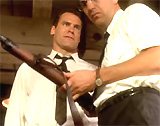 Re-Enactment of the Shooting from the Texas School Book Depository Building 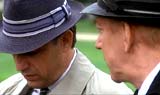 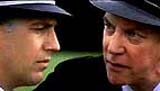 Rendezvous Between Garrison and "Mr. X" 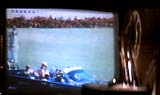 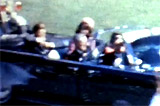 The Zapruder Film 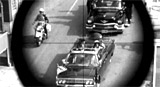 Other B/W Footage 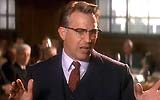 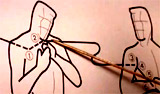 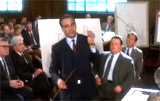 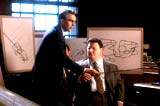 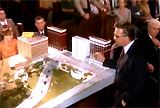 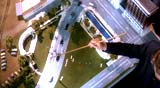 Garrison's Debunking of the Single or "Magic Bullet Theory" 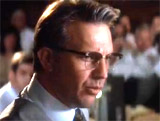 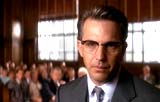 Closing Summary: An Indictment of the Military-Industrial Complex and Clay Shaw |
|||||||||||||||||||||||||||||||||||||||||||||||||||
|
Aladdin (1992)
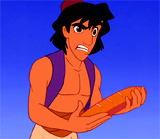
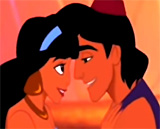
The musical was a box-office success, and on a $28 million budget, it earned $504 million (worldwide) and $217.4 million (domestic) in box office sales. However, it engendered considerable racial controversy for its pro-Western, alternate-universe, vilifying portrayal of the two leads seeking secular romance - both light-skinned individuals with Anglican features and English accents:
The other 'Arab' turbaned characters were mostly unattractive, bald and large-nosed and portrayed as grotesque, uncouth or villainous caricatures (with swarthy features, harsh accents and simitars), especially among the palace guards, many thieves and market-vendors. One of the brutal guards yelled at Aladdin for stealing a loaf of bread: "I will have your hands for a trophy, you street rat." Another of the main characters, the vile Royal Vizier Jafar, was always ready to be barbaric - to "slice a few throats." Also, Arabic script was portrayed as just non-sensical, scribbled characters, and 'Allah' was one of many mispronounced Arab words. Even the Genie came under criticism for being a representation of an enslaved 'Negro' - eternally serving others and longing for freedom. There were other criticisms of the negative way the main fictionalized, mythical desert city of Agrabah was represented - as 'Hollywood’s fabricated Arab-land.' It looked more like India (The Taj Mahal was one prototype for the Sultan's palace) than a Middle-Eastern city, and many of the street vendors/performers were Indian stereotypes (bed of nails, walk of fire, rope trick, fire eater, etc.). Many worried that the film's stereotypes would carry over to real-life, with views of all Arabs as bomb-wielding Islamic terrorists. And there was not a single Arab or South Asian voice actor in the cast. Another conflict arose, following protests from the American-Arab Anti-Discrimination Committee (ADC), regarding the offensive lyrics in one of the verses of the opening song "Arabian Nights." The original lyric about the film's Arabian setting was delivered by a street-peddlar, a storyteller atop a camel crossing the arid desert. He represented the entire Arab race as "barbaric":
It was censored/dubbed out and changed for subsequent video releases in 1993 and for the re-released soundtrack:
|
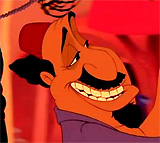 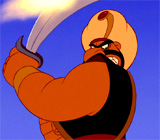 Arab Stereotypes 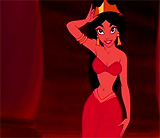 Jasmine as the Vizier Jafar's Near-Naked Sex Slave 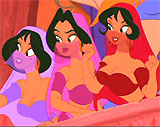 Harem Girls 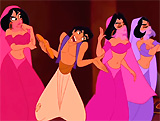 Aladdin with Harem Girls 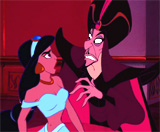 Royal Vizier Jafar Threatening Jasmine  Sultan's Palace Modeled After Taj Mahal in India 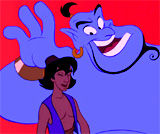 Genie - An Enslaved 'Negro' Figure  Basically Gibberish Arabic Script |
|||||||||||||||||||||||||||||||||||||||||||||||||||

|
Basic Instinct
(1992)
Screenwriter Joe Eszterhas created this exploitative, soft-porn, excessive, controversial film known for its negative portrayal of lesbianism, offensive violence, initial X-rating, and voyeuristic, sensational, gratuitous sex. The film was criticized for its permissiveness, steamy content (scene of cunnilingus), unnecessary and exploitative nudity, its depiction of lesbian characters, and its scenes of bondage (especially with reversed roles). Threatened with an NC-17 rating, and reduced to R rating (with cuts), this flashy film was then released with a more explicit 'Director's Cut' version for the video market, with the extra-steamy scenes. It gained its greatest notoriety for the film's well-known interrogation scene. Frank and raw dialogue, such as this much-quoted line reprised at the end of the film ("How about we f--k like minks, raise rug rats, and live happily ever after"), was woven throughout.
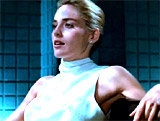
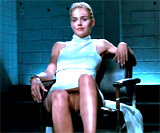
Womens' groups called the film misogynistic, and gay-rights groups in San Francisco (including The Gay & Lesbian Alliance Against Defamation (GLAAD)) called it stereotypically-homophobic and gay-bashing. They charged that the main murderess suspect in the film was a denegrating portrayal since she was a mentally-unstable, psychotic lesbian and bi-sexual that was potentially homicidal. Activists groups such as Queer Nation and ACT-UP protested at multiple San Francisco shooting locations, chanting "Hollywood, you stink" and they attempted to disrupt filming. The opening scene of a naked couple engaged in rough sex in a mirrored boudoir included views from all angles (and a reflection in a ceiling mirror) of a couple making love - the unidentified female was atop rock star Johnny Boz (Bill Cable), and elements of S&M were revealed when she tied his arms behind him to opposite sides of the bedpost with a long strip of the sheet - before writhing on top of him. Then she grabbed an icepick to her right, reared up, and stabbed him to death as he climaxed. The sexually-charged film featured the taunting femme fatale predator as the prime murder suspect - bisexual authoress Catherine Trammel (a star-making and career-launching role for Sharon Stone) - with an insatiable sexual appetite and possibly homicidal tendencies. She was known for using an ice pick in her writings, and was investigated by troubled, burned-out SF police detective Nick Curran (Michael Douglas), after a series of murders of males during intercourse and S&M sex. She matter-of-factly flirted and manipulatively toyed with the libidos and sexual appetites of the middle-aged men in a police station room. The suspect brazenly talked about sex, smoked (in a no-smoking area), and uncrossed and re-crossed her legs while wearing a short white mini-dress (without panties). She tersely revealed her past sexual activities with the victim and played sex games with their minds. After admitting to cocaine use with the dead Mr. Boz, she surprised the audience by directing a provocative, follow-up question toward Nick: "Have you ever f--ked on cocaine, Nick?" She smiled and revealingly uncrossed her legs (removing her left leg from atop her right leg), flashing her panty-less private parts at him. And then she re-crossed her legs in the opposite direction, crossing her right leg atop her left.
When Detective Curran visited Catherine Trammel at her home, he reinforced the notion of his voyeuristic tendencies when he watched Catherine undress from a distance. She flaunted her bisexuality when she introduced her lesbian girlfriend to Nick. She kissed her consort Roxanne "Roxy" (Leilani Sarelle), fondled her nipple, and then stood with her arm around her, asking: "You two have met, haven't you?" Then came a provocative three-some dance at a crowded nightclub disco (between the lesbian lovers Catherine and Roxy) - and an aroused Nick voyeuristically watching them as they touched and French-kissed and then also watched them from outside a nightclub toilet stall as they snorted cocaine. Later on the dance floor, Catherine (with a beguiling look) turned with her back toward Roxy, permitting her female lover to touch her breasts. In an instant, Catherine left Roxy, presumably to provoke and enflame the jealousy of her female lover. Catherine's live-in lover must resort to dancing with a black man. Catherine became Nick's dance partner - he rubbed her butt against his crotch. He turned her, suddenly grabbed her ass, pressed her toward himself, and then started kissing her on her neck and lips. Feverishly, they consumed each other in the middle of the writhing, turning bodies of other dancers. The scene immediately transitioned to the infamous, intimate, graphic, roughhouse sex scene between Nick and Catherine in her mansion in San Francisco. Afterwards, he was astonished to learn that Roxy had been encouraged to watch Catherine's heterosexual couplings with men. Another heavily-criticized controversial scene was one of forceful, animalistic near-rape sex between detective Curran and 'girfriend'/police psychiatrist Dr. Beth Garner (Jeanne Tripplehorn). Back at Beth's apartment in her living room, Nick took out his sexual aggression against her. He immediately forced himself on her, pinning her arms up on the wall, kissing her forcefully, grabbing her leg, caressing her rear, grabbing her breasts through her clothing, and ripping her dress open in the front. In the misogynistic, near-rape scene, he turned her toward the opposite wall as he lustfully pushed his hands under her bra, scooped out her breasts, and kissed her even harder. Then he dragged her over to the sofa and aggressively draped her over its top as she protested: "Nick, stop, no!" He pulled off his own pants and animalistically entered her from behind, climaxing quickly. Afterwards, as she lay next to him and they spooned together, she set the record straight: "You weren't making love to me." Then she sat up and dressed.
There were various sexual encounters between the Catherine and the detective, including two that exactly paralleled the film's opening sex sequence (one of murder). Although it appeared that the case was solved and Dr. Garner was implicated (although she might have been framed?), the final scene extended the ambiguity of Catherine's murderous instincts. In the film's final scene - Catherine was making love to SF police detective/lover Nick Curran in his bedroom, and in the midst of their amorous coupling as she straddled him, she stretched backwards and began rocking back and forth on his hips. As she and he climaxed, she reached back behind herself, and then suddenly came down on top of him - her whole body stretched across his - he remained motionless.
Fortunately for him, there was continued movement as they intimately kissed each other. Then, after a cut, they were seen lying next to each other in bed, both staring up. He was smoking a cigarette. She curled away from him toward the outer side of the bed:
Her right arm reached over the side of the bed (was she picking up an icepick?), as she retorted: "I hate rugrats." He revised his epitaph:
She half-turned and twisted around, watching him turn his body away to put out his cigarette. The music built - was she holding something in her hand? They looked at each other for a long moment. She reached out with her hand, pulling his neck and face toward her own body for another kiss. The screen darkened for a moment, and then returned. As they kissed more passionately as she pulled him down to her body, the camera slowly descended down below her side of the bed. When it lowered to the floor, the camera came to rest on a close-up of the murder weapon - a thin, steel-handled icepick. The finale of the ambiguous film arbitrarily left the inexplicable question of the guilt and/or innocence of the main character still up in the air --? |
     The Opening Scene: An Ice-Pick Murder of a Rock Star During S&M Sex With Unidentified Blonde Female - Was it Catherine Tramell?   Bi-Sexuals Catherine and Roxy (Leilani Sarelle) 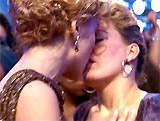 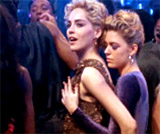 Threesome Dance Sequence 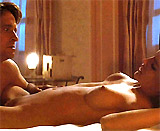 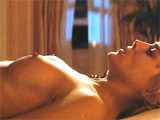 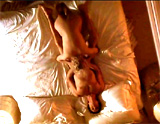 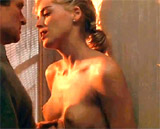 Nick's Various Sex Scenes with Catherine Tramell (Sharon Stone) 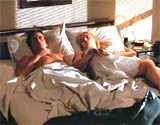 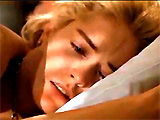 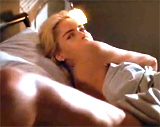 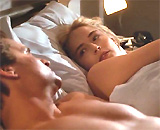 After Sex, Was She Going to Stab Him Now? 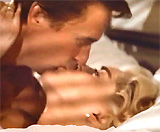 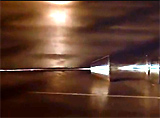 The Ending: The Ice Pick Was Still on the Floor on Her Side of the Bed |
|||||||||||||||||||||||||||||||||||||||||||||||||||
  |
Dead Alive (1992, NZ) (aka
Braindead)
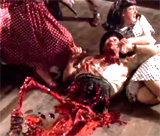
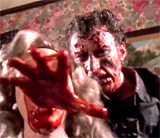
This over-the-top, disgusting, bloody and gory R-rated Peter Jackson horror-comedy zombie film, his third feature film following Bad Taste (1987, NZ) and Meet the Feebles (1989, NZ), was indisputably the goriest, grossest, and bloodiest (and funniest) film ever made. Its low-budget production (at $3 million) grossed only $242,623 - a major box-office disaster. Full of bad taste and cartoonish splatterings, some of the slapstick cult horror film's gory parts were often banned, edited, or censored. Its morbid gore and blood was reminiscent of Re-Animator (1985) and Evil Dead 2: Dead by Dawn (1987). The deranged film's tagline was:
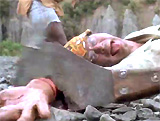
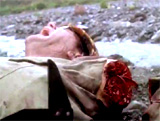
The film set up its premise in a pre-titles prologue - on Sumatra's Skull Island in 1957, zoo animal explorer Stewart McAlden (Bill Ralston) and his assistant were attacked by spear-throwing, face-painted natives, for trying to remove a rare Sumatran Rat-Monkey in a cage from the island. The dangerous creation was a rabid, hybrid organism (part monkey and part rat) that resulted from the rape of tree monkeys on Sumatra's Skull Island by ravenous, plague-carrying rats. During a rapid flight from the natives, Stewart became the first human to be infected by multiple rat-monkey bites, with bite marks on his right hand, left arm, and also scratch marks on his forehead. His fearful guides amputated his two appendages before it was eventually decided to slice off his head with a machete, to prevent the spread. Animated blood splattered as his head was chopped off, leading into the title credits. Stewart's captured rat-monkey was flown in a crate to a zoo in the New Zealand town of Wellington.
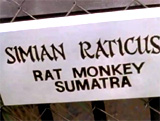
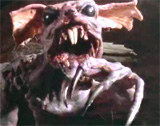
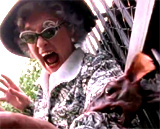
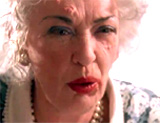
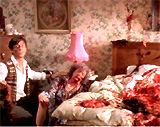
Shy bachelor, and clumsy, dweebish mama's boy Lionel Cosgrove (Timothy Balme) lived with his oppressive Mum Vera Elizabeth Cosgrove (Elizabeth Moody) in Wellington, NZ, in a multi-story Victorian mansion set on a hillside. The domineering and overbearing Vera developed an instant dislike for Lionel's growing romance with his first girlfriend - a sweet young grocery store clerk named Paquita María Sánchez (Diana Peñalver), a local Spanish shopkeeper's (Silvio Famularo) daughter. During their first date at the zoo, Lionel experienced a haunting, long-held memoriy of his father's death when he was attempting to rescue young Lionel from drowning at the beach. They watched in horror when inside the monkey cage, the nasty, vicious and super-rare, infected rat-monkey (SIMIAN RATICUS) dismembered another monkey's appendage and cannibalized it. The attending zoo keeper described the rat-monkey's origins: "Story goes, these great big rats come scuttling off the slave ships and raped all the little tree monkeys. You know, the natives use 'em in black magic rituals. Don't ask me how, probably suck the blood of virgins, eh, eh?" When Vera jealously followed them to the zoo to spy on the couple from afar, she slipped and fell up against the monkey cage, and was attacked and bitten in the left-arm by the rat-monkey: "Look at this! It bit me. I've been savaged! And my dress!" She angrily squashed its head with one of her high-heeled stiletto shoes to kill it. Lionel's date with Paquita was ruined, and she was disappointed that Lionel chose to devote himself to his Mum rather than her, although they made up that evening and Paquita strongly believed that he was her chosen one: "There will be one romance, and it shall last forever" - they slept together, although there were omens of death, dark forces, fear, danger and destruction foreseen by Paquita's grandmother (Davina Whitehouse) for the future. [Later, the grandmother presented Lionel with a necklace/pendant in the shape of a pointed cross to wear, to protect him with "the power of the White Knight."]
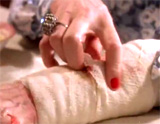
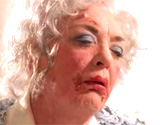
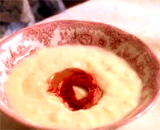
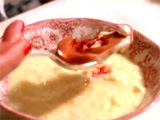
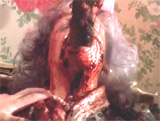
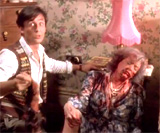
That same evening and into the next day, Vera began to show signs of physical deterioration, slurred speech, pus leakage on her arm and pulsating infection, face-skin peeling, zombification, a ravenous appetite for live flesh, and increased decrepitness. In the outrageous custard-eating lunch scene with Vera's friends, the Mathesons, over for lunch to represent the Wellington Ladies Welfare League, Vera accidentally squirted pus from her arm bandage into Mr. Matheson's (Lewis Rowe) bowl of porridge-pudding dessert, as he was noting aptly while taking a spoonful with his eyes closed: "Damn fine custard, rich and creamy, just the way I like it!" When her rotting right ear (with a pearl earring) fell off into her own custard pudding dish, Vera disgustingly ate it with the mush. The nauseated Mrs. Nora Matheson (Glenis Levestam) excused herself from the table to run off and barf before the couple fled.
Shortly later, Vera's desire for meat compelled her to eat Paquita's dog in her bedroom. Paquita exclaimed to Lionel: "Your mother ate my dog!" He responded with understatement: "Not all of it."
Vera seemed to succumb to her condition, after which she reanimated as a murderous zombie (Elizabeth Brimilcombe) and killed her attending nurse Mrs. Emma McTavish (Brenda Kendall) by attacking her face from behind, thereby infecting her as well. To prevent Vera and the Nurse from any more harm and from infecting others, Lionel pushed the two zombies into the basement and locked the door. He kept their confinement and condition a secret from Paquita. He then injected them with a sedative (animal tranquilizer) obtained from a veterinary office. Shortly later, Vera escaped from her imprisonment by busting through the door, but was hit by a passing tram in front of Paquita's store. Her body was propelled through the door and landed at Lionel's feet. He again tranquilized her with a shot of sedative to her nostril to subdue her. Lionel arranged for his mother's memorial service (led by Father Jon McGruder (Stuart Devenie)), funeral and burial in a church graveyard. Lionel's greedy and eagerly opportunistic uncle Les Kalkon (Ian Watkin) suspected that his sister Vera was deceased and arrived to attend the service - and to dispute the "inheritance" of the Cosgrove estate after her death. The despicable Les also attempted to come onto Paquita. During the service as the Father intoned: "Lionel, despite being deprived of his father at an early age, was blessed with an abundance of mother love," Lionel was with his mother's coffin in a back room. He approached her still-alive body in her coffin to tranquilize her and to prevent her from assaulting the mourners, when she burst out of the coffin and tried to strangle him. He crashed through the wall into the church service, disrupting the proceedings. The Father shockingly observed Lionel hugging his mother's corpse: "Well I've seen some displays of grief in my day, but nothing quite like that." After the service, in the middle of the night in the cemetery, Lionel was digging up his mother's grave when he was attacked and robbed by a foursome of punk delinquents, one of whom - Thomas Jacob "Void" Randell (Jed Brophy) - was urinating on Vera's gravesite (Lionel: "That's my mother you're pissing on"). Vera soon caused a zombie outbreak when she burst out of her grave, grabbed Void by the groin and disintegrated him and one his buddies, tranforming them into zombies. The alerted Father McGruder, actually a Kung-Fu Priest, attacked the two newly-enlivened zombies ("This calls for divine intervention...I kick arse for the Lord") and kicked the head off of one of them, but it landed on his shoulder and he was bitten and also became 'undead.' Lionel was forced to continue to keep the sedated zombies: Vera, Void, the Father, and the Nurse in his home's locked and concealed basement, feeding them mush laced with tranquilizers. During an unexpected visit, Les overheard the Father and Mrs. McTavish having loud sexual intercourse in the dining room behind closed doors and suspected something kinky was happening: "Ahhh, so you found your dad's old stag movies, hey?... Is that the one with the donkey and the chambermaid?" But then he left without any further questions. As a result of their love-making, the Father and Mrs. McTavish produced a troublesome Baby Zombie Selwyn Matheson (Daniel Sabic) that was birthed almost immediately.
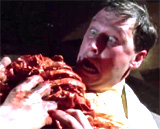
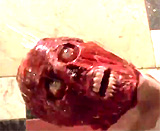
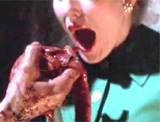
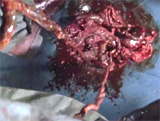
Lionel struggled in the park to take care of the aggressive, problematic baby. Shortly later, Les returned and discovered the zombies ("collection of stiffs") in the basement. He quickly blackmailed his nephew Lionel to relinquish his demands for the house and his inheritance, and then moved into Vera's luxurious mansion. Although Lionel objected, Les held an impromptu house-warming party to celebrate his acquisition of the Cosgrove property. Paquita entered the raucous house to find Lionel, and was sexually-assaulted by Les - she kicked him in the groin. Lionel came to her rescue when she was attacked in the basement, and they finally reconciled and got back together. She encouraged him to destroy the zombies. After all of them were injected, they were buried in the basement's soil. As the two emerged from the basement, Les grabbed his nephew and threw him down the stairs into the locked cellar, where Lionel discovered to his horror that he had wrongly administered an animal stimulant (rather than poison) to the zombies in the basement - it only activated their condition. Paquita was again attacked by Les and this time dragged into a side room to be raped. She fought back while simultaneously, the 'family' of zombies burst out of the soil in the basement. Super-energized and super-strong, they emerged upstairs where they attacked the party guests in an extended sequence of complete chaos and mayhem. During the climactic party scene, one flesh-eating living dead zombie removed a man's rib-cage, while another's face was pulled off, while another woman had her heart snatched from her chest. One man's legs were stripped of flesh. A fist was punched through the back of a woman's head and emerged out of her mouth. Even severed limbs (entrails and bowels) could continue to attack after being cut away. The regeneration or reanimation of dead guests who were transformed into new zombies intensified the havoc.
Zombified Void chased after Lionel through a bathroom into the attic, even though his body was cut in half (and both parts moved separately). Even his intestines moved independently. He was able to eventually pull all his disparate parts together and launch one final attack, although Lionel escaped, but continued to be pursued In the attic in an old wooden chest, Lionel discovered B/W photographs of his father with a mistress, and then found the skeletal rotting remains of his father. The zombie baby struck Les in the groin with a severed leg, causing Les to pursue Selwyn into the basement where he discovered Lionel's mother Vera unearthing herself from the soil. She grabbed him in the groin and then obliterated Les by pulling him up, thereby stretching his lengthy spinal cord and head from his body (seen in a silhouetted shadow), as Baby Selwyn chuckled. Most of the horde of zombies were finally massacred in the infamous and climactic zombie slaughter scene when dweebish Lionel strapped a running rotary-blade lawnmower (with the blades facing outwards) to his chest ("Party's over!") in the room full of party-crashing zombies - he sent buckets of blood, stringy intestines, spinal cords and body parts flying everywhere. After one pass through the zombies, he turned and grinded through them a second time. One decapitated head (with glasses) was chewed up in a blender. Paquita was able to destroy Les' zombified head by after spitting in his face by grabbing the attached spinal cord, swinging it around, and pounding it into a table-top counter. One of the most grisly images was of Baby Selwyn emerging from inside the body of bespectacled Rita (Elizabeth Mulfaxe), who had been zombified earlier from a bite. The baby's hands appeared on both sides of her head and pulled her face apart. At the same time, zombie Mandy's (Tina Regtien) head (impaled on a lighted bulb) ignited, and Paquita added to the flames by opening the gas valve nozzle to set the house ablaze.
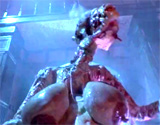
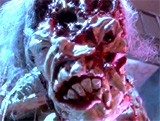
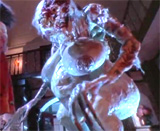
Vera was now transformed into a gigantic, grotesque, bloated, naked, over-estrogenized, fertile monster with a distorted huge head and pendulous breasts. She appeared and pursued Paquita and Lionel to the rooftop (through a fireplace chimney) where she cornered them during a final stand-off, while the house was becoming engulfed in flames. Lionel confronted his mother about the reason for his father's demise, admitting that as a child, he had witnessed Vera drowning his father and his mistress in the bathtub:
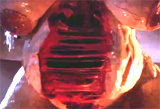
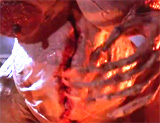
She had lied to him about the beach-drowning accident. Enraged, she opened up a cavity in her stomach and swallowed up Lionel by stuffing him back into her womb, to be with her forever. She enveloped him inside her opened-up body, declaring: "No-one will ever love you like your mother!...Such a good boy!" She also tried to kill Paquita, who screamed in horror while dangling and hanging from the rooftop. Lionel retaliated by rebirthing himself - cutting his way out of her giant, blood-gushing womb with the sharp necklace (a pendant-cross) he had been given by Paquita's grandmother. He emerged from her bloody placenta, as Vera fell back into the burning house's roof while fire officials arrived.
Covered in bloody gore, Lionel and Paquita kissed, embraced and walked away, together at last. |
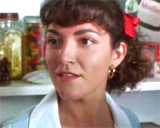 Paquita María Sánchez (Diana Peñalver) 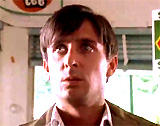 Lionel Cosgrove (Timothy Balme) 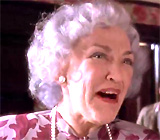 Mum Vera Cosgrove (Elizabeth Moody) 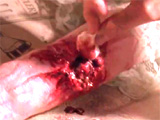 Vera's Infected Arm Bite 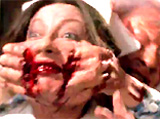 Re-Animated Vera's Murder of Nurse Mrs. Emma McTavish (Brenda Kendall) From Behind 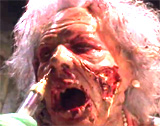 In Cellar, Zombie Vera Injected with Animal Tranquilizer Sedative 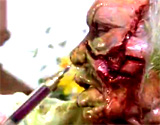 Lionel Tranquilizing Vera in Her Coffin at Funeral 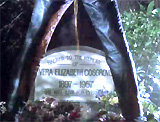 Void Pissing on Vera's Cemetery Grave 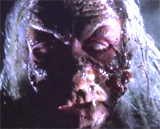 Zombified Vera's Attack on Hoodlums in Cemetery 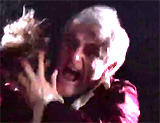 The Father Bitten by Decapitated Zombie Head During Cemetery Fight 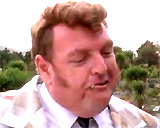 Lionel's Uncle Les Kalkon (Ian Watkin) 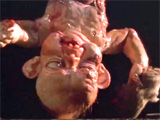 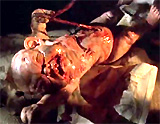 Zombie Baby Selwyn 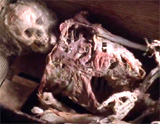 Skeletal Remains of Lionel's Father in Attic 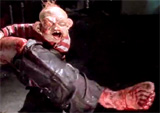 Baby Selwyn Using Severed Leg as Weapon 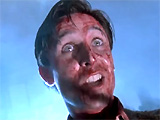 Lionel: "Party's Over" 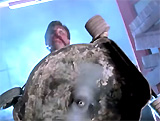 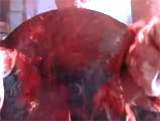 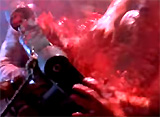  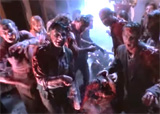 Rotary-Blade Lawnmower Scene - Lionel's Retaliation 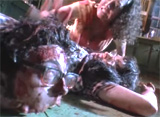 Decapitated Zombies  Severed Head Stuffed in Blender  Les' Zombified Head on an Extended Spinal Cord  Paquita Destroying Les' Head 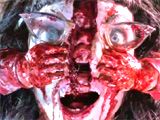 Baby Selwin Within Rita 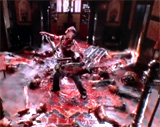 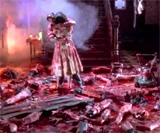 The Aftermath of Bloody Mower-Massacre - Paquita and Lionel Hug 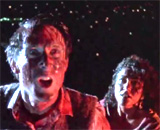 On the Rooftop: Lionel to His Mum: "You don't scare me, Mum!" 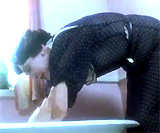 Lionel's Flashback to His Mum's Act of Murder That He Witnessed 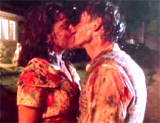 Ending Image: A Kiss Between Paquita and Lionel |
|||||||||||||||||||||||||||||||||||||||||||||||||||
 The
100+ Most Controversial Films of All-Time The
100+ Most Controversial Films of All-Time(chronologically, by film title) Intro | Silents-1930s | 1940s-1950s | 1960-1961 | 1962-1967 | 1968-1969 1970-1971 | 1972 | 1973-1974 | 1975 | 1976-1977 | 1978 | 1979 1980-1982 | 1983-1986 | 1987-1989 | 1990-1992 | 1993-1995 | 1996-1999 2000-2002 | 2003-2005 | 2006-2009 | 2010-present |




 The
first major studio release rated NC-17, this arty biopic featured
a guilt-free menage a trois, nudity and Uma Thurman in a lesbian
kiss.
The
first major studio release rated NC-17, this arty biopic featured
a guilt-free menage a trois, nudity and Uma Thurman in a lesbian
kiss.