|
Films of All-Time 1940s-1950s |


|
Citizen Kane (1941)
This widely-acclaimed film from debut film director/actor Orson Welles (24 years old) is usually regarded as the greatest film ever made. The film, budgeted at $800,000, received unanimous critical praise even at the time of its release, although it was not a commercial success (partly due to its limited distribution and delayed release by RKO due to pressure exerted by famous publisher W.R. Hearst) - until it was re-released after World War II, found well-deserved (but delayed) recognition in Europe, and then played on television. The film engendered controversy (and efforts at suppression in early 1941 through intimidation, blackmail, newspaper smears, discrediting and FBI investigations) before it premiered in New York City on May 1, 1941, because it appeared to fictionalize and caricaturize certain events and individuals in the life of William Randolph Hearst - a powerful newspaper magnate and publisher. The film was accused of drawing remarkable, unflattering, and uncomplimentary parallels to real-life (especially in regards to the Susan Alexander Kane character who represented Hearst's beloved mistress - young, and successful silent film actress Marion Davies). The notorious battle was detailed in Thomas Lennon's and Michael Epstein's Oscar-nominated documentary The Battle Over Citizen Kane (1996), and it was retold in HBO's cable-TV film RKO 281 (1999) (the film's title referred to the project numbering for the film by the studio, before the film was formally titled). The gossip columnist Louella Parsons persuaded her newspaper boss Hearst that he was being slandered by RKO and Orson Welles' film when it was first previewed, so the Hearst-owned newspapers (and other media outlets) pressured theatres to boycott the film and also threatened libel lawsuits. Hearst also ordered his publications to completely ignore the film, and not accept advertising for other RKO projects.
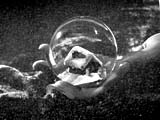
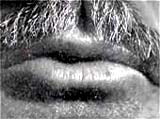
The opening prologue included a view of media tycoon Charles Foster Kane's (Orson Welles) estate of Xanadu (similar to W.R. Hearst's "Castle") and the uttering of the mysterious word "R-o-s-e-b-u-d" (the film's first line) by the giant rubbery lips of a dying, mustached man as a crystal globe/ball of a snowy scene (of a snow-covered house) fell from his hand and shattered on the floor. The discovery and revelation of the mystery of the life of the multi-millionaire publishing tycoon was determined through a reporter's search for the meaning of his single, cryptic dying word: "Rosebud" - in part, the film's plot enabling device - or McGuffin (MacGuffin). However, no-one was present to hear Kane utter the elusive last word. The reporter looked for clues to the word's identity by researching the newspaper publisher's life, through interviews with several of Kane's former friends and colleagues. Was it a favorite pet or nickname of a lost love? Or the name of a racehorse? The final fadeout scene started from the time the reporters climbed up the stairs to a shot that closed in on the incineration of a sled in the furnace -- (revealing the meaning of "Rosebud" as Charles Kane's childhood playtoy) - and the smoke rising toward the sky. At film's end, the identity of "Rosebud" was revealed, but only to the film audience.
|
 Kane's "Rosebud" Sled in Furnace |
|||||||||||||||||||||||||||||||
|
The Outlaw (1943)
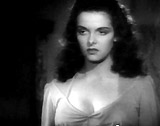
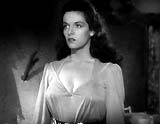
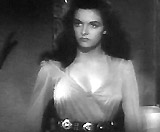
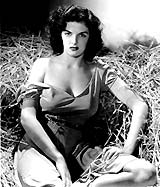
Hughes' picture was notorious for leering camera views of statuesque and formidable Jane Russell's ample, buxom cleavage - displayed to the fullest and greatest effect to anger Hays Code censors. The film was denied a Production Code Administration seal of approval for the exploitative use of young star Jane Russell's prominent, bulging breasts and cleavage. It faced close scrutiny by the Hays Office (and Joseph Breen), due to its exploitation of star Jane Russell's prominently-uncovered 36D chest in her debut film by Hollywood huckster Russell Birdwell. Salacious advertising added to the lurid sensationalism and kept the film from being widely circulated. Its original release had to be postponed until 1943 - and then only in very limited release to theatres. After a one-week run at that time, Hughes decided to withdraw and shelve the film for three years after which it was finally placed in general release in 1946 (in a cut version) without a seal of approval, and then again in 1947. The eventual release of the mediocre, fictional film ended up as an example of triumphant ballyhooing and film marketing. Pin-up shots of big-busted Russell rolling around in the hay had the desired effect at the box office (especially among WWII GIs). One of the film's most vulgar stunts, also orchestrated by Birdwell, was to have skywriting planes fly over San Francisco where they spelled the film's title followed by two giant circles -- each dotted in the center. One local judge in Baltimore, Maryland was quoted as saying that Russell's breasts "hang over the picture like a summer thunderstorm spread out over a landscape." However, it appeared that the publicity pin-up shots were much more revealing, sultry and suggestive than the film itself. The storyline was a western tale that featured three well-known historical figures in New Mexico:
Billy the Kid was being pursued by Sheriff Pat Garrett, with Jane Russell functioning as Doc Holliday's sexy, half-breed mistress Rio McDonald who was also engaged in a love-hate relationship with Billy -- it was considered too racy for contemporary audiences in 1941 when it was screened for the Hays Office.
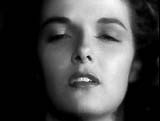
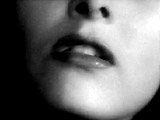
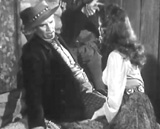
Rio (Jane Russell) was frequently seen with an oft-unbuttoned, low-cut peasant blouse - she was the formidable, sexy Mexican half-breed mistress of Doc Holliday. Early in the film was a wrestling semi-rape scene in a hay stable between Rio and Billy the Kid when he cautioned her to end her struggling resistance in the dark shadows. She condemned him for murdering her drunken brother and vowed to kill him. Later, a wounded and unconscious Billy was brought by Doc to Rio to care for him (she was tempted to stab him with a knife she used to cut off his clothes, but couldn't do it); with her Aunt Guadalupe (Mimi Aguglia) present, Rio made a promise to the unconscious Billy: "You're not gonna die. I'll get you warm" - once Billy began to recover and recuperate a month later, she bent down (in the uncensored version) to caution Billy from getting up: "Be careful, your wound. You'll hurt yourself." As he became stronger, Billy wished to kiss her, but she at first hesitated: "No, no, you'd better not get up until tomorrow...You're not strong enough yet"; he pulled her to himself: "Who says I'm not?!"; she responded as she wrestled with him: "Billy, you mustn't. You'll hurt yourself"; she was tempted to kiss him, although fearful at first: "But you've been so sick. You're not well enough. You're not..." - but then she surrendered to him; there was an incredible zooming full-face (and lips) closeup as she moved closer to kiss him.
When Doc returned, Rio was forced to admit to him that she had been charmed by the ailing Billy during one of his delirious periods to get married to him ("I'm married to him...That's the truth, Doc. Only please don't tell him.... I never would have done it, only I thought he was gonna die"). Later when an angry Billy returned and surprised Rio in her bedroom, he accused her of revealing their route to the Sheriff and of filling their canteens with sand. However, he also sarcastically vowed that he returned because he missed her - it was clearly a love-hate relationship.
To retaliate against Rio, Billy left her bound, gagged and strung up by her wrists within sight of a desert waterhole. After she was released by Doc and the Sheriff, Doc realized Billy's infatuation with Rio: "I think he's in love with you....The crazier a man is about a woman, the crazier he thinks and does." There was a frontal close-up view of Rio galloping along on horseback to escape pursuit by Indians on the way to Fort Sumner.
In the concluding sequence, after Doc showed a distinct preference for Billy, Pat reluctantly shot Doc dead. Following Doc's burial, Billy was allowed by the Sheriff to ride off. As he departed, Billy looked back at Rio - indicating that she could join him, and she happily jumped onto the back of his horse with him. |
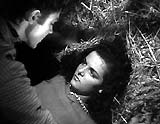 Semi-Rape Scene In the Hay With Billy the Kid 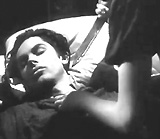 Rio Tempted to Stab Unconscious, Recuperating Billy 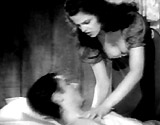 Bending Down, Rio to Billy: "Be careful, your wound. You'll hurt yourself" 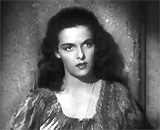 Rio to Doc, About Being Married to Billy: "I'm married to him" 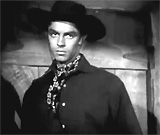 Billy's Angry Return to Rio 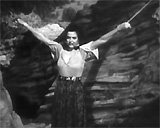 Rio Strung Up By Her Wrists 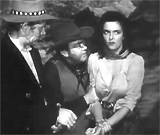 Rio Released by Doc and the Sheriff 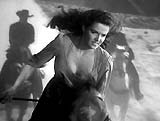 Rio Galloping on Horseback on a Race to Fort Sumner 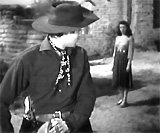 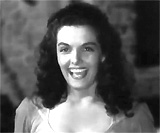 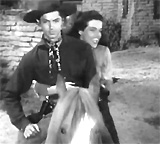 Conclusion: Rio Riding Off with Billy |
|||||||||||||||||||||||||||||||
|
Song of the South (1946)
This remarkable Disney film (a hybrid of live action and animation) was based on the "Uncle Remus" stories in the late 1800s of Joel Chandler Harris (first published as columns in the Atlanta Constitution newspaper), and was presented as one of their earliest, innovative live-action (70%) and animation (30%) mixtures. It was Disney's first attempt to make a feature film that included extensive, dramatic live-action footage. The film's song "Zip-a-Dee-Doo-Dah" won the Academy Award for Best Song. It was the first color film shot by famed cinematographer Gregg Toland who had filmed The Grapes of Wrath (1940) and Citizen Kane (1941). For many years, Disneyland's theme park log-flume ride 'Splash Mountain' was partly based on the film's animated sequences. Remarkably, the film has never been released for home video consumption in the US (although it has been available in European and Asian markets). After this film's last theatrical release in 1986 (on its 40th anniversary), it has simply vanished and been unavailable for purchase. Recently, a Disney spokesman reiterated the fact that the film would continue to be unavailable due to "the sensitivity that exists in our culture" and fears of political-correctness repercussions. Although it has been rumored that the NAACP (National Association for the Advancement of Colored People) banned this Disney movie, that was untrue -- they simply expressed their disapproval of the portrayal of African-Americans in the film, and their concern about its potential to present an image of an idyllic master-slave relationship. The NAACP's executive secretary Walter White wrote:
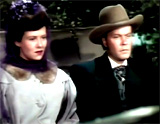
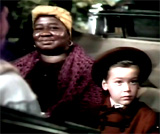
Harlem's black Congressman Adam Clayton Powell, Jr., called the film "an insult to American minorities." And NY Times film critic Bosley Crowther wrote: "No matter how much one argues that it’s all childish fiction, the master-and-slave relation is so lovingly regarded with the Negroes bowing and scraping and singing spirituals in the night, that one might almost imagine that you figure Abe Lincoln made a mistake. Put down that mint julep, Mr. Disney!" The main objection was its stereotypical depiction of blacks in the live-action sequences and its idyllic ("white-washing") depiction of slave and plantation life, although others mistakenly thought that the movie actually depicted slavery and tacit approval of the master-slave relationship. The film opened with a prologue: "Out of the humble cabin, out of the singing heart of the Old South have come the tales of Uncle Remus, rich in simple truths, forever fresh and new." Set presumably after the Civil War in the mid-to-late 1800s at a time when slavery was abolished during the Reconstruction Era in Georgia, it told about a family that journeyed from their home in Atlanta to a large rural plantation (owned by Sally's mother Miss Doshy (Lucile Watson), Johnny's grandmother) - they rode in an open carriage together. Sally and her husband John were in the midst of a marital separation, and Johnny was being taken by his mother to live with his grandmother for an extended period of time, while his father returned to Atlanta without them:
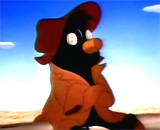
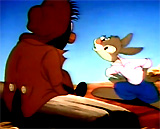
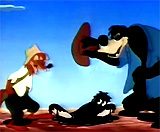
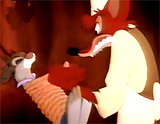
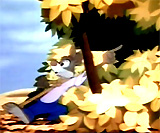
Once his father departed back to Atlanta and the distressed young Johnny feared the threatened divorce of his parents, he decided to run back to the city. He came upon a campfire where black slaves were singing about Uncle Remus tales (i.e., how the leopard got his spots, how the camel got his humps, and how a pig got his curly tail, etc.). He was befriended and comforted by the charismatic handyman and folk story-teller (and former slave) Uncle Remus (Special Oscar-winning James Baskett), who took him to his cabin for some "grub" (cornbread and sweet taters) and became his best friend and confidante. Storytelling Uncle Remus illustrated life lessons to help Johnny deal with his family and personal troubles through three animated sequences that featured Uncle Remus characters (i.e., Br'er Rabbit, wily Br'er Fox, and the stupidly dim-witted Br'er Bear). Br'er Rabbit was able to outtrick the fox and bear in all three instances of his tales:
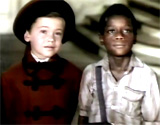
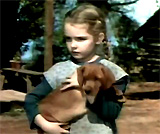
Rather than his own peers, Johnny preferred to spend time with his black servant Toby (Glen Leedy), playing with a croaking frog. He also suffered the bullying of two poor 'white-trash' boys, Joe (Gene Holland) and Jake Favers (Georgie Nokes), who threatened their blonde sister Ginny's runt dog named Teenchie, that was given to Johnny as a gift. As a result of Uncle Remus' second tale, Johnny used reverse psychology on the Favers boys, daring them to not tell their mother about the dog, but of course they did - and they received a whipping from their mother. However, Sally ordered Uncle Remus to stop telling tall tales to the impressionable Johnny, and Teenchie was reluctantly returned to the Favers. In the film's conclusion, when storyteller Uncle Remus was departing for Atlanta, the young boy was dismayed and felt deserted. He took a shortcut across a pasture to try and catch up to him. He was seriously injured by a bull, but was revived from death by the return of his father to the plantation and story-telling Uncle Remus who reprised the "Laughing Place" tale. He reached out for Uncle Remus' hand for comfort, and was assured by his father and mother that the family was back together for good ("We'll have the laughing-est place in the whole wide world") The film ended with the cartoon characters (butterflies, Br'er Rabbit, a frog and more) interacting with Uncle Remus and the children (Johnny, Ginny, and Toby) as they skipped along the road toward the horizon while singing "Zip-A-Dee-Doo-Dah." |
 Depiction of Happy Slaves Singing Spirituals While Returning From Work in Fields 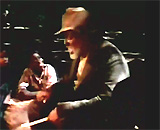 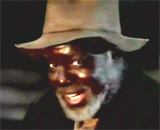 First Views of Storyteller Uncle Remus 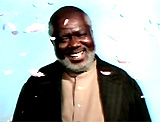 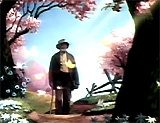 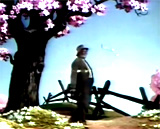 "Zip-a-Dee-Doo-Dah" 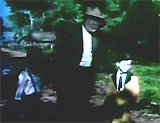 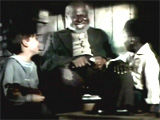 Storyteller Uncle Remus with Johnny and Toby 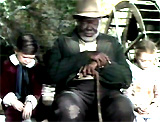 Storyteller Uncle Remus with Johnny and Ginny The Remus Tales:  Br'er Rabbit 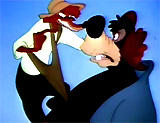 Br'er Fox and Br'er Bear 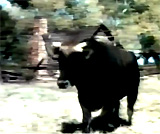   Bull Attack on Johnny   Revived from Death by Uncle Remus  Ending Image |
|||||||||||||||||||||||||||||||
|
The Miracle (1948, It.) (aka Il
Miracolo) (short) (part of L'Amore (1948, It.) (aka Ways
of Love))
This 43 minute neo-realistic drama was part of a longer 69 minute anthology film entitled L'Amore (1948, It.) (aka Ways of Love)] - it was the second episode, with a story scripted by Federico Fellini. After the release of the misunderstood film, it caused considerable controversy when it was maligned, censored and banned. It was exhibited at the 1948 Venice Film Festival, but was basically a flop in Italy after Catholic officials denounced it as "an abominable profanation." The film was imported into the US in 1949 by Polish-Jewish immigrant Joseph Burstyn, and in late 1950 opened at the Paris Theater in Manhattan. The short film was then challenged by the New York State Board of Regents in 1951 under 30 year-old censorship regulations barring 'sacrilegious' films. Pressure was also brought to bear by the Roman Catholic Archdiocese to revoke the film's license on the grounds that the work was "blasphemous" and "sacrilegious." Catholic leader Francis Cardinal Spellman, with the Catholic-dominated Legion of Decency, attacked The Miracle as "a despicable affront to every Christian" and "a vicious insult to Italian womanhood." The film was subsequently banned by the New York State Board of Regents. The film lost its license and the film's distributor, Joseph Burstyn, appealed the decision. The New York Appeals Court backed the Board of Regents decision. Soon, however, it became a landmark film in the fight against film censorship after a unanimous Supreme Court decision in 1952, in the case of Burstyn v. Wilson. It stated that the New York State Board of Regents could not ban the film - it declared movies a form of free speech. The Court ruled that "sacrilege" was too vague a censorship standard to be permitted under the First Amendment. Film was finally freed from federal censorship, although local censorship boards could still ban a film deemed 'objectionable'. The film starred Anna Magnani as a dim-witted, unwed, homeless young Italian peasant girl and goat-herder named Nannina, who had delusions that she was the Virgin Mary. While herding goats, she met a bearded vagabond stranger (with a bottle of wine) on a hillside where she was shepherding. She thought he was the incarnation of Saint Joseph, (a role played by young screenwriter Fellini!) - and delusionally believing that she was the Virgin Mary. In the afternoon after being offered wine, the drunken Nannina spent time with the man - and then seemingly passed out - there was a significant fade to black (an off-screen rape?). She was impregnated - presumably raped off-screen. She awakened shortly later with a goat licking her face, and found that the stranger was gone Later, believing that she was pregnant due to immaculate conception, the devout woman was mocked, ridiculed, ostracized and derided as transgressive by the townsfolk with her belief that her pregnancy was an immaculate conception. She was driven from town with people throwing vegetables at her, in a mock 'walk-to-Calvary' scene; at one point, the mob forced her to wear an empty bowl on her head (a crown of thorns). In the concluding scene, she gave birth, all alone, to her 'miracle' or 'special' child in an empty church located on a rocky hill outcropping. |
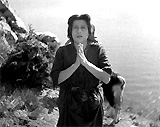 Italian Peasant Girl Nannina (Anna Magnani) 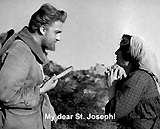 Vagabond Stranger: "My dear St. Joseph!"  Drinking Wine Before Passing Out 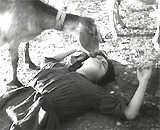 Awakened by Goat   Mocked by Townsfolk for Believing in Immaculate Conception Pregnancy |
|||||||||||||||||||||||||||||||
|
The Moon is Blue (1953)
This daring sex farce and romantic comedy was the first major studio-produced film from Hollywood that was released without an approved code seal from the Production Code Administration (PCA). It was deliberately made as a test case by its producer/director Otto Preminger. Despite its lack of a seal of approval and the controversy, it proved to be a major hit film (grossing $6 million). The PCA's Joseph Breen complained about the film's unacceptable, comedic "light and gay treatment of the subject of illicit sex and seduction." It was subsequently rated condemned by the Catholic Legion of Decency for vulgarity, in part because of its offensive use of prohibited words such as "virgin," "seduce," "pregnant," and "mistress" in the dialogue. Following the Kansas Board of Review of Motion Picture's decision to ban the film, the Kansas State Supreme Court upheld the decision. (Three states, Maryland, Ohio, and Kansas had banned the film.) The state's censorship board had used current state censorship laws to ban the film and release it without a seal of approval. In the case of Holmby Productions v. Vaughn brought up in a Maryland court in 1953, the blocking of the film's release by the Maryland and Kansas state censor boards was contested. In 1955, the US Supreme Court unanimously overturned the ruling of the Kansas Supreme Court to uphold the film's banning, declaring it unconstitutional. The film's court victory was one more indication that the influence of the Production Code was weakening. A PCA seal of approval was granted to two of Preminger's films in 1961, The Moon is Blue (1953) and The Man With the Golden Arm (1955). The film's philosophical theme was about the prospect of remaining a virgin, in order to remain respectable, and the efforts of two aging lothario-playboys attempting to score in a love triangle with an attractive young virgin. The three main characters were:
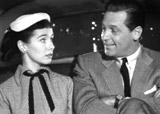
After meeting Donald on the top of the Empire State Building (where he impulsively kissed her), they shared a taxi ride to his Madison Avenue apartment for drinks before dinner.
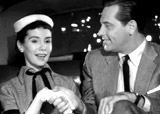
She warily asked: "Would you try to seduce me?" When he vowed he wouldn't ("I won't make a single pass at you"), but confessed that he might kiss her, she responded: "Kissing's fine. I have no objection to that." She then added: "Look, let's face it. Going to a man's apartment almost always ends in one of two ways. Either a girl is willing to lose her virtue or she fights for it. Well, I don't want to lose mine, and I think it's vulgar to fight for it, so I always put my cards on the table. Don't you think that's sensible?" They shook hands when she agreed with him on how to appropriately behave: "Affection but no passion." When they arrived at his place, she gratefully claimed: "I'm so glad you don't mind...Men are usually so bored with virgins. I'm so glad you're not." When the elevator doors opened in his apartment lobby, Donald's miffed ex-fiancee Cynthia Slater (Dawn Addams) was exiting - she was startled to see him escorting the younger woman upstairs. In his apartment, Don suspected that Cynthia had written "STINKER" in lipstick on his mirror after their recent break-up. Donald also noted that Patty was very inquisitive about his personal life, about Cynthia (and whether she was his mistress or not), and she also seemed very preoccupied with sex: (Donald: "Why are you so pre-occupied with sex?...You are always asking if people plan seduction or if they're bored with virgins or if they have a mistress"); she replied: "You may be right. But don't you think it's better for a girl to be preoccupied with sex than occupied?" In the meantime, Donald's ex-fiancee Cynthia was fuming over recently being dumped by him (because he DIDN'T seduce her). She had also called Patty a "professional virgin" (a female who flaunted her virginity to get something). Competing with Don for Patty's affection, her father David spoke about maintaining one's virginity, stating to Patty:
He offered a no-strings-attached $600 bet with her to wait 15 weeks before seeing another man. She held out and kept her virginity, but the bet was soon aborted. Eventually after all of the misunderstandings between the characters were cleared up, Donald truly fell in love with Patty and proposed (with an old-fashioned offer including the word 'love') - at the top of the Empire State Building where they first met. |
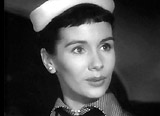
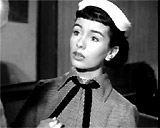 Virtuous Patty O'Neill (Maggie McNamara) 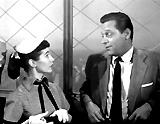 Patty Meeting and Flirting with Donald Gresham (William Holden) on Empire State Building Observation Deck 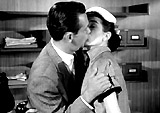 Impulsive Kiss with Donald in His Empire State Building Office 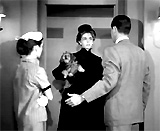 Meeting Cynthia Slater (Dawn Addams) - Donald's Ex-Fiancee 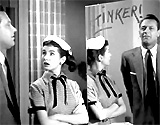 "STINKER" Written by Cynthia on Donald's Mirror  In His Apartment - Patty: "But don't you think it's better for a girl to be pre-occupied with sex than occupied?" 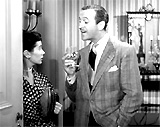 David Slater to Patty: "Is she or isn't she?" 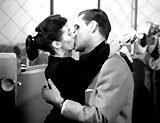
Ending: Donald's Proposal at Top of Empire State Building |
|||||||||||||||||||||||||||||||
|
Baby Doll (1956)
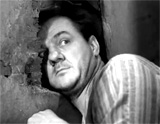
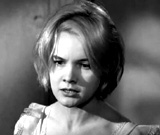
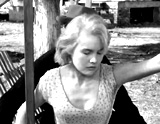
The Oscar-nominated film (with four nominations, but no wins, including Best Actress and Best Adapted Screenplay) was called notorious, salacious, revolting, dirty, steamy, lewd, suggestive, morally repellent and provocative. Time Magazine was noted as stating: "Just possibly the dirtiest American-made motion picture that has ever been legally exhibited..." New York's Cardinal Spellman declared the film "evil in concept... certain to exert an immoral and corrupting influence on those who see it." The defiant film was a condemned and censored drama (by the Catholic Legion of Decency for many of its scenes depicting older aged men pursuing an under-aged female. The stark, controversial, black and white film was so viciously denounced by the Legion of Decency upon its release with a "C" (or condemned) rating that many theaters were forced to cancel their showings, but it still did moderately well at the box office despite the uproar. Elia Kazan's pot-boiling film (based on Tennessee Williams' play) told about a thumb-sucking, white-trash, 19 year-old virginal child bride "Baby Doll" Meighan (Oscar-nominated Carroll Baker) with only a 4th grade education. She continually repulsed him because union with him wouldn't be sexually-consummated until her 20th birthday - two days away as the film opened. The first sensational image of her was sucking her thumb in a childlike crib in the nursery while being spied upon through a hole in the adjoining wall by her sexually-frustrated (unconsummated) and feverishly-horny "peeping tom" husband Archie Lee Meighan (Karl Malden), a Mississippi cotton gin operator. The desperate Archie peeked at her through a hole in the wall (and thrust with a penknife to make the hole wider - as her mouth opened and closed around her thumb). She caught him watching her, and confronted him: "Do you know what they call such people? Peepin' Toms!"
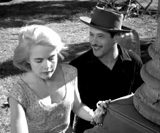
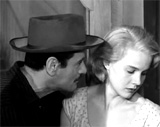
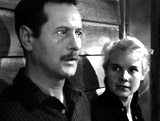
Shortly later, Archie barged in on Baby Doll who was in the bathtub, taunting and teasing Archie by bathing in front of him - and when he attacked her (off-screen), she yelled: "Get your hands off me...I'm movin' to the Kotton King Hotel the very next time you try to break our agreement. The very next time!" During a visit to town, Archie was the local laughing-stock - everyone knew that he was sexually-unsatisfied and ruled by his stuck-up, spoiled, child bride. While she sat in the back seat of his open car in town, he brought her a single-dip ice cream cone which she pleasurably and childishly licked - another blatant sequence of teasing temptation. Baby Doll knew that she had him wrapped around her finger: "What you've done is bit off more than you can chew." When she realized that their furniture was being repossessed, she threatened to move to the Kotton King Hotel in town and get a job, since Archie Lee could no longer provide for her. Her stipulation with Archie Lee was that he had to provide a furnished home for her - or otherwise his rights to her as a wife would be forfeited. Archie's vengeful and competitive business rival was a covetous, wily, sleek, beady-eyed and cocky Sicilian named Silva Vacarro (Eli Wallach in his film debut) - he was the manager of the up-and-coming Syndicate Plantation and Gin Company that had stolen away all of Archie's business in Tiger Tale County and had received recognition for his business success from a local Senator. Resentful and retaliatory, later that night, Archie took a kerosene can and set the Syndicate gin building on fire. Although some of the locals weren't sympathetic to the Sicilian outsider and refused to side with a foreigner against a local boy, Vacarro insisted on justice and carrying on his own investigation - he immediately suspected Archie. Vacarro announced that he would take twenty-seven wagon loads of his cotton for ginning to Archie Lee's gin, until his own gin could be rebuilt. Archie Lee was elated with his newfound prospect for business, and wished to extend every bit of hospitality to Vacarro, including entertainment by his willful child bride virgin while he worked ginning the cotton ("I believe in the good neighbor policy. You do me a good turn and I'll do you a good turn, Mr. Vacarro. Tit for tat and tat for tit is the policy we live on...Honey, honey, honey...Now I want you to entertain this gentleman"). Ultimately, Vacarro's aim during his time at Archie's place was to pursue the truth and bring forth a confession from Baby Doll about Archie's guilt. At the house on a hot afternoon, the virile Vacarro went to use the old-fashioned pump in the yard at the side of the house to get a nice cool drink and vigorously pumped the well - a sexual symbol and contrast to Archie's thwarted and elderly masculinity. The young "Baby Doll" nymphet was seduced (in a number of notorious, highly-sexual seduction sequences) by the vengeful Sicilian Vacarro to 'take' the virginity of Baby Doll and deflower her to get back at her husband for arson - the main reason for the film's vicious condemnation:
|
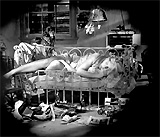 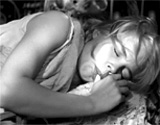 Baby Doll (Carroll Baker) in Crib 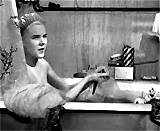 Baby Doll in Bathtub 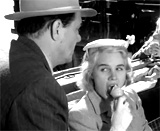 Baby Doll Licking Ice Cream Cone in Town 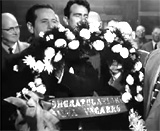 Silva Vacarro (Eli Wallach) Honored For Business Success by a Senator 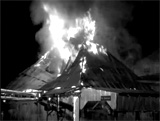 Competitor's Cotton Gin Set on Fire by Archie Lee 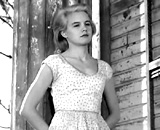 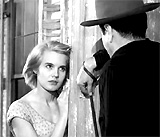 Baby Doll Introduced to Silva 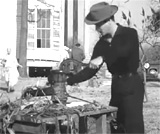 The Virile Vacarro Pumping Water 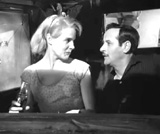 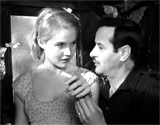 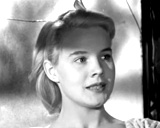 Vacarro in Car with Baby Doll 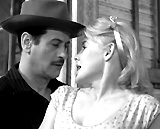 Falling Backward Into Vacarro's Arms on the Porch 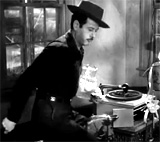 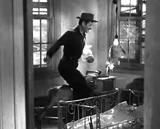 In the Nursery, Vacarro Rode a Hobby Horse 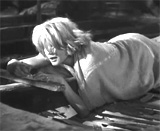 Baby Doll Signing the Affidavit Against Archie 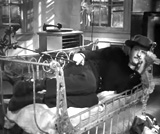 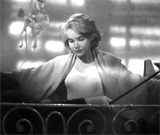 Vacarro in Baby Doll's Crib with Her 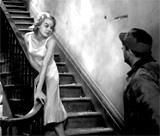 Baby Doll In Her Slip 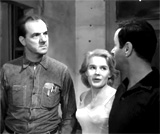 Vacarro Invited For Late Supper 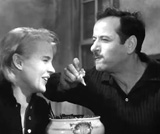 Baby Doll and Vacarro Eating Uncooked Greens 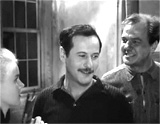 Archie Incensed by Vacarro and Baby Doll |
|||||||||||||||||||||||||||||||
 The
100+ Most Controversial Films of All-Time The
100+ Most Controversial Films of All-Time(chronologically, by film title) Intro | Silents-1930s | 1940s-1950s | 1960-1961 | 1962-1967 | 1968-1969 1970-1971 | 1972 | 1973-1974 | 1975 | 1976-1977 | 1978 | 1979 1980-1982 | 1983-1986 | 1987-1989 | 1990-1992 | 1993-1995 | 1996-1999 2000-2002 | 2003-2005 | 2006-2009 | 2010-present |




 Critics
loved it, but media mogul W. R. Hearst -- the inspiration for Kane
-- used his influence to discredit Orson Welles' groundbreaking
movie.
Critics
loved it, but media mogul W. R. Hearst -- the inspiration for Kane
-- used his influence to discredit Orson Welles' groundbreaking
movie.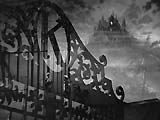
 This
infamous adult-oriented sex-western was obsessed millionaire director/producer Howard Hughes'
B-grade pet project. The B-grade western featured busty starlet Jane Russell in a breakthrough role.
It was marketed salaciously for full effect - such
as with this tasteless, salacious slogan: "What are the two great reasons
for Jane Russell's rise to stardom?", angering the MPAA for its unapproved ad campaign.
Hughes defied the Hayes Production Code (reportedly this was the first US film to do so),
and sued the MPAA organization,
but eventually backed down.
This
infamous adult-oriented sex-western was obsessed millionaire director/producer Howard Hughes'
B-grade pet project. The B-grade western featured busty starlet Jane Russell in a breakthrough role.
It was marketed salaciously for full effect - such
as with this tasteless, salacious slogan: "What are the two great reasons
for Jane Russell's rise to stardom?", angering the MPAA for its unapproved ad campaign.
Hughes defied the Hayes Production Code (reportedly this was the first US film to do so),
and sued the MPAA organization,
but eventually backed down.