|
Films of All-Time 1960-1961 |

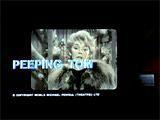 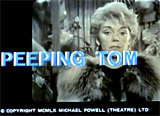 |
Peeping Tom (1960,
UK)
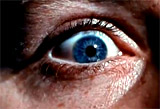
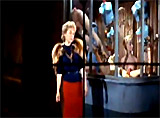
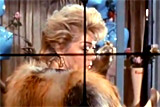
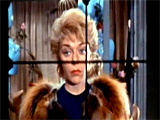
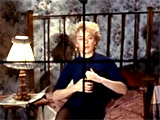
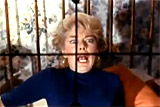
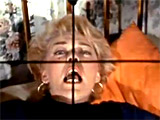
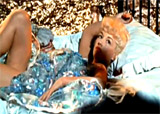
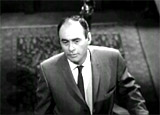
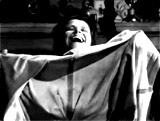
Although now widely praised (like Hitchcock's psychological horror film counterpart Psycho (1960) - and the film's thematic counterpart Rear Window (1954)), this chilling and disturbing film about voyeurism, child abuse, and serial murder by honored and best-loved film-maker Michael Powell was originally widely hated, universally loathed and denounced as sick, especially by British critics, who drove it off the screen. The infamous film with dark subject matter, made more lurid by its Eastman Technicolor, was criticized for its unsavory view of the perverted and morbid crimes perpetrated (and witnessed almost as "snuff films") upon unsuspecting female victims (a prostitute, an actress-dancer, and a nude model). In a subtle way, it appeared to implicate the voyeuristic viewer and force the audience to identify with the awful and perverse crimes committed by the madman. Critics pronounced it amoral, masochistic, perverted, wholly evil, necrophilic and trashy. It was called nauseating, depraved, depressing, filthy and stench-filled -- and allegedly destroyed the career of its director. It suffered from the devastating, vitriolic reviews and was removed from theaters and excised by its distributor. This censored version was briefly available in trashy US theatres in 1962 and in selected arthouse venues, but then removed for almost two decades. Not until 1979 was a full-length version viewable -- at the New York Film Festival. Over time, it has been critically re-evaluated and vindicated, and is now universally regarded as a masterpiece of psychological terror. This was the twisted, 'voyeuristic' chilling story of shy, reclusive and disturbed young studio cameraman (and psychopathic, morbid serial killer) Mark Lewis (Karl Boehm) who filmed call girls (mostly). He murdered them with his phallic weapon - his 16mm camera (with a cross-haired viewfinder creating a POV shot) at the time of their deaths with an ingenious mirror device attached so that his screaming, red-headed female victims could watch themselves die (after being impaled by the sharp metal-spiked leg of his hand-held camera tripod that was plunged into their throats); he was also perversely obsessed with voyeuristically capturing the moment of death and the fear it caused (the look of distorted, fearful faces in a mirror); it was an affliction termed scopophilia, the morbid urge to gaze. In the film's shocking pre-title credits opening sequence, filmed from the point-of-view of the voyeuristic camera's cross-haired viewfinder, a call-girl/prostitute named Dora (Brenda Bruce) negotiated on a dark London street for two quid ("It'll be two quid"), walked upstairs to her cheap apartment, disrobed, and then gave a look of horror as she was being murdered. The photographer Mark would then watch the projected grisly footage over and over in the darkness of his lab-studio. His viewing of this particular death was accompanied by the film's opening title and credits.
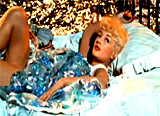
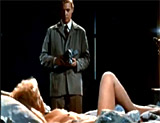
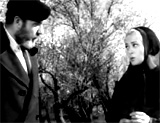
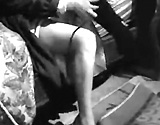
Mark viewed b/w home movies with red-haired female friend Helen Stephens (Anna Massey), his downstairs neighbor/tenant who lived with her blind mother Mrs. Stephens (Maxine Audley) - they included films of Mark's abused childhood when he was mentally tormented by his professor-father (director Michael Powell himself in a cameo) and experiments about fear were conducted on him to observe his reactions (e.g., his responses to the lizard dropped on his bed, his mother's corpse, or his father's new young wife). It masterfully told the back-story of how the monstrous killer had a very troubled and abused childhood with a sadistic father who filmed him for his studies on the physiology of fear in children. He had contributed to his son's violent and conflicted subconscious. The film presented an unsavory view of the perverted and morbid crimes perpetrated (and witnessed almost as "snuff films") upon unsuspecting female victims: (1) Dora (Brenda Bruce), a prostitute, (2) Vivian (Moira Shearer), an actress-dancer and studio stand-in, and (3) Milly (Pamela Green, a real-life 50s pin-up), a model. In the final murder scene, model Milly asked herself as she reclined backward (while Mark closed the blinds): "I might as well talk to a zombie. Is it safe to be alone with you, I wonder? It might be more fun if I wasn't." His shadow covered her face, as he moved and stood above her nude body. [Note: It was reportedly the first nudity in British film history, according to some reports, although Nudist Paradise (1959, UK) was released earlier. She displayed, momentarily, one nude breast.] The film faded to black with loud piano chords on the soundtrack, before she was murdered (off-screen).
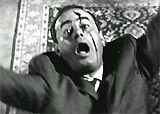
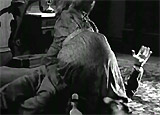
The much vilified film ended with Mark Lewis' own suicidal death. Although Mark's female friend and downstairs lodger Helen Stephens discovered his horrible secrets, he spared her life and took his own, suicidally (in the same horrific manner that he often used) as the police arrived. He impaled himself in the neck with his own spiked device, as he spoke to Helen:
Then, he slumped dead to the floor. The words of a tape recording of his childhood made by his father ended the film:
|
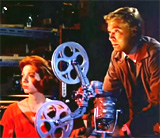 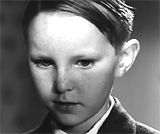 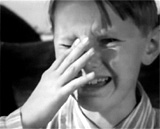 Viewing B/W Home Movies with Helen of Mark's Abused Childhood 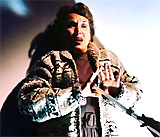 Mark Threatening Blind Mrs. Stephens 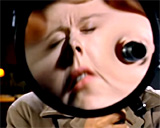 POV of Threatened Victim: "I made them watch their own deaths" 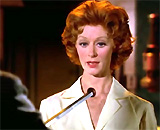 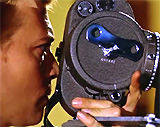 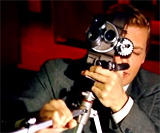 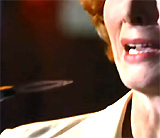 The Second of Mark's Spiked Tripod Leg Murders: Red Haired Vivian (Moira Shearer) 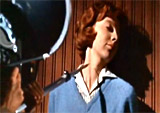 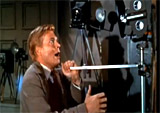
Threatening but Sparing Helen - Then Suicide |
||||||||||||||||||||||||||||||||
|
Psycho
(1960)
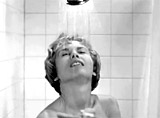
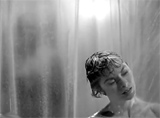
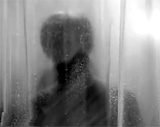
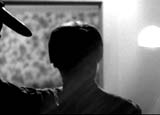
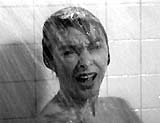
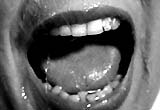
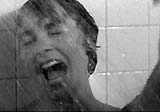
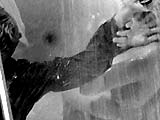
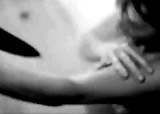
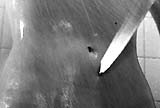
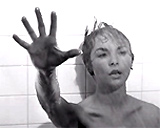
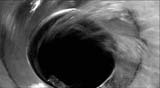
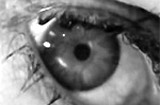
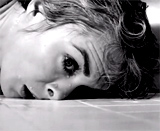
Alfred Hitchcock's powerful, complex psychological thriller was the "mother" of all modern horror suspense films - it single-handedly ushered in an era of inferior screen 'slashers' with blood-letting and graphic, shocking killings. The low-budget ($800,000), brilliantly-edited, stark black and white film came after Hitchcock's earlier glossy Technicolor hits Vertigo (1958) and North by Northwest (1959). Like many of Hitchcock's films, Psycho is so very layered and complex that multiple viewings are necessary to capture all of its subtlety. Symbolic imagery involving stuffed birds and reflecting mirrors were ever-present. Although it's one of the most frightening films ever made, it has all the elements of very dark, black comedy. This film wasn't clearly understood by its critics when released. When the film was originally aired in theaters in mid-1960, Hitchcock insisted in a publicity gimmick (a la P.T. Barnum) that no one would be seated after the film had started - the decree was enforced by uniformed Pinkerton guards. Audiences assumed that something horrible would happen in the first few minutes. Psycho also broke all film conventions by displaying its leading female protagonist having a lunchtime affair in her sexy white undergarments in the first scene. It was heavily censored (and edited) in some locales for repeated views of its main protagonist in a bra - both in the first scene during the lunchtime dalliance, and also twice later. Hitchcock's most unconventional choice was to kill off its major 'star' Janet Leigh (as Phoenix real estate office secretary Marion Crane) a third of the way into the film (in a shocking, brilliantly-edited shower murder scene accompanied by screeching violins). [Note: Hitchcock also photographed a toilet bowl - and flush - in a bathroom (a first in an American film).] Violence was present for about two minutes total in only two shocking, grisly murder scenes, the first about a third of the way through (the shower scene). Actually, the shower victim never really appeared nude (although the audience was teased by a body double) and there was only implied violence - at no time did the knife ever penetrate deeply into her body. In only one split instant, the knife tip touched her waist just below her belly button. Chocolate syrup was used as 'movie blood', and a casaba melon was chosen for the sound of the flesh-slashing knife. The horrific scene commenced when a figure with dark face, faint white eyes, and tight hair bun entered the bathroom and whipped aside the shower curtain. The killer wielded a menacing, phallic-like butcher knife high in the air - at first, it appeared to be stab, stab, stabbing us - the victimized viewer! The piercing, shrieking, and screaming of the violin strings of Bernard Herrmann's shrill music played a large part in creating sheer terror during the horrific scene - they started 'screaming' before Marion's own shrieks. Marion turned, screamed (her wide-open, contorted mouth in gigantic close-up), and vainly resisted as she shielded her breasts, while the large knife repeatedly rose and fell in a machine-like fashion. The murderer appeared to stab and penetrate into her naked stomach, shattering her sense of security and salvation. The savage killing was kinetically viewed from many angles and views. The only blood was seen washing down and circling into the shower drain - paired to a dissolving, rotating, zoom-out closeup of Marion's unblinking eye.
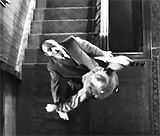
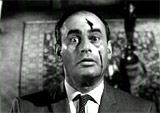
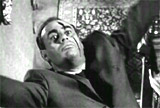
To his horror, Norman discovered the murder and meticulously cleaned up any evidence of the blood and her possessions, by dumping everything in the trunk of Marion's car, and sinking it in a nearby swamp. Most of the remainder of the horror and suspense in the film was created in the mind of the audience, although the tale did include such taboo topics as transvestism, implied incest, and hints of necrophilia. The nightmarish, disturbing film's themes of corruptibility, confused identities, voyeurism, human vulnerabilities and victimization, the deadly effects of money, Oedipal murder, and dark past histories were all realistically revealed. The second major violent sequence occurred when a Phoenix detective named Arbogast (Martin Balsam) was stabbed at the top of a flight of stairs and toppled backwards down the staircase - murdered with a gleaming knife wielded by Norman Bates/"Mother" (Anthony Perkins) (seen from a top-view). In the striking death scene, the camera remained fixed on his face as he fell backwards down the full flight of stairs, and then was stabbed repeatedly with the upraised knife at the foot of the stairs.
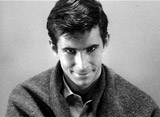
After Sam and Marion's sister Lila (Vera Miles) arrived to investigate the suspicious Bates Motel and its manager Norman, Lila made the shocking, revealing, basement fruit-cellar discovery scene when she turned a chair holding an elderly woman and saw Norman's mummified "Mother" under the swinging light - casting ghastly images onto the wall. She shrieked in response. The next-to-last image was of a psychotically-crazed Norman wrapped in a blanket with his Mother's voice-over, who condemned her son for the crimes while she claimed that she was harmless. A grinning smile slowly crept over Norman's face - subliminally superimposed by and dissolving into the grinning skull of his mother's mummified corpse. The film's final image was a dissolve into the dredging of the swamp - Marion's car with her body and the almost-$40,000 in the trunk was hauled trunk-first from the muck by a heavy clanking chain on a winch. Horizontal black bars partially, and then completely, covered the final image.
|
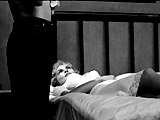 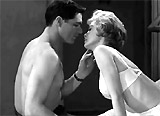 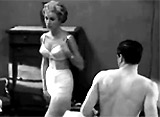 Marion's Furtive Lunchtime Love-Making With Sam (John Gavin)  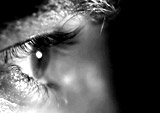 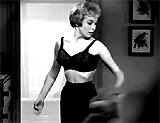 "Peeping Tom" 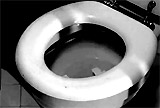 View of Toilet 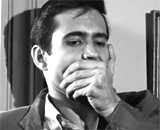 Norman's (Anthony Perkins) Reaction to Shower Murder 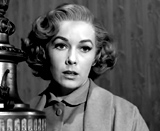 Lila Looking for "Mother" 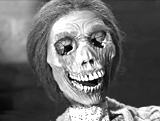 Norman's Mummified 'Mother' in Fruit Cellar 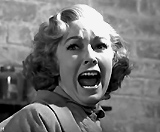 Lila's Shrieking Response 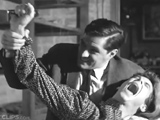 Sam Struggling With "Mother"/Norman to Save Lila |
||||||||||||||||||||||||||||||||
|
Victim (1961, UK)
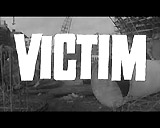
This film was most notable for reportedly being the first to speak the word "homosexual". Director Basil Dearden's non-judgmental, ground-breaking film-noirish thriller was a daring landmark film with its head-on presentation of the 'un-talked about' topic of homosexuality in the early 60s, when Britain still had anti-sodomy statutes as law. The controversial film was denied a PCA (Production Code Administration) seal of approval from the MPAA as a result of its subject matter and explicit use of the word 'homosexual." The unclassified film was not released in mainstream theaters in the US for that reason. Six years after the film's release, the UK's Sexual Offenses Act of 1967 that was passed by Parliament finally decriminalized homosexuality between consenting adults over the age of 21 (with a number of exceptions). The film was advertised with the tagline: "The Screen Comes of Age!" - with its story about a self-confessed, beleaguered, non-practicing homosexual and wealthy London lawyer (barrister) named Melville Farr (Dirk Bogarde, in a role as the screen's first gay hero). He risked his marriage and career to track down a creepy, slimy blackmailer (Derren Nesbitt) over accusations of closeted homosexuality.
Peter McEnery co-starred as Jack "Boy" Barrett (Farr's chaste 'boy friend' from his past as a Cambridge student with whom he shared a romantic relationship). Barrett was incarcerated for embezzling money from his employer to silence the blackmailers regarding his homosexual relationship with Farr. When he felt he was about to be outed, Barrett committed suicide by hanging himself in a police jail. In one of the film's most tense moments, Farr's stressed, estranged, but supportive wife Laura (Sylvia Syms) found out about Barrett's suicide and asked her husband about his feelings for him -
Although Farr maintained that he was no longer indulging himself with homosexual feelings or relations, he burst out to her an admission of his past indiscretions (with Barrett), after which she decided to leave him:
To pressure Farr, the blackmailers vandalized Farr's property, painting "FARR IS QUEER" on his garage door. Undeterred, Farr promised to cooperate with the police in their investigation and pursue the blackmailers, knowing that the publicity would inevitably ruin his public career. |
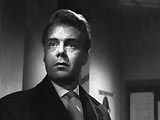 Melville Farr (Dirk Bogarde) 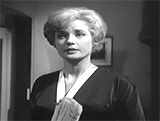 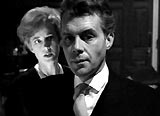
Farr Confronted by His Wife Laura About His Homosexual Feelings For Barrett 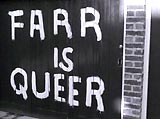 Vandalized Door |
||||||||||||||||||||||||||||||||
|
Viridiana (1961, Sp./Mex.)
Bunuel's ironic drama has been generally considered a masterpiece and it won the Golden Palm (Palme d'Or) at the 1961 Cannes Film Festival in the year of its release. The film was originally banned in the director's home country and condemned by the Catholic church for its perceived indictment of Catholic self-righteousness, blasphemy, and obscenity. It was also controversial for its scenes hinting at incest, rape and necrophilia. In the plot, devout Spanish convent novice Viridiana (Silvia Pinal) visited her rich, land-owning widower uncle Don Jaime (Fernando Rey) who was still mourning the death of his wife due to a heart attack on their wedding night in his arms - without consummation. The first view of the uncle's estate was actually the legs and feet of jump-roping young Rita (Teresa Rabal), the daughter of Don Jaime's maid Ramona (Margarita Lozano) - the lonely, admiring Don Jaime was watching her innocent activity, and offered her a new jump rope. The initial meeting between Viridiana and her uncle was somewhat chilly.
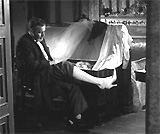
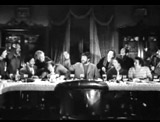
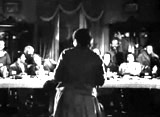
As Don Jaime played the organ, in Viridiana's bedroom, she partially disrobed and revealed her shapely legs when she removed her dark stockings. She also unpacked her suitcase, carrying a small wooden cross and a crown of thorns. In the secretive privacy of Don Jaime's bedroom (with a veil draped over his dressing chest), he was seen admiring his wife's wedding clothes - he slipped her white, high-heeled satin shoe over the top half of his right foot. He also modeled her corset in front of a mirror. When Viridiana appeared, he was entranced by the sight of her bare legs in front of the fireplace. Don Jaime had one last favor of the reluctant Viridiana - to satisfy his obsession with her similar looks to his deceased wife ("You look just like her"); he clothed his niece Viridiana in his wife's wedding gown. He admitted: "I can't keep my eyes off you" and reluctantly confessed ("You must think I'm mad") that he would like to marry her ("I never want you to leave this house"). She was repulsed: "You can't be in your right mind. I've been so happy here, and now you've spoiled it all." Don Jaime promised to drop the subject, but then after his servant Ramona (Margarita Lozano) secretly drugged her tea drink, Don Jaime carried Viridiana into the bedroom, reclined her on the bed, kissed her, loosened the top of her dress, buried his head in her breasts, and was tempted to rape her. The next day, he falsely confessed to her that he had taken her virginity to keep her from returning to the convent for her final vows. When she was still determined to leave, he admitted that he lied ("I only possessed you in my thoughts") -- but the ultimate result was his own guilty self-humiliation and a suicidal hanging with a jump rope. In his will, he left his estate property to her, shared with his illegitimate, cynical son Jorge (Francisco Rabal). Partly out of guilt, the virtuous and idealistic Viridiana charitably gathered together a destitute group of thieves, beggars, drunks, lepers, cripples, and whores. They took over the house after she had invited them to live at her uncle's crumbling estate, and she had briefly left to formalize inheritance of the property. While she was absent, they invaded the house, and nearly destroyed it - they killed goats for a feast, dirtied the tablecloth, and broke expensive china and furniture. The most controversial sequence was a drunken parody and re-enactment of Da Vinci's 'The Last Supper' by the group - they 'freeze-framed' in a tableau for a mock group portrait at the table, pictured to the sounds of the "Hallelujah Chorus" in Handel's Messiah. At that moment, one of the filthy female beggars, Lola Gaos (Enedina) pretended to be the 'photographer' and metaphorically suggested snapping the picture by lifting her skirt.
The celebration reverted into an orgiastic riot, with dancing, ribaldry, violence, food-fighting and cross-dressing. Anachronistically, a syphilitic beggar clothed himself in the dead wife’s corset and her veil and performed an obscene dance, while another couple had sex behind the living room furniture. One of the celebrants even attempted to molest and rape Viridiana when she returned to the house. Totally disillusioned or maybe more sexually aware of herself (after two attempted rapes), Viridiana submitted to playing a game of cards, to the sounds of the early 60s pop tune Shimmy Doll ("Shake Your Cares Away") - as the camera retreated backwards through a closeted doorway. The film ended with a suggested possible menage a trois scene between ex-nun Viridiana, servant Ramona, and her lothario, rakish cousin Jorge. |
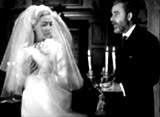 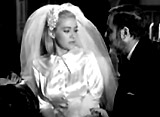 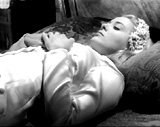 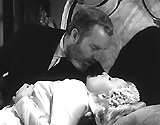 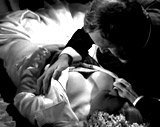 Viridiana (Silvia Pinal) with Perverted Uncle Don (Fernando Rey) 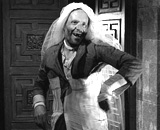 Beggar Dressed in Corset and Performing Obscene Dance  Sex Behind the Living Room Sofa 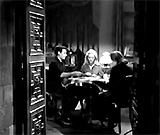 Final Threesome Card-Playing |
||||||||||||||||||||||||||||||||
 The
100+ Most Controversial Films of All-Time The
100+ Most Controversial Films of All-Time(chronologically, by film title) Intro | Silents-1930s | 1940s-1950s | 1960-1961 | 1962-1967 | 1968-1969 1970-1971 | 1972 | 1973-1974 | 1975 | 1976-1977 | 1978 | 1979 1980-1982 | 1983-1986 | 1987-1989 | 1990-1992 | 1993-1995 | 1996-1999 2000-2002 | 2003-2005 | 2006-2009 | 2010-present |




 British
critics called Michael Powell's disturbing thriller about a tormented
murderer perverted, necrophilic and trashy; his career never recovered.
British
critics called Michael Powell's disturbing thriller about a tormented
murderer perverted, necrophilic and trashy; his career never recovered.