|
Films of All-Time 1968-1969 |

|
Rosemary's Baby (1968)
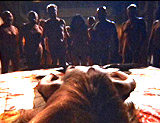
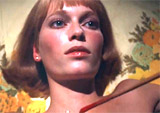
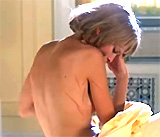
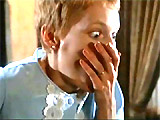
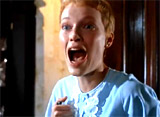
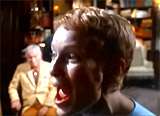
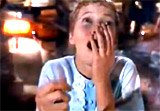
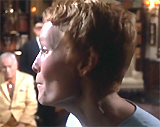
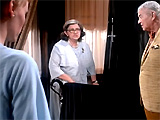
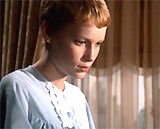
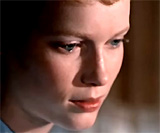
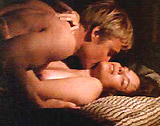
Polish director Roman Polanski's first American feature film and his second, scary horror film (following his first disturbing film in English titled Repulsion (1965)) - was about a young newlywed couple who moved into a large, rambling old apartment building in Central Park West, where the title character Rosemary Woodhouse (Mia Farrow) experienced a nightmarish dream of making love to a Beast. Becoming paranoid and hysterical, she believed herself impregnated so that her baby could be used by an evil cult in their rituals. The creepy film ended with the devil's flesh-and-blood baby being cared for by the mother! The film was one of the first with the theme of Satanism and the occult, before the onslaught of films such as The Exorcist (1973), The Omen (1976), and Demon Seed (1977). The National Catholic Office for Motion Pictures reviled the film, condemning it for "the perverted use which the film made of fundamental Christian beliefs, especially surrounding the birth of Christ, and its mockery of religious persons and practices" - these criticisms were due in part to sequences depicting Rosemary's guilt over her lapsed Catholicism, anti-religious references to the Pope made by Roman Castevet ("You don't need to have respect for him because he pretends that he's holy"), the portrayal of Rosemary's pregnancy as a sexually-transmitted disease, and the film's view of Satanism as the birth of the Anti-Christ. The incredible irony of the film was that the plot would be similarly played out a year later - Polanski's pregnant actress/wife Sharon Tate would be terrorized and murdered by the strange cult of Charles Manson followers in her Benedict Canyon home. A real-life tragedy also occurred when the Bramford apartment building (actually the Dakota apartments - the actual locale in the film) was where Mark Chapman shot John Lennon in 1980. Its most memorable sequence was the aforementioned surrealistic dream sequence. "Dizzy," woozy and disoriented after eating some tainted chocolate mousse (laced with sleeping powder), Rosemary hallucinated a Black Mass, imagining herself on a mattress drifting on the ocean, and then as a passenger on a presidential yacht. Undressed, shivering and naked, and then abruptly wearing a bathing suit, various images assaulted her: the Birth of Man paintings on the Sistine Chapel ceiling, a typhoon at sea, and a naked descent into the hold of the ship, where a fire burned and Rosemary was lying on a mattress. She was surrounded by many chanting, overweight, elderly naked figures (of the Satanists' coven), including husband Guy (John Cassavetes) and neighbors Roman (Sidney Blackmer) and Minnie (Ruth Gordon) Castevet.
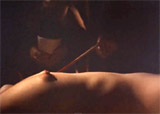
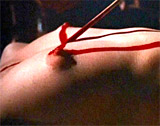
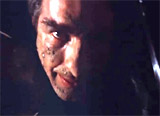
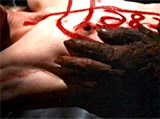
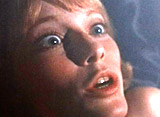
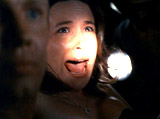
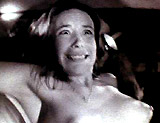
A bloody-red liquid was painted with rune designs on Rosemary's bare chest. A person resembling Mrs. John F. Kennedy (Patricia Ann Conway) who wore a white diaphanous gown descended a staircase and suggested tying her legs down in case of convulsions. Attendants spread her legs apart and bound them. In her dream-like sleep, Guy began making love to her, but then his appearance changed into a grotesque beast-like figure resembling the Devil, with yellowish eyes and clawed, scaly hands. He stroked the length of her body with his hairy claw. While being 'raped' during this horrific ritualistic copulation scene, as everyone watched her having intercourse with the Beast, she realized:
After a nightmarish dream of making love to a Beast, the paranoid, haunted, and hysterical bride believed herself impregnated so that her baby could be used in evil cult rituals. The next morning, Rosemary questioned mysterious scratches she found on the side of her body. She was appalled that Guy admitted making love to her while she was passed out - supposedly from mixing alcohol - "It was kind of fun in a necrophile sort of way." She remembered something quite different from Guy's recollection - a demonic, inhuman rape:
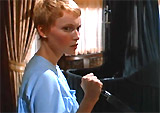
In the final equally momentous scene, Rosemary discovered her Anti-Christ child in a black-draped crib. Late one night, Rosemary had snuck into the Castevet's apartment through the closet passageway - with a kitchen knife upraised in her hand. There, she found a coven of witches (including Guy), surrounding a black-draped baby cradle to pay their respects - it was a macabre presentation of the Adoration of the 'Satanic' Magi, with visitors coming to view the babe from all parts of the globe. A framed portrait of Adrian Marcato hung above the fireplace. She approached the black bassinet expecting to see her own human child. In a frightened, angry tone, she asked about her baby cradled there with an inverted cross hanging above - fully expecting the child to have "Guy's eyes." She slowly walked over to the cradle, saw her child in the bassinet - and her eyes widen in terror: "What have you done to it? What have you done to its eyes?" And then she was told the truth - she realized that she was impregnated by the Devil and the baby was the offspring of Satan and Rose-Mary (a variant on the name Mary in the Biblical story). Her baby's eyes were NOT human. Although Rosemary rejected the devil-worshipping coven of witches, she accepted the reality of the situation and showed an instinctive mothering role and maternal instinct toward the baby in the final scene - she gently rocked the upset child to sleep. |
|
|||||||||||||||
|
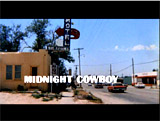
Midnight Cowboy (1969)
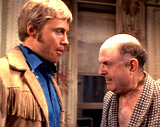
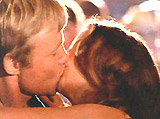
John Schlesinger's film was a major milestone although controversial at its time for its gay-related content and subject of male prostitution. Its title "midnight cowboy" referred to nocturnal cowboys in the big city - those who were hustlers. The ground-breaking film was the first (and only) X-rated (for adult-oriented, not porno) mainstream film (later reduced to R) to be voted Best Picture, with an A-list stars, at a time when the ratings system was first introduced. This Oscar-winning film, an exceptional, provocative, and gritty character portrait, was made on location in New York to portray seediness, corruption, and big-city anonymity, and was based on James Leo Herlihy's 1965 novel. It was unusual for its rating to be so high, since the unflinching film did not contain significant profanity, graphically-brutal violence, or frontal nudity, although it did portray some partial nudity and simulations of sex. It told an adult-themed story about a naive, swaggering, transplanted (and emasculated) dishwasher/stud - a displaced small-town "cowboyish" Texan named Joe Buck (Jon Voight) who struggled and aspired in the sordid 42nd Street area of NY to become a successful hustler or gigolo - while posing as a "macho midnight cowboy," although he eventually resorted to homosexual street hustling to survive. Upon his arrival in the big city, he vainly posed shirtless in front of his hotel room's mirror, and pasted up a beefcake poster of Paul Newman from Hud and a picture of a topless woman. His first 'trick' was fast-talking, brassy society girl Cass (Best Supporting Actress nominee Sylvia Miles) who out-hustled Joe for a cab-ride fee. In a comedic sex scene in which they humorously activated channels with the TV remote control beneath their bodies - the metaphoric climax came with the closeup view of the winning results of a slot machine jackpot - spewed-out coins. Joe's first homosexual client was a religiously fanatical and homosexual Jesus-freak Christian named Mr. O'Daniel (John McGiver). During the encounter, Joe flashbacked to his disturbed and abused boyhood when he was baptized in a river (recalled as terrifying). He also recalled an incident when town rednecks viciously assaulted him and his former girlfriend "Crazy" Annie (Jennifer Salt) when they were having sex in a car. He was homosexually raped and she was traumatically gang-raped.
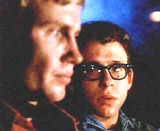
Another homosexual client in New York was a bespectacled, geeky young student (Bob Balaban) in a dark movie theatre who was penniless - while experiencing oral sex, Joe had memories of making passionate love with Annie who promised him she was being faithful by telling him: ("You're the only one, Joe...Kiss me, Joe, kiss me"). In another nightmare regarding Annie (who had a reputation for being a tramp), he also remembered her saying - as the authorities arrived: "He's the one. He's the only one" - implying something more sinister.
The Texas stud was befriended by a limping and coughing homeless con artist named Ratso Rizzo (Dustin Hoffman) and they experienced an unspoken homosexual relationship together which included frequent bickering. They both experienced the riches of the American dream when invited to a freaky Greenwich Village party by a "couple of fruity wackos" (Gastone Rossilli and Warhol's Viva), where they found free food, drugs, and opportunities for sex. Joe took stoned socialite Shirley (Brenda Vaccaro) to bed for his first successful heterosexual score with a paying female client ($20). At first, though, he suffered sexual inadequacy until angered when she teasingly suggested that he was gay: ("Gay, fey. Is that your problem, baby?") - and then he performed vigorously. Afterwards by phone, she recommended his studly services to an unhappily-married female friend. Joe's final trick was with another homosexual - a middle-aged Catholic man named Towny (Barnard Hughes). Back at the man's hotel room, in the last sordid act of his street-life existence, things turned violent. Joe ended up in a rage, brutally attacking the self-loathing, mother-dominated, despicable man after receiving a St. Christopher's Medal and only ten dollars. He committed a horrible crime - he robbed the man of all his money and then brutalized the customer, probably killing him. He left after jamming the phone receiver into the man's bloodied, toothless mouth. |
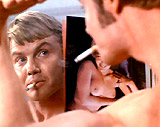 Hustler Texan Joe Buck 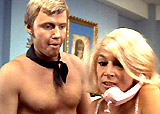 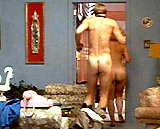   With Society Girl Cass 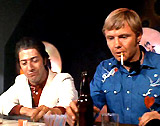 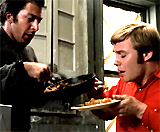 Co-dependent Joe Buck and Rizzo 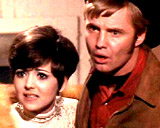 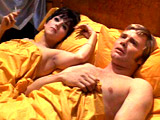
Joe with Shirley (Brenda Vaccaro) |
|||||||||||||||
|
The Wild Bunch (1969)
Director/co-writer Sam Peckinpah's provocative, brilliant yet controversial breakthrough Western was shocking for its graphic and elevated portrayal of violence and savagely-explicit, orgiastic carnage, yet hailed for its truly realistic and reinterpreted vision of the dying West in the early 20th century (at a time when mass-produced murder was possible with the Gatling gun). Due to its violence, the film was originally threatened with an X-rating by the newly-created MPAA (Motion Picture Association of America), but an R-rating was its final decision. A so-called 'director's cut' version of the film, threatened with an NC-17 rating when submitted to the MPAA ratings board in 1993 prior to a re-release in 1994, held up the film's re-release for many months. The film opened with innocent village children intrigued by putting red fire ants and scorpions together and setting fire to the swarming pile. Sam Peckinpah's harsh and extremely violent western cinematically visualized at both its beginning and end (with rapid-fire and slow-motion segments) the horrific, savage, yet glorified spectacle of death for a romantic band of men whose time had come. Both sequences served up as counterpoints to the media's honest display of violence during the late 60s, with the Vietnam War, assassinations, urban riots, and other events filling the airwaves. The much-imitated, influential film was book-ended by these two extraordinary sequences, both massacres. The two scenes included some of the bloodiest, most violent shoot-ups ever filmed. Peckinpah choreographed each of the film's two bloodbaths as a visually prolonged, beautiful ballet - a semi slow-motion, aesthetically breath-taking, non-gratuitous, lyrical, extreme celebration of bodies spurting blood and being torn apart by bullets.
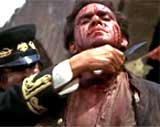
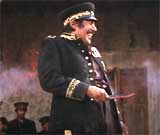
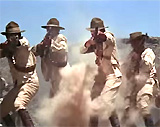
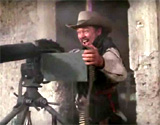
In the second sequence, the four Wild Bunch members loaded their rifles and marched across town - four abreast, reminiscent of the walk to the classic O.K. Corral in other westerns - to confront the drunken General Mapache, who held court next to the machine gun, his proud possession mounted on a table. Pike demanded the return of Angel ("We want Angel"), now bloodied, maimed and near-death from torture. Mapache appeared to comply, assisting Angel's walk over to them and then cutting his wrist ties with a knife. But in a brutal, full-frontal view, Mapache slit Angel's throat and was immediately killed in retribution by Pike and then by Dutch (Ernest Borgnine) and Lyle (Warren Oates).
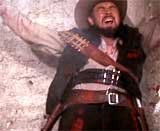
The precipitation of their last stand - a violent, seven minute bloodbath counter-attack of monumental proportions in the open courtyard - was delayed with a long moment of silence. With their guns drawn, the four men were able to hold off hundreds of surprised and dumbstruck Mexicans, which now stood leaderless and still for several seconds, gaping at what had happened. Warily and then gleefully, Pike and Dutch smiled and laughed, realizing that for an instant, they just might succeed. However, in the end, they were outnumbered, surrounded, and condemned to die in the pending climactic battle. It was truly an orgy of slaughter in one of the bloodiest scenes ever filmed, as the four remaining outlaws took down as many men as they could.
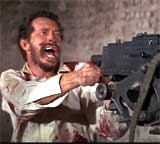
Although some of the Wild Bunch held off the troops momentarily by using grenades and by commandering the machine gun and firing it with orgasmic intensity, they were soon wounded and killed. With their violent deaths, they had become liberated. |
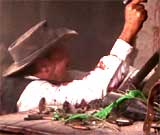
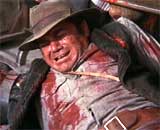
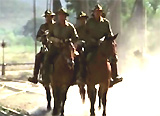 Opening Titles Sequence: The Approach of The Wild Bunch into Texas Town 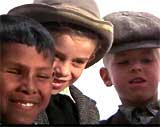 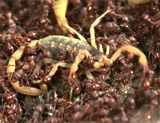 Village Children Happily Watched as Scorpions Were Eaten by Red Fire Ants 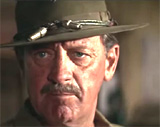 Pike's Command During Local Railway Office Robbery: "If they move, kill 'em" 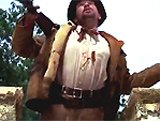 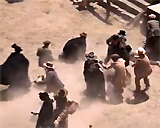 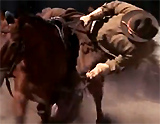 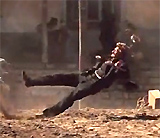 The Opening Massacre 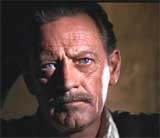 Pike's Decision to Save Angel: "Let's go" 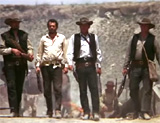
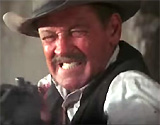 Pike with Machine Gun |
|||||||||||||||
 The
100+ Most Controversial Films of All-Time The
100+ Most Controversial Films of All-Time(chronologically, by film title) Intro | Silents-1930s | 1940s-1950s | 1960-1961 | 1962-1967 | 1968-1969 1970-1971 | 1972 | 1973-1974 | 1975 | 1976-1977 | 1978 | 1979 1980-1982 | 1983-1986 | 1987-1989 | 1990-1992 | 1993-1995 | 1996-1999 2000-2002 | 2003-2005 | 2006-2009 | 2010-present |




 The
National Catholic Office for Motion Pictures reviled Polanski's
dark horror classic for mocking religion and making "perverted
use" of Christian beliefs.
The
National Catholic Office for Motion Pictures reviled Polanski's
dark horror classic for mocking religion and making "perverted
use" of Christian beliefs.