|
Films of All-Time 1970-1971 |


|
Carnal Knowledge (1971)
The prurient title of this raw, profanity-laden, taboo-breaking Mike Nichols film (with a script by satirist and cartoonist Jules Feiffer), meaning 'sexual intercourse,' brought millions of patrons into the theatres for its character-based tale of the exploits and sexual encounters of two Amherst college roommates:
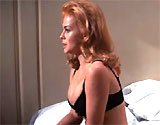
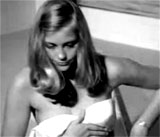
This striking film with adult subject matter told of their dysfunctional, misogynistic sexual attitudes and 'machismo' relationships (and breakups) with women over a 20-year period (from the late-1940s to the late 60s). It illustrated their fragile male egos and bravado, as it further pushed the boundaries of sex in cinema and challenged the ratings system and the general morals of the time - although the film had little in the way of explicit sex. A film print was seized by Albany, Georgia officials in 1972, claiming that it violated obscenity laws, and the manager of the film theatre was arrested (and convicted, but it was later overturned). It was brought as a major case before the US Supreme Court, which found in 1974 that the film was not obscene and "did not depict sexual conduct in a patently offensive way." The court ruled that a local Georgia law prohibiting the distribution of the "obscene" material had gone too far. Nowadays, the film would be considered tame, with its minor amount of nudity or explicit sexual activity, although its dialogue was ripe, candidly frank and open for its time. It began with the two males' difficult initiation into sex ("scoring" with coeds) during their 1940s student days at Amherst (with among others, Candice Bergen as the pretty, respectable and intelligent Smith College student Susan whom they both dated). Sandy awkwardly tried to feel Susan's breasts through her clothes during a date, details of which he later shared with Jonathan. In the meantime, Jonathan betrayed his friend and dated Susan ("Myrtle") and she lost her virginity to him, unbeknownst to Sandy, although eventually Sandy married Susan and had a family in a typical surburban setting. The story continued with playboyish Jonathan's later difficult relationship to voluptuous, big-breasted TV model Bobbie (Oscar-nominated Ann-Margret) who he first felt was his sexual salvation - and she soon became his live-in mistress: ("I took one look at the tits on her, and I knew I'd never have trouble again"). Jonathan soon resented Bobbie's hints at becoming more domestic and trapped-hitched, as she vulnerably drowned in depressing despair. He then berated and insulted her ("Answer me, you ball-busting, castrating, son of a cunt bitch! Is this an ultimatum or not?"). When she cried out and pleaded: "I want you!", he answered: "I'm taken --- by me!" He added: "For God's sake, I'd almost marry you if you'd leave me."
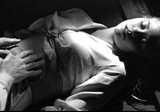
In a revealing close-up, a naked Bobbie sat up against a blank wall (filmed from the chest up), lost in her own thoughts of depression and suicide, and soon after took an overdose of pills. The film then followed Jonathan into his divorced, burnt-out life in the late 60s and 70s, when he looked back and called ex-wife Bobbie "Queen of the Ballbusters." Meanwhile, Sandy was dating 18 year-old free-love advocate and hippie chick Jennifer (Carol Kane) in the late 60s. Finding himself dysfunctionally impotent, Jonathan resorted to using the pleasuring services of paid prostitute Louise (Rita Moreno in a cameo) to massage his ego (and more) in the film's final scene. Obsessively, he had her recite a carefully-worded script (he yelled at her - "God-damn it! You're doing it all wrong" - when she deviated) while she kneeled between his legs. After accepting payment of $100, and as he reclined back on a couch, she reassured him as she stroked his thighs: "I don't think we're gonna have any trouble tonight." She called him "a real man, a kind man" and then went on to encourage him to rise up and be manly:
|
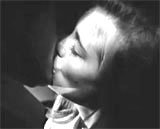
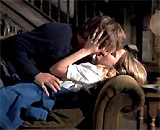
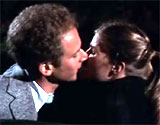 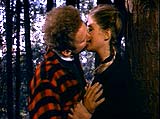 Sandy Kissing Susan 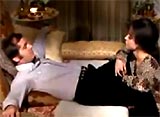  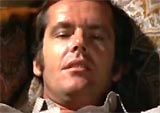
Jonathan Pleasured by Prostitute |
|||||||||||||||||||||||||||||||||

|
A Clockwork Orange
(1971, UK)
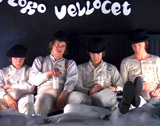
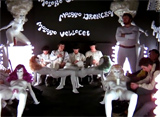
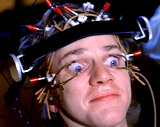
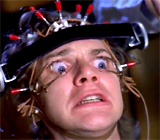
At the time, Stanley Kubrick's randomly ultra-violent, over-indulgent, graphically-stylized film of the near future - and most controversial film - was one of only two movies rated X on its original release (the other was Midnight Cowboy (1969)) that was nominated for a Best Picture Academy Award. The subversive film was hotly debated when it was released - both highly praised and objectionable for its bleak outlook, and for its pairing of comedy with 'ultra-violence' - including two rape scenes.
Because of the copy-cat violence (some gangs in the UK dressed as droogs sang "Singin' in the Rain" as they carried on violently) that the film was blamed for by the media and courts, Kubrick withdrew it from circulation in Britain about a year after its release. Some believed it was because it was rumored that Kubrick and his family had received death threats. It wasn't officially available there again - in theaters or on video - until 2000, a year after his death. The dystopic film about fascist social conditioning and free will, adapted from Anthony Burgess' novel, was heavily criticized and opposed by religious groups for its sexual and violent content. Feminists were outraged with some of the misogynistic images, including:
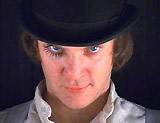
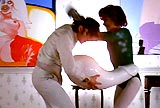
The delinquent gang led by sociopath Alex (Malcolm McDowell) conducted stylized "ultra-violence" rampages including the fight scene in an old theatre with a rival gang of five, led by Billyboy (Richard Connaught), while they were in the midst of raping a buxom victim or 'devotchka' (Shirley Jaffe) on an empty opera house stage, all synchronized with music from Rossini's The Thieving Magpie.
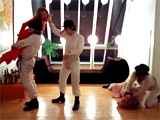
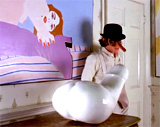
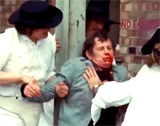
The most infamous was the rape scene of a couple in an ultra-modern, opulent house by Alex's gang of derby-hatted droogs (Pete, Georgie, and Dim) who were wearing masks with comical noses. Both victims: red pajama-suit-wearing writer's wife Mrs. Alexander (Adrienne Corri) and elderly husband Frank Alexander (Patrick Magee) were bound and gagged, with a rubber ball painfully inserted into their mouths and wrapped with long strips of Scotch tape around their heads. He was assaulted and kicked on the floor (with vicious blows of boots to his mid-section) by Alex who ironically punctuated and timed his rhythmic, soft-shoe kick-dance to his gleeful singing and tap-dancing of the lyrics of Gene Kelly's tune Singin' in the Rain.
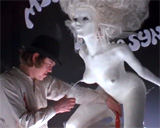
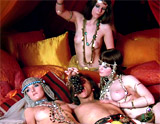
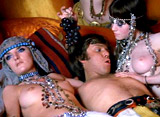
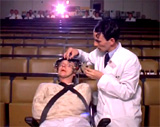
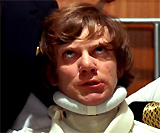
Mr. Alexander was also forced to helplessly watch the ugly disrobing and choreographed rape of his own wife when Alex cut away her skin-tght jumpsuit and attacked her breasts. He snipped off two circles of jumpsuit cloth around them to expose them and then in the mode of 'Jack the Ripper,' he slit her entire suit off from her pant leg upward. After unzipping and pulling his own pants down prior to her rape, he mocked the husband: "Viddy well, little brother. Viddy well." There was also a gruesome murder with a giant phallic art sculpture that was conducted in a gallery filled with erotic paintings, when lead droog Alex attacked Catlady (Miriam Karlin) with a over-sized porcelain dildo. In a later scene, Alex was subjected to corrective treatment and reprogramming -- experimental aversion therapy imposed by the state in which he was behavioristically conditioned (with his eyes clamped wide-open in order to view scenes of violence in films while drugged to induce nausea and forced to listen to his beloved Beethoven) to suppress his violent and aggressive sexual drives and urges - and in the process gave up his own individual and personal rights to become a model citizen. Alex experienced an orgy dream of eating grapes while surrounded by half-naked, bare-breasted handmaidens (Jan Adair, Vivienne Chandler, Prudence Drage). That was all that was left to him, to feed his violent and sexual personality. When approached by an abusive, homosexual Irish actor named Lardface (John Clive) who insulted, taunted and attacked him and forced him to be subservient and lick his boots, Alex was unable to defend himself.
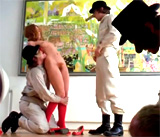
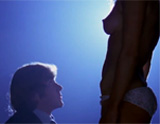
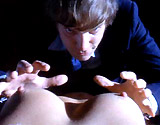
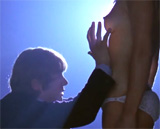
In a second demonstration to the tune of Music for the Funeral of Queen Mary, Alex was tempted before a topless blonde stage actress (Virginia Wetherell) - a half-nude woman wearing only bikini panties. Eyes glazed and on his knees, Alex lustfully reached out for her breasts (filmed both from a low angle and an overhead shot to emphasize their firm ripeness). As he cupped his hands tantalizingly close to her pink-nippled, fleshy protuberances, his urge for sex instantly turned to an urge to vomit and he fell to the floor belching to his former passion.
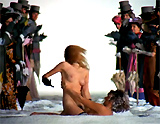
By the film's conclusion, Alex, now supposedly "cured," returned to his former self. It was apparent that Alex had learned nothing from his behavioral modification treatments by the state. He was returned to his former self - with his free will intact and with his old proclivities for sex and violence. After giving a thumbs-up signal to the press and mugging for the cameras, Alex's eyes glazed and rolled back (in a semi-Kubrick stare with facial contortions), and he found peace as he fantasized a pseudo-orgy while trapped in his hospital bed. An enigmatic dream-like image came on the screen - with both his free will intact and with his old proclivities for sex and violence. The final explicit scene emphasized the enormity of the state's hypocrisy. In his Ascot fantasy, a nude Alex had found peace and fantasized copulating (making love to/raping?) with a beautiful blonde woman (Katya Wyeth) who wore only black silk stockings. They were frolicking in slow-motion on piles of white snow, while two rows of genteel-looking, Victorian Londoners (ladies and gentlemen), the men dressed in top hats and the women carrying parasols, looked on and sedately applauded toward them. Alex had reverted to his old, pre-conditioned, natural behavior. In voice-over, he triumphantly and sardonically uttered:
|
|
|||||||||||||||||||||||||||||||||

|
The Devils (1971, UK)
Ken Russell directed this blasphemous, shocking and excessive depiction of the repressive 17th century when sexuality was equated with Satanism - a loose adaptation of Aldous Huxley's "The Devils Of Loudon." The film's setting was the fortified city of Loudon, 150 miles southwest of Paris, in the year 1634. It provoked protest and outrage from Christian groups and viewing audiences everywhere. It was banned outright in Italy and its stars (Redgrave and Reed) were threatened with three years' jail time if they entered the country. The film was vilified and met with outrage in its story of a womanizing (non-celibate), vain, libertine, rebellious activist renegade-priest Father Urbain Grandier (Oliver Reed) who faced questioning and persecution for his "diabolic possession" of the local, repressed Ursuline nuns. It included Vanessa Redgrave as tormented hunchbacked Sister Jeanne, who had unfulfilled, warped sexual desires for Grandier and expressed them through self-mutilation and self-flagellation. In the film's most fantastic vision, Grandier (as Christ) stepped off the cross on which he had been crucified, so that Mother Jeanne could lick his wounds. The only way the monarchy of Inquisition-obsessed France (including Cardinal Richelieu (Christopher Logue) and King Louis XIII's (Graham Armitage) establishment) could destroy the Protestant-leaning French town of Loudon was to attack the liberal religious leader as a sorcerer and practitioner of witchcraft. When the priest impregnated nobleman's cousin Philippe (Georgina Hale), married wealthy heiress Madeleine Dubroux (Gemma Jones) in secret, and then refused to remove the city walls around his fortified town, fanatical witch-hunter and exorcist Father Barre (Michael Gothard) was quickly dispatched to question Grandier The wicked, repressed and deformed Sister Jeanne confessed to depraved witch-hunter Father Pierre Barre that Father Grandier was responsible for her bewitching possession, and that he had violated her. Barre had been dispatched to question, torture (headscrews, nails into hands, etc), tie up, and execute the profligate priest. Sister Jeanne was physically examined for proof of sexual violation - in one of the film's most memorable scenes. She was laid on the altar and penetrated by intrusive instruments, causing her to scream and bleed, after which it was declared that she had been violated - and that Grandier was guilty as charged. During the proceedings, possessed nuns, led by Sister Jeanne's denunciations, performed orgiastic rituals publicly in Church to bolster claims against him. In one of the film's most shocking (and censored) scenes - a staged exorcism in Loudon's cathedral, the nuns acted as if they were possessed in front of masked townspeople. Dubbed the orgiastic "Rape of Christ" sequence (intercut with a scene of Grandier conducting a simple mass for himself by a river-bank), the crazed Ursuline nuns were whipped into a sexual frenzy of hysteria by Barre. They displayed full-frontal nudity when they removed their habits, cavorted naked, and masturbated with (or raped) a large-sized crucifix or effigy of Jesus that they had pulled down from the wall. They began to lick the enormous crucifix, and with their writhing naked bodies, some of the nuns ground their genitals over all parts of the wooden statue to pleasure themselves. One group of nuns let themselves be groped by male townsfolk, and others attacked and 'raped' a priest.
Father Mignon (Murray Melvin), who climbed a staircase to perch himself for a better view far up in the cathedral, watched from afar and committed desperate self-abuse under his robe - (the two and a half-minute scene was excised prior to the film's release). As he did so, a frenzied nun also suggestively stroked, rubbed and gripped a large altar candle between her legs. The camera zoomed in and out rapidly to portray his ecstasy and madness as he watched the masses of naked female bodies surrounding the Jesus statue. Meanwhile, Grandier was brought to trial - was condemned for witchcraft, obscenity, blasphemy, and sacrilege, and bound for the fiery stake. Unable to walk because his legs had been broken, Grandier was dragged out for public execution. The executioner (who had promised to strangle him with a noose so he could avoid torturous pain) was unable to, when Barre lit the pyre prematurely. Grandier's death was gruesome to watch, as his flesh blistered and he was burned to death. Prior to the film's release, the "rape of Christ" sequence was censored. And the scene of Grandier's burning-at-the-stake torture as a heretic was shortened. A scene at the end of the film of Sister Jeanne being handed the charred thighbone of Grandier after his execution - a "souvenir" - was eliminated. There was no doubt what she would use it for - as a dildo for masturbatory purposes. A scene at the end of the film was mostly edited out - of Sister Jeanne masturbating with the charred thighbone of Grandier after he was executed. The film contained graphic depictions of open sores and medieval medicine treatments for the plague (with hornets). |
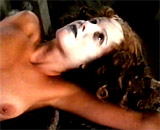 Philippe (Georgina Hale)  Madeleine (Gemma Jones) 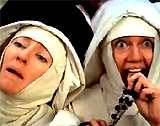 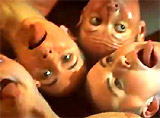 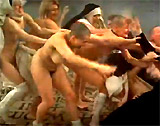 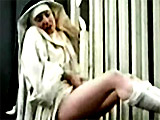 Sexually-Crazed Nuns 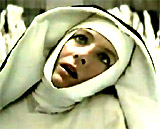 Crazed and Sexually-Tormented Mother Superior Jeanne (Vanessa Redgrave) 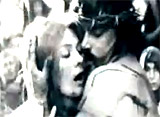  Sister Jeanne des Anges - Vivid Fantasies of Sex with Grandier   Grandier Burned at the Stake  The Charred Thighbone of Grandier |
|||||||||||||||||||||||||||||||||
|
Dirty Harry (1971)
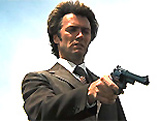
Director Don Siegel's sensational police drama was a seminal vigilante film of the decade, appealing especially because of its overt violence and occasional glimpses of nudity. Dirty Harry took its name from the fact that its unorthodox title character, San Francisco Inspector Harry Callahan (Clint Eastwood), became embroiled with the most challenging and controversial ('dirty') cases of urban crime, often using tactics of police brutality and an attitude of "take-no-prisoners" that ignored criminals' rights in order to restore victims' rights and create public order. Callahan's open contempt for normal Miranda law restrictions illustrated his belief that criminals must be stopped - by any means, since traditional law enforcement ("by the book") tactics weren't effective. He followed his own unconventional philosophy of justice by using "excessive force," ruthless methods, and "the end justifies the means" principle without much regard for the rules and legal regulations of his profession. Often, his methods were as vicious, taunting, sadistic and violent as the behavior of the criminals he opposed. Advertising posters for the film read: "You don't assign him to murder cases...You just turn him loose," and "He doesn't break murder cases. He smashes them." The police thriller spawned many debates about the political stance of the film and the complex issue of the conflicting rights of victims, suspects, and society.
The film reflected a pervasive fear of crime during the early 1970s. This seminal vigilante film of the decade, joined The French Connection (1971), the UK's Get Carter (1971), Death Wish (1974) featuring a vengeful vigilante killer Charles Bronson (and an awful rape sequence), Walking Tall (1973), The Seven-Ups (1973), and the Australian film Mad Max (1979) with Mel Gibson. Countless other cop-action films have been made to copy this original law-and-order film that was one of the first to appear on movie screens. Siegel's film was considered sensational because of its overt violence (reflecting the early 70s era of rising crime and calls for 'law and order') and occasional glimpses of nudity. The duelling combatants (the cop and the criminal) throughout the film were an individualistic, unconventional, neo-fascist, super-hero police detective with a .44 Magnum weapon who threw away the rule book, and his complementary opposite - a pathological, psychotic, malevolent and sadistic roof-top sniper/criminal named Scorpio (similar to SF's real-life Zodiac Killer, played by Andy Robinson), a serial killer who demanded an extortionist ransom of $100,000. Both shared traits of brutal violence and insanity. During the flood-lit Kezar stadium scene on the 50 yard-line, 'Dirty Harry' questioned Scorpio: ("The girl? Where is she?...Where's the girl?"). He also tortured and arrested Scorpio after wounding him, as the killer was pleading: ("I have the right for a lawyer") - ending with the lengthy pull-back helicopter shot into the darkness. In the film's conclusion, a quarry gun battle ended when the wounded killer heard another challenge with the same famous threatening lines of dialogue (from the opening bank robbery):
The hippie psycho-sadist made his choice and reached for the gun - but there was one more bullet in Harry's gun, and Scorpio was executed and shot dead - in cold blood. His body was propelled backward into the small lake. Callahan walked to the edge of the wooden platform above the water to gaze down at the murderer's bloodied corpse floating and slowly sinking below him. Harry's final gesture was to discard his police badge (Inspector 2211, SF Police) into the stagnant pond with the body of Scorpio. [Note: This scene paid homage to the final scene of High Noon (1952) when the lone Marshal contemptuously discarded his badge in the dust after being betrayed by the entire Western community.] |
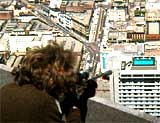 Sniper Scorpio (Andy Robinson) on Rooftop 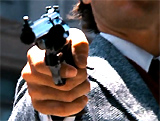 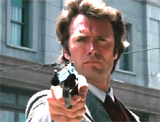 Vigilante Harry Callahan (Clint Eastwood) - Opening Bank Robbery Sequence  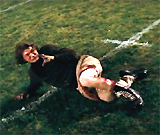 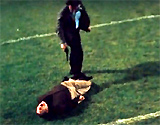 Kezar Stadium Confrontation Between Incensed Harry and Scorpio 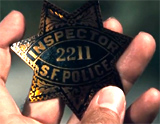 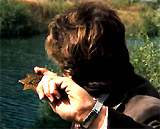 'Dirty' Harry Discarding His SFPD Badge |
|||||||||||||||||||||||||||||||||
|
The Last
Picture Show (1971)
Director Peter Bogdanovich's R-rated frank and realistic black and white drama told about the dreams and loves of small-town Texans in the early 1950s, confronting various issues such as adultery, alcoholism, and promiscuity. Although the adult-themed film was nominated for eight Oscars (with two wins for supporting performers), some considered it obscene for its full frontal nudity and explicit sexual situations. See also: Greatest Scenes, and Sex in Films The film was reportedly banned in Phoenix, Arizona in 1973 after a showing at a drive-in theatre, following complaints by the city attorney that it violated a state obscenity statute. Arguments in federal court focused on the nudity in a nude swimming party scene, and eventually the courts disagreed over whether it was obscene, and threw the case out. The co-captains of the HS football team, Texas high-school seniors Duane Jackson (Jeff Bridges) and Sonny Crawford (Timothy Bottoms), who lived together in a boarding house, often visited with the town's aging patriarch - old-timer, ex-cowboy Sam 'The Lion' (Oscar-winning Ben Johnson), owner of the local pool hall and theatre, to ponder their uncertain futures. In various sexcapades in Duane's and Sonny's shared pickup truck, Duane was dating rich, self-centered, and pretty town tease Jacy Farrow (Cybill Shepherd in her film debut), whose alcoholic mother Lois (Ellen Burstyn), who was providing her with a poor role model, was having an affair with attractive but dissolute oil driller Abilene (Clu Gulager). Sonny was in a short term relationship with his unattractive girlfriend of one year Charlene Duggs (Sharon Taggart, aka Sharon Ullrick); they customarily drove to a lover's lane area and listened to the radio, for awkward petting in the pickup truck; this Saturday night, she methodically removed her own sweater (he unhooked her pointed bra and hung it on the rear-view mirror), and as usual, she routinely permitted him to cup her full right breast (with his cold left hand) while they kissed; however, this time, she angrily asked: "What's the matter with you? You act plain bored" - and he decided to break up with her. In a short while, Sonny proceeded to get involved in a lengthy affair (and lose his virginity) with depressed, middle-aged, low-self-esteemed Ruth Popper (Oscar-winning Cloris Leachman), the wife of his basketball coach Coach Popper (Bill Thurman); after a few visits to her place, they embarrassingly kissed standing up and then hurriedly and self-consciously undressed (without looking at each other) in separate areas of the bedroom; once in bed and under the covers, she permitted Sonny to proceed with having sex: "It's all right"; during furtive love-making, the bed's squeaky springs poignantly reflected Ruth's inner anguish and pain as she cried and gave her heart to him. In the film's most controversial scene, the sexually-adventurous neophyte Jacy arrived at a private, teenaged, midnight skinny-dipping indoor pool party held at the Wichita Falls, TX home of wealthy Bobby Sheen (Gary Brockette), without boyfriend Duane's knowledge; at the party, she was greeted as a 'new victim' by the stark naked host with his nude girlfriend Annie-Annie Martin (Kimberly Hyde), who asked: "Wanna join the club?" Jacy was challenged to get undressed out on the diving board as part of her initiation rites ("So everybody gets to watch"); expectantly, the whole naked group of teenaged boys and girls eagerly sat by the edge of the pool to watch "the strip show" - she nervously and gingerly removed many articles of clothing, almost fell off the diving board, and then with one dramatic gesture, yanked off her bra top and flung it on top of her pile of clothes; finally, she was cheered as she hopped into the water - completely naked; she had succeeded in attracting the attention of the rich kids - and in particular, the young playboy.
By the spring during a class picnic, the town's ravishingly beautiful, calculating, fortune-hunting Jacy had decided to give up her virginity to Duane in a local motel, so that she could advance onto Bobby; during their pre-arranged rendezvous and sexual encounter at the Cactus Motel - she laid back on the motel bed and half-closed her eyes as she encouraged him to take her virginity: "Oh Duane, hurry"; but then asked annoyingly: ("Aren't you gonna do it?...What do you mean? How could anything be wrong? Just go on and do it"); aggravated by the aborted love-making when he became limp and impotent and was unable to perform, she blamed his recent Mexico trip for his inability ("No telling what you got down there. I just hate you. I don't know why I ever went with you"), and ordered him to dress: ("You think I wanna sit around here and look at you nekkid?"). Jacy feared that she might "never get to not be a virgin" - and thereby win Bobby Sheen's heart; she was also worried that classmates might ridicule them when they found out about their unsuccessful and clumsy encounter, and she confirmed what her mother had forecast: "I think you're the meanest boy I ever saw. My mother was dead right about you"; she instructed him to "not tell one soul - you just pretend it was wonderful," and then threw her panties at his face; afterwards she gushed to her admiring girlfriend-classmates: "I just can't describe it in words." After graduation ceremonies for the Senior Class of 1952, Duane assured Jacy that he was now ready: ("But I can do it now, I know I can"); at the same motel, Jacy gave Duane a second chance to deflower her - using him to provide an entree to dating Bobby Sheen; this time, Duane succeeded without an audience outside to witness the post-rites of passage; soon after, Jacy coldly broke up with Duane (who left town with furious frustration to take a wildcat oil rigging job), and further pursued her plan to snare Bobby, but she ultimately failed when he abruptly dropped her and married his girlfriend.
Disappointed with herself, and late on a Saturday night, the provocative, over-sexed Jacy enticed her father's older business partner Abilene, her mother's sex partner, to let her join him inside the town's dark and closed-up pool-hall; he removed her shorts and underwear and had sex with her on a pool table - while her hands grasped the two corner pockets behind her; after he drove her home, he coldly refused to kiss her: "How about hoppin' out?"
Later after returning home, Jacy's mother Lois had a look of pained shock and disappointment realizing that her daughter had slept with Abilene; to break them up, Lois encouraged Jacy to set her sights on Sonny (who always had a secret infatuation for her) - and end his well-known affair with 40 year-old Mrs. Popper. The opportunistic Jacy proceeded to quickly seduce Sonny into leaving Mrs. Popper (after six months together); the older woman soon sensed that Sonny had moved on from her. As the film ended, everything in Sonny's life seemed to have disintegrated and he was deeply depressed by multiple events: Duane's departure, Billy's death, and Jacy's permanent move to Dallas for school; for consolation, he drove to Ruth Popper's house to make amends after many months; the abandoned and long-suffering Ruth - surprised by his visit - delivered an explosive tirade at Sonny for abandoning her when he returned to her after Billy's death. In the final moments of the film, Ruth empathically realized Sonny's pain, forgot her anger, and realized that he was begging for forgiveness - she bravely and hopefully took him back and comforted him: ("Never you mind, honey, never you mind..."). |
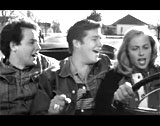 Threesome: Sonny, Duane, and Jacy 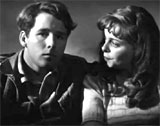 Sonny with Charlene Duggs (Sharon Taggart)  Sonny with Charlene in Pickup Truck 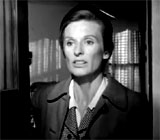 Ruth Popper (Cloris Leachman) - Coach's Wife 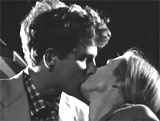 Sonny's Passionate First Kiss with Ruth After Xmas Dance 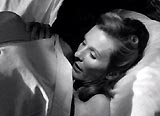 Sonny's Affair with Coach's Wife - Ruth Popper (Cloris Leachman) 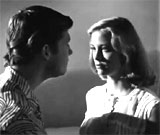 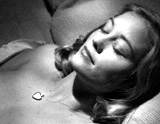    Jacy and Duane's Failed Sexual Encounter in Motel Room  Jacy to Her Girlfriends: "I just can't describe it in words"  After Jacy and Duane's 2nd Successful Attempt at Sex After Graduation  After Jacy's Sexual Experience with Abilene in Pool Hall: "How about hoppin' out?"  Billy's Senseless Death 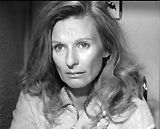 Ruth's Tirade Against Sonny 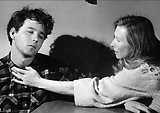 Last Line - Ruth to Sonny: "Never you mind, honey, never you mind" |
|||||||||||||||||||||||||||||||||
|
Straw Dogs (1971, US/UK)
This disturbing film further ignited controversy over screen violence and misogynistic sexual abuse of women in the early 70s, especially due to its graphic double rape scene, which led to a cathartic eruption and escalation of violence. It was re-edited for an R-rating and faced censorship bans in England for 30 years.
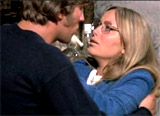
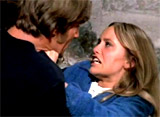
The unflinching film from Sam Peckinpah (following his equally divisive film The Wild Bunch (1969)) starred Dustin Hoffman as David Sumner, a bookish, mild-mannered American mathematician on sabbatical living in a rural England town - the childhood village of his teasingly-seductive young bride Amy (Susan George). To incite the sexual interest of local roof construction workers, Amy removed her sweater and deliberately stood topless in full view next to an upstairs window, although her husband had cautioned her: "Don't forget to draw the curtains." After she flaunted herself flirtatiously in view of the local townsfolk, in the scene preceding the rape (the first of two), the provocative Amy invited local laborer-thug (and ex-boyfriend) Charlie Venner (Del Henney) into her isolated farmhouse for a drink. He forcibly kissed her and although she protested unconvincingly ("Please leave me"). He dragged her by the hair to the sofa, as he struck her again and began tearing at her blue robe and continued kissing her. He tore her white top, leaving her breasts exposed, before he raped her.
The controversy stemmed from the idea that Amy was sexually excited by the aggressive violation that she was facing. The film was accused of implying that she brought on the assault (possibly as a means to insult her impassive husband) and actually might have enjoyed the first rape (a glamorization of rape). At first, she struggled and called out "No," but then surrendered to his kisses. In some ways, she didn't resist but submitted, although she was under tremendous duress. When he held her down, ripped off her panties and began removing his shirt, she helplessly begged: "Easy," and meanwhile fantasized about her husband above her. She showed obvious enjoyment and lovingly kissed her assailant and stroked his shoulders and chest during and after being entered, and begged for comfort: "Hold me." However, she was also shedding tears, feeling both humiliated and disgraced. Suddenly, Charlie was confronted by the barrel end of the shotgun pointed at him by fellow local workman Norman Scutt (Ken Hutchison). Charlie was motioned to get off Amy - who screamed boisterously when she realized she was going to be forcibly raped a second time. Charlie was ordered to hold Amy down by the neck as she was violated again - from behind. The climactic, stunning and barbaric ending also appeared to morally endorse vigilante violence, especially because of the main character's redemptive yet unsatisfying homicidal rampage. |
|
|||||||||||||||||||||||||||||||||
|
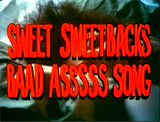
Sweet Sweetback's Baad Asssss
Song (1971)
This unconventional, revolutionary, and seminal blaxploitation film (released just before the Hollywood-financed Shaft (1971)) from the early 70s with an all-black cast was directed, co-produced, edited, scored, and written by African-American independent film-maker Melvin Van Peebles (his film debut) - he also starred as the macho black hustler title character. Peebles reportedly received VD during the making of this film. In Mario's own autobiographical film Baadasssss! (2003) years later about the making of the landmark independent film, he revealed the upset caused by the explicit scene he was forced to engage in. The Hollywood establishment refused to financially back this gritty, low-budget, sex-filled, realistic film with never-before-seen images, soft-core sex and inflammatory racial politics, so Peebles self-financed it (with $70,000 of his own money) and sought monetary backing from Bill Cosby ($50,000). It was the first highly profitable independent film made by a black filmmaker. It caused tremendous controversy for its militancy, under-age sex, anti-white sentiment, revenge-themes, and violence, although it was one of the most important black American films of the decade. It was exceptional that a vengeful black man (after witnessing corrupt police violence and almost beating two officers to death) could survive as a fugitive, as happened in the film. After he refused to submit the film to the ratings board (the MPAA), he rated his own film with an X-rating - and Peebles used this to his marketing advantage in its tagline advertising on posters: "Rated X By An All-White Jury!" However, only two theaters in the entire United States would screen the film at first - until it became a big hit and highly profitable. The radical Black Panthers praised the film, while the mainstream black-oriented Ebony Magazine denounced it - Hollywood studios were ultimately forced to acknowledge the monetary potential of the untapped, urban African-American market (similar to the effect Easy Rider (1969) had on its countercultural audiences) as a result of this influential film. The documentary-style, cheaply-made independent film (budgeted at $150,000), aimed at urban black audiences, was released by independent distributor Cinemation, and was shot on location in about three weeks. It was an anti-White, anti-authority diatribe. It was supplemented with jump-cuts, experimental lighting, split-screens, freeze-frames, zoom-ins, tinted and overlapping images and montages as it chronicled the successful (uncharacteristically) flight of a black fugitive nicknamed "Sweet Sweetback" (due to his large-sized manhood and insatiable sexual prowess) through Los Angeles - and toward and across the Mexican border. The film actually opened in an all-black brothel, where (in flashback, in the film's most controversial scene), an underaged, orphaned Sweet Sweetback as a 13 year-old minor (played by Melvin Peebles' own 13 year-old son Mario) was being fed by an older maternal black prostitute. (The scene was cross-cut with a quick image of the same character as an adult on the run underneath a city bridge - accompanied with the film's opening title: "This film is dedicated to all the Brothers and Sisters who had enough of the Man.") Then, young virginal Sweetback was coerced by one of the older black prostitutes to enter her room and have sex with her - explaining the derivation of his name when she said: "You've ... gotta ... sweet ... back!" The sex scene concluded and then opening credits rolled, stating that the film was "Starring THE BLACK COMMUNITY." It also contained an explicit sex scene of well-endowed Sweetback having unsimulated sex on stage in a brothel (with poorly-lit full-frontal nudity). The film ended with a shot of a hillside landscape with the superimposed text:
|
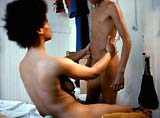 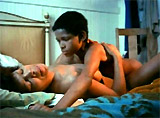  Scene of Initiation of Young Sweetback (Mario Van Peebles) 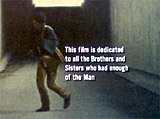 "This film is dedicated to all the Brothers and Sisters who had enough of the Man." 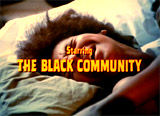 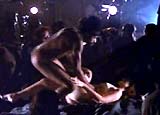 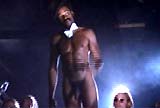 Older Sweetback (Melvin Van Peebles) 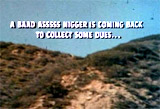
|
|||||||||||||||||||||||||||||||||
 The
100+ Most Controversial Films of All-Time The
100+ Most Controversial Films of All-Time(chronologically, by film title) Intro | Silents-1930s | 1940s-1950s | 1960-1961 | 1962-1967 | 1968-1969 1970-1971 | 1972 | 1973-1974 | 1975 | 1976-1977 | 1978 | 1979 1980-1982 | 1983-1986 | 1987-1989 | 1990-1992 | 1993-1995 | 1996-1999 2000-2002 | 2003-2005 | 2006-2009 | 2010-present |




 Moviegoers
expecting to be titillated were taken aback by this drama's raw,
taboo-breaking examination of misogyny and dysfunctional relationships.
Moviegoers
expecting to be titillated were taken aback by this drama's raw,
taboo-breaking examination of misogyny and dysfunctional relationships.