|
History of Sex in Cinema: 1971 |

|
The Beguiled (1971) Director Don Siegel's psychosexual western-horror drama was set in the Civil War period. The film's tagline descriptively stated: "One man...seven women...in a strange house!" The film was criticized as misogynistic. It starred Clint Eastwood as injured Union soldier Corp. John McBurney who took refuge in an all-female seminary school for prim and proper Southern girls, led by sexually-frustrated headmistress Martha Farnsworth (Geraldine Page). McBurney soon learned that the Gothic atmosphere in this matriarchal society was one of sexual repression, deceit, jealousy, and power struggle between a triangle of females vying for his love, attention, and sexual favors:
The manipulative McBurney (known as Mr. McB) was able to charm every one of the women - even 12 year-old Amy (Pamelyn Ferdin). Martha and Edwina were both jealous of Carol, who offered herself to the entrapped soldier. During a menage-a trois fantasy sequence (in Martha's mind?), McBurney was seen making love to Martha with Edwina next to him, and the two females shared a lesbian kiss. Abruptly, however, the scene changed and McBurney was viewed making love in a room above with Carol. The hotbed atmosphere of sexual repression, empowered females and vengeful jealousy led Edwina to violently attack him - and later led to further retaliation - a gruesome leg amputation with a hacksaw (and brandy as an anesthetic) and lethal poisoning. |
   McBurney (Clint Eastwood) with Carol (Jo Ann Harris) |
|||||||||||||||||||||||||||||||||||||||||||||||

|
The Big Doll House (1971) The vogue in the early 70s were low-budget sexploitative women-in-prison (WIP) films, such as this early and influential one by director Jack Hill, with the requisite nudity, violence, feministic attitude and lesbianism, and social grittiness. [Hill would later go on to direct up-and-coming star Pam Grier in the blaxploitation classic Coffy (1973).] This one was Roger Corman's second film produced by New World Pictures. The film's tagline expressed its main theme:
Its harsh sequel by director Gerardo de Leon, Women in Cages (1971) (co-produced by Roger Corman) featured basically the same setting, plot, and cast. A trio of WIP films was created when Jack Hill also directed The Big Bird Cage (1972). A group of six female inmates (the main stars) were incarcerated in a tropical jungle prison in the Philippines run by an unseen Colonel Mendoza, a member of the secret police. The penal institution was teaming with sadism from the head guard Lucien (Kathryn Loder) and cruel blonde warden Miss Dietrich (Christiane Schmidtmer), sometimes masked.
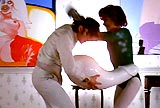
During the day, the prisoners were taken out to the fields to work. Caught for hiding contraband mail, Erica was subjected to water-torture, hung naked in a bamboo cage and whipped while topless, and nearly expired during the partially-hallucinatory scene. During a shower scene, Helen decided to subject Marni to her wishes, commanding her to wash her back. Karen enticed Fred (Jerry Franks), an American mercenary who sold goods to the prison (and brought in contraband), to watch her (through a frosted glass window) in a shower and touch herself. She was tortured by electrocution (clips attached to her breasts) after being found having sex at knifepoint with him (she had ordered rape, famously: "Get it up or I'll cut it off!"). Karen and Grear fought each other in a muddy sugar cane or rice field to establish dominance over Marni - Karen won the fight when she pushed Grear's face into the dirty water and forced her to submit. While many of the cellmates planned an escape, there were continual struggles within the prison - a food fight (and spraying with fire hoses), a starvation diet, more torture. Marni was tied down naked while a venomous cobra was dangled above her. The escape plan was abetted by Fred and a second mercenary named Harry (Sid Haig), and succeeded when the group took hostages: Lucien and the labor camp's ineffectual Dr. Phillips (Jack Davis). A number of deaths resulted - Grear, Harrad, Bodine, and Dietrich as the escape plan unfolded. |
 Marni's (Judith M. Brown) Prison Exam  Marni Tortured  Karen (Roberta Collins) Spied Upon by Fred 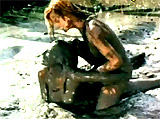 Mud Wrestling: Grear vs. Karen  Erica Bodine (Pat Woodell) Tortured |
|||||||||||||||||||||||||||||||||||||||||||||||
|
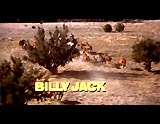
Billy Jack (1971) This martial-arts grindhouse film with a non-Asian lead title character (actor-writer-producer-director Tom Laughlin), a half-Indian, kung-fu-fighting, ex-Green Beret named Billy Jack, was a commercial success as a low-budget independent film. The character of peace-loving Billy Jack sought to protect the mistreatment of the students in a Freedom School, by combating rednecks, law enforcement and "the man.". It featured a few controversial scenes for its time including two scenes in which bigoted, mean-spirited mayor's son Bernard (David Roya) intimidated and assaulted two females:
|
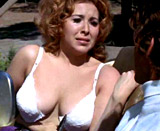 Miss False Eyelashes (Cisse Cameron/Colpitts)   Jean Roberts (Delores Taylor) |
|||||||||||||||||||||||||||||||||||||||||||||||

|
This Mike Nichols film with striking adult subject matter (regarding the fragile male ego and bravado, dysfunctionality, and misogyny), sexual encounters, and profanity further pushed the boundaries of sex in cinema although the film had little in the way of explicit sex. It challenged the ratings system and the general morals of the time. It was the subject of a major US Supreme Court rule in 1974 ruling that a local Georgia law prohibiting the distribution of the "obscene" material had gone too far. The film itself was an intense character study as it chronicled the sex lives of two friends:
It followed their difficult initiation into sex ("scoring" with coeds) during their 1940s student days at Amherst (with among others, Candice Bergen as the pretty and intelligent Smith College student Susan whom they both dated). Sandy awkwardly tried to feel Susan's breasts through her clothes during a date, details of which he later shared with Jonathan. In the meantime, Jonathan betrayed his friend and dated Susan ("Myrtle") and she lost her virginity to him, unbeknownst to Sandy, although eventually Sandy married Susan and had a family in a typical surburban setting. The story continued with playboyish Jonathan's later difficult relationship to voluptuous, big-breasted TV model Bobbie (Oscar-nominated Ann-Margret) who he first felt was his sexual salvation and soon became his live-in mistress: ("I took one look at the tits on her, and I knew I'd never have trouble again"). Jonathan soon resented Bobbie's hints at becoming more domestic and trapped-hitched, as she vulnerably drowned in depressing despair. He then berated and insulted her ("Answer me, you ball-busting, castrating, son of a cunt bitch! Is this an ultimatum or not?"). When she cried out and pleaded: "I want you!", he answered: "I'm taken --- by me!" He added: "For God's sake, I'd almost marry you if you'd leave me." In a revealing close-up, a naked Bobbie sat up against a blank wall (filmed from the chest up), lost in her own thoughts of depression, and soon after took an overdose of pills. The film then followed Jonathan into his divorced, burnt-out life in the late 60s and 70s, when he looked back and called ex-wife Bobbie "Queen of the Ballbusters." Meanwhile, Sandy was dating 18 year-old free-love advocate and hippie Jennifer (Carol Kane).
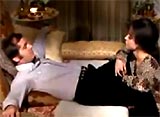
Finding himself dysfunctionally impotent, Jonathan resorted to using the services of paid prostitute Louise (Rita Moreno in a cameo) to massage his ego (and more) in the film's final scene. Obsessively, he had her recite a carefully-worded script (he yelled at her - "God-damn it! You're doing it all wrong" - when she deviated) while kneeling between his legs. After accepting payment of $100, and as he reclined back on a couch, she reassured him as she stroked his thighs: "I don't think we're gonna have any trouble tonight." She called him "a real man, a kind man" and then went on:
|
 Sandy with Susan (Candice Bergen)    Bobbie (Ann-Margret) |
|||||||||||||||||||||||||||||||||||||||||||||||

|
The Cat O'Nine Tails (1971, It.) (aka Il Gatto a Nove Code) This was one of the earlier Italian horror thrillers from Dario Argento, and he claimed it was one of his "least favorite" films - although it had an impressive score by Ennio Morricone and some effective Hitchcockian set-pieces. In the suspenseful murder mystery, James Franciscus starred as reporter Carlo Giordani, and Karl Malden as middle-aged, retired, blind puzzle enthusiast Franco Arnos, an ex-journalist. Together with Franco's young adopted niece Lori (Cinzia De Carolis) (who called Franco "Cookie"), they attempted together - in a private investigation - to solve a murder related to the genetic research/medical company (the Terzi Institute for Genetic Research) across from Franco's apartment. One of the Institute's scientists, Dr. Calabresi (Carlo Alighiero) had been suspiciously pushed, a victim of foul play, in front of a commuter train. The company's two most important, lucrative and top-secret projects involved manufacturing a "wonder" drug, and secondly, the use of an individual's genetic make-up to identify potential criminal tendencies (the rare XYY chromosome). There were a couple of other very gruesome death scenes, including a strangulation (with a cord), and an attempted poisoning (using tainted milk). The concluding death was of the maniacal and deranged killer himself, lab researcher Dr. Casoni (Aldo Reggiani), whom Carlo - in a fit of rage after being stabbed - pushed through a skylight on the rooftop of the Institute, where he fell down an elevator shaft to his death. In the midst of the case in an unusual sexual interlude, Carlo was romancing the adopted daughter of the research facility owner, icy and aloof Anna Terzi (Catherine Spaak). In one of the boldest pick-up lines ever, he asked:
As he began to unbutton his shirt, she unhinged the top of her dress on both sides and let it fall, shyly exposing herself to him. Soon, they were making love on the couch (blurred out in the background). |
   Anna Terzi (Catherine Spaak) |
|||||||||||||||||||||||||||||||||||||||||||||||

|
Director Stanley Kubrick's disturbing and controversial futuristic satire A Clockwork Orange (1971) was forced to be withdrawn from UK cinemas in 1973 after allegations that it was inspiring young people to copy its scenes of violence, including two controversial rape scenes. In the plot set in a futuristic, dystopic world of Britain, Alex (Malcolm McDowell) - an "ultraviolent" juvenile delinquent leader of a gang of four anarchic thugs ("droogs"), went on various crime sprees and rampages of rape, theft, assault and murder, intensified by Alex's love of Ludwig von Beethoven's music. They fought off a rival gang of five, led by Billyboy (Richard Connaught), that was in the midst of raping a buxom victim or 'devotchka' (Shirley Jaffe) on an empty opera house stage.
Then they came upon an ultra-modern house where they deceptively gained entry. Next came the abhorrent second scene - the assault and rape of the couple in the house. Both victims were bound and gagged, with a rubber ball painfully inserted into their mouths and wrapped with long strips of Scotch tape around their heads. The red pajama-suit-wearing writer's wife Mrs. Alexander (Adrienne Corri) was raped, while the elderly husband Frank Alexander (Patrick Magee) was assaulted and kicked on the floor by Alex who ironically punctuated his rhythmic, soft-shoe kick-dance with the lyrics of "Singin' in the Rain." He was forced to helplessly watch the ugly disrobing and choreographed rape of his own wife when Alex first attacked her breasts. He snipped off two circles of jumpsuit cloth around them to expose them and then in the mode of 'Jack the Ripper', he slit her entire suit off from her pant leg upward. After unzipping and pulling his own pants down prior to her rape, he mocked the husband: "Viddy well, little brother. Viddy well."
The stylishly-dressed Alex visited a local shopping mall record store, where he picked up two teenaged girls (brunette Marty (uncredited Barbara Scott) and redhead Sonietta (Gillian Hills)) licking lollipops; after inviting them to his home, in a sped-up, slapstick, group-sex orgy scene accompanied by the William Tell Overture, Alex had sex with both girls in his bedroom. There was also a gruesome murder with a giant phallic art sculpture that was conducted in a gallery filled with erotic paintings, when lead droog Alex (Malcolm McDowell) attacked Catlady (Miriam Karlin) with a over-sized porcelain dildo.
In other segments, Alex experienced an orgy dream of eating grapes while surrounded by half-naked, bare-breasted handmaidens (Jan Adair, Vivienne Chandler, Prudence Drage). That was all that was left to him, to feed his violent and sexual personality. He was also subjected to behavioral conditioning to once and for all prevent his violent and sexually aggressive tendencies and urges. In a second demonstration to the tune of Music for the Funeral of Queen Mary, he was tempted before a stage actress (Virginia Wetherell) - a half-nude woman wearing only bikini panties. Eyes glazed and on his knees, Alex lustfully reached out for her breasts (filmed both from a low angle and an overhead shot to emphasize their firm ripeness). As he cupped his hands tantalizingly close to her pink-nippled, fleshy protuberances, his urge for sex instantly turned to an urge to vomit and he fell to the floor belching to his former passion:
By the film's conclusion, Alex, now supposedly "cured," returned to his former self. An enigmatic dream-like image came on the screen after his eyes rolled back into his head - with both his free will intact and with his old proclivities for sex and violence. The final explicit scene emphasized the enormity of the state's hypocrisy. In his Ascot fantasy, a nude Alex had found peace and fantasized copulating (making love to/raping?) with a beautiful blonde woman (Katya Wyeth) astride him who wore only black silk stockings. They were frolicking in slow-motion on piles of white snow, while two rows of genteel-looking, Victorian Londoners (ladies and gentlemen), the men dressed in top hats and the women carrying parasols, looked on and sedately applauded toward them. Alex had reverted to his old, pre-conditioned behavior:
|
 Sped-Up Orgy Sequence With Two Teens in Alex's Bedroom  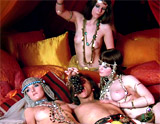 Fantasy of Eating Grapes with Bare Handmaidens (Prudence Drage, Vivienne Chandler, Jan Adair) 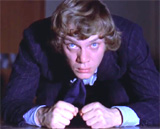       Alex Unable to Touch Breasts of Stage Actress (Virginia Wetherell) Without Feeling Nauseous 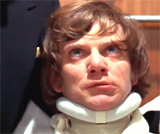  Final Fantasy with Blonde (Katya Wyeth) |
|||||||||||||||||||||||||||||||||||||||||||||||
|
Countess Dracula (1971, UK) Ingrid Pitt proved such a success in the Hammer film The Vampire Lovers (1970, UK) from the previous year (see Karnstein Trilogy feature) that she was immediately given the title role of Countess Elisabeth Nodosheen in this film the following year. It was a toned-down Hammer film (not technically a vampire film). It was based on the legendary story of Elizabeth (Erzsebet) Bathory - a Hungarian Countess who bathed in the blood of virgins to retain her youthful look. She accidentally discovered that blood spilt on her skin rejuvenated her. In one of the film's brief topless scenes, she emerged from her bloody bath naked, although she soon realized that the effects were temporary. |
  Countess Elisabeth (Ingrid Pitt) |
|||||||||||||||||||||||||||||||||||||||||||||||

|
Daughters of Darkness (1971, Belg.) (aka La Rouge Aux Levres, Blood on the Lips)
In this highly-stylized, erotic, art-house vampire film based upon Sheridan Le Fanu's lesbian vampire tale Camilla, it told of a newlywed couple staying at a deserted seaside hotel in Belgium during the off-season:
Other newly-arrived guests included:
Recently in the area, there was a string of murders of young girls whose blood was drained. Ultimately, the Countess had her sights on replacing Ilona with Stefan's wife, made easier after Valerie learned that Stefan was an abusive and sexual sadist (he beat her with a belt). Ilona was ordered to seduce Stefan, as a distraction, and she peeped on him naked as he took a shower. When he saw her, he playfully suspected she wanted to have sex and pulled her into the water. As they struggled (she knew what water would do to her), she screamed and grabbed his sharp razor-blade in her hand, bloodied herself, and then fell on the sharp instrument - killing herself.
Meanwhile, Elizabeth was seducing Valerie and vampirizing her, and the two conspired to kill Stefan. He died when a crystal glass dish neatly broke in two and slit both of his wrists, and the two 'daughters of darkness' sucked the blood from his arms ('blood on the lips'). By film's end, Valerie had taken on the spirit-persona of the Countess after she died by impalement on a tree branch following an automobile accident, speaking in her voice. |
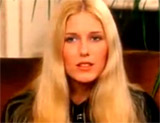  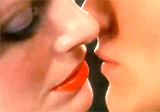 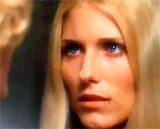 Valerie (Danielle Oiumet) 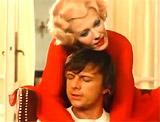 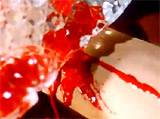 Death of Stefan |
|||||||||||||||||||||||||||||||||||||||||||||||

|
The Devils (1971, UK) Director Ken Russell's film was a blasphemous, shocking and excessive depiction of the repressive 17th century when sexuality was equated with Satanism - it was an adaptation of Aldous Huxley's "The Devils Of Loudon." The film was vilified and met with outrage in its story of a womanizing, vain, rebellious activist priest named Father Urbain Grandier (Oliver Reed). He impregnated and then abandoned nobleman's cousin Philippe (Georgina Hale), the daughter of a powerful city elder. He also married wealthy orphaned heiress Madeleine Dubroux (Gemma Jones) in secret, and then refused to remove the city walls around his fortified town. He faced questioning and persecution by Cardinal Richelieu (Christopher Logue) for witchcraft and sorcery. The only way the monarchy of Inquisition-obsessed France could destroy the Protestant-leaning French town of Loudon was to attack the liberal religious leader as a sorcerer and practitioner of witchcraft. He was discredited and accused of "diabolic possession" by the local repressed Ursuline nuns who were led by tormented, sexually-hysterical, sexually-obsessed, hunchbacked Mother Superior Jeanne des Anges (Vanessa Redgrave). She had unfulfilled, warped sexual desires (and vivid fantasies) for Grandier and expressed them through self-mutilation and self-flagellation. In the film's most fantastic vision, Grandier (as Christ) stepped off the cross on which he had been crucified, so that Mother Jeanne could lick his wounds.
During a public exorcism, the wicked, repressed and deformed Sister Jeanne confessed to depraved witch-hunter Father Pierre Barre (Michael Gothard) that Father Grandier was responsible for her bewitching possession, and that he had violated her. Barre had been dispatched to question, torture (headscrews, nails into hands, etc), tie up, and execute the profligate priest. Sister Jeanne was physically examined for proof of sexual violation - in one of the film's most memorable scenes. She was laid on the altar and penetrated by intrusive metal instruments, causing her to scream and bleed, after which it was declared that she had been violated. With bloody hands and lascivious smiles, the examiners concluded: "There's been hanky-panky." Father Barre insisted that the Beast had to be exorcised from her body, and he put her in a choke hold. On the altar, she was injected with a hot-liquid enema, as her legs were forcibly spread wide open. She blamed her possession on the priest - Father Grandier. It was concluded that Father Grandier was guilty as charged.
In one of the film's most shocking (and censored) scenes - a staged exorcism in Loudon's cathedral, the nuns acted as if they were possessed in front of masked townspeople. Dubbed the orgiastic "Rape of Christ" sequence (intercut with a scene of Grandier conducting a simple mass for himself by a river-bank), the crazed Ursuline nuns were whipped into a sexual frenzy of hysteria by Barre. They displayed full-frontal nudity when they removed their habits, cavorted naked, and masturbated with (or raped) a large-sized crucifix or effigy of Jesus that they had pulled down from the wall. They began to lick the enormous crucifix, and with their writhing naked bodies, some of the nuns ground their genitals over all parts of the wooden statue to pleasure themselves. One group of nuns let themselves be groped by male townsfolk, and others attacked and 'raped' a priest. Father Mignon (Murray Melvin), who climbed a staircase to perch himself for a better view far up in the cathedral, watched from afar and committed desperate self-abuse under his robe - (the two and a half-minute scene was excised prior to the film's release). As he did so, a frenzied nun also suggestively stroked, rubbed and gripped a large altar candle between her legs. The camera zoomed in and out rapidly to portray his ecstasy and madness as he watched the masses of naked female bodies surrounding the Jesus statue.
Meanwhile, the defiant rebel priest Father Grandier was brought to trial - was condemned for witchcraft, and bound for the fiery stake. Grandier was forced to crawl or be dragged to the funeral pyre set up for his execution, because his legs had been broken. Meanwhile, the crazed, self-righteous priests shouted out: "Confess! Confess! Beg forgiveness." Grandier responded: "Forgive me for defending your city so badly....I have finished confessing. Give me the kiss of peace and let me die...I am about to meet the God who is my witness. And I have spoken the truth." The executioner (who had promised to strangle him with a noose so he could avoid torturous pain) was unable to, when Barre lit the pyre prematurely, and the hysterical priest cried: "May your body be consumed by eternal fire". Grandier's death was gruesome to watch, as his body was licked by flames - his flesh blistered and he was burned to death. A scene at the end of the film was mostly edited out - of Sister Jeanne being handed the charred thighbone of Grandier after his execution - a "souvenir." There was no doubt what she would use it for - as a dildo for masturbatory purposes. |
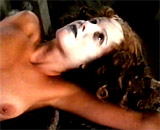 Father Grandier (Oliver Reed) with Philippe (Georgina Hale)  Father Grandier with Madeleine (Gemma Jones) 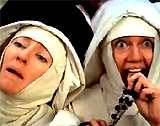    Sexually-Crazed Nuns  Deformed
(Hunch-backed) Sister Jeanne des Anges Deformed
(Hunch-backed) Sister Jeanne des Anges   Witch-hunter Father Pierre Barre's (Michael Gothard) Exorcism of Sister Jeanne des Anges  After Grandier's Burning at the Stake, The Presentation of His Charred Thighbone |
|||||||||||||||||||||||||||||||||||||||||||||||
|
Director Don Siegel's sensational film was a seminal vigilante film of the decade, appealing especially to male audiences because of its overt violence and occasional glimpses of full nudity. The main combatants in the crime film were:
In one scene during his investigation at night, Harry (standing on a garbage can) looked up into an apartment window and saw a bare-breasted female. He was accused by concerned neighbors of being a "lousy" peeping Tom after viewing half-naked Hot Mary (Lois Foraker) and her boyfriend, and getting an "eyeful". Harry's partner, Mexican-American cop Chico Gonzales (Reni Santoni), rubbed it in: "I just had another thought...about why they call you Dirty Harry." Also, as Harry was scouring the neighborhood with binoculars to locate Scorpio, he was distracted when he caught sight of a naked young girl (Ann Noland, uncredited) greeting two hippies at her door. He thought to himself: "You owe it to yourself to live a little, Harry." In the Roaring 20s Strip Club in San Francisco which Harry sometimes frequented, a Nude Stripper (Lolita Rios) performed on a stage, on a red bed.
One of Scorpio's victims of rape, kidnapping (and murder) was 14 year-old Ann Mary Deacon (Debralee Scott). Her nude corpse was found in the bluish dawning light, in the Marin Headlands on the other side of the Golden Gate Bridge. She was hauled out from her 'grave' (a hole in the ground), laid on a stretcher, and covered with a blanket. |
 Hot Mary (Lois Foraker) 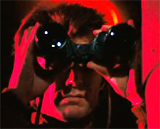  Harry Spying on Hippie Girl (Ann Noland): "You Owe It To Yourself to Live a Little, Harry" |
|||||||||||||||||||||||||||||||||||||||||||||||

|
Dr. Jekyll and Sister Hyde (1971, UK)
This Hammer Studios sci-fi horror film took advantage of the title of the familiar 1886 Robert Louis Stevenson tale about a Victorian London doctor with a dual personality, and teased with this warning:
The gender-bending film starred Ralph Bates as reclusive Dr. Henry Jekyll, who experimented with female hormones (from fresh corpses) for his magical elixir (an immortality serum), causing his transformation to unpredictably alter both his personality and sex. In the film's most gratuitous scene, a transformation scene, Dr. Jekyll took the potion and turned into Mrs. Edwina Hyde (Martine Beswick). He/she looked at herself in astonishment in a mirror, where he/she saw breasts. Hyde hugged him/herself and laughed out loud. He continued to fondle himself (through his clothes), then squeezed his/her left breast, but in horror realized that the fondling right hand was hairy and masculine. Dr. Jekyll became a murderous and jealous Sister Hyde female (aiding his quest for more hormones by killing prostitutes), whom he claimed was his widowed sister. The plot became interesting when Jekyll fell in love with upstairs neighbor Susan Spencer (Susan Brodrick) and Hyde carnally lusted after her roguish brother Howard (Lewis Fiander). |
 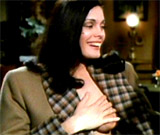 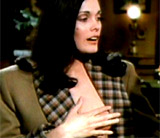 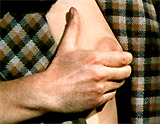 Mrs. Hyde (Martine Beswick) |
|||||||||||||||||||||||||||||||||||||||||||||||

|
During the "New Hollywood Wave" of films, actor Jack Nicholson directed (and scripted) this R-rated basketball drama that was loosely based upon Jeremy Larner's 1964 novel of the same name. It combined many different strands or subjects -- college basketball, insanity, anti-war protest and student rebellion, and sexual obsession. Nicholson's first solo directorial debut came after his successes in Easy Rider (1969) and his major starring role in Five Easy Pieces (1970). Later in his career, he also directed Goin’ South (1978) and the sequel to Chinatown (1974) - The Two Jakes (1990). This effort was released in the wake of other counter-cultural college films that flopped, such as Getting Straight (1970), The Strawberry Statement (1970), R.P.M. (1970) (aka Revolutions Per Minute) and The Revolutionary (1970). Columbia Pictures' film with explicit sex scenes (and rampant male nudity) was originally rated X - the studio's first such designation, but then downgraded to an R-rating after the ruling was appealed. After its release, it was quickly withdrawn from circulation after receiving poor reviews (it was widely criticized for its incoherent, anarchic, jumbled and disorganized plot, and for its anti-social protest stance). The tagline was based upon the protagonist's advice to younger kids:
It was a story of two dormitory roommates in the 1960s in Ohio:
In the film's opening scene, Gabriel led and staged a theatrical, guerrilla-styled mock raid in the midst of one of Hector's team basketball games being played in an arena. Gabriel was arrested and jailed, and overtly taunted one of the campus officers after being asked how it felt to be behind bars: "You're in jail, buddy." The locker room shower scene after the opening scene's game was considerably controversial at the time for its full-frontal male nudity. During the sequence, players were yelling at each other, making sexual jokes ("Why does mine get bigger when I soap up?"), and one black man pinched another man's butt. The one who was pinched began to touch his flaccid penis, and then hung from a pipe, opened his legs, and stroked himself.
In another set of sequences, Gabriel was with his hippie college student girlfriend Sylvie (June Fairchild). He annoyed her when he pointed his flashlight at her to illuminate her toplessness, while complimenting her: "You've got great tits, baby." The antagonistic Gabriel was also dismissive of Hector's love of sports: "Hey, why don't you drop all this rah-rah jive game number, huh?" but Hector rebuffed him: "The game is not jive to me." Gabriel furthered his rejection: "To you it's poetry. To me it's staying after school in your underwear. That's why you're here. A hang-up, a game. We're gonna tear the mother down, man." He also criticized Hector's affair with Olive: "And you're hung up on a bitch!", insisting that Olive was distracting him from being a true revolutionary. Later, he told Hector: "You're living in a diseased culture." During a medical evaluation for induction into the Army, Gabriel had deliberately remained awake for days in order to make himself crazed. He insulted the attending psychiatrist (Mark Malinauskas): ("You miserable cop-out. You're the lowest tub of guts in this rotten place, man. You and the rest of your headshrinkers and mummy-makers who endorse this war and Army death number, man"). And then he yelled out: "You're so much a piece of twisted s--t, It's not to be believed, man. I'd like to puke in your face" - and then attacked him. His deliberate intention was to disqualify himself due to a mental breakdown (similar to a sequence in Alice's Restaurant (1969)). After the failed draft exam, the increasingly-paranoid Gabriel moved out of his apartment, and visited Sylvie in her living quarters. While watching a NASA parade on TV, he spouted a conspiratorial theory to her that he had been sterilized by the government: ("We're being sterilized by the death ray. Our brains are literally being electrified into neon gas by this piece of history, HAH! History, my balls. My balls are history. They faked the whole god-damn moon shot...Do you hear that people, people of America?"). He destructively thrashed her apartment with a samurai sword - and caused her to flee and become terrified of him. During one of Hector's games (in a scene with cross-cutting), Gabriel focused his anger against Olive - and broke into her darkened house while wearing a nylon stocking-mask. He attempted to physically assault and rape her in the bathtub. Both laughing and screaming with hysteria, she fought back and raced outdoors in a dark red robe, where her husband Richard was pulling up with Hector.
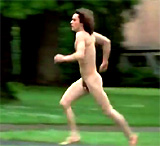
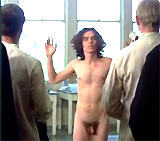
Later in the film's final scene, Gabriel (now totally mad) ran - stark naked and full-frontal nude - across the campus into the university's biology lab to free or "liberate" caged lab animals (including snakes, cockroaches, centipedes, mice, lizards, spiders, turtles, frogs, etc.) before he was confronted by white-coated attendants and officers with a strait-jacket and blanket. He asserted: "I want you to know one thing, that I'm totally sane. Understand? I'm seeing you exactly as you're seeing me. I'm sane, I'm right, and I'm sane." He was peacefully apprehended when he surrendered, wrapped in a blanket and judged insane, before he was led to the back of a padded wagon to be taken to an asylum. [The scene foreshadowed Nicholson in One Flew Over the Cuckoo's Nest (1975).] As he was being driven off, Hector jumped on the back of the ambulance, but then dropped off and yelled to him through the window as the vehicle pulled away: "Your mother called." |
 Gabriel's Hippie Girlfriend Sylvie (June Fairchild) 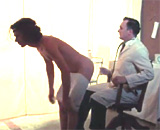 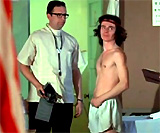 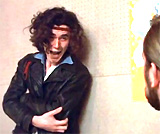 The Army Induction Scene: "I'd like to puke in your face, man!" 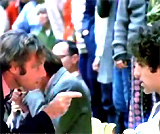 Coach Bullion's Criticism of Hector for His Bad Attitude and Play  Gabriel Ranting At Sylvie - Before Smashing Her Apartment With a Samurai Sword    Bathtub Sequence - Rape/Assault by Gabriel on Olive (Karen Black)  Hector: "Your mother called!" |
|||||||||||||||||||||||||||||||||||||||||||||||
|
This R-rated, sexually-frank romantic teen drama and coming-of-age story was directed by Lewis Gilbert. It told about an idealistic (natural and healthy?), superficial, fanciful and romantic 'Romeo & Juliet' relationship between a teenaged couple. It served as the precedent for other tween romances, after the success of Franco Zeffirelli's Romeo and Juliet (1968) and Love Story (1970), including George Roy Hill's A Little Romance (1979), and two films starring Brooke Shields: Randal Kleiser's The Blue Lagoon (1980) and Zeffirelli's Endless Love (1981). Its tagline was: "Who Needs the World When You Own the Moon and Stars." Both teens were alienated by the adult world, coincidentally met, and fell in 'first love':
The notorious film was noted for an Elton John soundtrack (and hit title song) and controversial nude scenes (whether they were prurient or naively innocent was debatable) between its very young performers. It opened under the credits (with the Elton John title song 'Friends') with newly-orphaned school-girl Michelle placing flowers on a grave, after her mother died during childbirth. She was taken in by her older cousin in a Montmartre apartment in Paris, but found that the living conditions were difficult. She was approached by her cousin's boyfriend while undressing, and often witnessed huge arguments between the adults. The two young people happened to meet at the outdoor monkey exhibit at the local Parc Zoologique.
In the simple narrative, the two attempted to make it together over a year's time by running away to a remote yet idyllic cottage (owned by Michelle's father) in the marshland region of the Camargue. They took up housekeeping chores and duties in the quaint 'Garden of Eden' story, struggling to live like adults. Once Michelle became pregnant (she giggled to Paul: "Of course I'm pregnant! I always wanted to be!"), they decided to birth the baby at home. With a doll in her arms, Paul helped to deliver the baby (named Sylvie), and they kept it in a wooden crate, substituting for a cradle, and baptized it in an empty church. At one point, Michelle breast-fed the baby. As the film ended in a freeze-frame, Paul waved farewell to Michelle on his way to work in a local vineyard - where he was about to be apprehended by a police inspector since his father had been looking for him and was intent on forcibly separating the two lovers. It was followed by the sequel Paul and Michelle (1974), with a jazz score by Michel Colombier. The follow-up film eventually brought Paul and Michelle together again in Nice, France after a three year separation. She was living with Garry (Keir Dullea), an American airline employee, who had taken up a 'fatherly' role regarding the growing child. Paul and Michelle (with the child) returned to the white cottage in the Camargue to attempt to relive their idyllic beginnings. Later, they set up a new home in an attic apartment in Paris surrounded by hippie drug-users, where they suffered the effects of urban life, and Paul faced a tough job in a meat-packing plant. Eventually in the bleak ending, they separated again - Michelle and the child returned to the cottage, while Paul remained in Paris to finish his degree. |
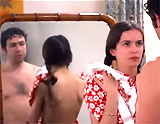 Privacy Invaded  Stripping in Front of Fire  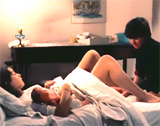 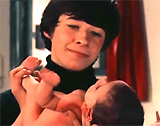 Childbirth Sequence  Michelle Breast-Feeding |
|||||||||||||||||||||||||||||||||||||||||||||||
|
Get Carter (1971, UK) Writer/director Mike Hodges' noirish and gritty crime drama-thriller (Hodges' debut directorial feature film) told about small-time, charming British gangster and enforcer-hitman Jack Carter (Michael Caine) involved a tale of blackmail, death, and betrayal. A remake with Sylvester Stallone in the Caine role, Get Carter (2000), was poorly received. The highly-acclaimed tough action film was originally rated "X" for violence and female nudity, then re-classified later as "R." Carter sought revenge for the suspicious murder/death of his brother Frank, and he was also attempting to get his niece Doreen (Petra Markham) out of the pornographic film business. After Doreen was coerced into participating in the illicit activity, Frank found out and threatened to tell authorities - and he was eliminated. [The plot also revealed that there was the possibility that Doreen was actually Jack's daughter.] At the same time that he investigated the unusual death, he became involved with Glenda (Geraldine Moffat), the drunken and promiscuous mistress of northern crime lord Cyril Kinnear (John Osborne), and an actress in Kinnear's porno films. (After having sex with Glenda, he realized that she had co-acted with his coerced niece in one of the pornos - enraged, he furiously half-drowned her in her sudsy bathtub.) The film's most notorious segment was a lengthy phone sex sequence between Carter and his boss Gerald Fletcher's (Terency Rigby) London wife - Anna Fletcher (Britt Ekland). Carter had plans for her to be his "fiancee" and to run off with her to South America in a week's time. His Newcastle boarding house landlady Edna Garfoot (Rosemarie Dunham) was moving back and forth in a rocking chair in front of Carter as he made the erotic telephone call. As he fixed his eyes on the eagerly-listening Edna and seduced her verbally, Anna followed his directions. First seen wearing only lacy black leggings, black panties and a black bra, she unhooked her bra, laid on the bed and pleasured herself by touching herself while Carter talked to her. He instructed her to touch and hold her breast and imagine that it was him touching her. She was forced to pretend that she was doing 'exercises' and talking with girlfriend Janet when Gerald walked in, heard her groaning, and asked: "You got gut trouble or somethin'?"
|
     Carter with Glenda (Geraldine Moffat) |
|||||||||||||||||||||||||||||||||||||||||||||||
|
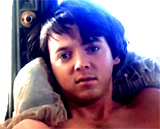
Harold and Maude (1971) Hal Ashby's black comedy was an enormously popular cult movie about an unusual couple with an eccentric, unconventional, inter-generational romance between:
|
   Harold The Morning After Sleeping with Maude |
|||||||||||||||||||||||||||||||||||||||||||||||
|
Klute (1971) "Hanoi Jane" redeemed herself in this Alan J. Pakula film noir thriller and won the Best Actress Oscar. Jane Fonda was one of many such actresses who were nominated for or won an award for playing a prostitute, including Elizabeth Taylor for Butterfield 8 (1960) and Mira Sorvino in Mighty Aphrodite (1995). This film realistically depicted the world of pimps, high-rollers, prostitutes, and drug-addicts, with a few semi-nude scenes. She portrayed a troubled, self-destructive, and independent high class NYC call-girl named Bree Daniels, an emotionally-contradictory female whose life was threatened. One indelible scene showed Bree with a paying client as she moaned authentically, took a quick peek at her watch, and then moaned some more. The cold-hearted character described her empowerment as a call girl to her therapist:
|
  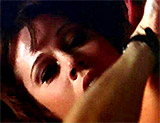 Bree (Jane Fonda) |
|||||||||||||||||||||||||||||||||||||||||||||||

|
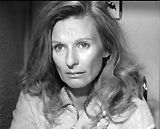
The Last Picture Show (1971) Critic turned director Peter Bogdanovich's best and most realistic, black-and-white drama The Last Picture Show (1971) provided a melancholy look at adultery, alcoholism and promiscuity in 1950s Texas; it was about life and rites of passage of the inhabitants of small, dying Texas town of Anarene from late 1951 until about a year later, and their many dreams and shattered loves; it was based upon Larry McMurtry's 1966 semi-autobiographical novel of the same name; most of the characters were high-schoolers who were dealing with the thoughts of their future beyond the isolated, dismal and bleak town; although the adult-themed film was nominated for eight Oscars (with two wins for supporting performers), some considered it obscene for its full frontal nudity and explicit sexual situations. The co-captains of the HS football team, Texas high-school seniors Duane Jackson (Jeff Bridges) and Sonny Crawford (Timothy Bottoms), who lived together in a boarding house, often visited with the town's aging patriarch - old-timer, ex-cowboy Sam 'The Lion' (Oscar-winning Ben Johnson), owner of the local pool hall and theatre, to ponder their uncertain futures; Sonny was tasked with taking care and watching over his mentally retarded, mute brother Billy (Sam Bottoms, Timothy's real-life brother); often, the youths would meet up with the cafe's salty-tongued waitress Genevieve (Eileen Brennan).
In various sexcapades in Duane's and Sonny's shared pickup truck (after attending the town's "picture show" on Saturday date night with their girlfriends), Duane was dating rich, self-centered, and pretty town tease Jacy Farrow (Cybill Shepherd in her film debut), whose alcoholic mother Lois (Ellen Burstyn), while providing her with a poor role model, was having an affair with attractive but dissolute oil driller Abilene (Clu Gulager).
Meanwhile, Sonny was in a short term relationship with his unattractive girlfriend of one year Charlene Duggs (Sharon Taggart, aka Sharon Ullrick); they customarily drove to a lover's lane area and listened to the radio, for awkward petting in the pickup truck; this Saturday night, she methodically removed her own sweater (he unhooked her pointed bra and hung it on the rear-view mirror), and as usual, she routinely permitted him to cup her full right breast (with his cold left hand) while they kissed; however, this time, she angrily asked: "What's the matter with you? You act plain bored" - and he decided to break up with her. Over a period of time, Sonny became acquainted with depressed, middle-aged, low-self-esteemed Ruth Popper (Oscar-winning Cloris Leachman), the wife of his basketball coach Coach Popper (Bill Thurman); after a few visits to her place, he proceeded to get involved in a lengthy affair (and lose his virginity) with her; they embarrassingly kissed standing up and then hurriedly and self-consciously undressed (without looking at each other) in separate areas of the bedroom; once in bed and under the covers, she permitted Sonny to proceed with having sex: "It's all right"; during furtive love-making, the bed's squeaky springs poignantly reflected Ruth's inner anguish and pain as she cried and gave her heart to him. In a high school classroom, the English teacher (John Hillerman) read a Keats poem to his disinterested class of teens: ("When old age shall this generation waste Thou shalt remain, in midst of other woe Than ours, a friend to man To whom thou sayest, 'Beauty is truth, Truth Beauty' That is all ye know on Earth And all ye need to know"). At the town's annual Xmas dance attended by some of Jacy's country-club friends, she was invited by Lester Marlow (Randy Quaid) to attend a private, teenaged midnight skinny-dipping indoor pool party taking place in nearby Wichita Falls, TX; to end her date with boyfriend Duane who had just given her an expensive watch as a Christmas present, the conniving Jacy told Duane that her mother had ordered her to attend Lester's swimming party. After driving off with Lester, in the film's most controversial scene, the sexually-adventurous neophyte Jacy arrived at the party held at the home of wealthy Bobby Sheen (Gary Brockette), without Duane's knowledge; at the party, she was greeted as a 'new victim' by the stark naked host with his nude girlfriend Annie-Annie Martin (Kimberly Hyde), who asked: "Wanna join the club?" Jacy was challenged to get undressed out on the diving board as part of her initiation rites ("So everybody gets to watch"); expectantly, the whole naked group of teenaged boys and girls eagerly sat by the edge of the pool to watch "the strip show" - she nervously and gingerly removed many articles of clothing, almost fell off the diving board, and then with one dramatic gesture, yanked off her bra top and flung it on top of her pile of clothes; finally, she was cheered as she hopped into the water - completely naked; she had succeeded in attracting the attention of the rich kids - and in particular, the young playboy.
Duane and some of the other town boys unwisely sought to help Billy lose his virginity by setting him up with a local waitress Jimmie Sue (Helena Humann); the experience went poorly with the confused and disabled young boy in the back seat of a car, and he ended up with a bloody nose; the incident caused a brief falling-out between Sam and the town's youth, who denounced their "trashy behavior" and refused to have them enter his businesses (pool hall, cafe, and theater) for awhile. At the old tank dam on an overcast New Years' Eve day, in the film's most memorable single sequence, while Sam was fishing with Sonny and Billy, he delivered a monologue about his recollection of the idyllic "old times" and his one true love; he remembered a "crazy" youthful romance with a girl who swam nude with him in the water: ("You wouldn't believe how this country's changed. First time I seen it, there wasn't a mesquite tree on it, or a prickly pear neither. I used to own this land, you know. First time I watered a horse at this tank was more than forty years ago. I reckon the reason why I always drag you out here is probably I'm just as sentimental as the next fella when it comes to old times. Old times. I brought a young lady swimmin' out here once, more than 20 years ago. Was after my wife had lost her mind and my boys was dead. Me and this young lady was pretty wild, I guess. In pretty deep. We used to come out here on horseback and go swimmin' without no bathing suits. One day, she wanted to swim the horses across this tank. Kind of a crazy thing to do, but we done it anyway. She bet me a silver dollar she could beat me across. She did. This old horse I was ridin' didn't want to take the water. But she was always lookin' for somethin' to do like that. Somethin' wild. I'll bet she's still got that silver dollar....Oh, she growed up. She was just a girl then, really"). At the end of the monologue, he explained why he didn't marry her - she was already attached: ("She was already married. Her and her husband was young and miserable with one another like so many young married folks are. I thought they'd change with some age, but it didn't turn out that way"); he concluded that marriages were often miserable and failed ("About eighty percent of the time, I guess"); he also lamented the coming of old age: ("If she was here, I'd probably be just as crazy now as I was then in about five minutes. Ain't that ridiculous? Naw, it ain't really. 'Cause bein' crazy 'bout a woman like her's always the right thing to do. Bein' a decrepit old bag of bones - that's what's ridiculous - gettin' old"). In order to work her way into Bobby's group of friends in Wichita Falls, Jacy approached Bobby privately, although he arrogantly rejected her after learning that she was still a virgin: ("Come and see me when you're not"). Following a New Years' weekend trip to Mexico by Duane and Sonny, the hung-over and exhausted teens returned to town two days later after wild partying; they were stunned to learn that in their absence, Sam had suddenly died from a stroke; he had willed to pool hall to Sonny, and the theatre to concession stand worker Miss Jessie Mosey, and the cafe to Genevieve; later, there was a cascade of misfortunes that followed in the wake of his death (i.e., the closing of the local movie house and the pool hall). By the spring during the senior class picnic, the town's ravishingly beautiful, calculating, fortune-hunting Jacy had decided to give up her virginity to Duane in the Cactus Motel, so that she could advance onto Bobby; during their pre-arranged rendezvous and sexual encounter - she laid back on the motel bed and half-closed her eyes as she encouraged him to take her virginity: "Oh Duane, hurry"; but then asked annoyingly: ("Aren't you gonna do it?...What do you mean? How could anything be wrong? Just go on and do it"); aggravated by the aborted love-making when he became limp and impotent and was unable to perform, she blamed his Mexico trip for his inability ("No telling what you got down there. I just hate you. I don't know why I ever went with you"), and ordered him to dress: ("You think I wanna sit around here and look at you nekkid?"). Jacy feared that she might "never get to not be a virgin" - and thereby win Bobby Sheen's heart; she was also worried that classmates might ridicule them when they found out about their unsuccessful and clumsy encounter, and she confirmed what her mother had forecast: "I think you're the meanest boy I ever saw. My mother was dead right about you"; she instructed him to "not tell one soul - you just pretend it was wonderful," and then threw her panties at his face; afterwards she gushed to her admiring girlfriend-classmates: "I just can't describe it in words." After graduation ceremonies for the Senior Class of 1952, Duane assured Jacy that he was now ready ("But I can do it now, I know I can"); at the same motel, Jacy gave Duane a second chance to deflower her - using him to provide an entree to dating Bobby Sheen; this time, Duane succeeded without an audience outside to witness the post-rites of passage; soon after, Jacy coldly broke up with Duane (who left town with furious frustration to take a wildcat oil rigging job), and further pursued her plan to snare Bobby, but she ultimately failed when he abruptly dropped her and married his girlfriend. Disappointed with herself, and late on a Saturday night, the provocative, over-sexed Jacy enticed her father's older business partner Abilene, her mother's sex partner, to let her join him inside the town's dark and closed-up pool-hall; he removed her shorts and underwear and had sex with her on a pool table - while her hands grasped the two corner pockets behind her; after he drove her home, he coldly refused to kiss her: "How about hoppin' out?"
Later after returning home, Jacy's mother Lois had a look of pained shock and disappointment realizing that her daughter had slept with Abilene; to break them up, Lois encouraged Jacy to set her sights on Sonny (who always had a secret infatuation for her) - and end his well-known affair with 40 year-old Mrs. Popper. The opportunistic Jacy proceeded to quickly seduce Sonny into leaving Mrs. Popper (after six months together); the older woman soon sensed that Sonny had moved on from her; the relationship between Sonny and Duane also deteriorated when he learned that Sonny had been "goin' together" with Jacy that summer during his absence; they quarrelled and physically scuffled together over Jacy's allegiance, and Sonny was briefly hospitalized after being hit with a beer bottle in the face and nearly blinded; Duane decided to join the US Army.
Double-crossing Jacy's runaway plan worked (and she even alerted her parents with a note) - she would elope with Sonny and head toward their honeymoon at Lake Texoma on the Oklahoma/Texas border; she predicted her parents and state officers would apprehend them, thwart the marriage and annul it before consummation - and Jacy would be sent away to college in Dallas; Sonny was returned to Anarene with Lois in Jacy's convertible; once back in Anarene, Lois confessed to Sonny that she was Sam's old flame, and that she fondly recollected their time at the tank together. Meanwhile by the fall of 1952, Duane had briefly returned home for a short military leave; Sonny and Duane reconciled as strong friends with each other and attended the 'last picture show' in the soon-to-close theatre in town - Howard Hawks' western Red River (1948) before Duane's deployment to fight in the Korean War; Sonny said goodbye to Duane as he boarded a bus early the next morning.
Afterwards, as Sonny was in the pool hall, he heard a loud truck horn and the screeching of brakes; outside, Sonny's mentally retarded brother Billy senselessly died when he was hit by a truck in a hit-and-run accident -- Sonny gave an anguished cry: ("He was sweepin', ya sons of bitches. He was sweepin'!") - before covering Billy's body with his letter jacket; Sonny was numb with horror, grief and shock. Deeply depressed, everything in Sonny's life seemed to have now disintegrated: Duane's departure, Billy's death, and Jacy's permanent move to Dallas for school; for consolation, he drove to Ruth Popper's house to make amends after many months; the abandoned and long-suffering Ruth - surprised by his visit - delivered an explosive tirade at Sonny for abandoning her when he returned to her after Billy's death: ("I'm sorry, I'm still in my bathrobe. What am I doing apologizing to you? Why am I always apologizing to you, you little bastard?! Three months I've been apologizing to you without you even bein' here! I haven't done anything wrong. Why can't I quit apologizin'?! You're the one oughta be sorry! I wouldn't still be in my bathrobe if it hadn't been for you. I'd have had my clothes on hours ago. You're the one made me quit caring if I got dressed or not! I think it's just because your friend got killed, you want me to forget what you did and make it all right? I'm not sorry for you. You'd have left Billy too, just like you left me. I bet you left him plenty of nights whenever Jacy whistled. I wouldn't treat a dog that way. I guess you thought I was so old and ugly, you didn't owe me any explanation. You didn't need to be careful of me. There wasn't anything I could do, so why should you be careful of me? You didn't love me. Look at me. Can't you even look at me? See? Shouldn't have come here. I'm around that corner now. You've ruined it. It's lost completely. Just your needin' me won't make it come back").
In the final moments of the film, Ruth empathically realized Sonny's pain, forgot her anger, and realized that he was begging for forgiveness - she bravely and hopefully took him back and comforted him: ("Never you mind, honey, never you mind..."). |
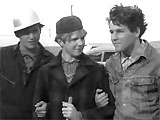 (l to r): Duane (Jeff Bridges), Mute Billy Crawford and Sonny Crawford 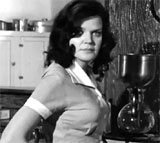 Cafe Waitress Genevieve (Eileen Brennan) 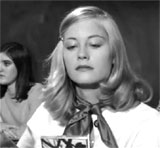 Vain Jacy Farrow (Cybil Shepherd) in Classroom 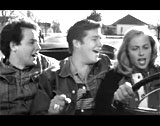 Threesome: Sonny, Duane, and Jacy 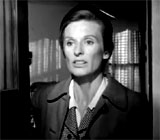 Ruth Popper (Cloris Leachman) - Coach's Wife 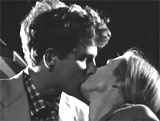 Sonny's Passionate First Kiss with Ruth After Xmas Dance 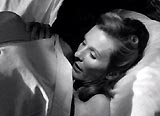 Sonny's Affair with Ruth Popper 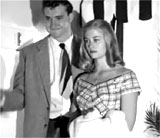 Lester and Jacy Arriving at the Nude Pool Party 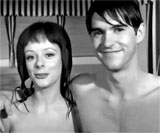 Host Bobby Sheen with Girlfriend Annie-Annie Martin (Kimberly Hyde): "Wanna join the club?"  Billy With Bloody Nose After Forced to Make Out with Local Waitress in Car  Sam's Denouncement of Boys' "Trashy Behavior"  Sam's Eloquent Monologue at the Old Tank Dam to Sonny About a Long-Lost Love  Duane's and Sonny's Reaction to Sam's Sudden Death During Their Mexico Trip 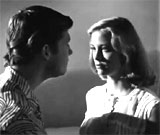 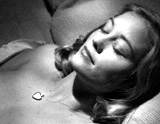 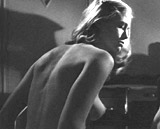  Jacy and Duane's Failed First Sexual Encounter in Motel Room 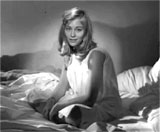 Jacy to Her Girlfriends: "I just can't describe it in words"  After Jacy and Duane's 2nd Successful Attempt at Sex After Graduation  After Jacy's Sexual Experience with Abilene in Pool Hall: "How about hoppin' out?"  Jacy Persuaded By Her Mother to Seduce Sonny   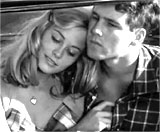 Sonny Enticed Away From Mrs. Popper by Jacy 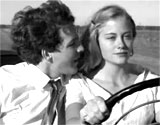 Jacy's Contrived Elopement Plan 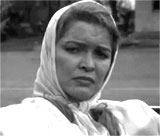 Lois' Tearful Confession to Sonny that Sam Was Her Lover 20 Years Earlier 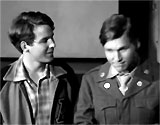 Sonny and Duane Reconciled - They Watched the "Last Picture Show" (Red River) 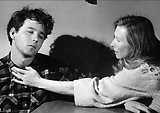 Last Line - Ruth to Sonny: "Never you mind, honey, never you mind" |
|||||||||||||||||||||||||||||||||||||||||||||||

|
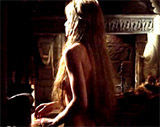
Macbeth (1971, UK/US) (aka The Tragedy of Macbeth) Roman Polanski's R-rated (backed by Playboy Productions) dark, bleak, graphically violent, and pessimistic rendition of Shakespeare's play contained lots of non-sexual nudity (most notably the scenes of a coven of dirty, aged, and often deformed witch hags). It was made two years about the bloody and horrific slaughter of Polanski's pregnant wife Sharon Tate and others at his LA-area home by followers of Charles Manson. The gratuitous, controversial nude (viewed from the back and side) sleepwalk was taken by long-haired Lady Macbeth (Francesca Annis). In another scene, a young male child was shown fully nude during a bath. |
|
|||||||||||||||||||||||||||||||||||||||||||||||

|
Maid in Sweden (1971, Swed.) (aka The Milkmaid) "Sweet Innocence Comes of Age" and "Inga at Sixteen: Her Coming of Age" were this Swedish sexploitation import's two taglines. Although filmed in Sweden, it was made with the performers speaking English. Reviewers have noted that the film ripped-off Joseph Sarno's Inga (1968) starring another Swedish beauty Marie Liljedahl. 21 year-old Christina (or Kristina) Lindberg made her film debut (although she had done nude pictorials, such as Penthouse's Pet in June 1970) as a young and naive country girl named Inga. She was a 16 year-old baby-faced beauty who traveled to Stockholm to visit her older blonde sister Greta (Monica Ekman) and her dope-smoking, sex-crazed live-in boyfriend Casten (Krister Ekman) for a long weekend -- and experienced a sexual awakening (or was it all a dream?). The film was an excuse for the very well-developed and curvaceous Inga to frequently become naked - while undressing on an overnight train and then at her sister's apartment, and while dreaming (in which she spied upon a naked couple making out, and then had an unwelcome lesbian-tinged experience with a female rescuer named Brita (Vivianne Ojangen) after being assaulted by a group of males at a bar). She also pleasured herself after spying on her sister/boyfriend making love, nakedly groomed-dressed in front of a mirror (a few times), and then resisted sex with Bjorn (Leif Naeslund) after a dinner-date with him - but then afterwards enjoyed the 'rape' experience. She took a post-coital tub-soaking, spent a second night of having sex together with Bjorn, and afterwards showered (in slow-motion). Although she claimed she was tired, she snuck out for a third night sexual rendezvous with Bjorn, fully engaging in nude-lovemaking all night long, and had to race home to avoid being detected. Before she was to return home by train later that day, she took another long nude bath-soaking, when she was interrupted by Casten who suspected that she had become promiscuous with Bjorn - they madly kissed each other until discovered by her sister, who accused her boyfriend of being a 'dirty swine'. Upon her return to her parent's home, she told them: "It was OK, but nothing special happened." Later in her career, Lindberg made a more notable film titled Thriller: A Cruel Picture (1973) (see separate entry), after lots of other erotic soft-core skin-flicks, including her third film Diary of a Rape (1971, Swe.) (aka Exponerad) and Anita: Swedish Nymphet (1973, Swe.).
|
       Inga (Christina Lindberg) |
|||||||||||||||||||||||||||||||||||||||||||||||
 |
Diary of a Rape (1971, Swe.) (aka Exponerad, or Exposed) Another 1971 Film With Christina Lindberg
|
||||||||||||||||||||||||||||||||||||||||||||||||

|
Secrets (1971, UK) This British melodrama (the first feature film shot in Super 16-mm) by director Philip Saville was released in the UK in late 1971, but didn't have its US opening until almost 7 years later. Jacqueline Bisset was little-known at the time of the film's making, even though she had been in the hits The Detective (1968) with Frank Sinatra, Bullitt (1968) with Steve McQueen, and The Sweet Ride (1968) starring Michael Sarrazin. Other performances were in The Grasshopper (1969) and the blockbuster Airport (1970). After the sexy actress had appeared in an iconic wet T-shirt in the box-office smash hit, the underwater adventure film The Deep (1977), this film was brought to life in 1978 with Bisset's renewed stardom. [The poster of Bisset in a wet T-shirt was one of the biggest selling posters of the era.] The producers re-released it to capitalize on her nude appearance. The film was heralded with:
Bisset played the role of ignored housewife Jenny who engaged in a steamy, brief and torridly passionate affair with eccentric textile millionaire Raoul (Per Oscarsson). She reminded him of his recently-deceased wife who succumbed to cancer. As she hung naked off the bed upside down, breathing deeply after an orgasm, Raoul continued to stroke and caress her, and then pulled her back onto the bed. During the same afternoon (the film took place over one day), Jenny's daughter Judy (Tarka Kings) and her husband Allan (Robert Powell) also experienced similar encounters or sexual interludes, that eventually brought them all back together. Allan was engaged in an affair with Beatrice (Shirley Knight), while Judy was sexually involved with Raymond (Martin C. Thurley). |
||||||||||||||||||||||||||||||||||||||||||||||||
 |
This very explicit film in the early 1970s was purported to be about the history of censorship, directed by John Lamb (aka M.C. Von Hellen). (See also Lamb's earlier Sexual Freedom in Denmark (1970).) It was about America's changing attitude towards pornography in the early 1970s. In between the educational history lesson on sex (narrated by Ron Gans) were also:
The film ended with the frolicking of a nude couple in the great outdoors, with a female voice proclaiming (in voice-over) - eventually the couple made love on a beach at sunset:
The narrator summarized the extent of life's sexual enjoyment:
|
|
|||||||||||||||||||||||||||||||||||||||||||||||
|
Shaft (1971) Esteemed black director Gordon Parks' film was the first major, commercial crime film with a black hero, John Shaft (Richard Roundtree). The colorful, action-packed, slightly tongue-in-cheek film portrayed the ultra-hip, handsome police detective John Shaft as the black version of Clint Eastwood's "Dirty Harry" Callahan. He worked in Harlem against the Mafia, and was also a "sex machine." In one inter-racial nude scene, a bold scene for the early 1970s, he took a shower with Linda (Margaret Warncke) - both of them visible behind a rippled shower glass door. She greeted him "Good morning," joined Shaft, and they hugged and kissed. |
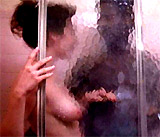 Linda (Margaret Warncke) with Shaft |
|||||||||||||||||||||||||||||||||||||||||||||||
|
Straw Dogs (1971, UK/US) This brutal, misogynistic and disturbing film from Sam Peckinpah further ignited controversy over realistic screen violence and sexual abuse of women in the early 70s, especially due to its graphic double rape scene, which led to a cathartic eruption and escalation of violence.
The unflinching film starred Dustin Hoffman as David Sumner, a bookish, shy, inhibited, and mild-mannered American mathematician on sabbatical living in a seemingly-peaceful, idyllic rural England town (in Cornwall) with his teasingly-seductive, provocative young English bride Amy (Susan George). He was preparing to write a book on the subject of astrophysics. The two had moved into and were renting her parents' old house and property known as Trencher's Farm near her hometown of Wakely; the ruined garage was in the process of being remodeled. In town, Amy became reacquainted with her old, lecherous ex-boyfriend Charlie Venner (Del Henney) - a portent of future trouble. There were obvious problems in the improbable marriage between the two - he was withdrawn, neglectful and condescending to Amy and often over-intellectualized things, while she was more vivacious, realistic, child-like and free-spirited. To incite the sexual interest of local roof construction workers, including Charlie and two other bullies - ex-convict Norman Scutt (Ken Hutchinson) and Chris Cawsey (Jim Norton), Amy removed her sweater and deliberately stood topless in full view next to an upstairs window, although her husband had cautioned her: "Don't forget to draw the curtains." The next troubling incident was David's discovery that Amy's pet cat had been strangled and was hanging by a cord in their bedroom closet. Amy immediately recognized the threat to their marriage - that the workers could easily enter their bedroom, and challenged her husband to confront the workers. The next day, instead of reprimanding and confronting the tough-talking, earthy locals, the ineffectual and hapless David sought their approval by drinking with them. Soon after, the workers pretended to be friends with David, and proposed to join him in a snipe hunting expedition into the woods; the hapless and cowardly David was fooled by the prank to lure him away, and found himself alone in a remote section of the moors. Meanwhile, in the scene preceding the rape (the first of two), the local laborer-thug Charlie was invited by Amy into her isolated farmhouse for a drink; he forcibly kissed her and although she protested unconvincingly ("Please leave me"), he removed her glasses and aggressively kissed her a second time. She screamed: "Get out!" and slapped him hard across the face. Incensed, he grabbed her and hit her hard across the mouth, and then approached her menacingly: "Don't tease me, Amy. Please." He dragged her by the hair to the sofa, as he struck her again and began tearing at her blue robe. He kissed her another time, and although she begged: "Please, Charlie," he continued to assault her by threatening, "I don't want to leave you but I will." He tore her white top, leaving her breasts exposed, before he raped her. At first, she struggled and called out "No," but then surrendered to his kisses. In some ways, she didn't resist but submitted, although she was under tremendous duress. When he held her down, ripped off her panties and began removing his shirt, she helplessly begged: "Easy," and meanwhile fantasized about her husband above her. She showed obvious enjoyment and lovingly kissed her assailant and stroked his shoulders and chest during and after being entered, and begged for comfort: "Hold me." However, she was also shedding tears, feeling both humiliated and disgraced.
At the conclusion of the rape, Charlie was suddenly confronted by the barrel end of the shotgun pointed at him by his fellow workman Scutt. Scutt held Charlie at bay with a shortgun while he prepared to brutally assault David's wife in a graphic second rape sequence. Charlie was motioned to get off Amy - who screamed boisterously when she realized she was going to be forcibly raped a second time. Charlie was ordered to hold Amy down by the neck as she was violated again - from behind. In the film's climactic, stunning and barbaric bloodbath sequence, David was transformed from a meek, spineless, bullied and pacifist academic into a rampaging homicidal husband and protective home-owner to protect the sanctity of his domicile and wife ("This is where I live. This is me. I will not allow violence against this house"). He erupted cathartically with bloody violence after locals raped Amy and then as a drunken and armed group later laid siege to their house. The lynch mob threatened to invade the Sumner home in search of the mentally-deficient 'village idiot' named Henry Niles (David Warner), who had just killed a local flirtatious teenager named Janice Hedden (Sally Thomsett) and taken refuge in the house. David retaliated against the assailants with vicious scalding using boiling oil, shotgun blasts, clubbing with a fireplace poker, and the use of an antique metal "man trap" to snap around Venner's neck - his retaliation was understandably redemptive yet mostly unsatisfying. As he surveyed the carnage, he exclaimed: "Jesus, I beat 'em all." |
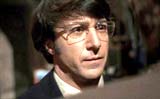 David Sumner (Dustin Hoffman)   David's Provocative English Bride Amy (Susan George)     The Pre-Rape First Assault of Amy by Charlie   2nd Rape by Scutt |
|||||||||||||||||||||||||||||||||||||||||||||||
|
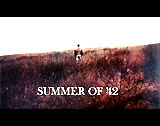
Summer of '42 (1971) Director Robert Mulligan's nostalgic, war-time, New England (1940s Nantucket Island) beachside summer romance and coming-of-age tale told a flashbacked account about the sexual awakening into manhood of an awkward, 14 year-old teenaged boy named Hermie (Gary Grimes). The film was originally rated R, but then re-evaluated and rated PG. However, objections by conservative groups caused the rating to be reverted back to R in the 1980s. In an earlier scene in the town's drugstore, an embarrassed Hermie nervously attempted to purchase prophylactics from an unsympathetic storeowner. The film was initially the subject of great controversy due to its frank and sentimental portrayal of teen sex and love for an older woman - a beautiful 22 year-old war bride named Dorothy (supermodel Jennifer O'Neill), after she learned by telegram that her husband had been killed in action. When Hermie entered her eerily-quiet beach-home, he saw a bottle of whiskey, cigarette butts, and a government telegram. With tears in her eyes and slightly drunk, she put her head on Hermie's shoulder, slowly danced (barefooted) with him to the tune (the film's theme song) playing on a phonograph record. Dorothy tenderly kissed him a few times (as the phonograph needle reached the end of the record) before beckoning him, taking him by the hand, and leading him to her bedroom for comfort; she slowly removed her white slip over her head, prepared the bed, and then removed her bra and panties before they gently entered her bed naked together.
When Hermie left her later that evening, she was outside on the porch in a robe, smoking a cigarette. She gave him a simple "Good night, Hermie" - and that was the last time he saw her. The next day, she left a note (to the swelling sounds of Michel Legrande's theme music) for Hermie (on her beach house door); he sat down on the porch to read it; she explained (in voice-over) that perhaps the meaning of the event would come to him in time:
|
 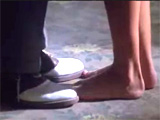 Slow-Dancing  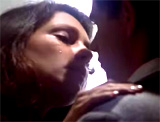 Tender Kisses 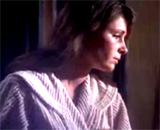 "Good night, Hermie" |
|||||||||||||||||||||||||||||||||||||||||||||||
|
Sunday, Bloody Sunday (1971, UK) This groundbreaking, acclaimed film by director John Schlesinger was notable for its tale of a romantic triangle. The major characters involved with each other included:
It was the first major motion picture to feature a romantic homosexual kiss (on the lips) between two male characters, Dr. Hirsch and Bob Elkin. |
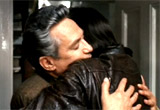 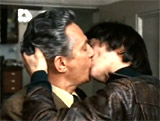
Dr. Hirsch and Bob Elkin - Gay Kiss |
|||||||||||||||||||||||||||||||||||||||||||||||
 Sweet Sweetback's Baad Asssss Song (1971)  Baadasssss! (2003) (aka How to Get the Man's Foot Outta Your Ass) |
Actor/director/writer Melvin Van Peebles' X-rated, confrontational cult film was the first true blaxploitation film - it was specifically designed to upset white audiences (advertised with "Rated X by an All-White Jury"), with Peebles himself playing the part of the sex-hungry, violent anti-hero. The successful independent film (budgeted at $150,000) was released by independent distributor Cinemation, and aimed at urban black audiences.
It caused tremendous controversy for its militancy, under-age sex, anti-white sentiment, revenge-themes, and violence, although it was one of the most important black American films of the decade. It was exceptional that a vengeful black man (after witnessing corrupt police violence and almost beating two officers to death) could survive as a fugitive, as happened in the film.
The film actually opened in an all-black brothel, where (in flashback, in the film's most controversial scene), an underaged, orphaned Sweet Sweetback as a 13 year-old minor (played by Melvin Van Peebles' own 13 year-old son Mario) was being fed by an older maternal black prostitute. (The scene was cross-cut with a quick image of the same character as an adult on the run underneath a city bridge - accompanied with the film's opening title: "This film is dedicated to all the Brothers and Sisters who had enough of the Man.") Then, young virginal Sweetback was coerced by one of the older black prostitutes to enter her room and have sex with her - explaining the derivation of his name when she said: "You've ... gotta ... sweet ... back!" The sex scene concluded and then opening credits rolled, stating that the film was "Starring THE BLACK COMMUNITY." It also contained an explicit sex scene of well-endowed Sweetback having unsimulated sex on stage in a brothel (with poorly-lit full-frontal nudity). The film ended with a shot of a hillside landscape with the superimposed text: "Watch out -- A Baad Asssss Nigger is Coming Back To Collect Some Dues..." The film was supplemented with jump-cuts, experimental lighting, split-screens, freeze-frames, zoom-ins, tinted and overlapping images and montages as it chronicled the successful (uncharacteristically) flight of the black fugitive (with a large-sized manhood and insatiable sexual prowess) through Los Angeles - and toward and across the Mexican border. |
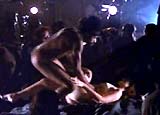  Older Sweetback (Melvin Van Peebles) 2003 Film Below:  Ginnie (Karimah Westbrook)  Moonbeam (Kate Krystowiak) |
|||||||||||||||||||||||||||||||||||||||||||||||

|
Vampyros Lesbos (1971, West Germ.) (aka Vampiros Lesbos, or Lesbian Vampires) Noted as one of the many erotic horror tales involving lesbian vampires that appeared in the early 1970s, this surrealistic, artsy soft-core European exploitation film from prolific, Eurotrash Spanish cult auteur-director Jesus Franco was inspired by Bram Stoker's short story Dracula's Guest. The entire convoluted and indulgent film was a treatise on the duality of dreams and reality. The stylish and surrealistic film was awash with a gaudy red and black color palette, metaphoric insects, and kites. It told about two "vampyros lesbos":
A passionate femme fatale brunette (later discovered to be Nadine) was appearing in the erotic dreams of Linda, subconsciously taking her away from her boyfriend Omar (Victor Feldman). She imagined herself turned on and kissing the female's body. To the psychedelic jazz-rock soundtrack, Linda with her boyfriend had first viewed dark-haired Nadine dancing naked (except for a red scarf) in an Istanbul nightclub stage performance where she transferred her clothes to another naked mannequin-like female. Linda was hypnotically attracted or bewitched by Nadine, and speculated that she was the dancer of her lesbian-tinged dreams. Nadine had recently acquired an inheritance of an estate - as the sole heir of Hungarian Count Dracula and the vampire's immortal bride. Linda was called by her German law office in Istanbul to meet the Countess on one of the nearby small islands of Kadidados ("a place of madness and death") to settle estate affairs. She found Nadine, the beautiful nightclub dancer of her dreams, wearing a skimpy white bikini and large sunglasses while sunbathing! The two went swimming (Linda was naked), and afterwards both sunbathed nude on the beach. After some drugged wine and seduction (Nadine stripped Linda naked on the floor), Nadine bit Linda on the neck and drank from her blood.
When Linda awakened, she saw Nadine floating naked (and drowned?) in the swimming pool (or was it only a scorpion?), with only her red scarf wrapped around her. After being institutionalized and a few more instances of neck-biting, Linda decided to end the spell put upon her and pierced Nadine through the eye. |
  Linda Westinghouse (Ewa Stromberg)   Linda and Nadine   Nadine With Pierced Eye |
|||||||||||||||||||||||||||||||||||||||||||||||

|
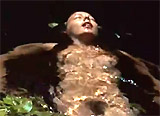
Walkabout (1971, UK/Australia) Nicolas Roeg's highly-respected tale was a controversial coming-of-age saga, due to its full-frontal nudity (of star Jenny Agutter). About five minutes of the original film were cut from the expurgated US version of the film when first released. The film was originally rated "R" but reduced to a PG-rating upon appeal. In the shocking opening scene during a picnic, a suicidal Australian businessman (John Meillon) tried to murder his teen-aged, 14 year-old schoolgirl daughter (17 year-old Jenny Agutter in her film debut) and six-year-old son (Lucien John) in the bush and then committed suicide in front of them. The two British schoolchildren were now stranded and forced to adapt to the harsh climate of the Australian outback. They were fortunately saved when aided by an adolescent Aboriginal Black Boy (David Gumpilil), who was involved in his ritualistic 'walkabout' (to prove his manhood and mark his entrance into adulthood). After overcoming self-consciousness and civilization's social conventions, the Girl engaged in a lengthy nude swim in a natural lagoon pond (with non-gratuitous full frontal nudity) - a symbol of her sexual awakening, although this would lead to tragic circumstances for the older aboriginal boy.
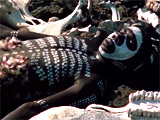
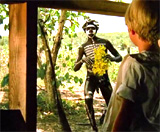
During the native aborigine's 'walkabout' - with a painted skeleton on his body - he performed a silent, ritualistic mating dance for the civilized, repressed girl at a deserted farmhouse, where he glimpsed her half-undressed.
She ignored and resisted his (and her own) sexual rite of passage, by continuing to treat him as a detached servant -- with disastrous results. After the aboriginal danced all night and became saddened and weary (with tears in his eyes), she found him the next morning hanging dead in a mango tree, and she barely reacted to his death. The film ended years later with the young girl now married and returned to civilization, living in a high-rise apartment complex. She was wishfully daydreaming back to her idyllic days in the outback when she happily swam naked with the aborigine and her young brother. They were long-gone days of paradise lost, reflected in a voice-over quote from Part 40 of A.E. Housman's 'A Shropshire Lad':
|
 Suicide of Businessman Father  Aborigine Boy (David Gulpilil) with Girl and Her Brother 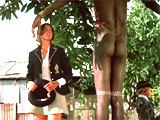 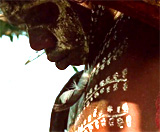 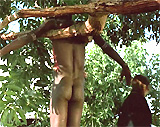 Mating Dance - With Disastrous Consequences 
  Girl's (Jenny Agutter) Recollections of the Outback in the Film's Conclusion |
|||||||||||||||||||||||||||||||||||||||||||||||

|
Yugoslavian director Dušan Makavejev's controversial, X-rated, montage-filled, avante-garde work was a documentary-fiction film (dubbed a "sex film" in the countercultural era of the early 1970s). The obscene and subversive film engendered intense criticism and censorship demands, and was banned in the director's own native Yugoslavia. It was reportedly one of the first films to depict full frontal nudity amidst its plentiful nude sex scenes and frank dialogue about free love, masturbation, genitals and orgasm. The unconventional film drew parallels between sexual liberation, political revolution and US bourgeois militarism, and repressive Soviet-style Communist totalitarian politics. During the title credits of the slapstick, interlocking film (composed of collages), some of the film's main characters passed a slippery, fragile uncooked egg yolk from one hand to another before it broke. A sepia-toned kaleidoscopic shot witnessed a nude couple on a blanket in an open field engaged in oral sex (with a view of his erect penis) before intercourse. A female narrated:
Documentary footage was shown about the early research work of radical psychologist Wilhelm Reich (the WR in the film's title) and his sexual politics. W.R. studied the orgasmic reflex, as Sigmund Freud's first assistant, and discovered life or "orgone" energy -- "revealing the deep roots of fear of freedom, fear of truth, and fear of love in contemporary humans." A female subject in transparent bra and panties was being experimented upon by a Reichian therapist Dr. Myron Sharaf, capitalizing on her breathing techniques and rhythmic pelvic movement. It then explored the contrasting relationship between two roommates:
Milena denounced the sexual attentions of proletarian worker Radmilovic (Zoran Radmilovic), calling him a great example of "proletarian decadence." The viewpoints of Milena and Jagoda were clearly juxtaposed. At one point, Milena emerged onto her outside 3rd floor porch and lectured to fellow communal apartment dwellers within the courtyard, while Jagoda was having sexual intercourse in their apartment. The theme of her radical speech was that there was an obvious linkage between state repression and sexual neurosis. She preached the virtues of orgasmic liberation, free love, enlightenment, and power to encourage true revolution:
In the audience, Radmilovic cried out: "Gentlemen, in our Democracy, everyone is entitled to a doughnut. Some get the doughnut, others get the hole in the doughnut. It would seem that the main problem is the hole." Milena continued:
Some of her listeners joined her in forming a dance line around the apartment's 3rd floor terrace - while repeating her words in song. Documentary footage intercut the sequence with a collage of interlinked images:
Milena pursued visiting, repressed and prudish, sexually-dysfunctional, old-fashioned blonde Bolshoi/Russian (black-wigged) iceskater Vladimir Ilyich (Ivica Vidović) - the Soviet leader Lenin's full name. When he came to her apartment, her roommate Jagoda flaunted her nudity to attract attention, and thrust her left nipple and breast in his face when Milena offered cookies and a drink: "And how about some milk?" The unfortunate Milena's seductive quest for sexual freedom, fulfillment, love and the ultimate perfect orgasm with Ilyich ended after a passionate kiss. She was violently beheaded by the sharp blade of the Soviet skater's iceskate (off-screen) - he couldn't control the liberating force of his own repressed orgasm.
Afterwards, her decapitated, disembodied head was placed on a white lab tray. The lab worker and coroner discussed that her death was probably the result of "a wild night of love" because there were no signs of a gang-bang or rape, and that she had accepted semen willingly. Miraculously, she began talking about the cosmic joys of their orgasm, and her continued love for Vladimir:
The film ended with Vladimir wandering around with bloody hands and singing, while Milena's smiling face dissolved into Wilhelm Reich's face. ========================================= The other portions of the film, almost like a mockumentary, followed a group of libertines in New York City, filmed in docu-style 16 mm. The inter-cutting segments included the following:
|
  Kaleidoscopic View of Sexual Intercourse  Reichian Therapy  Milena (Milena Dravic)  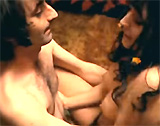  Jagoda (Jagoda Kaloper) with Ljuba 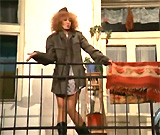  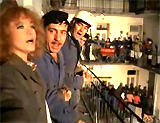 Milena's Radical Speech 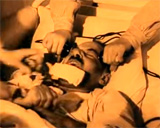 Electro-Shock  Vladimir Illych  Jagoda with Vladmir Ilyich  Final Scene ----------------- Intercutting Segments (below)   Tuli Kupferberg   Betty Dodson  Jackie Curtis |
|||||||||||||||||||||||||||||||||||||||||||||||






 Carnal Knowledge (1971)