|
History of Sex in Cinema: 1940-1944 |

|
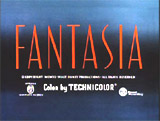
Fantasia (1940) The remarkable Disney animated feature Fantasia (1940) was slightly controversial for its depiction of bare-breasted centaurettes (without nipples) in the Pastoral Symphony segment. Adhering to the strict rules in the Hays Production Code, the figures were discreetly garlanded with flower bras for cover-up after bathing topless (still uncensored) in a waterfall and pond (seen from a distance). The more controversial segment in the Pastoral Symphony was of a female pickaninny centaurette with braided hair named Sunflower who was shining the hoof of a white female centaurette. The black centaurette was first abruptly cut from the film and as technology improved, the scene was edited by 'resizing' or 'zooming in' on the frames with the character in them so that she was not seen in the shot.] There were also uncensored bare-breasted harpies during the Chernobog "Night on Bald Mountain" sequence. |
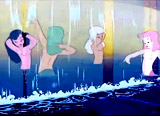 Bare-Breasted Centaurettes 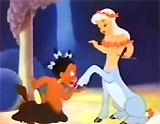 Female Pickaninny Centaurette 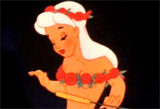 Centaurette with Breast-Covering Garland |
||||||||||||
|
Rebecca (1940) Alfred Hitchcock's Best Picture-winning film Rebecca (1940) (his first American film) depicted subtle hints of affectionate lesbianism, in the devoted and obsessed character of housekeeper Mrs. Danvers (Judith Anderson). Joseph Breen, the head of the Production Code Administration (PCA) at the Motion Picture Producers and Distributors of America (MPPDA) was decidedly concerned about the "quite inescapable inferences of sex perversion" in the film. In the most obvious scene, the sinister Mrs. Danvers opened the curtains to the bedroom of the deceased Mrs. Rebecca de Winter and went through her intimate belongings. There was also a strong undercurrent that not only was Danvers expressing her unusual lesbian feelings for the haunting Rebecca, but she was also trying to seduce the 2nd Mrs. de Winter (Joan Fontaine). She opened the woman's closet, selected a fur coat, seductively held it next to her own cheek and then brushed it by the cheek of a nameless, horrified, and recoiling second Mrs. de Winter, stating:
She also showed off an embroidered pillowcase on the bed (monogrammed with an "R") and its "delicate" sexy nightgown inside - one of Rebecca's most intimate articles of clothing:
The doubting 2nd Mrs. de Winter was fundamentally challenged and believed that her husband, Maxim de Winter (Laurence Olivier), was completely infatuated with his seemingly-perfect first wife Rebecca, who had drowned a year earlier. Until the film's final revelation of his troubled marriage to his first wife (an overtly sexually-liberated female), Maxim's new wife doubted that she was loved at all. In the film's conclusion, the enraged Mrs. Danvers burned down the Manderley country mansion, and also perished in the fire (in the bedroom). Whether this was symbolic of the punishment of lesbianism and the victory of heterosexuality and domesticity was open to question. |
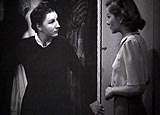 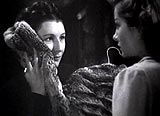 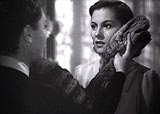 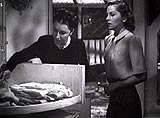 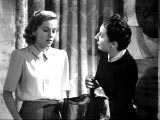 Mrs. Danvers (Judith Anderson) with Mrs. de Winter (Joan Fontaine) in Rebecca's Bedroom |
||||||||||||
|
They Drive By Night (1940) Due to the Code's restrictions on language and depictions of sexual behavior, some films resorted to using double entendres to pass the ratings board. A conversation at a truck stop counter with sexy waitress Cassie Hartley (Ann Sheridan) was dripping with sexual overtones:
|
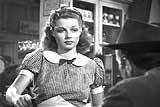
Cassie (Ann Sheridan) |
||||||||||||

|
Citizen Kane (1941) The widely-acclaimed film Citizen Kane (1941) from debut film director/actor Orson Welles (24 years old), usually regarded as the greatest film ever made, was focused on the search for the meaning of the last word spoken by tycoon Charles Foster Kane (Welles), shown in a massive closeup of his enlarged lips and mustache:
The film engendered controversy (and efforts at suppression in early 1941 through intimidation, blackmail, newspaper smears, discrediting and FBI investigations) because it appeared to fictionalize and unflatteringly caricaturize certain events and individuals in the life of William Randolph Hearst - a powerful newspaper magnate and publisher. It was commonly regarded that "Rosebud" clearly referred to young Kane's boyhood sled, consumed in a fire in the film's conclusion - a significant plot twist. Four years after Welles' death in 1989, Gore Vidal wrote in the NY Review of Books that "Rosebud" was also a symbolic or affectionately euphemistic reference to Hearst's pet name for his real-life actress Marion Davies' clitoris. It was speculatively possible that Davies had become drunk and had mentioned this private fact to Herman Mankiewicz, a friend and occasional visitor to Hearst's Xanadu castle named San Simeon. Mankiewicz had used this secret information in the screenplay he co-wrote with Welles. Davies was in the Ziegfeld Follies when she met Hearst, and she remained her patron's mistress and lover until he died in 1951. |
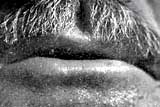 
"Rosebud" |
||||||||||||
|
The Lady Eve (1941) The Lady Eve (1941) contained one of the film's best, most artful, sexually-lustful scenes. Con artist Jean Harrington (Barbara Stanwyck) invited brewery heir Charles Pike (Henry Fonda) to sit next to her as she reclined on a chaise in his ocean liner cabin. She leaned over and wrapped her arms around his neck, almost holding it in a vise, and began to caress his hair, face and earlobe - while his eyes closed. As they talked, she also cradled his head with her right arm, and nuzzled close to his cheek - tantalizing him and driving him wild. |
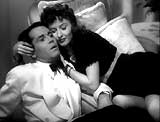 Seductive Jean Harrington (Barbara Stanwyck) with Charles Pike (Henry Fonda) |
||||||||||||
|
The Maltese Falcon (1941) John Huston's classic film noir The Maltese Falcon (1941) had one of the more memorable entrances of a homosexual character in a film. It was also one of the first instances of an obviously 'gay' character appearing on screen. Detective Sam Spade's (Humphrey Bogart) secretary Effie Perine (Lee Patrick) alerted her boss to a sweet-smelling client - effeminate, bow-tied Mr. Joel Cairo (Peter Lorre), who had just arrived in the outer office and presented her with a gardenia-perfumed business card. Spade sniffed the card - reacting with a bemused expression, before the strange, bug-eyed, shifty man confronted Spade in his office. In the original novel, Cairo was clearly described as "queer" although the film only hinted (quite obviously) at the character's sexual orientation, as he fondled his cane and touched it to his lips (hints of fellatio). In fact, some have speculated that the entire "Fatman" Kasper Gutman (Sydney Greenstreet) gang, including "gunsel" Wilmer Cook (Elisha Cook, Jr.) was homosexual. "Gunsel" referred to a young and inexperienced homosexual male who took care of an older male. |
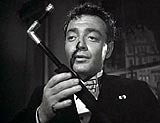
Effeminate Mr. Joel Cairo (Peter Lorre) |
||||||||||||
|
Two-Faced Woman (1941) This was Swedish-born star Greta Garbo's last film and final screen appearance, at the age of 36. MGM had attempted to 'Americanize' Garbo for US audiences in this picture as a romantic comedy heroine and glamour girl, due to the boycott of US films in Europe during WWII. Previously, Garbo's films had always done better internationally than domestically, but this one was mostly a critical and commercial flop. The film was trying to capitalize on Garbo's previous success opposite Melvyn Douglas in Ernst Lubitsch's Ninotchka (1939). [Note: It was actually a remake of Her Sister From Paris (1925) with Constance Talmadge and Ronald Colman.] The film's suggestive and immoral sexuality (adultery) and Garbo's low-cut gowns were condemned by the Legion of Decency. Reportedly, it was the first major Hollywood studio release to be condemned as such. The picture was accused of having an "immoral and un-Christian attitude toward marriage and its obligations; with impudently suggestive scenes, dialogues and situations; suggestive costumes." Marketing tauted that the "new Garbo" would appear in a bathing suit, sport a bobbed haircut, be shown skiing, and would also dance a sexy rhumba ("la chica choca"). Unwittingly, the film was advertised with the slogan:
The characters engaged in a love triangle in George Cukor's romantic comedy were:
After a shot-gun marriage to Larry at a ski resort, Karin feared a dalliance between her philandering, neglectful and straying husband Larry and his old flame and flirtatious ex-mistress Griselda, once he abandoned her (after the honeymoon) and returned to New York to attend to his job. Karin refused to join him in New York. However, to test her husband to see if he was faithful, Karin traveled to New York to deceptively pose as her sexier, high-living, uninhibited, gold-digging, globe-trotting twin sister, Katherine Borg (also Garbo). Unlike Karin, 'Katherine' drank, smoked, and danced. Her intention was to act like a complete 'vamp' so that Larry would retreat back to Karin. Larry played along with Karin's manipulative scheme to seduce him, and pretended to fall in love with Katherine. However, this angered Karin who couldn't believe that he would fall in love with her 'sister.' In the predictable conclusion set back in Idaho, Larry acknowledged that he knew all along that Karin had been posing as Katherine (the giveaway was that she had not removed her toenail polish). He suggested that he could be happy with both sides of her personality. She put on Katherine's negligee to prove her duplicity, but he pretended not to believe her. She quipped back: "We're both through with you" - and stormed off, but then they quickly reconciled as the film ended.
|
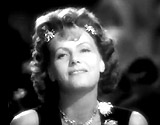 Karin Borg (Greta Garbo) 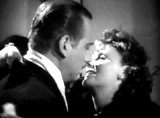 Karin with Larry (Melvyn Douglas) 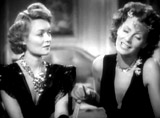 Larry's Ex-Mistress Griselda (Constance Bennett) with Karin |
||||||||||||
The Phenomenon of Pin-Ups During the war years, the most sexually-attractive star-actresses of an era would be popularized in seductive poses - usually semi-clad - in pictures, calendars, or mass-produced posters. The sexy photos were usually literally "pinned-up," often with thumbtacks, on bedroom walls, the insides of lockers, even on airplanes, and so forth. This practice started especially amongst GI servicemen away from home during military combat who pined for the 'girl-back-home.' The most popular pin-ups were Betty Grable (the "Girl with the Million Dollar Legs") and Rita Hayworth. They were followed by Gene Tierney, Marilyn Monroe, Bettie Page, Raquel Welch, Farrah Fawcett, etc. |
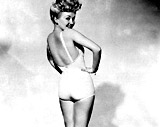 Pin Up Betty Grable 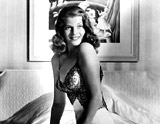
Pin Up Rita Hayworth |
|||||||||||||
|
Andy Hardy's Double Life (1942) This was the thirteenth of sixteen Andy Hardy-related films. A fashion model originally, Esther Williams was showcased in her first film in a small role as one of Mickey Rooney's love interests - Sheila Brooks. When the college-bound freshman first met Sheila in the film's pool sequence, she was stunning in a sexy, two-piece white bathing suit. She explained that she was a psychology major doing research on "reflexes" - and she surprised him with a kiss. The two also went swimming underwater, when she swam up behind him and gave him another kiss. During their conversation pool-side, he complimented her on her looks: "I'm not kiddin'. Honest, you're the best-looking girl I ever met in my life." He then asked for a date:
One of the main object lessons of the film was to teach Andy not to woo and become engaged to two different females with the same lines. Both Sheila and girlfriend Polly Benedict (Ann Rutherford) confronted Andy with incriminating evidence on a recording. Her notable debut led to Esther's starring roles in Bathing Beauty (1944) and almost two-dozen other extravagant swimming aquacades in the future. |
     Sheila (Esther Williams) with Andy Hardy (Mickey Rooney) |
||||||||||||
|
Casablanca (1942) Toward the end of the classic romantic drama Casablanca (1942), there was a suggestive fadeout after Ilsa Lund (Ingrid Bergman) fell into Rick Blaine's (Humphrey Bogart) arms in his upstairs apartment. She had confessed her love ("if you knew how much I loved you, how much I still love you") and offered a passionate kiss before the fade-out. Other aspects of the original script were also toned down:
In the film's famous finale at a foggy airport, Rick put patriotism before his passionate love for Ilsa and sacrificed everything:
|
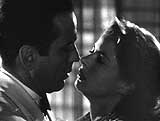 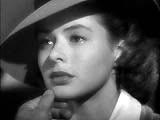 Rick (Humphrey Bogart) with Ilsa (Ingrid Bergman) |
||||||||||||
|
La Cena Delle Beffe (1942, It.) (aka The Jester's Banquet/Supper) The Italian film from director Alessandro Blasetti, based on Sem Benelli's 1909 play, was set in the early Renaissance in Florence. The film received tremendous publicity at the time, and was prohibited by the Catholic church, for its brief view of nudity. It was particularly notorious for being the first Italian film made under Fascism (during a time of a Mussolini-controlled Italian film industry) to display a white woman's breasts. Amoral courtesan Ginerva's (Clara Calamai) sheer nightgown was passionately ripped off by one of her young male admirers, Neri Chiaramontesi (Amedeo Nazzari). With only her few seconds of nakedness, Calamai became the first Italian actress to appear fully topless onscreen in a mainstream Italian feature film.
|
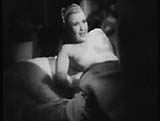 Ginerva (Clara Calamai) |
||||||||||||
|
Kings Row (1942) Kings Row (1942) was a fully-laundered, 'Peyton Place' type film released with little of the scandalous content from the original Henry Bellamann novel. Before production, Joseph Breen of the Hays Office wrote to the film's producers about his misgivings: "To attempt to translate such a story to the screen, even though it be re-written to conform to the provisions of the Production Code is, in our judgment, a very questionable undertaking from the standpoint of the good and welfare of this industry." It told about a turn-of-the-century town's squalid secrets (including hints of illicit premarital sex, homosexuality, and father-daughter incest leading to a murder-suicide) - i.e., Cassie's (Betty Field) nymphomania affliction was transformed to insane dementia. The "surgery" in the novel was not nearly as drastic as that suffered by Ronald Reagan's hedonistic character Drake McHugh, who had both of his legs unnecessarily amputated ("Where's the rest of me?"). |
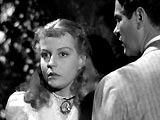 Insane Cassie (Betty Field) 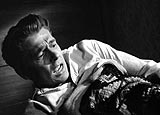
Drake (Ronald Reagan) "Where's the Rest of Me?" |
||||||||||||
|
Now, Voyager (1942) When the Hays Code was in full force, Hollywood films had to resort to metaphoric sex, imagery, and double entendres. Smoking became very sexualized in many films, such as Now, Voyager (1942). In this one, the shared use of cigarettes served as a metaphor for the sex act, between:
Jerry often performed a seductive two cigarette trick - he placed two cigarettes in his mouth, lighted both of them, and then passed one to Charlotte.
|
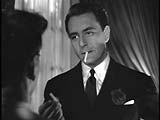 Jerry Durrance (Paul Henreid) 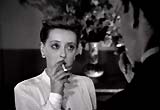 Charlotte Vale (Bette Davis) |
||||||||||||
|
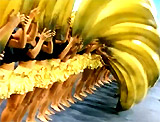
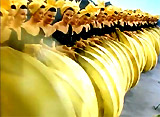
The Gang's All Here (1943) This Busby-Berkeley directed and choreographed film starred Alice Faye and the outrageously-vivacious Brazilian bombshell Carmen Miranda. The memorable film featured an erotic, symbolic sub-text involving suggestively-phallic, gigantic bananas that were subtly raised and lowered in a spectacular synchronized chorus girls musical number ("The Lady in the Tutti-Frutti Hat"). The sequence escaped US censor's eyes - but it was banned in Argentina, not because of the costumes, but because of the dancers' bare feet. |
|
||||||||||||
|
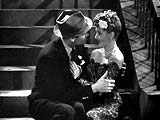
The More The Merrier (1943) George Stevens' delightful romantic comedy The More the Merrier (1943) featured a sexually-exciting apartment front steps kissing scene. It took place on a summer night in wartime Washington DC between:
As he embraced her, they collapsed on the front stoop of their shared apartment. She spoke about her plans for her own marriage and her future with her fiancee, an older man, forty-two year old ("a safe and sane age") government official. She was referring to her stuffed-shirt boss, Charles J. Pendergast (Richard Gaines): "I consider myself a very lucky little lady...being engaged to Mr. Pendergast." All the while, Joe was amorously embracing her, caressing her, and fondly touching her hands, arms, and shoulders - she vainly attempted to ignore his advances to make out. She fended off his nuzzling and roaming hands exploring her entire body (both in and out of view of the audience), and tried to conceal her growing desire by incessant talking. She held out her engagement ring for his approval and he responded by kissing her wrist. Connie became visibly distracted and her voice cracked when he admired and then nuzzled her bare neck. As she spoke, he interrupted her mid-sentence (with a passionate kiss on the lips):
When he released, she finished the sentence: "...viewpoint." She paused, looked away for a second, and then took the two sides of his face with her hands and boldly kissed him back - harder. But then, she realized that they were getting too involved. She stood and politely stated: "I've gotta go. Good night, Mr. Carter." He responded: "Good night, Miss Milligan." The smooching scene was followed by their own version of the "Walls of Jericho" bedroom scene (from It Happened One Night (1934)) between their apartment windows. As they bedded down in adjacent rooms - shot from outside in a frame split by the wall between them, they discussed how uncomfortable and restless they were, and Joe finally admitted: "I love you Connie." She responded likewise: "I love you more than anything in the world." |
 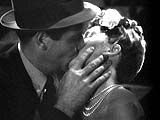 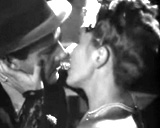 Joe (Joel McCrea) with Connie (Jean Arthur) - Sexy Kissing Sequence 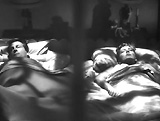 Split-Screen Bedrooms Between Connie and Joe 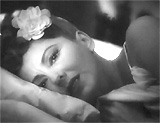 Connie to Joe: "I love you more than anything in the world" |
||||||||||||
|
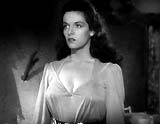
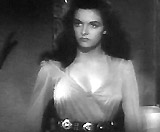
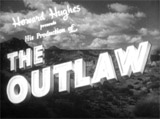
Many movies of the '30s and '40s troubled the Motion Picture Production Code but none quite as much as the sexed-up western The Outlaw. Bankrolling the notorious 'sex western' film was eccentric billionaire and producer/director Howard Hughes. The western was made in 1941 (during a 9-month marathon shoot) and first screened for the Hays Office in that year. The film's wide release was delayed for a few years due to its defiance of Production Code standards. It was finally released in 1943 in just one San Francisco theater for a one-week run, and then widely released in 1946 without a seal of approval, and again in 1947. The censorship board strongly complained and battled over Jane's open display of her ample bosom and cleavage in many scenes in which she wore low-cut blouses. It was unjustly famous for the full-busted 38D" cleavage of Jane Russell in her portrayal of the "half-breed" Mexican mistress Rio McDonald of gunslinger-gambler Doc Holliday (Walter Huston) -- with footage deliberately shot to accentuate her assets. The publicity shots were much more revealing, sultry and suggestive than the film itself, however. Even the outrageous tagline caused a scandal: "What are the two reasons for Jane Russell's rise to stardom?" along with the film's marketing question: "How would you like to tussle with Russell?" Playwright George Kaufman reportedly characterized the salacious marketing campaign for the film as "The Sale of Two Titties." The smash hit film, a highly-fictionalized western, included a semi-rape, wrestling in the hay stable scene with Billy the Kid (Jack Buetel). As he held her down, he cautioned her to end her struggling resistance in the dark shadows.
She condemned him for murdering her drunken brother and vowed to kill him, and although he admitted the murder in a fight over a woman, he also claimed: "How'd I know he was your brother? It was him or me." After she unsuccessfully tried to spear him with a pitchfork, she cried out, as he held her down:
Later, a wounded and unconscious Billy was brought by Doc to Rio to care for him (she was tempted to stab him with a knife she used to cut off his clothes, but couldn't do it). With her Aunt Guadalupe (Mimi Aguglia) present, Rio made a promise to the unconscious Billy: "You're not gonna die. I'll get you warm" - and once Billy began to recover and recuperate a month later, she bent down showing her bounteous breasts (in the uncensored version) to caution Billy from getting up: "Be careful, your wound. You'll hurt yourself." As he became stronger, he wished to kiss her, but she at first hesitated: "No, no, you'd better not get up until tomorrow...You're not strong enough yet." He pulled her to himself: "Who says I'm not?!" She responded as she wrestled with him: "Billy, you mustn't. You'll hurt yourself." She was tempted to kiss him, although fearful at first: "But you've been so sick. You're not well enough. You're not..." - but then she surrendered to him. There was an incredible zooming full-face (and lips) closeup as she moved closer to kiss him.
When Doc returned, Rio was forced to admit to him that she had been charmed by the ailing Billy during one of his delirious periods to get married (but he didn't know he was married): "I'm married to him...That's the truth, Doc. Only please don't tell him.... I never would have done it, only I thought he was gonna die." They clearly had a love-hate relationship, revealed in a confrontational scene when an angry Billy returned, surprised Rio in her bedroom, and accused her of revealing his route with Doc to Sheriff Pat Garrett (Thomas Mitchell) and filling their canteens with sand. He sarcastically vowed that he returned because he missed her: "The more I thought about seeing you, darling, the easier it got"; she spitefully invited him to proceed: "What are you waiting for, go ahead?" He encouraged her attitude: "Hey, that sounds real nice. I like to hear you ask for it. Keep it up. Beg some more." She questioned: "What would you like me to say?" Billy replied: "Well, you might say please, very sweetly." When she spoke the word "Please," he responded: "Will you keep your eyes open?...Will you look right at me while I do it?" (the scene again faded to black)
To retaliate against Rio, Billy left her bound, gagged and strung up by her wrists within sight of a desert waterhole; after being released by Doc and the Sheriff, Doc realized Billy's infatuation with Rio: "I think he's in love with you....The crazier a man is about a woman, the crazier he thinks and does." There was also a full-frontal close-up view of Rio galloping along on horseback. In the concluding sequence, after Doc showed a distinct preference for Billy, Pat reluctantly shot Doc dead. Following Doc's burial, Billy was allowed by the Sheriff to ride off. As he departed, Billy looked back at Rio - indicating that she could join him, and she happily jumped onto his horse. |
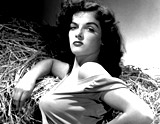 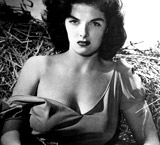 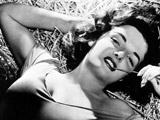 Publicity Shots of Jane Russell (as Rio) in The Outlaw 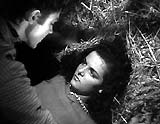 Semi-Rape Scene - In the Hay With Billy the Kid 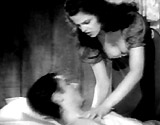 Rio to Recuperating Billy: "Be careful, your wound. You'll hurt yourself" 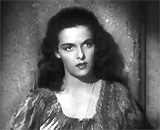 Rio to Doc, About Being Married to Billy: "I'm married to him" 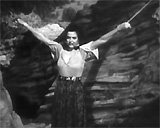 Rio Strung Up By Her Wrists 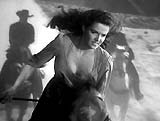 Rio Galloping on Horseback on a Race to Fort Sumner   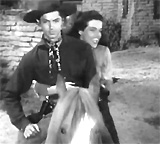 Rio Riding Off with Billy |
||||||||||||
|
Double Indemnity (1944) One of the greatest film noirs of all time was Paramount's and director Billy Wilder's definitive film Double Indemnity (1944), based upon James M. Cain's novel. It told of a sizzling relationship that developed between two murderous conspirators:
It depicted dangerous sexuality in the form of the predatory femme fatale. She was first seen after naked-sunbathing beguilingly wrapped in a towel at the top of a staircase. Then as she descended the stairs and buttoned her clothes after dressing, she showed off her leggy anklet bracelet to Neff. Afterwards, she appeared at the door of Neff's darkly-lit apartment, on the pretense of returning his hat from earlier in the afternoon. She peeled off her coat, and was revealed to be wearing a very tight, form-fitting white sweater designed to entice him. By the wet window pane, Phyllis related more about the suffocating relationship she had in her marriage. But as she drifted away from him to leave, he grabbed her by the wrist and kissed her, and they both told each other they were "crazy" about each other. Shortly later, the scene tracked/dissolved back to Walter's apartment, the same evening, where Neff reclined on the sofa smoking a cigarette, and Phyllis was fixing her makeup - presumably after they had sex. In the following scenes, she persuaded Neff to join her in scheming to kill her husband and help her make it look like an accident - to collect on her husband's accident insurance policy. Later, Walter confessed this about his partner-in-crime and their failed objective:
The Postman Always Rings Twice (1946) was a similar tale of murder and seduction a few years later. |
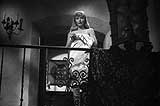 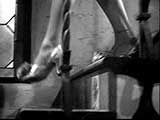 Phyllis Dietrichson (Barbara Stanwyck) - With Her Anklet Bracelet 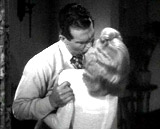 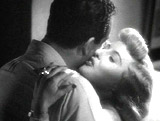 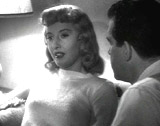 Phyllis with Walter (Fred MacMurray) |
||||||||||||
|
Laura (1944) The classic film noir Laura (1944), one of the earlier films from unconventional producer/director Otto Preminger, was a psychological study of deviant, kinky obsession - even at the height of the Hays Code enforcement period. Almost everyone in the cast loved the 'murdered' title character - Laura Hunt (Gene Tierney). Her lovers included the Svengali-like effeminate bachelor Waldo Lydecker (Clifton Webb). In an astonishing, sexually-charged scene, the unconventional, dead-pan-speaking detective Mark McPherson (Dana Andrews) - after her assumed murder - expressed his growing infatuation and sexual fixation for the unmet corpse (hinting at necrophilia) by:
And then he became uncomfortably shocked when she was 'reincarnated' and walked in on him. |
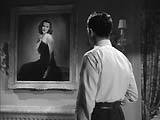 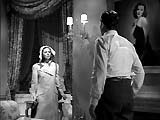 Mark (Dana Andrews) Admiring the Painting and Laura (Gene Tierney) |
||||||||||||
|
To Have and Have Not (1944) Warners' and director Howard Hawks teamed up to present To Have and Have Not (1944), a post-Casablanca romance based loosely on a Hemingway novel, with the first pairing of "Bogie" and "Bacall." The film's steamy foreplay dialogue was lucky to pass the Hays Code censors. Sultry and stranded American Marie 'Slim' Browning (19 year-old Lauren Bacall) erotically made a proposition during her first encounter with heavy-drinking, politically-uncommitted charter fishing-boat captain Harry Morgan (44 year-old Humphrey Bogart), nicknamed "Steve."
She appeared in the hallway-doorway of his upstairs room in the Marquis Hotel above the nightclub. She had come from her rented room across the hall, to make a simple, deadpan request for a match. In her first husky, sexy lines to him as she leaned in, her question sounded like an erotic challenge: "Anybody got a match?" He tossed her a box of matches so she could light her own cigarette. She aggressively lit the flame, looking at him with her wide expressive eyes. She flung the used match backward out the door, tossed the box of matches back at him, turned and left without any emotion: "Thanks." Later, at the beginning of one of the screen's most famous seductions, she appeared at his room's door for another visit, this time carrying a well-traveled liquor bottle in her hand. After a lengthy conversation, she said in a husky drawl:
As she pulled back, he asked: "What'd you do that for?" She answered his question about why she had found herself on his lap and kissed him, and then he wanted to know her reaction:
She described to her less-than passive partner that the second kiss was better than the first:
She then propositioned him midway from leaving his room with other famous lines, delivered with a purring, warm voice:
|
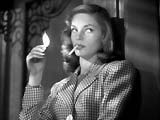 Marie/'Slim' (Lauren Bacall): "Anybody got a match?" 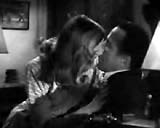 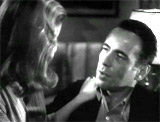 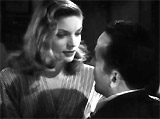 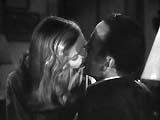 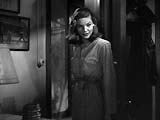 Seductive Kissing Scene: Marie/'Slim' with Harry/'Steve' (Humphrey Bogart) |
||||||||||||




 The Outlaw (1943)