|
History of Sex in Cinema: 1991 |


|
At Play in the Fields of the Lord (1991) This fairly realistic, three-hour long (186 minutes) South American/Brazilian rain forest tale was an adaptation of Peter Matthiessen's well-regarded 1965 novel by Brazilian director Hector Babenco (and producer Saul Zaentz). The six-month shoot in the Amazonian jungle was plagued by sickness, heat, reptiles, and other insect creatures. The well-intentioned Universal Pictures movie performed poorly - on a budget of $36 million, it only recouped $1.3 million in revenue (worldwide). The tagline of the dramatic and epic adventure story, about the clash of civilization vs. the uncivilized, was:
The film was set in the early 1960s, and opened with a plane running out of fuel in the dense Brazilian Amazon River basin, where members of the Niaruna tribes lived upriver and deep in the jungle. The two occupants of the plane - two mercenary-explorers or adventurers - were forced by the local Commandante Guzman (José Dumont) to remain in a remote outpost town known as Mae de Deus. [Note: Niaruna and Mae de Deus were both fictional.]
Currently in the area of Mae de Deus ("Mother of God"), there were also various groups of missionaries who were there to do "the Lord's work" - to convert the indigenous peoples to Christianity. They also attempted to bring Western civilization to the primitive natives, usurping their own ways by bribing them with food and other bribe-gifts and trinkets, and forcing them to adopt foreign practices such as baptism and clothing to cover-up nudity:
To leave Mae de Deus with a tank of gas and approved papers, Moon and Wolf were offered a deal by the corrupt, ruthless and land-hungry Commandante Guzman to frighten the tribal villagers in the Niaruna settlement (identified by a clearing and large roundhouse in the middle of the jungle), by bombing them from their small plane in order to scare and chase them off ("for their own good") and facilitate gold-mining and reap profits within the area. However, once Moon flew over the area with Wolf, he noticed the natives defending their village with simple bows and arrows, and decided against the Commander's diabolical agenda to eliminate the natives who impeded "progress." Lewis decided to return to his wild tribal roots and seek his true identity after he received a spiritual calling. He drugged himself with a drink known as "ayahuasca" to cause hallucinations, then flew by himself over the deep jungled area. He radioed back: "I'm at play in the fields of the Lord," then jumped out with a parachute, stripped naked and entered the Niaruna village while being escorted by tribesmen. He was greeted and accepted by the natives as an emissary - as the God of thunder (known as "Kisu-Mu"), and revered by the elders, the native children and young females.
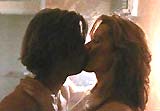
Moon potentially could enable the various jungle tribesfolk to join a crusade to unite against the incursions of the white man's missionaries. (Earlier, Moon had asked Martin the pointed question: "If the Lord made Indians the way they are, who are you people to make them different?") The destroyed Catholic outpost needed to be completely rebuilt and settled by the Quarriers, with initial help from the Hubens, and a civilized native known as Kori (Ruy Polanah). After the Hubens departed back to Mae de Deus, Martin - and particularly Hazel - struggled with accepting the 'wayward' customs of the natives, although their young son Billy, who immediately adopted nakedness, was blithely and quickly acclimated to the "nasty little savages." Eventually, the Quarriers established momentary contact with the curious Niaruna who emerged from the jungle during a brief visit and were amused by various objects, gifts and trinkets of mirrors, eyeglasses, machetes, and food. The Quarriers were devastated when Billy contracted blackwater fever (a fatal condition resulting from malaria) and swiftly perished. After learning of Billy's death, the Niaruna tribesmen (including an unrecognized Moon) performed their own ritualistic ceremony, and then angrily blamed Rev. Huben (who had come to take Billy to a hospital but was too late), forcing him to flee back to Mae de Deus for awhile. It was revealed that Huben was in cahoots with the Commandant, promising that if the Niaruna hadn't been pacified and civilized in a year by the mission, he would allow more forceful (deadly) measures to be taken. Martin soon appeared to completely lose his Christian faith: ("What more do you want, it cost me my son!"), while the grieving Hazel became moody, paranoid, irrational ("Are we in Hell and just don't know it?"), and gradually lost her mind. Much later, when the Hubens returned to check on the Quarriers' mission and fortify it with a barbed wire fence against the savages, Martin argued with and confronted Rev. Huben for his failed approach to tame the natives. Meanwhile while in the jungle, Andy performed a nude bathing scene in a natural pool, and then didn't realize she was being spied upon and approached while she rested next to a gigantic tree root. Startled by the presence of someone else, she abruptly stood up. She received and reciprocated kisses on her face and lips gently given by Moon (whom she thought was a native) before running off. She later confessed not to her husband but to Martin: "It was beautiful. He touched me so gently," and reluctantly admitted she wanted to have sex, but didn't: ("I never wanted anything so much in my life"). Andy then added: "It was Lewis Moon."
Ironically, the kisses turned out to be deadly. Moon returned to his Niaruna village and roughly approached his 'wife' to both kiss her and demand rape-sex after pushing her to the ground. Moon passed on Andy's contagious flu-cold that soon spread rapidly and infected the entire Niaruna tribe (and caused many deaths). The Niaruna attempted to quell the disease through ritualistic ceremonies, and then angrily surrounded the mission (with Moon in their midst "resurrected from the dead") and blamed the white-man missionaries for the pandemic. Moon had come with them to beg for medicine to prevent the Niaruna from dying, when suddenly, Martin and Andy realized that Moon had spread the disease by kissing her. Moon's efforts were thwarted (and the Niaruna departed) when a deranged Hazel appeared to perform an unflattering and embarrassing nude native dance (partially clothed with a thatch of leaves and layers of mud), before being ushered away. When the Reverend denied medicine to Moon, Martin sided with Moon and reprimanded his superior: "We can't save their souls if they're dead." Still, the stubborn Reverend resisted Moon: "You're leading these people into darkness and corruption," until Andy retrieved the box of life-saving medicine and handed it to Moon. Rev. Huben then chastised his wife for having sinfully compromised herself with Moon somehow, but she wouldn't submit to his hypocrisy: "Why is a white man's nakedness sinful to look upon when a red man's nakedness is not?" Another threat surfaced after Rev. Huben, who claimed he was justly doing the "Lord's will," radioed Guzman and gave him the go-ahead to begin bombing the uncooperative Niaruna - to literally "exterminate" them. The two missionary wives were evacuated from the mission, while Martin and the Reverend stayed behind. In the film's conclusion, a helicopter bombing of the village was imminent by the Commandante. With the help of the Reverend's Niarunan helper Uyuyu (Jose Renato Lana), Martin trekked to the already-decimated jungle village to warn them of danger, where he spoke to Moon. He concluded that his righteous crusade to bring Jesus to the natives was truly a delusional and failed enterprise: "It would have been better for them never to have known us." Meanwhile, Rev. Huben fearfully abandoned the Catholic mission and its doomed future and returned to Mae de Deus to admit defeat to "Satan's darkness." Back in the Niaruna village, Martin reluctantly followed Moon's orders to save their lives by praying to Moon (seen as a god) to protect the village. Nonetheless, a helicopter hovered over the village and began dropping fiery bombs from the sky. During the chaos, Martin was struck and killed by Uyuyu, who blamed him for his people's devastation. As Moon fled the village in a canoe, he was forced to defend himself (with his revolver) and kill the new young Niaruna chief who challenged his god-like status, although now, Moon was left not knowing where he belonged. The film ended with a lengthy pull-back aerial view of Martin in a crucifix-pose in the middle of the burned down native village. |
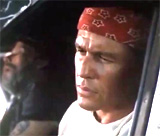 Pilot Lewis Moon - Flying Over the Niaruna to Bomb Them  The Niaruna Roundhouse in the Jungle - Aerial View  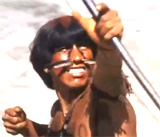 Niaruna Male Shooting Arrows at Moon's Approaching Plane     After Parachuting Down, Moon Entered Naked Into the Center of the Roundhouse, Greeted by Niaruna Elders   Naked Native Females Lined Up at Mission to be Clothed by Hazel  Billy Quickly Acclimated to the Native Lifestyle  Photo Taken of Native Children  Curious Niaruna Native Woman at the Catholic Mission 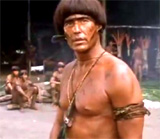 Moon Revered by the Niaruna 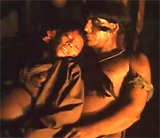 Moon with Pregnant Niaruna Wife Pindi 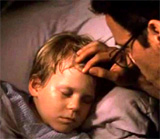 Death of Billy  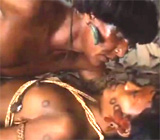 Moon Spreading the Contagious Virus to His Niaruna 'Wife' Pindi Through Kisses and Rape-Sex 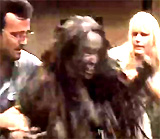 Hazel Quarrier's Weird Nude Tribal Dance 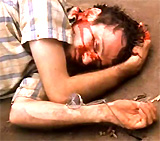 Martin's Death in the Niaruna Village |
|||||||||||||||||||||||

|
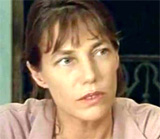
La Belle Noiseuse (1991, Fr.) (aka The Beautiful Troublemaker or The Beautiful Nuisance) Director Jacques Rivette's very-lengthy (almost four hour) and beguiling drama, with minimal dialogue (except for the first hour), was nominated for the Palme d'Or prize at the Cannes Film Festival, and won the Grand Prize of the Jury award. In the film's plot, during a 4-day ordeal of painting a fully-nude woman (for a portrait known as La Belle Noiseuse) and attempting to capture her true essence on canvas, the creative process produced troubling and unforeseen repercussions for all of the related characters' lives - the elderly painter, his ex-model wife, his young nude model, and her boyfriend. [Note: an abbreviated modified version was titled Divertimento (1992).] It told about the creative process regarding: Edouard Frenhofer (Michel Piccoli), an uninspired, married, impatient and aging French artist-painter who had become reclusive. He suddenly returned to work on an abandoned, neglected masterpiece of ten years - the painting was known as "La Belle Noiseuse." Ten years earlier, Frenhofer's original and favorite model had been his wife Elizabeth (Jane Birkin). But then his inspiration abruptly ended and his portrait was left unfinished. Attractive, aspiring children's book writer Marianne (Emmanuelle Béart) and her boyfriend (of three years) - gifted young painter-artist Nicolas Wartel (David Bursztein), were visiting at Frenhofer's rural Provence chateau; the night before they were planning to leave, Nicolas told Marianne that Edouard had asked him to have Marianne pose for him: "I think he'd like you to pose for him, very much...He asked me if you would...Well, I said yes." Marianne was very upset that she had been volunteered to be Frenhofer's newly-acquired muse - without her permission, and she complained: "Naked, I suppose. I've seen his paintings....You sold my arse!'; he tried to persuade her to agree: "He wants something different than a simple portrait....Maybe I was wrong, but I had to help him"; she argued back: "Even if it were the masterpiece, you should have let me decide"; he reemphasized: "It is the masterpiece. Anyway, it can be. It's La Belle Noiseuse. A project he gave up 10 years ago. He wants to start it again with you"; she continued to complain: "I don't give a damn about it. That guy's ridiculous"; she called her boyfriend "pathetic" for being duped by the crazed painter, and told him to "F--k off!"
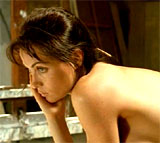
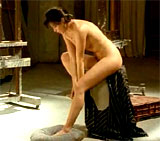
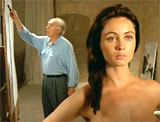
The next morning, however, she appeared at the chateau, and over breakfast with Frenhofer, asked him: "Am I too early?"; he walked with her to his vast, long-neglected stone-walled studio, where he set up and began by making multiple pen and ink artistic sketches of Marianne, the first two with her clothed; he told her: "I really didn't think you'd come." At the start of the film's lengthy, captivating, pain-staking process, accompanied with minimal dialogue, Frenhofer began to work on his long-postponed masterpiece; he asked Marianne to put on a dressing gown, after which she was required to remove it and pose nude for the remainder of their time together. After the first day of painting, she told Elizabeth that she had been asked back for a second day, but admitted it was very awkward: "I'm not made for it"; Elizabeth encouraged and persuaded her to return for a second day: "Please try, it's really important to him"; Marianne responded: "I don't know why he needs me"; Frenhofer admitted to Elizabeth that he wouldn't let Marianne get away and not return for another session, although he added: "She pesters me." To annoy her boyfriend, Marianne told him about her first days' experience: "More than good....This guy's a magician. He goes straight to the point. What happened to me is unique"; originally, she thought it would be only a one-day modeling assignment, but she told Nicolas: "I'm going back tomorrow." On the second day, he made many more preliminary sketches of her in various static naked poses, as he attempted to capture her essence from various angles; Marianne complained of having to pose in painful, demanding, contorted, cramping and unmoving positions as he touched her to set her postures, but she took the artist's challenge seriously; he insisted: "I don't want to see your face."
Elizabeth assured Nicolas: "Don't worry. Frenho's a gentleman. You don't have to be afraid." She further explained her own posing for him years earlier before they married: "I hadn't known him at all. I did it to pay for my studies..." While painting, Frenhofer remembered: "In the past, they tied up the models. They hanged them by their wrists or ankles to keep the pose." He described how his wife was one of his early models: "Anyway, at first I wanted her, before wanting to paint her. For the first time, I was scared. The fear became the driving force behind what I did. A change of speed, like a whirlwind. I became blind. A tactile painting. As if it were - as if it were my fingers that saw and commanded themselves. That's what I'm looking for. That's what I want. Yes, that's it!" - he admitted that was the moment when he became "a real painter." When he threatened to keep forcing her into various pretzel-shaped positions: "I'll break you to pieces. I'll get you out of your body, get you out of your carcass," she admitted that he had already done so; he insisted that she give him more, so that he could possess her from the inside out: "I want to know and see the inside of your body"; he told her his goal was all-encompassing: "The whole body, not just some pieces - I don't care about your breasts, legs, your lips. I want more. I want everything. The blood, the fire, the ice. All that's inside your body. I'll take it all. I'll get it out of you and put it into this frame.....I'll get to know what's inside under your thin surface. I want the invisible. No, it's not that! I want - It's not me who wants. It's the line, the stroke. Nobody knows what a stroke is. And I'm after it. Where am I going? To the sky? Why not? Why wouldn't a stroke burst the sky?" She almost broke down as the second day's work temporarily paused, and told him: "As you wish, but I'm fed up"; he yelled at her:
She called him "rotten"; he replied: "I'm nothing. I'm doing nothing. I want nothing, I told you. It's the painting...", but she felt like she was going numb ("I can't feel my body"); she began to cry - but then apologized; he took a break and went outside for fresh air. End of Part 1, beginning of Part 2 When they continued again, Liz briefly observed from afar and then left; Marianne asked why he had abandoned his original painting of his wife Liz, and when he didn't answer, she point-blank asked: "Tell me why I'm naked in front of you...Why are you using me?" but he wouldn't answer except to say, "If the painting's true, it will be you"; Marianne claimed she was confused and needed to understand; when she asked if he wanted to stop, he told her: "I think it'd be better...What's the use, I'd rather die." But by now, she was deeply engaged and determined to prevent him from despairing and quitting, and reflected back his words about being strong and the need to fight: ("We can go on further"). At the end of the exhausting day, he was ready to give up: "We'd better forget it," but she resolutely told him: "You can't leave me like that, all alone in this void. You're scared. I'm not scared anymore," and she was determined to proceed. In the meantime, Nicolas had become increasingly jealous and upset over Marianne's posing, fearful of losing her; he insisted that they leave before finishing the painting, but Marianne refused ("You're free to go, I'm staying"); after two days of painting, Liz confronted her husband and accused him of wrong-doing: "I think you're playing with this girl. You don't care about the danger." On the morning of the 3rd day of painting, Elizabeth warned Marianne: "Be careful....He values his work more than anything else. It can cause a lot of damage to people...If he wants to paint your face, refuse." During their 3rd day encounter in the studio, Marianne defiantly announced that she would choose her own positions: "Let me be myself... Let me find my own place, my way of moving, my timing. If you don't like it, we'll stop." Marianne also divulged that it was over between her and her boyfriend Nicolas, calling him a bastard and a fool: ("He hates me. He thinks I'm crazy about you. He's a bloody fool. A fool and a bastard"); she blamed the modeling assignment on him, and believed it was a pretext to break up with her: "I'm telling you my life's coming to a stop. Everything's over between Nicolas and me and I don't even know how it happened. He's the only man I could live with. Others, I spit in their faces. Including you." At the end of the third day, Frenhofer again took charge of his model and took out a long-abandoned, unfinished painting of Liz and began to reimagine it by painting over it with the new images of Marianne. After others went to sleep, Frenhofer returned to the studio to continue working, and ended up sleeping there for the night. When Liz entered the studio in the early morning and found out about her covered painting, she considered it a betrayal by her husband, and asked him: "Since when for one work in progress, you have to destroy another one?" Feeling unloved, Elizabeth (who was becoming more and more disconsolate, tormented and jealous because of her husband's rapt attention to his model), compared her painting of 10 years earlier with the current one. She told him: "You had to wipe me out...You replaced me, yes. You put some buttocks in place of my face...It's about you and me. What you've done is diminishing us. You've made us sick of each other." With some coldness and cruelty, she considered his recent painting project a sign that he lacked life's energy, was old and sad and at the end of his life: "But now it's not a new beginning. It's the end."
While the 4th and final day of painting commenced, Nicolas' pretty, worried sister Julienne (Marianne Denicourt) arrived with concerns about Nicolas' deteriorating relationship with Marianne; Elizabeth reassured Julienne: "He thinks they're going to have, how do you call it, an affair or something. I think he's wrong, but he's right to worry....It's not the flesh that's shameless, it's not the nudity, it's something else." She described her own earlier experiences as a model with her husband: "First he wanted to paint me because he loved me, and then...Then because he loved me, he didn't want to paint me. It was me or painting, that's what he said." She felt that her husband shouldn't show the finished painting to Marianne, because it would capture her whole unvarnished life on the canvas.
At the film's conclusion, after the painting was finished following a marathon battle of wills over a 4-day period, Marianne was allowed to view the finished work; and shortly later, Liz also took a long studied look at the portrait. As she was leaving the chateau, Marianne ran into Julienne and told her she was leaving Nicolas for good, but couldn't face him to tell him: "I can't stay with him. I don't love him enough"; she also described the painting's stunning image to Julienne: "A thing which was cold and dry -- it was me" - she realized that Frenhofer had actually captured a true representation of her personality. Then Frenhofer surprisingly and secretly sealed the tarp-covered painting - unseen - behind a newly-laid brick wall. He urged his housekeeper's daughter Magali (Marie Belluc) who assisted him: ("You mustn't ever look at it. Never. Our secret means you've never seen this painting. It doesn't exist"). He then went ahead and painted a replacement portrait. Later that evening, he also explained to Liz, after his exhausting work, that "everything" (including himself, his paintings and his marriage) remained dead and could not be restored. The next morning to an assembled group, including Liz, Marianne, Nicolas and Julienne, Frenhofer presented and unveiled another faceless painting as his finished product (it would be his last work of art), claiming: "It's my first posthumous work"; there was no visible reaction from any of the principals, although Marianne and Liz seemed relieved that the real painting was not displayed; privately, Liz thankfully confided in her husband: "What you've done is beautiful." In voice-over, the changed Marianne narrated: "Marianne put on her old mask again or maybe she took a new one"; Liz assured the shaken Nicolas that things would work out with Marianne: ("What's lasted for three years can't just break in three days"); Frenhofer also encouraged Nicolas: "Stay the way you are. I like you"; Marianne's voice-over continued: "So the story is coming to its end soon...What has become of Marianne you won't know tonight. Marianne? It's me. It used to be me"; as she walked up to Elizabeth, she confided that she now understood Elizabeth's earlier warning: "I'm not unaware any more" - her entire life's perspective had been irreparably changed; Nicolas was justified in being skeptical about his future with Marianne: "I am afraid." |
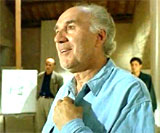 Edouard Frenhofer - Entranced by the Idea of Having Marianne As His New "Belle Noiseuse" 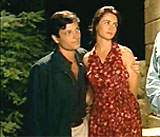 Marianne With Her Boyfriend Nicolas Wartel (David Bursztein) 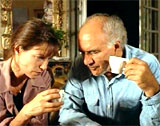 Liz's Husband Would Be Resuming His Painting  Marianne's (Emmanuelle Beart) Initial Clothed Posing  Marianne Removing Her Dressing Gown  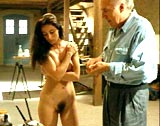 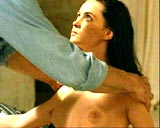       Marianne Posed Naked  3rd Day of Painting  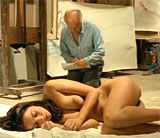 "Everything's over between Nicolas and me"  After Three Days of Paintings 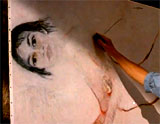 Frenhofer's Decision to Paint Over Liz's Abandoned and Unfinished Portrait  Sealing Up a Brick Wall to Hide the Portrait  Faceless Painting Displayed - Not the One Frenhofer Had Painted of Marianne  Impending Break-up Between Marianne and Nicolas |
|||||||||||||||||||||||

|
Boyz 'N the Hood (1991) Writer/director John Singleton's coming-of-age dramatic tale was set in South Central Los Angeles. Singleton became the first African-American and the youngest filmmaker to be nominated as Best Director for this film. Its themes were about life among African-Americans male youths involving temptations (and peer pressures) of crime, sex, drugs, gang violence, and the cultural pressures of racial inequality. It told about hoods growing up in South Central LA beginning in the year 1984, and spanning the years through to 1991, when the trio of African-American male youths attended Crenshaw HS:
One of the subplots involved a black teen couple - Tre and his girlfriend Brandi (Nia Long) who both were planning to attend college. The couple eventually lost their virginity together after she initially resisted his advances due to her Catholic faith beliefs. Tre had previously been cautioned by his stern father:
While kissing Brandi as she felt empathy for his exasperation over more gang violence, he asked two questions hinting at marriage and commitment with her: "What do you think about people getting married while they're still in college?" and "Are you sure you're down for this?" She agreed to proceed, but was worried: "I don't want to get pregnant," while he was touching her gold-cross necklace and assuring her: "You won't." In the film's climactic conclusion, Ricky was gunned down by the Bloods rival gang in an alleyway - (shot in the leg and lower abdomen with a shotgun) viewed by Tre in horror.
Tre and Doughboy took Ricky's lifeless body home to his hysterical and distraught single mother Brenda, who afterwards learned that Ricky had scored high enough on his SATs (a score of 710) to qualify for his USC scholarship. Tre seriously contemplated seeking revenge on Ricky's murder by getting a .357 Magnum and loading it - and thereby jeopardizing his entire future, before being confronted by his father: ("Tre, what are you doing? Huh? Oh, oh, you bad, now, huh? You bad. You gotta shoot somebody now, huh? Well, here I am. Come on, shoot me. You bad, right? Look, I'm sorry about your friend. My heart goes out to his mother and his family, but that's their problem, Tre. You my son. You my problem. Now I want you to give me the gun. Oh, I see, you wanna end up like little Chris in a wheelchair. Right? No, no, you want to end up like Doughboy, huh? No? GIVE ME THE MOTHERF--KIN' GUN, TRE. You're my only son, and I'm not gonna lose you to no bulls--t, you hear? I love you, man"). On the way with Doughboy to gun down the perpetrators, Tre decided to have the car pull over so he could return home. Doughboy and two other friends 'Dookie' (Dedrick D. Gobert) and 'Monster' (Baldwin C. Sykes) went on to cold-bloodedly and vengefully kill the three Bloods gang members responsible for Ricky's death. Doughboy shot and killed Ferris (Raymond Turner) and his Triggerman (Lloyd Avery II), while 'Monster' killed a third gang member. In the last scene set the following morning, Doughboy (who had sought deadly revenge for Ricky's killing) told Tre that he truly understood why he didn't get involved in avenging Ricky's death, and his personal denouncement of TV news and its lack of care for the cycle of violence in the ghetto:
Doughboy's prediction about the continuation of violence was accurate (he was gunned down two weeks later). |
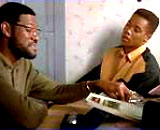 Tre Styles with Strict Father Jason (Laurence Fishburne) 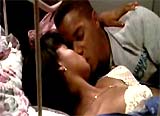   Tre and Brandi (Nia Long) 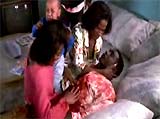 Single Mother Brenda Baker with Corpse of Her Son Ricky 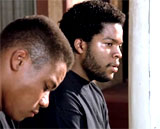 Tre with Doughboy After Revenge was Sought |
|||||||||||||||||||||||

|
Carnal Crimes (1991) Director Gregory Dark's (aka Alexander Hippolyte) film was the first fully soft-core erotic exploitation thriller. Its mostly unbelievable tale involved sex (bondage, S&M, threesomes, voyeurism), murder and blackmail. Its tagline was:
The sophisticated noir-romance hybrid film, a direct-to-video release, was set in the early 1990s. It told about a woman caught in a four-year loveless marriage in Beverly Hills, CA:
The film, told in flashback, opened with Elise's dreamlike voice-over:
Unsatisfied, neglected and feeling alone, she sought out sexual satisfaction from another handsome male:
She was sexually and passionately energized after meeting him and then after spying on a photo (and seduction) session in his warehouse studio that he was having with Mia (Yvette Nelson, aka Yvette Stefens), his sexy dark-haired model. She engaged in a threesome with them after photographs were taken of her with Mia. After Detective Ronas (Alex Kubik) informed Elise that Renny was suspected of being a sadistic serial killer, she was called upon to set up a sting operation against him by being wired. When she visited with the mysterious photographer in his photo loft, he revealed that her sexploits (photos and videos) (her "carnal crimes") had been filmed to be used for blackmail purposes against her with her husband. The material would be publicized as typical of her life - "10 days in the life of a Beverly Hills socialite turned whore." Renny added how he now had power over her: "Knowledge equals control equals power." To come clean, Elise admitted to her husband that she was having an affair with Renny. Acting self-righteous and spurned, Stanley grabbed his gun and vowed revenge against her lover. An additional twist came when it was revealed that all along, Elise's sick and perverted husband Stanley had paid for Renny to meet and entrap her. He congratulated Renny for a job well done: "You really did a number on her." And then greedily asked: "Where are the videotapes?" He congratulated Renny for his talent on the job and for his convincing ability to coax or lure Elise back to him: "She came roaring into my conference room like a whore out of hell." It was unknown to them that Elise was eavesdropping on their conversation, and would seek compensatory revenge. She was able to lure Renny to her Beverly Hills home bedroom where she promised a threesome with her friend Jasmine (Paula Trickey). She had also alerted the detectives and police to be present. To Renny's surprise, she had set up her red-lit bedroom as an S&M torture chamber, with cuffs, whips, chains and other implements of pain and pleasure, and costumed herself as a dominatrix. Elise had also promised Stanley that he could enjoy her and Jasmine for S&M sex that same evening. During her dominatrix games with the two men, she was able to handcuff Stanley, but Renny violently reversed roles and threatened Elise with stabbing. During their surveillance, the authorities burst into the room, and apprehended and arrested Renny. Elise claimed to Detective Ronas that now she wouldn't "run away," but was able to set herself free and take back her own life.
|
 Elise Trying to Tempt Her Husband Stanley to Have Sex   Elise with Mia, Renny's Model  Threesome with Mia and Renny in Photo Studio  Another of Elise's Sex Partners  Elise as a Dominatrix  Stanley and Renny Both Tricked by Elise  Ingrid (Julie Strain) |
|||||||||||||||||||||||
|
Close My Eyes (1991, UK) Writer/director Stephen Poliakoff's R-rated British drama (his second feature film) was about forbidden incestual love during the mid-late 1980s and early 1990s (at a time of AIDS fears, the Thatcher era of government, and apocalyptic concerns). Its tagline was:
The controversial lyrical arthouse drama told about two estranged adult siblings, recently-reunited with each other:
Each grew up with a different parent after their parents divorced. Although the film opened with Natalie as a single working woman and Richard as an unattached hedonist, she soon married older, affluent entrepreneur and stock analyst Sinclair Bryant (Alan Rickman) and they lived in an extravagant riverside mansion. Although Natalie was now in a marital arrangement, she willfully engaged in an ill-fated love affair ("strange bond") with her younger brother.
The duo were overwhelmingly attracted to each other and engaged in a passionately physical, clandestine sexual encounter in his apartment. She kept begging him, "Stop me, please," but continued to kiss him as they were embracing naked on the floor. Richard was amazed that they were so close to each other: "And to think, we never even really liked each other as kids." Natalie responded: "OK, that's the last bit....It just happened...It's never gonna happen again....I tried to stop it happening, and it's finished." However, their incestual pairing did happen again in London during a sultry summer sexual encounter, although Natalie was thoroughly guilt-ridden and self-castigating. She also confided in Richard about her inferior relationship with her husband Sinclair, and tried to rationalize her unnatural feelings for her brother: "Sometimes I feel this big with Sinclair. No, this big. Even this big. It's nice to be able to tell someone at last. That's all that's going on here. Understand?...This isn't cheating. Absolutely not." Natalie kissed her brother and then as they strolled along, both spoke about how their incestuous relationship was illegal, and that they had worries:
Richard contemplated the thought of them running away as fugitives to Mexico, but she rejected the idea: "We can't go anywhere. Don't think it, not even as a joke." He also mentioned his fear of growing older: "Being single....It's not as simple as it used to be." Eventually, Natalie insisted that her brother find a more appropriate partner, since she regarded him as "addicted" to her:
However, he was reluctant to break off their affair for the remainder of the summer, and forced her to continue their incestuous relationship after initially trying to fulfill her demand that he find a girlfriend for himself ("I did what you said. Your task"). She suspected that he was making his love for her sound overly dramatic: "You want to pretend this is all going to end tragically, something enormously final, because you find that idea exciting." And then she asked to only be 'friends' with him: "I need you, Richard, I really need you, as a friend." They parted with one very passionate kiss, although she had specified: "You can have one kiss, just one. I shouldn't, but one kiss can do no harm. Keep away from me till the end of next month, then you will have proved something to me." Ultimately, the unbelievable truth began to come out when Sinclair privately confided to Richard that he was suspicious of Natalie's indiscretions: "She's having an affair, isn't she?...She's lying to me all the time. When people lie to you, you suddenly can't think of anything else....She's been carrying around a giant placard saying, 'I'm f--king somebody else.'" Richard lied and replied that he didn't know the identity of Natalie's cheating partner ("So who is it?"). In the meantime, Sinclair announced that he and Natalie were leaving for America to live there for a few years, due to an "irresistible" job offer. Richard resisted the idea and begged Natalie: "Please, don't go yet." She responded about their disastrous, self-indulgent and irresponsible affair that he had become obsessed over: "I should never have let this happen. It was a terrible mistake. Couldn't handle it, could you?...I don't believe you're this hooked! It's not that serious, Richard." He threatened: "I'm not gonna let you go away" and desperately begged: "I cannot answer for what will happen if you try and leave." He made a half-hearted effort to kill himself (and frighten her) with an overdose of vitamins and sleeping pills, but Natalie was undeterred:
The film's awkward ending was set at Natalie's and Sinclair's going-away party at the end of the summer, where Richard physically assaulted Natalie and chased after her: "I want to kill you." She fought him off and tried to escape from him. He forced her to the ground as he hatefully and angrily spoke out - feeling discarded after being used: "You used me....To get a little excitement into your marriage, make it take fire again, make you feel strong, help you find yourself." They narrowly missed being run down on the country lane by a truck. She apologized:
And then she admitted that their party was a sham - they weren't moving after all. When they returned to the gathering, completely disheveled and bruised, Sinclair calmly confessed that he already knew everything about their affair - and that their relationship seemed to have been purged: "I know a few things. I know that there was something extraordinary between you two, something that had to be purged. I don't want to know any more....It's enough that the worst is over." When Sinclair was asked by Richard what would now happen, he answered: "I haven't a clue." They took a walk together as the sun was setting, and Natalie commented:
|
  Playboy Richard With His Secretary (credited as Scottish Girl (Helen Fitzgerald))  During Incestuous Affair, Natalie in Bed With Her Husband Sinclair     Hot Summer Pairing - Second Instance   Confessing Worries to Each Other While Still in a Sexual Relationship  Natalie: "Get yourself a girlfriend"  Natalie to Richard: "One kiss can do no harm"  After Richard's Botched Suicide Attempt  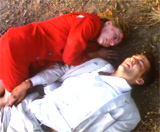 Richard's Physical Assault of Natalie 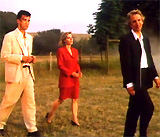 Film's Conclusion |
|||||||||||||||||||||||

|
Delicatessen (1991, Fr.) Jean- Pierre Jeunet and Marc Caro's French black comedy was set in a post-apocalyptic 1950s France (of the future). Outrageous and zany scenes among apartment building tenants were common-place. Its tagline was:
This film became well-known for its montage set-piece called the "Squeaky Bedsprings" scene. It was a clever and non-explicit sex scene that took place in a tenement apartment building above a ground floor butcher's shop/delicatessen. Above him as newly-hired handyman and circus clown Louison (Dominique Pinon) painted the ceiling with a roller, the cannibalistic butcher/landlord Clapet (Jean-Claude Dreyfus) made love to his mistress Mme. Plusse (Karin Viard) on a squeaky bed ("squeak squeak").
Other tenants kept synchronized in symphonic rhythm to the squeaking with an increasingly sped-up tempo:
Eventually, the fat-faced butcher climaxed - and:
|
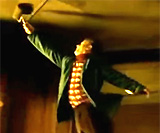 Rolling Paint 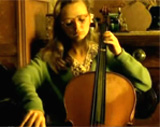 Cello-Playing  Rug Beating  Bike Tire Pumping  Knitting  Mooing Toy |
|||||||||||||||||||||||

|
Doc Hollywood (1991) In director Michael Caton-Jones' PG-13 rated romantic comedy, hot shot Washington DC emergency-room physician Dr. Benjamin Stone (Michael J. Fox) was planning to take up a cushy reconstructive plastic surgery business in the lucrative town of Beverly Hills in California. On the way to his new work driving cross-country to the Los Angeles area, Stone careened off the road in his 1956 Porsche Speedster in the town of Grady, Missouri, and destroyed a white picket fence belonging to small-town judge Judge Evans (Roberts Blossom). Stuck in the town, he was ordered by the judge to work 32 hours of community service in the amiable, eccentric, and quaint burg. Dr. Stone feared his fate as he said to himself: "I'm in the Twilight Zone." He found a 'bed' for the night in the local clinic's operating room. Soon after, however, Stone was picked up by Mayor Nick Nicholson (David Ogden Stiers) and taken to his lakeside country lodge for the night. A welcoming committee of ladies in the home, including the town's café proprieter/waitress Lillian (Frances Sternhagen) and her two friends Maddie (Helen Martin) and Violet (Amzie Strickland), offered him home-made meals, moonshine, and a friendship quilt for warmth - supposedly, a legend stated that "the first person to sleep under a friendship quilt will meet the one they're gonna marry." Stone immediately fell asleep and began to dream of a nude female swimming in a lake in golden sunlight.
The next morning near the cabin, while sitting next to a lake wrapped in the friendship quilt, he became entranced by the sight of attractive Lou (Julie Warner) who was skinny-dipping there. She emerged unabashedly from the water like the goddess Aphrodite in front of him, and greeted him with a friendly "hello." When he stuttered, she asked: "Is something wrong?" He said there was nothing wrong, adding: "I'm a doctor." She matter-of-factly replied: "If you're a doctor, I don't have anything you haven't seen before." As she walked away after putting on her dress, she added: "You can blink now." He soon learned she was a single parent and the town's ambulance driver. Slowly, fish-out-of-water, big-city slicker Dr. Stone began to adapt to the slow-motion pace of the town and its quirky inhabitants, becoming the local practitioner at the town's hospital while falling in love with Lou. |
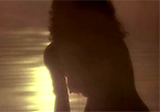 Dream 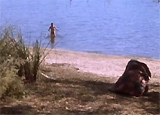 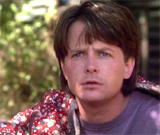 Morning Sight of Skinny-dipping Female |
|||||||||||||||||||||||

|
Jungle Fever (1991) Writer/director Spike Lee's urban romance, his fifth feature-length film, was considered controversial in the early 1990s. The film was featured as the cover story, titled "TACKLING A TABOO: Spike Lee's Take on Interracial Romance," in the June 10, 1991 issue of Newsweek Magazine. The cautionary film's advertising poster displayed two hands clapsed together - a white female's nail-polished left hand, and a black man's right hand. It told of a brief, inter-racial, adulterous romance in New York City between:
Angie lived with her brutish and racist father Mike (Frank Vincent) and her two brothers Charlie (David Dundara) and Jimmy (Michael Imperioli) in Bensonhurst. The tumultuous flashpoint of the film was the fact that Angie and Flipper, both curious about the opposite race (with black-white attraction known as "jungle fever"), injudiciously had sex during a late-night, after-dinner work session at the Manhattan office - on one of the drafting tables. Afterwards, when Flipper confided in his best friend - high-school teacher/neighbor Cyrus (Spike Lee) about his affair with a white woman named Angie, his reaction was two-fold:
Angie also told her two girlfriends about her relationship with Flipper, an African-American. There were numerous repercussions:
Angie and Flipper briefly moved in together in an apartment in Greenwich Village where they suffered further racial discrimination. Due to their scandalous and problematic liaison, they were eventually broken apart by their relatives and friends residing in their two neighborhoods:
By the film's conclusion, Flipper and Angie broke up and she returned to her father's house after apologizing and being forgiven. Flipper reconciled with his wife Drew although their marriage was possibly irreparably damaged. |
 Newsweek: June 10, 1991  Cover Art/Poster For Jungle Fever 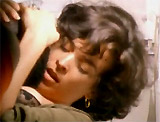 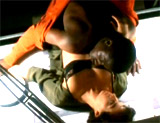 Flipper and Angie (Annabella Sciorra) Making Love on a Drafting Table |
|||||||||||||||||||||||

|
Mississippi Masala (1991) Director Mira Nair's R-rated romantic family drama (a Romeo and Juliet, or West Side Story tale) was set in the 1990s in the Mississippi bayous of the American South. This was Nair's follow-up film to her widely-successful Salaam Bombay! (1988). It was budgeted at $5 million, and made $7.3 million (worldwide), after its premiere showing in early 1992 at the Sundance Film Festival in Park City, UT. The arthouse film performed well mostly in racially-diverse metropolitan areas (such as NYC, Chicago, and San Francisco). Its tagline was:
The film opened with the devastating expulsion of a specific Indian family (and all other Asians) by the dictatorial and militaristic government of General Idi Amin in Uganda. In 1972 as part of the leader's effort to eliminate Asians and make his country more "black" - an order that required all of his country's Asian minority to leave the country within 90 days. One of the main characters, young Mina (Sahira Nair) who was the daughter of Indian expatriates who had been living in affluence in Kampala, Uganda, was expelled with her parents:
Mina's family was first relocated in England, but had now spent the previous three years in their new provincial American home of Greenwood, Mississippi. In that area, their extended family members dominated the motel industry, and Mina's family lived in the roadside Monte Cristo Motel. For employment, Kinnu operated a liquor store in a poor section of town, and Mina was employed as a motel cleaning maid-housekeeper. The film's title "Mississippi Masala" - meaning the mixing of different races and the spicy nature of a relationship, told of the forbidden romance between an inter-racial couple in the southern state of Mississippi:
Demetrius and Mina happened to meet due to her causing a minor car accident by ramming into the back of his van (symbolic of the clash of cultures), but they soon fell in color-blind love. The two attempted to keep their secret and erotic affair private due to racial tensions and extreme color-consciousness from her racially-prejudiced father who wanted her to solely socialize with exiled Indian nationals. In one sensuous scene in which both lovers were near naked in their respective beds, Demetrius phoned Mina to speak of their mutual desire for each other - and his invitation to take her for the weekend to Biloxi:
She agreed to spend a romantic clandestine weekend together in a Biloxi beachside hotel with him. They kissed while strolling along the seashore, and in the evening attended a carnival. The two were seen there by relatives and members of their Indian community, including Mina's cousin Anil (Ranjit Chowdhry) and his friends. In their hotel room, they became entwined for hot love-making before spending the night there. [Note: The film's R-rating was an over-reaction, since the main sexual sequence was very non-graphic.] But then when Demetrius' parked van was also spotted the next morning, the couple were reported to authorities that burst into the hotel room. Soon, word got back to Mina's controlling father Jay who was forced to come to Biloxi to pick her up. Her father regarded Demetrius as "kaalu" (a black man), and even Demetrius' brother and business partner Tyrone Williams (Charles S. Dutton) warned: "You better leave them f--kin' foreigners alone, boy. They ain't nothin' but trouble." Their dating and relationship as an inter-racial couple was greeted with shock and indignation on both sides. Mina was shamed and berated for associating with Demetrius, although she defended herself to her parents:
Demetrius had the opportunity to speak to Mina's father, and asked him: "So you think I ain't good enough for your daughter, is that it?" Jay accused Demetrius of being insensitive to the problems of Indian immigrants, and how he was attempting to protect his daughter: ("Mina is my only child. I don't want her to go through the same struggle as I did"). Demetrius reminded him of the oppression he and other blacks faced in the Deep South: ("Look, I'm a black man born and raised in Mississippi. Ain't a damn thing you can tell me about struggle"), and also noted that both of them were 'people of color' as viewed by the white majority - and that they shouldn't treat each other with disrespect: "I know that you and your daughter ain't but a few shades from this here. That I know!" Afterwards, Jay demanded that his daughter stick with her own ethnic race: "People stick to their own kind. You are forced to accept that when you grow older. I'm only trying to spare you the pain." The resulting gossip ruined Demetrius' reputation and business in Greenwood when his contracts were voided (he told Mina: "All those years of building up my business are gone"), and he felt she was partly to blame for his problems: "You never told me your family had trouble with black folks." He was forced to move his business enterprise out of Greenwood to Indianola. Mina decided to trail after Demetrius (while her family was planning to move back to Uganda in Africa), and move on together in his van to find a new area to help establish his clientele: ("Can I come with you?...Wherever you're going...I could be your partner. I know how to clean rooms"). She phoned her shocked parents and announced: "Demetrius and I are gonna work together. We're leaving Mississippi to see what we can do....If l don't leave now, I'll never leave. You know that." By this time, only her father Jay had decided to return to Uganda. Upon his arrival, he realized the country had changed so drastically that he couldn't move back permanently - so he would return to Mississippi. The film concluded - during the end credits - with the happy couple kissing, twirling, and dancing through a Delta cotton field together. |
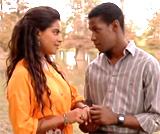 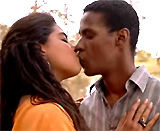 The Couple - Falling in Love 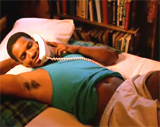  Sensual Phone Call 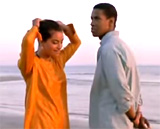 At the Biloxi Seashore  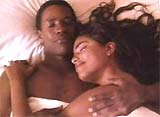 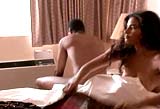 In Biloxi - Sexual Sequence: Between Demetrius (Denzel Washington) and Mina (Sarita Choudhury)  Conversation Between Demetrius and Mina's Father 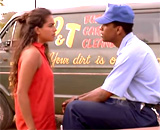 Mina to Demetrius: "Can I come with you?"  End Credits - Mina and Demetrius Together |
|||||||||||||||||||||||

|
My Own Private Idaho (1991) Writer/director Gus Van Sant's off-beat, buddy/road independent film (his third feature film), part of the New Queer cinematic movement, was a modern reworking of William Shakespeare's Henry IV (two parts) and Henry V. Some of the conversational dialogue was dubbed 'bardspeak' as it drew directly from Shakespeare's plays. On a budget of $2.5 million, it grossed $6.4 million. Its main taglines were:
There were two main mismatched male characters in this enigmatic and intense character study (of unrequited homosexual love) - both were street hustlers in the Pacific Northwest:
In a scene during the film's opening title credits, Mike was apparently having a narcoleptic episode - finding himself alone on a deserted rural stretch of two-lane road in Idaho. He counted down from 5 with his pocket watch, then muttered (in voice-over):
Then, almost lifeless as he twitched, he fell down and began to sleep. Clouds moved across the sky with snow-capped mountains in the background. In Mike's idealized view in a farmlike setting (in his own "private Idaho"), his mother held his head in her lap and was lovingly assuring him: ("Don't worry. Everything's gonna be alright. I know. It's okay. I know you're sorry. I know."). Various surreal images (including home videos) were displayed from his mind. More shadows of clouds moved across the road and landscape as the golden rays of the setting sun burnished the sky. On the soundtrack, Tex Owens' Cattle Call cowboy song sung by Eddie Arnold was playing in the background. Mike was reclined backwards in a chair as he received fellatio from a male client. As he strained - with the camera only showing his face - salmon lept upstream (in slow-motion) to get back to their place of birth (spawning grounds).
The dreamy sequence ended when a wooden barn crashed onto the two-lane road from the sky, signifying that he had orgasmed during fellatio. Mike was actually in a cheap Seattle hotel room with a balding and fat client-john named Walt (Robert Lee Pitchlynn). As the camera panned down Mike's naked body, two $10s were thrown as payment onto his bare chest. The bills slid down into his crotch area as he fastened his blue jeans. He was forced to beg for another $10 bill as he crouched outside the customer's bathroom door. In an early scene, Mike and his friend Scott and others were displayed on the covers of porn magazines in an adult book store. They came to life and talked to each other. Scott was the first to speak from the cover of MALE CALL: "I never thought I could make it as a real model. You know, fashion-oriented modeling. 'Cause I'm better at full-body poses. It's all right so long as the photographer doesn't come on to you and expect something for nothin'. I'm trying to make a living. I like to have a professional attitude. Of course, if the guy can pay me, hell yeah. Here I am for him. I'll sell my ass. Do it on the street occasionally for cash. Or I'll be on the cover of a book. It's when you start doing things for free that you start to grow wings." From another porn cover titled G-STRING, Mike responded: "What do you care about money? S--t, you got plenty. Why don't you just go ahead and do whatever it is that you do - I can only imagine what that is - for free?" Scott replied by gloating about his inheritance, due from his soon-to-die father. Both the homeless Mike and Scott were mentored (as part of a larger street family of low-lifes and druggies) by middle-aged, stringy-haired, overweight, and cocaine-addicted guru Bob Pigeon (William Richert) [Shakespearean Note: Falstaff] in an abandoned downtown hotel building in Portland, Oregon. Scott admitted his closeness to Bob when compared to his family: "I'd say I love Bob more than my mother and my father." In the film's arc-story, the two quested to locate Mike's elusive mother, traveling from Portland to Idaho ("the potato state") where Mike's older alcoholic brother Richard (James Russo) lived. They found themselves traveling on Scott's motorcycle in the middle-of-nowhere - on the two-lane road from the film's opening. In the celebrated campfire scene in Idaho while camping overnight, Mike nervously and painfully professed his true love for Scott:
Once in Idaho, Mike's brutish brother Richard explained "the real truth" about how their mother was promiscuous and had fallen in love with an irresponsible "cowboy f--k" - Mike's father ("That guy is your real father"). One night at a drive-in movie showing John Wayne's film Rio Bravo (1959), she allegedly stuck her gun in his mouth and blew his brains out. However, Mike knew the real truth - it was his own brother Richard who had incestuously 'fathered' him, and then raised him: (Mike: "Richard, you're my dad, I know that"). Then, they continued to trace Mike's mother to farmland area near Rome, Italy where she had moved to as a maid and English tutor, but learned that she had already returned to the US a long time earlier. Suddenly becoming homophobic, Scott fell in love with beautiful local Italian woman Carmela (Chiara Caselli) and they made love (in a series of freeze-framed images), upsetting Mike with their incessant noisy love-making. Scott announced to Mike that he was leaving: "I fell in love, Mike. I'm sorry," and returned separately to Portland.
Mike soon followed and returned to the US where he continued his role as a down-and-out Portland street hustler under Bob's tutelage. Meanwhile, Scott inherited his father's fortune upon his death and had decided to disavow his disreputable past by rejecting Bob's continued acquaintance as his "former and psychedelic teacher": ("I don't know you, old man. Please leave me alone...And although I love you more dearly than my dead father, I have to turn away. Now that I have, and until I change back, don't come near me"). That night, Bob suddenly died of a heart attack - possibly of a broken heart. A double funeral was held for Scott’s two 'father' figures - Mayor Favor and Bob Pigeon - who both died almost simultaneously. Contrasting funeral services and burials (formal and staid, vs. chaotic and raucous) were held near each other in the same cemetery. Bob's noisy revelers danced and chanted his name while a religious figure read Bible verses at the respectable Favor gravesite. The film concluded with a bookended ambiguous ending (with a repeat of images from the opening) back in Idaho. Just before another narcoleptic episode on a deserted highway in Idaho, Mike spoke the last line of the film (in voice-over): "I'm a connoisseur of roads. I've been tasting roads my whole life. This road will never end. It probably goes all around the world." Mike was seen unconscious on the road when two unidentified males in a truck drove up and stole his backpack and shoes. Viewed from a distance, another anonymous figure drove up, dragged Mike into the car, and took Mike away in his 4-door sedan - to the tune of "America the Beautiful." The film ended with a simple title-card: "have a nice day." |
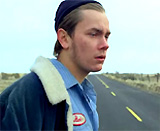 Film's Opening: On Deserted Stretch of Idaho Highway  The Two-Lane Road: "Like a F--ked Up Face"  Live-Action Porn Magazine Covers: Scott 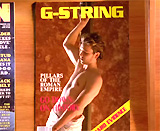 Porn Cover: Mike  Other Cover Models Joined in the Conversation 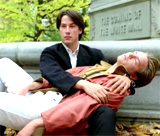 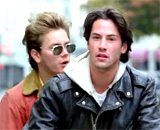 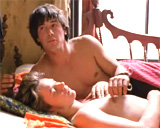 Narcoleptic Mike With His Friend Scott in Portland   Guru Bob Pigeon (William Richert)    Campfire Scene - Unrequited Love Between Mike and Scott  Mike's Older Brother Richard (James Russo) in Idaho  Scott and Carmella (Chiara Caselli) in Italy  Back in the US - a Now-Respectable Scott with Carmella  Scott's Rejection of Bob 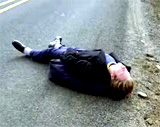 Ending: Mike By the Side of the Road - Again |
|||||||||||||||||||||||
|
Poison (1991) Director Todd Haynes' first full-length feature was this provocative NC-17 rated film - part of the Queer Cinema movement, with the title referring to the 'poisonous' effects of sex. This low-budget film (with a budget of $250,000) was attacked by right-wing, reactionary Christian fundamentalist groups as part of their family-values campaign against "government-funded pornography" (the film was funded, in part, by the National Endowment of the Arts, for $25,000). "Poison" began with the provocative statement:
The most controversial of its three, non-linear interwoven stories (adapting French Jean Genet's homoerotic writings and only film Un Chant d'Amour) was titled "Homo." The story set in the year 1944 was told with flashbacks and vignettes. Its most memorable segment was in Fontenal prison where two inmates developed a thwarted homosexual romance:
Broom experienced obsessed homosexual feelings for Bolton, someone he knew years earlier in reform school as a bullied, often-taunted weakling teen, but had now become tough and domineering. One of the most disturbing segments was a notorious spitting scene that Broom recalled watching in the past, as an unseen and silent voyeur. A group of teenaged guys forced young Bolton to hold his mouth open as they tried to spit into it from a distance. In the present in a nighttime prison scene (shot in blue light) in which the inmates were sleeping side by side, Broom tentatively and erotically touched Bolton on his bare chest and then lower over his genitals. Suddenly, Bolton woke up and discovered that he was being transgressed, stroked and touched through his pants (and then directly on his penis in a brief close-up). [Note: In particular, there were complaints about this homosexual scene including a short explicit view of an erection (removed in the unrated and R-rated versions), and an anal rape scene.]
The sequence was interrupted by an intertitle card:
Then, Broom was surprised to have his touch reciprocated. A scene of harsh, simulated forbidden anal sex (from behind) followed (with a lot of grunting), while the two stood up against a wall. A male love triangle ultimately developed between Broom, Bolton, and prison gang leader Rass (John R. Lombardi). |
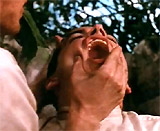 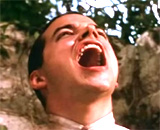  Flashback of Spitting Scene Involving Jack Bolton as a Bullied Teen |
|||||||||||||||||||||||
|
Prospero's Books (1991, UK/Fr.) Eccentric arthouse director Peter Greenaway deconstructed and radically retold Shakespeare's final play The Tempest in this lurid, lavish, imaginative, confounding, and visually stunning R-rated film production and fantasy drama. The visual orgy also featured a pop-minimalist score by Michael Nyman. In the multi-layered film, there were numerous super-imposed images, frames, voice-overs, swirling choreographed dancers, processions, pans, and tableaux. The bacchanalian pretentious spectacle was advertised as containing copious full-frontal nudity at various times (provided by hundreds of unclad extras of both sexes) as nude dancing nymphs and resident sprites on the island. The island was portrayed as a Roman bathhouse. Its tagline described the visionary film's content:
The protagonist was:
He had fled in exile twelve years earlier to a small Mediterranean island with:
During the elaborately-choreographed opening credits with a lengthy traveling shot moving from left to right, the books were placed on tables and passed from one naked spirit/character to the next, and then opened and read. The multi-media film began with nude young boy-sprite Ariel urinating into the Roman bath-pool where Prospero (with a toy ship in his hands) bathed and wrote, followed by an underwater nude ballet sequence.
Most of the dialogue (including the lines of other characters) was spoken or narrated by the God-like Prospero, as he wrote out (or read) the calligraphic letters (with his voice-over) while flipping through the pages/contents of the many books. He manipulated, with magical control, the characters of his drama as well as all the resident fairies, sprites, nymphs and monsters.
Castaway Prospero imagined that he had created the play The Tempest, and the products of his vivid imagination became the action of the film. A tempest brought his usurping brother Antonio (Tom Bell), as well as Alonso (Michel Blanc), the King of Naples and his son Ferdinand (Mark Rylance) to the shores of the island, where Prospero planned to seek revenge against his turncoat compatriot-enemies. He was also dealing with a deadly plot conceived by lonely, primitive, deformed and beast-like Caliban (Michael Clark), the son of witch Sycorax. With the help of sorcerer's sprite Ariel (in another form) and Prospero's own efforts to bring them together, Prospero's daughter Miranda fell in love with Ferdinand, the son of his chief enemy, and they planned to marry. Prospero was moved by his brother Antonio's remorse (thinking Ferdinand was dead), forgave him, and decided to forego or abandon his vengeance against his cohorts. |
 Opening Credits 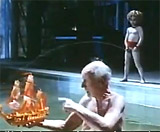 Magician Prospero (John Gielgud) in Pool, While Young Boy Peed 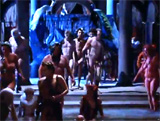 Abundant Nudity 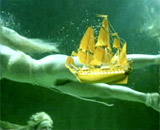 Underwater Nude Ballet  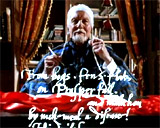 Prospero's (John Gielgud) Writing of Calligraphic Letters 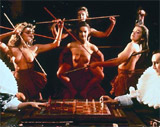 Naked Sprites, Nymphs, Etc. |
|||||||||||||||||||||||

|
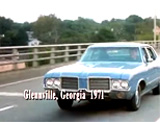
Rambling Rose (1991) Director Martha Coolidge's coming-of-age dramatic tale was set in the South (Glennville, Georgia) during the mid-30s Depression era, with a tale adapted from Calder Willingham's 1972 novel. Its tagline was:
It told about a scandalous, sexually-precocious, uneducated, troubled, love-seeking young woman:
The film was told as a flashback from the year 1971, by Southerner Willcox 'Buddy' Hillyer (John Heard) who had returned to his childhood home where "Rose" had made such an impact on his early life: ("She was the first person I ever loved outside members of my own family. But as my father said, she caused one hell of a damnable commotion").
She was employed as a maid-domestic servant in the household of a Southern family, run by:
'Rose' was graciously greeted: "Rosebud, I swear to God. You are graceful as a capital letter S. You will adorn our house. You will give a glow and a shine to these old walls. Yes indeed." In a scene of inevitable sexual temptation (when 'Mother' was away for the evening at a garden club meeting), 'Rose' tempted or bewitched 'Daddy' by throwing herself at him and sitting on his lap - she declared her love and begged for a kiss ("Oh, God, Mr. Hillyer! I love you! I tried! But I can't help it. Please kiss me. Will you kiss me!"). Although he protested ("I can't kiss you. I only kiss Mrs. Hillyer"), he kissed her once, and then as she laid down, he continued the kisses while fondling her right breast with one hand (while 'Buddy' (Lukas Haas) and his younger sister Doll (Lisa Jakub) spied on them through a door crack, and 'Buddy' provided commentary: "Rose's tittie's out! He's got his hand on it!").
But then, 'Daddy' became unnerved, composed himself and self-righteously resisted and ordered her to calm her ardent love as he backed away:
He claimed: "Now let me warn you. I am standing here at Thermopylae...And the Persians shall not pass." That same night, Rose came to 'Buddy' to seek consolation ("Buddy, I have been wandering in the wilderness, lost. I just feel awful. Do you mind if I get in bed with you for a little while?"). She complained of a broken heart and her mad "lost love" for 'Daddy': ("Men, I don't understand 'em. I can't see through 'em. I can't figure 'em out. And they break my heart, that's all. But this is the worst ever. 'Cause it wasn't his fault, it was my fault. I was bad"), but 'Buddy' had only become more sexually-inquisitive about the facts of life and female anatomy. She allowed him to sexually touch her breast over her thin nightgown: ("It's awful soft. I thought it would feel like a cantaloupe"). At first, she told him: "You're just a child. You're not supposed to be interested in such things...A child like you asking such things!"), but he was persistently curious and kept asking: "Come on, Rose, just for a second...Can't I just see what the nipple looks like?" and he was allowed to place his hand directly on her breast: ("It's got a nipple on it...it's like a little acorn...it was softer than I thought"). She tried to explain again: "You're just a child, and wouldn't understand, but that type of thing can stir a girl up." And then he went further and asked with a whisper for a more "nasty thing" ("Can't I touch it just a little bit?") - he boldly moved his hand down to her privates under her gown. When he touched her and asked with curiosity: "Am I hurtin' you?", she breathed deeply and responded: "No. No, you're not hurtin' me. You'd just better quit it, Buddy, that's all...". Before she was brought to a shuddering orgasm, Buddy admitted: "Without a doubt, this is the most fascinating experience of my life." Afterwards, he asked: "What's the matter, Rose? Are you sick or somethin'?" She replied guilt-ridden with regret: "I've robbed the cradle and fell into Hell. I must be crazy! I got to get out of here! Buddy, you wouldn't tell nobody, now would you?" Later, she returned to his room and piteously begged for Buddy not to squeal: "I'd never hurt you, ever, but they'd think I did....They'd blame me, not you. They'd think I was awful. A disgusting girl, which I am." Rose was determined the next day to go out and find a husband: ("Mr. Right is out there somewheres, and I'm gonna find him") - disembarking from 'Daddy's' car, she pronounced: "I'm going out amongst 'em, boys." She sashayed into town in a tight, slinky, handmade cotton dress and raised-heels, posturing for attention that only brought catcalls and male gawking; as 'Buddy' and 'Daddy' watched, she swiftly was able to attract gazes: "Incredible, the swiftness of it. The girl strikes like a cobra." "Daddy" also found himself fending off her many eager male suitors. Early one morning, he found a pair of shoes on the back porch, and burst into Rose's room - he found that a male suitor, a poor and unemployed would-be fireman named Billy (Matt Sutherland) had spent the night with Rose. She pleaded: ("Mr. Hillyer, I know I was bad. And I hadn't ought to have done it. But I am only a human girl person. And I ain't always perfect. Don't fire me. I love you all so much"), but he responded: "Rosebud, you break my heart. But I am only a human man person myself of the father variety. Pack your bag, baby. As of this moment you're hired, mired, and fired" - however, he relented. In the film's most pivotal scene, when 'Rose' was suspected to be 3 months pregnant (possibly by someone who had left town with "no forwarding address"); she was seen by Dr. Martinson (Kevin Conway). He diagnosed that she wasn't pregnant, but had an ovarian cyst; and due to rampant "promiscuity" in her past, she had also suffered from gonorrhea (untreated when she was 15) and had been rendered infertile. He prescribed a radical but therapeutical surgical operation (a hysterectomy, the removal of the womb), along with removal of both ovaries, to cure Rose's over-sexed, "near-nymphomania" sexual appetite - "She is an extreme psychoneurotic with uncontrolled sexual impulses" - and 'Daddy' agreed ("Spay her!"). 'Mother' stood up to the surgeon and her own husband for their savage cruelty: "Over my dead body! Are you human beings or are you some kind of male monsters? Is there no limit to which you will not go to keep your illusions about yourselves?...You'd go so far as to mutilate a helpless girl, who has no means of defending herself?...Could you really take Rose's womanhood away from her, when it's all she's got?" After 'Daddy' came around to her pleas and admitted he was wrong by agreeing with the doctor, 'Mother' threatened the doctor's practice: "And if you hurt that girl, I'll hire lawyers, and I'll sue you from here to kingdom come. I'll ruin you"; subsequently, only one cystic ovary was removed from Rose. In the last, inevitable farewell scene between 'Buddy' and 'Rose', she admitted: "I'm gonna have to leave here. I gotta go...I got to, Buddy." She shared details of her unhappy and abusive childhood, and then revealed: "Sex don't mean nothin' to me, Buddy. It ain't nothin' but a mosquito bite....Buddy, I'm gonna tell you a secret. Girls don't want sex. Girls want love." As the film concluded, 'Rose' was married to "Mr. Right" - Dave Wilkie (Robert Burke) - the policeman whose thumb she bit earlier when she was arrested and jailed. 'Daddy' joked as they drove away from the wedding's BBQ: "Thank God we're rid of her at last. And she's happy, that's the main thing, she's happy"; 'Buddy' cried as she receded in the distance. The film's final lines - a return to the opening scene - were between widower 'Daddy' and 'Buddy' who recalled details about 'Rose's' life and both grieved over news of Rose's recent death a week earlier and their mutual love for her; 'Daddy' described 'Rose's' lasting influence: "Rose was so alive. It's hard to believe. Nobody lives forever, and who'd want to?...Now boy, get a grip on yourself. She had a good life. She met Mr. Right. Then what are you blubbering about?...Rose isn't dead, son, not really. Some of us die, some of us don't. Rose lives! (a long pause before they walked back to the house) Don't worry about it, boy. She's at rest with Mother in the creative universe. She's at rest with Mother." |
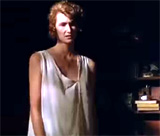 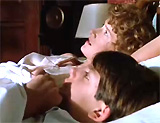 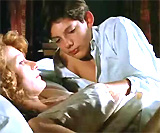 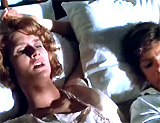 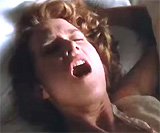 Rose's Sexual Experience with 'Buddy' 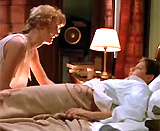 Begging 'Buddy' Not to Tell 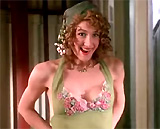 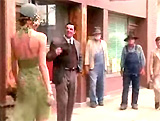 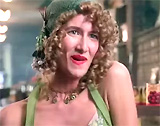 Rose Out on the Town   Confronting Rose About Early-Morning Suitor Billy in Her Room  "I ain't always perfect. Don't fire me"  Dr. Martinson's Diagnosis and Drastic Remedy - a Hysterectomy  'Mother's' Objection to Radical Surgery  Last Scene Between 'Buddy' and 'Rose'  Rose's Marriage  Epilogue: Sharing Sad News of Rose's Death |
|||||||||||||||||||||||

|
Return to the Blue Lagoon (1991) Producer/director William A. Graham's romantic adventure film was a sequel to the more highly-tauted The Blue Lagoon (1980), which starred Brooke Shields and Christopher Atkins. The original film's director Randal Kleiser served as the film's executive producer. The film was a major box-office bomb - on a budget of $11 million, the film only grossed $2.8 million. It was nominated for five Razzie Awards, including Worst Picture, Worst New Star (Krause and Jovivich), Worst Director, and Worst Screenplay. Its taglines promised:
The film opened with scrolling text to explain the historical context:
It told the same sanitized 'coming of age' story of two young children in the next generation (the boy was the offspring of one of the original castaways) who were again shipwrecked on the same South Pacific tropical island in the year 1897. The film repetitively explored the same themes with the two young children:
The two children were shipwrecked on the island and raised by Sarah Hargrave until her death eight years later in 1905. By this time, Richard was 10 years old and Lilli was 8. As the two children grew into young teens over the next six years, they experienced the onset of puberty and changing bodies (with Lilli's first menstrual period and Richard's erections). Soon after, the two became passionate lovers and exchanged wedding vows.
The film concluded with the two having a baby child together and remaining on the island, although they had an opportunity to return to civilization. The last lines of the film confirmed their choice:
There was only discreet and minor nudity in the film, allowing the film to appeal to a wider PG-13 audience.
|
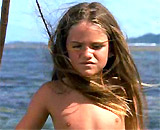
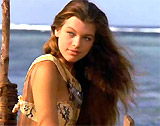
 Lilli with Richard    Lilli (Milla Jovovich) |
|||||||||||||||||||||||
|
La Riffa (1991, It.) (aka The Raffle) Writer/director Francesco Laudidio was responsible for bringing the voluptuous actress Monica Bellucci first to the screen in this 85 minute-long Italian drama - the 27 year old actress' first starring or major film role. Before entering films in the 1990s, Monica Bellucci had started out as a very curvy Italian model - unusual in the high-fashion world due to her Mediterranean features and her full breasts. Interestingly, her role in this film was about the commercialization of her beauty through a high-stakes raffle.
The film was inspired by the last episode (filmed by Vittorio de Sica) of the Italian film Boccaccio '70 (1962), in which her role was played by Sophia Loren (as Zoe). The main female role was:
She was forced to support herself (and her young daughter Giulia), and advised to sell all of her possessions (house, jewels, furs, yacht) to survive for awhile. Afterwards, without a job or secure future, she decided to become the prize in a raffle bid upon by twenty wealthy men (each bidding 100 million lire), in which the winner was entitled to live with her for 4 years and demand whatever he wanted.
Many lecherous friends of her husband, and her own lawyer Cesare (Massimo Ghini), all vied to win her at the same time that she fell in love with a new boyfriend Antonio (Giulio Scarpati).
As the film concluded, she decided to run away with her daughter and escape becoming victimized by a lottery winner. |
  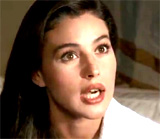 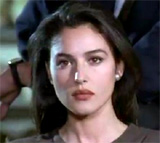 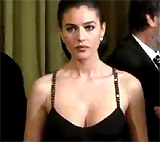 Various Views of the Beautiful Francesca (Monica Bellucci) |
|||||||||||||||||||||||
|
The Silence of the Lambs (1991) The taut, suspenseful, Best Picture-winning psychological thriller The Silence of the Lambs (1991) was directed by Jonathan Demme and written by Ted Tally. The tense film was a major commercial and critical success, although gay groups complained about its stereotypical and negative depiction of the killer in the finale, and the film's implicit homophobia. They believed that the film equated homosexuality and transgenderism with insanity, monstrous individuals, dangerous sexuality and serial murder. Demme defended his film, claiming that the suspected killer was not specifically portrayed as gay or trans-sexual, but just psychologically and pathologically damaged - and was seeking some kind of transformation. In the film's basic plotline, ambitious FBI agent trainee Clarice Starling (Jodie Foster) was sent by her superior Jack Crawford (Scott Glenn) to the Baltimore Hospital for the Criminally Insane. There, she was to interrogate serial killer Hannibal Lecter (Anthony Hopkins), a former psychologist and a cannibalistic psychopath, in his subterranean cell, about another trans-sexual killer:
Lecter had insisted to Clarice that the self-loathing Buffalo Bill, who had suffered a life of abuse, was not a real trans-sexual but only believed that he was, or showed symptoms of gender dysphoria:
Gumb abducted overweight women as his victims, to be skinned after they were kidnapped and forced to lose weight. He would then peel (or flay) off their loose skin and make a female 'suit' for himself. As Clarice described: "He's making himself a 'woman's suit,' Mr. Crawford, out of real women. And he, he can sew, this guy. He's, he's very skilled. He's a tailor or a dressmaker. That's why they're all so big. He has to keep them alive, so he can starve them awhile, so he can loosen their skin."
'Buffalo Bill' was very much depicted as trying to feminize himself throughout the film, in order to accept himself. His dark abode and basement lair held a collection of sewing forms and mannequins, and a record of his victims on Polarioid photos. The transvestite serial killer was seen primping before his mirror, applying makeup to his eyebrows, adjusting a nipple ring, adorning himself with jewelry, and putting on lipstick. He would play dress-up, and he was also fond of petting his pet white poodle Precious. He hid his large gun under a quilt with a pattern of orange swastikas. With frizzed-out hair, a naked and hairless Gumb danced, spread his arms out and opened his colorful robe like wings, and tucked his genitals out of sight between his thighs - ready to emerge ('from his cocoon' like the Death's-head Hawkmoth) and metamorphically change into a completely-transformed person. |
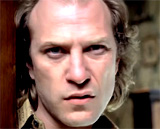 'Buffalo Bill' or Jame Gumb (Ted Levine) 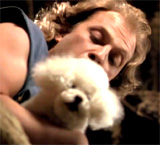 Gumb With White Poodle Precious  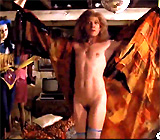 Opening His Wings, With Genitals Tucked Away - For a Self-Photo |
|||||||||||||||||||||||

|
Thelma & Louise (1991) Director Ridley Scott's feminist road trip and crime tale was a tremendous success and milestone film for its time. On a budget of $16.5 million, it grossed $45.5 million, and was the recipient of six Academy Award nominations (with two Best Actress nominations, Best Director, Best Cinematography, Best Film Editing, and one win for Best Original Screenplay for Callie Khouri). Its tagline was:
It showcased the title characters, two on-the-road fugitives:
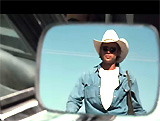
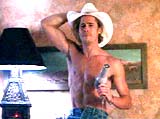
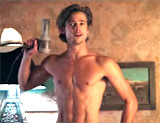
They fled after an ugly threatened rape incident in the Silver Bullet roadhouse parking lot that led to a retaliatory killing. Along the way driving a 1966 Ford ThunderBird convertible, they picked up hitchhiker J.D. (Brad Pitt in a star-making role), a good-looking hunk and redneck cowboy. J.D. was first viewed in the rear-view mirror. During a motel fling in Room 133 with Thelma when he came in from a rainstorm, he told her he'd broken parole and had robbed a number of small businesses - he flaunted a hair dryer as a gun when he demonstrated his "gentlemanly" technique. The "outlaw" sweet-talked Thelma with:
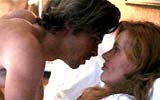
The camera panned up J.D.'s chiseled abs (shot from the female point of view) as he stood at the foot of the bed, pulled Thelma's bare legs toward him, kissed the sensitive area above her pantied crotch, and then proceeded to make passionate and energetic love to her on top of the room's dresser - to the sound of Chris Whitley's singing of Kick the Stones.
The next morning in the motel's coffee shop, Thelma showed Louise her hickie and admitted to Louise that she had her first orgasm:
But on departing, they were shocked to discover that J.D. had stolen their "future" money that they had left on the nightstand next to the bed, forcing them into a life of crime. In the film's conclusion, before the two fugitives drove their convertible into the Grand Canyon (and oblivion), Thelma had urged them to keep going:
They kissed each other, and then grasped hands as they met their fate, taking off in a swirl of dust. It was a soaring, freeze-frame, white-out finale ending as they roared forward and sailed into the air. [Note: The scene was reminiscent of the Bolivian army massacre at the freeze-framed conclusion of Butch Cassidy and the Sundance Kid (1969).] |
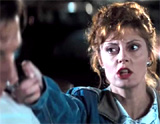 Louise Threatening Thelma's Rapist 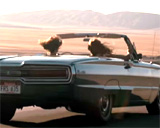 On the Road as Fugitives   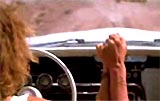 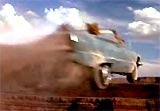  Thelma & Louise Sailing To Their Deaths at the Grand Canyon |
|||||||||||||||||||||||
|
Whore (1991, UK/US) (aka If You're Afraid to Say It, Just See It) Director Ken Russell's third American film was this pseudo-documentary drama - an uncompromising, realistically bleak look at the dehumanizing, promiscuous occupation of prostitution - advertised as the "flipside to Pretty Woman." Its tagline was:
The film was available in three versions (82-minute R and NC-17 version, and longer 92-minute European version). A film with cheap production values and sloppy editing, it included latent lesbianism and violent gang-rape in a van. It examined the life of:
She often talked directly to the camera through flashbacks. While having a drink at a strip club, among other things, she spoke about her experiences, including her bad marriage, lewd sexual encounters, dirty talk and abuse from:
In one scene, she unzipped the back of her skirt for sex in the rear of a car with an elderly client (Charles Macaulay) - while mocking his sexual excitement, and in another, she complained to her pimp about a tough workout (sit-ups on an incline bench) while wearing lingerie, but then had hot-tub sex with him afterwards. |
   Streetwalker Liz (Theresa Russell) |
|||||||||||||||||||||||

|
Zandalee (1991) This erotic, steamy bayou thriller by director Sam Pillsbury was basically a direct-to-video sexploitation flick (originally rated NC-17) about a tragic romantic love triangle. Its taglines were:
The main title character was:
Zandalee's main male partner thus became Johnny, who appeared in town for a visit:
Johnny's first scene at a bachelor party found him licking whipped cream off a stripper's chest: ("He always had a sweet tooth"). The spirited and egotistical Johnny was crude and pretentious at the same time: "Without creativity, without life, then you are truly unable to go straight up the devil's ass, look him right in the face, smile, and survive," and
After attending a "Bourbon Street" sex show, horny Zandalee asked her husband to experiment sexually: ("I want you like we used to want"). She coaxed him to try to make love anally, but he was unfulfilling to her - without the power both to make love or write (he admitted: "I'm just paralyzed. A paraplegic of the soul"). The frustrated, vixenish wife began to pleasure herself in front of him to humiliate him, not understanding his lack of desire. Soon, she reluctantly turned to the selfishly-hedonistic, predatory Johnny for uninhibited and passionate sexual encounters. He approached her:
When she disagreed: "That's not a relationship," he kept advancing: "You know what I like? I like it when you don't wear anything under." She removed her panties and he kissed her as he stood her up against a wrought-iron gate in an alleyway. He then made forceful, thrusting and grinding love to her in his art studio. Afterwards in a colorful body-painting scene, when she denied being a "sad woman" or sexually dissatisfied - he dipped his index finger in blue paint and sensually drew a line down between her bare breasts (in close-up), through her belly button and to the top of her pubic hair. Later, in a dinner scene with the Thierrys which he attended with ditzy date Remy (Marisa Tomei) - while Johnny and Zandalee were in the kitchen getting dessert, she called him a "dumb coon-ass prick." He suggested: "Take my dumb coon-ass prick inside of you with your husband in the next room" -- and they risked coupling together on the washer-dryer in the laundry room. Eventually, Zandalee was feeling guilty about their surreptitious, destructive relationship and feeling like she had become white trash: ("I can't do this anymore! I can't be what you want me to be...It's not me!"), but he insisted (as he massaged her breasts): "Yes, you can...You can be what I want you to be. You just have to relax. When I'm inside you, I feel us at the edge of the universe, traveling, exploring." He applied a powdery drug substance to Zandalee's nether regions from behind ("Where else can you express this need to free our bodies. We're gonna f--k like animals in the altar of the primal"). More memorable scenes included sex in a church cathedral confessional booth where he angrily took the clothed Zandalee from behind: ("Are we in the real church? Isn't this the way he really shows Himself to us?"). Afterwards, he looked upward: "Thank you, Father." Their self-destructive affair led to Johnny's request that she leave her husband and live with him, although she refused and recommitted herself to her marriage. Obsessed by Zandalee, drugged-up Johnny pursued the married couple to the bayou where they went to patch up their relationship, "start clean," wear flowers in their hair, and make love after many months ("See, all our parts work"). A tragic end came to them - the cuckolded husband committed suicide in the bayou when he plunged into the water from the speeding boat driven by Johnny - he drowned when he wouldn't allow himself to be saved by either Zandalee or Johnny: ("He wanted to be let go"). Back in New Orleans after her husband's burial, Johnny expressed his desperation and growing rage by slashing his art canvasses (screaming: "Die!") and coating himself in black paint ("Black it out!"). He confessed to Zandalee his longing for her: "I can't get you out of me" - but she slapped him: "You don't know anything about love." And then Zandalee sacrificially jumped in front of a bullet intended for the indebted Johnny, in a drive-by shooting by his drug lord who yelled out: "You gotta make accounts payable, man." She died in his arms on the street, after which he carried her limp body to the nearby cathedral. |
    Zandalee (Erika Anderson)     Zandalee with Johnny (Nicolas Cage) |
|||||||||||||||||||||||