
|
History of Sex in Cinema: 1920-1926 |

Early Stag Films (1920s) Young aspiring starlets or contest winners, who felt that Hollywood would be a perfect place for them to be discovered, journeyed there - often ending up stranded and needing assistance to return home, and finding their dreams shattered. Some desperate girls became either high-class whores or resorted to appearing in various stag films to avoid going hungry. |
  Stag Film Nudity |
||||||||
Early French Adult Films (1920's) The earliest known adult films first began to appear in France in the early part of the century, and then began to flourish in the 1920's. They were known as "risque" or 'stag' films. They were sold on the black market and viewed mostly in private settings. Lesbianism and heterosexual intercourse were the most common subjects (male homosexuality was very rare). |
French Adult Film Excerpts |
||||||||

|
Way Down East (1920) D. W. Griffith's classic, silent melodramatic film Way Down East (1920) starred Lillian Gish in a vivid portrayal as Anna Moore - a young, fragile and innocent country girl in the big city, an ecstatically-infatuated new bride, a betrayed "wife," a bereaved unwed mother, and a matured woman.
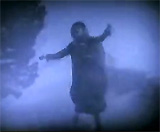
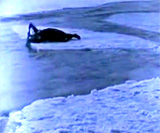
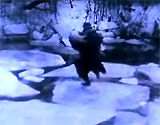
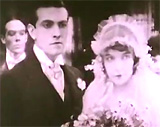
In the film's plot, Anna was seduced and exploited by callous city playboy Lennox Sanderson (Lowell Sherman) into a sham marriage and then despoiled - the camera faded to black as they went to the bedroom. The duplicitious scoundrel admitted their marriage was fake, then abandoned and walked out on her when she became pregnant, and the ruined girl bore a nameless, sickly illegitimate baby (that died shortly after birth). Later, Anna was cast out by Squire Bartlett (Burr McIntosh) into a fierce winter blizzard (the film's most famous scene) due to having a child out of wedlock, but was saved from ruin and death on an ice floe by Squire Bartlett's son, country farm dweller David Bartlett (Richard Barthelmess), her future husband.
|
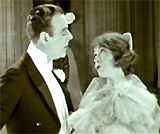 'Playboy' Sanderson Flattering Innocent Young Anna's Beauty  Anna's Revelation to Sanderson That She Was Pregnant With His Child 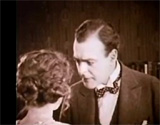 Sanderson's Confession to Anna: "Well - if you must know the truth - because we aren't married at all!" 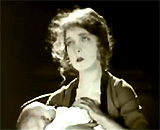 Anna With Her Illegitimate, Newborn (and Sick) Baby 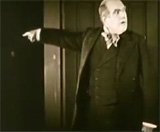 Anna Cast Out Into a Blizzard by Squire Bartlett |
|||||||
The Queen of Sheba (1921) This presumed lost Fox Studios film, an exotic epic by director J. Gordon Edwards, starred Betty Blythe (instead of vamp Theda Bara) as the titular character. Its tagline was:
Only a few provocative still photos remain of the revealingly-dressed actress - usually scantily-clad, thinly-veiled and mostly bare-breasted. In the film, she reportedly wore 28 different diaphanous costumes, but still displayed ample nudity. |
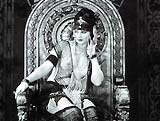
Still Photo of Betty Blythe - Actress |
||||||||
|
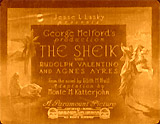
The Sheik (1921) The starring role in this adventure film brought legendary Latin lover Rudolph Valentino to the attention of screen audiences. He was the first international (and Hollywood) male sex symbol and the biggest star of the silent era. The 'sheik' came to be used in slang, meaning a man who aggressively wooed women.
It was a kitschy Arab desert romance melodrama, with the title character - Arab chieftain Sheik Ahmed Ben Hassan, representing seductive passion and forbidden eroticism (often represented by a smile and rolling eyes). He starred opposite free-willed British socialite - Lady Diana Mayo (Agnes Ayers). During their opening conversation in his tent, the Sheik flattered his future conquest:
|
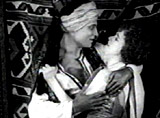 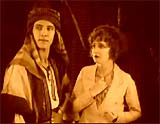 Arab Sheik (Rudolph Valentino) With Agnes Ayers |
|||||||
|
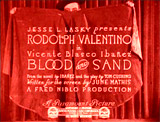
Blood and Sand (1922) Valentino (Rodolph in the credits) continued to woo moviegoers with this 1922 film. He further solidified his heartthrob image as the "Latin lover" in this very popular film. Director Fred Niblo's work also was an anti-bullfighting treatise that condemned the bloody sport. It was adapted from Vicente Blasco Ibanez' 1908 novel, Sangre y Arena. In this rags-to-riches romance melodrama, Valentino portrayed Spanish matador/toreador Juan Gallardo from Seville in turn-of-the-century Spain. Although he was married to his childhood sweetheart, the beautiful, pious and faithful Carmen (Lila Lee), he was engaged in a torrid affair with:
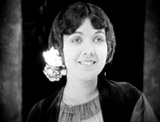
Pre-Code sado-masochism was evidenced by Dona Sol who bit Gallardo's hand during erotic pursuit - similar to the bite of a venomous snake or a real vampire. Tempted and corrupted by fame and by the spell of a female, he strayed, became reckless, and his life spiraled downward.
He was gored during his last bullfight, when Carmen returned and comforted him in a last-minute reconciliation scene, while Dona Sol had deserted him and taken another lover. |
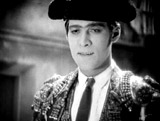  'Latin Lover' Valentino with Carmen (Lila Lee) 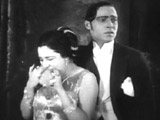
Dona Sol's Hand Biting Scene |
|||||||
|
This 8-reel silent Danish production from director Benjamin Christensen (who portrayed the Devil) was essentially an historical, documentary-style, dramatized narrative. The sensationalistic film was banned in some countries and re-edited in others due to its controversial content about medieval witchery and superstition. It surveyed sexually-repressive, misogynistic witch-hunting (the torture and slaughter of innocent women) during the Middle Ages. The film contained occasional glimpses of semi-nudity to titillate audiences with erotically-tinged witch lore. |
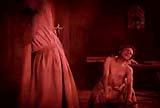 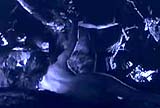 Semi-Nudity |
|||||||
|
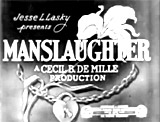
Manslaughter (1922) Cecil B. De Mille challenged the limits of screen sexuality in this silent melodrama. As was typical of many of De Mille's films, he would display sensational scenes of debauchery and then punish the perpetrators in order to have them pay for their sins. In this moralizing film, he provided a flashbacked fantasy sequence depicting the decadence and downfall of Ancient Rome with an orgy scene and a lesbian kiss. |
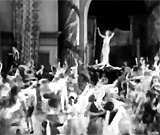 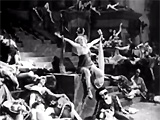 Ancient Rome Orgy Scene |
|||||||
|
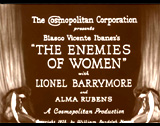
The Enemies of Women (1923) Director Alan Crosland's costume romantic epic-drama was produced by newspaper tycoon William Randolph Hearst through his Cosmopolitan Productions. A full version of the film has not survived intact. Currently, 20 minutes (approx. 2 or 3 reels of 11) are missing, and many sections of the film are in poor shape. The first two title-cards described the self-indulgent behavior in the old regime of a rich Russian class of aristocrats who were "fabulously rich" and reckless in the "corrupt and dissolute society":
Wealthy profligate Russian Prince Michael Fedor Lubimoff (Lionel Barrymore) (known for his "unlimited wealth" and his single-minded "duty" to pursue "selfish pleasure") was paired up with Duchess Alicia de Lille (Alma Rubens) from Paris - prime examples of the film's preface. They were engaged in a love-hate affair since childhood, and she reportedly was paying her husband 5,000 francs a month to stay away from her so she could pursue her own promiscuous interests. When she arrived at his luxurious palace (an enormous set), there were numerous sequences, duplicating Cecil B. DeMille's excesses, of the degenerate behavior of dozens of women, cavorting around, bowing down and dancing. The film was famous for the Prince's saber duel against the Duchess' Cossack brother (Paul Panzer). When he killed his opponent, the Prince was forced to flee his country, and after a short stint in Paris, he ended up in Monte Carlo (where Alicia was also relocated), living at Villa Serena - another decadent locale after the Great War:
He was jealous that she had a young 'boyfriend' or 'lover,' not realizing that the young man was her own son Gaston (William Collier Jr.). Lubimoff had become an "enemy" of women - declaring to a gathering of other men that women must be denounced. He proposed the establishment of a male "community" that called themselves "enemies of women":
Near the end of the film, Lubimoff hosted a ball at his Villa Serena, similar to the party in the opening palace sequence.
A face-off/duel with guns was conducted between the jealous Lubimoff and Gaston. Although both declined to shoot, Gaston collapsed and died from strain, due to a bad heart (from gas exposure in the war). Then, Alicia arrived and accused Lubimoff of killing her son: "He's my son! My son! You have killed my son!" - and he reacted with astonishment and dismay. After Lubimoff returned to his villa, all of the revelers were lying all over the courtyard, satiated after a night's drunkenness and orgy. He whipped them to get them to leave, and then was so distressed by the thought of hurting Alicia that he hung his head in despair. One of the final title cards told the moral of the story:
He decided to sacrifice his hedonistic ways by courageously entering the front lines in the Great War, in order to "redeem the cowardice of self-indulgence." He turned over Villa Serena to Alicia to care for the wounded, and returned there to reconcile with her. She stated what they both now had realized: "We were wrong - - life does not mean self-seeking. We can never find joy except in self-giving. And we who have learned this in pain and suffering - - may yet find a little happiness - - together!" The film concluded with them in each other's arms. |
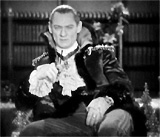 Prince Lubimoff (Lionel Barrymore)  Duchess de Lille (Alma Rubens) 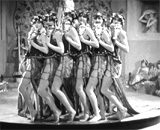 Female Entertainers & Dancers in the Russian Court 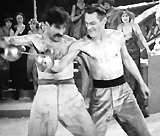 The Prince's Bare-Chested Saber Duel 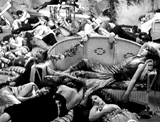 Drunken Revelers in Villa Serena Party in Monte Carlo 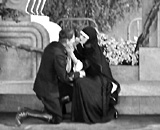 Lubimoff and Alicia Reconciled in Ending |
|||||||
|
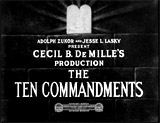
The Ten Commandments (1923) Director Cecil B. DeMille claimed that his films condemned sex and sins of the flesh, although this Biblical tale about Moses contained lots of both. The film was regarded as an allegory of the idolatry of Hollywood (i.e., the worship of false gods) and its controversial behaviors in the early 20s (especially following the Fatty Arbuckle scandal/trial). Sex and debauchery were combined in the scene of the Hebrews worshipping the golden calf. The people engaged in a massive orgy (kissing, licking wine off of a woman's leg/foot, etc.). Their fitting judgment would be punishment when leader Moses' return - their subsequent retribution. |
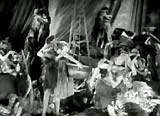
The Golden Calf Scene |
|||||||

|
Michael (1924, Germ.) (aka Chained: The Story of the Third Sex) Danish master film-maker Carl Theodor Dreyer co-wrote (with director Fritz Lang's wife Thea von Harbou) the script for this silent, gay-themed romantic melodrama (subdued in tone although providing an erotic subtext). The film was banned in France, and was not released in the United States until 1927, when it was retitled as Chained: The Story of the Third Sex. It was the visually-sumptuous story (with excellent cinematography by Karl Freund and Rudolph Mate) of a love triangle between:
It was one of the earliest representations of gay love, although unrequited. After Michael was commissioned to finish painting the Princess' portrait (after Zoret could not complete the task because he could not capture her eyes), he fell in love with his subject and disregarded his Master's attentions. |
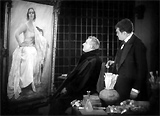 Love Triangle - Painter Zoret, Apprentice Michael and Princess Zamikoff |
|||||||

|
Ben-Hur: A Tale of the Christ (1925) There was fleeting nudity in a few of this epic film's amazing two-color Technicolor segments:
|
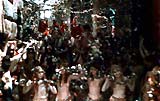 Bare-Breasted Flower Girls 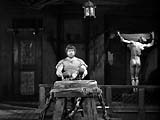 Nude Galley Slave 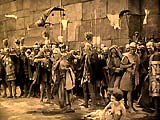 Exposed Breasts |
|||||||
|
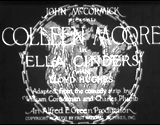
Ella Cinders (1926) First National's film Ella Cinders (1926) with Colleen Moore as the title character, dramatized the dilemma (still faced today) of young starlets coming to Hollywood with high dreams and hopes - only to be dashed shortly thereafter. Publicity for the film was launched with an Ella Cinders comic-strip with characters from the film script. The story was derived from the fairy tale Cinderella with a modern twist. It told about young Ella (Colleen Moore) living in Roseville, Colorado with a wretched stepmother (Vera Lewis) and two evil step-sisters, Lotta Pill (Doris Baker) and Prissy Pill (Emily Gerdes). She was befriended by a handsome iceman in town named George Waite (Lloyd Hughes), nicknamed Waite Lifter. She entered a local beauty contest, enticed with its promise of a cash award and a Hollywood studio contract. She had practiced eye exercises (in a book on Motion Picture Acting) to more fully express her emotions. The headshot from a photographer (costing $3) used for the contest was one showing her cross-eyed with a fly on her nose. She resolutely headed by train to Hollywood, where the studio contract was non-existent, and vowing not to be humiliated, she struggled to enter the studio to get noticed. Eventually by accident (with the help of Harry Langdon in a cameo) when caught screaming (for real) in a fire scene, she was hired by a director and put under contract. There was a happy ending when George (actually wealthy and a football hero) reunited with her in California and they were married. |
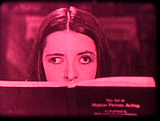 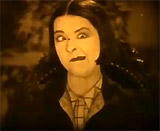 Ella Cinders (Colleen Moore) |
|||||||
|
Flesh and the Devil (1926) A glossy, melodramatic, sensual silent film about a bitter and deadly love triangle (with a homosexual subtext), from director Clarence Brown - marked the first time John Gilbert co-starred with Greta Garbo. The film was produced in 1926 and released late in the year. It was the first of six films Garbo made for director Brown and the first of four she made with real-life lover John Gilbert - two of which were directed by Brown. The couple portrayed the tragic protagonists:
Leo was smitten by her when he first saw her descend from a train car at a train station and enter her carriage when he returned home from duty, and then when he pursued her at a fancy social ball at Stoltenhof into an outdoor shadowy garden, telling her: "You are very beautiful." She responded: "You are very young" - their faces lit only by a single match flame as they shared a cigarette together, exquisitely photographed. He interpreted her blowing out the match as an invitation to kiss her - and although clothed, they erotically shared their first kiss together, in the first of the film's three extended love scenes. Reportedly, this was Hollywood's first French (open-mouthed) kiss on screen. In the next scene, as the Countess laid back on a chaise-lounge, she and Leo kissed again - allegedly the first-ever horizontal-position kiss in American film. She removed her wedding ring and placed it on his little finger, promising: "So that you may not forget me." The two lovers were caught kissing by her enraged aristocratic husband Count Rhaden (Marc MacDermott). After a deadly duel between von Harden and the Count over Felicitas' love and honor, officially blamed on a dispute at a card game to avoid scandal, von Harden was advised by the military court to enlist in the African service for five years (although he served only three). She promised: "When you come back, Leo...I'll be waiting." During his long absence, he had his childhood male friend Ulrich (Lars Hanson) (blood-brothers in "undying friendship forever") attend to and console the grief-stricken, "unprotected", and widowed Countess (without Ulrich knowing of the affair). He didn't expect that Ulrich would fall in love with her and marry her. When Leo returned, the bond between the two friends was seriously threatened. The local town's Pastor Voss (George Fawcett) knew that Leo had retained his love for Felicitas even though she had married, advising:
Although he felt betrayed, Leo was sinfully tempted to carry on an affair with her (and re-establish his relationship with Ulrich), after she told him: "Why do we pretend? I love you, and you love me." During a communion scene in the church, after Leo drank wine from the cup, Felicitas turned the goblet back to where his lips had touched before drinking herself. Unhappily married to Ulrich, Felicitas confessed to Leo: "If you stay away from me, I can't go on with Ulrich." Driven emotionally mad with lust for each other, they succumbed to kissing again (while lying down) during Ulrich's absence, causing Leo to become crazed: "This is the end, Felicitas! I can blow out my brains or run away!" She vowed: "If you die, I'll die with you! I'll never be parted from you again!" They kissed as they decided to run away together, although their plan was delayed when Ulrich returned with a diamond bracelet present for Felicitas, and she confessed that she wasn't "brave enough to leave all this." Losing control, Leo began to choke Felicitas in her bedroom, questioning why she had duped him: "You mean, stay here in Ulrich's house, faithless to him?" Ulrich saved her as she double-crossed Leo and accused him of breaking in, going mad, and harming her when she wouldn't leave with him. The two men prepared to duel the following morning for Felicitas' love on the Isle of Friendship (evoking childhood memories) - but reconsidered, dropped their weapons, and embraced each other. Ulrich realized the truth - that Leo had shot the Count because he was in love with Felicitas. However, the duplicitous temptress, who had been persuaded by Ulrich's virtuous, younger teenaged sister Hertha (Barbara Kent) (who always had a secret crush on Leo, pure unselfish love in contrast to Felicitas, but was ignored) to stop the duel, raced to the men but fell through thin lake ice and drowned - breaking her spell over the two men. |
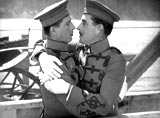 Ulrich (Lars Hanson) and Leo (John Gilbert) 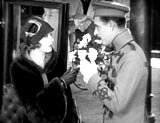 Leo Smitten by Countess  Countess Felicitas (Greta Garbo) 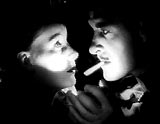 Garden Scene: Illuminated by Match  First Steamy Kiss 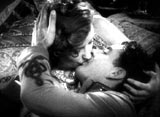 Chaise-Lounge Horizontal Kiss 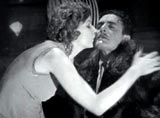 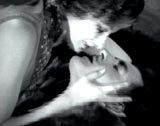 Leo and the Countess 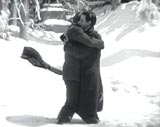
Ulrich and Leo Embracing Before Duel 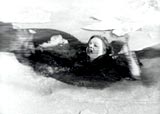 Drowning Death of Felicitas |
|||||||
|
Moana: A Romance of the Golden Age (1926) Director Robert J. Flaherty's Moana (aka Moana: A Romance of the Golden Age) (1926) was a Paramount studio-financed, follow-up sequel (of sorts) after his earlier landmark film Nanook of the North (1922) about Eskimo life. An early title card claimed the authors lived for two years in one of the island villages (Safune), and "the generosity, the hospitality and kindliness of its people made possible this drama of their lives." The film 'documented' rituals on the Samoan island of Savii among the people who "still retain the spirit and nobility of their great race." The rites included tattooing, cooking, fishing, dancing, hunting/gathering. The story was a coming-of-age tale, and was advertised by the studio as featuring close-to-nature bare-breasted native girls. Although dubbed a "documentary" in a New York Sun review of the South Seas film, it was actually cinema's first docu-fiction film, reconstructing the traditional life of islanders in Samoa in its semi-fictional tale. The beautiful utopian film was beset with problems (casting issues with the lead heroine, problems with the film stock, the presence of island corruption and the loss of traditional ways of life, etc.), and although it did well in Europe, it failed to find an audience in the US. |
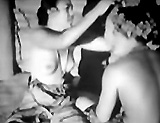 Native Girl Nudity |
|||||||
|
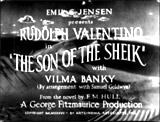
The Son of the Sheik (1926) The superior follow-up silent adventure/melodramatic romance film to The Sheik (1921) featured the decade's most popular, legendary male screen lover Rudolph Valentino. It was his final film before his sudden death in August 1926 following his collapse at the film's NY premiere. Valentino starred in the title dual role as the now-older Sheik and his hot-blooded son Ahmed, who played opposite alluring, kidnapped bejeweled dancer, Yasmin (Vilma Banky). The melodrama engendered criticism for being "morally objectionable" for its vengeful rape scene against Yasmin (only suggestively seen by a sequence of wide-eyed, soft-focus close-ups). As he forced himself upon her, he asserted as he approached her:
The screen faded to black. |
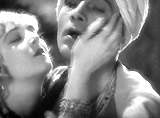 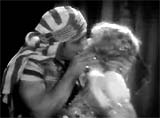 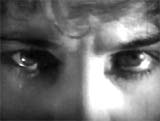
The Sheik with Yasmin (Vilma Banky) |
|||||||




 Haxan (aka Witchcraft Through the Ages) (1922, Denmark)