|
History of Sex in Cinema: 1985 - 1 |

 |
Barbarian Queen (1985) (aka Queens of the Naked Steel) After Conan the Barbarian (1982) and Deathstalker (1983), the demand for other entertaining sword and sorcery, fantasy sexploitation tales increased. Director Hector Olivera helmed this newest entry or spin-off, executive produced by Roger Corman. B-movie actress Lana Clarkson reprised her title role as a statuesque barbarian warrior woman.
Its taglines announced the Barbarian Queen's fearsome power:
In Barbarian Queen (1985), Queen Amethea (Lana Clarkson) was preparing for her marriage to Prince Argan (Frank Zagarino) when her village was raided and pillaged by royal guards of the Roman Empire, led by evil and tyrannical monarch/war-lord Lord Arrakur (Arman Chapman). Her younger sister Taramis (Dawn Dunlap) was attacked and gang-raped by the riverside, and taken prisoner. Her fiancee was also captured and taken to perform in the gladiatorial area in Rome. Amethea set off on a journey for revenge and the liberation of her sister from the Romans. She was part of a trio of she-warriors who set off from their destroyed village:
Along the way at a military outpost, Amethea halted and killed an old man who was raping a young topless female (with an X across her chest) tied to a fence. She impaled the man with her sword through the neck - unfortunately, the girl perished in Estrild's arms. Fortunately, they were able to rescue the traumatized Taramis from a contingent of guards. The group of females was then led by a very young girl named Dariac (Andrea Scriven) and smuggled into the heavily-guarded city's underground catacombs, where her eye-patched father and other rebels were organizing resistance. Taramis became one of Arrakur's harem-concubines, while the three warrior women were captured when they came to Estrild's defense during another rape. Tiniara was lethally stabbed in the abdomen during a failed escape attempt. After Amethea's capture and interrogation by Lord Arrakur (she retaliated and bit him when he ripped off her top and tried to kiss her), she was taken hostage and placed in the dungeon. There, she was tortured while stripped topless on an upright, X-shaped cross or rack with her hands tied above her head (the most common torture scene that occurred in both films). A mechanized metal glove was ominously positioned at the level of her breasts. Her comically-accented captor Zohar (Tony Middleton) grabbed her right breast (and she growled at him). He threatened to tighten the rack if she didn't talk or if she resisted: "If it hurts, you have only yourself to blame. Every time you move, the machine is tightened." Then, he forced himself upon her with stand-up rape/intercourse:
She was able to cleverly turn the tables on her captor and seek release of her hands above her head by tightly and painfully squeezing his manhood with her vaginal muscles during intercourse. When she was freed, she pushed him backwards into a trough of acid (where his body disintegrated), and then escaped. The film concluded with an uprising of the gladiators in the arena led by Argan and the rebels, and a fight to the death between Amethea and Lord Arrakur. After being disarmed and about to be killed, Amethea's life was saved when Taramis stabbed Arrakur in the back. Argan was happily reunited with Amethea. |
  Taramis (Dawn Dunlap) - Attacked and Raped by Riverside Near Village  Another Unidentified Rape Victim at Military Outpost     Queen Amethea (Lana Clarkson) - Raped On A Torture Rack  Amethea and Argan Reunited |
|||||||||||||||||||
|
Cavegirl (1985) This romantic teen comedy from writer/director David Oliver (his only film) was an unusual example of an 80's sex spoof of films in the caveman genre (i.e., One Million Years B.C. (1966) or Quest For Fire (1981)), most recently exemplified by Caveman (1981). The tagline referred to overaged and overweight, nerdy anthropology student/explorer Rex Tarrison (Daniel Roebuck), who was the story's main character.
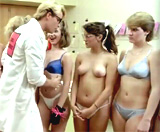
It was reported that the opening scene in the girls' locker room was obviously added (filmed after the initial shoot), since it was entirely out of place. The distributor Mark Tenser believed that the film needed more gratuitous female nudity. The topless females were all credited as Locker Room Student, including:
After playing tennis and then disrobing partially - the group went chasing after Rex, who was in the building because the sign on the door "WOMEN ONLY" had been changed to "MEN ONLY." Laughing and smiling with bouncing boobs, they ran after him. Rex's main pursuits were to fail miserably when asking a girl for a date, to spend all night long building a model of a homo erectus skull, or to be the brunt of mean pranks by his classmates - they coated his chair with glue, dropped cherry bombs into the portable toilet he was using, and with Halloween masks, they scared him from a nap during a bus trip. On the field trip excursion with other students to the inside of a cave where there were paintings accidentally discovered by miners, he touched a large clump of pinkish-red glowing crystals. Somehow, this interfered with a government missile test launch nearby, and the helicopter-launched missile exploded into the cave. He was mysteriously transported back through a gateway to prehistoric times, evidenced by wild animals (a bear and a mountain lion), and some grunting, antagonistic fur-clothed cavepeople. One of them was exceptionally beautiful:
She was very intrigued by his stick deodorant. One of the first things he asked her - since she didn't speak English - was: "How would you like to sit on my face?" Rex's main goal was to bed down Eba. He narrated:
During his quest, he was constantly interrupted by the other cave-people - even Eba frustrated him by blowing up (like a balloon) his only condom in his wallet. He also kept getting assaulted by the big breasts of aggressive cavewoman Aka (Cynthia Rullo), and the curious interests of the other cavemen. The primitive, child-like Eba was eventually convinced to become the attractive love-interest of the predatory Rex, at the 1-hour mark of the 85 minute film. She removed her top for him after he presented her with a bouquet of flowers (he had become forlorn when she became separated from him), and she laid down underneath him as they began to kiss and make love, to the tune of the sappy pop song "Show Me Your Love." In the end, Rex became a man when he saved Eba and the rest of the local clan from bone-wearing cannibals.
|
   Girls' Locker Room: An Added Opening Sequence     Eba (Cindy Ann Thompson) with Rex  Aka (Cynthia Rullo) |
|||||||||||||||||||

|
Cocoon (1985) Ron Howard's science fiction parable told about friendly aliens who rejuvenated a group of retired elderly folks with an energized swimming pool infused with a life-force, derived from oyster-shell-like cocoons being stored at the bottom of the pool. The tale was based loosely on writer David Saperstein's novel. Its tagline was fanciful:
In one of its sexiest scenes, Kitty (Tahnee Welch, Raquel Welch's daughter in her first US film) was spied upon by local charter boat operator Jack Bonner (Steve Guttenberg) as she undressed in the boat cabin. To his amazement, she removed her human skin mask - revealing that she was an alien from the planet Antarean. He was aghast: "She's not normal. There's something very abnormal about her!"
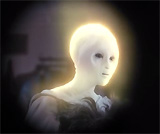
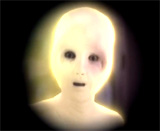
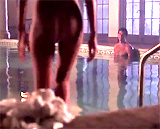
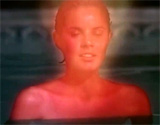
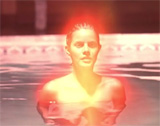
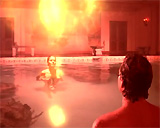
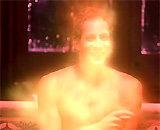
Shortly later, the old guys at the pool watched from hiding as the group of aliens removed their skin masks, revealing golden glowing bodies underneath, with bodies that could move unhindered through the air. The sight of the golden creatures scared the elderly men who fled in horror. Also in another scene of extra-terrestrial sex in the life-giving swimming pool, the naked Kitty demonstrated how Antareans expressed their affection by sending their energized orgasmic light to a partner, in this case Jack; when he approached her, she ordered him back: ("Don't touch me...Go to the other side of the pool"). He complained: ("I hope you're not gonna take your skin off, because I really like skin on a woman"). A golden burst of light energy from her zapped around the room until it targeted Jack - collided with him, and caused him to light up, without physical touch. He exclaimed: "If this is foreplay, I'm a dead man." The scene immediately cut away before answering the question if it was just foreplay.
|
 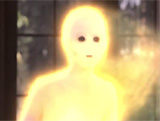 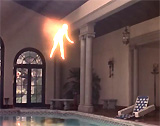 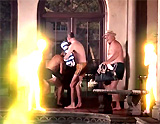 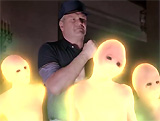 Alien Life Forms Revealed at the Pool |
|||||||||||||||||||

|
Desert Hearts (1985) This ground-breaking low-budget romantic drama was a seminal gay film from first-time director Donna Deitch. It was the first full-length lesbian-themed feature film written and directed by a woman. Reportedly, it was the first mainstream lesbian movie to have a positive outcome in its straightforward plot, and not involve negative plot devices such as a love triangle struggle, or suicidal feelings. This film won a Grand Jury Prize at Sundance in 1986. The poster's tagline described the plot:
It told about a growing relationship between two females in the late 1950s:
Vivian had traveled by train to Nevada where, after a 12-year marriage, she was seeking residency for a quickie 6-week divorce outside of Reno at a dude ranch run and owned by gruff alcoholic Frances Parker (Audra Lindley), who in her younger days used to be a casino dancer. Frances explained to Vivian how a man named Glenn was Cay’s father, with whom she had a 10-year relationship and a son named Walter (Alex McArthur). However, Cay was not Frances' child, but was an 'adopted' step-daughter. Although appearing out of place, Vivian slowly explored a very unlikely yet romantic and intimate lesbian relationship with Cay. A repressed Vivian surrendered to Cay's first kiss in a rainstorm, when Vivian rolled down the passenger's window and briefly succumbed to Cay's advances. Cay asked: "Where'd you learn to kiss like that?" but Vivian was reluctant: "I don't know where that came from" and didn't want to talk about it. Later after Vivian was forced to move to town because of increasing gossip about them, the two tried to have a "mature conversation" in Vivian's room in the town's Riverside Hotel and Casino about the repercussions of the kiss:
Vivian claimed that she was a "respected scholar" and called the kiss "a moment's indiscretion" and a "fleeting lapse of judgment." After pouring herself a drink in the kitchen, Vivian turned back toward the bedroom, where Kay was topless and sitting in her bed - she asked: "What do you think you're doing?" Kay replied: "Waiting for you" and she insisted on staying. After putting the "Do Not Disturb" sign on the door, Vivian admitted: "I wouldn't know what to do." Cay began with a series of long and passionate kisses, with Vivian confessing:
During a non-exploitatively-filmed love scene (shot in real-time), their bare breasts came together in a symbolic mirror image of their mutual love for each other. The scene ended by slowly fading to black.
The film ended with Vivian (after her divorce was finalized) at the train station planning to return to NYC, when she convinced Cay to join her - at least until the next station stop 40 minutes later, so they could be together a bit longer. |
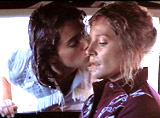 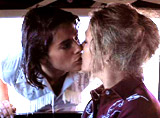 First Kiss Between Vivian and Cay During Rainstorm  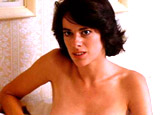   Exploring Lesbian Love in Vivian's Hotel Room 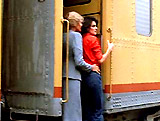 Film's Conclusion - Would They Remain Together? |
|||||||||||||||||||

|
The Emerald Forest (1985, UK/US) Director John Boorman's naturalistic R-rated tale was a coming of age tale (based on an uncredited true story), set among the 'Invisible People' indigenous tribe in the rainforests of the Amazon Basin of Brazil. The film contained considerable nudity, for authenticity's sake, of the tribal natives. The film's tagline described the basic plot outline:
The main characters were a father and son:
Tommy became separated from his family during a picnic near the Brazilian construction site for a hydro-electric dam, when he was abducted by the natives, known as "The Invisible People" and taken into the dense jungle. The young boy was snatched and adopted by the future chieftain-head of the tribe, named Wanadi (Rui Polanah), and renamed Tomme. Meanwhile, Tommy's father spent many years searching for his lost son as dam construction continued, and meanwhile, civilization was increasingly encroaching upon the tribe. After he grew up and ten years later, 17 year-old Tomme became acculterated with the native way of life. His local love interest when he had grown to manhood and was interested in courtship was Kachiri (Dira Paes). A formal wedding ceremony was held for them. In a major side-plot during Markham's search for his son, he was abducted by a rival cannibalistic, hostile and violent aboriginal tribe known as the 'Fierce People' led by Chief Jacareh (Claudio Moreno). When allowed to escape and treated as hunted prey, Markham happened to locate Tomme during his son's coming-of-age ritual (a vision quest) to collect sacred stones (green-colored clay used for the tribe's body-paint camouflage). Markham was shot in the shoulder with an arrow by the Fierce People, and was brought to recuperate amongst Tomme's tribe. Once Markham recovered and was encouraged to go on his own spiritual quest, he was returned to white civilization. The story came to a head when many of the Invisible People were murdered by the tribe of Fierce People and the native girls were kidnapped and taken to be traded with white slave traders. In exchange for their use as prostitutes in a nearby brothel close to the dam's construction zone, the Fierce People were offered guns, ammunition, and liquor. In the stirring conclusion, Tomme ventured into the city to alert his "Daddy" to help rescue Kachiri and the other enslaved young girls. After a shootout and successful rescue effort (although Chief Wanadi was killed), Tomme became the tribe's new chief to replace the deceased Wanadi. The film ended with Markham's attempt to deliberately destroy the hydro-electric dam (a symbol of the white man's incursion into the jungle that would destroy the native tribe), but it remained unclear: had it been destroyed by the detonated explosives or by drenching torrential rains? |
    Love at First Sight - In the Brazilian Rainforest: Kachiri (Dira Paes) with friends   Kachiri (Dira Paes) |
|||||||||||||||||||

|
Flesh+Blood (1985) Co-writer and director Paul Verhoeven's lurid, bloody and brutal adventure (a sexy period costume drama), his English-language debut film, was made with cinematographer Jan de Bont. It was produced entirely in Europe (Spain), and was the bridge between Verhoeven's earlier Dutch films and his later Hollywood blockbusters. The censored US version of the film cut some of the graphic sex scenes (including key footage from the prolonged rape scene). Its title promised to deliver on two basic elements - bestial sex and unbridled violence. Its taglines described the entire plot concerning the female protagonist:
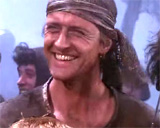
It told a story set in Western Europe during the early 16th century (the Middle Ages) - a time of plague, constant bloody warring, dirt, disease (the Plague), suffering and filth. Females were treated as spoils of war. A brigand of peasant soldiers, hired to take control of a walled Italian city, was led by the main heroic figure:
Although Martin's mission was successful in retaking the city, the duplicitous Arnolfini then betrayed the mercenaries, disarmed them, and drove them away without loot, reward or reimbursement. To seek recompense, Martin retaliated against Arnolfini and one of his caravans - the mercenaries slaughtered the lord's guards, seriously wounded Arnolfini, and stole and raided his wagons. The main female figure was then introduced, and became part of a vicious love-triangle:
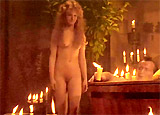
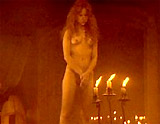
Martin unknowingly captured Agnes as part of his retaliation against his rival Arnolfini. When Martin first discovered and confronted Agnes after the caravan was attacked, she was about to be gang-raped by his men. He stepped forward and deflowered-raped her himself: (he ordered: "Lift her, hold her real tight"). She was held and propped up by his men with her legs spread, as Martin lubricated her with his spit before taking her: ("Let's see if this angel bleeds"). Those holding her up were told to "move her" back and forth on him, as she winced in pain. As a boy pounded rhythm on a drum, Martin also shouted: "Show me your face, look at me, show me your face." When she was lowered to the ground, he taunted her to scream, but she bluntly responded by taunting him and flirtatiously daring him: "You want me to scream? If you think you're hurting me, you're wrong. I like it. I like it. I'll take you, I'll take you" - and she willingly began humping him back. Martin and his barbaric mercenaries then took over a castle, and Martin was made their leader. Agnes tried to civilize Martin (and his men) by teaching them how to eat with a fork and knife. To keep herself alive presumably, the tough-minded, conniving and self-centered Agnes pretended to love Martin and aggressively seduced him into loving her. In one sexy scene, they got naked together in a bath surrounded by candles. He told her: "This castle and everything in it belongs to us." As she raised her hands above her head, she asserted: "The whole world belongs to us" - and she jumped in with a splash.
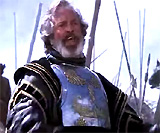
At the same time, Arnolfini's Captain Hawkwood and Agnes' fiancee Steven were pursuing the barbarians in order to rescue Agnes during a counter-attack. The scheming damsel-in-distress repeatedly switched her love allegiance between the macho Martin and the scholarly prince Steven, demonstrating ambiguity toward both - what was her true allegiance? |
      During Agnes' (Jennifer Jason Leigh) Gang-Rape by Martin and His Mercenaries        Various Undraped Views of Agnes  Agnes with Steven  Agnes with Martin |
|||||||||||||||||||
 
|
Friday the 13th, Part V: A New Beginning (1985) Although hockey-masked mass murderer Jason Voorhees did not appear in Friday the 13th, Part V: A New Beginning (1985), the fifth installment of the franchise (except as part of the prologue's nightmare or as Tommy Jarvis's haunting hallucination), it was evident that the bloodletting was mounting. Its tagline was: There was a record number of killings of peripheral characters in this film - almost two dozen, and there were longer glimpses of female topless nudity of soon-to-be female victims.
|
 First Victim Lana (Rebecca Wood)    Second Victim Tina (Debi Sue Voorhees)    Third Victim Robin (Juliette Cummins) |
|||||||||||||||||||
|
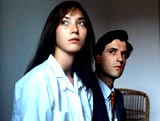
French New Wave director Jean-Luc Godard's controversial and upsetting film retold the story, now demythologized for modern times (present-day Switzerland), of the virgin birth and Mary. Outrage came over the reinterpretation of the Immaculate Conception and the fact that the Mary figure was often in various states of objectively-viewed, non-prurient undress, exhibiting her corporeal flesh throughout the provocative film. The film was condemned and denounced by Pope John Paul II at one time (he said that the offensive film "deeply wounds the religious sentiments of believers"), and picketed at theatres. The title character who represented the Virgin Mary was:
A plane flying overhead brought two others:
Both were taken by taxi, driven by Marie's platonic, school dropout boyfriend Joseph (Thierry Rode), to the petrol station where Marie worked. There, the Annunciation occurred when she was told that she was mysteriously and unexplainably pregnant:
She asked quizzically: "By whom?...I sleep with no one." Gabriel insisted it wouldn't be by Joseph: ("It won't be his. Never!"). Maintaining a chaste relationship with the petulant, short-tempered Joseph was difficult, since he pressured her: "What is this? Miracles don't exist. Kiss me. What is all this?" She continually vowed to not be touched or kissed by him. Irritated and unconvinced, he couldn't believe she was pregnant without sex, suspicious that she had other lovers: "Be simpler if you said you've seen other men." She responded: "I sleep with no one." He was very upset:
During a visit to the gynecologist, Marie told her doctor: "I've got a pain: in the belly." As she was being examined, she asked: "Does the soul have a body?" but was told she had it reversed - that the body has a soul. It was confirmed that she was indeed mysteriously pregnant (and still virginal) without having had sex with Joseph:
She told her doctor as he examined her: "Being a virgin should mean being available, or free, not being hurt. Well, do you believe me?" He was amazed when he found her hymen intact: "It's true that it's true." Joseph was still disbelieving: "It must be mine!" As she bathed in a tub and examined her own full breasts, she began to accept the miraculous fact that she would bear the Son of God, in voice-over:
Marie continually meditated about the meaning of the soul (or spirit) and the body (fleshly desire): (voice-over) "I think the spirit acts on the body, breathes through it, veils it to make it fairer than it is. For what is flesh alone?...You may see it and feel only disgust. You may see it in the gutter, drunken, or in the coffin, dead. The world's as full of flesh as a grocer's counter is of candles at the start of winter. But not until you've brought a candle home and lit it can it give you comfort." Grumpy angel Gabriel was angered by the choice of Joseph as Marie's boyfriend and called him a "nitwit" and a "jerk," but his young secretary urged: "Have trust." Joseph asked Marie: "Why does my body repel you?" She admitted she was "scared" because "all this doesn't happen every day. One's better as a pair..." She asked: "Why don't you believe the spirit affects the body?" Joseph stated he believed the opposite. Frustrated, he insisted: "At least say you don't love me. I can't stand the silence." She said that he must love and respect her soul and spirit by remaining chaste: "I know you love me. But it has to be something else...The hand of God is upon me and you can't interfere." She added: "Your body's not the snag, it's your lack of trust." He asked: "Why can't I want the child to be mine? Tell me who you did it with. I don't care, if you stay with me, if I stay with you, sleep with you, wake up with you." He insisted that he didn't love another girlfriend, Juliette (Juliette Binoche): "I don't love her. I love you." Marie allowed Joseph to touch her through her clothing, to prove her innocence: "You see, I'm sleeping with no one. But I'll still have a child. You must believe it." He vowed to act as her shadow: "I'll only be your shadow," to which she responded: "God's shadow...Isn't that what all men are...for a woman who loves her man." As she undressed for sleep, she said: "Let the soul be body. Then no one can say the body is soul, since the soul shall be body." As she laid down, she promised: "Thy will be done." Soon, she admitted she could see Joseph's love for her, and he slowly began to stop pressuring Marie to sleep with him and to be sexual with him, but he still wanted to see her naked: "We're getting married: can I see you naked just once? I'll only look." She also struggled with her sexual nature -- "...though I hide it, I'm in pain, like others. Even a bit more." She wrestled in bed with her sheets ("They'll wrest from me that which I dare not give"), and touched her own bare skin - "To be chaste is to know every possibility, without ever straying." In a scene publicized on the DVD cover and in posters, Marie stood (bottomless) before Joseph as he reached toward her swelling stomach and said: "Je t'aime." Marie replied, "No," and repeatedly slapped his hand away every single time until he said the words respectfully, with the forceful urging of exasperated angel Gabriel. She felt closer to God and asked if he wouldn't leave her, and he vowed to stay: "I'll never touch you." She then continued to struggle with her own discomforting and painful pregnancy, especially when she was alone at night in bed: "It will always be horrible for me to be the Master, but there'll be no more sexuality in me. I'll know the true smile of the soul, not from outside, but from inside. Like a pain that's always deserved." She tossled more in bed, and arched her back, and resisted the human temptation to masturbate - making an angry fist gesture with her hand over her hairy genitals, although she slowly and clearly accepted her plight:
After the child was born in the spring, she mused: "There are no looks in love, no outward seeming, no likeness. Only our hearts will tremble in the light. I can't describe Him as He stood there, but I can tell you how the women looked on seeing Him." When he grew to be a few years old (Malachi Jara Kohan), he was permitted to stick his head under Mary's nightgown at the breakfast table, and point to her various euphemistically-named body parts: ("the hedgehog or the lawn" for her genitals, and her breasts were referred to as "bells"). Joseph grumbled: "He's too old to see you naked now," to which Mary replied: "Quia respexit, Joseph" - referring to the Magnificat when Mary in the Bible said: "For he hath regarded the low estate of his handmaiden." One day, the young child announced: "I am who he is...I must tend to my Father's affairs" - and he disobediently ran off into the woods, neglecting his father. Marie was confident: "He'll be back - at Easter or Trinity Sunday." The film ended after Gabriel hailed Marie -- "Hail, Marie." Marie sat in her car, smoked a cigarette and applied lipstick:
|
 Marie (Myriem Roussel) With Joseph  Gynecologist Visit: Marie Mysteriously Pregnant and Virginal  Bathing in Tub  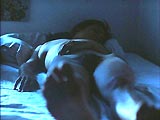   Joseph Touching Her Pregnant Belly 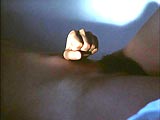    Marie Resisting the Urge to Masturbate  Marie's Child  Final Scene |
|||||||||||||||||||
|
Howling II: Your Sister Is a Werewolf (1985, UK) (aka Howling II: Stirba - Werewolf Bitch (1985, UK) This inferior sequel to the original werewolf-themed horror film, Joe Dante's The Howling (1981) was directed by Philippe Mora - both films were loosely adapted from Gary Brandner's 1977 novel. Mora made a pair of sequels - he also directed a third film, Howling III: The Marsupials (1987). The series continued with five more direct-to-video films from 1988-2011, most of which were unrelated to the original trilogy except for Howling IV: The Original Nightmare (1988) - it was a remake of the first film from 1981.
One of the film's main criticisms, other than it was an awful sequel, was that the film had more vampire lore or mythology in it than traditional werefolk folklore. The poster's taglines proclaimed two things:
In the film's opening, a dignified monologue (from the biblical Book of Revelation) was delivered by the well-dressed Christopher Lee character before a black star-screen:
Then after the credits, the story continued from the original film. A church 'funeral' was being held in Los Angeles ("City of the Angels") for 'deceased' newscaster-journalist Karen White (Dee Wallace Stone in the first film), who had been transformed into a werewolf during a television broadcast and then killed after being shot by two silver bullets. Karen's corpse (now played by Hana Ludvikova!) was seen in an open coffin at the altar of the church. After the ceremony, two central characters were introduced:
Ben mentioned to Jenny how he recently heard news of a leaked police report about the burgeoning threat of werewolves in the area: "The police leaked the story that six bodies were found mauled and killed, by either wild dogs or coyotes." Jenny was urged by Ben to assemble a film crew to cover the story. Soon after, Jenny and Ben unexpectedly met a mysterious gentleman that neither of them knew:
Ben didn't believe Stefan's assertion to Jenny that his sister Karen was a werewolf. There was a quick cut to the interior of Karen's closed coffin where she was visibly alive. Remarkably, Karen's body had become reactivated within her mausoleum casket and she was pounding inside the coffin to get out. (In this sequel's version of the story, Karen's transformation into a werewolf and her death were videotaped but never seen publically, and Karen was still alive since the two silver bullets that had killed her had been removed during an autopsy.) In the next scene set in a punk-music nightclub, Stefan and other strange attendees - later identified as Mariana (Marsha Hunt) (a hissing, lusty, violent, and cunning werewolf siren) and her elderly minion Erle (Ferdy Mayne) were drinking and listening to a band. She lured and led two horny males, Deacon (Patrick Field) and Dom (Jimmy Nail) and a third punkish couple (including a red-haired female) on motorcycles to a run-down, deserted multi-warehouse building for sex. There the two reverted to vicious, snarling werewolves and stalked and bloodily attacked and killed all four individuals. With Ben, Jenny was interested in following up on the werewolf story and the two met and spoke with Stefan. He again asserted that Karen was a werewolf. He warned: "Even now, there are great numbers of werewolves living secretly among us." Stefan informed Ben and Jenny that he had attended the funeral in order to destroy Karen (and give her final peace in her resting place). Stefan's ultimate plan was to return to the mausoleum/cemetery and stake Karen's heart with a sharp titanium spike. He believed that Karen had planned her own murder to avoid the inevitable, and he played the videotaped evidence of her death for them, but Ben thought it was fake (and indeed it appeared to be fake since the person playing Karen was completely different). Stefan revealed that all werewolves would be revealed very soon on the next full moon - at midnight on the 10th millennium of Stirba's birth - and "transformations have already begun." He divulged that Karen was part of a larger werewolf cult, led by:
He also stated: "There are many stages before man becomes a beast." When Jenny and Ben returned to the cemetery at night and found Stefan in the mausoleum crypt inside a church deep in the forest, he was about to stake Karen's heart. Multiple werewolves attacked as Karen reverted into a werewolf (her hairy arm was visible), and Ben had to defend everyone with gun blasts of silver bullets from both a rifle and handgun to kill the werewolves, including Karen. From Erle, one of the dying werewolves, the group learned that Stirba could be located in the "Dark Country," before Stefan stabbed him in the heart with a titanium spike to bring him peace. Soon after, the threesome of Jenny, Stefan and Ben traveled to Europe and arrived by car in the town of Vlkava in Transylvania. [Note: Vlkava meant: "The place where wolves live."] Stefan's main objective was to destroy Stirba and forever end the werewolf curse and a threatened apocalypse. They arrived during the celebration of a folk festival of the new full moon (that brought together an assemblage of werewolves from all over the world to the town). Mariana also arrived by train at Vlkava, and was greeted by alpha-male werewolf Vlad (Judd Omen) at the station. On their way to Stirba's medieval castle, the truck carrying Vlad and Mariana picked a pair of hitchhiking German tourists. They were quickly devoured in the back of the truck. The next scene was a S&M-tinged ritual of chanting by black leather-clad devotees (including one male Vlad), and the sacrifice of a young virginal girl (Miriam Lugerova) (a blonde dressed in white). As she reclined on a platform, blood was poured onto her garment, and an elderly female crone (Valerie Kaplanova) sucked her life's essence (and her face/head was melted). After lots of werewolves howling, the old lady revealed herself to be Stirba. The reason for Stirba's immortal longevity was by regularly draining young women of their life to feed her own. In a memorable pre-orgy scene involving an unusual hairy threesome (including Mariana, Vlad, and Stirba), Stirba admired the sexy figure of the coven's newest member Mariana, and told Vlad: "She is a huntress. She will bear us many fierce daughters and sons. Does she please you?" Vlad tore off the top of Mariana's costume to reveal her full breasts, and answered: "Very much." After Stirpa ran her fingers over Mariana's breasts, she allowed Vlad to have her: "Take her." Mariana guided Vlad by the hand to a nearby bed to have sex. Watching them, Stirba could not control her lust and dramatically ripped off her black dress, in two stages, to reveal her own curvaceous breasts - amidst some growling and werewolf howling.
After exposing herself, Stirba's chest grew some blonde wolf-fur and she had one elongated ear. Mariana also offered herself to Stirba in a lesbian-tinged sequence, and the hairy threesome ended up in bed together.
The next couple to have sex was Ben and Jenny, who made love in their shared hotel room after checking in - now boyfriend and girlfriend. The film continued with the introductions of a dwarf named Vasile (Jiri Krytinar) and a middle-aged priest named Father Florin (Ladislav Krecmer), and others who lost loved ones to the werewolves, including Konstantin (Petr Skarke), and Luca (Igor Smrzík) - they were all "sworn to fight the forces of evil." With Stefan and the others, Jenny and Ben planned to assault the group of werewolves in Stirba's castle. A startling plot twist and revelation then occurred - Stirba announced to Vlad and Mariana that Stefan was her brother. In the climax, Jenny required rescue in the castle where she was being prepared to be transformed into a werewolf by being painted in sheep's blood: (Vlad told her: "You will know pleasures such as you have never imagined"). Ben shot Vlad as he attacked Jenny, and Mariana was stabbed to death in the abdomen. Stefan confronted Stirba who tried to seduce him: ("You could never resist me, Stefan!") - but he titanium-knifed her to death - and they were both consumed in and disappeared in flames: (Stirba: "Now my brother, in blood and in flames, we will be wedded for eternity, for eternity!"). The epilogue was at Jenny's apartment after they had escaped safely and returned home to LA. It was Halloween night, and Ben and Jenny were greeted at her apartment door by a costumed trick-or-treat werewolf (presumably their neighbor's child), and Ben exclaimed: "Helluva costume, kid." The child left and was heard entering an apartment door across the hall. When they inquired at the door about the child with their neighbor (a priest), they were told that he was an unmarried bachelor and had no child - confirming the suspicion that the child was really a werewolf, or that the priest was also a werewolf. |
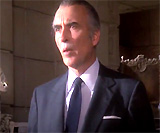 Stefan Crosscoe (Christopher Lee)  Mariana (Marsha Hunt) 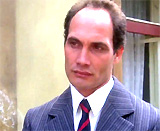 Vlad (Judd Omen) 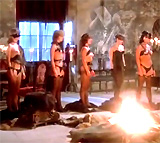 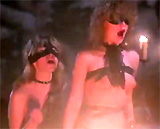   Queen Stirba's (Sybil Danning) Ritualistic Sacrifice of a Virgin with Coven of Female S&M Werewolves    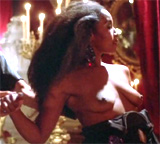 Mariana (Marsha Hunt) with Queen Stirba and Vlad 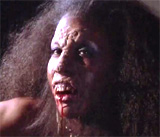 Mariana As a Werewolf 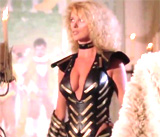 Stirba with Dominatrix Costume 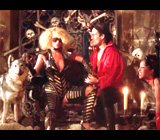 Stirba with a Real Wolf, Vlad, and Mariana  Stirba with Awesome Powers    A Second Orgy Sequence Before the Final Assault on Castle  Climax: Stefan vs. His Sister Stirba |
|||||||||||||||||||

|
James Joyce's Women (1985, Ire.) Director Michael Pearce's R-rated film was advertised as an intimate, passionately-told "erotic masterpiece" - it was the film version of the acclaimed 1977 play which classical Irish actress Fionnula Flanagan herself wrote and produced. In the lead role in this one-woman production, Flanagan portrayed all six female roles of the 'women' in James Joyce's (Chris O'Neill) real and imaginary worlds - including three key women in his life, and three women from his novels:
The most memorable character was Molly Bloom (with her lengthy, stream-of-consciousness, masturbatory monologue-reverie or soliloquy filmed in real-time, taken from Ulysses). The scene was notable for female frontal nudity and masturbation in full view of the camera, as Molly fondled her own breasts and intimately touched herself as she laid back on her bed. She mused about the beauty and sex characteristics of both men and women, and the act of love-making. The sequence ended as she experienced an orgasm while she spoke the final words: "And yes, I said, yes I will, Yes."
|
         Molly Bloom (Fionnula Flanagan) |
|||||||||||||||||||

|
Just One of the Guys (1985) Female director Lisa Gottlieb's intelligent, low-budget PG-13 rated film was a teen sex 'comedy of errors' (about gender switching and cross-dressing). Its plot premise was similar to Tootsie (1982) and Victor/Victoria (1982), and even Shakespeare's 'Twelfth Night.' Its tagline was:
The gender identity film told about the efforts of an aspiring HS journalist in 1985, who felt discriminated against, to prove that she could be a true journalist:
Her article (on the nutritional content of the school's lunches) to win a 'dream job' summer internship at the Phoenix Sun Tribune newspaper was bypassed by her sexist English teacher Mr. Raymaker (Kenneth Tigar). Instead, he had selected the writings of two other males to be submitted, although she wasn't dissuaded: "I am going to be a reporter." She was further insulted when her teacher suggested she could be a model: (Terry: "Be a model. Why? Because a pretty girl can't possibly have a brain?...You are so clueless to life. It is really pathetic"). She explained the issues of being cute, gender discrimination, and no one taking her seriously to her horny, wise-cracking younger 15 year-old brother Buddy (Billy Jayne), who was in his room recently decorated with Playboy centerfolds. She complained: "Your room is why my life is totally screwed up. You guys think beautiful women are nothing but decoration, total airheads...Can't you think of anything more profound than getting laid?...It's as if women's lib never existed." When Buddy asserted: "Today's woman has the freedom to be just as sick and perverted as us guys," she responded with exasperation: "Sometimes I just wish I were a guy." He tried to dissuade her: "No you don't. The male body needs sex at all times. It's a living hell." To prove her point that she was the victim of male sexist attitudes, she began to contemplate submitting her article as a guy at a different high school so that it would be accepted. Shortly later that evening, to test if she could be convincing as a boy, she fooled Buddy when she dressed up as a guy and came to the front door. She asked: "Is your sister home?" Convinced that the stranger was one of his sister Terry's friends, Buddy called upstairs: "Hey Terry, you got company." And then he realized who she was. She told him: "I just fooled my own brother..I think I can pull this off." He wondered what her objective was to impersonate a male by wearing his clothes, asking incredulously if she wanted to be Tootsie, Yentl, or possibly a rabbi. She decided she must impersonate and take the identity of a freshman male by cutting her hair and speaking in a deeper voice, as a second persona in her rival HS. Buddy gave her helpful hints on how to act tough and walk like a swaggering boy, with specific instructions on crotch-shifting adjustment and testicle-scratching:
When she retorted, "Yeah, well, maybe my balls don't itch," he shouted back: "All balls itch! It's a fact!" She stuffed a wad of socks into her crotch area under her pants, and Buddy was impressed: "Maybe I should try that." She went through with her plan to switch into a rival high school, and infiltrated into Sturgis-Wilder High School, where complications immediately ensued when she was treated harshly by the school bully Greg Tolan (William Zabka), an exercise addict. She met introverted Rick Morehouse (Clayton Rohner), a fellow transfer student who commiserated with her, who later told her he was a "professional new kid...Seven schools in three years," and had transferred in two months earlier. Terry began to be confronted by various issues, including participation in P.E. class, when she had to enter a male locker room. She spoke to the gym teacher, Coach Mickey Morrison (John Apicella), a bowling enthusiast, explaining that as a new transfer student, she didn't have gym clothes. He insisted that she borrow some athletic clothes (including a jock strap). In the humorous scene, she was forced to set off the sprinkler fire alarm system to clear out the place for privacy to change into the borrowed clothes. But then later on the court, the gym coach yelled: "Shirts...Skins" when determining sides for BB teams. She fell down and feigned stomach pains to avoid taking off her shirt. The English teacher at Sturgis-Wilder, Mr. Mendosa (Ramon Chavez), also shocked Terry with criticism of her article, but gave her until "a week from Monday" to submit a revised article. Therefore, Terry's plan to quickly get her writing submitted as a male fell through. She decided to continue going undercover to research and write a new article. Further problems arose when she attracted the attention of a sultry, oversexed, flirtatious and popular Sandy (Sherilyn Fenn), who took an interest in her ("Look, what a fox! Dresses like Elvis Costello, looks like the Karate Kid. I'm gonna get him"). Her greatest issue came when she developed her own romantic (and awkward) interest in Rick, and her attraction for Rick grew after he stood up to the school bully Greg and humiliated him in front of other students, insinuating that Greg had a small penis: ("Most psychologists tell us that guys, well, they get into bodybuilding to compensate for either a lack of IQ or a small wienie. Which is it, Greg?"). In the meantime, Terry kept avoiding contact with her boyfriend Kevin, and ultimately decided to break up with him. A climactic scene of 'realization' occurred outside the Senior Prom ("Passion in Paradise") at an ocean-side setting. Terry had asked her girlfriend Denise to act as her date, while Rick's date was Deborah Strowbridge (Deborah Goodrich), bully Greg's ex-girlfriend - a pairing that made Terry very jealous. Greg socked Rick in the jaw for dating Deborah, prompting Terry to come to his defense - and he threw her into the ocean. Terry's boyfriend Kevin arrived into the confusing mix at the prom, discovered Terry's ruse, and announced to Rick that he was her boyfriend: ("Terry, we can work this out. I know you still love me...Look Terry, we belong together...You're my..."). Terry covered Kevin's mouth to cover the word "girlfriend" and blurted out her love for someone else: "No, I don't. I love someone else." Terry pulled Rick aside, fearing correctly that he thought that she/he was gay. To prove that she wasn't gay, she confessed to Rick as she ripped open her tuxedo shirt to reveal her full breasts:
The two returned to the prom, where Terry begged: "Can't you just forgive me?" but Rick refused. After the embarrassing rejection, Terry made a desperate effort to kiss Rick in front of all the students. Feeling foolish, Rick pushed her away and again insulted her: "It's OK, everybody. It's all right. He has tits," and promptly left the prom with his date Deborah. Upon returning home, Terry found Buddy happily in bed with Sandy, but felt completely defeated: "My voyage of self-discovery has ended in despair." However, Terry/Theresa won the writing contest and internship with her new article: "I WAS A TEENAGE BOY." She returned to her original high school, but lost Rick's friendship. Later during the summer, after he had read her winning article on gender discrimination, Rick and Terry were reconciled in front of the Sun-Tribune office where she was working.
|
  Theresa Griffith (Joyce Hyser) 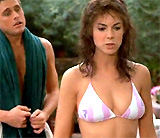 Theresa with Boyfriend Kevin (Leigh McCloskey)  Theresa as Terry to Fool Her Brother Buddy 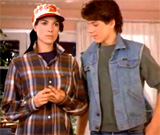 Lessons from Buddy on How to Dress and Be Just Like a Guy 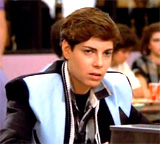 Terry at a Rival High School 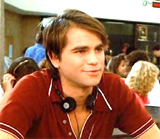 Rick Morehouse (Clayton Rohner)  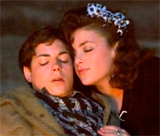 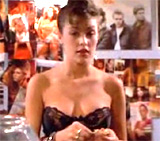 Sandy (Sherilyn Fenn) 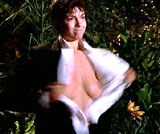  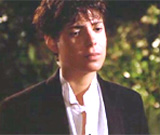 Theresa as 'Terry' - Proving to Rick That She Wasn't a Male 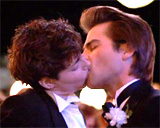 Terry's Desperate Kiss to Get Rick Back  Terry At Her Old HS After Winning the Internship with Her Article |
|||||||||||||||||||
|
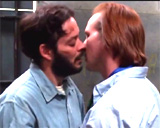
Kiss of the Spider Woman (1985, Braz./US/Arg.) Argentinian-born director Hector Babenco's Brazilian/American co-produced melodramatic R-rated film, a small independent film, was based upon Manuel Puig's 1976 novel. It was historically important as one of the first (if not first) gay films that was heralded by the mainstream media. Although the film had one homosexual love scene, it was not on-screen and almost the entire film was devoid of sexual content. Its major themes were gender roles, toleration of differences, escapism from reality through fantasy (melodramatic film itself), oppression, political idealism, and betrayal. The two major cellmates incarcerated in the 1970s in the same cell of a South American (Brazilian) prison (Pavilhao IV), who developed a deep friendship over time, were both 2nd class citizens living in a repressive political dictatorship:
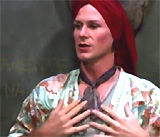
Molina often entertained the two of them by fancifully escaping their predicament in prison and passing the time through story-telling: ("Why should I think about reality in a stinkhole like this?"), although Valentin objected and had various prohibitions for what could be described: "I told you, no erotic descriptions....Don't talk about food...I'm serious. No food and no naked women." Later, he criticized Molina for living in his fantasies: "You just use these movies to jerk yourself off." Nonetheless, Molina continued to describe his fond memories of an old noirish B-film - a 1940s, anti-Semitic Nazi propaganda film. The remembered film - framed as a "film-within-a-film" - was shown as interspersed, sepia-toned "clips." It was a romantic thriller in which Leni Lamaison (Sonia Braga) in the Vichy-era French Resistance, first sensuously seen in a bathtub and then singing in a nightclub, fell in love with dashing and blonde Aryan officer Werner (Herson Capri) - Chief of Counter-Intelligence in France and an enemy Nazi SS soldier. Leni was portrayed as a femme fatale Spider-Woman - "the most ravishing woman in the world." Also working for the Resistance with one of its patriot leaders Clubfoot (Antônio Petrin) was nightclub cigarette girl Michele (Denise Dummont). In Molina's film tale, Michele lost her life when she was deliberately run over by Clubfoot for engaging in a love affair with German lieutenant Hanschen. After Michele's death, Leni was reluctantly pressured by the rebels to acquire a secret map to the German arsenal from her lover Werner. She was romanced by Werner in his luxurious chateau, and fell in love with him, but realized she must betray him since he was in charge of executing Resistance patriots.
Later in the film, Molina described the Nazi film's ending. Leni asserted to Werner: "I refuse to love a man who is the butcher of my country." With government archival evidence, Werner was able to persuade her that his true mission was "to liberate humanity from injustice and domination" - resulting in the rekindling of Leni's love for him (she told him: "My love, how could I ever have doubted you?"). However, she was duplicitous and betrayed him in the dark castle of a Resistance leader (Nildo Parente) by turning over the secret map. In a surprise twist, when the sex-hungry Resistance leader assaulted her, she stabbed him in the back with a steak knife. She fled and rushed into Werner's embrace and kissed him, but then was shot by another dying patriot named Flunky (Wilson Grey) and perished in Werner's arms. Her life ended as Werner heard her singing about her sacrifice - "not in vain." During Molina's interspersed film scene descriptions, Valentin was disgusted and repelled by both Molina's homosexuality ("You damn faggot!") and his trivial romanticization of Nazi fascist propaganda: ("Your Nazis are about as romantic as the f--king warden and his torture room....Fantasies are no escape"). One night he had a major outburst: "Don't you know what the Nazis did to people -- Jews, Marxists, Catholics? Homosexuals!" When the self-hating Molina whimpered about being gay and feminine: ("That's what I am! That's what I am!"), Valentin tried to get Molina to accept his maleness:
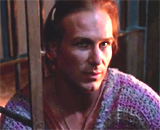
When Molina helped Valentin cope with severe stomach poisoning and diarrhea, he learned the name of Valentin's current uneducated girlfriend Lidia who was "in the movement" and had written him a letter. Visualized in a second flashback (or film of sorts), Valentin described a former lover named Marta (also Sonia Braga), an upper-class bourgeoisie member who begged him to leave the movement. He would stay with her when forced to hide from the authorities, but then he was apprehended, tortured, and jailed immediately after providing a passport at a train station to an elderly revolutionary leader code-named Americo (Fernando Torres) - "one of the last surviving members of the original movement." He would never see Marta again. [Meanwhile, Americo was also brought bloodied and bruised to the prison and placed in a cell across the way from Valentin and Molina. At first he was hooded and not identifiable. After continued torture, he died and his cell was emptied, causing Valentin to be highly distressed by his passing.] The film's plot twist was that in prison as he befriended Valentin, Molina was actually working undercover with the prison's corrupt Warden (José Lewgoy) and abusive, homophobic secret police officer Pedro (Milton Gonçalves), the one who had arrested Valentin at the train station. Molina's objective was to cautiously gather vital information from Valentin to help identify other traitors, accomplices, and anti-government groups. In exchange for betraying Valentin ("The quicker he talks, the quicker you get out"), he bargained for food and for early parole. Just before being paroled, Molina imagined and spun a new film tale (with a bluish-purple tint) of tropical romance on a desert island - an allegorical tale about the two of them. The central character was a masked "strange woman" (again Sonia Braga) with a black gown, who "was caught in a giant spider web that grew from her own body." One night when a shipwrecked man (portrayed by Raul Julia) drifted onto the beach, she cared for him, "nourished him with love," and brought him back to life:
Gradually, the two prisoners had also become unlikely compatriots who ultimately developed compassion for each other. Molina was increasingly feeling conflicted about his deal to betray Valentin after falling in love with this "real man." When Molina suggested that they make love on his last night in prison: ("Do what you want with me, because that's what I want. If it doesn't disgust you"), Valentin complied, and they came together in the dark (off-screen).
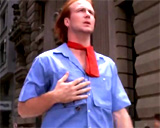
The film concluded with Molina's release (and a farewell kiss from Valentin). Molina was melancholy after his return to society and to his mother (Míriam Pires), as he often sat silent at a bay window looking out at the city. He was unaware that he was under surveillance by agents who wanted him to lead them to the cadre of Valentin Arregui. Finally, he mustered the courage to make contact with the rebels (with a secret message from Valentin). He phoned from a subway pay-phone, and then withdrew wads of cash from his bank account to provide for his mother's care. After bidding goodbye to his mother, he wore a tell-tale red scarf to signal his identification to the rebels. In the city streets and the busy town square, Molina was pursued by Pedro and other agents, as he made contact with Valentin's girlfriend Lidia (Ana Maria Braga) in a taxi. Gunfire erupted when the agents charged forward. Lidia's taxi took off as Molina fled from the agents. The taxi reappeared, and Lidia - who suspected he was an informant, shot and mortally-wounded Molina in the chest before racing away. His death mirrored the death of his heroine Leni in the Nazi propaganda film. He was thrust into a car at gunpoint by Pedro and while he was dying, Molina self-sacrificially and heroically refused to divulge the phone number. Once his body went limp, he was dumped onto a pile of trash in a shanty-town. The authorities spread a false story about how he had collaborated with the extremist revolutionaries and was shot dead by them. The same fate also arrived for Valentin back in prison - where he had been tortured mercilessly with electricity. A prison intern-medic in the infirmary decided to inject him with a potent overdose of a pain-killer (morphine), to release him into the escapist world of film (into a romantic paradise). His death was a replay of the short 'Spider Woman' film described earlier by Molina. [Note: Their roles were switched - Molina died a heroic death for a cause, while Valentin died escaping from life.]
As he appeared to possibly die in a fanciful delirium, Valentin's former lover Marta (Sonia Braja) came to him, happily ran with him hand-in-hand out of the prison, and brought him - as the Spider Woman - to the idyllic desert island setting where he was miraculously healed and she assured him after kissing:
|
  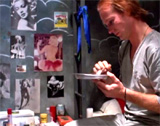 Luis Molina (William Hurt) 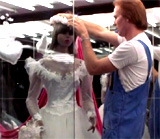 Molina - Flashback as a Store Window Dresser 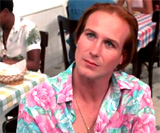 Molina - Flashback as a Gay Man 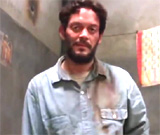   Valentin Arregui (Raul Julia)   Flashback: Valentin's Former Lover Marta (Sonia Braga)  Plot Twist: Molina Was an Informant for Pedro (l) and the Prison Warden (r)  The Telling of the End of Molina's Nazi Film Tale 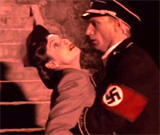 The Melodramatic Death of Leni in Werner's Arms 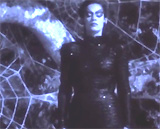 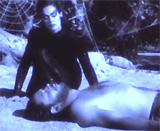 Film Tale on a Tropical Island with Spider Woman and Shipwrecked Man   Molina's Confession of Love for Valentin  Molina's Heroic Attempt to Contact Rebels for Valentin - (Wearing Red Scarf) |
|||||||||||||||||||

|
Lifeforce (1985, UK/US) Director Tobe Hooper's science-fiction horror/adventure/disaster tale (and 'guilty-pleasure' film) had the working title Space Intruders or Vampires from Outer Space - similar to the name of the original 1976 Colin Wilson novel The Space Vampires upon which the film was based. It was a hybrid mix of many genres-subgenres: vampire, zombie, horror, science-fiction, and thriller, with many allusions to Alien (1979) (due to a co-scripting effort by Dan O'Bannon). Its main tagline was:
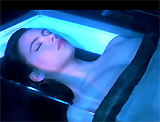
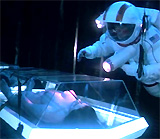
It opened with a British-American H.M.S. Churchill space shuttle mission to intercept and study Halley's Comet. During its mission in August of 1985, it discovered a 150-mile long derelict alien spaceship hidden within the comet's coma (tail or atmospheric cloud). Inside the spacecraft were:
30 Days Later: upon the shuttle's return to Earth, a US rescue mission that involved docking with the Columbia discovered that the interior of the ship had been gutted by fire and the crew were dead, presumably drained of their 'lifeforce.' All that remained untouched were the three suspended animation cases holding the aliens. At London's European Space Research Centre (as Halley's greenish comet trail filled the sky), the aliens in the cases were prepared for autopsies and dissection. The creatures, considered vampirish life-forms, were to be studied and investigated by Dr. Leonard Bukovsky (Michael Gothard) and Dr. Hans Fallada (Frank Finlay), assisted by SAS member Col. Colin Caine (Peter Firth).
The main alien vampire was formerly introduced:
At around 2 am, the "Space Girl" who was laid out on an examining table, suddenly opened her eyes and awakened, and sat straight up. She slipped off the table and smiled/glared at a guard. The beautiful naked, human-looking creature removed the guard's helmet, and kissed him - sucking the energy 'lifeforce' out of him. She turned him into a dessicated, shriveled-up mummy corpse with leathery withered skin. Then, the vampirish creature seductively walked up to Dr. Bukovsky (who had rushed into the lab after viewing what was happening on closed circuit TV), overpowered him with her feminine presence and suggested: "Use my body," but he was saved from the guard's fate by the intervention of Professor Fallada and other guards. The naked "Space-Girl" calmly walked out of the facility by subduing other guards in the main lobby and blowing out the large window panels with her supernatural powers. She went on to further terrorize London. The scientists met together, when Dr. Bukovsky described how he was overpowered: "It was the most overwheImingIy feminine presence I've ever encountered." Fallada described her as a vampire:
It appeared that the aliens were a race of "space vampires" - who consumed "life-force" energy rather than blood from their victims. The two humanoid males then awoke and approached the guards armed with assault rifles, and were unaffected by a barrage of bullets. All three vampires were able to transform into the identity of others - the two males took on the identity of guards to evade detection. It was demonstrated that all infected or zombified victims could then regenerate or transform themselves after two hours and become "living dead" - to continue the exponential, chain-reaction cycle of draining others (with a two-hour time limit until they needed a new energy transfusion), or otherwise becoming dessicated (a pile of dust) a final time. This pattern or phenomenon was seen to occur numerous times, beginning when the dessicated guard who had sucked the lifeforce from one of the autopsy pathologists, and exchanged places with him. Meanwhile, the alien girl was transforming herself by possessing various host bodies. Her first target was an unnamed Hyde Park female who was completely dessicated. One of the Churchill astronauts Col. Tom Carlsen (Steve Railsback) was discovered to have survived. He had jettisoned in an escape pod from the H.M.S. Churchill, entered Earth's atmosphere, and landed in Texas. He was returned to London, where he described (with partial flashbacks) how he had set fire to the shuttle to prevent the disastrous cargo from exposing the entire Earth, since crew members were dying one by one (their lives were drained) on the return trip. He made a crucial confession when he admitted his psychic attraction to the "Space-Girl":
During a nightmarish, red-tinged hallucination, Carlsen dreamed that the "Space-Girl" visited him while he was sleeping to make love, and drained him of most of his energy (he complained: "You're taking too much of me!"). Through hypnosis, it was determined that Carlsen was closely and psychically linked to the alien female. Then, it appeared that the "Space-Girl", as she moved "from body to body, mind to mind," had decided to take only a small amount of energy from each new victim - so that there was no trail of bodies. Carlsen and Col. Caine went to Yorkshire to investigate. They found that her next target was:
On her way to work, hitch-hiking Ellen then seduced a healthy male named Ned Price (Sidney Livingstone), and then the "Space-Girl" left her and possibly went on to inhabit the body of one of the inmates - a child murderer named Jeffrey Sykes (Ken Parry) - a mentally-deficient patient in a padded solitary confinement cell at the institution. However, the spirit of the Girl actually possessed the body of the asylum manager Dr. Armstrong (Patrick Stewart). Armstrong was heavily-sedated in order to trap the Girl inside of him. Carlsen was able to talk to the "Space-Girl" captive inside of Armstrong. She could be heard pleading with him: "CarIsen, be with me....I Iove you...." The voice of the "Space-Girl" then confessed, through further hypnosis, that the aliens had taken on human form after entering the minds of the Churchill astronauts. The "Space-Girl" had taken her "perfect" shape from Carlsen's mind: "I took my shape from your mind. I took your Ianguage. I became the woman I found there, in your deepest thoughts, your deepest needs. I am the feminine in your mind, Carlsen." Carlsen appeared to go crazy, yelling at Armstrong (who had taken the form of the "Space-Girl") as he begged: "Where are you? Where's your body? Let her go!" But then Carlsen began begging for his own captivated life: "Let me go!" As Armstrong's body convulsed and blue light emanated from his body, Caine overdosed him to help stop the escape of the Space-Girl from his body. Carlsen then became gravely concerned about the possible imminent threat of alien annihilation: "It's aIready spreading....You didn't stop it. It's too Iate." Carlsen and Caine both worried together:
As the body of a heavily-sedated Armstrong was transported back to London in a helicopter, the alien "Space-Girl" finally broke free of Armstrong's body, coalesced into a bloody-red creature and disappeared: ("We've lost her, she's gone"). In another full flashback by Carlsen about his time on the Churchill, he divulged to Caine that he had actually sabotaged the mission: ("I didn't want the ChurchiII to be abIe to reach Earth. And if it did, I didn't want anyone to know what happened"). He described the experience when he was spiritually called to her and fully connected to her: ("She wanted me"). He opened her vampire-like container and shared his spiritual 'life-force' with her:
However, Caine reminded Carlsen of her real nature: "Carlsen, she's not human. She's not a woman. She'II destroy you. She's destroyed worlds." Like "vampires of legend," the spawned alien creatures were spreading infection like a plague in London (even infecting the Prime Minister (Peter Porteous) who attacked his own secretary Miss Haversham (Katherine Schofield)). They caused the streets to be overrun with rabid-like, vampire-alien-zombies. There were reports that the alien vessel was "bearing down on the Earth" and was in "geostationary orbit" over London. With martial law ineffective, a thermonuclear device delivered by NATO (now in military command), might need to be detonated to sterilize the air-space. All of the drained human life-force energy (blue lights symbolizing human souls) was seen being directed first toward the "Space-Girl" and then collected by the awaiting, immense 150 mile-long, umbrella-shaped mothership parked above her. With the successful elimination of the two male vampires by impalement just below the heart (through the energy center) with an iron "leaded metal shaft" (or sword) (one by Dr. Fallada, and one by Col. Caine), it was up to the chosen one, Carlsen, to confront and kill the "Space-Girl." Through his psychic connection, Carlsen felt that he was being drawn back to reunite or "mate" with the female alien, to "end the madness" and to give back the energy she had originally given him. A gigantic blue column of light (of countless human souls) ascended and funneled its way into the umbrella-shaped alien mothership hovering above ("All those littIe blue lights going up toward the cIouds are human souls"). In the finale, Carlsen was drawn to the altar inside St. Paul's Cathedral ("the crypt of kings and queens") where the "Space-Girl" reclined. He approached her and accepted her entreaty as she sat up: "Come. Be with me. I need you. It was aIways intended you shouId find us and bring us to Earth. The web of destiny carries your bIood and souI back to the genesis of my Iife-form. Come, be with me." During an ecstatic nude embrace and kiss within the swirling column of light, he asked: "What are these feeIings? Why do I feeI so cIose to you, need you?" She admitted (with the film's final lines of dialogue):
Self-sacrificially during mid-coitus, he then skewered both of them with the leaden metal stake offered to him by Caine, as electric red and blue rays and swirls emanated from their bodies. Their souls merged together into the blue column of light, and the combined blue energy from their two bodies blasted off the top of St. Paul's Cathedral dome as the two moved up the light column into the vessel. The energy from the blue light was sufficient to power up the giant alien spaceship, to enable it to disengage from Earth's orbit and set itself on a course toward Halley's Comet.
|
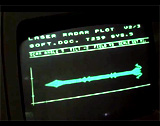 Radar Trace of 150 Mile Needle-Shaped Alien Ship Inside Halley's Comet Tail      Death of Guard - His Lifeforce Was Sucked Out by "Space Girl"  Afterwards, "Space Girl" Approached Dr. Bukovsky in Lab   Space-Girl's Escape From the Research Centre 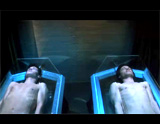 The Two Male Alien Creatures in London's Space Research Centre  The Hyde Park Female Victim  Carlsen's Nightmare Dream of Making Love to the "Space-Girl"   The "Space-Girl" In Armstrong's Body and Escaping From It   Carlsen's Second Flashback About the Churchill: ("She wanted me")      During His Flashback About the Churchill, Carlsen Described How He Became Entranced by Space-Girl  The Alien Ship (Umbrella-Shaped) Connected by Blue Light Column to the "Space-Girl"  Caine's Stabbing Death of the 2nd Male Vampire on the Steps of Cathedral |
|||||||||||||||||||

|
Loose Screws (1985) (aka Screwballs II) This typical mid-1980s teen sex comedy from director Rafal Zielinski was a sequel to Screwballs (1983), and was followed by Screwball Hotel (1988) - forming a trilogy of films by the same director. It was basically a rip-off of Porky's (1983).
The goofy sex farce was awash with female toplessness - and 'screwing' around -- with loose females, and lots of sexual puns for the characters' names. Its tagline announced:
The first breast-baring scene (in a film with 39 naked breasts acc. to Joe Bob Briggs) was about 1/2 minute into the film when Dice Girl (Nancy Vacheresses) lost a bet with the throw of dice, and had to remove her top.
A number of other female characters, who had bit parts, were named after their sequences -- i.e., Bathtub Girl (C.J. Fidler) and Convertible Girl (Laura Potter). After creating mischief at Beaver High, four troublemakers (fifth year seniors) were identified - each with a fake-sounding, sex-related character name:
The four horny male teens were detained by Principal Hardbutt (Ken Taylor) and then assigned or transferred to Coxwell Academy ("a college for morons") for summer school in the nearby town of Wadsworth, run by Principal Mr. Arsenault (Mike MacDonald). In their convertible while driving along side another vehicle, Brad exchanged his "Trade Me?" T-shirt with the T-shirt of Convertible Girl (Laura Potter) who responded: "Sure!"
At the academy when a school bus pulled up, they described their mission - impossible: "Our mission, should we decide to take it, is to locate and ravage as many women on that bus as possible." Once the bus arrived, the ladies were directed by the guys to a room and lined up for breast exams in their bras and panties. One girl named Gail (Karen Wood) stood topless, since she was braless. Her breasts were video-X-rayed. She ended up running down the hall screaming, with a full-sized skeleton clinging to her bare body.
The other male students were directed to the ladies' room, marked with a sign for Chest X-Rays and instructed to strip - where they were confronted by one of the shocked female teachers. Meanwhile, points (from 1 to 5) were also acquired for each sexual conquest in a get-laid contest between the males. Brad dressed in drag, infiltrated into the girls' dormitory, and took the name Bradine. Required to take a bath by the dorm counselor, he found himself in the bath-tub area where two girls were bathing in separate tubs - he first helped by handing a towel to Bathtub Girl (C.J. Fidler) who was leaving one tub. Then he found himself in a bathtub with blurry-visioned Candy Barr (Beth Gondek), without her contact lenses, who mistook his penis for a pink rubber duckie (She asked: "I'll wash yours if you'll wash mine?"). One of their additional simple-minded goals (worth 100 points) was to seduce the sexy new French teacher Mona Lott (Cynthia Belliveau) at the Academy, who announced with an accent: "I'll be available for private French lessons in the evening." Steve also set his sights on seducing big-breasted red-head Claudia Arsenault (Stephanie Sulik), revealed to be the wife of the school's principal when he walked in on them. As Steve hid under the covers, he stroked her nipple. There were many other predictable scenes - a nighttime beach party and make-out scene, Steve's stalking of Mona Lott (with a shower and massage sequence), nude water polo in the pool, spying on girls undressing in a locker room ("It's wall-to-wall tits"), and a wet T-shirt, "best ass" and whipped-cream bikini contest at The Pig Pen strip club, in which the French teacher appeared topless.
|
 Males Stripped  Two Girls Bathing in Tubs 
  Brad (In Drag, Wearing Bra) in Tub with Candy Barr (Beth Gondek)   Make-Out Beach Scene with Candy Barr    Steve with Claudia Arsenault (Stephanie Sulik)  French Teacher Mona Lott (Cynthia Belliveau) in Shower  Mona Lott Topless in Strip Club |
|||||||||||||||||||

|
Mischief (1985) Typical of many mid-80s films was this coming-of-age film and teen romantic sex comedy by director Mel Damski - a tale about a nerdy, virginal, and introverted high school senior male who dreamt of attracting females, but first needed a personal transformation. Originally, it was to be titled "Heart and Soul" and "Getting Lucky." The film was remarkable for its ever-present 50's soundtrack, including such oldies as Sweet Little Sixteen and School Days (Chuck Berry), Be-Bop-a-Lula (Gene Vincent), Peggy Sue (Buddy Holly), Young Love (Tab Hunter), At the Hop (Danny and the Juniors), Blueberry Hill (Fats Domino), Don’t Be Cruel (Elvis Presley), Since I Don’t Have You (The Skyliners), and more. The nostalgic film's young star Kelly Preston, in one of her first prominent film roles (and first nude scene), also starred the same year in the romantic comedy Secret Admirer (1985), a comedy of errors tale. Its tagline described:
Set in 1956 in the small town of Nelsonville, Ohio (introduced by a pre-title card: "A long time ago in a galaxy far, far away...Ohio, 1956"), clumsy, introverted, gawky, shy and clueless Jonathan Bellah (Doug McKeon) was lacking in self-confidence. The virginal Jonathan was in love from afar with a completely unattainable classmate:
In the film's opening, she was introduced walking down the street as Jonathan drove by and became distracted, hitting a fire hydrant. His nerdy friend Harry Horner (Andrew Ream) had just noted: "Look at those knockers, they defy gravity." Soon after, Jonathan was befriended in an unlikely association with his new next-door neighbor - black leather-clad, motorcycle-riding, profanity-mouthed, non-conformist, and rebellious Eugene "Gene" Harbrough (Chris Nash), whose role model was James Dean's persona in East of Eden (1955) and Rebel Without a Cause (1955). Gene had previously attended a Catholic school in the Chicago area and was expelled for illicit sexual behavior (sleeping with two females). He also had an abusive and violent father named Claude (Terry O'Quinn) who often beat him, especially after the death of his mother.
Gene became genuinely interested in Bunny Miller (Catherine Mary Stewart), whose wealthy boyfriend - an athletic, popular but obnoxious bully named Kenny Brubaker (D.W. Brown) (whose parents owned the town's department store), instantly became jealous, and the two males often argued or engaged in fist-fights over her throughout the film. To help his new friend Jonathan, Gene took the challenge-bet to hep Jonathan to lose his virginity and go "all the way" within 30 days: ("I bet you I could get you laid in a month, with Marilyn"). Meanwhile, Jonathan received tips from Gene about how to attract a girl's attention. He went through various rules: "Make eye contact every chance you get...You gotta look hung...", etc. Jonathan dreamt of being with Marilyn, and during a contrived bicycle accident when she helped to treat his bloody lip, he reached up and briefly fondled her breast. Shortly later, he bragged to Gene: "My first breast. I owe it all to you." He was miffed, however, when in the soda shop, Marilyn asked Gene for a date to a Saturday night drive-in movie to watch Rebel Without a Cause (1955) (with a trailer for Elvis Presley's upcoming Love Me Tender (1956)). The insult was softened a bit when Jonathan was asked to join in a double-date with Bunny (the plan was to swap dates), although Jonathan remained jealous of Marilyn kissing Gene in the front seat. Afterwards, Gene and Bunny were regularly sneaking around to see each other, while falling in love, although Bunny was forced to be with Kenny due to parental pressure. Finally, Jonathan had his wish come true after getting a formal date from Marilyn - when he received his first kiss on her front steps at the end of the evening. After a long passionate kiss, she promised him: "We'd better save something for next time." They soon progressed to heavy-petting in his car: "Jonathan, you've got your hand in my panties....We can't go any further." He begged: "Oh, please, Marilyn. It's been 17 years," but she refused to continue ("Let go!"). As he ripped off her panties, they tumbled out of his Studebaker's passenger car door in front of Gene and Bunny, completely embarrassed, as Marilyn noted: "Jonathan, you really should get that door fixed. A person could fall out and hurt themself." At her door as he dropped her off, she scolded him:
It was a sly insinuation that Jonathan had been invited to her home for sex while her parents were out of town on the weekend. In a comedic bedroom scene, the two both slowly stripped each other in her flowery-wall-papered bedroom. She unhooked her bra, and he lowered the straps to reveal her nakedness. She then slipped off her panties (from a side view), and turned to slip into bed.
After he was reminded to take off his underwear as they kissed, she asked: "Aren't you gonna put something on?" When he dumbly asked: "You just told me to take them off," thinking she was referring to his removed shorts, she added: "I'm talking about protection, Jonathan. Don't you have any?" She decided to proceed but only if they were careful: "We can play, but we can't go all the way." He begged to have intercourse and promised he wouldn't orgasm: "I could put it in just a little bit, and then get out before anything happens." After the inevitable, however, she was upset with him for climaxing inside of her:
They were both interrupted by the inopportune and unexpected arrival of Marilyn's parents (to pick up a forgotten wedding gift), and Jonathan was forced to hurriedly dress and sneak out of the house through her bedroom window and onto the roof. He was spotted by Mrs. McCauley (Julie Noble) on the front porch as he dropped to the ground and ran off. Gene and Bunny faced continuing problems in their relationship, due to the prejudice against him by her parents, who favored Kenny. Gene also was confronted by his reprimanding father, kicked out of the house for being a bum, and expelled from school, and he abruptly left town. The relationship between Marilyn and Jonathan soon soured. She first asked him to the "Oriental Nights" Senior Prom, but then about a month later just before the prom, she changed her mind and instead attended with former boyfriend Jerry Jeager (last year's HS quarterback) who was in town - this caused Jonathan to forcefully break up with her. Bunny attended the dance with Kenny, while dateless Jonathan declined to go. That same evening, Gene returned from being in Kentucky, and planned to leave town altogether: ("My father kicked me out, so I went to Kentucky, got a job as a stable boy. But I liked it, you know? Came back to get Bunny, hoping she'd run away with me. What a laugh, huh?"). As the two talked on the evening of the prom, Jonathan admitted his relationship with Marilyn was doomed to fail:
Jonathan was able to patch up the relationship between the estranged Gene and Bunny, who decided to run away to Kentucky to run a horse stable together (his lifelong dream). After saying goodbye to Jonathan, Gene rode off on his motorcycle with Bunny holding on behind him. As the film concluded, Jonathan became interested in dating geeky and frumpy classmate Rosalie (Jami Gertz), who had in the meantime had been transformed from a wallflower into a beautiful girl. She happily accepted his invitation for a date to see a Saturday night movie. She was one of Marilyn's friends who worked at the soda shop and had always been infatuated with Jonathan.
|
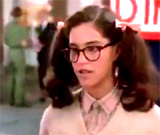
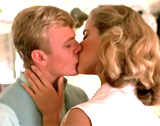
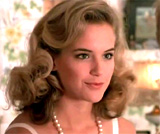
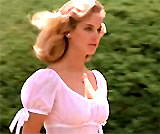  First View of Marilyn McCauley (Kelly Preston) on the Street: "Look at those knockers. They defy gravity" 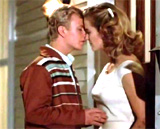 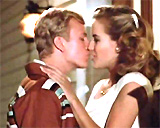 Jonathan's First-Date Kiss with Marilyn 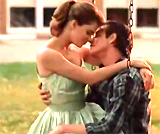  Bunny Falling in Love with Gene 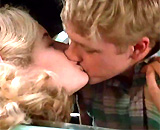 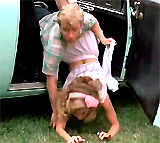 Jonathan and Marilyn - Progressing to Heavy Petting 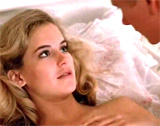    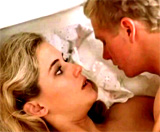 Sexual Intercourse Between Marilyn and Jonathan  Wallflower Rosalie (Now Transformed) at Senior Prom   Gene and Bunny Reconciled and On Their Way to Kentucky Together  Rosalie Happily Accepting Date With Jonathan |
|||||||||||||||||||











 Martin (Rutger Hauer)


 Hail,
Mary (1985, Fr.) (aka Je Vous Salue, Marie)
Hail,
Mary (1985, Fr.) (aka Je Vous Salue, Marie)