|
History of Sex in Cinema: 1933 |

|
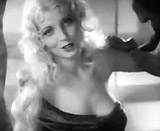
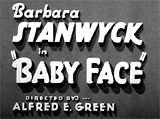
Baby Face (1933) This lurid, potent "fallen woman" pre-Code melodramatic Warner Bros. film was about a female who used sex to advance herself. It was the subject of intense scrutiny and Code-related censorship. The film's trailer left nothing to the imagination: "She played the LOVE GAME with everything SHE had for everything THEY had and made "IT" pay!" It also stated, "A woman without a conscience, she used her power over men to get what life denied her. It was fatal to offer her LOVE." The "pre-release" version of the film, considered amoral, faced Production Code censorship challenges almost immediately that demanded four minutes of cuts. Warner Brothers had to make numerous changes for the theatrical version by reshooting several scenes and adding new ones, and re-dubbing or changing dialogue. In any case, the film still retained its sensational nature and offended some critics and conservative audiences. A saloon/speakeasy bar-maid in a steel mill factory town (Erie, PA), Lily "Baby Face" Powers (Barbara Stanwyck) suffered a brutal upbringing as "the sweetheart of the nightshift." During one startling scene, Lily's breasts were groped from behind by sleazy and corrupt local politician Ed Sipple (Arthur Hohl). She retaliated by smashing a beer bottle over his head. This was just one example of how her abusive bootlegging father (Robert Barrat) was prostituting her to perform sexual favors, and allowed her to be pawed by drunks. One of the film's censored lines (in italics) delivered to her angered father was explicit:
After her father's death, she vengefully used the principles of Nietzche's Will to Power, quoted to her by cranky local cobbler Cragg (Alphonse Ethier).
To move to New York, she had sweet-talked a railyard brakeman (James Murray) and offered him sex to acquire free train fare - with this come-on (after a sly and seductive grin at him):
The workman's gloves came off before he dimmed his lantern in the boxcar. In the city, she continued to use her provocative charms and feminine allure to land a job:
She used the same line with him: "Well, why don't we go in and talk this over?" She became a carnal, calculating gold-digger, and literally seduced - and then discarded many male victims as she slept her way to the top (literally) of a banking corporation, the Gotham Trust Company. She ascended from floor to floor - the camera panned up the side of the building to illustrate her ascent from the Personnel Office, then to the Filing Dept., and to the Mortgage Dept. [One censored line about seduction was whispered by Mortgage Dept. boss Brody (Douglas Dumbrille) to Lily: "Stick around after 5." Watching him from afar, two other secretaries gossiped together about their implied adultery: "Look at that, will you? It's sickening the way those two carry on. You'd never think he had a wife and three kids." At quitting time, Lily slipped through a door marked "Ladies Rest Room" for a squalid encounter with Brody, who followed after her.] One of her rejected suitors, who invited her out but was soundly rejected, was lowly office worker Jimmy McCoy Jr. (John Wayne). Another secretary reminded him: "You don't know you're out 'til they stop counting. Wake up, kid. Baby Face is movin' out of your class." Lily eventually married the bank president Courtland Trenholm (George Brent), situated on the top penthouse level. An earlier version of the film had an ambiguous ending regarding the outcome of a character's suicide attempt, but the theatrical ending (tacked-on, preachy and phony) included punishment of the protagonists and a conclusion in which the main female character justly learned her lesson. |
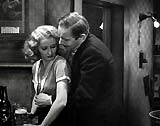 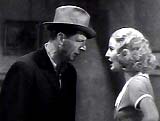 Lily 'Baby Face' (Barbara Stanwyck) 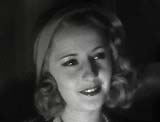  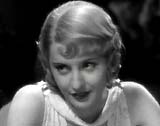 Seductive 'Baby Face' 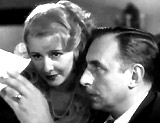 With Brody (Douglas Dumbrille) |
|||||||
|
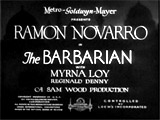
The Barbarian (1933) This Sam Wood-directed MGM film was a racy, pre-Code, inter-racial romantic adventure (with a script by liberated screenwriter Anita Loos). It told about an inter-racial, love-hate romance, involving deception, kidnapping, abuse (whipping), rape?, and forbidden desire.
The romance starred Myrna Loy as American Diana 'Di' Standing who was vacationing in Egypt with her aunt and uncle, and there to meet her pompous British fiancee Gerald Hume (Reginald Denny). She attracted the attentions of young Egyptian hotel tourist guide/driver Jamil El Shehab (Ramon Novarro) - resembling Rudolph Valentino. He was known for taking advantage of female tourists by disguising his true identity - as part of a tribal coming-of-age ritual. The scheming, deceitful, persistent and opportunistic Jamil, after wooing Diana with love songs and flattery, soon confessed that he was really an Arab sheik-prince that wanted her hand in marriage. After many forced advances upon her, she finally accepted his proposal, but then humiliated him during their wedding ceremony, and fled to Cairo to be married to Gerald. Again, she fell under Jamil's spell when he reappeared (he was now wanted for the capital offense of piracy), sang her a love song, and professed that he would rather die than leave her. Dressed as a bride, Diana realized her true love for him and voluntarily abandoned her wedding to Gerald. She floated down the Nile with Jamil, to fulfill her romantic fantasies. It was noted as scandalous for Diana's nude lounge-in-the-bathtub scene at an oasis, although the actress later admitted in her autobiography that she was wearing a flesh-tinted body suit. |
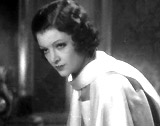  Diana Standing (Myrna Loy) |
|||||||

|
Bosko's Picture Show (1933) This short, 7-minute Looney Tunes Bosko cartoon was the last one produced by Hugh Harman/Rudolf Ising for Warner Bros/Leon Schlesinger Productions. Even animated shorts would often need to be censored. Bosko was hosting a theatrical stage show and sing-a-long while playing a "mighty Furtilizer organ." In the conclusion, Bosko stood up on his bench and shouted out angrily:
He was angrily responding to darkly-dressed, mustached, stereotypical villain Dirty Dalton who was riding his bicycle to capture Bosko's girlfriend Honey, seen in a projected burlesque melodrama. Bosko proposed to save her from the dastardly 'cur.' The offending phrase was changed to "The dirty cur!" It was dubbed as "Stop, you cur!", and in some video versions captioned as "The dirty fox!" |
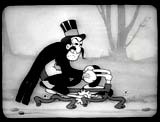 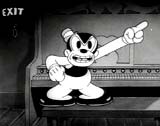
Bosco Swearing |
|||||||
 Trailer |
Convention City (1933) This First National/Warner Bros. pre-Code comedy film by director Archie Mayo was censored for its objectionable, sleazy story and lewdness. It displayed rampant drunkenness and adultery, implied bestiality (with Elmer, a goat), lechery, and statutory rape. It was one of the casualties of the era - unfortunately, a destroyed or lost film. One of its ads touted:
It told about unhappily-married, out-of-town conventioneers - the sales force of the Honeywell Rubber Company - pursuing extra-marital affairs and inebriation during their stay in Atlantic City, NJ. The characters in the film included two competing salesmen for the manager job: elderly small-town salesman George Ellerbe (Guy Kibbee) with an ill-fitting toupee, and T.R. "Ted" Kent (Adolphe Menjou); also in attendance were saleswoman Arlene Dale (Mary Astor), good-time "hostess" Nancy Lorraine (bosomy Joan Blondell), young salesman Jerry Ford (Dick Powell). Kent attempted to seduce boss J.B. Honeywell's (Grant Mitchell) underaged teenaged daughter, Claire Honeywell (Patricia Ellis) as a way to acquire the managerial position. He would ruin the girl in a scandal, force marriage, and then become the boss' son-in-law - and shoo-in for the job. However, he had second thoughts about her age: "She's old enough ... ALMOST, anyhow." |
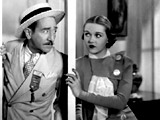 Ted Kent with Claire (Patricia Ellis) 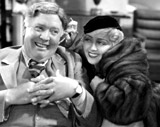 George Ellerbe (Guy Kibbee) with Nancy (Joan Blondell) |
|||||||

|
Design for Living (1933) Director Ernst Lubitsch's suggestive romantic sex comedy was based on Noel Coward's intelligent play. This film was released only six months before the Production Code began to be enforced. Because of its risky and unacceptable subject matter and sexual interplay for its time (although completely toned down and handled with Lubitsch's brand of innuendo, sophistication and subtlety), it was forbidden for re-release or re-make for its 'gross travesty of marriage' in the film's second half. The plot was about a sexy menage a trois, an unorthodox love relationship between two Americans and one female, who were sharing a Bohemian apartment in Paris:
|
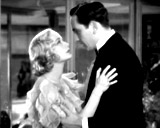 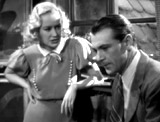 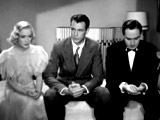 (l to r): Gilda (Miriam Hopkins), George (Gary Cooper), Thomas (Fredric March) |
|||||||
|
This Czechoslovakian romantic drama by Czech filmmaker Gustav Machaty was once notorious, earth-shattering and scandalous. The film was confiscated by the Treasury Department (US Customs) when it was imported into the US - the first film to be blocked for censorship purposes, although it eventually played (without a Hays Code seal) at some independent theatres. Either it was completely banned, partially censored (with various cuts), or played with restrictions. Even until only recently, versions were revised with the nudity removed. It was the first theatrically-released film (non-pornographic) in which the sex act was depicted (although off-screen). It was unusual at its time for depicting obvious female sexual pleasure (ecstasy) during orgasm (simulated) from the effects of oral sex. Sexually-frustrated child-bride Eva Hermann (19 year old Hedwig Kiesler, or later known as Hollywood glamour queen Hedy Lamarr) was a newly-wed bride, married to elderly, impotent, uncaring husband Emile (Zvonimir Rogoz). They did not consummate their love with sexual relations.
The film was censored for a number of scenes of Eva in the nude:
The film was, arguably, the first to depict female orgasm from oral sex (albeit off-screen), in an adulterous scene with Adam. The orgasmic expressions were only evident on Eva's face - caused by the director poking her with a safety pin. |
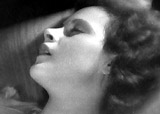  Eva's (Hedy Lamarr) Orgasm Scene |
|||||||
|
Elysia (Valley of the Nudes) (1933) This pseudo-educational, pre-Code, amateurish exploitation film by producer Bryan Foy (about 25 minutes in length) was shot at the largest nudist camp in California - 10 miles from Lake Elsinore at an elevation of about 2,000 feet. It was one of the earliest (if not the first) "authentic" film made at an American nudist colony. According to news reports at the time, producer Foy was forced to get an injunction against the Los Angeles police to restrain them from interfering with its exhibition, due to its sensationalist subject matter. It began with a boring lecture around a campfire to a group of clothed individuals about the dangers of "morbid, unhealthy ideas about sex and the human body - you carry them with you through life." "Nervous and mental breakdowns" were reportedly caused by these unhealthy ideas. There was an abrupt cut to the nudist camp, where a male reporter named Mack (James Mack) had been assigned to write an article on the camp. He was encouraged to remove his clothes by cute blonde Prudence Kent (Constance Allen, a real-life nudist at the Elysian Fields club, who was discovered at the naturist camp playing baseball) - she was the camp's secretary. He met with the camp's elderly director, Dr. King (Hobart Glassey), who forecast that he would soon be embarrassed ("if you keep your clothes on - you'll continue to be embarrassed, self-conscious, and the entire purpose of your visit here will be lost"). In a short space of time, Dr. King predicted that Mack would feel like one of them - without his clothes on. After they both disrobed, there were many long shots of nudists (including families) around the camp grounds performing normal activities and playing leap-frog. He waved at Prudence, who was on a rock-outcropping far away. After breakfast, there were more distant views of nudists lying on the ground while sunbathing and playing games, including the national pasttime of baseball, and a pair of boxers engaged in a match, as others took part in a nude walking race (filmed from the rear), or a spirited game of volleyball (without any clothes restrictions), or a strange water-bucket dousing game. Mack made a statement about how he had soon forgotten that he was naked.
After Prudence splashed water on Mack, they frolicked in the outdoors, then he asked her how she had become a nudist. She explained how she was in ill health when she was young, and the only thing that cured her was "bathing my body in the open air." At lunch, one busty young girl stuck her chewing gum on her chest so that she could attach her napkin to it. A few more pronouncements were made (with Prudence standing between Dr. King and Mack) about how colds were practically unknown among nudists. Dr. King asserted how gathering together collectively as nudists (to enjoy the air and sunshine) was preferable over practicing nudity privately. He argued for the very morality of being naturally naked (better than at dances, nightclubs, or "the average bathing beaches"), and of the common human desire "for social contact" - and the safeguarding of morals by fellow nudists at all times. Mack bragged that he had witnessed first-hand how the nudists were wholesome, sane, healthy and well-behaved. The campers bid Mack goodbye as he drove off, after he told everyone: "It's been a wonderful revelation. I promise what I write will be exactly what I've seen." Prudence waved again from the rock outcropping. |
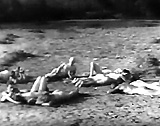 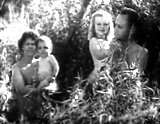 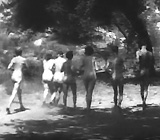 Nudist Camp Views 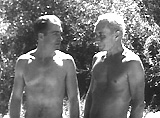 (l to r): Mack, Dr. King   Camp Nudists |
|||||||
|
Employees' Entrance (1933) Advertising copy for this audacious, pre-Code Roy Del Ruth-directed Warner Bros' film about sexual harrassment proclaimed:
Kurt Anderson (Warren Williams), a ruthless, amoral, cut-throat scoundrel and the workaholic fanatical head of the Depression-Era Franklin Monroe & Co., the world's largest department store, pronounced his own credo: "Smash or be smashed." He was known to seduce and exploit much-younger, naive employees who needed work. In one case, the despicable man was greeted by perky blonde employee Polly Dale (Alice White). He didn't recognize her right away and then remarked:
He used her to pimp for him with board members and to do his bidding. He also took advantage of homeless Madeleine West (Loretta Young) whom he hired as a sales girl/model - after she slept with him to assure her "career move." He had sex with her in his apartment after dinner when he pressured her to stay, and then later in a hotel room during a company office party, when he ravished her while she was compliantly drunk. Later, he set out to destroy her relationship - and secret marriage - to top salesman and aspiring subordinate Martin West (Wallace Ford). |
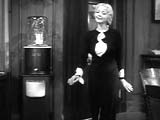 Polly Dale (Alice White) 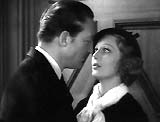 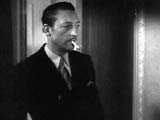 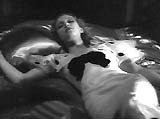 Kurt (Warren Williams) with Madeleine (Loretta Young) |
|||||||
|
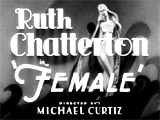
Female (1933) This daring, salacious pre-Code film from First National Pictures and director Michael Curtiz was released just before the enforcement of the Code. Once the Code went into effect in mid-1934, Joseph Breen placed this film on his "no re-release" list, and the film was unseen until the 1950s. It explored a major role reversal of typical stereotypes, and the dilemma professional women still face - the choice between career and marriage. A Drake Motor Car Company plant executive Alison Drake (Ruth Chatterton), a powerful, sexually-liberated and unrestrained, man-hungry female (portrayed without apology, uncharacteristic for its time), had no time for romance or love. She had adopted a "hard and cynical" gender-role reversal for her own life:
She admitted to married visiting friend Harriet Brown (Lois Wilson): "Oh, I see lots of men, but I've never found a real one." She often used her handsome young male secretaries for leisurely one-night stand pleasures and seduction at her lavish house (with servants serving vodka "to fortify their courage" and having them serenaded by organ music). During one seduction of new male employee George Cooper (Johnny Mack Brown), she asked him: "Are you naturally enthusiastic?" as she suggestively flung a pillow onto a couch and told him that she didn't want to be "entirely mental all the time." She leaned back on the floor and asked: "You're not scared of me now, are you?" In the mornings, she would work before breakfast at her home in a modified desk-bed. She regularly discarded male secretaries who began to show romantic feelings for her - for example, she told Mr. Briggs (Gavin Gordon) after he vowed that he loved her:
She transferred "sentimental" rejects like him to the Montreal office, with their transportation arranged by her older fatherly-male assistant Pettigrew (Ferdinand Gottschalk). Frustrated by her many male secretaries, the no-nonsense Alison vowed semi-seriously: "From now on, I'll have nothing but women secretaries," although men she liked received a bonus added to their salaries. She was known to her employees as "Miss D," and by Pettigrew as a "superwoman," who thought:
She was ruthless in her business practices, and other married women feared her, cautioning at a party she hosted: "Better watch your husband." When she met "irresistible" pipe-smoking engineer Jim Thorne (George Brent) at a night-time shooting gallery and enjoyed hamburgers with him, she was surprised when he bluntly told her: "I don't take pickups home with me" - and then was further shocked that he was working at her factory the next day with a two year contract. After inviting him to her house for dinner, he wanted to talk about his designs, although she was "thinking about something else" - presumably sex with him. Unlike her other secretaries, he was unaffected by the vodka and avoided her predatory traps, exasperating her: "Must you talk about automobiles?" He straight-out told her when she flung a pillow onto the floor and invited him to sit by her:
In order to win him over, Miss D. started to see Thorne as a strong and "dominant male" who preferred "gentle and feminine" women who would look up to him, so she decided to "strive to please" by becoming more submissive, gentle, and loving with him. Her strategy worked -- he kissed her at a picnic, and the scene ended with a fade-to-black, signifying they had sex together. The day after when he proposed marriage in order to be "decent," she accused him of being "old-fashioned." He argued back as he tore up the marriage license that he had brought with him:
Remarkably in a drastic reversal, she soon capitulated to Thorne's assertion that women were born for "marriage and love and children" - as one of her executives had earlier predicted: "One of these days, she'll meet a man that will knock her right on her rear." Emotionally distraught, she broke down in a board of directors meeting, telling them that the job was too much for her:
She pursued Thorne on the road, finding him at an outdoor carnival's shooting gallery. There, she confessed:
As the film ended, he was accompanying her to obtain loans from bankers in New York to save the business, and she gave up the leadership of the automotive factory to him, while expressing her hopes of raising nine children. |
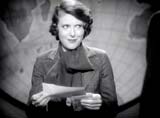 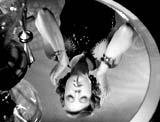   Alison Drake (Ruth Chatterton)   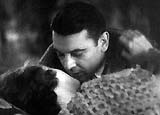 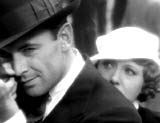 Miss D. with Jim Thorne (George Brent) |
|||||||
|
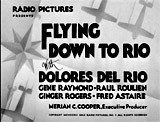
Flying Down to Rio (1933) This south of the border musical-dance film was pre-Code, therefore uncensored. It featured lots of see-through dresses, skirts and blouses in a number of production numbers or dance sequences. It also marked the first pairing between Fred Astaire (as Fred Ayres) and Ginger Rogers (as Honey Hale) - as two supporting performers. During the large-scale and racy Carioca dance sequences, and in the memorable Flying Down to Rio number atop bi-plane wings, skimpily-attired chorus girls performed wing-dancing and other stunts (the sequence was filmed in an airplane hangar with wind machines and a few planes hanging from the ceiling - enhanced with backdrops of Rio and Malibu Beach). Even Ginger Rogers, as Honey Hale, wore a fairly-transparent dress while singing "Music Makes Me." The film also featured risque dialogue - early on in the film, one of the American girls who was jealous of flirtatiously-successful Brazilian Dolores Del Rio (as Belinha DeRezende), asked:
In addition, the hotel manager character Hammerstein (Franklin Pangborn) was decidedly gay and played up the "sissy" elements of his role. The film was also historically notable -- Dolores Del Rio was the first major star to wear a two-piece women's bathing suit onscreen.
|
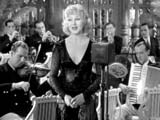 Honey Hale (Ginger Rogers) 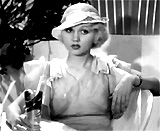 "What do these South Americans got below the Equator that we haven't?" 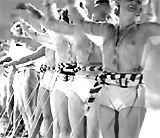 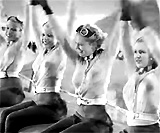 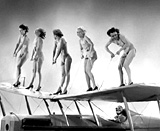 Title Number with Scantily-Clad Wing-Dancers |
|||||||
|
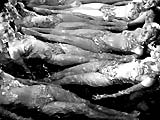
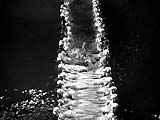
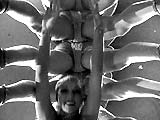
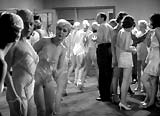
Director Lloyd Bacon's and Warner Bros' musical was the third backstage musical from Warner Bros in 1933 (after Lloyd Bacon's 42nd Street and Mervyn LeRoy's Gold Diggers of 1933), and in Dames (1934), with choreography by Busby Berkeley. For the five years before the Hays Production Code of 1934 went into effect, dance choreographer Busby Berkeley featured barely-clad bathing beauty starlets (clothed to appear naked) in his extravagant productions. Teasing, gold-digging, scantily-clad smiling chorus girls and views of dressing rooms were often featured. Especially in this film, he was able to display the female form through kaleidoscopic abstract designs, many swimming with legs wide open or body parts seen in close-up. During the bawdy "Honeymoon Hotel" sequence, married (?) couples (all anonymously named Smith), along with honeymooners Dick Powell and Ruby Keeler, had to put up with her young lecherous 'Little Boy' brother (midget Billy Barty) who almost shared their wedding night This film also had the racy and naughty "By A Waterfall" sequence with dozens of legs of floating swimmers being unzipped and zipped.
|
 Back-Stage |
|||||||
|
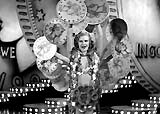
Gold Diggers of 1933 (1933) As in Footlight Parade (1933), Busby Berkeley featured opulent production numbers with barely-costumed chorines, in numbers such as "We're In the Money." In the naughty pre-Code "Petting in the Park" number, straw-hatted men romanced chorines on a lawn - with the camera leering at their crossed legs and petticoats. After a drenching rainstorm, the chorines were forced to provocatively strip in silhouette behind a transparent screen. A lascivious, leering young boy (midget Billy Barty) pulled up the screen to peer at them. |
 "We're In the Money" 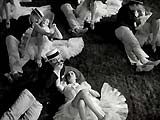  "Petting in the Park" |
|||||||
|
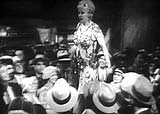
I'm No Angel (1933) I'm No Angel (1933) was bawdy Mae West's next scandalous film after She Done Him Wrong (1933). Predictably, it featured more of the same - smart, sexy and snappy dialogue, one-liners, and double entendres. West's films single-handedly saved Paramount Studios from financial ruin, although they brought intense criticism from the Catholic League of Decency. In the film's opening on the midway on a raised catwalk, floozy lady lion tamer and carnival queen Tira (Mae West) paraded past a crowd of leering men in a sexy gown and purred to the spectators:
She also said in the course of the film: "When I'm good, I'm very good, but when I'm bad, I'm better" - and "Well, It's not the men in your life that counts, it's the life in your men." She had made it big on Broadway and was hustling men out of their money. While on the phone with millionaire leading man Jack Clayton (Cary Grant, reuniting with West in their second film together), she advised him, coyly (in one of the film's oft-misquoted lines):
|
 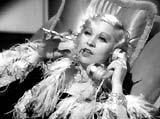 Tira (Mae West) |
|||||||

|
King Kong (1933) King Kong (1933) was the ultimate Beauty and the Beast monster film, extensively censored for its violence. The film's subtext was the introduction of the feminine into a man's world and into uncharted territory, and the release of the primal male beast upon the civilized world (NYC). The film was considered slightly scandalous for its inter-racial 'love story' of a giant black ape with a white blonde woman. Their forbidden love resulted in Kong's subsequent punishment - death. Sexy screamer Fay Wray (as Ann Darrow) was featured as the object of male affection and of the desires of the giant hairy Beast. The Empire State Building was the ultimate phallic symbol from which the beast was toppled. The white blonde woman was regarded as a more valuable virginal substitute for Kong by the natives of Skull Island, They had regularly sacrificed half-naked, garlanded black virgins (white woman Ann was worth the equivalent of six native women, acc. to the tribal chief). The film even contained sexual double entendres, as in the scene when film-maker Denham (Robert Armstrong) told First Mate Jack Driscoll (Bruce Cabot) that he feared his crewmember had been emasculated and gone "soft" (or impotent) and "sappy" over Ann's Beauty, as the Beast would do later:
In addition, the film had some sex-related sequences:
Censors did away with other scenes of doomed sailors being eaten by giant spiders, of natives being crushed in Kong's mouth or trampled into mud, of a woman being snatched from her NY apartment's bed (and held upside down over the street and then released after being mistaken for Ann), and the scene of the ape peeling down the blonde beauty's clothing - these were all censored and cut.
|
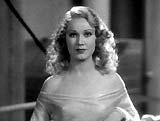 Ann Darrow (Fay Wray) 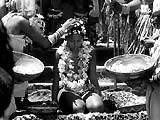 Native Girl 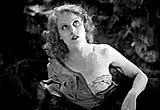 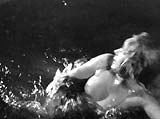  Ann with King Kong  Jessica Lange in King Kong (1976) |
|||||||
|
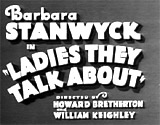
Ladies They Talk About (1933) This was an early 'women in prison' pre-Code film, featuring lesbianism and brutal prison life, with the presence of butchy prison guards, and a burly cigar-smoking lesbian inmate, as well as a former, elderly brothel ("beauty parlor") Madame named Aunt Maggie (Maude Eburne). In the film's trailer, the film advertised Barbara Stanwyck's role:
Stanwyck starred as gun-moll Nan Taylor with boyfriend Don (Lyle Talbot), who was a member of a bank-robbery gang. She had a love-hate relationship for her childhood friend and prosecutor - the reformed-minded radio evangelist David Slade (Preston Foster) who turned her in when she confessed her guilt to him about the heist. Nan was sentenced to prison at San Quentin for 2-5 years, and when she entered as a new fresh inmate, she was called a "new fish." She was warned by an inmate named Susie (Dorothy Burgess): "Listen. Don't think you can walk in here and take over this joint. There's a lot of big sharks in here that just live on fresh fish like you." She gave the smart reply: "Oh yeah, when they add you up, what do you spell?" Susie also reproached her and she quipped back quickly:
When Nan discovered that other members of the stickup gang, Don and Dutch (Harold Healy) were in the men's section of the prison, they communicated and set up the groundwork for an escape plan. Toward the end of the film after Nan was freed on parole, she lost her temper speaking to Slade in his office, impulsively drew her hand-gun from her purse, and shot him in the shoulder. She immediately apologized: "I didn’t mean to do that," and he apologized: "Why, that's all right, Nan, it's nothing" - and they made plans to get married! |
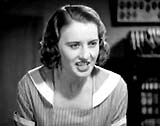 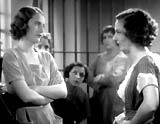 Nan Taylor (Barbara Stanwyck) Talking Back to Susie (Dorothy Burgess) 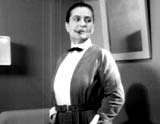 Cigar-Smoking Lesbian Inmate 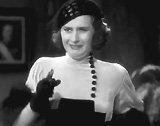 Nan Shooting Slade in Film's Conclusion |
|||||||
|
Mary Stevens, M.D. (1933) This pre-Code "woman's film," based upon a novel by Virginia Kellogg, dealt with issues of alcoholism, single unwed motherhood, and professional prejudice based upon gender. Kay Francis starred as the title character Dr. Mary Stevens - an intelligent, emotional and strong female pediatrician. The trailer captured her personal and professional dilemmas, however: "Men trusted her with their LOVES, but not with their LIVES," and "Must she give up woman's privileges to make good in a man's profession?" Some patients refused to be treated by her - preferring instead a male doctor. Mary was in love with Dr. Don Andrews (Lyle Talbot), who had graduated with her from medical school years earlier. At first, they had offices in the same building and struggled during the Depression Era in New York. Then due to his desire for an easier life, Andrews married Lois Cavanaugh Rising (Thelma Todd), the daughter of wealthy political boss Walter Rising (Charles Wilson). Even with high-class clients and a new office, Andrews faced difficulties in his life including alcoholism (and performing operations on children while under the influence) and charges of insurance fraud/graft. He eventually separated from his wife, due to selfishness, jealousy and mistrust. Although Mary severed her relationship with her ex-boyfriend, now married, she continued to pine for him. When the two were unexpectedly reunited in an upstate New York hotel, they engaged in an affair (when he agreed to divorce his wife). Mary became pregnant, booked a trip to Europe, and was excited about becoming a mother. She delivered the baby in Paris (with plans to avow that the baby was adopted). However, her baby died after contracting infantile paralysis on the return trip home. Depressed, and stating: "I'll never practice again," she was about to commit suicide by hurling herself from a hotel balcony. She changed her mind and was convinced to live when she reaffirmed her purpose and dedication to medicine. She was interrupted by having to save a child from choking to death after swallowing a safety pin. ("They say medicine is a man's game, but I wonder what a man could do in that situation.") Andrews also promised to make her an 'honest woman' now that his divorce was official. |
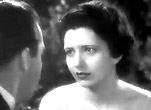  Dr. Mary Stevens (Kay Francis) with Dr. Andrews (Lyle Talbot) |
|||||||
| Our Betters (1933) This early George Cukor, pre-Code, satirical drawing-room comedy about the English aristocracy, adapted from a W. Somerset Maugham play, was a typical early example of how 'the movies' overtly portrayed homosexuals as a 'sissy' stock character (or prissy dancing fop/queen). The objective of the stagey high-comedy by director Cukor (an openly gay man) was to provide extreme contrast with other males (and females), or a humorous element. In this example, the over-the-top character of Ernest (Tyrell Davis, uncredited) appeared with garish 'gay' make-up (rouge on his cheeks with his lips painted with lipstick) and his formal 'town clothes' to teach lecherous Duchess Minnie (Violet Kemble Cooper) how to dance the tango. Ernest also delivered the film's curtain-closing, final line of dialogue after witnessing Minnie kiss rich American beauty-heiress Lady Pearl Saunders/Grayston (Constance Bennett):
|
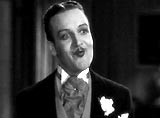
Ernest (Tyrell Davis) |
||||||||
|
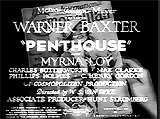
Penthouse (1933) Director W. S. Van Dyke's mystery-crime drama, a risque pre-Code era film from MGM, was marked by sexual innuendo and intimations that the main 'call-girl' character was sexually free. The witty script was written by Frances Goodrich and Albert Hackett, screenwriters for The Thin Man (1934). Myrna Loy starred as the intelligent, quick-witted, beautiful and charming Gertie Waxted - a high-class "call-girl" character (although never specifically labeled that in the film). In the complex story, however, she was regarded in a positive and sympathetic light. Defense lawyer Jackson "Jack" Durant (Warner Baxter) was known for taking cases of disreputable clients (showgirls, bootleggers, other criminals). His girlfriend Sue Leonard (Martha Sleeper) had dumped him for "Park Avenue" man Tom Siddall (Phillips Holmes), but then solicited Jack's assistance for help when Tom was framed by the mob. Tom was accused of murdering his ex-moll girlfriend-mistress, jealous Mimi Montagne (Mae Clarke). He was found holding a gun on a balcony after the sound of a gunshot (off-screen), next to Mimi's dead body. Jack enlisted Gertie Waxted, Mimi's pretty apartment-mate, to secretly help expose the real killer. Gertie agreed to stay with Jackson until he had exhaustively questioned her regarding suspected racketeer Jim Crelliman's (C. Henry Gordon) activities. When they first arrived in his apartment, she bluntly stated: "Don't stall. You didn't ask me up here because of my fatal fascination. I was Mimi's pal. I was at Crelliman's party. You want to help Miss Leonard. It adds up too smoothly." When she said it might take "weeks," he promised to be patient and would make her feel "comfortable." When he showed her the bedroom, he didn't mention the word. She coyly asked: "But isn't it going to be pretty dull just talking all the time?" When he suggested that she go to bed, she responded: "I hate to quit on you. But cheer up, maybe I talk in my sleep." After spending the night in his apartment, she told him:
A ballistics report showed that the fatal shot was fired from the penthouse apartment above the balcony, owned by Crelliman's "finger man" Tim Murtoch (George E. Stone). Although Durant's life was threatened, he escaped being ambushed - saved by aid from grateful gangster Tony Gazotti (Nat Pendleton) - he was appreciative that Jack had previously saved him from the electric chair. The murderer eventually confessed - it was Murtoch. In the film's last lines, Gertie was planning to marry Jackson and go to Europe: "I can't marry you. I'll ruin you with all your friends. Why, I'm not even a lady," to which he replied:
|
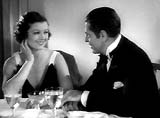 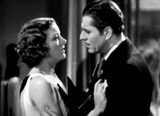 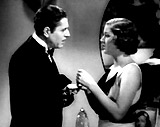 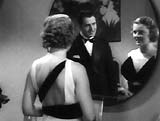 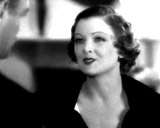 Gertie Waxted (Myrna Loy) |
|||||||
|
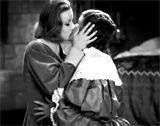
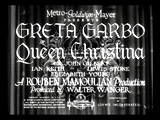
Queen Christina (1933) The fact that the actual 17th century Queen Christina of Sweden was bisexual in orientation provided this Rouben Mamoulian-directed film, Queen Christina (1933), with a pretext for its lesbian leanings. Although Hollywood attempted to 'heterosexualize' the Queen's life story, the film's subtext also included cross-dressing, 'butch' mannerisms, and shared kisses with her lady-in-waiting. Most of the film was troubling to film censors at the time. The film showcased the cross-dressing and gender disguises of the Queen who often wore male hunting clothes and adored her Great Dane dogs. Specifically, she had a strong romantic attraction to her own neglected, complaining lady-in-waiting Countess Ebba Sparre (Elizabeth Young) whom she affectionately kissed twice (once on the lips) and promised more personal time after Ebba groused: "You're surrounded by musty old papers and musty old men and I can't get near you" - the Countess was assured by the Queen:
Later, it was revealed that Ebba was only pretending to be sympathetic, concerned, and caring for the Queen, and the Queen confronted and reprimanded her: "You pretended to be interested in me and my problems. Your sympathy, your concern - all pretense, underneath which you resent me." [Note: After finding heterosexual love herself later in the film, the Queen excused Count Ebba's behavior and blessed her marital intentions to wed Count Jacob.] When pressured by her Chancellor (Lewis Stone) to marry her older, Swedish-born cousin Prince Charles (Reginald Owen), a military hero, in order to produce an heir for Sweden, she responded with a startling statement - expressing her professed desire to remain a bachelor:
During a hunting trip to escape the court's pressures, she made a cross-dressing announcement in a country inn (where she became stranded during a snowstorm) while standing on a table about her assessment of the Queen's highly promiscuous behavior - in order to settle a wager and contentious dispute amongst some of the drunken guests:
After being charmed by the wit and intelligence of a Spanish Catholic emissary (John Gilbert) in the inn's dining room, she was asked to share her bedroom with him and she reluctantly agreed, knowing full-well that there would be complications. At the start of the film's centerpiece sequence, a prolonged and sizzling bedroom scene, she revealed her true self to the Spanish ambassador that she was female (but he remained unaware of her identity as the Queen); the revelation occurred as she removed her outer garment and averted her eyes downward; the emissary took one look and was surprised to realize that she had breasts under her thin blouse - in a double-take, he exclaimed: "Of course!"
Afterwards, they had a notorious, multi-night tryst (before a roaring fire) in their inn's accommodations during the snowstorm. Later in the afterglow of their heterosexual love-making (a scene considered offensive by the censors), she caressed objects in the room (she even touched and hugged a phallic-shaped stack of wool next to a spinning wheel), and then laid her head on a soft bed pillow. On the other side of the bed, she touched a religious picture hanging on the wall and embraced the massive wooden bedpost (another phallic symbol), and then made sentimental joyous statements as she 'memorized' every single item:
|
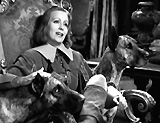 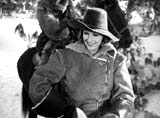 Often Dressed in Young Men's Clothing with Her Hunting Dogs  "I shall die a bachelor" 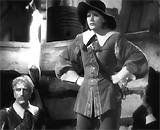 "The Queen Has Had 12 Lovers This Past Year..." 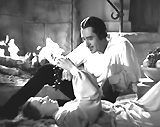 The Queen with Spanish Emissary (John Gilbert): Eating Grapes Before Fire  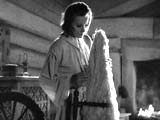 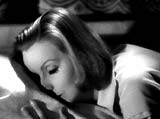 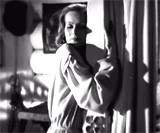 Caressing Objects in the Room 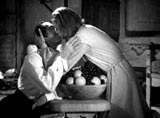 Passionate Kisses |
|||||||
|
Roman Scandals (1933) This escapist Eddie Cantor musical comedy, with a time travel plot, wove several risque, pre-Code Busby Berkeley choreographed numbers into the fantasy. During the production number, "No More Love," the setting was a slave market. While other bikinied, enslaved females danced around, dozens of scantily-clad Roman slave girls (Goldwyn Girls, one of whom was Lucille Ball in her screen debut), nude except for long blonde wigs that reached almost down to their knees, were chained to a round, rotating pedestal. One of the females was sold into slavery, and then was thrown to her death. In another more lively musical number,"Keep Young and Beautiful" with Cantor singing in blackface, various states of undress were also viewed in a Roman bath, where the 'Goldwyn Girls' cavorted around and were primped and prepared by slaves. As the scene ended, Cantor was subjected to a steambath and was shrunk to midget size (Billy Barty).
|
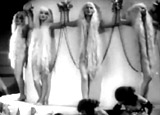 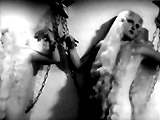 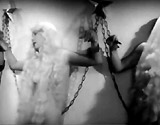 Roman Slave Girls (Goldwyn Girls) |
|||||||
|
She Done Him Wrong (1933) Mae West's She Done Him Wrong (1933) deeply worried censorship officials and helped to speed the enforcement of the Code in the next year. Her main goals were to demolish the double standard, to be sexually frank, and to end prudery on screen. Seductive Mae West ("Queen of the Sex Quip") starred as the liberated, racy character of Lady 'Diamond' Lou. She described herself as:
She drawled a bawdy and carnally-suggestive famous one-liner to young handsome, psalm-singing Captain Cummings (Cary Grant):
Cummings evaluated her diamonds: "They always seem so cold to me, they have no warmth, no soul. I'm sorry you think more of your diamonds than you do of your soul." She responded about her own value: "I'm sorry you think more of my soul than you do of my diamonds. Maybe I ain't got no soul." Lady Lou also provided liberated quips - such as: "Men's all alike - married or single. It's their game. I happen to be smart enough to play it their way", and sang her suggestive, heavily censored "I Like a Man That Takes his Time." She responded to Capt. Cummings' query: "Do you mind if I get personal?" with: "Hmm, go right ahead, I don't mind if you got familiar." |
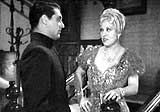 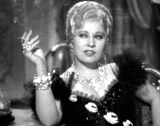 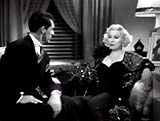 Lady Lou (Mae West) with Capt. Cummings (Cary Grant) |
|||||||
|
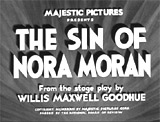
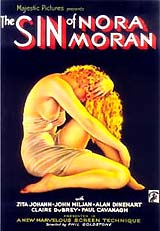
The Sin of Nora Moran (1933) The promotional poster for this "poverty row" Majestic Films melodrama was much more sensational than the film's actual content. The 'sin' didn't refer to a sex crime, but to the title character's (Zita Johann) degrading descent and execution for murder (told with flashbacks and flash-forwards) after taking the rap for a murder that her lover committed. |
|
|||||||
|
The Story of Temple Drake (1933) This was a tricky and daring film adaptation of William Faulkner's notorious 1931 short story Sanctuary that required the re-naming of the film. The film's taboo subject matter was considered so shocking in its day that it was attacked by the press even before its release. It was responsible for spurring the rapid passage of the restrictive Production Code. The plot was about a young, upper-class, pampered, flirtatious and promiscuous 'bad-girl' southern belle named Temple Drake (Miriam Hopkins), the daughter of a Mississippi judge. She was kidnapped and then raped by ruthless, degenerate bootlegger-gangster Trigger (Jack La Rue) in a farmhouse. The actual rape scene was not explicit - basically communicated by a candle (in the original tale, it was a corncob) approaching Drake's bed followed by a scream and quick fade to black. She was then taken to the city to serve as a kept woman (not completely unwillingly) in a house of ill repute. In the film's shocking climax in a courtroom, she finally admitted on the stand that she had killed Trigger. |
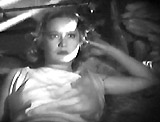 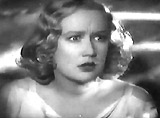
Temple Drake (Miriam Hopkins) |
|||||||
|
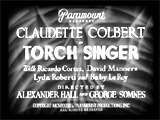
Torch Singer (1933) In this pre-Code baiting, irreverent and moving melodrama ("woman's picture") with music from Paramount, Claudette Colbert starred as an impoverished chorus girl named Sally Trent. She was a 'fallen woman' when she gave birth, without marriage, to a baby girl - a common theme of pre-Code films. During hard times, she gave up her illegitimate baby daughter Sally for adoption at a Catholic charity hospital in New York City. She had been abandoned by the father of the child, wealthy Bostonian Michael Gardner (David Manners). She delivered this timely cynical line:
She eventually became Manhattan's most notorious, morally-loose and flirtatious café chanteuse, renaming herself Mimi Benton. In one scene after being told that she was hard and disreputable, she replied:
She also became a popular daytime children's radio show host, a storytime narrator, as a way to locate her daughter. By film's end, she was reunited with her five year-old daughter and the biological father Michael Gardner, who had adopted her. |
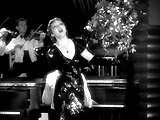
Sally Trent (Claudette Colbert) |
|||||||




 Ecstasy (1933, Czech) (aka Ekstase or Extase)