|
History of Sex in Cinema: 1999, Part 2 |


|
The General's Daughter (1999) Director Simon West's often-offensive, misogynistic psychological military thriller was based on the 1992 novel by Nelson DeMille. It told about a sexual murderous assault (and its scandalous corrupt and "lunatic" underworld within a military base). Although the film commented upon the gender inequalities in the military, it was also criticized for leering at the female victim when she was gang-raped by trainees dressed in camouflage, and the horrific image of the murdered victim laid out and then decomposing was often revisited during the film. The film began by introducing its two main military characters, a father and daughter:
At the Army base outside Savannah, Georgia, Elisabeth was soon found murdered. She was staked down with tent pegs and ropes, spread-eagled, mock-raped (there was no semen found and after tests, no sign of rape), and strangled in the middle of a training compound field for urban warfare training. The case was investigated by two undercover warrant officers (from the US Army's Criminal Investigation Command or CID) who had a romantic history together:
During the initial investigation, Brenner met with the base's Provost Marshal Colonel William Kent (Timothy Hutton) and the general's overprotective adjutant Colonel George Fowler (Clarence Williams III). Brenner curtly summarized the motives for murder to Sunhill:
The CID officers had 36 hours to investigate before the FBI entered the case with a task force, when the media would make the death "a goddamn circus." Brenner was cautioned by Fowler to do things "the Army way" - not "the right way or the wrong way." Soon, secrets about the daughter's dark sexual past were revealed. A hidden room behind a false wall with a sliding door in her basement was found complete with a bed, condoms on a table, bondage paraphernalia (handcuffs, harnesses, a belt with a dildo on it, etc...) as well as a camera and videotapes. As Brenner left the room, he was attacked by an unidentified masked man who stole the bag of videotapes. At the murder site, Sarah astutely examined the evidence. Strangely, there were no signs of a struggle, although there were tear marks on Elisabeth's cheek. Panties placed under the rope tied around her neck were there to presumably prevent rope-burn ("What's a little rope burn if you're going to kill somebody?"). Either more than one person was the killer/rapist, or she had been compiant with her killer(s)/rapist(s). Her clothes and dog-tag were found stashed in a plastic bag on a nearby rooftop. Headlights were seen at the scene the night of the murder at 3:00 am, 3:30 am, and again at 4:00 am. Elisabeth's mentor and commanding officer Colonel Robert Moore (James Woods) was arrested on suspicion of murder (or accessory to murder) - with his fingerprints found on Elisabeth's dog-tag. Shortly later after being released under house arrest, he was found dead in his home - with a self-inflicted gunshot wound to the head. It was assumed that his guilt caused him to apparently shoot himself - and the case appeared to be solved. As the investigation proceeded, it was revealed that Elisabeth had been involved in flagrant S&M sexual activity with her father's officers and staff (many married) to embarrass her father ("The general's daughter banging his entire male staff"). She called it "psychological warfare, and that the enemy was daddy." Elisabeth was dating the Chief of Police's deputy son Wes Yardley (Chris Snyder), but only for outward show. Seven years earlier, she had been gang-raped by six men as a West Point cadet (in her sophomore year) during a nighttime training exercise when she became separated from her group. Her rape was in the same manner she was found at the time of her death (held down with stakes in an isolated area) by men dressed in camouflage. [The gang-rape was committed by the 6 man recon squad led by Captain Bransford (Brad Beyer), who was fooled into confessing to the gang-rape.] She was hospitalized, and treated for venereal disease and pregnancy. However, this rape case was covered-up and kept confidential, when Gen. Sonnenberg (John Frankenheimer) convinced her Lt. General father to cooperate and protect his daughter:
In the hospital, the General had coerced and urged his daughter to forget the incident: "It never happened. None of this ever happened." When the General met with Brenner, he still believed that the rapists couldn't be caught, and that he had no other choice but to deny the rape. Brenner presented him with the list of 6 names - the men in Captain Bransford's squad, who had been arrested and faced 20 years in prison. Then Brenner described that sexually-traumatized Elisabeth had deliberately re-enacted or recreated the original rape incident from seven years earlier, just before her murder, to show her father first-hand what had been covered up:
It was revealed, in flashback, what had occurred. She had herself tied up at 3:00 am, aided by Col. Moore -- to force her father to deal with her earlier rape. Her father had given her an ultimatum - either resign her commission, or agree to undergo therapy. When she refused both options, he threatened to draw up charges of misconduct and present her for a general court-martial. Campbell strode onto the site at 3:30 am where Elisabeth was spread-eagled. She provoked him: "Do you see what they did to me?...I want to hear you say it happened." She called him a coward for covering-up and denying her rape. After betraying her and telling her: "I don't give a damn what happened to you 7 years ago," he walked away. As an aside, Colonel Fowler had wrongly thought all along that the General had killed his own daughter. Afterwards, Kent met with Brenner and Sunhill on a training site, where she hypothesized: "I think this was a woman giving it out all over the post, and the one man who cared about her, the one who's willing to risk it all for her, is the person she doesn't want. And that's because she couldn't want anybody." Kent confessed to what had happened: "She owned my heart. She tormented me. She became my obsession. So I followed her and found her out there on the range, on display." When Kent came up to her after she had been rejected by her father, she threatened him - and was strangled to death by the spurned soldier:
To avoid capture by Brenner, Kent suicidally killed himself by stepping on a "bouncing betty" mine that he had planted in the surrounding mine-field training site. In the conclusion, Brenner reprimanded General Campbell, who still claimed he had done nothing wrong: "Nothing is gained by my involvement." He was planning on further covering-up his participation in the entire incident. Brenner was steadfast as he confronted the General:
The General was court-martialed and found guilty for failing to report and concealing the West Point gang-rape. He subsequently withdrew from public life. The film's ending title: "Today, nearly 200,000 women serve on active duty in the military services." |
 Captain Elisabeth Campbell (Leslie Stefanson) 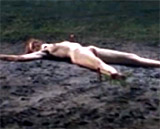 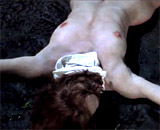 The Murder Scene   Her Dark Sexual Past 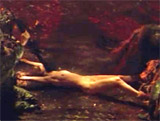 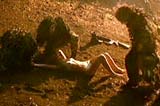  The West Point Rape 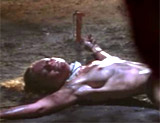 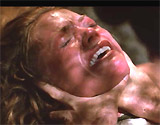 The Rape Re-Enactment and Strangulation |
||||||||||||||||||

|
The Girl Next Door (1999) Not to be confused with the romantic comedy The Girl Next Door (2004) with Elisha Cuthbert or the 1999 teen drama of the same name with Polly Shannon and Gary Busey, this porn documentary film from director Christine Fugate was about an adult-film star who was in the business for four years. The featured porn star was Stacy Valentine, an ex-housewife from Oklahoma named Stacy Baker who moved to Los Angeles and entered the skin-trade business in San Fernando Valley - after her husband suggested she submit nude pictures for men's magazine Gallery, and she won the contest as the magazine's "Girl Next Door" in July 1995. She followed up with a spread in Hustler magazine.
Over the film's two-year period, she endured a number of things:
In the film's opening, divorcee Stacy boasted matter-of-factly about her "sexual capabilities" before the film reviewed her life beginning 26 years earlier:
She also said: "When I get horny, I go to work and when I need affection, I have my cats." |
     
Stacy Valentine (Herself) |
||||||||||||||||||

|
Writer/director Davide Ferrario's mainstream erotic biopic drama (in Italian without subtitles) about the porn industry (two years after Boogie Nights (1997)) was based on the life of Italian X-rated adult movie actress Moana Pozzi, who died of cancer at the age of 33. The film was criticized for its bold and explicit scenes of stage sex, hardcore closeups (gynecological), lesbian sex, oral sex (fellatio), and S&M sex.
The film starred Italian mainstream actress Elisabetta Cavallotti as Nina who became involved in a romantic lesbian relationship with Cristiana (Stefania Orsola Garello) - the publicist/editor of a hard-core adult magazine.
|
   Stage Sex with Nina 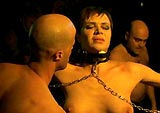 Nina - S&M |
||||||||||||||||||

|
Holy Smoke (1999, US/Australia) Writer/director Jane Campion's sexual-politics film was a risk-taking, powerful, R-rated drama (for scenes of strong sexuality and language). It starred Kate Winslet as young, earthy Australian religious cultist Ruth Barron who had been to India where she was spiritually enlightened by a hypnotic cult guru named Baba (who renamed her Nazni). Upon her return to Australia, she was forced to be deprogrammed over three days in a remote Halfway Hut in the outback by professional "number one exit counselor" P. J. Waters (Harvey Keitel) from Los Angeles - a misogynistic, rough-hewn, mustached man with dyed black hair. Confining her and making her captive for the treatment, he first attempted to gain her respect, then strip her of her sari ("remove her props, upset her and provoke her"), but succumbed to her sexual advances.
Its most notorious scene was the one of full-bodied Ruth - after her sari had been burned - vulnerably standing in the outback, stripped nude and urinating while walking toward him, and then a scene of Waters overpowered by her seductive, vengeful, manipulative sexuality - as he had sex with her. Both were mutually deprogrammed in an about-face from their own experiences (him from his misogyny and vanity, her by using her sexuality to humiliate and 'feminize' him). With a reversal of power roles, she convinced him to wear her red dress, lipstick (and one cowboy boot) - and he heat-stroke-hallucinated - seeing her as a Hindu Kali goddess with multiple arms (to the tune of "Baby, It's You"). By the film's end, she had returned to India with her mother for further enlightment, and he had returned to the United States - married (to Pam Grier) and the father of twins, and a letter between them conveyed that something did happen between them in the desert. |
 Ruth with P.J. Waters (Harvey Keitel) 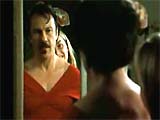 P.J. Waters 
|
||||||||||||||||||
  |
Idle Hands (1999) and Late Last Night (1999) (TV) Pretty model/actress Kelly Monaco, fresh from being Playboy's April 1997 centerfold Playmate, also gained greater public acclaim for her roles on the soaps General Hospital and the spin-off Port Charles. She had bit parts (both showing off her naked form) in two 1999 films:
[Note: Kelly Monaco was the 2005 winner of the first season of TV's popular Dancing With the Stars, and a finalist in the 2012 seasons All-Stars show.] |
 Tiffany (Kelly Monaco) in Idle Hands (1999)   Elaina (Kelly Monaco) in Late Last Night (1999) |
||||||||||||||||||
|
The Loss of Sexual Innocence (1999, US/UK) British writer/director Mike Figgis' pretentious film was an episodic, poetic meditation (composed of vignettes) on coming of age, love, loss of sexual identity and relationships. In non-linear fashion, it told about the life and sexual exploits of a British director/ethnographer Nic (Julian Sands) in various stages of his life, when young and teenaged, during the 50s, and then in present day. One of its episodes was a stylized retelling of the Adam and Eve Garden of Eden expulsion story (filmed with an amber filter), with two characters exhibiting graphic full-frontal nudity, and also reacting to each other urinating:
|
 Eve (Hanne Klintoe)   With Adam (Femi Ogumbanjo) |
||||||||||||||||||
Mascara (1999) Director Linda Kandel's melodramatic, independent film, a rights-of-passage drama, was not to be confused with the thriller Mascara (1987) starring Charlotte Rampling. This character study and overblown 'chick flick' told about the anguishing and self-pitying plights of three unsettled, emotionally-scarred young females (30-something college friends) over a year's period. They experienced everything from rape (date and statutory), abuse of all kinds (including substance abuse), assault, adultery, prostitution, mental illness, pedophilia, incest - and even more:
In this serious film, the women were involved in failing or conflicted relationships (involving loss of love, emotional breakdown, infidelity and vengeful sexual retribution, possible incest, etc.). The film followed their struggles for passion, happiness and truth beyond society's expectations, and to make life choices. |
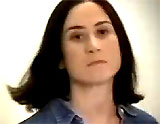 Laura (Lumi Cavazos)   Jennifer (Amanda de Cadenet)   Rebecca (Ione Skye) |
|||||||||||||||||||

|
The Ninth Gate (1999) Director Roman Polanski co-wrote the screenplay for this neo-noirish, sometimes plodding gothic mystery thriller, with themes of double-cross, supernatural devil worship, and a trail of murder. Unscrupulous, self-interested, mercenary NYC rare book dealer Dean Corso (Johnny Depp) (who was quoted as saying: "I believe in my percentage") was hired by wealthy book collector, publisher and witchcraft-demonology expert Boris Balkan (Frank Langella) of Balkan Press to authenticate or validate his recently-purchased copy of a rare 17th century (1666) book on demonology, The Nine Gates of the Kingdom of Shadows -- a "supreme masterpiece." The book was authored by writer Aristide Torchia (AT), who was burned at the stake during the Inquisition. Corso, with eyeglasses and a goatee, was to travel (all-expenses paid) to Europe to track down two other existing copies. They were privately owned in two different locations:
Corso was to discover which of the three copies was genuine: (Balkan: "I'm convinced only one is authentic - I want to know which."). Nine slightly-different engravings (found in all three of the books) in the pentacle-emblazoned book -- correctly interpreted and spoken out loud, would according to legend reportedly "conjure up the Prince of Darkness" - Lucifer (LCF) himself, the book's reputed co-author. Presumably, Balkan wanted the authentic book so he could ritualistically summon Lucifer through the Ninth Gate. Corso suspected that Balkan had already failed once to raise the devil ("You mean the devil won't show up"). Before leaving for Europe, the first contact of the shady "mercenary" Corso was Liana Telfer (Lena Olin), the conniving sultry, gold-digging femme fatale widow of Andrew Telfer (Willy Holt) who originally owned the book (bought in Toledo-Spain) and had sold it to Balkan. She failed to reacquire the book from the "book detective" when she appeared at his NY apartment door, proposed an orchestrated theft, and then offered herself as a "bonus" - she seduced him by feeling his crotch and then 'f--ked' him, but failed to acquire the tome. She angrily bit his chest and knocked him unconscious with a liquor bottle. Corso had temporarily entrusted the book to his NY business partner Bernie Ornstein (James Russo) for safe-keeping, while traveling. He found Ornstein murdered - hanged from his left ankle and made to appear like the 6th engraving in the book. Enticed by more money from Balkan, Corso flew to Europe - to Toledo, Spain - to the bookstore of twin Cineza brothers who had sold the book to Telfer (at his wife's insistence), and learned that the initials LCF on three of the engravings referred to Lucifer (the book's "illustrious collaborator"), the other six to AT (the author). As he traveled by train to Portugal, he found himself again pursued (actually assisted and protected) by a mysterious and enigmatic 'guardian angel' figure named The Girl (Emmanuelle Seigner) - nicknamed "Green Eyes," who appeared in various situations (always wearing jeans, jogging shoes and mismatched red and green socks). She helped him navigate through the perils of his search, including saving him twice from harm inflicted by Liana's blonde-haired, black bodyguard (Tony Amoni). It was in Portugal at the home of Victor Fargas (Jack Taylor) who owned a second copy, that Corso discovered three of the nine engravings (# 2, # 4, and # 6) were attributed to LCF - slightly different from Balkan's copy (only # 3, # 8, and # 9 were attributed to LCF, while all the others were attributed to AT). As it turned out, three different engravings in each book ("all three copies are genuine") varied from those in the other two books - Corso surmised an important plot point:
In Paris, he learned from stump-handed, wheel-chaired Baroness Frieda Kessler (Barbara Jefford) about the Order of the Silver Serpent (member Liana Telfer's left buttocks was tattooed with its coiled serpent icon). The Order was a secret society ("a kind of witches coven"), dedicated to worshipping the Prince of Darkness, that had degenerated into a "social club for bored millionaires and celebrities who use its meetings as an excuse to indulge their jaded sexual appetites." The Baroness had long since dropped out ("My orgy days are over"), although members still met annually on the anniversary of Torchia's death. In the Baroness' copy, as expected, # 1, # 5, and # 7 were attributed to LCF. Liana ("the Telfer woman") stole Corso's copy (Balkan's book) from his Parisian hotel room, and was pursued to her gated St. Martin chateau where she was about to lead a Satanist Order occult ceremony (similar to Kubrick's Eyes Wide Shut (1999)), dressed in a black robe and reading from the book. She became the fifth victim associated with the book, when suddenly attacked by Balkan who called her a "charlatan." The trail was littered with death - those who owned (or were associated with) copies of the book ended up dead:
Caught in the floorboards, Corso witnessed as Balkan, believing that he was invincible and immune to flames, self-immolated during the Satan-summoning ritual. When he managed to get free, Corso mercifully put him to death with a gunshot. Afterwards, Corso succumbed to the sexual temptations of the hypnotic green-eyed Girl as the castle/tower continued to burn down behind them.
And he also became obsessed with finding the diabolical Ninth Gate - a passageway to reach hell. She told him the "game" was not over for him. The 9th engraving was a forgery - the reason for Balkan's failure. She then hinted with a clue (a note on the car's windshield: the fake 9th engraving had the words "CENIZA BROS." scrawled in red across it) to the location of the authentic 9th engraving (she looked like the naked demoness riding a seven-headed dragon in the ninth illustration). Corso found the real engraving on top of a dusty bookcase being dismantled in the abandoned Spanish bookshop owned by the twin brothers. The film's final image was of Corso crossing the threshold
with the nine engravings (including the authentic 9th one) - departing
through the ninth gate into an 8-pointed blaze of light at the castle. |
 Boris Balkan (Frank Langella)  Dean Corso (Johnny Depp) 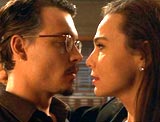 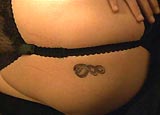 Corso with Liana Telfer (Lena Olin) - With Tattoo  The Girl (Emmanuelle Seigner)  Liana Telfer and Bodyguard (Tony Amoni) 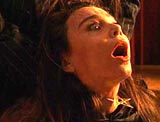 The Death of Liana Telfer - Killed by Balkan 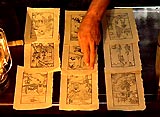 The Nine Pages of the Book  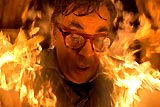 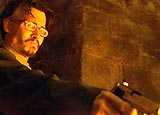 The Fiery Death of Balkan Due to the Wrong Incantation 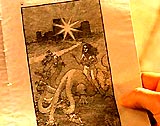 The Authentic 9th Page Engraving 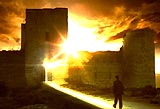 Entering the Ninth Gate |
||||||||||||||||||

|
The highly-charged Léos Carax-directed art-house film updated Herman Melville's 1850s novel "Pierre, Ou, Les Ambiguites" (Pierre, or: The Ambiguities) to modern-day France. The film was considered controversial for its scenes of unsimulated sex (although some involved body-doubles). This extreme film told about privileged would-be writer Pierre Valombreuse (Guillaume Depardieu), living (incestuously or Oedipally?) with his domineering and doting mother Marie (Catherine Deneuve) on the family's Normandy estate. He was engaged to marry wealthy and refined blonde fiancee Lucie (Delphine Chuillot). Together, they both shared an unusual, ambi-sexual relationship with his moody cousin Thibault (Laurent Lucas). After weird dreams and haunted meetings in town and in the woods with a ragged Yugoslavian refugee, he abandoned everything to her. The mysterious waif-vagrant claimed that she was his half-sister Isabelle (Katerina Golubeva) who had been abandoned by their father, a famous diplomat, after his affair. Pierre joined her to engage in an illicit and passionate dark affair, and to experience a life of vagabonding and squatting in a freezing, abandoned factory. Their relationship was marked by an explicit, X-rated scene shot in a shadowy room including mutual masturbation, cunnilingus, fellatio and intercourse - as his life slowly disintegrated during their incestuous relationship. |
 Marie (Catherine Deneuve)  
Pierre with Isabelle (Katerina Golubeva) |
||||||||||||||||||


|
This sexually-graphic drama import at the turn of the century from daring French filmmaker Catherine Breillat faced international censorship problems for its explicit depictions of fellatio and intercourse. It was the first mainstream movie to feature an erect penis. It was released with no MPAA rating, although it undoubtedly would have been an NC-17 rating with its full frontal nudity, masturbation, penetration and explicit unsimulated oral sex - a turning point in the candid depiction of non-pornographic sex on screen for a mainstream film. Breillat would continue to release controversially graphic works, such as Fat Girl (2001, Fr.) and Anatomy of Hell (2004, Fr.), prompting some to question: “What is cinematic art and what is pornography?” The main character was a sexually-frustrated, self-reflective, semi-depressed Parisian elementary school teacher named Marie (Caroline Ducey) who was paired with an unresponsive, unloving male partner and model named Paul (Sagamore Stevenin) who no longer touched her or agreed to intercourse, although she still clung to him. She complained to him: "You won't make me give up sex," and "You don't deserve my faithfulness" and threatened to leave: "You'll never see me again." When she initiated sex with him and began fellating him, he responded disinterestedly. She requested that he touch and pleasure her, stating: "Women come a lot more than men," but seemed to feel that he despised her: "You despise me because I'm a woman...You think I'm the lowest." Feeling dishonored, she began to contemplate finding unbridled sexual gratification and lustful fulfillment through various 'no-strings-attached,' explicit sexual encounters with others - one began almost immediately with a studly Italian stranger from an all-night bar. She expressed pleasure from their first encounter of "pure desire," although she didn't have sex with him at first: "I can never stop myself from yielding" - she mused.
She soon began full sexual involvement (including rear-entry sex) with the Italian stranger, named Paolo (Italian porn star actor Rocco Sefredi), complaining to him about how most men who wore condoms would go limp. She also engaged in a long monologue about the shape of male genitals ("A thin cock isn't noble"), and then requested rear-entry sex:
However, she wouldn't kiss him (or someone she didn't love), saying: "It's too intimate," although she said: "I don't care who stuffs my cunt." She also became sexually intrigued and involved, in a "trivial" and "shameful" relationship, with her older boss Robert (Francois Berleand), a "prince of seducers," who claimed he had enjoyed 10,000 women (with a record of his conquests), and promoted her potential for S&M masochism, degradation and bondage, although she was at first freaked by the experience. However, they maintained a long-term association:
Upon returning to Paul's empty bedroom, she masturbated with her legs tightly closed ("It's proof I don't need a man") -- providing the image for the film's red-X'ed poster - her self-pleasured private parts. Later, when she began pulling away from Paul, she became pregnant with his child during one rare act of sexual contact (through a drop of his seminal fluid without ejaculation). The film's additional scenes included a degrading rape (the rapist called her a "whore, bitch") in a stairway, a probing gynecological exam after Marie became pregnant by Paul, and later clear footage of her childbirth (edited and replaced by Blockbuster Video). After her gynecological exam, the most controversial segment was a fantasy dream sequence in which she imagined herself sexually defenseless with other women. Their waists were available and positioned next to a hole in a wall as unseen strangers on the other side of the wall could engage in explicit sex with them through the opening. There was a close-up of ejaculation onto a female's stomach, juxtaposed with jelly being applied to her belly for an ultrasound reading.
After nine months of drifting further apart from Paul, she left his apartment to deliver her baby, accompanied by Robert, while Paul was left passed out from booze in his apartment's bed, with the gas stove turned on - so that he would die in the subsequent explosion. The film ended abruptly with Paul's funeral and her voice-over:
|
   Marie (Caroline Ducey) with Paul (Sagamore Stevenin)   Marie with Robert (Francois Berleand)   Self-Pleasuring  More Random Sex - Rape  Gynecological Exam  Jelly For UltraSound (After Ejaculation Shot)  Childbirth |
||||||||||||||||||

|
The Sex Monster (1999) This lightweight, teasing sex comedy farce (basically nudity-free) had the taglines: "A comedy that answers the question: 'What would happen if your wife said yes to a menage-a-trois... and loved it!'", and "His fantasy was a great idea, until she liked it...a lot." After six years of marriage, LA contractor-businessman Marty Barnes (director/star Mike Binder) encouraged his wife Laura (Mariel Hemingway) to sample his fantasy of a menage a trois:
She didn't realize that being introduced to experimental sex would lead to much greater Sapphic desire, making her an insatiable lesbian sex monster. Laura first came onto her hair-dresser co-worker Didi (Renee Humphrey) who was invited over for dinner. After some hip-grinding dancing with Laura on the outdoor patio, Didi was found wearing a black thong and nothing else in the swimming pool, before the trio ventured to the bedroom for three-way kissing and sex.
And then the plot heated up with Laura going after Diva (Missy Crider), Marty's secretary, by stroking her leg under an outdoor dinner table, and then apologizing in the kitchen, although they ended up secretively lip-locking together:
When Diva and Laura were discovered together in bed by Marty, to excuse her behavior to her husband, Laura rationalized her feelings for Diva by explaining that they were 'warming' up and waiting for him, although they essentially ignored him:
|
 Didi (Renee Humphrey)    Diva (Missy Crider) |
||||||||||||||||||

|
Varsity Blues (1999) Director Brian Robbins' teensploitation sports and coming-of-age film, from MTV Films, about West Texas high school football, was memorable for its one scene - a breakthrough appearance for the actress. Slutty cheerleader/girlfriend Darcy Sears (blonde bombshell Ali Larter) dumped her injured boyfriend - first-string quarterback Lance Harbor (Paul Walker). She wore a strategically-placed whipped cream bikini to entice brainy jock and star back-up quarterback Jonathon "Mox" Moxon (Dawson Creek's James Van Der Beek), who was being coached by hard-driving and tyrannical Bud Kilmer (Jon Voight). In another part of the debauched, formulaic comedy film, awash with breast, sex, gay, puke and drinking jokes, the football players took a night out at the local strip club, where they found that their sex-ed science teacher Miss Davis (Tonie Perensky) had a secret side-profession as a stripper. In class, she had requested: "Now I want y'all to repeat after me: penis, penis, penis; vagina, vagina, vagina!" and then had them call out names and slang terms for aroused male genitals:
|
 Darcy (Ali Larter)  
Miss Davis (Tonie Perensky) |
||||||||||||||||||
|
The Virgin Suicides (1999) Director Sofia Coppola's mystery drama (her debut feature-length film) was set in an affluent Detroit suburb. There was one pivotal scene on the nighttime football field in which beautiful Lux Lisbon (Kirsten Dunst) finally made love to high-school football player Trip Fontaine (Josh Harnett). Post-coitally, he left her there to wake up alone, causing her restrictive Catholic parents, the Lisbons (Kathleen Turner and James Woods), to apply more pressure to their family, and ultimately making them partially responsible for the tragic demise of all of the adolescent girls. Lux died from carbon monoxide fumes from the car in the garage, after stalling everyone so that her older sisters could all commit suicide too:
Earlier, 13 year-old Cecilia (Hanna R. Hall) had succeeded in her second suicide attempt by throwing herself from a second-story window onto the front yard's iron-spiked fence. |
  Lux (Kirsten Dunst) with Trip (Josh Hartnett) |
||||||||||||||||||
|
Volaverunt (1999, Fr./Sp.) (aka The Naked Maja) Director Bigas Luna's film was based on a historical novel by Antonio Larreta, set during the rule of King Carlos IV, a Spanish ruler of the early 19th century. It was a murder-mystery surrounding the untimely death of the Duchess of Alba (Aitana Sánchez-Gijón). Artist Francisco de Goya (Jorge Perugorria), who had recently painted her portrait, was implicated. Penelope Cruz played the part of peasant girl Pepita Tudo, whose beauty was admired by the Prime Minister Manuel de Godey (Jordi Molla). He invited her to the royal court in Madrid, where she became his mistress and the subject of several of Goya's nude paintings, including the Naked Maja. |
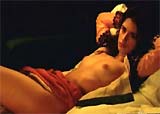 
Pepita Tudo (Penelope Cruz) |
||||||||||||||||||

|
A Walk on the Moon (1999) Tony Goldwyn's nostalgic romantic drama told about the life of a married, frustrated Jewish mother of two, who was vacationing at a Catskills summer resort in the late 60s in upper New York state. Pearl Kantrowitz (Diane Lane) engaged in a lustful extra-marital affair with traveling blouse salesman/hippie Walker Jerome (Viggo Mortensen). She fulfilled her inner fantasies and was sexually-awakened at the Woodstock music festival with him - she made love to him under a waterfall and also stripped down wearing only body paint. At the rock concert, she was also surprised by a chance meeting with her rebellious teenaged daughter Alison (Anna Paquin). |
   Pearl (Diane Lane) |
||||||||||||||||||

|
The War Zone (1999, It./UK) Director Tim Roth's emotional drama (his directorial debut film) had the enigmatic tagline: "When the worst of men hides in a family with no history." The disturbing context of the film was family sexual abuse and violence - specifically, incest. It was not a secret that both director Roth and his father were abused by his grandfather as children. The uncompromising, painful-to-watch story was about a close-knit family that had moved from London to the gray and desolate countryside, to live in a two-storied, whitewashed Devon farm cottage, near a cliffside where angry and ominous waves crashed. The family in the "war zone" consisted of:
During one scene, Tom had a heart-to-heart talk with his casually-nude sister Jessie about what he had witnessed (off-screen) between his father and her through a bathroom window - their sharing of a bath together.
She denied that there was anything that happened: ("It's a pretty weird thing you're suggesting, if you're saying what I think you're saying. Look, I haven't told you to f--k off or anything, which I probably should've. Nothing happened, OK? I'd tell you"). Tom also discovered Jessie's nude photos of herself, and again confronted Jessie, pondering: "It must be better than love, better than anything. How could you let him?" She asked knowingly about his adolescent horniness:
The main locale for fatherly abuse was in an abandoned, obsolete, WWII cement bunker (machine-gun post), on a cliff-top near the house, where Dad took Jessie to sodomize her. To prove his accusations, Tom used a video-camcorder to record the violations, viewing (actually peeping upon) the sexual trauma of his sister through one of the bunker's narrow slits. He watched as Dad undressed Jessie and instructed: "Turn over." She whimpered: "I'm not a boy...Why don't you do it like you do it with Mum?" He replied: "I mustn't do that." She cried as he thrust and grunted at her from behind. Afterwards, Tom was so disgusted that he threw his video-camera into the sea. When Tom confronted Jessie about the rape: ("You lied to me. You're still f--kin' him. I saw you together in that shelter. I saw everything"), she again accused him of peeping: "Do you get off on all this?" Turning self-masochistic (and Tom was briefly co-sadistic), she held a cigarette lighter to her right breast for a long period of time without seeming to be in pain, and then offered that he also burn her: "Do you wanna hurt me? Do it, you'll feel better." He complied, then abruptly stated: "That's bullocks. It's got to stop. I mean it, or I'll tell Mum." During a trip to London, Jessie urged her friend Carol (Aisling O'Sullivan) to have sex with her "baby brother," just because she thought he needed sex, but then interrupted them mid-way when they were undressing. On their drive home, Jessie told Tom: "You just want everything to be nice and sweet, but it isn't." All family members kept the fatherly incest as a deep-dark secret, evaded talking about it and wanted to be unaware, but the dynamics of the hurt had long-term damaging effects on their family life. In particular, it was hinted that the young baby's sudden bleeding was the result of Dad's further dysfunctional behavior. Tom warned his shocked mother: "Don't trust him. Keep him away from the baby." In the end, Tom stood up to his hated father's abuse and called him "sick." Dad exploded in rage: "You break this family up and I'll kill you." Tom ended the lying and suffering of Jessie and the entire family in one swift act of justice against his self-denying Dad, by stabbing him in the stomach with a kitchen knife. The film's last scene was Tom's entrance into the bunker, where Jessie stood in the open doorway, entered and comforted him after he asked: "What are we gonna do?" Would the cycle of seduction and abuse continue? |
 Nude Photos of Jessie    Jessie With Tom   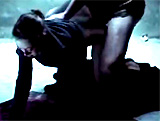 Jessie's Sexual Abuse by Dad in Bunker Witnessed by Tom  Jessie's Breast Sado-Masochism   Carol's Aborted Seduction of Tom 
|
||||||||||||||||||

|
Web of Seduction (1999) The film's poster tagline for this erotic thriller by writer/director Blain Brown, from Mystique Films and Playboy, asked the tantalizing question:
The opening credits were tantalizing - they appeared over the view (in extreme close-up) of a seductive blonde female slowly removing her blue lingerie (panties and then her bra) and letting the clothing drop to the floor around her feet - and then a brief full-frontal (shaved) view of her genitals as she pulled on another pair of panties. She then stripped off her newly-donned underwear for a young male client. The soft-core film starred lots of little-known, non-mainstream actresses, two in roles as wealthy, ignored housewives:
Two of the females, Jenni and Simone, were involved in a complex murder plot to kill each other's spouses - a lesbian twist on Hitchcock's suspenseful Strangers on a Train (1951). However, the film basically was an excuse to show the idle, passion-seeking, seductive women in self-pleasuring scenes (in lounge chairs and a hot tub), Brandy's naked underwater masturbatory scene, one lesbian sex scene in a hot tub (Brandy and Jenni), a threesome sex scene (including Brandy and Simone), and various scenes of the women cheating on their husbands. |
     Brandy (Nancy O'Brien)  Jenni (Tracy Ryan) and Brandy (Nancy O'Brien) |
||||||||||||||||||





 Guardami (1999, It.)