|
History of Sex in Cinema: 1945-1949 |

|
Brief Encounter (1945, UK) Director David Lean's romantic tearjerker Brief Encounter (1945) was a simple but realistically-honest, unsentimental, self-told social melodrama of the quiet desperation involved in an illicit, extra-marital love affair between two married, middle-class individuals over seven weekly meetings, mostly against the backdrop of a railway station. The two lovers were:
They never consummated their romantic involvement by sexual relations in the bedroom (at least on-screen), although there were many erotically-charged moments:
In the second scene, set in the dark, shadowy underground subway tunnel-passage of the train station, she succumbed to their first kiss (after he told her: "I love you so"). As they passionately kissed for the first time, two large, long shadows of approaching passengers darkened the tunnel's wall behind them, a newspaper swirled in front of them, and the roar of the approaching train was heard. The forceful speed of the noisy train represented their passion rising and crashing through the silence. |
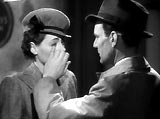 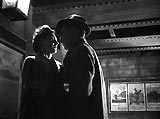
Dr. Alec Harvey (Trevor Howard) with Laura (Celia Johnson) |
||||||||||||
|
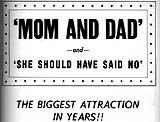
Producer/promoter Kroger Babb's (self-dubbed as "America's Fearless Young Showman") low-budget, heavily-promoted 'educational' film was released by Hygienic Productions. It soon became one of the most successful exploitation films of all time - it was the third highest grossing film during the 1940s (and easily recouped its $62,000 in expenses). Banners and ads cried out:
Besides being socially-significant as a sex (or personal-hygiene) film about the facts of life, female anatomy, the 'birds and the bees,' the dangers of venereal disease and the disastrous results of premarital sex, prints of this black and white feature drama were made and road-showed for more than two decades, with screenings divided by gender. Each showing included a traveling lecturer named Elliot Forbes -- an "eminent sexual hygiene commentator" -- (and two assisting nurses) who promoted the film's "educational" value, lectured during intermission about the importance of contraception ("The Secrets of Sensible Sex"). They also profitably sold two sex-ed manuals in the theaters, both written by Babb's wife, and Mom and Dad co-screen-writer, Mildred Horn:
Each print showed innocent (virginal) young Joan Blake (June Carlson) ("a sweet innocent girl") deflowered ("going all the way") and becoming pregnant (without displaying nudity or sex of any kind), and then becoming an unwed mother when the father-pilot Jack Griffith (Bob Lowell) subsequently died in a plane crash. Her neglectful parents, especially her mother Sarah (Lois Austin) had not instructed her in any way about the facts of life, and faced the disastrous results. In the preface a title card stated: "...her mother, like many mothers, still thinks that ignorance is a guarantee of virtue." It then asserted: "IGNORANCE IS A SIN - KNOWLEDGE IS POWER." Joan suffered an off-screen suicide attempt, but eventually traveled by train to Boston with her mother to live out the pregnancy in secret under a doctor's care. The preface also condemned a generation of youth to delinquency if it didn't receive sex-hygiene instruction: "Boys and girls of today aren't bad! But millions of them are becoming sexual delinquents and the victims of venereal disease, simply because they do not know the Full Truth about these subjects." The film also featured the introduction to a sex-education curriculum, including three films within-a-film:
The ending of the film varied, depending upon the venue - either Joan's baby was stillborn, or put up for adoption. |
 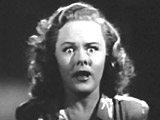 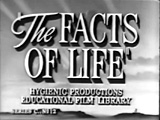 Film-Within-a-Film 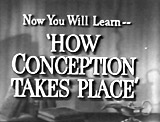     Live Birth 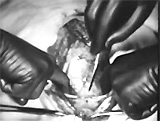 C-section Surgery 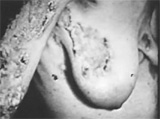 Ravages of Venereal Disease |
||||||||||||
|
The Big Sleep (1946) Howard Hawks' definitive detective noir The Big Sleep (1946) faced condemnation by the Production Code of the time. It wouldn't have condoned the exposition of explicit details of portions of the depraved plot, so they were presented in disguised fashion:
It opened with a scene of young, leggy, and provocative Carmen (Martha Vickers) as she first met detective Philip Marlowe (Humphrey Bogart) by attempting to sit in his lap while he was standing up. The film noir also featured an interlude sex scene in which Marlowe convinced an aggressive book salesgirl (Dorothy Malone) to share a drink of rye with him during a wet and hard rainstorm! She quickly lowered the shades, coyly removed her eyeglasses and the barette from her hair, and conveniently brought out two cups. After a fadeout, Bogart left the shop many minutes later (their long dalliance was signaled by the end of the rain). Also, the film included the famous scene of a slyly flirtatious, sexy horse-race conversation ("who's in the saddle") between Marlowe and Vivian Rutledge (Lauren Bacall). At one point, she rated him as a potential lover, using a horse analogy to talk in a veiled way about her feelings toward men and sexual intercourse. The dialogue was a classic of sharp-edged wit, double entendre and sexual innuendo, communicating their real feelings for each other in race-track and poker-game terms with outrageously-suggestive and metaphorical language:
|
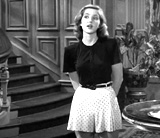   Marlowe with Carmen (Martha Vickers)  Marlowe (Humphrey Bogart) with Book Salesgirl (Dorothy Malone)  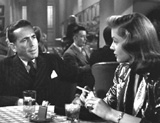 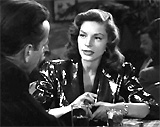 Marlowe and Vivian: Horse-Racing Dialogue |
||||||||||||
|
Ditte, Child of Man (1946, Denmark) (aka Ditte Menneskebarn) Director Bjarne Henning-Jensen's grim, post-war socially-realistic drama was based on a novel by Martin Anderson Nexo. It told about an impoverished young peasant girl, Ditte (Tove Maës) who was born out of wedlock to her promiscuous, alcoholic mother Sorine (Karen Lykkehus), the daughter of a Danish fisherman. An outcast as an illegitimate child, she was first raised by her grandparents Soren and Maren Mand, then by her herring dealer stepfather Lars Peter Hansen (Edvin Tiemroth) (who was planning to marry her mother) at his rural Danish farm to help care for three step-siblings. Eventually (after Ditte's evil mother was convicted of the murder of her grandmother - for money - and imprisoned), she moved to a different farm and became a servant-maid to another family. There, she established a relationship with the young farmer's weak-willed son Karl (Preben Neergaard), and eventually became pregnant by him (following her mother's pattern), but was abandoned. It contained the first nude scene in a Danish feature film. In the controversial scene (edited out of many prints), Ditte was in a rural field with grazing sheep, when she suddenly turned, ran toward a lake, and began stripping down. By the edge of the water, she sat topless as she stroked her leg, then touched and looked down at her young breasts, removed her dress, and waded into the water. Nearby she heard Karl's voice calling out her name and interrupting her swim. She hurriedly returned to her clothes, dressed, and sat with him.
In the film's conclusion, she was reunited with her prison-released mother, whom she cared for (as well as her own newborn child) - she had become a social outcast like her mother. (Another controversial scene earlier in the film was of one of the step-siblings, a little boy without clothes from the waist down, urinating outdoors.) |
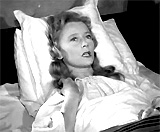 Ditte's Alcoholic Mother Sorine (Karen Lykkehus) 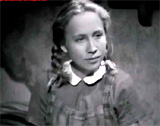 Young Ditte (Tove Maes) 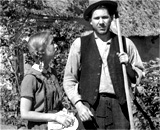 With Stepfather Lars 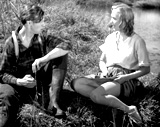 With Farmer's Son Karl 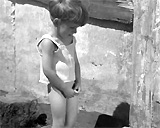 Controversial Scene - Urination |
||||||||||||
|
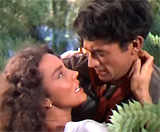
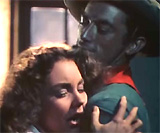
Duel in the Sun (1946) Producer/writer David O. Selznick and director King Vidor teamed to present this epic western Duel in the Sun (1946) (nicknamed "Lust in the Dust"), a sexually-frank production. It was a lustful and grandiose motion picture featuring two loving combatants:
It included numerous scenes of the over-sexed, wild-living Lewt ravishing the hot-blooded, sex-pot peasant girl Pearl. An early scene showed Lewt forcefully kissing a resistant Pearl when he first met her. It was a passionate love-making scene accompanied by thunder and bolts of lightning, and kisses for the "bob-tailed little treecat." After she fought him off, he told her: "Don't you pretend nobody ever did that before!" Then, after riding bareback with the wild-living Lewt, he spied on her when she took a provocative nude swim at the sump
In the so-called 'rape' scene: Lewt grabbed and and kissed Pearl, and she acquiesced, as a flash of lightning and sound of thunder boomed; they slowly sank out of the camera's view to the bed below. (The highly-charged 'rape' scene was severely edited - instead of Pearl trying to get away from Lewt, she gave in to his advances, but not without some resistance. In the next scene, Lewt was seen with three long scratch marks on his left cheek.) But then, after Lewt refused to respectfully marry Pearl, she had a short relationship with older rancher Sam Pierce (Charles Bickford), but he was gunned down in a saloon by Lewt; when he came back to her, he told her: "Of all the ornery females. One minute you're yammerin' 'cause I don't love ya enough. And when I go out and show ya how much I do, you're wantin' to plug me. You're my girl, honey...Anybody who was my girl is still my girl. That's the kind of guy I am, you know, loyal....There ain't nobody gonna take my girl. Nobody. Same little tigercat" - she couldn't resist him and collapsed in his arms. However, then in the so-called "degradation" scene, Lewt again rejected Pearl's love and rejected her request to join him in Mexico - he left her rejected and alone, writhing and whimpering on the floor. A final notorious, and infamous show-down scene at the film's end was the 'orgasmic' climax of all the confrontations between the two of them. In the rocks, they both shot at each other to end their passionate love-hate affair, and both suffered serious wounds. He was wounded in the leg, and she was shot in the chest. Satisfied that he had killed her, he said to himself: "I guess that does it," but then felt twinges of regret that he had shot his beloved, calling out "Pearl, hey Pearl!" The ex-lovers continued their bloody shoot-out in the hot desert sun and Lewt was shot in the stomach, and he told her: "I can't shoot no more, honey. Honest." Seriously wounded, she dragged herself over the rocks and up the side of the mountain toward her dying lover, while spouting blood and shouting threats ("I'm not scared of you. I'm coming up after you"). Dying, Lewt asked Pearl:
In their final moments, she cried out for him: "Lewt, hold on Lewt, Hold on. Wait for me, Lewt," and lustfully crawled toward him, as she slid back with her grasp of sand. When she finally reached him, they stretched their hands out toward each other:
They bloodily and passionately embraced and died in the dust in each other's arms. As they died, the camera pulled back until they were lost in the landscape under the blazing, hot sun, under the massive face of Squaw's Head Rock. |
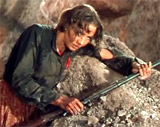 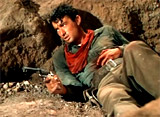 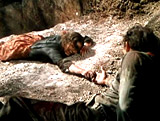  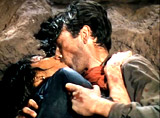
The Final Lethal Shootout Between Them |
||||||||||||
|
Gilda (1946) The noirish film Gilda (1946) was a complex, eccentric, cynical tale that told of a menage a trois (between husband, wife, and lover) - with homo-erotic overtones. The film's tagline proclaimed:
In one of the film's earliest scenes, there were homoerotic tensions in the first meeting between:
Mundson saved Farrell during a crooked game of dice with his ebony cane and its protruding stiletto dagger (a perverse, compensating Freudian phallic substitute):
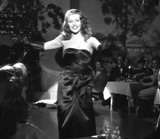
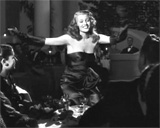
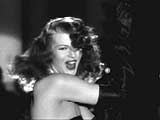
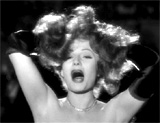
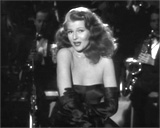
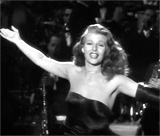
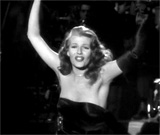
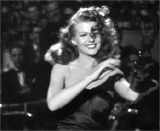
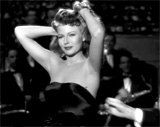
The film's real star was title heroine Gilda (WWII's GI "love goddess," the beautiful, alluring, and provocative, red-haired pin-up Rita Hayworth). She was introduced by her mobster-husband Ballin Mundson to Johnny: (Mundson: "Gilda, are you decent?" Gilda: "Me?" - she gave a long, sensual look at Johnny and pulled up one side of her strapless dress as she added: "Sure, I'm decent"). As she spoke, she threw back her head and tossed her thick mane of hair in a blatantly sexual response. She was also the ex-flame of Johnny - who was entrusted as her bodyguard, to watch over her trampy behavior in the casino. In one sizzling scene, Gilda gave a passionate confession of love for Johnny - although their relationship was mostly composed of love and hate:
When Mundson mysteriously disappeared and was presumed dead (in a suicidal airplane crash, possibly faked), Gilda and Farrell resumed their dangerous affair while Farrell assumed control over the casino business. Johnny replaced Mundson as Gilda's emotionally-abusive husband in a continuing love-hate relationship - he treated Gilda with increasing sadomasochism, vindictiveness and abuse after taking her as his wife. After being shunned and locked away, Gilda confronted Johnny and questioned the icy treatment she had been receiving: ("Remember me? I'm Gilda, your wife. Remember?"); she also asked expectantly of Johnny: "Got a light?" - he turned and stood there with the lighter flame burning for her; she claimed that she had always been faithful to him: "All those things I did were just to make you jealous, Johnny. There's never been anybody but you and me" - but he remained doubtful. In the film's most notorious sequence, she performed a memorable, bawdy and sultry (but minimal) black glove-striptease dance before a large live casino audience (backed by an orchestra), as she was swathed in a slinky black satin dress displaying bare upper arms and shoulders. In her sexually-empowered performance, she beckoned with extended arms toward the lusting men in the audience and peeled off one of her long, elbow-length black satin gloves as she sang the torchy defiant number - keeping the casino audience (and viewers) in suspense - wondering whether the strapless gown would remain suspended on her frame. To proceed further with undressing after receiving accolades and encore-applause, Gilda flung her second glove toward the hungering audience. As she started to shed her strapless dress, she entreated two gentlemen volunteers for assistance ("I'm not very good at zippers, but maybe if I had some help") before she was dragged off the stage and Johnny struck Gilda across the face.
But then Mundson vengefully returned after three months, and when he was just about to gun down both Farrell and Gilda, he was stabbed in the back (with his own cane) by Uncle Pio (Steven Geray), the aging, white-coated washroom attendant of the casino's nightclub - murder charges were dropped when the death was judged to be "justifiable homicide." In the upbeat finale to satisfy the Hays Code censors, Johnny admitted how wrong he was and they reconciled with each other after many months of an explosive relationship. The film's final line of dialogue was spoken by Gilda to Johnny:
|
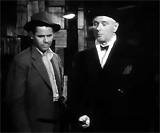 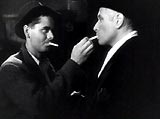 Johnny and Ballin     "Decent" Gilda (Rita Hayworth) 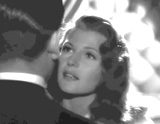 "I hate you too, Johnny" 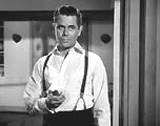 Gilda to Johnny: "Got a light?" 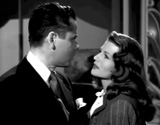 "Johnny, let's go home" |
||||||||||||
|
It's A Wonderful Life (1946) RKO's and director Frank Capra's film It's a Wonderful Life (1946) remains a beloved, tearjerking Christmas tale (adapted from Philip Van Doren Stern's "The Greatest Gift"). It included an intense, fully-suggestive 'telephone' scene between two of its main characters:
Earlier in the film, George was having a phone conversation with friend Sam Wainwright (Frank Albertson) while Mary was also squeezed together next to him to share the same earpiece extension. As they were listening and talking on the same phone, his romantic attraction to her was undeniable with this close proximity, but such an admission would mean remaining in Bedford Falls, where he had been forced to stay against his will and give up his other dreams. In a long closeup of them ear to ear with the phone between them, they listened to Sam while George squirmed and tried to contain himself, standing so close that he could smell Mary's hair. She looked upward at him and with her lips almost on his lips reinforced what Sam has said in a whisper, but she was almost unable to say the words: "He says it's the chance of a lifetime." The phone suddenly dropped to the floor, and instead of grabbing and embracing Mary with a kiss, George held her fiercely by the shoulders and violently started shaking her, passionately protesting that he didn't want to get married:
Then, he ran out of words. She responded by crying helplessly, silently, and then the conflicted George all of a sudden reversed himself and pulled Mary to himself in a fierce and passionate embrace. He overcame his resistance to her and started to kiss her all over her upturned face, holding her intensely. Their undeclared love for each other overwhelmed both of them. After a quick cut, the next scene was in the hallway of the Bailey house and the sound of the Wedding March. |
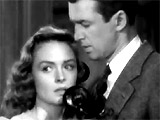 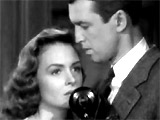 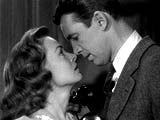 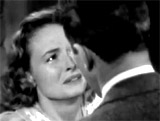 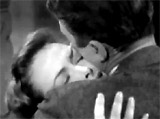 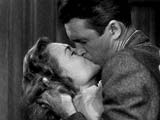 The Phone Call: Mary (Donna Reed) and George (James Stewart) |
||||||||||||
|
Notorious (1946) The classic Hitchcock spy thriller Notorious (1946) included suspense, intrigue, plot twists, and also at the time of its production 'the longest kiss in film history.' It was able to cleverly circumvent censorship (no kiss could be longer than three seconds) by having the kisses composed of lots of pecks and necking, alternated and interspersed with whispers of discussion. The famous marathon kissing scene, almost three minutes in length, was a romantic interlude between two of the film's main characters:
It began on a scenic Rio de Janeiro hotel balcony over the beach in Alicia's apartment, and was entirely shot in a tight closeup of their faces. They rapidly alternated passionate, clinging kisses and whispered endearments, and then continued with nibbling bites and nuzzling hugs as they walked from the balcony to the telephone (where he engaged in a conversation) and then to the front door. During part of their conversation when he was dialing the telephone (calling his hotel for his messages), Alicia told him: "This is a very strange love affair" - and he asked why as she kissed him. Then she replied: "Maybe the fact that you don't love me." |
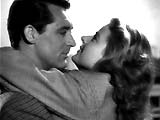 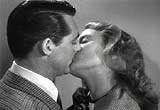 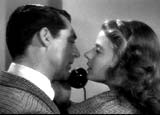 The Record-Long Kiss: Devlin (Cary Grant) and Alicia (Ingrid Bergman) |
||||||||||||
|
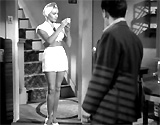
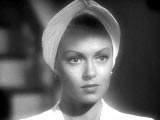
The Postman Always Rings Twice (1946) This 40s prototype of erotic thrillers of later years, The Postman Always Rings Twice (1946) based on James M. Cain's 1934 crime novel, told about how an adulterous sexual relationship would soon lead to a murder scheme. The two lovers were:
She plotted the elimination of her elderly husband Nick (Cecil Kellaway) after a long series of enticements toward Frank. At first, she teasingly introduced herself to Frank by rolling a tube of lipstick down a cafe floor toward him. This was followed by the camera's pan up the length of her long and shapely legs. Then, there was a medium shot of Cora wearing a white-hot outfit (a revealing top and shorts) as she stood framed in a doorway. The neglected hamburger on the stove burned as Frank gawked at her.
After Cora's dramatic entrance into the cafe, she and hired worker Frank officially met and spoke for the first time. She began bossing and sizing him up while he made suggestive advances towards the untouchable yet glamorous woman. Suddenly, Frank grabbed her and planted a kiss on her lips. She reacted with great poise - she pulled out her vanity mirror, cleaned up the smudged lipstick on her lips, and then reapplied the lipstick before leaving - without a word. Soon, after a moonlight swim, they would be sharing more furtive, passionate and intimate kisses. |
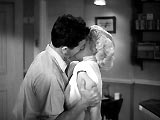 Illicit Love Between Cora (Lana Turner) and Frank (John Garfield) 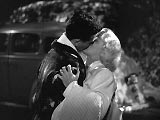 Furtive Kisses 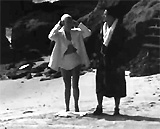 Moonlight Swimming |
||||||||||||
|
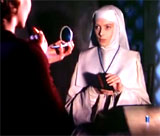
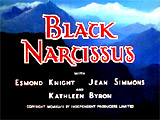
This Powell/Pressburger classic film was noted for its theme of repressed sexuality within a nun's mission (located in a former brothel with sensual murals on the walls), situated on the precipitous edge of a Himalayan mountainside. The film was controversial for a number of scenes and plotlines:
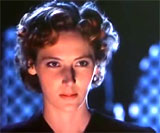
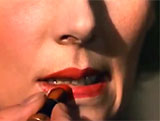
The film concluded with Sister Ruth's climactic confrontational scene opposite devout and pious Sister Superior Clodagh (Deborah Kerr), who begged: ("I know that you've left the order. I only want to stop you from doing something that you'll be sorry for"). As a symbolic statement of her break from the nunnery, Sister Ruth wore a forbidden scarlet red dress and sensuously applied bright red lipstick in Sister Clodagh's presence.
In the cathartic ending, intended victim Sister Clodagh was saved from death as she grabbed hold of the belltower rope after being pushed toward the precipice by jealous, mad and vengeful Sister Ruth, who lost her balance and fell during the lethal struggle.
|
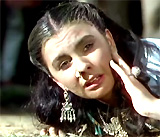 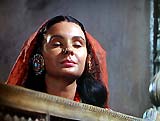 Kanchi (Jean Simmons) 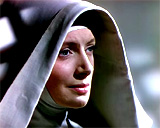 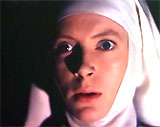 Sister Clodagh (Deborah Kerr) 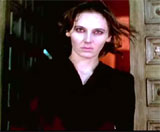 Insane Sister Ruth 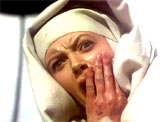 The Death of Sister Ruth and Sister Clodagh's Reaction |
||||||||||||

|
Fireworks (1947) (short) Avante-garde filmmaking director Kenneth Anger's first official, experimental film (his earliest surviving film) was shot over just one weekend and initially charged as being obscene - it was a landmark gay movie:
|
 Flexing Muscle 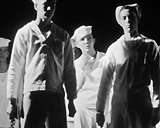 US Sailors Beating and Raping the Dreamer 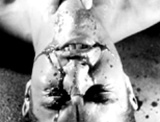 Man's Beaten Face 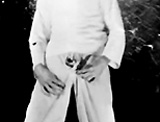
Roman Candle In Crotch |
||||||||||||
|
The Ghost and Mrs. Muir (1947) There was a non-sexual but extremely sensual, romantically sappy and transcendent ending to this film, which told about a creepy, haunted romance between:
He had been haunting her bedroom and thoughts in his non-flesh-and-blood format. Recently-deceased, Lucy rose from her British seaside cottage's chair and - rejuvenated and young again - walked off, hand-in-hand with Daniel through the front door into the afterlife. |
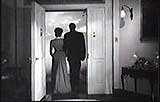 The Ending: Lucy (Gene Tierney) with Daniel Gregg (Rex Harrison) |
||||||||||||
|
The Bicycle Thief (1948, It.) (aka Ladri di Biciclette, or Bicycle Thieves) Vittorio De Sica's neo-realistic Italian masterpiece (an Academy Award-winning "most outstanding foreign film" recognition) told the story of a father and son's search for a stolen bicycle (by a kid in a German military hat (Vittorio Antonucci)):
It contained two non-explicit scenes that were questioned by Hollywood's Production Code Administration (PCA):
Although the PCA was accused of petty demands, the film was the first to be successfully released and exhibited without a seal of approval. |
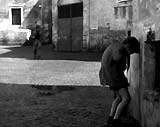 Urination Scene 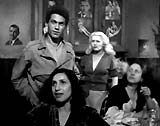 Bordello Scene |
||||||||||||
|
Red River (1948) The classic Howard Hawks' cattle drive western Red River (1948) had one notorious scene which was homosexually charged, with subtle references to their weapons. Cherry Valance (John Ireland) and Matt Garth/Dunson (Montgomery Clift) discussed and showed off their guns. Cherry made covert advances toward Matt, while they both exhibited much symbolic macho posturing and sexual innuendo about their respective guns:
The scene was followed by their competitive target practice session with a tin can to demonstrate their shooting skills. |
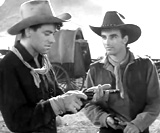 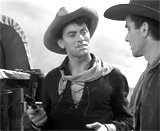 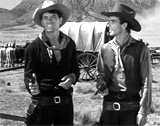 Showing Off Guns: Cherry (John Ireland) and Matt (Montgomery Clift) |
||||||||||||
|
Rope (1948) Alfred Hitchcock's first color film was another of his suspenseful thrillers, noted for its many lengthy takes. It featured two gay villains in a plot that was loosely based upon the Leopold-Loeb murders. The two implicitly homosexual and psychopathic college buddies-lovers were:
The two thrill-killed (by rope strangulation) a third individual and then hid his body in a chest. In one chilling, sexually-tinged scene, Shaw recounted his feelings about the murder to Morgan:
|
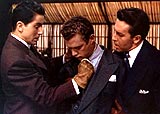 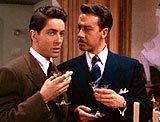
Phillip (Farley Granger) and Brandon (John Dall) |
||||||||||||
|
Beyond the Forest (1949) The melodramatic film Beyond the Forest (1949) from director King Vidor warned in its opening, necessary for code restrictions at the time, that it was salutory to view this "story of evil" in order to be delivered from it. It told the story of black-hearted, dissatisfied wife Rosa Moline (Bette Davis), with low-cut blouses, terrible makeup, and hip-moving swaggering. Her many evil sins included:
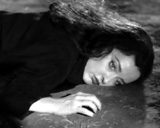
Rosa forced her patient and forgiving country doctor-husband Dr. Lewis Moline (Joseph Cotten) to stop the car so she could leap into a steep ravine embankment in a crazy attempt to force an injury and miscarriage of her unwanted pregnancy. As the film concluded in the most memorable sequence, the feverish and sickly Rosa was found face-down and dead in the dirt after failing to reach the train station to escape her plight by taking the train to Chicago to meet up with Latimer.
|
 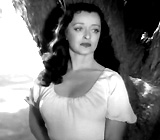 Rosa Moline (Bette Davis) 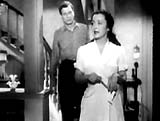 Rosa with Husband Dr. Lewis Moline in Her House: "What a dump!"  Forced Miscarriage - Jump Into Ravine |
||||||||||||




 Mom
And Dad (1945) (aka The Family Story, UK)
Mom
And Dad (1945) (aka The Family Story, UK)