|
|

|
Backwoods Sexploitational Films - Early 1970s
A number of low-budget, backwoods sexploitational films were produced in the early to mid-1970s, offering fairly explicit soft-core escapades with hillbilly characters, incest, lots of nudity (male and female genitals, although with no real closeups, penetration, or erections) and sex in the great outdoors, and an emphasis on stereotypical Southern accents and sensibilities. The most common of these types of trashy, low-budget, drive-in favorites with poor acting were produced by sleaze-merchant Harry Novak. They were sometimes labeled "corn-porn" - characterized by tongue-in-cheek humor, lots of casual nudity and lengthy sex scenes. |
 Country Cuzzins (1970) |
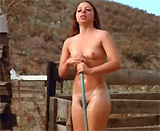 Billie Jo Peabody (Rene Bond) |
Billie Jo Peabody (Rene Bond) |
 Tobacco Roody (1970) |
 Tootie (Dixie Donovan) |
 Danielle (Maxine DeVille France) |
 Midnite Plowboy (1971) |
 Sally (Cristy Anna) |
 Bernice (Debbie Osborne) |
 Southern Comforts (1971) |
 Brenda (Judy Angel) |
 Carol (Monica Gayle) |
 The Pig Keeper's Daughter (1972) |
 Ma Molly Swiner (Gina Paluzzi) |
 Moonbeam Swiner (Terry Gibson) |
 Sassy Sue (1972) |
 Dottie Lee (Tallie Cochrane) |
 Dolly Lou (Sharon Kelly) |
 Sweet Georgia (1972) |
 Georgia (Marsha Jordan) |
|
 Country Hooker (1974) |  Sue (Rene Bond) |
 Honey (Maria Arnold) |
|
Beyond the Valley of the Dolls (1970) This was the first studio film of successful independent 'nudie-cutie' king Russ Meyer who was the sexist, exploitative director of Faster Pussycat, Kill! Kill!! (1965) and VIXEN! (1968). It was co-written by film critic Roger Ebert as an unofficial sequel to Fox's Valley of the Dolls (1967) - based upon Jacqueline Susann's trashy novel. Rated X originally (but re-rated as NC-17 in 1990), this T & A exploitation spoof film was made for a $1 million budget, but grossed $40 million overall. The cult melodrama, with a twisted plot filled with sex, drugs, and rock 'n' roll, was one of the most successful 20th Century Fox films ever made. It told about an uninhibited, marijuana-smoking group of hick girls in a rock trio known as The Kelly Affair. The film opened with them playing at the Westmont Senior Prom for $300. The group was managed by Kelly's boyfriend Harris Allsworth (David Gurian):
They relocated to the West Coast (and Hollywood) to make it big, where their first break was to play at an outrageous party for pan-sexual rock producer Ronnie "Z-Man" Barzell (John LaZar). The music mogul Z-Man renamed the band The Carrie Nations. A sub-plot was about intrigue surrounding a family inheritance acquired by Kelly’s Aunt Susan (Phyllis Davis) and the greedy wishes of Susan’s financial adviser and accountant Porter (Duncan McLeod), who wished to discredit the band in order to embezzle the money for himself. The group soon found the decadent Hollywood was awash with orgiastic sex, bondage, gays and gigolos, lesbianism, drugs, a bizarre record promoter and murder. Each member of the group abandoned their original boyfriend and became involved with some else:
Relationships soon broke up or changed by the end of the film:
|
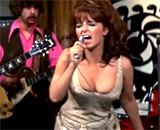 Kelly MacNamara (Dolly Read) - Lead Singer 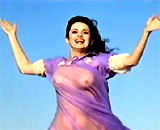 Aunt Susan (Phyllis Davis) 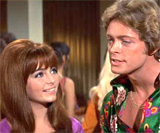 Kelly with Lance (Michael Blodgett)  Girl Dancing (Angel Ray) 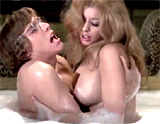 Girl-in-Tub (Angel Ray) 
Fashion Model (Susan Reed)  The Carrie Nations  Kelly (Dolly Reed) with Lance  Casey in Bed with Roxanne (Erica Gavin)  Cynthia (Samantha Scott) |
|||||||||||||||||||||||||||||||||||||||||||||
|
The Boys in the Band (1970) This milestone film from director William Friedkin (an adaptation of Mart Crowley's off-Broadway 1968 stage play, with the original stage actors) was notable as being the first Hollywood feature film to examine the homosexual culture and community in close-up fashion, and to portray gays as human beings who could have a sense of camaraderie. It was rated R by the usually ultra-conservative MPAA (when the previous year's Midnight Cowboy (1969) and The Killing of Sister George (1969) received X-ratings) for its subject matter and for its bold language. However, symbolic of its times, it also included some gay stereotypes and images, and negativity. Set in the late 1960s, it told about a gay birthday party (held for Harold (Leonard Frey)) in an Upper East Side apartment among some miserable and bitchy individuals that turned confessional and vindictive as the night wore on. It especially became uncomfortable after the arrival of host Michael's married straight (heterosexual) friend/college roommate, lawyer Alan McCarthy (Peter White). The six homosexuals at the party included:
Conversations were often coarse and abrasive. While preparing for the party as Donald was showering, Michael sang:
During the early stages of the party, Michael told Donald: "Donald, you are a real card carrying cunt." Emory bluntly asked: "So, who do you have to f--k to get a drink around here?" Cowboy Tex (Robert La Tourneaux) arrived at the door - a male hustler hired by Emory as a birthday "gift" for Harold. When Harold came late and was reprimanded by Michael, he replied:
They also played a game in which they each telephoned their most loved one - revealing many past anxieties and issues. Michael accused Alan of being a "closeted" homosexual who had at one time spurned homosexual advances from male college friend Justin Stewart. The film ended with a devastating attack on Michael by Harold, who characterized him as an unhappy homosexual - forever. In the climactic searing scene with self-deprecating humor before he left, Harold attacked Michael:
Michael fell apart and collapsed in Donald's arms. |
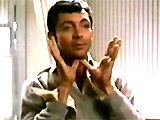 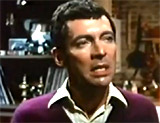 Michael (Kenneth Nelson) 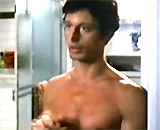 Donald (Frederick Combs) 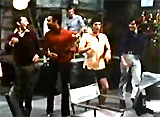 Dancing to "Heat Wave" 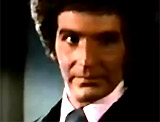 Harold (Leonard Frey) 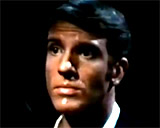 Alan McCarthy (Peter White) |
|||||||||||||||||||||||||||||||||||||||||||||
|
Catch-22 (1970) Direction Mike Nichols' anti-war comedy, an adaptation of Joseph Heller's anti-establishment 1961 first novel, was an autobiographical novel about a bomber squadron and its pilots in WW-II Italy on a Mediterranean island:
The film was daring in many aspects, none the least for its on-screen nudity (a major thing in the early 70s).
|
 Nurse Duckett (Paula Prentiss) 
Luciana (Olimpia Carlisi) |
|||||||||||||||||||||||||||||||||||||||||||||
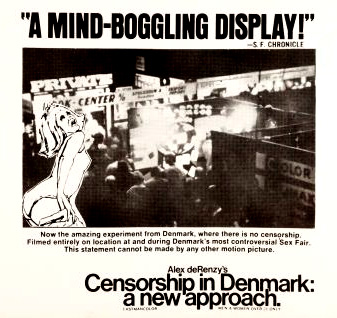
A wave of imported X-rated 'pornography' films were beginning to invade the US from Europe in the late 1960s, heralded by the arrival of I Am Curious (Yellow) (1967, Swe.) after the Supreme Court ruled in 1969 that the film's depiction of sexual intercourse was not obscene. It became one of the first films to show hard-core sex in American cinemas. Censorship in Denmark: A New Approach (1970) was a full-length (90 minute), exploitational X-rated feature film from San Francisco's hardcore pioneer producer/director Alex de Renzy (in his directorial debut) was the first successful mainstream film widely distributed with pornography in it and shown in a commercial theatre. Along with other films, it was one of the first widely-released films to show non-simulated hard-core sex on the American screen. And it was the first film with hard-core sex to be reviewed by critic Vincent Canby of The New York Times.
A skin-flick producer, de Renzy joined many others on a trek to Copenhagen, Denmark to attend a sex trade show exhibition known as SEX '69. During his sojourn, he brought along his camera. Theatres in New York, San Francisco, and Los Angeles projected the film. A 90-minute version screened in San Francisco at de Renzy's own Screening Room theater and at a larger venue in the Marina district was busted, but the theatre wasn't closed. The film was more directly prosecuted when it played in a local New Jersey venue, where theatre managers were arrested and prints were confiscated. Although it ran into trouble, it also made $800,000. De Renzy's film was vaguely disguised or masqueraded as a serious or educational 'documentary' look (with redeeming social importance and value) at how Denmark became the first country to legalize hard-core pornography in 1969. De Renzy made the wry comment: "Those who expected Denmark to become a country of rapists were pleasantly disappointed." De Renzy served as the film's main man-on-the-street interviewer during the travelogue, who spoke to a handful of interviewees, including an un-self-conscious 18 year-old adult-magazine porn model named Toni (as Herself). He also visited an international trade show or porn expo titled Sex '69, other porn cinemas, sex clubs and adult shops (including a live lesbian nightclub sex show titled "Olga and Her Sex Circus"), the set of a Danish hard-core film, and the home of a couple in the sex-film business. The narrator's comments were almost humorous: "Making a pornographic film can raise a sharp appetite! Here the staff and the film stars interrupt the film’s work to have open-faced sandwiches and coffee!" However, he noted about the porn films: "Emotional relationships between the characters are nonexistent." Some of the film's most explicit and forbidden hard-core content came from de Renzy's filming of sex sequences straight from a screening, as a way to argue that the sex scenes were objectified, documented accounts of the way sex was being regarded in Denmark. |
|||||||||||||||||||||||||||||||||||||||||||||||
|
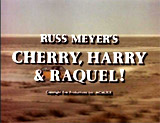
(Russ Meyer's) Cherry, Harry & Raquel! (1970) This Russ Meyer classic exploitation film was his last independent movie before 20th Century Fox lured him to Hollywood, to make his next film, Beyond the Valley of the Dolls (1970). The trailer described its exciting premise, with "hot cars, blazing guns and beautiful women." And although the film's poster advertised a "menage-a-trois" - the film didn't include one. Although its theatrical premiere was in late 1969 in Atlanta, Georgia, its widespread release was in mid-1970. According to many sources, much of the original footage of the film was ruined in a photolab, so additional footage was shot to fill in the gaps in the film - the padding consisted of naked females frolicking in the desert. It was another bosomania action tale of sex-crazed individuals in an Arizona-Mexico border town, featuring drug-dealing and pot smuggling, shoot-outs, and car-crashes. The film's narrator - with a long opening text scrawl (over views of nudes dancing on a bed) about the First Amendment, and a speech about the evils of marijuana ("that mind-bending narcotic") - while the film's big-breasted actress Uschi Digard was lounging in an orange bikini on a yacht. The two main male characters who were both involved in illegal drug operations, included:
They had problems with their drug "associate" Apache (John Milo) who was siphoning off profits and going into business for himself. In their many attempts throughout the film to eliminate and kill Apache, they failed and ultimately Apache murdered Mr. Franklin. It was also noted, typical for a Meyer fantasy erotic film, for featuring an asynchronized 'love triangle' between Harry, Cherry, and Raquel, including lesbianism (a central sex sequence between Cherry and Raquel in the film's conclusion). The female characters were:
Harry had clothed sex with Raquel in an abandoned car, and then after calling in that he was sick, he visited with his next sex partner - Cherry - as he promised to make love to her twice a day to make her happy. In the desert with her, he playfully buried her nude in the sand, and then sculpted out or uncovered her breasts and torso before having sex. He described how he had sex for the first time when he was 14 as a grocery-delivery boy. While Enrique was having sex with Raquel, Harry interrupted them. After Enrique agreed to leave and pursue 'Apache,' Harry replaced him and made love to Raquel. Later, when Raquel went to the hospital to 'service' Mr. Franklin (where he was having his annual check-up), she found him dead in bed with his throat slashed. Inexplicably, out of the blue, there was a view of Harry running naked and hand-in-hand with Raquel in the desert. Statuesque and well-endowed Uschi Digard (aka Astrid Lillimoor) also starred as the German-speaking Native American ghost Soul, who intermittently posed nude in short snippets - gyrating in a bedroom, or in a swimming pool with a tennis racket, and against various desert locations and rock formations (often phallic-shaped), sometimes with an Apache feather headdress.
The film's feverish climax intermingled and juxtaposed violence during a bloody shoot-out (between Apache and Harry) - ending with their bloodied bodies on top of each other, with the Sapphic dance and sexual interactions between nurse Cherry and Raquel in a hospital bed after they smoked a joint together.
The film ended with a sharply-edited montage of dozens of quick images of previous scenes. In the film's twist epilogue, it was revealed that the plot had come from the creative mind of Raquel - a housewife at her typewriter who was married to a very-conservative Harry. He asked Raquel's collegiate-looking brother Tom (Robert Aiken): ("Did you ever read any of this anti-social dribble your sister writes?"). One of the last title credits cards stated: "A WILD SOUL INHABITS THIS PLACE...INSPIRING ALL MANNER OF BIZARRE AND ABANDONED EXCESS..." |
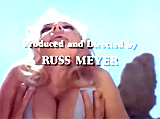 Raquel (Larissa Ely) Beneath Opening Credits  Clothed Sex: Harry and Raquel in a Car 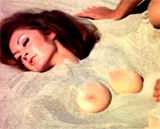    Sand-Burying: Harry with Cherry (Linda Ashton)  Millie (Michelle Grand)   Raquel with Enrique  Raquel Finding Mr. Franklin Dead in Hospital  Raquel in the Desert Running Hand-in-Hand with Harry (Charles Napier) |
|||||||||||||||||||||||||||||||||||||||||||||
|
The Christine Jorgensen Story (1970) Veteran Hollywood director Irving Rapper's campy biopic released by United Artists, was adapted for the screen from a best-selling, late 60s autobiographical account. It was Hollywood's first attempt at exploring transgender issues - yet the dated and fictionalized film (although respectful) contained howlingly bad acting, dialogue, and writing. The poster proclaimed - "I couldn't live in a man's body!" and "Did the surgeon's knife make me a woman or a freak?" The overwrought and melodramatic film told about an effeminate, introverted young boy who enjoyed dolls and "sissy" things, George Jorgensen Jr. (John Hansen). After growing up and serving as a GI, he worked as an ad agency's professional photographer, where he was nearly raped by his predatory gay boss Jess Warner (Rod McCary). After researching gender issues and sex disorders in a New York library, and speaking to sex researcher Professor Estabrook (Will Kuluva), George realized that he had a hormonal imbalance. He arranged for a radical, new surgical procedure with Dr. Victor Dahlman (Oscar Beregi) in a Denmark clinic (his homeland) in the early 1950s. George became blonde beauty Christine Jorgensen, one of the earliest surgically-altered transsexuals ("The First Man to Become a Woman" the film falsely implied) with sex reassignment surgery. In one post-surgical shot, there was a view of Christine's hormonely-enhanced, developing breasts. A reporter named Tom Crawford that became Christine's love interest was invented for the movie. |
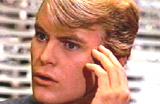 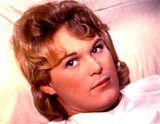 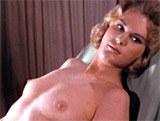 George/Christine Jorgensen, Jr. (John Hansen) |
|||||||||||||||||||||||||||||||||||||||||||||
|
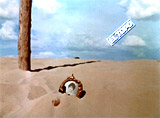
El Topo (1970, Mex.) Director/star Alejandro Jodorowsky's self-conscious, surrealistic, often incoherent and incomprehensible, unique and avant-garde El Topo (translated "the Mole"), a gory (and spiritual) "spaghetti" western and first 'midnight movie' cult film, told the story of the existential quest of a black-clad, violent gunfighting title character (the director himself). The film opened with El Topo riding in the Mexican desert with his naked son (Brontis Jodorowsky) on the saddle in front of him. He had his son bury past artifacts - his mother's picture and his favorite childhood stuffed animal, in order to become a man and take his father's place. In the startling opening sequence, they found the bloody remains of a town massacre where animals were gutted and people were decimated, leaving a river of blood. When threatened by three crazed evil-doer bandits, El Topo quickly dispatched with them, and then sought further vengeance in a mission town against the fat, balding (with a toupee), pasty-faced but vicious and sadistic Colonel (David Silva) and his outlaw gang. After executing the Colonel's gang members and castrating the Colonel (who then committed suicide), El Topo rescued the man's terrorized concubine-slave (Mara Lorenzio) and rode off with her, while leaving his naked son in the care of monks. The freed slave, later named Marah (meaning "bitter water") accompanied him on his journey into the desert. Their trip included a notable rape scene between El Topo and Marah in which he tore off her clothes and forced himself upon her. He sexually imparted to her the ability to find eggs in the sand and bring water from a rock. In a symbolic scene, she touched a phallic-shaped rock that ejaculated forth life-giving water - and then hugged it. She convinced him that for her to best love him, he had to prove himself by journeying onward to defeat and kill the "four great gun masters" who lived in the desert. After killing the first master (a holy man) through a bit of cheating, El Topo and Marah were joined by another 'Woman in Black' named Desconocida (Paula Romo), a whip-cracking bi-sexual gunslinger (speaking in a man's voice) at an oasis, possibly signifying El Topo's feminine side.
The two women bathed naked together, and El Topo made love to Marah while buried in the sand, and afterwards shot the mirror that she was often viewing herself in. [Note: The self-important director later dubiously claimed - for publicity's sake - that the sex scenes were deliberately real.] In the other three duels with masters, El Topo defeated each of them with more mystical trickery - and luck. After killing the third master (a rabbit man), he rubbed blood onto Marah's breasts to signify his victory. But with the demise of all four adversaries and after acquiring their wisdom, he believed he was contaminated:
He was betrayed by the 'Woman in Black' Desconocida when she wounded him - shooting him four times through both his hands and feet (a crucifixion-passion-stigmata symbol). Marah also chose to shoot El Topo in the side to finish him off, and he was left for dead, while the two women became lovers and rode off together. In this second part of the film, El Topo's comatose body was found by a group of small-statured deformed cripples, and taken into their subterranean home inside a mountain, where they slept in stacked barrels and were led by an old woman. After he awoke from a long sleep, he realized they were a strange and "repulsive" outcast colony of mis-shapen underground people (due to "continuous incest"), who were worshipping him as a god and savior, believing he would free them from their imprisoned state. He took one of the "small" women (Jacqueline Luis) as his lover, and as an act of atonement, promised to free the exiled cave-dwellers by helping them dig an escape tunnel out of the cave. Depraved and weird religious cultists from the neighboring western town were led by outlaws and sex-starved and degenerate matriarchal women. The female leaders were hypocritical members of the Decent Women League who demanded sex from slaves and then had them executed for rape. They brutalized and enslaved white-clad townsfolk. They branded them like cattle with a symbol - an eye within a triangle. El Topo appeared to have found enlightenment and holy "sainthood" and was born again - he shaved his head and dressed in peasant or Buddhist monk garb, and became a pacifist servant-beggar. He provided street entertainment and performed menial tasks to earn money from the villagers. He discovered that his son was now grown-up (Robert John) and had become a religious figure in the village, but was disillusioned by the cultists and began to dress in his father's black-clad gunfighter outfit. In the frontier town, worshippers played Russian roulette with a gun as a means to produce "miracles" until a young boy was killed. When the underground people exited the tunnel into sunlight and entered the town, they were slaughtered by the cultists. Invincible to their gunblasts, El Topo approached the killers to retaliate, grabbed a rifle, and in a flurry of gunfire shot all of the clan members, and then immolated himself in the dusty street. Survivors of the bloodbath massacre included El Topo's grown son and his dwarf girlfriend (and a child born to her at the same time as El Topo's death). They constructed a swarming beehive grave for El Topo's remains. The film ended as El Topo's son, the child, and the dwarf female rode off on the horse into the desert, mirroring the scenes in the film's opening. In other sex-related scenes, a fringe-jacketed bandit laid on top of a rock sculpture of a naked woman that he had just drawn, the 'Woman in Black' suggestively stroked and then licked a piece of sliced-open green cactus fruit before grabbing Marah for an unwanted lesbian kiss, and after seriously wounding El Topo, the two traitorous women again kissed and made love.
In the film's most bizarre and decadent scene, El Topo and his dwarf lover were taken to the village's saloon where in a trap-doored underground sex cantina, they were forced to strip and re-enact their wedding night in front of a group of voyeuristic degenerates.
|
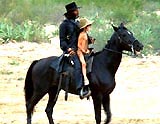 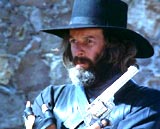 El Topo (Alejandro Jodorowsky) 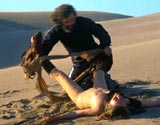 El Topo's Rape of Marah (Mara Lorenzio) in Desert 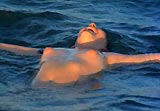 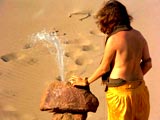 Water Brought Forth From Rock   El Topo's Love-Making To Marah in Sand   El Topo Wiping Blood of 3rd Defeated Master Onto Marah's Breasts 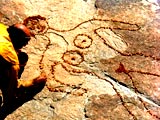 Rock Sculpture of Naked Woman 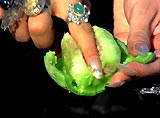 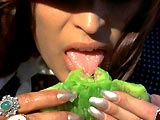 "Woman in Black" Desconocida Suggestively Ate Opened Cactus Fruit |
|||||||||||||||||||||||||||||||||||||||||||||
|
Electrosex 1975 (1970) Mike Henderson's hard-core, one hour-long, crude black and white adult feature was the first pornographic film to be advertised in New York's newspapers. The film began with Paul (Mike Henderson), a slightly balding middle-aged man, in his apartment where he was joined by his male friend Jim (male porn star Tommy Toole). Paul bragged about creating the perfect woman - in fact, three female sex robots. In the opening scene, the three were marched into the living room, all completely naked, perfectly shaped (and with tan-lines):
Then, an all-out orgy basically commenced. Immediately, two of the three women began making love to each other, and were soon in a '69' position. The third robot Delta was taken into an adjoining bedroom by Jim, where they began to have sex on the bed. Meanwhile back in the living room, Paul joined the two females. Eventually, everyone drifted back into the living room, where there was a brief session of S & M (whipping). Sex between the threesome (and with the two men) resumed, with explicit shots of ejaculation, intercourse, and oral sex for both sexes. When Jim complained that he was becoming sex-exhausted ("I don't know how much more of this I can take. I feel like my balls are gonna drop off"), Paul ordered his sex robots: "OK. Stop. All right, goddamn it. Stop! Deprogram. Stop!" One of the robots replied: "No, we won't stop! You made us like sex. You made us that way." Jim begged some more: "You gotta make 'em stop. I don't know how much more of this I can take." There was a failed attempt to manually stop one of the robots by touching the On/Off button behind its ear. The robot retorted: "You cannot stop us. You will never be able to keep us from loving. We will f--k you always!" The film abruptly ended with Jim's male member being chewed up due to over-manipulation and stimulation, and Paul appeared to bloodily die of the same fate (was his penis bitten off?). |
 The Three Sex Robots  Alpha and Gamma With Paul  Jim with Delta 
|
|||||||||||||||||||||||||||||||||||||||||||||
|
He & She (1970) Director Matt Cimber's adult film from New World Productions was another of this time period's sex documentaries. It was noted as the first hard-core porn film to get national distribution. The sex film introduced a fake doctor and a "sex research institute." It began with a long scrolling preface from the producers, partly excerpted here, that meant to describe how the film would "open new avenues of learning":
In the film (while a sex education professional narrated), an attractive young married couple were seen in various locales, including a circular bed and a shower. The narrator described different techniques of sexual stimulation, in a fairly clinical way, while the camera focused on the couple's nude bodies. Intercut were various montages of the couple strolling on a street's sidewalk or running through a field.
The two were mostly demonstrating the art of lovemaking (seen in explicit close-up) and foreplay (with sensitive kissing and touching, rubbing and massaging, mutual masturbation, and oral sex), and eventually engaged in actual intercourse. Their final orgasmic moments (as the film ended) were accompanied by lots of traditional symbols, including surging ocean waves, flames, a phallic-shaped rocket blasting off, and bursts of fireworks. |
|
|||||||||||||||||||||||||||||||||||||||||||||
|
A History of the Blue Movie (1970) Director Alex de Renzy's follow-up film to Pornography in Denmark (1970) (see below) was the quasi-historical two hour and twenty minute A History of the Blue Movie (1970). The porn film was designed to include copious amounts of sex and nudity while circumventing obscenity laws. It was an evolutionary survey of pornography with rare vintage erotica from the silent era ("blue movies" or stag films), to peep shows (and burlesque), and then the modern day sex industry (with self-serving footage of de Renzy's own blue films). The historical overview included scenes from films dating from 1915 to 1970:
Toward the end of the film, nude interviewee (uncredited Bonnie Holiday) offered explicit advice about love-making (and then played with her genitals in a fairly explicit close-up). She ended with a statement about sex: "It really turns me on." The film concluded with a Berkeley, California hippie couple artistically filmed making love (fully naked) during an audition in a movie theatre's screening room. |
  A Free Ride (1915)  On the Beach (1920)  Ever Ready (1928/29)  Creeping Tom   Candy Barr in Smart Alec (1951) |
|||||||||||||||||||||||||||||||||||||||||||||
|
M*A*S*H (1970) This macabre, black-humored, anti-war comedy by director Robert Altman (originally rated X, but reduced to an R rating) was one of the first films to use the F-word (in the football game scene, in which "Painless" (John Schuck) said: "All right, Bub, your f--kin' head is coming right off"), and among the first to feature brief full nudity. A prank was planned by the members of a free-wheeling camp on uptight chief nurse Major Margaret "Hot Lips" Houlihan (Sally Kellerman). It was part of a $20 bet to discover whether she was a natural blonde or not ("I'll bet she's not a real blonde"). They pulled away the front tent flap of her shower stall and exposed her to an audience of jeering spectators ("What a performance!"). She hurried to bitterly complain to the commanding Col. Blake: "This isn't a hospital. It's an insane asylum. And it's your fault because you don't do anything to discourage them." Earlier, they had broadcast her love-making tryst on loudspeakers with hypocritical tee-totaler Major 'Frank' Burns (Robert Duvall), when she deservedly earned the nickname "Hot Lips":
As he hungrily was atop her and undressing and they began making love (in the dark), she cried out:
|
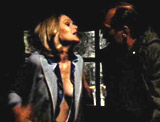 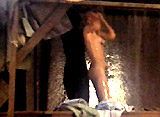 "Hot Lips" Houlihan (Sally Kellerman) |
|||||||||||||||||||||||||||||||||||||||||||||
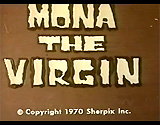 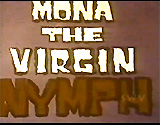 |
Porn pioneer Bill Osco's film was remarkable as the first, theatrically-released, feature-length 35mm 100% hardcore narrative film with an actual storyline -- actually a threadbare plot (accompanied by explicit sex scenes) that created the pattern for future porn films of the 70s. However, there was competition for attaining the landmark milestone with Andy Warhol's Blue Movie (1969). This film's storyline (the predominant act of fellatio) was borrowed, to some degree, by Gerard Damiano's Deep Throat (1972) - which was NOT the first theatrically-released porno. This 'porno chic' movie was screened without cast or production credits (to avoid legal problems). It was shot in three days on a budget of about $5,000. Remarkably, it played in major US cities (San Francisco and New York) and was not banned or shut down. The prurient film opened with the title character - Mona (Fifi Watson), an engaged girl, in the great outdoors during a picnic with her fiancee Jim (Orrin North). After they both stripped down and began to make love to each other, she halted him by claiming that she had promised her nefarious widowed mother (Judy Angel) that she wouldn't have intercourse until marriage. She vowed that she would be a virgin on her wedding day - meaning no explicit penile-vaginal penetration (except that everything else, including oral sex, was permissible). She joyfully performed fellatio on Jim on their blanket. She told him: "Here, let me do that other thing to ya. I know, it always makes you feel so good." At the moment she began administering sex, there was a second title screen with a blast from an organ - adding the word "NYMPH" to the first title screen shown earlier ("MONA THE VIRGIN"). She was indeed a 'nympho virgin.' Shortly later, it was revealed that Mona had been initiated into oral sex by her father (his strange intention was to preserve her virginity for her future husband). Mona came up to a young male stranger on a street corner and blatantly asked: "Do you want me to suck your cock? I'm good, really good." He was skeptical until she led him to a side alley and pleasured him: "You just relax, let your Mona do the work." She boasted to the complete stranger: "I think you'll enjoy it...I think I'm going to enjoy this too...I just love sucking cock." Afterwards, Mona also had cunnilingus performed on her (and engaged in 69) with a blonde prostitute (Susan Stewart). The insatiable Mona then touched herself in a movie theatre before providing more oral sex to a nearby male patron (Gerard Broulard) in an aisle seat: ("You get two treats for the price of one this evening"). At the same time, Mona's self-pleasuring, garter-belted, bespectacled mother (who liked to read dirty novels while touching herself and using a sex toy vibrator) was interrupted by her future son-in-law Jim who arrived and was looking for Mona. After telling him she hadn't had sex for three years, she offered to have passionate sex with him by hinting: "You remind me so much of Mona's father! Just like I had my own young man back again when I was a girl." When Jim found out about Mona's other oral-sex partners, he tied Mona down on a bed, and he called on all of her previous partners to surround her and engage in a very excessive, up-close-and-personal oral sex-party. The film ended with mother and daughter confessing to their full-on sexual indiscretions. |
  Mona (Fifi Watson) with Fiancee Jim  Mona's Mother (Judy Angel)  Concluding Oral Sex-Party |
|||||||||||||||||||||||||||||||||||||||||||||

|
The Music Lovers (1970, UK) Ken Russell's fourth feature film was the bizarre and excessive musical biography of the life of 19th century Russian piano teacher/composer Peter Ilych Tchaikovsky - a homosexual (portrayed by a sexually-conflicted Hollywood actor, Richard Chamberlain, who came out of the closet in 2003). Other Russell music-themed films included: The Boy Friend (1971), Mahler (1974), Tommy (1974) and Lisztomania (1975). In the opening sequence of this surrealistic fever-dream of a movie with numerous musical montages, Russell introduced all of the main characters (in the composer's present and future). Drunken homosexual Tchaikovsky (Richard Chamberlain) and his lover Count Anton Chiluvsky (Christopher Gable) joyously raced up and down an icy toboggan slide run during a Moscow winter carnival, to the accompaniment of "Dance of the Clowns" from The Nutcracker Suite. Afterwards, the two inebriated men jumped into bed together. Nearby, where Russian soldiers paraded on horseback, young conservatory music student Antonina Milyukova (aka Nina) (Glenda Jackson) (Tchaikovsky's future sex-crazed wife) watched and became infatuated (with a manufactured wild fantasy in her head) with one of the mounted lieutenants (Ben Aris), whom she later invited to her place where she was sexually ravaged. In the next sequence, many of the characters then reassembled at the Moscow Conservatory, where Tchaikovsky debuted his Piano Concerto No.1 in B-flat Minor, including many of Tchaikovsky's "loves" - his music, and other characters including Tchaikovsky's semi-incestuous sister Sasha (Sabina Maydelle) and his widowed, wealthy art patron/benefactress Madame Nadedja von Meck (Izabella Telezynska). The main focus of the biopic was Tchaikovsky's struggle with his own repressed sexuality. The self-denying musician chose to engage in a disastrous marriage of conformity and convenience to admirer Nina - to counteract and deflect damaging rumors. He impulsively married her after receiving a crazed love letter in which she threatened to kill herself: ("You were frank with me and I owe you a similar frankness. My first kiss will be yours and no one else's. I can't go on without you so it maybe that I'll soon put an end to my life. Let me look at you at least once and kiss you, so that I may take that kiss with me into the other world"). Director Russell also engaged in fantastic imagery, including a traumatic flashback scene as a young boy, triggered when Tchaikovsky confused a bathing female with his mother Martha (Consuela Chapman), who succumbed in a scalding hot bathtub from cholera. And in his first meeting with Nina, Tchaikovsky envisioned her as his sister. His homosexual lover Count Anton suggestively stroked a phallic-shaped bottleneck, and later cautioned against the marriage: "Not all women are satisfied with spiritual relationships." In one of the most controversial sequences, their overnight train journey to Moscow of unrequited love, honeymooning Nina exhibited her alcohol-fueled, voracious (nymphomaniacal) sex drive by kissing him and stripping off her many layers of clothes. At one point, she lifted up her red garment three times to have him look at her genitals. The newly-wed couple were encased in a cramped sleeping compartment, and as the car violently heaved back and forth, the drunken, nude, and semi-unconscious Nina rolled and flailed around on the carpeted floor. The repulsed composer reacted with bug-eyed horror to her full-frontal nakedness.
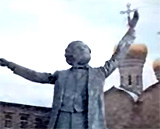
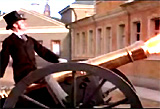
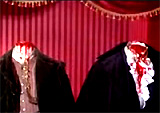
In the impressionistic "1812 Overture" fantasy sequence, Tchaikovsky had fled from his family and friends, and was mobbed by admirers led by his brother Modeste (Kenneth Colley), who was envisioned as an impresario. As colored streamers descended and he was draped in garlands of flowers, Tchaikovsky was carried forward in a parade, where he conducted before crowds and was ultimately transformed into a bronze statue. Modeste blasted a phallic-shaped cannon and blew the heads off various enemies ("music lovers") his brother wished to escape - except for Nina.
In the final sequence, Nina's ultimate fate was neglect, promiscuity, and commitment within a mental asylum. There with shorn hair, she bragged to her mother:
Nina allowed herself to be abused and fondled by other lunatic male patients, as she sat over an open grating. Her mother was aghast: "Oh, no, no. Don't! Nina! Oh, no! Poor baby." The film ended with Nina's imprisonment in a strait-jacket while locked in a room with bars, while Tchaikovsky suffered a painful, delirious death from cholera like his mother (he was also submerged in a bath of scalding water against his will) - a self-inflicted disease, the result of drinking infected water. |
 Tchaikovsky and Count Anton  Stroking a Phallic-Shaped Bottleneck  Tchaikovsky and Sasha    Nina   Death of Tchaikovsky's Mother  Corset-Removal and Horrifying View of Nina's Genitals  Nina Being Pleasured in Mental Asylum  Tchaikovsky's Death From Cholera |
|||||||||||||||||||||||||||||||||||||||||||||

|
(Gore Vidal's) Myra Breckinridge (1970) 20th Century Fox's film was one of the biggest bombs ever made. Originally rated X, it was the cinematic adaptation of Gore Vidal's 1968 notorious story about a man-hating trans-sexual Myron (Rex Reed), then re-named Myra Breckinridge (Raquel Welch) in Hollywood. It included the infamous scene of a sham physical exam (and dildo rape!) conducted by star-spangled pattern-wearing Myra on hapless de-pantsed patient and young Hollywood acting student Rusty Godowsky (Roger Herren) - she told her subject as she put on a large strap-on dildo:
The outrageous scene was complete with intercut shots of various stars (Gary Cooper, Marilyn Monroe - in her famous pin-up pose, Clark Gable, etc.), bucking broncho-riding, the assault of a fortress with a large wooden battering ram, clips from a Laurel and Hardy film, a shot of the Hoover Dam collapsing, an image of Myra on a flowery swing spouting: "Hooray for Mickey Mouse and Donald Duck. Uncle Sam, here I come," the cresting over the top of a roller-coaster, the tune "Love is a Many Splendored Thing", and an H-bomb explosion. The story also featured an aging 77 year-old Mae West (caricaturing herself) as sex-craving talent agent Letitia Van Allen with many one-liners: (i.e., "Well, the end of another busy day. I can't wait till I get back to bed. If that don't work, I'll try to sleep"). Other preposterous scenes included:
|
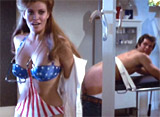 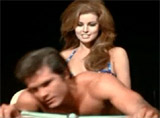 Myra (Raquel Welch) with Rusty 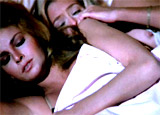 Myra with Mary Ann (Farrah Fawcett) 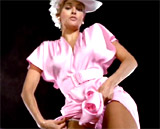 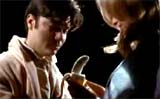 Myra with Myron |
|||||||||||||||||||||||||||||||||||||||||||||
|
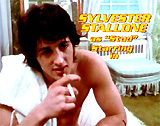
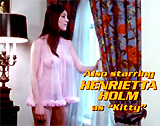
Party at Kitty and Stud's (1970) (aka Italian Stallion) To break into the film-making world, many well-known actors and actresses first starred in marginal films, such as this one, originally an 8 mm porn-stag flick. 23 year-old Sylvester Stallone was featured in this low-grade, crude film (originally rated X, but drastically edited for its retitled re-release on 35 mm) in his first acting role as Stud, for which he was paid $100/day for two days' work.
He followed this role with a bit part in Woody Allen's Bananas (1971) and a half-dozen more films before his breakthrough with Rocky (1976). Then, this little-known film came to light and was renamed and re-released (heavily-edited without the hard-core penetrative sequences) with a more provocative title in reference to his nicknamed role in the boxing film, The Italian Stallion.
This adult film displayed two bathing scenes (shower and bath) between Stud and Kitty (Henrietta Holm), bestiality, fellatio, lesbianism, semi-light S&M (belt-whipping), and a prolonged orgy scene on the psychedelic-carpeted floor of the couple's Manhattan apartment. |
  Girl in Park (Janet Banzet)    Kitty (Henrietta Holm) |
|||||||||||||||||||||||||||||||||||||||||||||
|
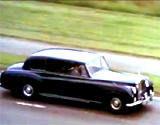
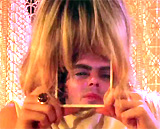
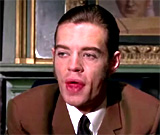
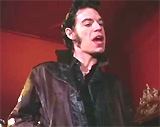
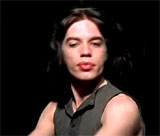
Performance (1970, UK) Directors Donald Cammell's and Nicolas Roeg's (his directorial debut film) controversial (originally X-rated), dark, psychedelic and violent avant-garde psychological melodrama was about dualities and the blurring (or merging) of sexual identities; it featured multiple examples of experimental and innovative film-making (fast and jarring jump cuts, shifts in POV, forward and backward flashbacks, elliptical editing, visual tinting effects, montages, etc.); it was a wild and drug-filled psychedelic, originally an X-rated cult film kept out of circulation for two years after production until edited down. The non-linear gender-bending cult film was criticized as sleazy and worthless for its homoerotic violence, explicit sex and nudity when first released. Director Nicolas Roeg went on to make a series of legendary films, such as Walkabout (1971), Don't Look Now (1973), and The Man Who Fell to Earth (1976). The tagline of the weird and peculiar film referred to its emphasis on identity and sexual fluidity: "Mick Jagger. And Mick Jagger. James Fox. And James Fox. See them all in a film about fantasy. And reality. Vice. And Versa." It shared similar themes with Ingmar Bergman's Persona (1966, Swe.). The opening disjointed and disorienting title credits sequence included views of a screeching Lockheed fighter jet in the air, a black Rolls Royce driving down a country highway, and two naked heterosexual bodies making love:
Chas Devlin was a macho, brutal, hot-tempered and sadistic East London gangster hit-man or thug, working under London crime kingpin, mobster boss and gay racketeer Harry Flowers (Johnny Shannon). His job was to aggressively beat and threaten potential "protection" customers. Early on, there was a particularly disturbing scene of a rival gangster's chauffeur being thoroughly humiliated by having his head shaved after strong acid was poured all over his expensive Rolls Royce automobile, while he was handcuffed to it. Flowers also compelled Chas to acquire a betting shop owned by independent, licensed betting bookie Joey Maddoxs (Anthony Valentine), once a close friend to Chas.
Despite his boss' wishes, Chas disobeyed and intervened inappropriately to persuade Joey - and soon after found himself assaulted in his apartment by Joey and a thug that had vandalized his place with blood-red paint; as Chas was violently beaten up and then tortured and whipped with a belt on his bare buttocks (as he recalled love-making with Dana from earlier), he suddenly turned the tables on his punishers; he grabbed a gun in self-defense, threatened Joey with the words: "I am a bullet" - and then shot him to death, as he cowered behind a bed-sheet. Afterwards, the second thug was released, who then ran off to inform Flowers about the murder; fearing being charged with conspiracy to murder, Flowers ordered Chas to be eliminated; Chas was forced to adopt a disguise, go into hiding and to keep a low profile. He dyed his hair red, wore sunglasses, and prepared to flee London by train to Devon from Paddington Station. While waiting for his train, Chas overheard a guitar-carrying black musician named Noel (Ian McShane) talk about his basement room at 81 Powis Square being sublet by his landlord during his upcoming six-week musical tour; Chas listened as the musician described his drug-addicted landlord: "He's peculiar. He's a hermit. He can't face reality. That's what it is. A world of their own, these kids. Powis Square, Notting Hill Gate." Chas pretended to be a professional juggler in the entertainment business, named Johnny Dean, who was a friend of the musician. He inquired to rent the recently-vacated basement room from the reclusive, androgynous, washed-up, former hippie rock/pop-star named Turner (the film's main star - Rolling Stones' singer Mick Jagger (in his first feature film)).
However, he first met Pherber (Anita Pallenberg, at the time of filming, the girlfriend of Jagger's band-mate Keith Richards), Turner's poly-amorous blonde junkie lover-girlfriend and secretary, who told him: "I didn't recognize your voice." In the film's most erotic scene, acting on Turner's behalf, she laid down on a bed while talking to London hit-man gangster Chas to negotiate the terms of rent; she stroked/fondled her fur coat covering her otherwise naked crotch. In the next sequence, she entered the bedroom of Turner where he was sleeping naked next to an equally-naked Lucy in a large canopy bed - she filmed them with her movie camera, touching and posing them; the sequence was filmed in extreme close-up as a jumble of body parts; then, she stripped down and began making love to both of them. Turner was living a bohemian hermit's existence in a luxurious but decaying London (Notting Hill Gate) mansion with lots of drugs and his two beautiful groupie, free-love love-mates: Pherber and Lucy (16 year-old Michèle Breton), Pherber's small-breasted, young, androgynous French girl lover; one of the film's most publicized scenes was the shared menage-a-trois bath scene amongst them - Pherber, Lucy, and Turner.
Chas phoned his friend Tony Farrell (Ken Colley) and knowing he was in danger, expressed an interest in getting out of the country; he had stashed away some money, but needed to get a fake passport in order to leave England and evade his pursuers; he then described where he had acquired a room to rent: "What a freak show!...I tell you, it's a right piss-hole. Longhair, beatniks, druggers, free-love, foreigners - you name it! But I'm not bothered, Tone. I'm well in. And you couldn't find a better hidey-hole." While Chas was on the phone, elsewhere in the house, Pherber injected her bare bottom with what she claimed was Vitamin B-12 (although it was probably heroin) ("Too much vitamin B12 has never hurt anybody"). In the film's central dynamic, Chas met with Turner who wanted to do away with the contemptuous Chas, and give him back his advanced rent payment, but Chas begged for his room: "I need a bohemian atmosphere. I'm an artist, Mr. Turner. Like yourself"; Turner mocked Chas' profession as a juggler: "I can tell by your vibrations you're the anti-gravity man! Amateur night at the Apollo. Cheops in his bloody pyramid"; a close-up image of an upright nipple provided a brief visual pun; Turner kept pressing: "You'll have to go. You wouldn't like it here...You wouldn't fit in here," but Chas insisted: "I've got to fit in, Mr. Turner"; Turner reconsidered on a day-to-day basis. Pherber was harvesting hallucinogenic mushrooms in the backyard's greenhouse, while Chas decided to remove the red hair dye with a solution, causing the reddish dye to cover his face in blood-like liquid. Chas decided to remove his red hair dye with a solution, causing the reddish dye to cover his face in blood-like liquid; on a second call with his friend Tony, he learned that he had arranged for Chas to board a freighter ticket to NYC that week, with a passport and other payments for 900 quid; Chas only needed to acquire a Polaroid camera to take a small B/W photo for the passport. Chas described his new hair-look without red dye to change his image; as he spoke about how he was a "performer" who was undergoing change for his agent ("It's time for a change"), his face morphed into Turner's face. Pherber and Turner were both mushroom and drug users, and Pherber was harvesting hallucinogenic mushrooms in the backyard's greenhouse, to trick Chas and learn more about him through drugs and mind games, Pherber fed Chas one of her psychedelic mushrooms mixed into a salad; he first reacted by noticing: "What's wrong with the lights?" and began to trip out; Pherber had bandaged his bruised back (from the beating), and he claimed he was feeling "pretty sharp"; Pherber told him she had fed him some mushrooms, and he reacted: "You poisoned me!"; she claimed it was "Just to speed things up...We just dismantled you a little bit, that's all." Then in a scene of the exchange of the personas of Chas and Turner after presuming that Chas was a hit-man trying to flee, Turner came to believe that Chas' violent energy as a "performer" might inspire him and break him out of his own 10 year creative slump in which he had "lost his demon"; aging pop star Turner changed into the outfit of a slick-haired, mobster as he stated: "The only performance that makes it, that really makes it... that makes it all the way, is the one that achieves madness...Nothing is true. Everything is permitted." While Chas was under the influence, Pherber announced their intentions with him before he left them the next day: ("Time for your new image") - her objective was to shift his sexual identity and characteristics by costuming and the use of mirrors. Pherber changed and transformed Chas' sexual identity by cross-dressing him up in effeminate clothing (and an androgynous curly wig) to give him a "female feel"; she then asked after comparing his pectoral muscles to her breasts: "Do you like my physique?...I've got two angles. One male and one female. Just like a triangle, see? Did you notice?... Did you never have a female feel?"; as she asked the question, she mirror-reflected or super-imposed one of her breasts onto Chas' chest - causing Chas to lose his sense of manliness; he objected: "No, never! I feel like a man, a man all the time."
She replied while she reflected her face onto his: "That's awful. That's what's wrong with you, isn't it?...A man's man's world"; he claimed that he was "normal" and that nothing was wrong with him: ("There's nothing wrong with me. I'm normal"); she laughed, and then reflected his face onto hers: ("How do you think Turner feels like, huh?"), but he thought Turner was "weird" and that she was both "weird" and "kinky"; she asserted that Turner was "a man, male and female man - and he feels like me." Chas continued to negate and reject what she was saying about him having a female side; when she proposed making lesbian love with him, he reacted violently: "I said I'm not one of those....You're sick. You... You... You degenerate. You're perverted." Pherber explained to Chas how Turner wanted to reinvent himself - he had become "stuck" because he had "lost his demon," but after looking at himself in his favorite mirror, he saw more clearly that he was "just a beautiful, little, freaky, stripy beast, darling. So he thought maybe... Maybe it's time for a change, he thought"; but then as he watched, his image faded and "his demon had abandoned him...He's still trying to figure out whether he wants it back - He's gotta find it again. Right?" In the next pseudo-dream sequence - the film's most talked-about segment, Chas joined up with Turner in his recording studio (where Lucy was also dancing) and watched as Turner wielded a flourescent light tube, and then fantasized taking on the identity and persona of Chas' London gangland boss Harry Flowers (with slick-black hair and wearing a dapper gangster's business suit); he sang the raunchy song "Memo From Turner."
During the musical segment as Turner sang and impersonated Chas' boss in the darkened room, he was watched by his own subservient associates and thugs whom he ordered to strip naked as he performed; Turner sang to Chas’ criminal henchmen and partners; when the song ended, Chas' henchmen were seen dead on the floor; there had been a total and complete merging of the personas of Chas and Turner. Chas again spoke on the phone with Tony about plans to leave London the following evening with his faked passport; it was revealed that Tony was double-crossing his friend to acquire his location at 81 Powis Square, Notting Hill Gate - Flowers was in the room listening to the conversation. Chas (still wearing his wig and female costuming) and looking very identical to Turner, met up with Lucy who seduced him. While making love to Chas in the basement, she admitted that she was boyish - she had "small titties," was "a bit underdeveloped" and was "skinny like a little boy or something"; she bathed afterwards when he told her he had to leave. In the film's deadly conclusion, Chas realized he had been double-crossed by his friend Tony, who had tracked his whereabouts to Turner's place, when he was confronted by his fellow gangsters in the mansion's foyer; they told him: "We've got to get off, Chas. Harry's waiting for you"; his boss' parked limousine was awaiting him outside and the house was entirely surrounded (on the rooftop and garden). Chas went upstairs to tell Pherber and Turner in their bedroom that he was leaving; Turner expressed a desire to join him: (Chas: "I've got to be off now..." Turner: "I might come with you then" Chas: "You don't know where I'm going, pal" Turner: "I do. (pause) I don't know" Chas: "Yeah, you do"). Then, Chas took out his gun and shot Turner in the head, as Pherber screamed next to him in bed. There was a dramatic bullet's-eye zoom-in shot as the fatal bullet penetrated and tunneled into Turner's brain - the bullet shattered a photograph of Jorge Luis Borges and then emerged into the outside street; Turner psychologically morphed into Chas at that moment; Chas left a note for Pherber ("Gone to Persia - Chas"). Chas/Turner was escorted to walk (first seen from a rear view) toward his boss' parked limousine. He entered the back seat of a white Rolls Royce, where he was greeted by Flowers sitting next to him: "Hello, Chas"; as the car sped off, a zoom-in through the car window revealed that Chas (still dressed with a wig and feminine clothing) had been stunningly "transformed" into his doppelganger - Turner; but one must ask: who died - was it Turner, or was it Chas? |
 Chas' Girlfriend Dana (Ann Sidney)  Mobster Boss Harry Flowers (Johnny Shannon) 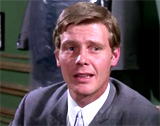 Gangster Hit-Man Chas Devlin (James Fox) Working for Flowers 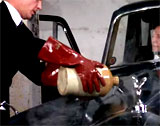 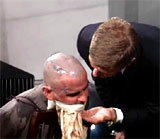 Acid Poured on Hood of Rolls Royce, and Chauffeur's Head Was Shaved 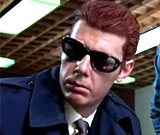 Chas' Disguise: Red Hair and Sun Glasses As He Fled From London 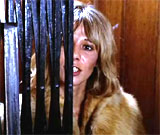 Pherber (Anita Pallenberg), Turner's Blonde Junkie Lover-Girlfriend, Meeting Chas ("I didn't recognize your voice") 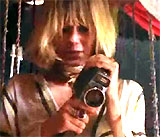 Pherber Filming Turner and Lucy Sleeping in Bed Together 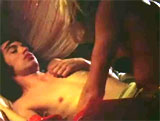 Threesome: Pherber Entered Turner's Bed  Pherber Injecting Herself With Vitamin B-12 (?) 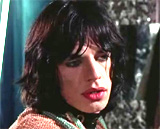 Androgynous Rock Star Turner (Mick Jagger)  An Abstract Image - A Visual Pun of an Upright Nipple: ("Cheops and his bloody pyramid") 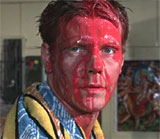 Chas Removing His Reddish Hair Dye  Pherber Eating a Psychedelic Mushroom  Superimposed Images of the Faces of Turner and Chas: "It's time for a change" 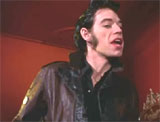 The Exchange of Personas - Turner Dressing as a Mobster Hit-Man: "The only performance that makes it..." 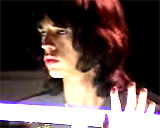 Turner In His Recording Studio Wielding a Flourescent Light Stick 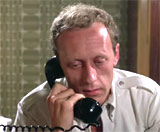 Chas' Friend Tony Double-Crossing Him    Lucy with Chas (Appearing Like Turner)  Surrounded and Knowing That He Was About to Be Executed, Chas Said Goodbye to Pherber and Turner in Bed  Chas Fired His Gun at Turner in Bed  Pherber Screamed at Chas' Murder of Turner 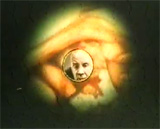 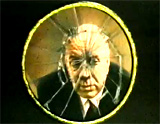 The Trajectory of the Bullet's Path In and Out of Turner's Brain  Chas Walking to Mob Boss Floers' Parked Car  Last View of Turner Bloodied in Closet  In Limousine Outside - Flowers to Chas: "Hello, Chas"  Chas/Turner in Back Seat of Mob Boss' Car |
|||||||||||||||||||||||||||||||||||||||||||||

|
Pornografie in Danemark (1970, W. Germany) This sexploitation film, directed by co-writer Michael Miller (as Renato Frustratus), had a similar title to Alex de Renzy's milestone film: Censorship in Denmark: A New Approach (1970) (see above). The low-budget German sex comedy (with some soft-core sex) followed bearded, bespectacled, sweaty-faced German optical salesman Siegfried Maier (Siegfried Zügel) to Copenhagen, where he was shepherded around the capital city by optical assistant Ullah (Miriam Liv) - to a sex porn shop, to the making of a cheap soft-core movie, and to a dance party at a swingers club.
In the conclusion, the two were entertained and aroused while viewing a slow-striptease by a dancer - and retreated to a bedroom to strip each other and have non-explicit sex. |
|
|||||||||||||||||||||||||||||||||||||||||||||
|
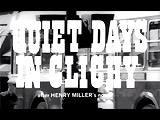
Quiet Days in Clichy (1970, Denmark) (aka Stille Dage i Clichy) This tale of free love, hedonism, and the Bohemian lifestyle was first told in director Jens Jørgen Thorsen's black and white Quiet Days in Clichy (1970, Denmark), with a Country Joe McDonald soundtrack. It was unusual for its numerous on-screen text statements and cartoon-like thought bubbles. It became notorious for charges of obscenity when it was seized by US authorities and viewed as pornography.
Paul Valjean starred as balding, middle-aged Joey (a stand-in for Miller), living in the town of Clichy near Paris with his misogynistic, mustached, schoolteacher roommate Carl (Wayne Rodda). The main objective of the two impoverished males in the film was to have as many sexual encounters as possible. In the opening scene, their stoned neighbor the Surrealist (Louise White) flamboyantly offered sex for money (200 francs) to pay her rent ("Whatever you want, I'll do it. If you want me to suck you off, or if you want me to do it old-fashioned, it is all the same to me. My breasts are still firm and exciting"), and she stripped down. In their bathroom, she began scrawling poetry on the wall before Carl jumped on top of her for intercourse, and afterwards wrestled her on the floor. Meanwhile in Paris, Joey became involved with easygoing Nys (Ulla Koppel) whom he met in a cafe. After she stripped nude and before they had sex in her apartment, he complimented her beauty: "You're beautiful, you're like a Renoir." When they were finished, she asked for money. Although sexually satiated, Joey was now broke but hungry (and experiencing food fantasies), unable to buy food. He imagined that she was dining on his funds.
One of its many almost hard-core sexual encounters was between Carl and another female that he brought home - a well-developed, mentally-deficient young Belgian virgin and pig-tailed runaway named Colette (Elsebeth Reingaard). The young girl claimed to be 17 (but was probably younger). Carl spoke to Joey: "She's a little idiot but look at those tits. I don't believe she's seventeen, but she swears. (He felt her breasts) Pretty ripe for fourteen." She wore a skimpy dress and sucked on lollipops as she did their ironing. While ineptly serving breakfast, she also boiled the coffee and burned the eggs on the stove ("all of her brains are between her legs"- according to Country Joe's soundtrack). Eventually, Colette was located by police and returned to her parents, who didn't press charges. Later, a trio of others were picked up in Paris for sex - prostitutes from the Cabana jazz night club, including Adrienne (Petronella) and Mara (Avi Sagild). During a bathroom orgy sequence, Joey cavorted with two of the streetwalkers in a bathtub (filled with red wine and soggy bits of long French baguettes). Joey also became obsessed with a Danish blonde named Christine (Susanne Krage), who was brought back to the flat for sex. Carl bluntly congratulated Joey on his selection: ("She's the best c--t you ever dug up"). At the same time, Carl was about to bed naked Corinne (Anne Kehler) in the next room. When Joey began to make love to Christine, she stopped short: ("I cannot...I'm thinking of my husband"). Joey suggested that Carl take a turn with Christine ("It's your turn now. Why don't you take over here. I'll go check Corinne"), while Joey complained to Corinne about Christine: "She babbling about that husband all the time." But after a few moments, Christine fled from Carl and came running into Joey's arms, and the two couples soon became entangled during love-making, concluding with Christine's accusation as she ran into the hallway from the other three, screaming: "You disgusting, terrible, perverted pigs!" The film ended with the mad laughter of the two men and Corinne.
|
      The Surrealist (Louise White)  Colette (Elsebeth Reingaard)    Christine (Susanne Krage)  Corinne (Anne Kehler) |
|||||||||||||||||||||||||||||||||||||||||||||

|
Sexual Freedom in Denmark (1970) A second quasi-documentary film from director John Lamb was Sexual Freedom in Denmark (1970), (see another similar film, Pornografie in Danemark (1970, W. Germany above, and Lamb's Sexual Liberty NOW (1971)) although he was credited as M.C. Von Hellen. The film purported to be about Denmark's recent and permissive legalization of pornography. After playing for over half a year in Manhattan, the controversial film was busted for obscenity, but during the trial, it was ultimately declared legal - due to a ruling that it was protected by the First and Fourteenth Amendments. A narrator intoned about how Denmark's society had engaged in a "bold experiment" - as images of erotica and nudes were liberally displayed:
The shock-sexploitation movie began with an Adam and Eve segment, then a nude sailing ship cruise and nude volleyball on the beach. Interviewer Olle Lassen (as Himself) questioned individuals on a Saturday afternoon in the Copenhagen area, including a liberated 18 year-old Karen Biller (as Herself) on the street, visited a sex shop (displaying hard-core still images on magazine covers), and engaged in a talk with nude models during a photo-shoot. One of its main purposes was to serve as an investigative report and survey on the history of erotic art:
The discussion continued with a visit to a modern nudist camp, with pool swimming, volleyball, and a nude beauty contest ("A girl who enters such a contest in the raw does have reason to feel that she has competed more honestly than her sisters under their suits"). There were also views of nude body painting at a hippie party (Michelle Angelo and Linda O'Bryant), including literal 'body painting' by slithering around in wet paint on a canvas. Interviewer Olle Lassen also spoke in Copenhagen to Dorrit Frantzen (as Herself), a 21 year-old Miss Denmark, who was questioned about her sexual attitudes and behaviors. Visits to topless strip clubs initiated a discussion of more lenient classifications of movies with nude scenes, and the demand for more low-budget "girlie movies" - prompting the narrator to impine:
Before another interview with "star reporter" Lizzie Bundgaard (as Herself), there were closeups of diseased genitals afflicted by VD (syphilis). There was a discussion of sex education in society and samples of various advanced primers on sex and birth control. Diagrams and videos explained the process of human reproduction, culminating with two live births (one a breech birth or bottom first), and then a detailed visual explanation of the sexual changes and organs of both sexes during puberty. A closeup of an ejaculation into a glass test tube was included with its counterpart - a female orgasm. For the concluding twenty minutes of the film, the mechanics of sexual intercourse were demonstrated with a heterosexual couple (slightly blurred on the edges of the frame). The narrator stressed the importance of pre-sexual foreplay, stimulation and arousal techniques before bringing the sexual organs together during coitus. The basic positions for intercourse included face-to-face (missionary), woman-on-top, and rear-entry. Included were techniques for increasing sexual muscle tension. The sex film ended with a clinical description and demonstration of birth control methods. The last brief sequence was of another naked couple (the female was well-endowed Swedish model Uschi Digard, a frequent adult film actor in Russ Meyer's films) in a garden setting. |
|
|||||||||||||||||||||||||||||||||||||||||||||
|
Song of the Loon (1970) The first gay-friendly independent film with homoerotic content was this gay frontier romance (about free love among the Loon tribe) with frequent full-frontal male nudity (often filmed with a reverse negative). It was based upon Richard Amory's (pseudonym Richard Love) fictional and erotic Loon Trilogy, Soon of the Loon (1966), followed by Song of Aaron (1967), and Listen, the Loon Sings (1968). The coming-of-age story about tormented gay love was set in 1870's California. It was released with the tagline:
The film opened with an explanatory title card: "This film is the tale of a young man named Ephraim McKeever and his search for true love and happiness. After meeting an old Indian Nakumtra, in town, he learns that he must go into the forest and find Running Bear, the only man who can help him understand himself." It provided audiences with one of its first serious representations of homosexuality, although the film was campy and amateurish. One scene (about 40 minutes into the film) was fairly well-acted, an earnest fireside talk between Ephraim MacIver (Morgan Royce) and Cyrus Wheelwright (John Iverson) followed by a tender kiss. |
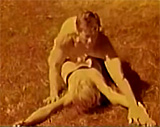 Frequent Male Nudity 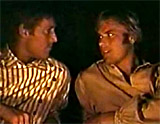 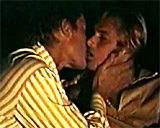
Campfire Scene |
|||||||||||||||||||||||||||||||||||||||||||||

|
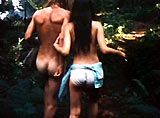
Woodstock (1970) (subtitled 3 Days of Peace & Music) Michael Wadleigh's over 3-hour documentary of the 1969 concert in upper-state NY was originally rated R for brief images of nudity (mostly skinny-dipping, various instances of toplessness or nudity, and love-making in the bushes) - and also for rampant drug use and profanity among young concert-goers.
One female who was interviewed noted as others were swimming naked:
The film won the Academy Award for Best Documentary Feature. |
 |
|||||||||||||||||||||||||||||||||||||||||||||

|
Zabriskie Point (1970) Italian director Michelangelo Antonioni's simplistic and failed view of 1960s America was this iconic movie. It was his first (and only) US film, and his second English-language film following Blow-Up (1966, UK). The controversial, anti-Establishment and counter-cultural film, with two disconnected and disillusioned young people as its stars, came out the same year as the Woodstock Festival. It also was released a year after director/star Dennis Hopper's similar culture-clash film Easy Rider (1969). It was an embarrassing financial box-office disaster for MGM, due to its low revenue of approx. $1 million, on a budget of $7 million. The tagline of this unique, one-of-a-kind film was: "Zabriskie Point - How you get there depends on where you're at." The R-rated film was considered controversial and explicit for its language and desert orgy scene (with some implied oral sex), although restrictions were beginning to loosen up by the MPAA following Midnight Cowboy (1969) and its win as Best Picture. The film's two disconnected young people were portrayed by newcomers:
Toward its conclusion, she met up with Mark and drove off with him into the desolate desert and into an area of open landscape known as "no-man's land" of Death Valley; in a parking lot overlook at Zabriskie Point - the lowest point in the United States, she read the display sign before they ran down the very steep slope to the dry river-bed where Daria smoked marijuana, while he abstained. As the uninhibited couple walked on, now holding hands, she decided to pretend that their thoughts were like plants, and asked: "What do you see? Neat rows? Like a garden? Or wild things? Like ferns and weeds and vines?"; he replied: "I see, sort of, a jungle"; she thought about how nice it would be if the thoughts planted in their heads didn't include "bad memories...wonderful things, like a happy childhood, real groovy parents, only good things"; he thought her idea was "far out" - and proposed: "Make out and forget how terrible it really was"; after frolicking around in the dust and shouting to produce echos, she offered another unusual thought: "Anyway ought to be one word. The name of some place or a river. The So-Anyway River"; shortly later, he asked her to join him on his life's journey: "Would you like to go with me...wherever I'm going?" They began to kiss, undress each other, and make love on the desert sand dunes, to the tune of the Grateful Dead's Jerry Garcia playing "Love Scene" on the soundtrack; it was the film's most extraordinary sequence - an hallucinatory, symbolic, dust-swirling orgy or love-making sequence; several dozen ash-covered copulating and kissing couples (and trios) (at least 100 phantom individuals, credited as the improv Open Theatre group of Joe Chaikin) magically appeared, creating a massive 'love-in'; the views of the contorting bodies began to blend into the landscape, uniting and becoming one.
After the free-love experience and the dust cleared, Mark remarked: "I always knew it'd be like this"; Daria asked: "Us?" but he replied instead: "The desert." |
 Dropout/Drifter Mark (Mark Frechette)  Hippyish Daria (Daria Halprin) - Temp Office Worker-Secretary  Daria - Enroute in a Car to Phoenix, AZ  Real-Estate Developer Mr. Allen (Rod Taylor)  Mark in Hijacked Cessna Airplane Heading Toward Phoenix  Daria in Buick Also Headed Eastward  Together At the River-Bed Below the Overlook at Zabriskie Point in Death Valley |
|||||||||||||||||||||||||||||||||||||||||||||




 Censorship
in Denmark: A New Approach (1970) (Pornography in Denmark: A
New Approach, or Denmark Without Censorship)
Censorship
in Denmark: A New Approach (1970) (Pornography in Denmark: A
New Approach, or Denmark Without Censorship)