|


|
Bed and Sofa (1927, Soviet Union) (aka Tretya Meshchanskaya, or Third Meshchanskaya St.) Directed by co-writer Abram Room, this comedic, modern love-triangle silent film drama was considered a Soviet version of Ernst Lubitsch's Design For Living (1933), and had hints of Francois Truffaut's Jules et Jim (1962, Fr.). Its subject matter involved adultery, menage a trois, polygamy, and abortion. The influential film was originally banned in the US and Western Europe due to the sexual nature of its subject matter. The ahead-of-its-time story told of a threesome living arrangement in a small, one-room Moscow apartment in 1920s USSR, during an overcrowded, housing shortage crisis, between:
Volodya shared their cramped basement apartment on Third Meschanskaya St. - sleeping on the sofa, while the couple's bedroom was separated by only a small curtain. Volodya began an affair with Lyuda when Kolya was out of town for business, after showering her with gifts, taking her for a plane ride, and paying attention to her. The three decided to retain their "open" living arrangement when the affair was admitted (Volodya revealed to Kolya: "I've got to tell you that your wife and me..."), and soon after, Volodya took over Lyuda's bed - and Kolya was sleeping on the sofa. However, it was unclear who the father was when she became pregnant. Abortion was considered ("You must have an abortion. I don't want somebody else's baby"), although strong-willed Lyuda rejected the idea when she decided to leave both men after visiting a private hospital and foregoing the operation ("Semyonova got frightened and left" recalled a nurse). While waiting for her turn in the waiting room along with a prostitute, as well as a young girl with her mother, she looked out the window and saw a young boy playing with a doll - after which she quickly exited. She decided to take control of her life - she quickly packed her things, and left a note that she would never return to the Third Street apartment. With tears in her eyes, she assured herself: "I'll find a job. Everything will be all right." She departed from Moscow on a train for a new life of freedom. The two men, after discovering that she had vacated the apartment, admitted they were "scoundrels," but then resumed their lives as comrades-bachelors, as if nothing had happened. |
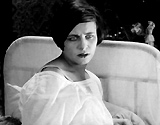 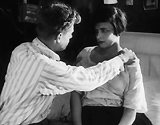 Lyuda Seduced by Volodya 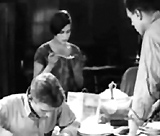 Threesome Living Arrangement  Lyuda - in Abortion Clinic, Deciding to Forego Operation 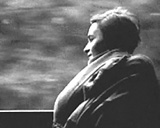
Lyuda On the Train to Freedom |
|||||||||||||||
Forbidden Daughters (1927) (short) Director and prominent nude photographer Albert Arthur Allen's 13-minute short was a forerunner of the "nudie" comedy feature films that emerged in the late 1950s. It told of a wealthy NY socialite wife named Alva (Clarice Conwell) (naked under her robe) who received a telegram from a London detective bureau about the whereabouts of her lost adventurer-husband-explorer Russell Silby (Ralph O'Brien) in Africa. He was reported to have been distracted and "held captive by the great love" of Loma, a lovely native Princess. In the next scene set in a trading post in Central Africa, Alva was searching for him and dressed in jodhpurs and jackboots. She entered the adjoining harem (filled with bare-breasted black natives), where she viewed a Caucasian female, labeled the Harem Favorite (Gladys DeLores) of the wealthy Rajah Sana.
Soon, Alva was wrongly blamed, apprehended and placed in a dungeon (with other nude prisoners) for stabbing the Harem Favorite to death. (Another jealous dancer had murdered her.) One night, Alva picked open the lock, slipped through a window, and escaped into the African jungle where the sound of tom-toms led her to a village where the nude natives were performing "The Dance of the Forbidden Daughters." Afterwards, they celebrated with the Feast of Lom-a-Loma (bananas!). Alva spotted her "lost" husband entranced by the dancing of the nude Princess Loma. The title card described: "Alva sees Princess Loma's native dance; she obeys the impulse of love - - Native as native does." She stripped off her clothes before confronting her husband - and asked: "The judgement - - - Choose between us!" There was a long pan up Alva's naked body - from Russell's point-of-view. The film abruptly ended with Russell taking his naked wife into his arms and kissing her.
|
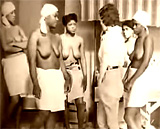 Alva (Clarice Conwell) in Trading Post 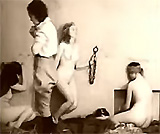 Alva in Dungeon 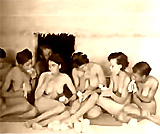 The Feast of Lom-a-Loma 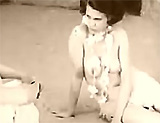 Princess Loma 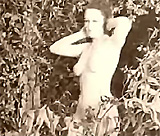 Alva Stripping |
||||||||||||||||
|
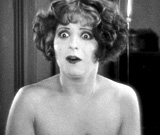
Hula (1927) The star of this film was flapper icon Clara Bow, dubbed the "It" girl during the 20s, who was one of the earliest sex symbols. This romantic adventure was a forerunner of Red Dust (1932), starring Jean Harlow and Clark Gable. Bow appeared in this Victor Fleming-directed film as Hula Calhoun, a flapper girl raised on a ranch near Hana (Maui) in Hawaii. She was the daughter of a Hawaiian planter, who became infatuated with a married man - Anthony Haldane (Clive Brook), a young English engineer who was supervising the construction of a dam on the rural estate. She was featured langoriously nude (implied) in a lagoon bathing scene in an early scene, and performed a provocatively sexy hula dance (more like the Charleston) to entice Haldane. She connived to have Haldane's wife Margaret (Maude Truax) agree to a divorce so that they could marry. |
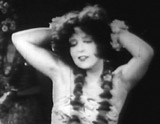 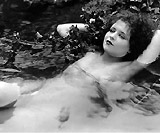 Hula Calhoun (Clara Bow) |
|||||||||||||||
|
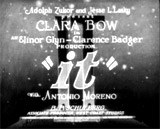
It (1927) This was appealing sex symbol Clara Bow's most famous, star-making, signature film as the self-proclaimed "It" Girl, her first film for Paramount. She has often been regarded as the first major sex symbol. A title card early in the Clarence Badger-directed film described the meaning of "It" - a quote by British novelist Elinor Glyn, the author of the novella that was serialized in two parts in 1927 in Cosmopolitan Magazine:
To emphasize the 'sex appeal' aspect, another quote about "IT" was highlighted in the Cosmopolitan magazine article written by Glyn, as it was being read by the film's gay character, 'Monty' Montgomery (William Austin), the friend of the department store's wealthy owner:
Monty then viewed himself in a mirror and declared: "Old fruit, you've got 'IT'!" The main film role was of a devil-may-care, quintessential flapper type named Betty Lou Spence - a vivacious Waltham's department store lingerie salesgirl who represented female independence, sexual freedom, Jazz modernity and the modern lifestyle in the Roaring 20s Jazz Age.
When she first saw her handsome young mustached boss Mr. Cyrus Waltham, Jr. (Antonio Moreno), heir to the Waltham's department store empire, she declared: "Sweet Santa Claus, give me him!" Later, in the romantic/melodramatic scene pictured, after receiving her salary check, she closed her boss' PRIVATE office door, sat on his desk, and asked: "Are you mad at me because I slapped you?", then stretched across his entire desk, and sweetly apologized:
She then had him profess: "I'm crazy about you" and confessed back: "I love you, too." Furthermore, he promised: "I'll buy you diamonds - clothes - everything you want - " but then she realized he was buying her off:
As she left his office, she reminded him that being 'crazy' about her wasn't enough: "I suppose that's what you men call love!" The film continued with a series of misunderstandings, mistaken identity and missed opportunities between Betty and her 'dream man' (at one point, Betty claimed she was an unwed mother!), until the closing when the two finally fell in love and kissed in a curtain-closing scene. |
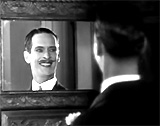 Monty (William Austin)   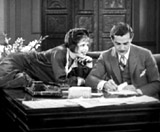 Flapper Betty (Clara Bow) with Boss Cyrus (Antonio Moreno)   Curtain-Closing Kiss |
|||||||||||||||

|
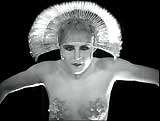
Metropolis (1927, Ger.) In Fritz Lang's masterpiece Metropolis (1927) in the early Eternal Gardens sequence, Freder (Gustav Frohlich), the aristocrat capitalist's son, frolicked with young ladies (wearing sheer and braless blouses) in a grotto. He chased one young lady with a backless tight black top around a circular fountain. When he caught her, he bent her backwards, and pressed towards her for a kiss. Later in the film, the mad scientist Rotwang (Rudolf Klein-Rogge) created a female robot - a double of ethereal nurse Maria (Brigitte Helm).
As the evil robotic Maria (Helm also), she performed an erotic, Salome-style, hip-swiveling semi-nude dance ("the dance of the whore of Babylon") at Yoshiwara's depraved night-club, arousing the lecherous, wide-eyed male audience into a frenzy. |
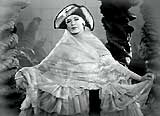 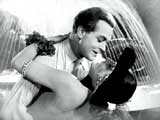 In the Eternal Gardens |
|||||||||||||||
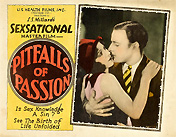
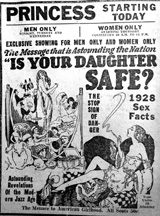
Pitfalls of Passion (1927) Two openly defiant, tawdry exploitation films about brothels, teenage pregnancy, birth control, white slavery (women lured into prostitution), and venereal disease-syphilis (all forbidden topics according to the Hays Office), were circulated as road shows by independent producer and entrepreneur Sam .S. "Steamship" Millard. They were exhibited to display nudity in the guise of educational and medical documentary films. Pitfalls of Passion (1927) featured the tagline: "Is Sex Knowledge a Sin? See the Birth of Life Unfolded."
|
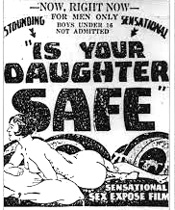 Is Your Daughter Safe? (1927) |
||||||||||||||||

|
Sunrise (1927) F.W. Murnau's exquisite film Sunrise (1927) told the story of the corruptibility of a married country Man (George O'Brien). He fell prey to the seductive wiles of a city vamp and tempting mistress (Margaret Livingston) in an illicit affair. He met her at night on the edge of the misty, moonlit marshes. The supernatural spell and erotic charm of the city woman seduced him and he pulled her into his arms for a passionate, fervent kiss. She stole his sanity and soul as she literally pulled him down into the swamp. While being kissed as they sprawled on the grass and tempting him with a seductive dance, she visualized for him how he should sell his farm, murder his wife, and come to the decadent City. In a later scene after being reconciled with his wife (Janet Gaynor), the couple magically appeared in a flower-blooming country field - and then they suddenly reappeared back within the congested City - and found themselves in the midst of honking city traffic (another rear-projected image) - while still kissing and stopping traffic! |
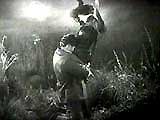 Adultery with Vamp (Margaret Livingston) 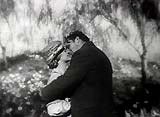 Reconciliation With Wife |
|||||||||||||||
A Wanderer of the West (1927) This late 20s silent western was one in a series of six Maynard oaters released by Rayart. It starred First National star Ken Maynard's brother Kermit (billed as Tex Maynard). The western delivered an early (and common) portrayal of homosexuality - a stereotyped sissy or effeminate foil to provide contrast with the other more masculine men. Often, male names such as Clarence or Leonard signified gay men. One of its title cards read:
In one scene, Clarence (Al Rogers) was ogling a western cowboy, and then boldly leaned on the cowpoke's shoulder and asked: "I wonder if you're going out with the boys tonight." The irritated cowboy responded by pushing Clarence away. |
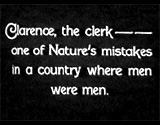 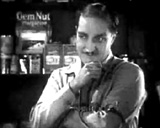 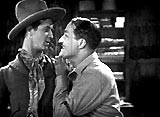 Clarence (Al Rogers) |
||||||||||||||||
|
Wings (1927) This first Best Picture winner (a silent film) was noted for having some of the earliest examples of nudity in the Pre-Code era. In the military enlistment office scene, nude men in the background were undergoing physical exams. It also portrayed the first on-screen male-male kiss on the lips during a death scene. Handsome young soldier John "Jack" Powell (Charles "Buddy" Rogers) placed a lingering fraternal kiss on the mouth of his dying friend David Armstrong (Richard Arlen), with the title card reading:
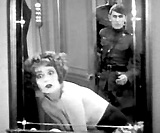
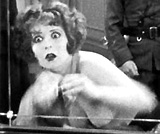
In addition, Wings was one of the first mainstream, widely-released films to portray a leading actress' nudity -- in this case, it was a scandalous, quick glimpse of the breasts of "It" girl star Clara Bow (as "girl next door" and ambulance driver Mary Preston). On leave in Paris during the war with the AEF (American Expeditionary Forces), Mary was in the same hotel room with drunken, passed out John "Jack" Powell on a nearby bed. Suddenly, she was interrupted by two Army military police officers while she innocently undressed - she was changing from a borrowed dress back into her military uniform, in front of a mirror behind a divider.
Since they thought she had just had sex with him, they forced her to resign and return to America. The caption card read:
|
 Enlistment Office: Three Naked Men in the Background 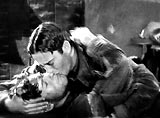 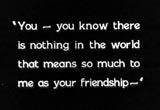 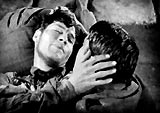 Gay Kiss |
|||||||||||||||
|
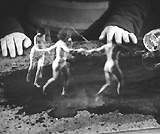
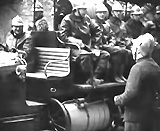
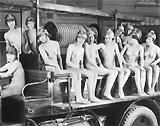
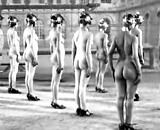
The Fireman of the Folies Bergere (1928, Fr.) (aka Le Pompier des Folies Bergères) (short) This short Pre-Code French film (some dated it as 1930), not subject to the restrictions of the US' Hays Code, was a promotional piece for the famed Folies Bergeres in Paris, France. In particular, it advertised dancer Josephine Baker's Vents de Folies revue at the famous showplace in the late 1920s. The central character was a lecherous fireman, who had subliminal surreal thoughts about the nude dancers from the stage show he had just watched. After drinking in a bar, he began to imagine all of the females in his view as naked - in the bar on the tabletop (even in the ring left by his drink) and at other tables, in the subway station on the platform (where he viewed Josephine Baker wearing only a bra and hula skirt), on a streetcar, and at his place of work. When he sat down on a streetcar bench between a priest and a woman with a hat box on her lap, he suddenly saw another female rider in front of him lose her clothes (through a double-exposure dissolve), and then his seat-mates on his right and left turned female without clothes. His entire crew of male firemen were seated on the fire truck, transformed into females wearing only firemen's helmets. Slightly later, they were transformed a second time as a group while performing deep knee-bend exercises.
|
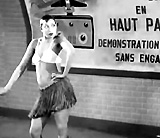 Josephine Baker (Herself) in the Subway 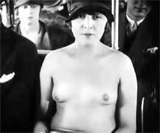 Woman on Streetcar 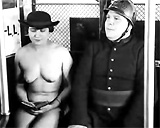 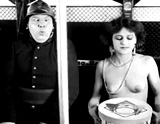 Two Fellow Passengers Naked |
|||||||||||||||
|
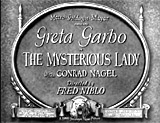
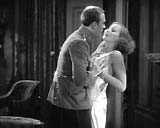
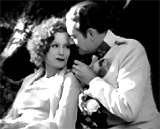
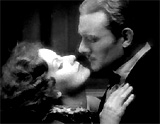
The Mysterious Lady (1928) The beautiful and bewitching Greta Garbo provided great sex appeal and numerous love scenes in this MGM, Fred Niblo-directed silent melodrama. The tagline described the espionage-tinged plot set during WWI:
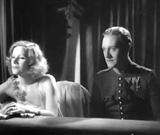
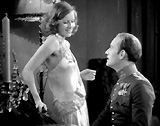
The main characters who became passionate lovers in the Mata Hari tale were:
Early on in the film, the seductive Tania stole important and top-secret war documents (with military plans) from Capt. Raden after meeting him at the opera in Vienna and spending a flirtatious and loving night together. (Raden had been set up to meet her, although she later professed that she really loved him.) Raden was court-martialed, demoted and imprisoned for the crime of treason, but then his uncle, Col. Eric von Raden (Edward Connelly), head of the Secret police, proposed a way for Capt. Raden to restore his honor. He would escape from prison, take the identity of a professional pianist from Serbia, and pursue and confront Tania in Moscow at a birthday party held in her honor by her platonic lover and spy-boss, Gen. Boris Alexandroff (Gustav von Seyffertitz). With great sexual tension and uncertainty during the final confrontation, Raden was trying to prove decisively whether she loved him or not, and whether she was truly a cold-hearted Russian spy or not. In the end, Raden's friend Max Heinrich (Albert Pollet) was revealed to be the real traitor, and Tania chose to aid Raden in killing Alexandroff, retrieve the stolen plans and escape with her. |
     |
|||||||||||||||
|
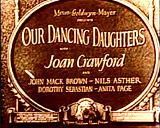
Our Dancing Daughters (1928) MGM brought out a loosely-constructed three-part set of racy, pre-Code films in the late 1920s. All of the films featured premarital love-making and sex, hip flasks and wild parties, loose morals, hedonistic lifestyles, slang of the day, the latest expensive fashions, and hot Charleston-dancing scenes. The first two films were released with synchronized musical numbers and sound effects (background noise). The three-part series (they were not sequels) was composed of romantic melodramas that starred young, amoral ('modern') Jazz Age flappers - free and easy, fortune-hunting single women of the time who vied for various marital partners:
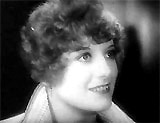
The title characters in Our Dancing Daughters (1928) were:
The film opened with a shot first from the knees down, of Diana simultaneously dancing while pulling on her lacy underwear in her fancy bedroom. It then opened to a full view of her before a multi-sectioned mirror. Her most memorable scenes were while dancing the Charleston. |
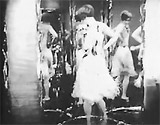 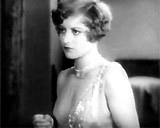 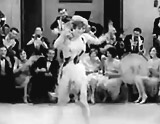 Diana (Joan Crawford) |
|||||||||||||||
|
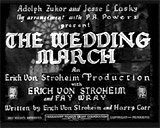
The Wedding March (1928) Director Erich Von Stroheim's examination of corrupt pre WWI Vienna included a doomed romance between:
The two first met in an extended sequence before a horse procession. The film was most noted for their romantic scene under an apple-blossom tree that dropped its petals. Eventually, Nicki must marry crippled rich heiress Cecelia Schweisser (Zasu Pitts) for money instead. The film was also noted for a decadent risque scene of a drunken celebration and orgy in a brothel. |
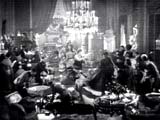 Orgy Scene |
|||||||||||||||
|
Swedish director Victor Sjostrom's last surviving silent film was filled with sexual metaphors, including semi-incestuous desire, jealousy, seduction, rape (off-screen) by a brutal male attacker, frigidity, virginity, insanity and sexual aversion - a predecessor to Roman Polanski's Repulsion (1965), and similar in part to Hitchcock's Rebecca (1940). It told about a lost and delicate young woman named Letty Mason (Lillian Gish, in her final silent movie) who moved to wind-swept frontier life in Texas where she became isolated in a desert cabin struck by sandstorms and was slowly driven mad. |
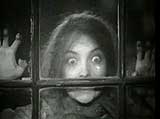
Letty (Lillian Gish) Driven Mad |
|||||||||||||||
|
Buried Treasure (1929) (aka Eveready Harton in Buried Treasure) This crude, 7-minute, silent-era pornographic cartoon was reportedly created by an anonymous group of animators. According to some reports, American film labs refused to process it, and it had to be developed in Cuba. It was dated to either 1928 or 1929 and might have been produced for a party honoring Little Nemo creator Winsor McCay. Predating Fritz the Cat (1972) by many years, it was the first animation to contain sexually-explicit scenes. However, it was never released into circulation and was only available for viewing many years later in the 1970s. It featured the adventures of a well-endowed male protagonist Eveready "Harton" (pronounced 'Hard-On') who was always aroused. He was shipwrecked on an island, and awoke with another case of perpetual morning stimulation. Excited by the sight of creatures in the wild having sex, he spotted a lusty and curvaceous naked female who entreated him to join her. He asked: "Oh, sweet maid for once I will be Big Hearted...Will you share my treasure?" She rolled her eyes at him, cupped her breasts, stuck out her wagging tongue, and fondled herself. He sucked on her nipple, then squeezed it to produce a stream of milk into his mouth. She laid back and agreed to have intercourse. However, he was stymied by other objects inside her, including an alarm clock, a shoe, and a crab (a joke?). He also battled with a man who was in the middle of having sex with a donkey (it was a contest of dueling hard-ons), before attempting to have sex with the animal himself, but became injured when his pecker landed on cactus. He finally found pleasurable oral satisfaction with a flexibly-tongued, licking cow through a fence knot-hole. |
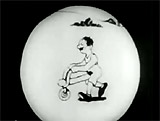 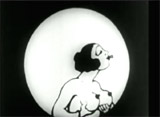 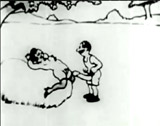 Crude Pornography |
|||||||||||||||

|
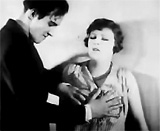
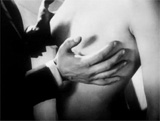
Un Chien Andalou (1929, Fr.) (aka An Andalusian Dog) (short) This shocking, and provocative surrealistic film, only 17 minutes long, by Salvador Dalí and Luis Buñuel, was banned in various countries. Its most infamous scene was an eyeball razor-slashing. Other images were of sexual assault images (pictured) of a man's (Pierre Batcheff) hands lustfully fondling or cupping the breasts of a clothed and then naked woman (Simone Mareuil). In the next image, the breasts disappeared and then were transformed into buttocks - which the man continued to palpate. She pushed him away and ran from him.
|
 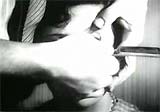  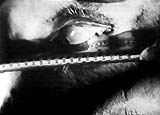 The Shocking Eye-Slitting Scene |
|||||||||||||||
|
Glorifying the American Girl (1929) Paramount Studios and producer Florenz Ziegfeld created this pre-Hays Code partly-Technicolored musical comedy. This was the first feature-length film to contain virtual nudity and revealing costumes in color! A censored, black and white version of the film was nine minutes shorter. In one non-speaking scene during the colorful revue sequence in the film's final third, a segment titled Loveland, future Tarzan's Johnny Weissmuller appeared as Adonis wearing a fig leaf. He was standing next to an unidentified semi-nude chorine. |
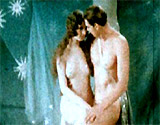
Adonis (Johnny Weissmuller) with Chorine |
|||||||||||||||

|
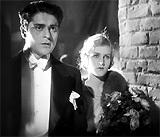
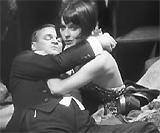
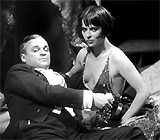
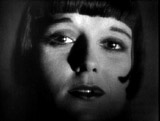
Pandora's Box (1929, Ger.) (aka Lulu or Die Büchse der Pandora) Georg Wilhelm Pabst's early erotic and hypnotic silent film melodrama produced hateful critical reviews for its overt sexuality, and was heavily edited/censored. Throughout the film, Louise Brooks portrayed a tempting goddess named Lulu wearing silky dresses and billowy gowns, even though she sported a pageboy haircut (or black bob). In an early scene, the insatiable, free-spirited yet innocent 18 year-old cabaret chorus girl and femme fatale Lulu (Louise Brooks) was caught backstage scandalously kissing obsessed and spell-bound wealthy newspaper owner Dr. Schon (Fritz Kortner) by his more socially-acceptable fiancee Charlotte Marie Adelaide (Daisy d'Ora) and his son Alwa (Franz Lederer).
After he was forced to break off his engagement to Charlotte, there was a wedding party celebrating Schon's marriage to the virginally white-dressed (inappropriately), bi-sexual and amoral Lulu; but even before he could dance with her, she engaged in an intimate, flirtatious dance (waltz) with black silken-dressed, chic lesbian aristocrat Countess Anna Geschwitz (Alice Roberts) - it was notable for this was the first film to present a well-developed lesbian character - the aristocratic countess. She also flirted with Schon's son Alwa (who professed: "I can't live without you any longer") and two others in her bedchamber: Schigolch (Carl Goetz) (revealed as Lulu's father) and Rodrigo Quast (Krafft-Raschig), a trapeze performer (and future blackmailer). After becoming insanely enraged and jealous at Lulu, Schon thrust a gun at her, and commanded her to shoot herself: "Take it! Kill yourself!...so that you don't drive me to murder as well." Schon was accidentally shot and killed during a struggle for the gun between them and the gun discharged. During her trial, she was charged with manslaughter. Punished for unleashing Pandora's box of evil, she eventually ended up dying at the hands of 'Jack the Ripper' (Gustav Diessl) in London's squalid Soho on Christmas Eve, when he glanced at the knife on a nearby table and couldn't control his homicidal impulses; during an erotic embrace and kiss, he grabbed the knife and stuck the sharp and gleaming knifeblade into her back (off-screen) (her hand grasping him went limp to indicate her death); meanwhile outside, the Salvation Army paraded through the fog.
|
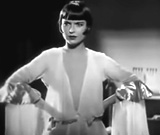 Lulu (Louise Brooks) 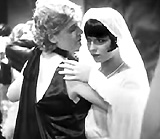 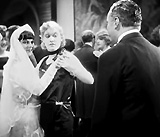 Wedding Party Scene: The Forbidden Lesbian Dance With the Countess 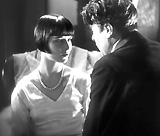 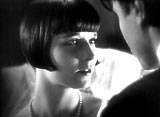 Flirting with Alwa at Her Own Wedding to His Father 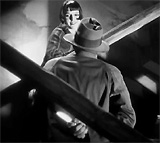 Fateful Meeting with Jack the Ripper (Gustav Diessl) |
|||||||||||||||
|
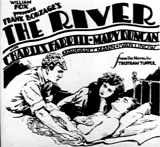
The River (1929) Director Frank Borzage's partially-lost, sublime, silent era, pre-Hays Code masterpiece was this erotic drama. It was his last silent film (however, 43 minutes of a total of 84 minutes were all that survived, restored and reconstructed with fragments, explanatory title cards and surviving stills in 2006). The romantic leads at a backwoods construction-logging camp near a river were naive, bashful, innocent, motherless, virile farm boy-man Allen John Spender (Charles Farrell), and local urban vamp and femme fatale Rosalee (Mary Duncan) (the mistress of con-man Marsdon (Alfred Sabato) who was just jailed for murder) - and his villainous pet crow that kept interrupting them. They met at the riverside where Allen was swimming naked near the river’s lethal whirlpool. Later, she made a sexual appeal to him, when she was lying down and allowed Allen to touch her breast through her clothing, to feel her heart. She told him: "My heart...", and after a long pause, he answered: "Mine too." She listened to his heart and then said: "Mine beats much stronger!" With increasing sexual frustration, in one symbolic scene, Allen maniacally chopped down a succession of four trees with an axe to show his strength and release tension. And then in a near-death scene, Allen was almost frozen, but warmed up in bed by Rosalee's body heat as she opened her coat and laid on top on him (wearing only her silky slip); she prayed: "Please... please... let him live!" - and he soon revived. In the climactic ending, the violent Marsdon returned and Rosalee was plunged into the river's whirlpool. Marsdon met his own fate, while Allen dived in and rescued Rosalee. |
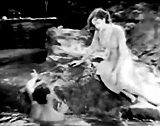 Allen Swimming Naked with Rosalee 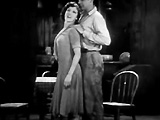 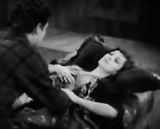 Love Affair Between Allen and Rosalee 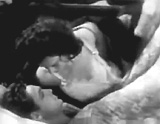 Rosalee Warming Up Allen |
|||||||||||||||