|
History of Sex in Cinema: 1957-1959 |


|
Island in the Sun (1957, UK) This breakthrough torrid political and family drama by director Robert Rossen (an adaptation of Alec Waugh's best-selling novel about racial tension) was noted as groundbreaking for its soapish inter-racial romances (although almost entirely devoid of onscreen physical contact except for a rare kiss or hug). It was Darryl Zanuck's first independent production after leaving 20th Century Fox. The drama was mostly filmed in Granada and Barbados with an all-star cast, and registered as a UK film. The controversial film further chipped away at and defied the Production Code standards that forbid miscegenation. In the late 1950s, 28 states still prohibited inter-racial marriage. In 1957, the picture was banned in Memphis, Tennessee, and the KKK protested against its showing in Jacksonville, Florida. In New Orleans, the American Legion launched an unsuccessful campaign to halt its screening. Belafonte, married to a white Jewish woman (Julie Robinson), was forbidden by the studio to discuss his inter-racial romantic role. It was set on a fictional British-controlled West Indies Caribbean island (Santa Marta) under British rule, where two inter-racial romances developed in a complex web of parallel stories, and two very contrasting individuals (one white, one black) were running against each other for political office on the island. A number of the characters, members of a wealthy, expatriate, white plantation-owning family known as the Fleurys, became involved in a momentous scandal concerning their racial origins - it was feared that the Fleury name had been tainted by mixed "tarbrush" blood.
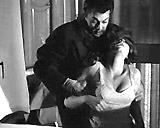
Maxwell was watchful of his younger sister Jocelyn Fleury who was being courted for marriage by young British aristocrat and war hero Euan Templeton (Stephen Boyd), son of the island's governor Lord Templeton (Ronald Squire). Euan was bound for Oxford and then a political position in the British House of Commons. According to an expose titled "THE COLOR PROBLEM," written by journalist Bradshaw (Hartley Power) and printed in the Santa Marta Record newspaper, there was a possibility of the Fleury's ambiguous racial inheritance - Julian's mother - or Maxwell's grandmother - (who was "3 quarters white" and died during childbirth) - "was a Jamaican with colored ancestry." Julian Fleury - who claimed he had only 1/6th "colored blood" - was unperturbed. Earlier, Maxwell assumed that his wife Sylvia was having an affair with retired war hero Hilary Carson (Michael Rennie), due to a misplaced cigarette. The extremely agitated Maxwell accused Sylvia of infidelity and raped her - the film's most overt sex scene. He threatened her after tearing her dress: "Women get bored making love in the same room. A change of scenery helps" - and then forced himself on her as the film faded to black.
Later, during a quarrel when Maxwell accused Carson of an affair with his wife Sylvia, Carson rightly denied the accusation and then retorted by questioning Maxwell's tainted racial heritage (with a "tarbrush rubbed across his face"). Enraged, Maxwell punched and then strangled him and disguised the deadly attack as a robbery by stealing his wallet (and then tossing it aside in a field). The murder was investigated by the head of police Colonel Whittingham (John Williams), who suspected Maxwell had accidentally committed the murder after a brawl. The Colonel suggested that Maxwell confess and then face charges of manslaughter to "find peace of mind." Afterwards, the guilt-ridden Maxwell learned from Sylvia that accusations of infidelity with Carson were completely unfounded. And then after receiving a copy of Dostoevsky's Crime and Punishment from the Colonel, Maxwell contemplated suicide (in Waugh's novel, he did) by shooting himself with a gun in his bathroom, but couldn't pull the trigger. He smashed the mirror instead. Shortly later (off-screen), he admitted to the Colonel that he had committed the crime.
At the same time as their romance progressed, Jocelyn and Euan became very close, but she became fearful of being engaged and marrying him because of gossipy concerns about her own questionable racial ancestry. After a sincere kiss at an ocean overlook (30 minutes before the film ended), and a discrete fade-out, they presumably had sex with each other. She was seen adjusting her hair in the next sequence. Soon after, Jocelyn confided to her mother Mrs. Julian Fleury that she was pregnant with Euan's child, and wanted to go to Canada in three months to deliver the baby before adopting it out. Jocelyn was counseled by her mother that she needn't fear having a child with her beau Templeton and ultimately marrying him. Mrs. Fleury revealed to Jocelyn a long-hidden secret - that Julian Fleury wasn't Jocelyn's real biological father - Jocelyn was indeed racially pure because she had been fathered by someone else due to a previously-undisclosed sexual indiscretion on Mrs. Fleury's part with a different white man - it was an astonishing revelation:
This paved the way for Jocelyn and Euan to be married and board a plane bound for England. Underlying all of the racial intrigue were two other inter-racial romances in the making - both ignited by the characters who first met at a garden party at the governor's mansion:
Their interracial screen hug and half-way aborted kiss while they were dancing together was quite controversial at the time of the film's release. By film's end, Denis resigned his post (due to the Governor's distaste for his relationship with Margot) and Margot was asked to accompany him to England (she accepted: "Where you go, I go") - they boarded after Euan and Jocelyn onto a British Airways plane bound for London.. There was another inter-racial romance between two others, with only a slight touching of hands (reflecting a double standard regarding the black male) who were unable to show any physical affection and often talked about their incompatibility:
Boyeur never touched Mavis in the final version of the film. The film's steamiest moment between them came when they drank from the same cut-open coconut. As the film ended in the final scene (as David and Mavis watched the plane carrying the two other couples away from the island), he told Mavis that he could not leave his country with her to get married because he belonged with his own people, and because there were prejudiced people elsewhere. He ultimately decided to forego the possibility of inter-racial marriage to her - and they had no choice but to end their relationship:
|
 Maxwell Fleury (James Mason) 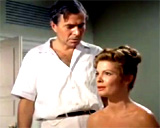 Maxwell Suspicious of Wife Sylvia (Patricia Owens) 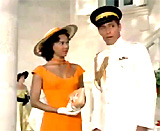 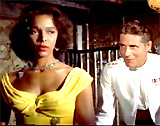 Margot (Dorothy Dandridge) with Denis (John Justin) 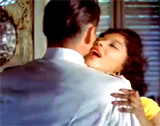 Altered Half-Way 'Kiss' or Hug While Dancing Together  Margot Doing Limbo 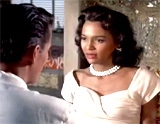 Margot Accepting Denis' Invitation to Go to England ("Where you go, I go") 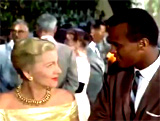 David Boyeur (Harry Belafonte) with Mavis Norman (Joan Fontaine) 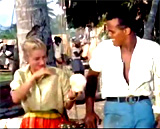 David and Mavis Sharing a Coconut Together 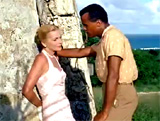 David and Mavis at Plantation 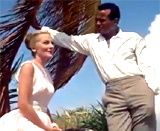 David and Mavis in Final Scene - An End to Their Relationship 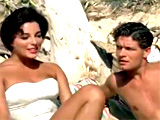 Jocelyn Fleury (Joan Collins) with Euan Templeton (Stephen Boyd) 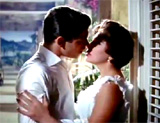 Near-Kiss Between Jocelyn and Euan 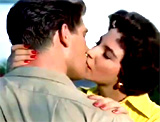 Love and Kiss Between Jocelyn and Euan at an Overlook Was Clouded By Her Fear of Her Own Racial Heritage 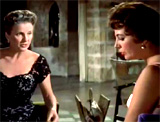 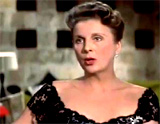 Jocelyn's Discussion With Her Mother About Her Ancestry |
||||||||||||||||||||||||
|
Peyton Place (1957) Grace Metalious' torrid, potboiling soap opera in her sensational 1956 novel was adapted, toned-down and sanitized for the screen's film release. It was set in a New England town and was considered extremely scandalous at its time -- with its interwoven stories of adultery, incestuous rape, repression, illegitimacy and abortion (or miscarriage), frigidity, suicide, skinny-dipping, mother-daughter conflict, and murder. Neurotic, prudish single mom Constance MacKenzie (Lana Turner) was over-protective of her sexually-curious teenaged daughter Allison MacKenzie (Diane Varsi), an aspiring writer and high-school senior, who began a relationship with nerdy, shy and virginal Norman Page (Russ Tamblyn), who also had an oppressive mother. Red-dressed, overtly-sexual, fast-living trampish sexpot Betty Anderson (Terry Moore), who realized that showing cleavage had its advantages, told her girlfriends in a dress shop: "Just remember: men can see much better than they can think. Believe me, a low-cut neckline does more for a girl's future than the entire Britannica encyclopedia." In town on the wrong-side-of-the-tracks, the Cross family was composed of alcoholic step-father Lucas Cross (Arthur Kennedy) - the school's custodian, his wife Nellie (Betty Field) - housekeeper for the MacKenzies, and two step-children: Paul Cross (William Lundmark) and Selena Cross (Hope Lange). Lucas became a drunken and abusive rapist of his tormented step-daughter Selena. During the film's incestuous rape scene, Selena had returned home (a tarpaper shack), where her alcoholic father suggested they drink to celebrate her "growing up." He approached her: "About time I started teaching you something...Never had nothing I ever wanted. Never had a beautiful woman." She fought off his advances - with views of her straining hands holding onto the bedframe. She pleaded: "Let me up" with her face seen in full close-up, as the scene shifted. Following Selena's rape by her father, she became pregnant and consulted with Dr. Swain (Lloyd Nolan), requesting an 'abortion' (the word was not used in the film); the outraged doctor, who promised to keep her situation a secret, threatened Lucas with jail-time, and was able to force him to sign a confession that he had fathered the child. But then when Selena returned home, she was again attacked by her lecherous father; she fled from him into the woods, and fell - suffering a miscarriage; Dr. Swain reported his operation on her as 'appendicitis.' In another climactic scene after Connie heard vicious untrue rumors about her daughter Allison's behavior, she stunningly revealed to her shocked daughter that she was born out of wedlock (illegitimate), and that she had been lied to about her father:
Horrified by the revelation, Allison fled to her upstairs bedroom, where she found her mother's maid, Nellie Cross (Lucas' oppressed wife, who knew about the sexual attacks on Selena) dead from a suicidal hanging. And then during WWII, upon Lucas' return to the family's shack on Christmas Eve while he was serving in the Navy, Selena was forced to bludgeon her father to death with a piece of firewood during a second rape attempt, and then buried his body in the backyard. A few months later when Lucas was considered AWOL, Selena confessed her crime to Connie, who then reported the murder to the authorities. In the film's climactic courtroom trial for murder, during an unapologetic confessional testimony as a witness for the defense, Dr. Swain claimed that Selena's act of murder was not pre-meditated; he produced a signed confession from Lucas that stated the father's responsibility for Selena's pregnancy, and that she had fought him off in self-defense: ("I assisted her (Selena) in a miscarriage - a miscarriage of Lucas Cross' baby"), although earlier in the film, the doctor had claimed that she had an appendectomy; Selena was acquitted of wrong-doing. |
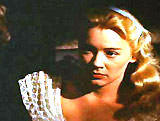 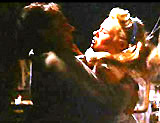 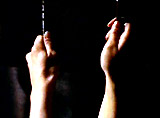 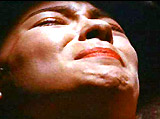 The Rape of Selena Cross (Hope Lange) By Her Own Father Lucas Cross (Arthur Kennedy) 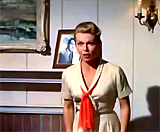 Connie's Revelation to Her Daughter Allison That She Was Born Out of Wedlock  Dr. Swain's Climactic Courtroom Murder Trial Confession About Selena's Rape-Pregnancy and Her Act of Self-Defense |
||||||||||||||||||||||||
|
Sweet Smell of Success (1957) Alexander Mackendrick's acerbic, dynamic and intense film Sweet Smell of Success (1957) exposed the diseased under-side of New York City's glamorous night life, revealing brutality, capriciousness, greed, evil, psychological violence, corrupt American ambition, betrayal and cynicism. It also unearthed NY gossip columnist J.J. Hunsecker's (Burt Lancaster) semi-incestuous - or at the least, an agitated obsessive attachment of the newspaperman to his 19 year old sister Susan (Susan Harrison). She was engaged in a forbidden romance with a young jazz guitarist/singer named Steve Dallas (Martin Milner), and her domineering, over-protective, and controlling brother forbid their planned marriage together. Throughout the entire film, Hunsecker often sat in his office, where he lived a forbidding, secretive life as a repressed, asexual bachelor who was solely attached to his sister. [An inappropriately-oversized portrait of his daughter rested to his left on his desk.] Covetous of her beauty and possessively jealous of her romantic attentions to any other man, he kept her cooped up with himself, to protectively avoid the tainting of her innocence and purity. His twisted love for her was a combination of sibling affection, repressed incestual domination, possessive jealousy, and selfish need. At one point, he told her:
In a relationship that also hinted at a homosexual connection, Hunsecker had bargained with success-seeking, hustling, slick, unethical and smarmy, PR press agent Sidney Falco (Tony Curtis) to ruin their romance. Sidney attempted to regain the displeased columnist's good graces after failing to break up Susie's romance, and received tacit approval to carry out his secretive, 'uncharitable' deed/scam and 'deliver' - for later rewards given in secret (rewards of publicity). A slanderous article was printed in The Record. The stereotypical, libelous accusations were that the bohemian musician, Steve Dallas, was both a marijuana smoker and a card-carrying Communist:
In a second act of revenge and hate, Hunsecker had Sidney unobtrusively plant marijuana (in a pack of Cambridge cigarettes) in Steve's overcoat that hung on a coat-rack near the club's entrance. Distraught by the latest news, Susan blamed Sidney and J.J. as being responsible for the assault and false arrest of her boyfriend. She threatened to commit suicide, claiming that J.J. would then punish Sidney for allowing her to jump. When Sidney saved her from throwing herself off the balcony, J.J. arrived home, and assumed the worst - that Falco had sexually assaulted his sister. After hearing that both venal men were responsible for Steve's hospitalization and confirming that her brother was behind the whole plan to separate her from Steve, Susie packed a small suitcase and prepared to leave - to go to Steve - the one thing that J.J. had wanted to prevent. At the half-opened front door, she announced that she was leaving for good:
Ultimately, by film's end, when she decisively asserted her independence, he failed to corral her and she broke away from him for good. |
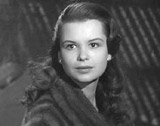 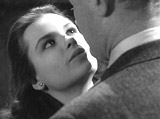 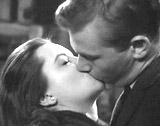 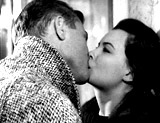 Susan (Susan Harrison) with Steve Dallas (Martin Milner) 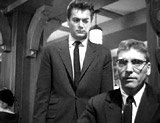 Sidney Falco (Tony Curtis) and J.J. Hunsecker (Burt Lancaster) 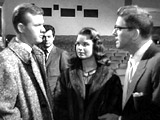
|
||||||||||||||||||||||||

|
Cat on a Hot Tin Roof (1958) The Southern marital drama by director Richard Brooks Cat on a Hot Tin Roof (1958) was a powerful, highly-charged, moving story of a neurotic, dysfunctional Southern family with its rivalries, tensions, and avarice. Its provocative screenplay by Richard Brooks and James Poe was adapted from the Pulitzer Prize-winning play of the same name by Tennessee Williams. Because of strict censorship Production Codes in the late 1950s at the height of Hollywood's concern about film content, it was completely bowdlerized. All references to homosexuality and four-letter words were deleted, watered down, or obscured from the shocking, original play, and the ending was considerably changed from the original Tennessee Williams play. The homosexuality of the male lead (Paul Newman) was eliminated. He refused to sleep with his wife, not because he was gay (the reason in the original play), but for other reasons. As a result, the film's references to sexuality were almost illogical and incomprehensible. The action occurred on the occasion of the 65th birthday of 'Big Daddy' Pollitt (Burl Ives reprising his stage role) - the patriarchal plantation head (who was secretly suffering from terminal cancer), when the greater Pollitt family gathered and inevitably quarrelled - greedily - over the granting of the expected inheritance. Elizabeth Taylor co-starred as the passionate, provocative, sexually-frustrated and deprived feline Maggie ("The Cat" in the film's title). Her sizzling advances and lustful cat-like sensuality (often while wearing a white slip) were thwarted in her difficult marriage. She was frustrated by the unloving temperament of her alcoholic, injured (with a broken ankle), impotent, sexually-conflicted and apathetic husband Brick Pollitt (Paul Newman). The tension between the two was one of unhappiness and sexual discontent - Maggie and Brick no longer shared a marital bed in their passionless marriage, since he refused to sleep with her. She was intensely frustrated by her husband's rejection. In one of the film's most famous scenes, a sensual but deprived Maggie described her obsessed, passionate feelings for a husband who wouldn't bed her or touch her:
Love and sex-starved from Brick, she admired her father-in-law's lechery, believing that he found her sexually attractive: "I think it's mighty fine the way that ole fellow on the doorstep of death still takes in my shape with what I consider deserved appreciation." It was later revealed that Brick was mostly suffering from the suicidal death of his friend Skipper whom he loved - while Maggie had opposed Skipper ("I hated Skipper, because you loved him so much!"). [In the play, Maggie had allegedly seduced Skipper, an instance of heterosexual infidelity - to keep their homosexual relationship at bay - an important plot element missing in the film. Now, the story had been modified to suggest that Skipper had seduced Maggie.] After Maggie suggested that she cheated on Brick with his now-deceased best friend, Brick had since refused to sleep with her. Infuriated by reminders of the truth [a homosexual relationship or "friendship" was heavily disguised in the film], Brick wished for her to not bring up the forbidden subject. Maggie kissed Brick on the mouth in front of Big Daddy, but Brick almost immediately wiped off his lips with the back of his hand. Big Daddy criticized Brick for his marital problems, their childlessness (after hearing reports from his wife Big Mama that Brick refused to sleep with Maggie, and his drinking. Brick became fiercely defensive of his noble, incorruptible, idealized relationship with his deceased friend [a veiled defense of innuendo regarding his homosexual relationship]. Brick disavowed any "shameful" or "filthy" interpretation. He asserted to his wealthy plantation owner father that he had an implied relationship with Skipper:
Brick's marriage to Maggie was altered by his unnatural affection for Skipper (a "great and true friendship"). Big Daddy suggested that Skipper's suicide occurred when he cracked up:
Ill-advised, Maggie had tried to keep Skipper from coming between her and her husband. She was with Skipper in a Chicago hotel room following a disastrous football game loss - before his suicidal death. To end the strong affection between Skipper and Brick [and to test her suspicions about an unnatural (homosexual) relationship between them], Maggie thought she could lead Skipper to sleep with her to arouse her husband's anger at his best friend [and to prove that her suspicions were untrue - that Skipper was indeed heterosexual.] Brick admitted that he felt responsibility for Skipper's despairing death because he had rejected his friend and ruthlessly hung up on his anguished call from the hotel room. He projected onto Maggie his own guilt about Skipper's death. He rejected his own manhood and alienated himself from her in their marriage. In the film's denouement, to help win Big Daddy's favor and inheritance for Brick (and because of her genuine concern for Big Daddy and Brick), Maggie shocked the assembled gathering around the dying Big Daddy by announcing her surprise birthday present for him. She had cunningly fabricated the lie that she and Brick had reconciled and she had conceived Brick's child ("I have Brick's child in my body. And that is my present to you") - there was the coming of new life that Big Daddy had hoped for. She helped bring a reconciliation between the dying man and his estranged son. Finding a new lease on life following the discussion with his father, Brick backed her up and confirmed that Maggie was going to bear his child. Brick commanded her to join him in the bedroom, and she thanked him: "Thank you for keepin' still, for backin' me up in my lie." Brick told her that they would make the lie come true:
The film faded out on their embrace and kiss as he tossed his pillow from the couch onto their bed - the one that they would now share. |
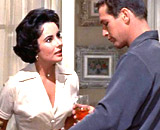 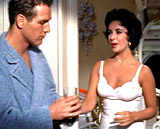 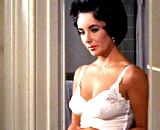 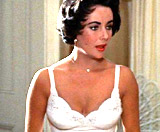 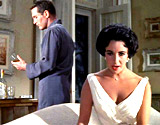 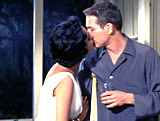 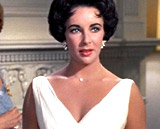 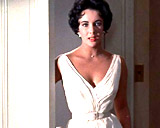 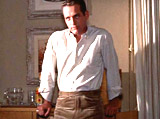 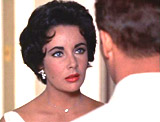  Maggie the Cat (Elizabeth Taylor) with Brick (Paul Newman) |
||||||||||||||||||||||||
|
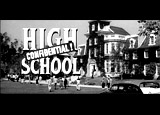
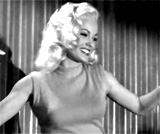
High School Confidential! (1958) Jack Arnold's exploitative, juvenile delinquent ("wild youth") B-film cult classic was the first of three Mamie Van Doren films produced by Albert Zugsmith, followed by College Confidential (1960) and Sex Kittens Go to College (1960). It featured drug trade in a high school, lots of 50's slang words, and hep-talk beat lingo: ("Don't flip your lid", "I dig you," "Do you want to start a rumble?", and "If you flake around with the weed, you'll end up using the harder stuff"). There was also a switchblade fight, jalopy drag racing, and beatnik poetry, and the assertion that marijuana use led to hard drugs (such as heroin). Some of the scenes of High School Confidential! were re-shot for more liberal European standards, such as the shot of a young girl named Doris (Jody Fair) in overdosing or withdrawal agony (and partially unclad) in an adjoining room - and possibly being pressured into being raped. The film with an anti-drug message appeared on screens soon after similar films, including Laslo Benedek's The Wild One (1953), Nicholas Ray's Rebel Without a Cause (1955), and Richard Brooks' The Blackboard Jungle (1955). Platinum blonde sex starlet Mamie Van Doren was one of the leading sex symbols of the day, known as one of the three M's (the others were Marilyn Monroe and Jayne Mansfield). She had earlier starred as Penny Lowe in a late 50s teen movie hit titled Untamed Youth (1957) -- a women's prison farm musical. Van Doren appeared as co-actor Russ Tamblyn's 'bad girl' nympho, cat-in-heat guardian-aunt Gwen Dulaine, vamping throughout the film when her husband Vic was absent. In the film's opening, crooner Jerry Lee Lewis (as Himself) sang the title song from the back of a flatbed truck, while high school teen couples danced outside Santa Bella HS. In Mamie's first scene, she appeared in her kitchen, bath-robed and sexually-aggressive when she asked her younger 'nephew' - authority-defying, troublesome, switchblade-carrying new high-school transfer student Tony Baker (Russ Tamblyn): "Are you looking for excitement?" as she bit into an apple, and then she jealously worried about his dating prospects in high school: "That's why I worry, thinking of you coming up against those young, tight sweaters." With her husband Vic away, she came onto him: "Stop treating me like a stranger. With Vic out of town, it's lonely. Relatives should always kiss each other hello and goodbye, polite-like" - and she planted a passionate kiss on him. He revealed his arrangement with her - she was being paid to provide him with room and board and nothing more. Later, Tony's conservative school counselor and teacher Miss Williams (Jan Sterling) visited Tony's sultry Aunt Gwen to see about his living situation as a clue to his outrageous behavior. When Tony's teacher arrived, Gwen sported a tight-sweatered, pointed 'bullet bra' covering her protuberant breasts. She began smoking and pouring herself a drink, as they confronted each other:
After Miss Williams left as Tony arrived home, Gwen alerted him: "Your teacher's got a yen for ya...Don't forget. I really know you're not a baby." In Tony's bedroom, the sex-starved seductress rolled around on his bed while Tony changed his clothes behind his closet door. She demanded his immediate attention rather than to his girlfriend Joan Staples (Diane Jergens):
She vaguely threatened to expose him - although it was unclear what she was getting at. |
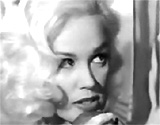 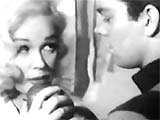 Aunt Gwen to Tony: "Are you looking for excitement?" 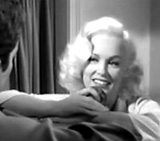 "Thinking of you coming up against those young, tight sweaters." 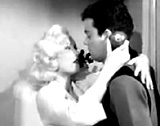 "Stop treating me like a stranger." 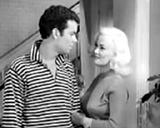 Gwen to Tony: "I really know you're not a baby." 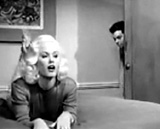 Gwen Rolling Around on Tony's Bed As He Undressed 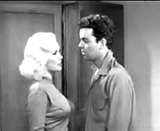 "Pay attention to me...I'm lonely." 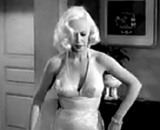 "Aunt" Gwen - Drunk 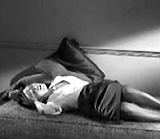 Heroin-Addicted Doris  Deleted From Some Versions |
||||||||||||||||||||||||
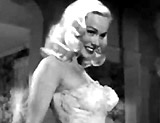
Mamie Van Doren's Films (1957-1964) Scandalous roles for Van Doren occurred in drive-in quickies, juvenile delinquent films, or sexploitation films, in which she often co-starred with younger actors:
|
||||||||||||||||||||||||||
|
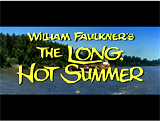
The Long, Hot Summer (1958) Martin Ritt's sultry southern romantic melodrama adapted a melange of William Faulkner stories. This was the Fox film that was made during the passionate courtship (in their first film together) of a future husband-wife:
Their scenes at a picnic, and in a department store after closing time were sensually hot and exuded on-screen chemistry - w/o nudity or explicit sexual love scenes (except for kissing). Clara repeatedly turned down Ben's seductive come-ons. She gave him a memorable speech about her ideal relationship. |
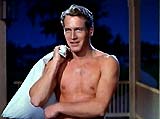 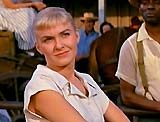 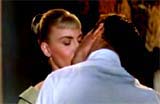
Ben (Paul Newman) with Clara (Joanne Woodward) |
||||||||||||||||||||||||
|
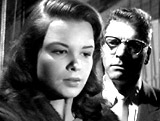
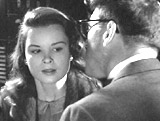
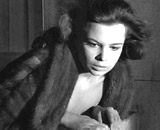
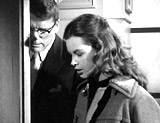
Louis Malle's scandalous second feature film The Lovers was an over-rated tale of French adultery and feminine liberation (with minimal nudity). A Cleveland Heights, Ohio theatre manager was convicted and fined $2,500 for screening this 'obscene' erotic film (later overturned by the US Supreme Court 1964 ruling in Jacobellis v. Ohio with Justice Potter Stewart's famous and much-quoted definition of obscenity: "I know it when I see it...") - delaying the film's US release. Its notorious tale was about a repressed, sexual-yearning married family woman who was experiencing a mid-life crisis and a "double life. The main character was:
She was engaged in a weekend affair (twice a month to start, but then increasingly more frequent) in Paris with suave Spanish polo player Raoul Flores (Jose Luis de Villalonga) while unhappily married after eight years to job-devoted, disinterested Dijon newspaper proprietor Henri Tournier (Alain Cuny) of the Burgundy Monitor. Between them, they had a daughter named Catherine. Jeanne then became involved in a second affair with young archaeology student and brief houseguest Bernard Dubois-Lambert (Jean-Marc Bory) after their chance meeting by the roadside when her car broken down. He drove her to her husband's countryside Dijon villa where he was invited to spend the night. During a sleepless night, a casual love affair developed between Bernard and Jeanne who, by chance, met in the moonlight gardens of the villa, with the first indication that they would be intimate when he put his hand over hers, grasped it, and then came close to her. She narrated in voice-over:
In an almost-wordless, extended 20-minute sequence at film's end to the sounds of Brahms' 'Sextet No. 1 in B-flat Major' playing on the soundtrack, they strolled through the surrounding environs. After releasing some of Henri's trapped fish from a cage, they experienced their first tender kisses. They continued to passionately get familiarized with each other while drifting in a rowboat, and then returned to her second floor separate bedroom, where he kissed her, expressed his love: "I love you and I love Catherine."
He removed her nightgown, and kissed her on the bed (with a quick view of the heroine's left nipple) before making love to her. Her opening hand going limp signaled pleasurable release during a non-explicit, understated scene of female oral sex. Afterwards, she continued kissing him, telling him:
They then shared a bathtub soaking together and afterwards bedded down again with Jeanne stroking his hair and assuring him: "We'll sleep together always. I'll take care of you. My life for yours. We'll be fine. You'll see." She promised: "When our morning comes, we'll be far from here," and after she pledged herself to him, he replied: "Let's get out of here." The adulteress scandalously abandoned her family by driving off with Bernard after their passionate night, while the rest of the group was assembling at 4 am for a fishing excursion. The film ended with her voice-over narration:
|
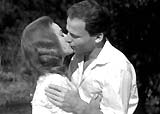 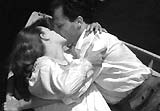 Affair: Jeanne (Jeanne Moreau) with Bernard (Jean-Marc Bory) 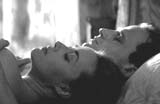 Bedroom Sex 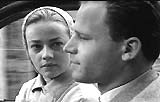 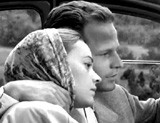 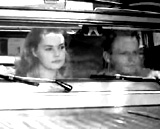 Driving Off Together - Toward An Uncertain Future |
||||||||||||||||||||||||
|
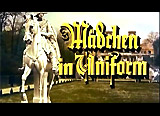
Mädchen in Uniform (1958, W. Germ.) (aka Girls in Uniform) Although made in 1958, this landmark lesbian film wasn't released in the US until 1965. In fact, it was a remake of an earlier controversial film made in 1931 in West Germany with an all-female cast. Both films were based on Christa Winsloe's novel/play Gestern und Heute. The plot told of young boarding-schoolgirl Manuela Von Meinhardis (Romy Schneider) who developed a lesbian attachment to her sympathetic teacher Fraulein von Bernburg (Lilli Palmer) in a Prussian boarding school for girls. During the dormitory goodnight sequence in this film, the Fraulein only planted a kiss on Manuela's forehead, but they kissed in her school classroom. Later, Manuela publically declared her scandalous love for her teacher to the school's superiors and other girls. She was accused of being "depraved" and having "an unhealthy fascination" for her teacher by the Sister Superior. Threatened with losing her job even the Fraulein told Manuela: "Your love for me is wrong." In the film's conclusion, the heartbroken Manuela threatened to jump to her death from the school's upper stairwell, but was restrained. The Fraulein had the option to stay at the school, but declared resolutely and positively:
Manuela reacted by rolling over and smiling in her infirmary bed as the film ended. |
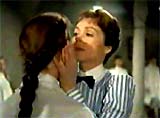 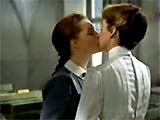 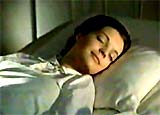 Manuela (Romy Schneider) with Fraulein (Lilli Palmer) |
||||||||||||||||||||||||

|
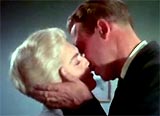
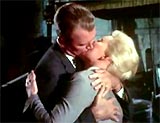
Vertigo (1958) Director Alfred Hitchcock's critically-acclaimed, non-explicit, subtle masterpiece of obsessive love Vertigo (1958) was a dark film without explicit scenes of sexuality. Retired detective John "Scottie" Ferguson (James Stewart), during an investigation of an old friend's blonde wife named Madeleine (Kim Novak), rescued her from drowning in SF Bay. The thriller film made the implication (with a slow panning shot around his apartment) that he had seen his unconscious victim naked after removing her clothes and placing her in his bed in his apartment. She was fearful and startled to find herself in a strange man's bed (and presumably naked). With a slight smirk - since he had previously seen her naked as he assisted her, Scottie chivalrously offered his maroon robe for her to wear. When she seductively and gracefully appeared at his bedroom door wearing his silky robe and posing for him, they had their first conversation as Scottie began to be bewitched by her. He developed an obsessive love for the enigmatic female. At one point, she appeared frightened and ran down to rocks at the water's edge. He raced after her and they embraced - in a perfect synthesis of both death and erotic romance within their relationship:
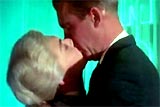
Vowing to protect her from harm (and thereby possess and identify with her, even if it meant personal annihilation due to her death wishes), they again clung to each other and kissed passionately as the turbulent waves once more crashed melodramatically into the rocks behind them. The climactic scene fadesd to black. When she died from an apparent suicide (that Scottie couldn't prevent due to his fear of heights and vertigo), he experienced a nervous breakdown until he met a brunette 'Madeleine look-alike' named Judy (Kim Novak again) - who unbeknownst to him - was in on the plot to stage the wife's murder earlier. Guilt-ridden, she played along with Scottie's fetishistic, manipulative, and compulsive needs to make her over and appear like the dead Madeleine - ultimately revealed as a ghostly figure bathed in the eerie greenish-tinged neon light of her cheap hotel room. As he embraced her in the glow (and the camera circled around them during a kiss), there were creepy hints of psychological necrophilia.
Her metaphysical, spiritual figure assumed solid shape as she moved out of the ghostly green light and crossed the floor to him, to surrender to him. They embraced and kissed passionately. The camera panned and swirled completely around them as they kissed, causing the walls of the room to appear to turn and change. Their background surroundings dissolved and placed them in the past - in the dark livery stable in Scottie's subjective imagination - the location at San Juan Bautista where he had attempted to cure Madeleine's hallucinations. Completely lost in the dream, overlapping fantasy and reality as Judy became one with Madeleine, Scottie also surrendered to her and she clung to him. The loving couple continued kissing passionately in front of the pale, greenish haze of the window. Later (after consummating their love?), they were sitting together and relaxing in her hotel room. |
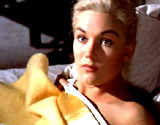 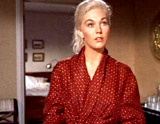 Madeleine (Kim Novak) 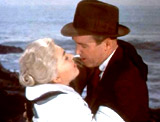 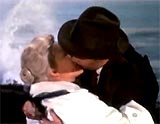 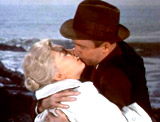 Madeleine Kissing Scottie (James Stewart) In Front Of Thunderous Waves |
||||||||||||||||||||||||
|
Anatomy of a Murder (1959) Otto Preminger's daring courtroom drama was another of his 50s films that confronted the Production Code's and the Legion of Decency's stringent regulations and censorship. The sensational elements in the film included the shocking-at-the-time, frank and clinical dialogue with the taboo words: "panties," "sperm," "spermatogenesis," "intercourse," "rape," "contraceptive," "bitch," "slut," "sexual climax," and "penetration." It involved the case of an Army lieutenant Fred Manion (Ben Gazzara) who was charged with killing his trampy wife Laura's (Lee Remick) rapist - bar-owner Barney Quill, in the presence of many witnesses. The courtroom deliberations were conducted between:
Biegler used the argument of 'irresistible impulse' (or temporary insanity) in the presence of trial judge Harlan Weaver (Joseph Welch, a real-life Boston trial lawyer famous during the McCarthy hearings). |
 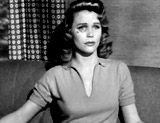 Battered and 'Raped' Wife - Laura Manion (Lee Remick) 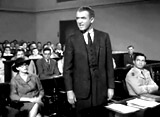 Defense Lawyer Paul Biegler (James Stewart) |
||||||||||||||||||||||||

|
Ben-Hur (1959) Acclaimed director William Wyler's Best Picture winner Ben-Hur (1959) contained an interesting, non-overt homosexually-tinged subtext in the relationship of the two main friends/combatants, Roman and Jewish childhood lovers in the past:
Their greeting scene expressed the best evidence of their unusual relationship when they both threw spears at a wall. Messala made the cheery comment to Judah:
They grasped forearms for a lengthy time. They also blended arms as they drank a toast to each other. |
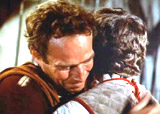 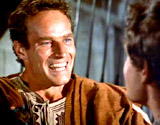
Judah (Charlton Heston) with Messala (Stephen Boyd) |
||||||||||||||||||||||||

|
The Best of Everything (1959) Jean Negulesco's underrated,CinemaScopic campy melodrama was an urban Peyton Place. Its social themes included the world of working women and adultery, love vs. career, unwed pregnancy, abortion, casting couch seduction, and alcoholism. The influential CinemaScope film was advertised as a cinematic work that: "Nakedly Explores the Female Jungle Where Women Fight and Love Their Way to the Top - To Get the Things and Men They Want!" It also stated in the trailer that: "It undresses the ambitions and emotions of the girls who invade the glamour world of the big city, seeking success, love, marriage, and the best of everything...and who often settle for much less." It was Hollywood's look at the new sexual morality of the time ("This is a story of the female jungle, of the girls who didn't marry at twenty, and of the men who wanted them - but not as wives"). It told about three aspiring young starlet-secretaries in the glamorous world of publishing in New York City, at the Fabian Publishing Company:
The film also implied what might happen to a working woman if she never married - the result would be the ruthless, sterile and calculating editor Amanda Farrow (Joan Crawford), who was engaged in an unsatisfying affair with a married man. She eventually married an old acquaintance, a widower from Illinois, but was dissatisfied with a life of domesticity and returned to the work world. Some of the most quotable lines included:
|
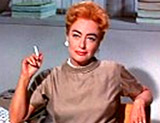 Amanda Farrow (Joan Crawford) 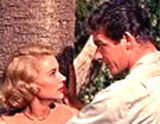 Caroline (Hope Lange) and Mike (Stephen Boyd) 
April (Diane Baker) and Dexter (Robert Evans)  Gregg (Suzy Parker) and David (Louis Jourdan) |
||||||||||||||||||||||||

|
Blue Denim (1959) 20th Century Fox released this controversial teen exploitation/social-issue film by director Philip Dunne, with a score by Bernard Herrmann. Due to its subject matter about adolescent sexuality and teenage pregnancy (and abortion), the film was censored in Memphis and Dallas. The film's tagline only hinted:
This fairly insensitive melodrama preached the dangers of late 50's pre-marital sex between a young unmarried couple - two virgins:
When she was "in trouble," he caught her in the library looking at a book with the chapter heading: "PREGNANCY - The First Stages." She was distraught: "But they don't tell you how to stop it!" On one of the film's posters, Janet was quoted as saying: "Maybe I could just disappear somewhere or - just kill myself." Arthur responded: "I'm responsible and I know a way out!...I'll take care of everything." He sought an $150 illegal backstreet abortionist ("that doctor - for girls") for Janet (yet the word 'abortion' was never used in the film) after she became pregnant. In fact, the word "murder" was used to refer to the operation to end the pregnancy. In the original Broadway stage play, Janet actually had the abortion, although in the film version's upbeat 'Hollywood' ending (a modified storyline due to the Production Code), she was 'saved' from going ahead with the 'dirty deed' and planned to marry Arthur and keep the child. Arthur joined her on the train traveling out of town - promising to get married to her (thereby sacrificing his career), while she lived at her Aunt Clara's house before having the baby. |
   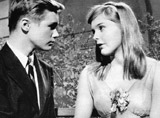 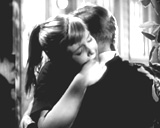 Arthur (Brandon De Wilde) and Janet (Carol Lynley) |
||||||||||||||||||||||||

|
Girls Town (1959) This teen sexploitation film about youthful rebels from MGM featured B-movie sexpot Mamie Van Doren in the lead role. It contained vulgarity, horny makeout sessions, catfights, lesbianism, drag racing (games of "chicken"), and more. Censors were angered by views of the naked back of Van Doren as she showered. It was sensationally marketed with lines such as:
27 year-old Van Doren starred as sexy, misbehaving 16 year-old juvenile delinquent Silver Morgan, who was falsely accused of a crime (the death of rapist Chip (Harold Lloyd, Jr.)). She was sent to a reform-school correctional institution run by Catholic nuns. |
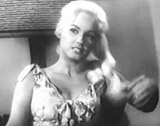
Silver (Mamie Van Doren) |
||||||||||||||||||||||||

|
Hiroshima, Mon Amour (1959, Fr./Jap.) Director Alain Resnais' artistically-intimate French "New Wave" art-house film (with flash-forwards and flashbacks) displayed a brief love affair between a cross-racial, cross-cultural couple who were committing an intimate act of adultery. The film was considered shocking and provocative in the late 50s. In this story of contrasts, nameless French actress "Elle/She" (Emmanuelle Riva) from Nevers was shooting a film about peace in the city of Hiroshima. She engaged in a tragic love affair with Japanese architect "Lui/He" (Eiji Okada) from the city. They referred to each other by the names of their hometowns. In the opening lengthy montage-scene, their discreetly-nude bodies were held together and entwined - with both ash and then rain blowing across their skin (recollecting the horrific scenes of devastation caused by the atomic bomb at Hiroshima). |
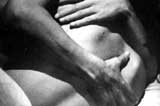   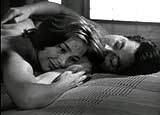 Elle (Emmanuelle Riva) with Lui (Eiji Okada) |
||||||||||||||||||||||||
|
To skirt censorship laws, movies like The Garden of Eden (1954) claimed to be “educational” documentaries about nudism. In 1955, a New York judge finally ruled that nudism in itself was not obscene; the Supreme Court basically followed suit in 1957. Then, after the legal rulings were in favor of nudism in films, Russ Meyer released this low-budget ($25,000) landmark film - his first commercially-successful effort that was the first soft-core film to exceed the million-dollar mark. It was advertised as a "frenchy comedy for unashamed adults - in revealing Eastman color." It was the first of a so-called trilogy of 'nudie-cutie' films for Meyer:
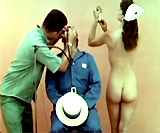
This was the first non-pornographic 'above-ground' film to exhibit female nudity (breasts and butts only) without the pretext of naturism, although it was also of the no-touch variety. Therefore, it was considered the first official 'skin-flick' (but still discreetly devoid of genitals in view), that at the time was called a 'nudie-cutie.' It was the essential link between the culture's post-war fascination with the female breast (the three M's: Marilyn Monroe, Jayne Mansfield, Mamie Van Doren), and the popularity of Playboy Magazine. Soon would come the first open views of genitalia in director John Lamb's nudist film The Raw Ones (1965), and then the emergence of hard-core pornography ("porno chic") in the 70s, such as Deep Throat (1972). The hour-long, dated and very repetitious fantasy-comedy, without synchronized spoken dialogue, was about a voyeuristic California delivery man (or handyman) and door to door worker named Mr. Teas (Bill Teas), a repressed man who was often preoccupied with sex. His work outfit was a straw hat and orange overalls. The middle-class delivery man - with a boring and repetitive job - who lived and worked in a metropolitan city, was described as a "simple, uncluttered fellow who merely lives from day to day." During his rounds on a red Schwinn bicycle, the breast-obsessed, goateed gentleman ogled various women in low-cut tops in everyday, naturalistic settings. For example, as he entered a dental office waiting room, he fantasized that the assistant's (Marilyn Wesley) open-zippered white uniform displayed her breasts. At a coffee shop, he lecherously stared at the v-necked black top of his busty server (Ann Peters). He also lasciviously watched as a secretary (Mischele Roberts) with a low-cut dress typed and worked at her desk. [Note: In all three cases, he would later imagine them as fully naked.] On a day off, Mr. Teas rode his bicycle to the beach to escape the city. He strode along the shore line with his closed umbrella as a walking stick, trying to avoid staring at lovers under a large beach umbrella. He watched as a pretty red bikinied blonde beauty (Dawn Danielle) was having topless pictures taken (and snuck a few pictures himself), and then observed as she frolicked in the surf and removed her bikini top. While he was fishing a short while later, the beauty rowed up and sunbathed topless next to him - to his consternation. Later during his rounds, he returned to the dentist's office and complained of a tooth-ache. While he was having a tooth pulled after being injected with an anesthetic, he saw (in his dream imagination) the dental assistant (Marilyn Wesley again) without her clothes; the anesthetic appeared to have a lasting effect upon his brain - he was able to mentally undress women. After the procedure, he unpeeled a banana as he stood in front of a gigantic display of melons and other round fruits. He looked around and saw a nude torso (June Wilkinson) in a window. There was the obvious sight-gag - he bounced two large round melons in each hand. In an alleyway, he was enticed by a buxom female (Althea Currier) to follow her up a fire escape - and then inside the building, he watched her iron some clothes. He returned to the coffee shop where he ordered a huge slice of pink watermelon, and imagined the waitress (Ann Peters again) serving him naked (except for a white apron). Outside a marquee advertising a peep show, he followed a stripper (Althea Currier again) down an alleyway to a side entrance, and then watched as she undressed and prepared for her burlesque strip club show. He watched her perform from the side of the stage as she stripped out of her black dress to panties and red pasties. Then, he visited the office secretary/typist (Mischele Roberts again) and imagined dictating a letter to her as she was nude.
After all of these strange fantasies and hallucinations, the off-screen narrator (or documentarian) (G. Ferrus) asked:
Worried about a "sick" mental disorder or neurosis that he might be developing, he met with a psychiatrist, Dr. C.P. Floodback (Mikki France). After Freudian-styled therapy on a couch, Mr. Teas returned to his normal life with "newfound confidence." During a fishing outing, Mr. Teas fell asleep - and began to fantasize wildly about what he had earlier experienced. He spied (peeped) on three naked females while they were nude sunbathing in the outdoors nearby. He realized that they were the same women from his other experiences:
He watched as they went row-boating, and then caught more rays of sunshine. The corny and whimsical narrator provided non-sensical commentary aft:
Mr. Teas also observed them skinny-dipping, and swinging in a rubber tire attached by rope to a tree. He also watched as:
And then he awoke from his slumber, and found a new fishing spot. As he threw out his fishing line, it became caught on the black bra of the blonde waitress (she had thrown it onto some plants). She was by herself and was skinny-dipping. This proved to him it wasn't entirely a dream. He returned to the bespectacled psychiatrist - who now was taking notes and then appeared naked in front of him - the film's punchline was provided by the narrator who intoned:
|
 Mr. Teas (Bill Teas)  Dental Office Receptionist (Marilyn Wesley) 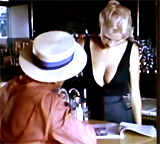 Coffee Shop Waitress (Ann Peters) 
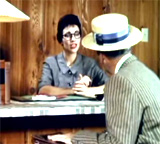 A Visit to a Psychiatrist (Mikki France) Mr. Teas' Sleep-Dream While Fishing  Peeping On Three Sunbathers  Three Nude Sunbathers  Three Nudes Row-boating  (l to r): Secretary, Coffee Shop Waitress, Dental Assistant  Two of the Three Sunbathers  More Sunbathing  The Dental Assistant on an Inflatable Raft     Nude Guitar-Playing (Mischele Roberts) - The Secretary  Bathing (Ann Peters) - The Waitress |
||||||||||||||||||||||||

|
North by Northwest (1959) Director Alfred Hitchcock was always able to skate around the censors, as he cleverly did in the classic suspense thriller North by Northwest (1959), with its sexy close-quarters travel (in a cross-country train compartment). During the main protagonist's flight in the direction of north by northwest, the dapper man traveled from New York to Chicago via the 20th Century Limited train. He engaged in a long series of seduction scenes, intriguing and suggestive dialogue, kissing (circular) motions and romantic intentions. The two lovers were:
In the film's twisting plot, Thornhill was menaced and mistaken for someone else by master-criminal Phillip Vandamm (James Mason) and his homosexual hitman Leonard (Martin Landau), and mocked by his mother Clara (Jessie Royce Landis).
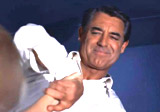
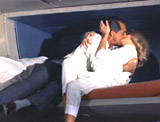
In its final clever Freudian transition, Thornhill tugged on Eve (hanging on the immense carved stone face of Mount Rushmore) and - CUT - pulled her up into a berth to make love to her in the interior of a Pullman sleeping car (that was heading into a dark phallic tunnel). |
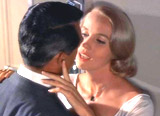 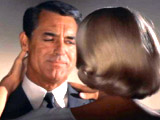 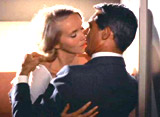 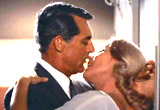
Roger Thornhill (Cary Grant) with Eve Kendall (Eva Marie Saint) |
||||||||||||||||||||||||
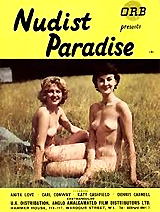
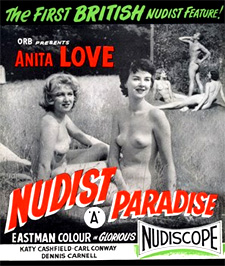
Nudist Paradise (1959, UK) (aka Nature's Paradise)
The plot was sensationalized:
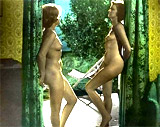
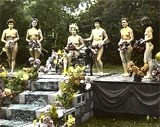
Its simple story was about a relationship that developed in England between American art student Mike Malone (Carl Conway) and a nudist woman named Joan Stanton (Anita Love). She regularly visited England's Spielplatz nudist camp (in St. Albans) every weekend, now accompanied by friend Pat Beatty (Katy Cashfield) who became hooked on visiting the 'nudist paradise' with her. There at the naturist camp, Mike met Joan as the nudists gathered together for the annual Venus Contest, composed of still-life classic poses of the naturists (holding a mirror, beach ball, and tennis racket). There they also experienced a nudist beauty contest and a nudist wedding. |
|
|||||||||||||||||||||||||

|
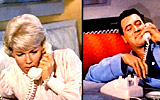
Pillow Talk (1959) This virginal, maturely-risque and sexy romantic comedy was one of the largest grossing films of the late 1950s (at $18.75 million) - and considered quite racy by its studio, Universal. It starred one of the most successful moneymaking stars of the 50s -- Doris Day, a squeaky-clean, non-threatening, old-fashioned and classy actress. The classic film acquired five Oscar nominations (with one win for Best Story and Screenplay). It was the first (and best) of three similar films with Oscar-nominated Doris Day and co-star Rock Hudson:
It featured a battle of the sexes during the erotic courtship of the two main characters, exemplified by their naughty double entendres:
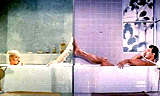
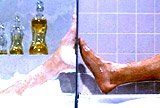
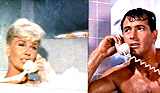
They shared a party phone line (splitting every hour of the day in two) and were constantly on the phone - usually viewed in split-screen to create the illusion and imply that they were together and involved sexually (in the bathtub, in bed, etc.) when they really weren't. They both stretched out in separate bathtubs and their bare feet seemed to touch - through the split-screen.
In one of the film's most prophetically-ironic scenes, Rock Hudson's (who was a straight actor who was a closet homosexual) character posed as 'gay,' wealthy, chivalrous and naive Texan 'Rex Stetson' in order to bed the Doris Day character (he extended his pinkie finger when taking a drink). Exasperated by his gentlemanly and apparently guileless ways, she was anxious to actually be romanced by him:
She was completely flustered by a set of passionate kisses, and excused herself to go to the powder room to fix her lipstick. Shortly later, 'Rex'/Brad schemed to take Jan to a Connecticut country home for the weekend, where he was attempting to "score" with her. He wooed her by a fire with chilled champagne, telling her: "You're more like a forest fire, completely out of control." They shared some steamy kisses, after which he advised: "The fire's nearly out. I'd better get some more logs." But his ruse was discovered and she was furious with him. She ran to her room and slammed the door. |
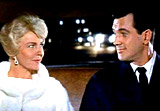 Jan Morrow (Doris Day) and Brad Allen (Rock Hudson) 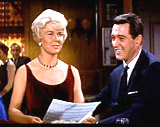 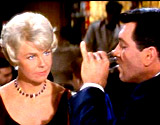 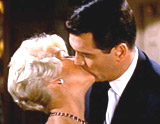 Brad as Texan Rex 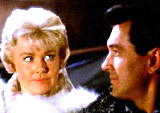 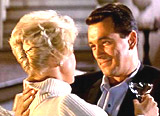 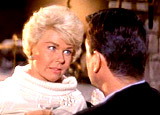 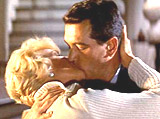 Seduction in Country Home |
||||||||||||||||||||||||
|
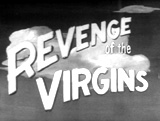
Revenge of the Virgins (1959) Directed and produced by Peter Perry, Jr. (his first feature), this early "nudie-cutie" western flick was scripted by notorious cult director and filmmaker Ed Wood (with the name of Pete LaRoche), who was transitioning to seedier film material. In the hour-long storyline (with a bit of nudity but no explicit sexual sequences), white treasure hunters were assailed by fiercely angry and topless Native American females (known as "The Golden Horde") who battled with them to protect their sacred grounds (and its gold treasure). All of the females were allegedly strippers or pin-up models (and none were of Native-American ancestry) (Joanne Bowers, Pat O'Connell, Jewell Morgan, Betty Shay, Jan Lee, and Ramona Rogers). None of them spoke a single line of dialogue. The leader of the six members of the savage and feral female tribe was "Yellow Gold" (Nona Carver), a blonde-haired white goddess. The film opened with the narrator (Kenne Duncan) describing the legendary history of the 'virginal' tribe that refused to be converted to Christianity and was opposed to the white man's encroachment. They defended and lived in an area that was thought to be rich with gold:
Even before the credits, there was a brief glimpse of one of the topless tribe members shooting off an arrow. The film opened in a frontier town with the introduction of a couple seeking to buy a saloon: city slicker Melvin Potter (Charles Veltman) and his greedy, domineering and sexy wife Ruby (Jodean Russo), who had only one motive in life: "I wanna make money. Big money!" They learned from hard-drinking, crusty-old gold prospector "Pan" Taggart (Stan Pritchard) about his crazed belief that there was a mother lode of gold at Gold Creek located deep in Indian Territory. A group of individuals was assembled to trek to Gold Creek: the two Potters, "Pan" Taggart, and two other untrustworthy, scheming and despicable outlaws: gunslinger Wade Connor (Hank Delgado) and gunslinger Mike Horton (Hugo Stanger). Later, they were joined by two Army Cavalry deserters: Jones (Lou Massad) and Curt (Del Monroe). Along the way to the gold and after arriving at their destination, the members of the expedition-party were shot one-by-one with arrows. The natives on the warpath performed a ritualistic war dance by hopping around on one foot circling their "Yellow Gold" leader, and then kneeling as the Goddess danced inside the circle. "Pan" Taggart died with an arrow in his back just as he discovered gold, and Ruby was stabbed to death. Later with only two white men left, Melvin was shot by the double-crossing gunslinger Connor, but Connor luckily survived (the bullet hit a silver dollar inside his vest). He turned the tables on his killer and murdered Connor.
The film's final images, as the drum beat intensified, were of the female Indians stalking, swarming around, and then ambushing the last male victim - Melvin. The film ended with the Narrator's warning:
|

Pre-Titles 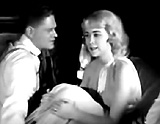 Ruby With Husband Melvin: "I wanna make money, big money!" 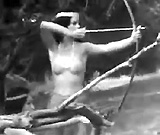 Native Tribe Member Attacking White Men 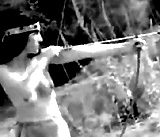  Death of "Pan" Just As He Discovered Gold  Tribe Members  Melvin Shot in the Back - Double-Crossed by Connor  Tribe Members' Final Ambush of Melvin |
||||||||||||||||||||||||

|
Shadows (1959) Pioneering independent filmmaker John Cassavetes' low-budget, controversial, pre-cinema-verité first feature film has often been cited as the start of the independent feature movement in the US with its daring subject matter, and a non-professional cast and crew. The film was first shot in 1957, then screened, re-edited and re-shot in the following years, and re-released. It told the story of an inter-racial couple in 1950s bohemian New York City:
They experienced a brief love affair (a sex scene between the lovers was filmed for the second version), and they made love.
Their first sexual experience was disastrous. While still in bed, as he caressed her hair, he confided:
Later on, back in Lelia's apartment, Lelia's brother Hugh (Hugh Hurd) arrived. She kissed him and hugged friend Rupert (Rupert Crosse). In a long close-up, Tony revealed his disgust, realizing that because her brother was black, she must also be black. He was repulsed, and his face grimaced. He told them: "I have an appointment. I have to go." Lelia confronted him at the door as he left after realizing his spurned reaction: "Tony, I love you. Doesn't that mean anything?" |
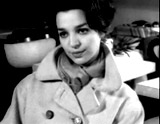 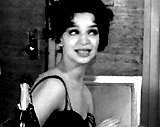 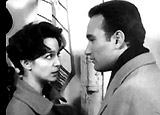 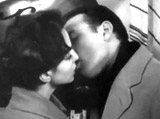 Lelia and Tony  Lelia Kissing Black Brother Hugh (Hugh Hurd)  Tony's Reaction |
||||||||||||||||||||||||

|
Solomon and Sheba (1959) This Technirama Biblical epic was King Vidor's last film. The sand and sandal film, similar to the earlier films of Cecil B. DeMille, pushed the Hays Code to its limits. Robert Aldrich's Sodom and Gomorrah (1962) also featured debauched sex, sin, and exotic belly-dancing, with a famed opening tracking shot over the intertwined bodies of exhausted orgiasts. It began with the long-standing enmity between Egypt and the fabled land of Israel, a kingdom commanded by David (Finlay Currie) and his two sons: warrior Prince Adonijah (George Sanders) and poet/songster Prince Solomon (Yul Brynner with a head of hair!). The benevolent younger Solomon was chosen to become king upon David's death, and inherited the kingdom of Israel, while Adonijah declared that he had been robbed of his birthright. As Solomon was building a temple to Jehovah in Jerusalem, he was targeted by the Egyptian Pharaoh (David Farrar), who allied and conspired with the hot-blooded seductive temptress and pagan spy the Queen of Sheba (sultry post-war Italian actress Gina Lollobrigida). She was offered the port of Melish on the Red Sea in return for bringing Solomon's downfall. She predicted that Solomon had a "human weakness," and schemed: "The way of a woman is simple, my lord. It is always to follow the way of a man." But when she traveled to Jerusalem, she found it impossible to be alone with the King, complaining: "This great king has time for everything, except the time for being a man." She prayed to her god of love, Rha-gon:
Solomon was invited to her encampment, where she offered him Sheban wine and kisses, but he didn't allow himself to be dangerously tempted. However, he revisited her after midnight, when she admitted she was there to entrap him with her love ("I have been trying to entrap you, with these. To bind you to me in soft chains so that I may do with you as I will") - "blind to the truth" Solomon became her lover. He waxed poetic about her beauty with words echoing the Biblical book of the Song of Solomon:
Solomon's shameful association with the "pagan woman," who moved into the king's palace and lived in an adjacent chamber, soon became scandalous. Sheba was also conflicted when she developed romantic feelings for the king and forgot her queenly duty ("to make an end of him"), although she thought she could bring down the lustful king by having his own people rebel against him. Meanwhile, Adonijah was looking for an opportunity to dethrone his brother: "You and your Sheban slut have defiled the fair name of Israel." The Legion of Decency had problems with Sheba's risque and lascivious appearances, often in exotic and revealing costumes. Her most memorable scenes were:
The film concluded with the outnumbered, seemingly-vanquished Israelites clashing with charging Egyptian armies (joined by treacherous Adonijah) - and a reflecting-shield miracle that drove their blinded chariots and foot-soldiers into a chasm. Sheba (pregnant with Solomon's child) took refuge in the temple where she had a complete change of heart - she confessed her true love, converted to Judaism and renounced her own gods. She was saved from being stoned to death when Solomon returned victorious - and Solomon rescued his kingdom from Adonijah's grasp with a deadly sword fight. Sheba was miraculously healed of her wounds by God, and then bid Solomon farewell to fulfill her promise to return to her own land to bear Solomon's child with God's blessing ("And he shall walk in the way of the Lord God Jehovah. That we must part is our atonement") - she stoically departed from the temple. |
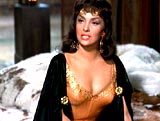 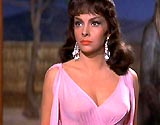   Queen of Sheba (Gina Lollobrigida) 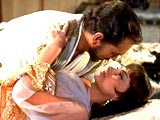  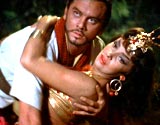 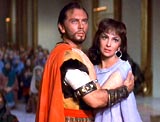 Queen of Sheba (Gina Lollobrigida) with Prince Solomon (Yul Brynner) |
||||||||||||||||||||||||

|
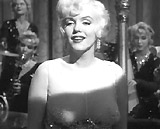
Some Like It Hot (1959) As one of the top-rated comedies ever made, director-producer Billy Wilder challenged the system with the gender-bending and risqué comedy Some Like It Hot (1959). It was released at the end of the repressive 1950s at a time when the studio system was weakening, the advent of television was threatening, and during a time of the declining influence of the Production Code and its censorship restrictions. The classic comedy was filled with sly and witty sexual innuendo (i.e., the "sweet" and "fuzzy end of the lollipop" represented oral sex), unembarrassed vulgarity, free love, spoofs of sexual stereotypes (bisexuality, transvestism, androgyny, homosexuality, transsexuality, lesbianism, and impotence), and a mix of serious themes including abuse, alcoholism, unemployment, and murder, among others. There was the priceless first view of cross-dressing Jack Lemmon (as Jerry) and Tony Curtis (as Joe) at the train station, pretending to be Daphne and Jo-sephine and their reassuring line to their bandleader:
The film was most noted for well-endowed, bosomy Marilyn Monroe's sexy portrayal of Sugar Kane, including her dramatic hip-swinging entrance at the train station, the party scene onboard the overnight train to Florida, and the scene of her beach swim wearing a sexy, form-fitting one-piece suit. Her sexiest appearance was during her singing of I Wanna Be Loved By You in a nightclub while wearing a sheer, low-cut white sparkling dress that was lit with a teasing spotlight to make her appear topless. The film's highlight was an outrageous and steamy reversed seduction scene aboard a millionaire's yacht between Sugar and millionaire impersonator and Cary Grant-like Joe (Tony Curtis) who pretended to be impotent.
|
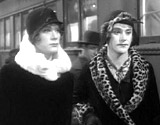 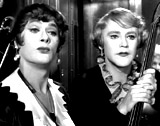 Jo-sephine (Tony Curtis) and Jerry/Daphne (Jack Lemmon) 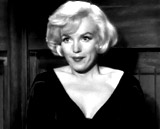 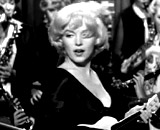 Sugar Kane (Marilyn Monroe) |
||||||||||||||||||||||||
|
Suddenly, Last Summer (1959) Although Gore Vidal's original screenplay alluded to homosexuality, cannibalism, pedophilia, murder, and incest, all of these sordid elements were toned down (due to demands of the Catholic Legion of Decency and others that considered it sickening and 'degenerate') in Joseph L. Mankiewicz' melodramatic and lurid version of the Tennessee Williams 1958 tale Suddenly, Last Summer (1959). The film still retained the ripe sensuality of Elizabeth Taylor as the pretty Catherine Holly, now the institutionalized niece of rich widow Mrs. Violet Venable (Katharine Hepburn). Catherine was threatened with a 'brain-cutting' lobotomy for telling the truth about a horrifying incident that had occurred the previous summer in Spain. She had been invited to join her homosexual cousin Sebastian Venable (never speaking and unseen fully in the film) to travel in Europe together, taking the place of Sebastian's jealous and doting mother Violet who had grown too old. Catherine bluntly told neurosurgeon Dr. Cukrowicz (Montgomery Clift) and her Aunt Violet how Sebastian had used her (and earlier Violet's) youthful and seductive beauty as a ploy or decoy. She described how both were used to lure males closer to the predatory Sebastian for his own pleasure (and for sexual favors):
Catherine's lengthy account of her summer trip was illustrated with impressionistic flashbacks when she started talking about her recollections at the beach under the white-hot sun. Catherine became embarrassed when Sebastian dragged her into the water in order to attract attention ("I was procuring for him") - when her white one-piece bathing suit that he had bought for her became transparent:
In the film's climactic monologue, she described a horrifying chase and surrealistic murder scene when Spanish youths attacked Sebastian (wearing a full white suit). It was hinted that these were boys that Sebastian knew - that he had earlier exploited (he had paid them for homosexual encounters) - and now they were seeking revenge. The assault ended with a cannibalistic homicide at the top of a hill at the ruins of an ancient stone temple. The male youths overtook Sebastian, and literally tore him apart and devoured him. She watched his body being ravaged by the angry young boys. Catherine heard him scream as his outstretched hand was grabbed, and she screamed in unison with him:
|
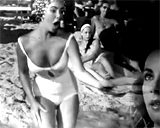 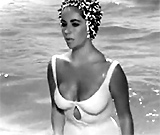 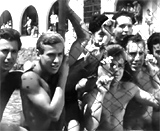  The White Bathing Suit Incident 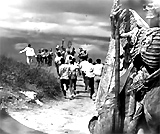  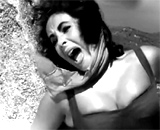 The Murder of Sebastian |
||||||||||||||||||||||||







 The Lovers (1958, Fr.) (aka Les Amants)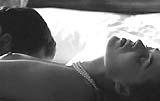

 This
was the first "nudist" documentary
made in Britain, by director Charles Saunders. It was advertised
as: "The First British Nudist Feature!" and Filmed in
Glorious Nudiscope! It was also described as "a film of beauty
and honesty...a delicate subject produced with charm and discretion."
This
was the first "nudist" documentary
made in Britain, by director Charles Saunders. It was advertised
as: "The First British Nudist Feature!" and Filmed in
Glorious Nudiscope! It was also described as "a film of beauty
and honesty...a delicate subject produced with charm and discretion."