|
History of Sex in Cinema: 1950-1954 |

|
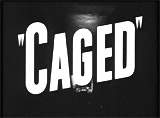
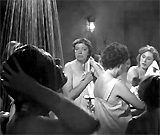
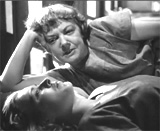
Caged (1950) Director John Cromwell's drama was a grim, black-and-white women-in-prison film, with a memorable score by Max Steiner. It starred Best Actress-nominated Eleanor Parker as initially-naive, teenaged 19 year-old newlywed Marie Allen - sentenced for being an accomplice to armed robbery (of $40) of a gas station. Her equally-young husband Tom was killed during the crime (subject from 1-15 years imprisonment). In the opening scene, the fearful Marie was transported by prison wagon-van to the Illinois Women's State Prison, where the driver/guard coldly snarled as he ordered the female passengers to disembark: "Pile out, you tramps – It’s the end of the line." After a physical exam, she soon found out that she was two-months pregnant. The suspicious infirmary nurse (Eileen Stevens) asked bluntly: "Say, you expectin' company?" The reformist prison warden/superintendent Ruth Benton (Agnes Moorehead) assigned Marie to work as a checker in the laundry. The facility was mostly cruelly run by sadistic, malevolent and corrupt guard/matron Evelyn Harper (Hope Emerson), who read romance magazines and ate caramels. She engaged in a private racket where she often exchanged favors and money for hard-to-get items ("little comforts," such as cigarettes, lifesavers, gum, etc.) with the "tramps" (the name for inmates). There were unstated hints of lesbianism when widowed Marie was introduced to Harper:
When Harper learned that Marie had no "dough" and was therefore worthless to her, Marie was given a new assignment - to scrub the floors with lye ("I'm the boss here, start scrubbing!"). One of the inmates blamed their fates on men: "If it wasn't for men, we wouldn't be in here." Marie's plan, after her baby (named Tommy) was born, was to "temporarily" grant full custody to her mother until she was paroled and could attend to the child, but when Marie's mother (and her stepfather) refused to take her baby (arguing that they had no money), it was put up for adoption. Marie became acquainted with fellow inmate Kitty Stark (Betty Garde), head of a shoplifting racket, who gave cautionary advice to Marie about lesbian tendencies that would develop, if she stayed imprisoned too long:
Kitty also added: "You see kid, in this cage, you get tough or you get killed. Better wise up before it's too late." Harper's cruel and heartless sadism was exhibited when she gagged Marie and shaved her head. The lustful guards regarded Marie as a "cute trick." The film also included the requisite titillating shower room scenes - although tame by today's standards.
The film ended on a down-note, as the increasingly-hardened Marie was paroled after 15 months, with plans to join 'vice queen' Elvira Powell's (Lee Patrick) shoplifting (and prostitution) gang, while Warden Benton predicted (watching from her office window) that she would soon be returning to prison - and that her file shouldn't be discarded: "Keep it active. She'll be back." |
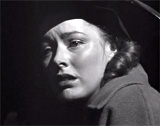 Scared and Fearful, Marie Allen (Eleanor Parker) Transported by Van to Prison  Admitted to Illinois Women's State Prison 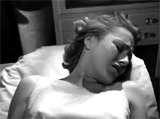 Infirmary Check - Revealing Her Pregnancy 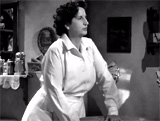 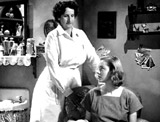 Marie with Guard/Matron Evelyn Harper  Marie's First Parole Attempt at 9 Months Denied  Elvira Powell (Lee Patrick)  Marie With Shaved Head |
||||||||||||||||||||||||||||||||||||

|
Sunset Boulevard (1950) (aka Sunset Blvd.) Director Billy Wilder's dark film-noir Sunset Boulevard (1950) told about "behind the scenes" Hollywood, self-deceit, spiritual and spatial emptiness, and the price of fame, greed, narcissism, and ambition. In the film's plot, B-movie hack screenwriter/narrator-gigolo Joe Gillis (William Holden) with financial problems sought to trade himself for monetary support from an aging silent film queen Norma Desmond (Gloria Swanson). He lived with her in her decaying mansion in Tinseltown. After being showered with bribes (clothes, money, flattery and other gifts), he was quickly spoiled and ensnared in her web of delusion - and death trap. |
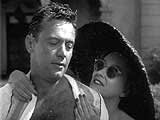 Gigolo-writer Joe Gillis (William Holden) With Norma (Gloria Swanson) |
||||||||||||||||||||||||||||||||||||
|
Young Man with a Horn (1950) Michael Curtiz' and Warner Bros' black and white musical drama was an incisive morality play, very loosely based on Dorothy Baker's 1938 novel about 1920s jazz artist Bix Beiderbecke. The noirish biographical drama was one of the first big-budget Hollywood productions hinting at lesbianism. The main couple (who were wrongly-married) in the drama were both going down a path of self-destruction:
The disturbed Amy was still suffering from her mother's recent suicide, while the selfish and depressed Rick, as their relationship deteriorated, began to drink heavily, further complicating his life and their misguided relationship. Amy admitted that she was confused about her goals in life, when compared to Rick's single-minded dedication to his musical craft:
There was a third person involved in an inevitable love triangle:
Jo introduced Rick to her friend, archetypal femme fatale Amy (a "strange girl") had confused lesbian leanings (a then-taboo occurrence in the early 1950s) and envied the pure heterosexuality of Martin's kind of love. Although Rick was soon married to Amy (and distracted from his trumpet playing), Jo had also fallen in love with him. Amy expressed her admiring thoughts about Jo's normality from the sidelines:
Rick was seriously affected by the unexpected and tragic death of his mentor friend, black trumpet player Art Hazzard (Puerto-Rican actor Juano Hernandez), who was seriously injured and soon died after being struck by a car. Rick attended Art's funeral, where he played his trumpet in tribute. Art had tutored him as a younger player when he dreamt of reaching a high note on the trumpet. This cautionary tale warned against wayward lesbian leanings, unspoken affections, and unfocused career plans that could destroy a traditional marriage. Bad girl Amy's subtle emotional feelings for female painter and party guest Miss Carson (uncredited Katharine Kurasch) were an indication that their troubled marriage was disintegrating. When Rick returned home after Art's funeral, Amy had just disbanded a poorly-timed cocktail party she had held. She was angry at Rick for missing her event with her friends. He found her drunken and enraged - she had just failed her psychiatry exams, and was exhibiting instability and confusion about her professional career plans, including contemplating traveling to Paris with Miss Carson to become a painter, or to retake her exams. In a tumultuous scene, Rick broke up with Amy, citing Amy's lesbianism as a sickness - one of the many reasons to leave her:
The film ended with a tacked-on, and essentially phony happy conclusion requested by the studio, in which the loyal Jo came to alcoholic Rick's side to help him recover his health, rekindle their relationship, and restore his love of music. He was enthusiastic about his future with her - restored by playing his music his way:
Rick sat up as he heard a police or ambulance siren passing by outdoors. He imagined hearing a high-note that he had always attempted to hit, but that realistically didn't exist: "Hear it? Jo, hear it? You said I tried for something that didn't exist. There's no such note. Hear that note, Jo? It's clean and sweet. See, it's a good note." A epilogue- commentary about Rick was presented (addressed directly to the camera) from the film's narrator - Rick's faithful piano player Willie 'Smoke' Willoughby (Hoagy Carmichael) in a parable about hitting a "high note" (as a human being and as an artist) that ended the film:
|
 Rick Martin (Kirk Douglas)  Amy North (Lauren Bacall)  Amy's Dual Nature (Symbolically Reflected in Mirror)  Jo (Doris Day) with Rick  Miss Carson (Katharine Kurasch) with Amy (Becoming Girlfriends) 
Rick with Amy: Their Tumultuous Break-Up   Conclusion: Jo with Rick As He Recovered: "Hear that note, Jo? It's clean and sweet."  Commentary about Rick by "Smoke" (Hoagy Carmichael)    Last Images of Film: Jo and Rick Playing and Singing Together - "With a Song in My Heart" |
||||||||||||||||||||||||||||||||||||

|
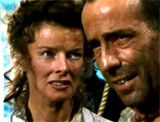
The African Queen (1951) Various elements in the plot of the John Huston adventure film The African Queen (1951), based on the 1935 novel of the same name by English novelist C.S. Forester, were toned down in its story of the unlikely romance and unmarried cohabitation between:
Negative references to missionaries, gross profanities, and nudity were non-existent. During their implausible love affair, they kissed once - triumphantly happy after avoiding being shot at by guns from a German fort, and for having miraculously navigated the rapids. After their spontaneous embrace and lip-smacking kiss, they forgot themselves entirely. They shouted exultantly: "We made it...Hip, hip, hooray." Their kissing scene couldn't be prolonged or lustful either, although she did express her physical enthusiasm for a ride down the rapids:
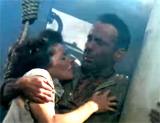
Charlie loaded fuel into the furnace - his face reflected both skeptical dismay - and then a freeze-frame of pleasurable shock and incredulity. The two sighted the German gunboat Louisa and plotted to blow it up by attaching a torpedo to the African Queen and ramming the gunboat. However, a fierce rainstorm submerged The African Queen, and they were separated. Both found themselves captives of the Germans on-board the Louisa, where Rose brashly bragged: "We came here to sink this ship...with torpedoes." There were ominous views of the capsized Queen slowly surfacing upside down in the lake, with the torpedoes angled upward above the waterline and aimed directly in the path of the Louisa. In the final scene (not in the book), the two requested to be married on the German ship Louisa just before they were to be hanged, in order to avoid censorship. After the short ceremony just before they were hung, and the nooses were about to be tightened around their necks, an explosion disrupted their post-nuptial execution. The Louisa collided with their partly submerged Queen, and exploded. Both were spared, and Charlie was impressed that they had accomplished their goal, and that they were also man and wife.
|
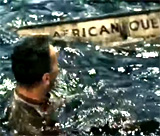
  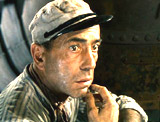 Rose (Katharine Hepburn) with Charlie (Humphrey Bogart) 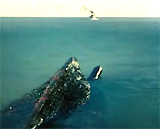 A Torpedo Angled Upward from the Submerged Queen 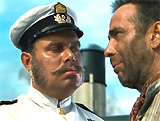 Charlie: "Marry us" 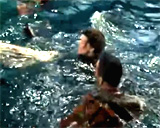 After the Explosion: Both In the Water |
||||||||||||||||||||||||||||||||||||
Sophia Loren - in the 1950s and 60s and Beyond Long before Sophia Loren (earlier credited as Sofia Lazzaro and Sofia Scicolone) became an international star and Oscar-winning actress, she was a beauty pageant contestant. At the age of 16, she owed her future film success to producer Carlo Ponti (her future husband who married her in 1957), who judged her second place in the 1950 Miss Rome competition. See below one of her earliest film appearances as a 17 year-old extra - in Era lui,... SI, SI! (1951, It.) (aka It Was Him... Yes, Yes!) in two versions (semi-nude and clothed).
Soon after, she starred in a number of low-budget campy foreign language films, and was sometimes required to appear semi-nude. In later years, she admitted: "I can't bear being seen naked. I'm not exactly a tiny woman. When Sophia Loren is naked, this is a lot of nakedness."
|
||||||||||||||||||||||||||||||||||||||
|
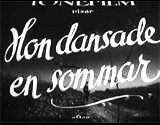
One Summer of Happiness (1951, Swe.) (aka Hon Dansade en Sommar) Director Arne Mattsson's romantic melodrama was based on the 1949 novel Sommardansen (The Summer Dance) by Per Olof Ekström. The film was sensationalized by taglines on its posters, declaring: "A Romance of Ecstasy," and "The Picture Everyone Is Talking About." It helped to establish Sweden's reputation as a 'free love', liberated country with erotic summer movies, along with Ingmar Bergman's Summer with Monika (1953, Swe.) (see below). It was cited as an example of why censorship was important to shield audiences from "immoral" images and candid nudity - because of "a scene where a boy, nineteen, and a girl, seventeen, spending a vacation together, swim and embrace in the nude."
The film revolved around an idyllic summer at the farm of Anders, the uncle of 19 year-old, rich university city student Goren (Folke Sundquist). There, he fell in love with teenaged country girl Kerstin (Ulla Jacobsson) - class-crossed lovers. In the film's most sensational skinny-dipping scene, the two young people were in a wooded area next to a lake, sharing their affection for each other, but worried about his departure in the fall back to school:
Both of them splashed and frolicked in the water, backlit by the sparkling sun shining behind them. Suddenly, they stopped, shared a nude embrace and kissed (she implored: "Goran, don't forget me"), and then he picked her up. The two returned to the shore where she laid down beneath him - with her breasts briefly visible. He answered her request: "Never, I'll never forget you, darling Kerstin." She reminded him: "But you'll be leaving soon." He promised: "I'm staying here. I'll stay with you forever. Would that make you happy?" She smiled: "Yes, more than I can tell you." Before presumed love-making (off-screen as the camera tracked to the right back to the surface of the water), he cautioned: "Do you know what we're getting into?" Kerstin answered openly: "I care so much for you, Goran...." In the film's tragic and abrupt ending, after a motorcycle accident when she was thrown from the back of Goran's vehicle and suffered lethal wounds, she succumbed in his arms. After he sent for an ambulance, he returned to her side where she spoke her final words to him: "Don't leave me. Stay here...Come and lay down next to me. Why is it so cold? It's not winter yet. It was summer today." After covering her with his coat, Goran asked: "Are you alive?" She whimpered: "Why is it so dark?" and then died. After her funeral, Goran sadly sat alone and remembered Kerstin's words to him (in voice-over): "Goran, don't forget me. My name is Kerstin" - as the camera zoomed back from him and the film concluded. |
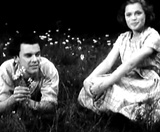 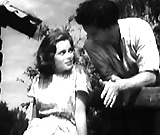 Goren with Kerstin 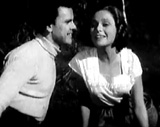 At the lakeside  Kerstin's Accidental Death When Goren Asked: "Are you alive?"  Film's Ending: (voice-over) "Goran, don't forget me. My name is Kerstin." |
||||||||||||||||||||||||||||||||||||
|
A Place in the Sun (1951) Director George Stevens' tragic romantic drama A Place in the Sun (1951) updated Theodore Dreiser's novel An American Tragedy, and dared to confront themes forbidden by the Production Code: out-of-wedlock pregnancy and oblique references to abortion (a no-no word). In the story, a working-class man (Montgomery Clift) impregnated a co-worker (Shelley Winters) before falling in love with his boss’ daughter (Elizabeth Taylor). Clift’s character was ultimately tried for murdering his pregnant mistress (although it could have been interpreted as an accident), and there were disguised suggestions that she should abort. In one of the most romantic performances ever filmed, in an extended scene of budding romance, this George Stevens film captured the sensuous and sexually-electrifying romantic interplay between:
In an electrifying series of images as they danced together and talked intimately with each other, George finally confessed his love to Angela - hers was the promise of the love of an ideal woman which had now been discovered:
Breathlessly, Angela was worried that they were being watched, so they retreated to an outer balcony terrace for more privacy, where she began to confess her love for him in kind: "I love you too. It scares me. But it is a wonderful feeling." They made plans to be together for the entire summer when he wasn't working on weekends, as she told him:
George was overwhelmed during these powerfully-erotic moments. Enormous, extreme closeups of their faces filled the screen as they revealed innermost, heightened emotions and inflamed passions, and they pledged themselves to each other. George confessed: "I'll be the happiest person in the world" - but Angela corrected: "The second happiest." George revealed: "Oh Angela, if only I can tell you how much I love you. I can only tell you all" - and she comforted him: "Tell Mama. Tell Mama all" as they closely embraced and kissed passionately, caught up in an all-consuming relationship over which they had no control. |
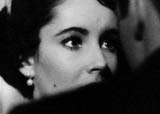 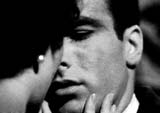 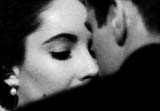  Angela (Elizabeth Taylor) and George (Montgomery Clift) - Ecstatic Balcony Kisses |
||||||||||||||||||||||||||||||||||||

|
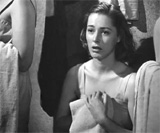
Elia Kazan's sizzling melodrama A Streetcar Named Desire (1951) was stripped of many of its 'objectionable' elements (i.e., rape, homosexuality, abuse, etc.) by the studio's altering and cutting of dialogue and various scenes (12 cuts and four minutes of screen time) to escape the Catholic Legion of Decency's condemnation rating. A restored version or "Director's Cut" of the film was released to theatres and video in 1993. In perpetual conflict with each other were the film's two main characters:
The film was also noted for the sex-related scene of the lonely Blanche pathologically desperate and yearning for sexual attention. She was attracted to a young newspaper delivery boy (Wright King) who came to her door one rainy afternoon. He reminded her of her young husband who committed suicide, and still neurotically grieving, she wanted to subconsciously make up for his death. She caused the bashful young man to linger with small talk, and she seductively offered herself for a maternal kiss.
But she caught herself after seductively pressing one kiss into his lips, knowing she had a weakness for young males:
In another scene, the morning after being ravished by her husband Stanley, Stella (Kim Hunter) was obviously sexually satisfied. However, while Stella was in the hospital giving birth, Stanley overpowered Blanche to complete her degradation, using intimate sexual union to permanently destroy any connection she had with the real world. An ornately-framed mirror was smashed and shattered in the climactic assault. In the reflection of the mirror, it appeared that Blanche fainted or was knocked unconscious, and fell into Stanley's arms. [Note: The explicit rape scene was excluded by censors.] The assault accelerated Blanche's descent into madness.
|
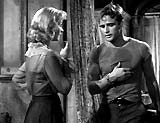 Friction Between Blanche (Vivien Leigh) with Stanley (Marlon Brando) 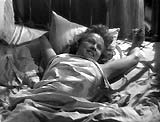 Sexually-Satisfied Stella (Kim Hunter) 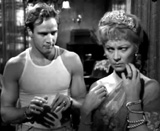 Prelude to Stanley's Rape of Blanche 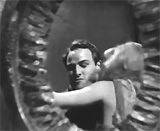 Rough-housing/Rape Assault 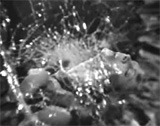 Blanche's Assault/Rape - Thrown Into a Mirror, Knocking Her Unconscious |
||||||||||||||||||||||||||||||||||||
|
Calamity Jane (1953) David Butler's lighthearted, rousing Warner Bros' musical was loosely based on historical facts and set in the Old West in the year 1876 in Deadwood, Dakota Territory. The heterosexualized story told about the Golden Garter saloon and Calamity Jane's romance with Wild Bill Hickok (Howard Keel). It was created in response to the success of Annie Get Your Gun (1950), MGM's musical western based on the life of legendary sharpshooter Annie Oakley (Betty Hutton) - also opposite Howard Keel as rival marksman and love interest Frank Butler. The film was released on the 50th anniversary of Calamity Jane's death. The musical starred the title character:
In a few other scenes with a Sapphic subtext, she sang the Oscar-winning Best Original Song about "Secret Love."
She warbled the song in the context of expressing her physical attraction and tomboyish, lesbian leanings toward a bustier-wearing actress' maid named Katie Brown (Allyn Ann McLerie). Calamity Jane looked Katie up and down and suddenly realized that women had different bodies than men:
The song finished up with her on horseback:
They moved in together and painted "Calam and Katie" in a big heart on their ramshackle cabin's wooden front door, and eventually Katie made a domesticated 'lady' out of Calamity by getting her to change from buckskins to jeans to a blouse and skirt. Meanwhile, Calamity entered into competition with Katie for the love of Army Lieutenant Danny Gilmartin (Philip Carey) - and soon switched her love (after becoming a well-behaved, real and true marriageable woman by dressing in Katie's finery) to Wild Bill Hickok. |
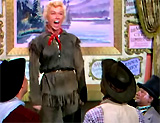 Calamity Jane (Doris Day) Singing "Just Blew In from the Windy City" 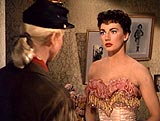 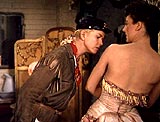 Calamity Jane with Katie Brown (Allyn Ann McLerie) 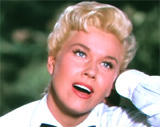 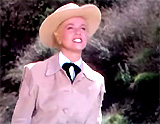 Calamity Jane Singing: "Secret Love" 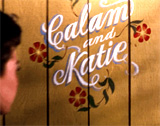 "Calam and Katie" |
||||||||||||||||||||||||||||||||||||

|
From Here to Eternity (1953) Director Fred Zinnemann's Best Picture-winning military drama From Here to Eternity (1953) was based on James Jones' hefty, 859-page smoldering 1951 novel about a number of civilian and military-related individuals (stationed on a barracks in Hawaii) and their relationships and circumstances just before the attack on Pearl Harbor in late 1941. For background, Jones had served as a soldier from 1939 to 1945, and experienced both the attack on Pearl Harbor and the Battle for Guadalcanal. Although altered to some degree, it still retained ground-breaking subjects including: prostitution, adultery, military injustice, brutality, corruption, alcohol abuse, bullying, racism and murder. The topic of homosexuality (and receiving oral sex from a man) that was explicitly part of the original novel, was excised due to censorship concerns. All of the passionate sex scenes were limited to simple kisses, embraces, and other unexplicit references to adulterous behavior. The main plot was set at Schofield Barracks on the island of Oahu, where bugler and career soldier Private Robert E. Lee "Prew" Prewitt (Montgomery Clift) had just been transferred. The reluctant ex-boxer was being pressured to fight by Captain Dana "Dynamite" Holmes (Philip Ober), and other soldiers. His commanding officer, Sergeant Milton Warden (Burt Lancaster), a tough, rugged and cynical military man, was being compelled to coerce Prewitt's acquiescence to the demands. In the meantime, Sgt. Warden learned of the infidelities of Capt. Holmes' cold but sexy wife Karen Holmes (Deborah Kerr in an against-type role), a neglected adulterous wife who had suffered a miscarriage that necessitated a hysterectomy, rendering her infertile. [Note: In the novel, she also had a hysterectomy after being afflicted with gonorrhea transmitted to her by her unfaithful husband Holmes.]
The sanitized epic drama has always been most famous for its bathing-suited, entwined, nighttime Hawaiian beach-surf embrace and forbidden kissing between the two central characters - Sgt. Warden and Karen Holmes. Although erotic and daring in its time, the scene has now been considered a cliche. The churning Hawaiian waves covered them at night on a deserted sandy beach. After their clinch, she rose, pranced up the sand, and collapsed onto their blanket. Warden followed and stood above her, dropped to his knees, and found her lips in his, and then Karen breathlessly spoke:
But their idyllic, iconic love scene immediately turned ugly and combative when he queried: "Nobody?" "No, nobody," she replied. "Not even one? Out of all the men you've been kissed by?" he asked. She responded with a question: "Now that'd take some figuring. How many men do you think there've been?" He asked again: "I wouldn't know. Can't you give me a rough estimate?" Irritated and insulted by his implication that she was highly promiscuous, she sarcastically replied: "Not without an adding machine. Do you have your adding machine with you?" When he said he forgot to bring it, she told him: "Then I guess you won't find out, will you?" The scene quickly became one of alienation and conflict, as his probing and hinting denegrated her character. His knowledge of her loose promiscuity and numerable other previous affairs at other outposts nagged at him and produced feelings of ambivalence about her free sexuality. Subplots in the film involved a private Honolulu 'social club' known as the New Congress Club, stocked with hostesses (another term for prostitutes), often frequented by Prewitt. He became close to employee Alma Burke, or "Lorene" (wholesome actress Donna Reed in an 'against-type role), who with low self-esteem claimed she was only a streetwalker "two steps up from the pavement." He learned that her goal was to earn enough to return to the mainland some day, and marry a man of "proper" means in a "proper" marriage. In the conclusion of the film, circumstances led a desperate and wounded Prewitt to go AWOL and he sought refuge with Lorene. When he was returning to the base during the Pearl Harbor attack, he was suspected as a trespasser and shot dead by an MP sentinel guard. In the final scene, both Lorene and Karen stood side-by-side as passengers on a Matson ocean-liner returning to the mainland. Due to her husband's resignation to avoid a court-martial for cruel malfeasance toward Prewitt, they were forced to return to the States. Her relationship with Sgt. Warden had already ended because, as she put it, he was "married - to the Army." |
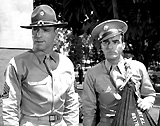 (l to r): Sgt. Warden (Burt Lancaster) & Pvt. Robert E. Lee "Prew" Prewitt (Montgomery Clift) 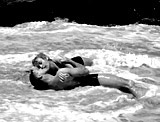 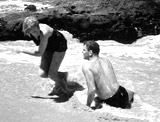 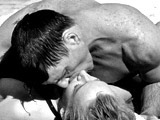 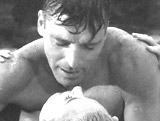 The Beach Kiss Between Sgt. Warden (Burt Lancaster) and Karen (Deborah Kerr)  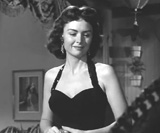 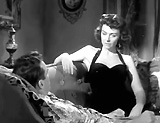 "Prew" with Hooker-Girlfriend Alma (Lorene) (Donna Reed) 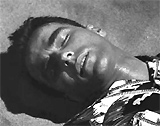 Prewitt Killed by Sentinel Guards 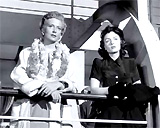 Karen and Alma at Cruise-Ship Railing, Leaving Hawaii |
||||||||||||||||||||||||||||||||||||

|
Gentlemen Prefer Blondes (1953) This Howard Hawks musical film starred two of the era's most notorious sex symbols:
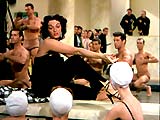
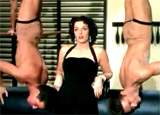
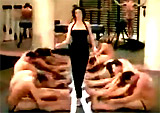
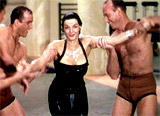
Portraying two golddiggers on a cruise ship, they sang and danced the opening number Two Little Girls From Little Rock wearing glittering red and white costumes - with a blue background. One of the film's lines: "The one you call daddy ain't your pa" was censored and changed to: "Men are the same way everywhere." There was also a notorious choreographed song/dance scene of the sexy Russell in an athletic gym filled with disinterested male body-builders and gymnasts as she sang Anyone Here For Love: "Ain't there anyone here for love?"
She sang, "I'm not in condition to wrestle. I've never trained in a gym. Show me a man who can nestle, and I'll pin a medal on him. Need some chappie to make me happy, and he don't have to be Hercules. Don't anyone know about birds and bees? Ain't there anyone here for love? Sweet Love. Ain't there anyone here for love?" She strutted down a row of exercising athletes on the floor while swinging two badminton rackets - asking:
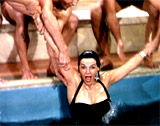
She was tumbled into the swimming pool when struck by divers, and ended the song as she was pulled out by some of the athletes. [Note: This scene was referenced in singer Olivia Newton-John's popular Let's Get Physical music video.] Gold-digger Lorelei Lee (Marilyn Monroe) also dazzled with her pink-dress show-stopping performance of Diamonds Are A Girl's Best Friend - her most famous musical number.
|
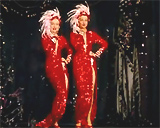 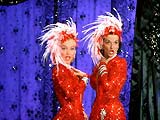 "Two Little Girls From Little Rock" 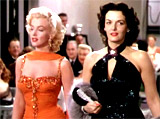 (l to r): Lorelei (Marilyn Monroe) and Dorothy (Jane Russell) 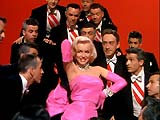 "Diamonds Are A Girl's Best Friend" |
||||||||||||||||||||||||||||||||||||
|
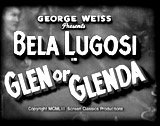
Glen or Glenda (1953) (aka I Changed My Sex, I Led Two Lives, The Transvestite, or He or She) Oft-maligned auteur Ed Wood's best 'worst' cult film of all time (his directorial debut film) was this low-budget, semi-autobiographical, docu-drama production about cross-dressing (transvestism) and transexuality (identifying with one's opposite birth gender). Its plot was about a police inspector (Lyle Talbot) who had just discovered a transvestite's suicide, and sought to find further understanding from a knowledgeable psychiatrist named Dr. Alton (Timothy Farrell) - the film's Narrator. This exploitation film was designed to capitalize on the recent headlines about the late 1952 male-to-female sex change or reassignment surgery of Christine Jorgensen. The film's taglines proclaimed:
The film opened with a title screen preface:
The film's narrator (Bela Lugosi), credited as "The Scientist," was introduced reading from a large book in a rustic room filled with skeletons, and then mixing substances in test-tubes. He mused about how science struggled to make discoveries about life, but most revelations were "not new." A newborn baby indicated that a new life had begun in the cycle of life:
In the main narrative of the story, an oft-arrested cross-dressing transvestite named Patrick/Patricia (Mr. Walter) had committed suicide. His/her clothed corpse was lying in a bedroom - death was preferable to dress-constrictions in life: "Let my body rest in death forever, in the things I cannot wear in life." More information was sought by the Inspector about the unusual motive for the suicide from the film's Narrator/Dr. Alton, who described the life story of another transvestite - the title character - a conflicted cross-dressing Glen/Glenda (the director Edward D. Wood, Jr. himself, with the screen name of Daniel Davis), who was struggling with his addiction to angora cloth. He/she was shown in women's clothing looking at items in a shop window, and lounging at home. A Young Man and a Young Woman made comments about how the Creator gave us birth as either boys or girls, followed by Dr. Alton (in voice-over) explanation about how nature can make mistakes:
Glen's fiancee Barbara (Dolores Fuller) was suspicious that Glen had another woman in his life - and of course, he did. According to the Narrator, Glen faced a major dilemma:
Glen agonized over whether to reveal his secret to Barbara before or after marriage, although she already had suspicions. He was afraid to tell her, because he feared he might lose her. The Scientist noted that Glen's destiny and fate as a transvestite had constricted him, similar to a puppet controlled by a marionette: (The Scientist: "Pull the string. Pull the string! A mistake is made. A story must be told"). The Narrator explained that Glen was a transvestite, but not a homosexual: ("The transvestite is not interested in those of their own sex. The clothing is not worn to attract the attention of their own sex, but to eliminate themselves from being a member of that sex"). However, Glen still remained unhappy and in "mental turmoil" about the way he was. A longer dream sequence was introduced by the Scientist who warned about the danger approaching for Glen/Glenda: "Beware! Beware! Beware of the big, green dragon that sits on your doorstep! He eats little boys, puppy dog tails, and big, fat snails! Take care! Beware!" The couple were married, but it was implied that they were doomed and damned.
A number of the surreal images (a striptease, a whipping, auto-eroticism, a rape-assault on a sofa, etc.) suggested that Barbara was mocking and disapproving of their relationship for being unnatural and deviant (after Glenda forcibly removed her blouse, Barbara transformed into the devil). At the end of the dream, Barbara was finally informed about Glen/Glenda's aberrant behavior (Narrator: "Glen has decided to tell Barbara of his dual personality. To tell her of the nighties, the negligees, the sweaters and skirts, the robes and dresses, the stockings and the high-heeled shoes, the wig and the makeup. All that goes to make Glen into Glenda. He tells Barbara he cannot cheat her of the knowledge that she as his fiancee should posess. All the facts"). She accepted his condition, and gave him the gift of an angora sweater. Ultimately, Glen's case had a "happy conclusion." The film concluded with a second narrative about another more "advanced" case concerning an individual (a pseudo-hermaphrodite) named Alan/Anne, who was raised by his mother as a girl, and self-identified as a female during the teenaged years. After serving in the military during WWII, he/she had a sex-change operation: "Anne was indeed meant to be a woman. And now that the sex change had been completed, Anne was a very happy woman, and a woman who was eager to learn, and now was accepted by society." The film ended with the Scientist's concluding words about "less fortunate Glens" in the world: "Yes. But what of the others, less fortunate Glens, the world over? Oh, snips and snails and puppy dog tails." |
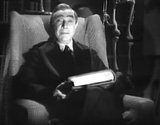  Bela Lugosi ("The Scientist") in the Film's Opening 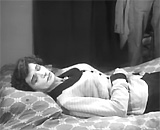 Suicidal Death of Patrick/Patricia - A Transvestite 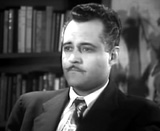 Dr. Alton/Narrator 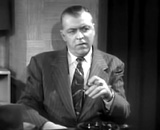 The Inspector (Lyle Talbot) 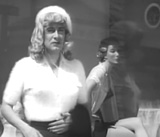  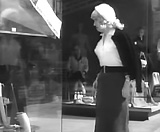  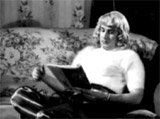 Cross-Dressing Glen/Glenda (Ed Wood) at Store Window and Lounging at Home   Glen Engaged to Marry Fiancee Barbara (Dolores Fuller) 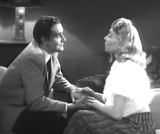 Glen with Barbara Who Was Wearing His Favorite Angora Sweater 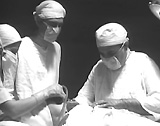 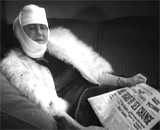 Sex-Change Operation for Alan/Anne 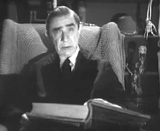 The Scientist's Concluding Words |
||||||||||||||||||||||||||||||||||||
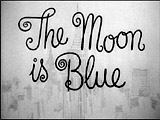
|
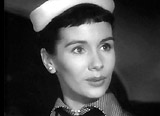
This daring sex farce and romantic comedy was the first major studio-produced film from Hollywood that was released without an approved code seal from the Production Code Administration (PCA). It was deliberately made as a test case by its producer/director Otto Preminger. Despite its lack of a seal of approval and the controversy, it proved to be a major hit film (grossing $6 million). The PCA's Joseph Breen complained about the film's unacceptable, comedic "light and gay treatment of the subject of illicit sex and seduction." It was subsequently rated condemned by the Catholic Legion of Decency for vulgarity, in part because of its offensive use of prohibited words such as "virgin," "seduce," "pregnant," and "mistress" in the dialogue. Following the Kansas Board of Review of Motion Picture's decision to ban the film, the Kansas State Supreme Court upheld the decision. (Three states, Maryland, Ohio, and Kansas had banned the film.) The state's censorship board had used current state censorship laws to ban the film and release it without a seal of approval. In the case of Holmby Productions v. Vaughn brought up in a Maryland court in 1953, the blocking of the film's release by the Maryland and Kansas state censor boards was contested. In 1955, the US Supreme Court unanimously overturned the ruling of the Kansas Supreme Court to uphold the film's banning, declaring it unconstitutional. The film's court victory was one more indication that the influence of the Production Code was weakening. A PCA seal of approval was granted to two of Preminger's films in 1961, The Moon is Blue (1953) and The Man With the Golden Arm (1955). The film's philosophical theme was about the prospect of remaining a virgin, in order to remain respectable, and the efforts of two aging playboys attempting to score in a love triangle with an attractive young virgin - wholesome and chatty 22 year-old heroine and struggling beer-commercial actress Patty O'Neill (Maggie McNamara in her film debut). The two lotharios were:
In her initial conversation with Donald after meeting on the top of the Empire State Building, she admitted she was anxious to get married but was very choosy: "The kind of men I want don't grow on trees...I'd much rather have a man appreciate me than drool over me." Patty was wary when Donald impulsively kissed her, and then invited her to his Madison Avenue apartment for drinks before dinner. During their taxi ride, she asked: "Would you try to seduce me?" When he vowed he wouldn't ("I won't make a single pass at you"), but confessed that he might kiss her, she responded: "Kissing's fine. I have no objection to that." She then added:
They shook hands when she agreed with him on how to appropriately behave: "Affection but no passion." When they arrived at his place, she gratefully claimed: "I'm so glad you don't mind...Men are usually so bored with virgins. I'm so glad you're not." However, Donald noted that Patty seemed very preoccupied with sex ("you are always asking if people plan seduction or they're bored with virgins or they have a mistress"). She replied: "But don't you think it's better for a girl to be preoccupied with sex than occupied?" In the meantime, Cynthia was fuming over recently being dumped by him. She had also called Patty a "professional virgin." Competing with Don for Patty's affection, David spoke about the significance of maintaining one's virginity:
He made a $600 bet with her to wait 15 weeks before seeing another man. She held out and kept her virginity, and eventually Donald fell in love with her and proposed - again at the top of the Empire State Building. |
 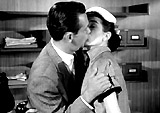 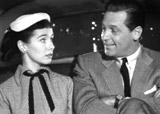   Patty (Maggie McNamara) with Donald (William Holden)  Proposal At the Film's Conclusion |
||||||||||||||||||||||||||||||||||||

|
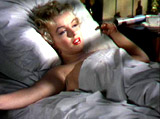
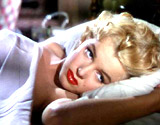
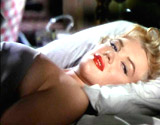
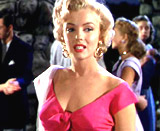
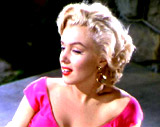
Niagara (1953) This melodramatic film-noir thriller by director Henry Hathaway and 20th Century Fox was advertised as "Niagara and Marilyn Monroe: The two most electrifying sights in the world!" A poster also proclaimed:
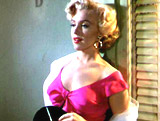
The film's theme was the destructive nature of a femme fatale's alluring, out of control sensuality and lust. 26 year-old Marilyn starred as Rose Loomis, a voluptuous and sexy woman (advertised as a "tantalizing temptress whose kisses fired men's souls!") plotting to kill her depressed and emotionally-unstable, Korean War veteran-husband George Loomis (Joseph Cotten). The married couple were vacationing together (on the Canadian side), residing at the Rainbow Cabins (modern housekeeping units) within sight of the landmark, famed Niagara Falls vacation spot. At the same time, Rose was engaged in an affair with Ted Patrick (Richard Allan). Rose and Ted had together arranged to murder George and make his death look like a suicide. Two others (on a 'delayed' honeymoon after two years of marriage) who arrived at the Cabins from Toledo, Ohio, were pretty Polly (Jean Peters, who later married Howard Hughes) and clean-cut Ray Cutler (Casey Adams). They became friends with the Loomis couple, but soon suspected something was wrong with the troubled pair who exhibited tremendous tension between them. The most memorable sex-related scenes featured Marilyn's naked appearance in bed, and two views of her sexy walking (filmed from the rear) in a form-fitting dress. In the film's opening, the sensual, adulterous Rose was lounging naked in her bed sheets in her cabin next to the Falls.
Her most flaunting appearance was in a pinkish-red dress at an outdoor teenaged dance party. She asked that the DJ play the record, "Kiss" and then sat closeby and listened, telling other guests: "There isn't any other song." She sang along: "With all your heart's protection, This is a moment of thrill. Thrill me, Thrill me, with your charm, Take me, Take me in your arms, And make my life perfection, Take me, Darling, don't forsake me, Kiss me, Hold me tight, Love me, Love me tonight."
Her angry husband interrupted the romantic musical interlude by racing from their cabin and destroying the LP with his bare hands (causing a cut). Later, George provided information to Polly about how he had become mixed up with Polly. He was a failing sheep rancher who met Rose in a Duluth, MI beer hall where she worked as a waitress. He described the reason for his rage against her:
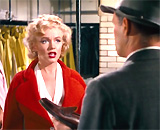
Rose had a provocative conversation with her husband who suspected that she was scheming and plotting with another man against him:
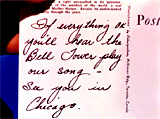
George followed after Rose and confirmed his suspicions. Ted had written her a message on the back of an unmailed postcard: "If everything OK you'll hear the Bell Tower play our song - See you in Chicago." After Ted had killed George, he would request the Rainbow Tower Carillon to play Rose's special song ("Kiss") to signal that George was dead. Soon after, George was reported as a "missing person" - and a pair of George's unclaimed shoes were discovered at the exit to the scenic tourist tunnel under Horseshoe Falls. The Bell Tower carillon played, causing Rose to believe that Ted had murdered George.
In reality, George had killed Ted in self-defense and thrown his body into the Falls, and then decided to "stay dead" to start his life over (by collecting Patrick's shoes at the exit instead of his own). At first, Rose believed that George was dead until she visited the city morgue, where she was called upon to identify a retrieved body from the Falls. She was shocked that the dead man was Ted, not George - she fainted and collapsed. Sleeping in the Loomis' cabin, Polly was frightened when she momentarily glimpsed a view of the supposedly-dead George in her room (he had come to kill Rose) - it was interpreted as a nightmare. Shortly later at the falls, George confronted Polly privately and explained his predicament, and pleadingly begged: "Please, I'd do the same for you if it meant as much. Let me stay dead." George conducted a revenge killing in the film's most suspenseful sequence. Rose's jealous and incensed husband stalked and pursued his scheming and trampish wife who was trying to flee. He followed her up a shadowy, carillon clock-bell tower before murdering her by strangulation (in a striking overhead shot). Then he told her corpse: "I loved you, Rose. You know that."
In the exciting and climactic finale, Polly and George (who hijacked the boat that she was on) were adrift (the boat ran out of gas) and heading toward the waterfall precipice. A desperate George tried to submerge and scuttle the boat, but went over the falls to his death, while she was rescued by helicopter from a rock outcropping. |
 George Loomis (Joseph Cotten)  Other Honeymooners at the Cabins: Polly (Jean Peters) and Ray Cutler 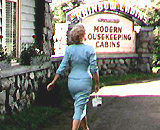 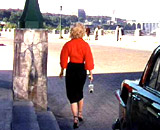 Two Rear-Views  Polly Spotting Rose's Adulterous Rendezvous with Ted Patrick  Enraged George Destroying "Kiss" LP Record 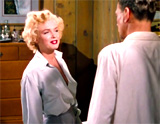 Trampish Rose: "Anybody suits me, take your pick" 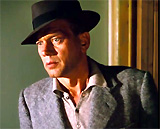 Polly's Fright at Seeing the "Dead" George in her Cabin 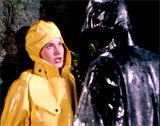 George Begging Polly: "Please... let me stay dead" 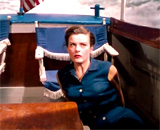  Kidnapped Polly on Boat with George, Heading Toward Falls  George Saving Polly  Polly Watching George's Death Before Being Rescued |
||||||||||||||||||||||||||||||||||||
 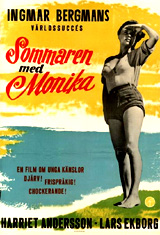 Summer With Monika (1953, Swe.) (aka Sommaren med Monika)  Monika: The Story of a Bad Girl (1955) |
Summer With Monika (1953, Swe.)
(aka Sommaren med Monika) (repackaged as Monika:
The Story of a Bad Girl (1955)) Writer/director Ingrid Bergman's controversial romance film was one of the first foreign-language films that made its brief nudity a major selling point for US audiences, and helped create the stereotype that Swedish women were sexually liberated and enjoyed swimming in the nude. [Note: An earlier Swedish film that created the same sensation was One Summer of Happiness (1951, Swe.) (aka Hon Dansade en Sommar).] Legendary exploitation distributor, producer and showman Kroger Babb, after purchasing the American rights to Ingmar Bergman's Summer With Monika (1953, Swe.), cut out approximately 33 minutes of the film, dubbed it into English, replaced the musical score with a jazzy one by Les Baxter, and renamed it to ready the film for the drive-in circuit - it was now known as Monika: The Story of a Bad Girl (1955). Everything was sensationalized about their relationship, but they had only one very brief yet controversial scene of nudity (skinny-dipping) and love-making in the beautiful, sunny outdoors. Babb sensationalized the repackaged film with racy advertisements and taglines such as:
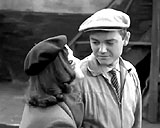
In the story, a young couple (two disaffected rebel teens), both from working class families in Stockholm, ran off to escape their tawdry lives and to experience a brief idyllic romance one summer at the beach on an island in an archipelago:
Monika urged them to both pack up and run away: "Now we can go wherever we like!"; they took Harry's father's boat out of Stockholm. As they hugged, they congratulated themselves for rebelling: "We've rebelled, Monika, against all of them." In the film's only scene of very brief semi-nudity, she stripped off her clothes to sunbathe, then let Harry touch her breasts before she impulsively jumped up stark naked and ran to the water; their time of freedom was filled with sun-drenched cavorting and singing in the outdoors, love-making and romancing, but then Monika noticed one day: "Oh dear, I've grown tubby" - a sign of her impending pregnancy. Now things turned less than idyllic, and Harry realistically insisted that they had to return home: "We have to go back so I can start working. You need proper food," but Monika disagreed: "No, I'm not going back. I want summer to go on just like this"; Harry argued: ("Monika, we have to make something real out of our lives. We'll care for each other. I'll study and get a decent job, so we can get married and have a nice house, you and me and the little one on its way"). Harry decided that they must return to civilization, and was more optimistic about their future: "We can't go on like this. We have to get married, and I need a job to support us"; Monika protested: " I don’t want to go back... Harry, why do some people have all the luck while others are miserable?"; Harry answered: "We have each other" and hugged her while admitting the truth - that their time together had only been a dream-like experience: ("We've been in a dream of our own"). Upon their return, they were forced to have a quiet shotgun marriage and live in a very claustrophobic rented apartment with their new infant daughter "Little Monika" (or June as Monika preferred). Shortly later, the resentful and frustrated 'bad-girl floozie' Monika, who was lacking any maternal instincts, became impatient and dissatisfied about her domesticated, monogamous role as a homemaker-mother. The unsettled and promiscuous Monika would soon fall from grace; she was caught cheating by Harry in their own bed (off-screen) during an affair with ex-boyfriend Lelle (John Harryson), when Harry unexpectedly returned a day early from a business trip; afterwards during a fierce argument and fight about her unfaithfulness and the fear of eviction due to Monika's overspending, Harry asked for a divorce; Monika blamed him and worried more about her looks: "You got me pregnant! Things wouldn't be like this!...And I'm all ugly now!"; she added: "I want to have fun while I'm still young"; he repeatedly struck her, and she abruptly left him; it was the end of their marriage; Harry responsibly retained custody of their child as a single father. The film concluded with a close-up of the grown-up Harry (who had come of age) wistfully recalling and reprising the best memories of their time together in the sun-kissed outdoors (seen in a flashback as he gazed into a mirror while holding his baby daughter 'Monika').
|
 Harry and Monika: "Almost Like We're Married"  Deciding to Run Away Together 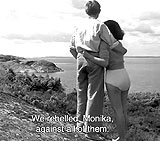 Rebelling Against Society 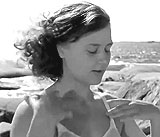 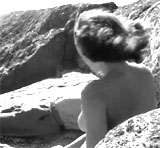 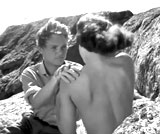 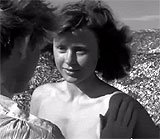 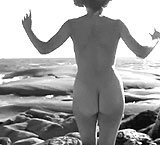 Monika (Harriet Andersson) with Boyfriend Harry (Lars Ekborg) on Island |
||||||||||||||||||||||||||||||||||||
First issue of Playboy (December, 1953) Though not a film, Marilyn Monroe's appearance in the first issue of Hugh Hefner's Playboy magazine in late 1953 was a landmark moment for sex in film. It heralded that one of the biggest sex symbols in film history had voluntarily appeared nude in a nationally-distributed magazine.
It would be a major influence in the loosening of morals in the film industry, although it brought calls for censorship, and at the same time catapulted Monroe to superstardom as a sex goddess and icon. Marilyn's picture was originally taken for a calendar rather than for the magazine. Playboy would begin to feature various film stars and celebrities in states of undress, and showcase their performances in films, as well as chronicle the development of sex in cinema.
|
 Marilyn on Cover of Playboy  Jayne Mansfield (Playboy Centerford/Playmate of the Month in February 1955) |
|||||||||||||||||||||||||||||||||||||
| Bettie Page's
Burlesque Trilogy: (1953-1955)
Cult icon and black-haired pin-up "Queen of Curves" Bettie Page (also credited as Betty Page) starred in this "burlesque trilogy" of "adults only" vintage erotica (with little if any nudity, and mostly 'tease'). These were Page's only three feature films. All of them portrayed the naughty and tawdry world of stripping and vaudeville comedy. The last two films were produced and directed by photographer and mail order blue movie-maker Irving Klaw. Famous 1950s strip-tease artist Lili St. Cyr joined Page in the first two films.
|
||||||||||||||||||||||||||||||||||||||

|
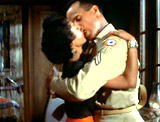
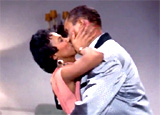
Carmen Jones (1954) Daring, risk-taking director Otto Preminger's musical film of seductive passion, obsession, and murder was remarkable for its all-black cast and its original and exciting premise. It was adapted from the 1943 stage musical of the same name. Georges Bizet's 1875 opera Carmen was refitted for the big screen as a romantic musical, transposing the tale from 19th century Spain to WWII-era in the US, with the main cast composed of African-Americans who were stationed at a military base. It starred Oscar-nominated Dorothy Dandridge in a career-defining role:
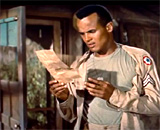
The radiantly-beautiful, vixenish spitfire Carmen, a parachute-making factory worker in an all-black army camp of paratrooper trainees, was arrested for fighting with a co-worker ("a blabbermouth bitch") who had reported her arriving late for work. When she was held as a military prisoner, handsome, honorable military Corporal Joe (Harry Belafonte), a paratrooper trainee destined to be a fighter pilot, was assigned by his superior Sgt. Brown (Brock Peters) to transport Carmen to jail over 50 miles away. With lustful purposes needing to be satisfied, Carmen stole Joe away from his long-time, virtuous, hometown girlfriend-fiancee Cindy Lou (Olga James), who had observed Carmen's ways:
While driving her in an open jeep, he decided to take a dirt-road shortcut to Masonville. Crossing an old rickety-wooden bridge, the Jeep became stuck in a stream-river and they were forced to spend the night at her nearby hometown in her grandmother's house. There, she sidetracked him by enticing him to kiss her, and they made love after a pan to the left and dissolve.
The next morning, he found out, through a farewell note, that she had run off as a fugitive:
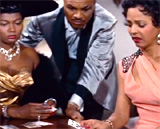
For allowing his prisoner to escape, Joe was subsequently court-martialed, demoted to private, and placed in a stockade (to work on a chain gang during the day). While Cindy Lou visited Joe, she was dismayed when a package was delivered to him from Carmen - containing a note and a cut rose-flower. Carmen found work at a local roadhouse - Billy Pastor's jive night-club cafe in Louisiana, where one night another character was introduced - wealthy, heavyweight prize-fighter Husky Miller (Joe Adams), with an entourage. He was due shortly to board a train to return to Chicago. The well-dressed champ (and his associates) pursued her best friend Frankie (Pearl Bailey) and Carmen (she was nicknamed "Heatwave") with promises of expensive items, including jewelry and furs and the good life, but she refused to agree to the boxer's enticing offer to join them (she sang: "There's a Man I'm Crazy For"). Joe again encountered Carmen at the Cafe, where she asked him to stay the night with her. He explained how he couldn't - he had to take a bus to report for attendance at flying school 400 miles away - in training for the Korean War. Angry about his offer of "love on a pass," the fiercely-independent Carmen demanded that he demonstrate his love for her. He took out from his left-breast uniform pocket the dried up rose that she had sent to him in the package, telling her: "That's been with me all the time. Right here, where you are." When she questioned his sincerity: "That don't ring so true," he took her in his arms and kissed her: "I swear it's true." Then she enticed him:
Angered by his reluctance to go AWOL, she rebuffed him:
To spite Joe, Carmen instead decided to accept an offer to accompany Joe's superior Sgt. Brown for the evening, inciting Joe's angry and jealous lust for her. After a fistfight with Brown, who was knocked out, Carmen suggested that they hide the body in the bushes before they fled. Joe deserted his regiment and went AWOL to avoid an inevitable jail term and detainment by the MPs. He ran off with the sultry Carmen to take the train to Chicago. Joe was forced to seclude himself and hide out in a shabby rented hotel room (near the noisy train tracks) with Carmen, while she was free to come and go. In a sexy pose, she stretched out her long bare left leg toward Joe with recently-applied toenail polish, and suggested that he "blow on 'em, sugar, to make 'em dry faster." Then she extended both legs and instructed: "You can turn the heat off now" after a few moments. Although remaining faithful for awhile to Joe ("What's mine's yours, Joey, and that goes right down the line"), she continued to have contact with her friend Frankie (who had been lured by Husky to the city) at his gym and hotel suite. With her fortune-telling friend Frankie at Husky's luxury hotel, Carmen's future was foretold - the drawing of a nine-of-spades was a premonition that Carmen's romance with Joe was doomed. She decided to give up loving a man who was cooped up and running away, and give herself up to a better life.
Their ill-fated affair declined when Carmen quickly tired of Joe, deserted him, and became romantically-involved instead with heavyweight Chicago prize-fighter Husky Miller, who offered her clothes and diamonds and a better way of life. She had moved on from Joe - and refused to return to him, considering him a loser. In a jealous rage, after a two-round fight that Husky won, Joe cornered Carmen in a storeroom and begged for her to return to him, but she rebuffed him. She claimed that what they had was over and there was no going back for them. When she gave him the option of death or freedom, he chose to strangle her to death.
|
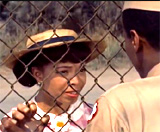 Cindy Lou (Olga James) - Corporal Joe's Fiancee  Corporal Joe (Harry Belafonte)  Factory Worker Carmen (Dorothy Dandridge) 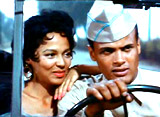 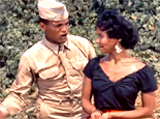 On the Way to Jail with Corp. Joe 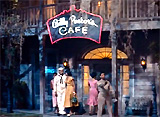 Billy Pastor's Cafe 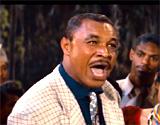 Prize-fighter Husky Miller (Joe Adams) 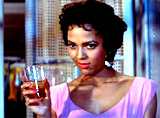 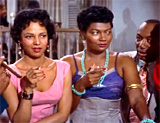 Carmen with Best Friend Frankie (Pearl Bailey) 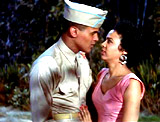 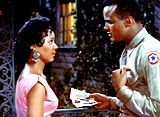 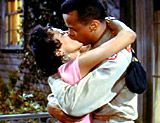 Rekindled Love - But He Refused Her Offer to Join Her in Chicago 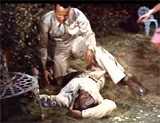 Joe's Fistfight Against His Own Superior Sgt. Brown 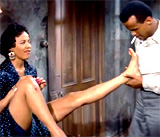 "Blow on 'Em" |
||||||||||||||||||||||||||||||||||||
(trailer) |
The French Line (1954) After producer Howard Hughes' earlier conflict with the Production Code over his sexy western The Outlaw (1943), he ran into further difficulties over using his same 34-D busty starlet Jane Russell. The film was originally made in 3-D, and came with the provocative RKO taglines:
The film was denied a seal because it was considered "sexually immoral, obscene and indecent" - but the PCA promised to approve it if the final sexy dance number was removed. The entire dance sequence ran into trouble with censors - the Production Code of America (PCA) claimed that the "costumes were intentionally designed to give the bosom peep-show effect beyond even extreme de'colletage." Ultimately, the controversial film was released without a seal of approval, and declared 'unfit' for audiences and 'condemned' by the Catholic Legion of Decency. The Roman Catholic Archdiocese called it "a mortal sin" and asked for copies to be confiscated. The film reportedly had two versions, however: one cut version with little breast exposure (and a Production Seal), and one with lots of flesh showing (in the uncensored, unapproved version). The light-weight musical comedy, a Technicolored RKO film, was set on a ship bound ultimately for Gay Paree. Russell starred as:
Traveling incognito and switching identities with model Myrtle Brown (Joyce Mackenzie), Mary posed as the model, while Myrtle posed as Mary. She began an affair with suave Frenchman Pierre DuQuesne (Gilbert Roland), although in the plot with identity confusion and misunderstandings bound to occur, he had been hired by her business partner Waco (Arthur Hunnicutt) to trail 'Mary Carson.' The most controversial scenes, often excised, were:
During a fashion show in the film's conclusion, Mary (or 'Mame') was revealed in a sparkling, silver-beaded black, bikini-like costume (with strategically-placed cut-outs), while delivering this suggestively-spoken dialogue - as she did a teasing bump-and-grind dance number ("Lookin' for Trouble") with her bounteous breasts jiggling and overflowing:
|
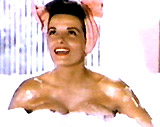 Bubble Bath Sequence 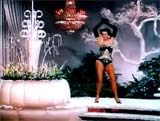 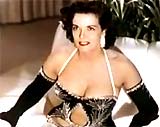 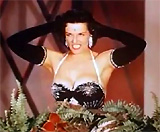 Mary 'Mame' Carson (Jane Russell) in "Lookin' For Trouble" Bump-and-Grind |
||||||||||||||||||||||||||||||||||||

|
By claiming to be an 'educational' naturism documentary, this 90-minute film by Hollywood 'B' movie director Max Nosseck skirted the anti-nudity film restrictions of its time. It faced legal battles and was banned as obscene (or "indecent") after its controversial release - until 1957 when the NY Court of Appeals ruled in its favor that the film (depicting nudism in existing nudist camps) was neither "indecent" or "obscene" and therefore not subject to censorship. There was a wave of inexpensive-to-make naturist (nudist camp) exploitation films following the 1957 decision, shot in the outdoors with either models (pretending to be nudists) or using real nudists at the camps. Films in this sub-genre included eight films by Doris Wishman (see details here), including these first five:
Garden of Eden (1954) was the first naturist film shot in color and the first nudist camp film since the 1930s. Although female breasts and both sex's buttocks were visible, shots of genitals were obscured, not visible or concealed by various objects - volleyballs, beachballs, guitars, and towels. It featured lush outdoor Everglades photography, as well as the requisite volley-ball games, swimming, and water-skiing in the nude. The exploitation film had a dubious plot about gorgeous young, red-headed war widow Susan Lattimore (Jamie O'Hara) who vowed to escape an evil father-in-law, conservative East Coast businessman Jay Randolph Lattimore (R.G. Armstrong). Her plan was to vacate his house, move to Miami, and resume her modeling career. But outside of Tampa, her 1946 Chrysler convertible broke down in a remote area. With the assistance of Johnny Patterson (Mickey Knox), she was forced to take refuge in the nearby "member's only" nudist camp, known as "Garden of Eden" with her six year-old daughter Joan (Karen Sue Trent). Meanwhile, she awaited car repair by a professional mechanic at a nearby gas station. She was surprised later in the day to see swimmers going to the lake without wearing clothes. When Susan was asked if she was going to be swimming, her excuse ("I haven't a bathing suit") was dismissed by a sun-bathing nude female: "Well, as a matter of fact, none of us do. It's not allowed here. It's so nice not to have to get into a soggy suit." She called her naked uniform "nature's clothing - clothes are artificial." Susan was taken by boat to a nearby island to find some privacy. Relaxed, she laid down and fell asleep. During an elaborate romantic dream sequence, she imagined herself disrobing and skinny-dipping. In the unlikely scenario that developed, her late husband's father located her and drove to the resort. He was morally outraged and upset by her actions and insisted that she leave immediately. However, it was late at night and he accepted an offer to stay overnight free of charge in one of the empty cottages until morning, when he would take Susan (and Joan) away. The next morning after a good night's sleep, Lattimore exclaimed: "I feel like a new man already." But then he looked around and was shocked: "I'm surrounded by naked people." After strolling around for awhile, he saw how innocent, friendly, and natural the nudists were in the "nudist park." He decided to adopt the naturist lifestyle after his short stay and he joined the club as a member. He sincerely apologized to Susan for believing for a moment that she was an unfit mother - and they were reconciled. As the story ended, Johnny and Susan were married. Lattimore had been quickly converted to the lifestyle and advocated stripping down, before going swimming naked with the newlywed couple: ("Get comfortable. Get out of your clothes. Do you a world of good"). |
 Garden of Eden - Resort Sign 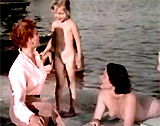 Susan Lattimore (Jamie O'Hara) with daughter Joan 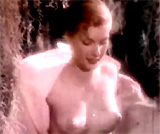   Susan's Dream Sequence 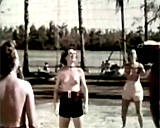  Nudist Camp Activities |
||||||||||||||||||||||||||||||||||||
|
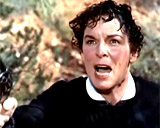
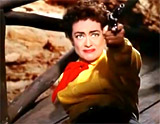
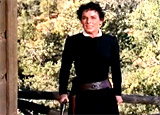
Johnny Guitar (1954) Director Nicholas Ray's unconventional, bizarre, off-beat cult Western from Republic Pictures has sometimes been called a 'lesbian western', because it reversed traditional gender roles while providing commentary on the early 1950s McCarthy era. In the bold-colored (Trucolor), perverse melodrama replete with Freudian sexual symbolism, the two main stars were role-reversed, aggressive females who hated each other:
Emma was supported by cattle ranchers who opposed the coming of the railroad and Vienna's support of it - Emma called her a "railroad tramp." The gun-toting Vienna often wore a black shirt, a string tie around her collar, pants, and boots and was described by her saloonkeeper Sam (Robert Osterloh) as masculine:
The opportunistic Vienna's intention was to wait for business in her mostly-deserted casino, while allowing the townsfolk and a notorious outlaw and former lover known as the Dancin' Kid (Scott Brady) to frequent her saloon. She was looking forward to the arrival of the railroad to be built nearby: "All I have to do is sit here and wait for the railroad to come through. And that is my intention." She knew how lucrative it would become: "The railroad's sending in people by tens, twenties, hundreds, and thousands! You can't keep them all out!" In her casino, she was confronted by Emma's group of vigilantes, who displayed hostility and animosity toward her new casino on the outskirts of town. Emma was stirring up trouble to wrongly blame Vienna as an excuse - to accuse her of helping her former lover Dancin' Kid (Scott Brady) rob the stagecoach and kill Emma's brother, the town's banker. Vienna cautioned them to back down since they had no proof: "Down there, I sell whiskey and cards. All you can buy up these stairs is a bullet in the head. Now which do you want?" During her rivalry with Emma in the scene, Vienna referred to the delirious effect that the unscrupulous, suspected stage-robbing outlaw Dancin' Kid had on Emma. She was able to reveal Emma's jealous and unrequited 'crush' and passionate love for the thief, but wouldn't openly admit it - and had somehow transferred her resentment and jealous anger into irrational revenge against Vienna:
She descended the stairs to listen to Emma's face-to-face warning: "I'm going to kill you," and immediately replied: "If I don't kill you first!" Vienna was threatened to leave town in 24 hours, but she refused to be intimidated by either Marshal Williams (Frank Ferguson) or Emma.
Earlier, in the film's opening, gun-crazed drifter and reformed gunslinger Johnny Guitar/Johnny Logan (Sterling Hayden) arrived during a sandstorm into Vienna's deserted Arizona saloon with a guitar strung over his shoulder. Later, during Vienna's 'love scene' with ex-lover Johnny Guitar, a reformed Albuquerque gunslinger that she had hired to keep the peace, he tried to rekindle their relationship from five years earlier - in the past, when he wasn't ready for marriage. He asked Vienna, "How many men have you forgotten?" She answered: "As many women as you've remembered." He asked for her to tell him something "nice" - "Lie to me. Tell me all these years you've waited. Tell me...Tell me you'd have died if I hadn't come back...Tell me you still love me like I love you." When she was forced to comply (without feeling), he briskly said: "Thanks. Thanks a lot." Vienna claimed that she struggled on her own as a self-made, hardened woman to build her saloon (due to inequities in gender and the double-standard), and that life was now different: "Once I would have crawled at your feet to be near you. I searched for you in every man I met." He claimed that they could still be married: "It's your wedding day." She said she had waited for him, and was finally relieved for his return: "What took you so long?" and she sobbed in his arms as she kissed him. After Dancin' Kid's gang robbed the town's bank, the town's cattle ranchers believed that Vienna had aided them, due to false testimony and other unfounded suspicions - the McCarthy Era allegory. The bullying Emma (full of rage and fury) and her gang used the incident to again blame Vienna - and her posse rode to Vienna's saloon to seize and lynch her, and in the process vindictively burned down her casino. Johnny Guitar saved Vienna from hanging and they fled for refuge to the Dancin' Kid's secret hideaway cabin.
In the film's final show-down, the lynch-happy Emma (and her posse of vigilantes) challenged Vienna (and Johnny). On the porch of the cabin, the two female leads faced off with a bloody one-on-one pistol duel, and although Vienna was wounded in the shoulder, she shot and killed Emma. Now reunited, Johnny carried the victorious Vienna away for a new life, as Peggy Lee sang the title song with the words: "There is no one like my Johnny." |
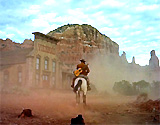 Arrival of Gunslinger Johnny Guitar 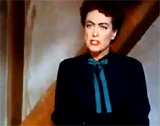 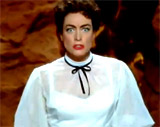 Vienna (Joan Crawford) 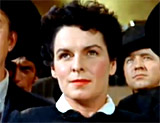 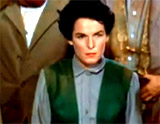 Emma Small (Mercedes McCambridge) 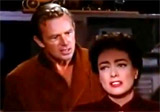 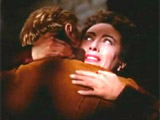
Vienna Rekindling Love Relationship with Ex-Paramour Johnny Guitar (Sterling Hayden) 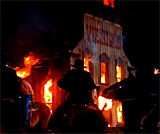 The Burning of Vienna's Casino 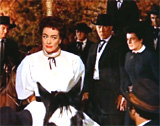 Emma's Lynch Mob Posse |
||||||||||||||||||||||||||||||||||||
|
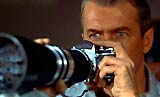
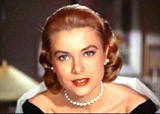
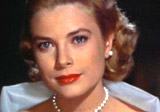
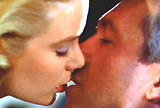
Rear Window (1954) Hitchcock's voyeuristic thriller Rear Window (1954) implicated its audience as 'Peeping Tom' viewers of apartment neighbors - sharing in the voyeuristic surveillance by the film's protagonist: a photographer L.B. "Jeff" Jefferies (James Stewart) with a cast on his broken leg (symbolic of his impotence) and a 'phallic' telephoto camera to peer at his Greenwich Village neighbors. His rear window view into other apartments across the courtyard kept him preoccupied. He demonstrated his lack of commitment and avoidance of commitment to beautiful and sexy fiancee -- fashion model designer society girl Lisa Fremont (Grace Kelly). During a reddish Manhattan sunset as the wheel-chaired photo-journalist dozed, the courtyard outside his rear window buzzed with activity. A shadow slowly rose up Jeff's face as Lisa (in close-up) approached. She was a stylish vision of beauty - elegant, lovely, affluent, and blonde. She bent over, and then lovingly kissed him. She roused and awakened him from his sleep. She whispered suggestively as she asked:
As she flicked on the apartment's lights one-by-one, she told him her name, disjointedly:
Later, she emerged in his doorway wearing an elegant white silk nightgown - a "preview of coming attractions" for an intimate evening/sleep-over. |
 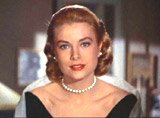     Lisa Fremont (Grace Kelly) |
||||||||||||||||||||||||||||||||||||
















 A
Streetcar Named Desire (1951)
A
Streetcar Named Desire (1951)