|
History of Sex in Cinema: 1968 |

|
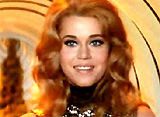
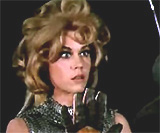
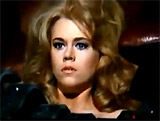
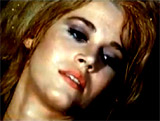
Barbarella (1968, Fr./It.) This 'adult' sci-fi fantasy sex-capades comedy from French director Roger Vadim (featuring his new wife Jane Fonda) with a screenplay by Terry Southern was edited to receive a PG rating. Based on the French comics by Jean-Claude Forest, it contained many sexual references, and numerous instances of Barbarella's interstellar love-making. The story set in the 41st century involved Barbarella's journey to a distant galaxy to save humanity. The cult film opened with an infamous credits sequence that teasingly stripped French comic-strip heroine Barbarella (Jane Fonda) of her black space-suit outfit in zero gravity. Her gloves, leggings, and then helmet were gradually removed, before she became completely exposed and nude, although often obscured by floating and jiggling white letters.
There was a teasing sequence about Barbarella experiencing traditional or "old-fashioned" physical-penetrative copulation instead of the latest virtual sex (consumption of exaltation transference pills). When she was asked by Mark Hand (Ugo Tognazzi) to make love to him (in gratitude for rescuing her from robotic devil dolls) the old-fashioned way, she responded: "Make love, did you say?...What do you mean? You don't even know my psycho-cardiogram!" - and then explained how in the futuristic society on Earth, human sex was accomplished in non-physical ways. She told him: "Well, on Earth, for centuries, people haven't made love unless their psycho-cardiogram readings were in perfect confluence," and then she asked: "Do you have any pills?" - but happened to produce her own. She was referring to a second way of having sex, via sex pill ("an exaltation transference pellet"):
Mark knew nothing about and was disinterested in both of her suggested new sexual techniques, and suggested that they bed down together instead. She exclaimed: "But nobody's done that for centuries! And nobody except the very poor who can't afford the pills or the psycho-cardiogram readings....cause it was proved to be distracting and a danger to maximum efficiency. And, and because it was pointless to continue when other substitutes for ego support and self-esteem were made available." However, he was able to convince her to have physical sex with him - and she reluctantly laid back, took off her garments, and laid under a fur covering:
After having sex with him, she was apt to agree with his stated question: "Now, Barbarella, don't you agree with me that in some things, the old-fashioned ways are best after all." She concurred: "What? Oh, that. Yes, I must admit it was rather interesting. Still, I see what they mean by saying it's distracting." In another situation after being rescued from pecking birds by goofy underground revolutionary Dildano (David Hemmings), she thought he was asking to have physical intercourse with her as a reward for saving her life. When she began to remove her coverings, he objected and said that he preferred hygienic futuristic sex with the pill:
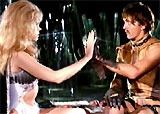
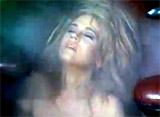
They communed together without physical intercourse by reaching out and touching with one hand - eventually causing her hair to curl. The title character also made love with the aid of a gigantic 'orgasmatronic' type machine (an organ of love) - and was sentenced to death by multiple orgasm (delivered by the 'Excessive Pleasure Machine'). Dr. Durand Durand/Concierge (Milo O'Shea) attempted to torture and kill Barbarella with pleasure by orgasmically "playing" her with the euphemistic pipe organ (with the tune "Sonata for Executioner and Various Young Women"). He promised a swift but pleasurable death, as he began playing, and her clothes were expelled:
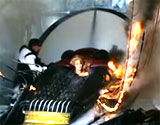
To his amazement, she completely enjoyed the lethal experience, exasperating him even further by orgasming. He was aghast at the sexually self-determined female for defeating the machine and causing it to smoke and burst into flames:
|
|
||||||||||||||||||||||||

|
Candy (1968, It./Fr.) Director Christian Marquand's semi-vulgar, hip, 'psychedelic', anti-establishment sex farce was created by scriptwriter Buck Henry from Terry Southern's updated, racy (and supposedly 'unfilmable') 1958 novel (originally based on Voltaire's 18th century Candide). Voltaire's story about Candy was later the basis of two "adult" porno films by writer/director Gail Palmer, starring blonde adult-films actress Carol Connors:
Nubile, vacuous and sexy nymphet Swedish blonde Ewa Aulin (a former Miss Teen Sweden in 1965 and Miss Teen International in 1966) starred as the title character, gorgeous blonde high-school student Candy Christian. The naive waif (from another world?) experienced a series of bizarre sexual exploits, misadventures, experiments, and strange erotic encounters with a succession of men. In fact, the film glorified molestation, date-rape, and sexual exploitation. The big-budget, sexist, and crude film flopped miserably with its misogynistic subplot (now badly dated) that starred a lot of big name actors in mostly embarrassing roles within vignettes (who later admitted it was the worst film they ever made), such as:
|
 Candy (Ewa Aulin)   Candy With General Smight   Candy With Grindl |
||||||||||||||||||||||||
|
The Detective (1968) Director Gordon Douglas' frank and adult-oriented, socially-conscious, neo-noir crime drama, with themes of police brutality, homosexuality, and corruption was based on the 1966 best-selling Roderick Thorpe novel. The dark crime drama's star Frank Sinatra had just finished another seedy private eye film, 20th Century Fox's caper Tony Rome (1967), and was planning on soon making its sequel Lady in Cement (1968). Its tagline was:
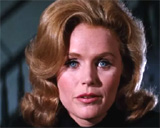
With the adoption of the MPAA ratings system on the immediate horizon in late 1968, The Detective was able to push various taboo topics farther than ever before. The film was controversial for its portrayal of homosexuality (and its repression) and a female's sexual sickness known as nymphomania (it was one of the first to deal openly with these two subject areas, although has since been considered slightly offensive and dated), the use of the words "penis" and "queer," and the character of the detective's flawed, sexually-promiscuous ("nymphomania") and estranged wife Karen (Lee Remick) - in the film's romantic side sub-plot. The film was sidelined by numerous flashbacks that destroyed the even flow and continuity of the main plot. When considering the portrayal of all the deviant gay characters (that ended up dead, disgraced or both) in the negatively-stereotyped film, they were either perverted self-loathing killers, suicidal, or psychotically-insane nut cases. The main title character was:
It told about the case of a murdered/mutilated wealthy homosexual man named Theodore "Teddy" Leikman, Jr. (James Inman) - the son of a politically-connected department store owner. The opening scene of the gruesome discovery of the body after a violent hate crime was graphically described - including both knife-mutilations of the body and five or six killing blows to the head:
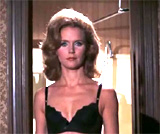
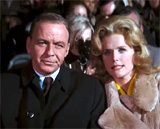
Leland also noted "Semen stains on the sheets" and it was surmised that Leikman was gay: "Junior there was a homosexual...Mutilations were caused by some kind of knife....Lovers' quarrel. This is the way they settled it." He was working the case with a rookie cop named Robbie (Al Freeman, Jr.) and another faithful partner Dave Schoenstein (Jack Klugman). Neighbor Carol Linjack (Dixie Marquis) described Teddy Leikman's roommate, a possible suspect, as "an unsavory character. Medium build. Long sideburns, like an actor." A magazine and weights in Leikman's bedroom identified the victim and/or his roommate as a bodybuilder. In the meantime, Leland remembered - in flashback, how he met his wife Karen (Lee Remick), before their marriage began to dissolve and break up and they parted ways. She was a future Sociology professor who revealed she was a foster child when they first met. She also undressed down to her black bra and panties, and then unhooked her bra before embracing Joe after telling him: "Let's just enjoy each other...I want this to be different." Later at a football game, she told him he should be wary of her: "I've been around and you've been around. We're both kind of set in our ways and everything...Are you wacky enough to take on me?" But then added that they should marry: "If I don't marry you, I'm crazy."
Back in the present with the Leikman case, the cops made a nighttime raid - they drove up to a truck-trailer in the meat-packing district jammed with preppy, white males (wearing pastel-colored sweaters) kissing each other. Treated with harrassment by the authorities, the gays were lined up and harshly questioned by bigoted cop Nestor (Robert Duvall) - to find out whether they knew either the murdered Leikman - derogatorily called "one of your kind" - or his roommate shown in a sketch drawing. The case led investigators to "all the Ys - the body-beautiful places, weightlifting joints, and the gyms" where the roommate used to hang out: "Maybe that's where he met his roommate." The chief suspect was identified as a "strange one" - a short-term, live-in roommate/lover and drifter named Felix Tesla (Tony Musante). He was arrested after a chase at his beachside hotel and brought to police headquarters. The psychologically disturbed and clearly-psychotic Tesla made odd faces and cringed in the police interrogation room during intense pressure (when he was brutally asked: "What did you do with the knife, you fag!"). He admitted to Leland that he hated Leikman who had ridiculed him for being uneducated, and called him names such as "bull" and "stud." Their short time together led to a deadly argument about whether Tesla could stay on as a roommate. Under coercion by Leland, Tesla quickly confessed to a "violent and savage" murder. Even Leland became upset by the feverish frenzy that surrounded the clearly insane Tesla: ("What a gorgeous little circus. Everybody out to fry the little fag, including me...he's a psychotic and they're gonna burn him, that's why I'm upset"). The trial resulted in a rapid conviction and execution (in the electric chair), and Leland was rewarded with a promotion to Lieutenant in the police precinct. In the meantime, Karen's infidelities became an insurmountable problem in Leland's marriage. She admitted to her addictive tendency to want sex with strangers: "You know what's the matter with me. You've known it for a long time....There's something wrong with me....I couldn't sustain a relationship. I was scared to death of that. Do you know what sex was like for me? I'd walk down the street or go into a bar or anything. Meet somebody. Anybody. Someone I never knew before. And I'd have an affair with him. It was the only way I could do it." Afterwards, they separated. Later during another conversation, Karen asked herself:
In his work life, Leland had second thoughts about the resolution of the Leikman murder case after a second unrelated case of suicidal death was reported to him. He received an office visit from Norma MacIver (Jacqueline Bisset) - the lovely wealthy widow of a CPA-accountant named Colin MacIver (William Windom). She suspected that her husband had been murdered related to a conspiracy (involving the Rainbow Corporation) when he died after a "jump" or fall from a race track's grandstand roof during a race (seen from his POV). With undue pressure placed upon him to not pursue the already-concluded MacIver case (including an attempt on his life), Leland knew that he must conduct his own underground investigation after he discovered a disturbing and shady connection. MacIver had arranged payouts to several members of the Rainbow Corporation (whose stockholders were all members of the Borough Planning Commission) - Leland realized that he had stumbled upon corrupt land speculation in slum properties, political payoffs and police kickbacks to keep everyone quiet. Leland realized that his actions would ruffle many feathers: "We're sitting on something pretty dangerous." During Leland's sleuthing, he began to suspect that MacIver's slick psychiatrist, an LSD-promoting Dr. Wendell Roberts (Lloyd Bochner), was concealing evidence about his involvement in Rainbow, and more importantly about MacIver's sexual orientation. In Roberts' office, Leland found cassette tape recordings of one of MacIver's therapeutic visits to the doctor. Leland ordered Roberts to play the tapes of MacIver's revealing confession. In an overwrought, melodramatic flashbacked sequence (narrated with MacIver's cynical voice-over on the tape), middle-aged, tormented homosexual-in-denial Colin MacIver remembered how he had been recognized as gay by other homosexuals: "You're a faggot. A dirty queer." He worried that he was a "homosexual without conviction" during a session with Dr. Roberts:
MacIver drove to the grungy and dark waterfront docks in search of a homosexual connection in the gay "underworld," where he found sinister-looking individuals lounging around and snuggling. MacIver believed (wrongly) that he could get his homosexuality purged or forever denounced, in order to restore his heterosexuality intact:
He couldn't control his detestable urge to enter a gay bar and hook up with a gay man (Leikman). The recordings proved that Leikman had picked up the closeted MacIver at a bar and took him home for sex.
Afterwards, the self-loathing, conflicted, and guilt-ridden MacIver became anguished and homicidal when Leikman told him he couldn't hide that he was gay: "You're a shy one, aren't you? You're a closet queen. You're the kind that thinks he's fooling people. Forget it. I knew you were gay the moment you walked into the bar....We know each other. Something about the way you walked. Something about the eyes." The seething MacIver attacked Leikman, bashed him in the head with a solid ashtray, and murdered him. The recording ended with MacIver's stunning realization: I killed one man, and another was about to die for something I did. When it was announced that Tesla was executed, I should have felt something, I know. I was responsible now for the deaths of two men. But I never did feel a great deal. You see, I felt more guilty about being a homosexual than a murderer. Leland had uncovered the lurid relationship between MacIver and Leikman that had led to the murder. The anguished MacIver was triggered to murder Leikman and then committed suicide a few weeks later by throwing himself off the racetrack roof. As Leland later explained: "A man committed a murder because he didn't want it known he was a homosexual." Leland also recalled how the wrong man Tesla had been executed for Leikman's death, and admitted he was partially to blame: "I knew that poor bastard was a psychotic. Hmm. He didn't know real from unreal. But I saw a chance for a promotion." As in a number of similar films in the 60s, the homosexual characters met terrible fates. Despite pressure to not turn over the tapes and cover-up the Rainbow scandal, Leland made the responsible choice - he made public MacIver's CPA records proving corruption. He then resigned from the department for lofty reasons: ("There are things to fight for and I can't fight for them while I'm here"), turned over his gold badge to his boss Captain Farrell (Horace McMahon), and exited. He mused with Norma MacIver:
|
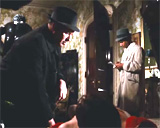 Leland's Description of Leikman's Gruesome Murder ("Penis Cut Off") 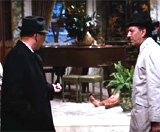 The Crotch of Leikman's Corpse Was Hidden by a Fern Plant 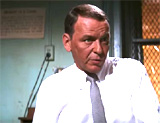 Joe Leland (Frank Sinatra) 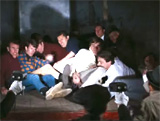 Homosexuals in the Back of a Truck Making Out 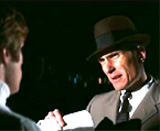 Nestor (Robert Duvall) Questioning One of the Gays 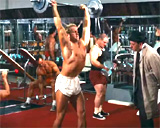 A Gym Filled with Beefcake Body-Building 'Homosexual' Males - Possible Suspects 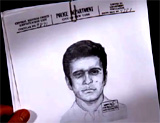 Sketch Drawing of Suspect Felix Tesla 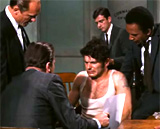 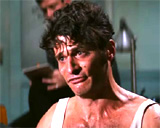 The Police Interrogation of Tesla 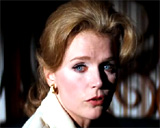 Karen Admitting Her Infidelities to Leland 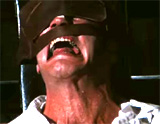 Electric Chair Execution of Tesla 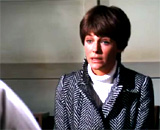 Norma MacIver (Jacqueline Bisset) Questioning Her Husband's 'Suicide' 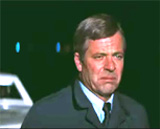 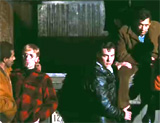 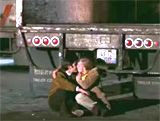   MacIver's Visit to Homosexuals at the Dock and In a Gay Bar 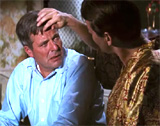 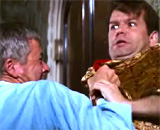 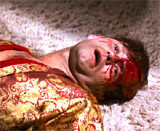 MacIver's Attack and Murder of Leikman After Homosexual Encounter 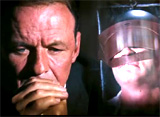 Leland's Recollection of Wrongly-Convicted Tesla's Execution |
||||||||||||||||||||||||
|
Flesh (1968) (aka Andy Warhol's Flesh) Director Paul Morrissey was responsible for this avante-garde low-budget experimental film from pop artist Andy Warhol. Some considered Warhol's film about a male hustler as an attempt to undercut John Frankenheimer's Midnight Cowboy (1969), filming at the same time, about another NYC street hustler. It was one of a trilogy of Morrissey films produced by Andy Warhol and starring Joe Dallesandro - the other two films were:
This cult film was an explicit, X-rated underground film with non-chalant, frequent male nudity. It also featured transvestite drag queens (i.e., Candy Darling and Jackie Curtis in their film debuts), an exotic stripper (sexploitation actress "super groupie" and stripper Geri Miller - before breast implants), and fellow hustlers and johns. The film was essentially a candid chronicle of one day in the life of handsome, heroin-addicted, bisexual hustler Joe (Joe Dallesandro) in New York City. In the opening scene next to a small TV playing an episode of The Honeymooners, he woke up after prompting from his wife Geri (Geraldine Smith). After making out with her (including one of the earliest instances of an erect penis in a non-pornographic film), she begged him to make $200 to pay for an abortion for the pregnant lover-girlfriend Patti (Patti D'Arbanville). And then she playfully wrapped his flaccid penis in her white scarf and called it a "pretty package...It's so much prettier wrapped up." After playing with his infant son (his real-life one-year old son) while Geri ironed his clothes, Joe was out on the street soliciting himself, and soon received a $20 bill for his services from a customer (John Christian). He was then propositioned to be a nude photography model for an elderly Artist (Maurice Braddell). He also got together with stripper ex-girlfriend Terry (Geri Miller), who administered a blow-job to him, and then described a recent rape she had experienced ("...it was fun...at the time it wasn't, but when I think about it, it was weird"). She then announced to everyone that she was considering silicon breast implants to help get more customers ("I know they're too little, especially for dancing topless...Wouldn't you like them bigger? I mean, like, the bigger, the better"). As Joe sat next to her, he gently touched and fondled her breasts and nipples. She also wanted Joe to become as interested in her breasts as he had been in the past, because she thought they were slightly drooping: ("Joe, you don't seem to like them like you used to. Are you turning gay or something?"). When he urged her to go ahead with implants, she responded: "Well, if you want it, you got it." While she gave a demonstration of her topless dance gyrations behind him, Joe spoke with transvestite Jackie Curtis.
In the film's final sequence, Joe was back home in bed with Geri and pregnant Patti where they undressed him, but then when they became talkative with each other and cuddled together - Joe became bored and fell asleep (mirroring his sleeping in the opening scene).
|
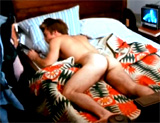 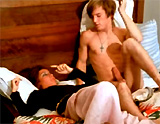 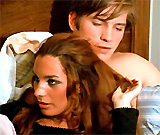 Opening Scene With Wife Geri (Geraldine Smith) 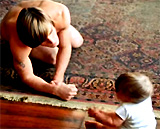 Playing With Son 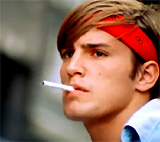 Hustler on the Street  Transvestite Candy Darling (as Herself)   Terry (Geri Miller) and Transvestite Jackie Curtis (as Herself) with Joe |
||||||||||||||||||||||||
|
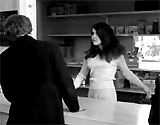
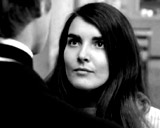
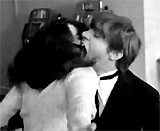
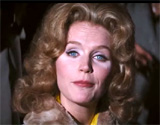
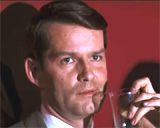
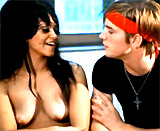
Director/co-writer Brian DePalma's second released feature-length film (and his first important film) was an episodic, improvisational anti-war (and anti-military) satire of late-1960s events, manners and mores among the 'under-30' counter-culture. DePalma later admitted that he was attempting to imitate the Novelle Vague films in France, including those of Jean Luc-Godard. The low-budget independent film was an early and primitive example of the "New Hollywood" movement emerging in the late 1960s. The experimental and irreverent film was originally rated X (it was the first film in the US to receive the 'new' X rating, predating I Am Curious - Yellow (1967, Swe.) by a few months) but later was re-rated to R. It opened with the broadcast of a black and white news clip playing on a portable ZENITH television, that concluded with President Lyndon Johnson defending his record and the state of the union to a military gathering, on the need to continue with the Vietnam War ("This is a pretty good land. I'm not saying you never had it so good, but that is a fact, isn't it?"). [Note: The film ended with a reprise of Johnson's statement: "You never had it so good."] Afterwards, a man walked down the street (under the credits) and entered a bar, with the title card: "Paul goes to his friends, Jon & Lloyd, for advice." The three friends (all interested in avoiding the draft), appearing in episodic segments, included:
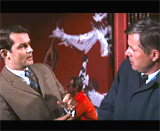
The first in a series of disconnected, NYC based sketches included a discussion about draft-dodging (by faking homosexuality), as the trio made up scenarios about how they were gay. The racist-minded Jon proposed telling a recruiter about his distaste for the Army's recruitment process:
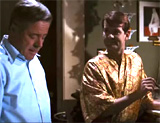
Other topics they discussed included free love and computer dating, voyeuristic and amateurish 'peep art' film-making, the JFK assassination and conspiracy theories, Vietnam and politics embodied by LBJ. In one of the film's episodes, Lloyd drew diagrams of bullet paths (the location of JFK's neck wound in particular that was measured at the intersection of "5 1/2 inches from the tip of the right shoulder joint" and "approximately the same distance below the tip of the right mastoid process, the bony point immediately behind the ear") on the neck and shoulder of the nude body of his sleeping girlfriend, a Bronx Secretary (Ashley Oliver). He was bound to prove that the discredited Warren Commission used false information: ("Everything's wrong, the whole thing is a blatant falsification...the FBI, Hoover, liars, cheats, defraud the American public" - he muttered). He shouted out how Kennedy must have been shot standing on his head, based upon the evidence. He finally turned to the camera and concluded: "The Warren Commission's a whitewash!"
In another scene after viewing her shoplifting a book into her purse in a bookstore, Jon was able to persuade (or blackmail) aspiring actress and petty thief Linda (Rutanya/Ruth Alda) to disrobe down to her see-through underwear in front of the camera, for one of his filmed, avant-garde "peep art" works (he claimed he was recording "a private moment"). She was pretending to be in her Manhattan apartment - viewed (and filmed) entirely from the perspective of someone watching her undress on her bed through her window. The scene ended when Jon stepped into the frame and joined her in bed. The projection of Paul's stag movie ("The Delivery Boy and the Bored Housewife") was also shown - it was the "Dirty Movie" or Computer Date No. 4: Paul's Last Stand (according to the title card). It was projected at fast speed with a tinkling piano soundtrack - viewed through the camera's iris peephole. Eventually, Private Jon was sent to Vietnam - and in a strange sequence when he was being interviewed by a news-reporter in a rice paddy about his "search and destroy" mission, he was distracted by the sight of a female Viet Cong (VC) member in the near distance. As the camera continued to roll, he approached her and coaxed her to pretend she was alone in her room before a window, and was disrobing - first her shoes and then her dress - as he had previously instructed Linda (who was seen in brief flashbacks). The film concluded with a reprise of LBJ's televised speech, again inspiring the American people to support the war effort. |
 Draft-Dodging Strategies Proposed by Jon  Lloyd Explaining Falsified Evidence in the "Whitewashed" JFK Assassination 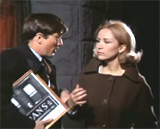 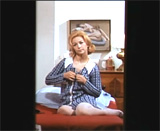 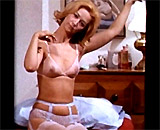 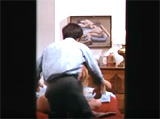 Linda (Rutanya/Ruth Alda) with "Peeping Tom" Film-maker Jon   "Dirty Movie" 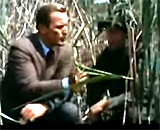  Interview with Jon in a Vietnam Rice Paddy - and Female VC |
||||||||||||||||||||||||

|
Hugs and Kisses (1968, Swe.) (aka Puss & Kram (1967, Swe.)) Director Jonas Cornell's notorious parody of Swedish sex comedies, opening in the US (in New York) in 1968, was noted for breaking more nudity barriers in its story of friendship. In the black and white film, a love triangle developed between a woman and her husband (a young, middle-class Bohemian couple in a conventional marriage), and one of his friends who lived with the couple in exchange for doing domestic chores.
In the plot, Eva (with Max's assent) pretended to sleep with John as a ploy to rid John of his boorish girlfriend - typing instructor Hickan (Lena Granhagen), who had moved in with John and was beginning to dominate the apartment. However, Eva's dissatisfaction with her lackluster marriage to Max soon led her to actually make love to John. It included the first extended full frontal view of female genitalia (actually pubic hair). In the 'celebrated' scene, the film's heroine Eva undressed in front of a full-length mirror, looked at her reflection, and then went over to the bed and put on a silky white see-through nightgown before getting into bed.
|
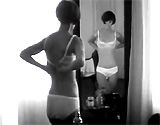 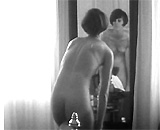 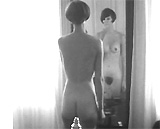 Eva (Agneta Ekmanner) |
||||||||||||||||||||||||
|
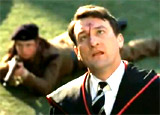
This British coming-of-age social drama and anti-establishment film from Lindsay Anderson presented a firm condemnation of the British Public School (a symbolic microcosm of a repressive Establishment-oriented society) and its long outdated and archaic traditions, rituals and customs, brutal social hierarchy, and many brutal whippings and other indignities (and perversions) suffered by the male boarding school students. The film's plot was told from the point-of-view of a non-conformist, rebellious young upperclassman who had reached his breaking point, after clashes with authority figures (and oblivious adults) resulted in constant condemnation, criticism, and persecution. It was one of the first films to mix color and black-and-white footage in an impressionistic way to connote fantasy vs. reality. It was notorious and controversial for its frontal male nudity (in a shower scene) (excised by censors), female nudity, sex, violence and homosexuality. Considered a precursor of Stanley Kubrick's A Clockwork Orange (1971, UK), it was originally X-rated (but subsequently edited and re-rated as R) and most noted for its controversial finale - a violent, vengeful bloody revolt led by an anti-authoritarian student anarchist accompanied by his girlfriend, against the school's pupils, teachers, and parents. In the film's opening set in the late 1960s, students arrived at a British public school for the new school year; there was the ever-present rivalry and bullying between the younger, first-year lower-form boys (treated as slaves and called "Scum"), and the upper-form senior Prefects (known as "Whips") who enforced discipline and took advantage of the junior boys by making them their slaves. Returning student Mick Travis (Malcolm McDowell in his debut film role) was introduced as a rebellious and anti-authoritarian character, called Guy Fawkes by one of the prefects ("It's Guy Fawkes back again") - a foreshadowing; he removed the black scarf on his face (hiding his mustache), spoke into the mirror: "My face is a never-failing source of wonder to me," and soon after was shaving off the illegal growth of hair. Mick made some off-handed, fatalistic quotes while speaking to his roommates: "The whole world will end very soon - black, brittle bodies peeling into ash...War is the last possible creative act....(looking at a side-profile of a nude pinup model in a magazine) Hello, sweetheart. There's only one thing you can do with a girl like this. Walk naked into the sea together as the sun sets. Make love once. Then die." Mick and his classmates were punished by the Whips for being "degenerate" - they were subjected to a two-minute cold shower [Note: the full-frontal male nudity was excised by censors].
During a slow-motion, black and white homoerotic gymnastic scene with great sexual tension, Mick's roommate Wallace (Richard Warwick) flirtatiously and seductively grabbed the horizontal high bar and performed graceful rotational moves, at the same time that he knew that younger Bobby Philips (Rupert Webster), one of the 'prettier' boys standing on the balcony above, was pulling a sweater over his head, and watching him. [Note: Later in the film was a view of the two males peacefully sleeping in the same bed together.] In another scene, Mick and friend Wallace disobediently went joyriding on a stolen motorcycle during a truant day from school. In the Packhorse Cafe coffee-shop, Mick rudely flirted with an unnamed waitress, the Girl (Christine Noonan), and she slapped him across the face for stealing a kiss.
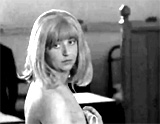
In a fantasy sequence, she came up behind him at the jukebox and animalistically taunted him: "Go on, look at me. I'll kill you. Look at my eyes. Sometimes I stand in front of the mirror and my eyes get bigger and bigger. I'm like a tiger. I like tigers. Rrrah!" He contemplated kissing her, but was fearful of getting too close, during their ritualistic mating (using the metaphor of two tigers); their love-making was accompanied by growls, sniffs, clawing, swipes, hissing, and biting - suddenly, they appeared totally naked as they rolled around and wrestled each other on the floor. Mick (and his pals Wallace and Johnny Knightly (David Wood)) had continually been regarded as a "nuisance" because of their attitude by one of the "Whips" - the mean head of house Rowntree (Robert Swann); Mick insulted him: "The thing I hate about you, Rowntree, is the way you give Coca-Cola to your scum, and your best teddy bear to Oxfam, and expect us to lick your frigid fingers for the rest of your frigid life." In a protracted whipping corporal punishment scene in the gymnasium, Mick and his two pals were caned. The last to suffer a brutal lashing was Mick, who was bent over a bar and whipped with ten strokes instead of the usual four for his comrades (most of Mick's whippings were off-screen, accentuated by the sounds of quickening steps and the slashing whip against his buttocks); as he left the room, Mick was required - by tradition - to shake Rowntree's hand and thank him: "Thank you, Rowntree." Mick contemplated a retaliatory and brutal attack on all of his enemies, during a blood-brother oath ceremony with his two buddies, when they all cut themselves on the palm of their hands with a straight-edge razor. A nihilist - Mick vengefully and fatalistically vowed to them: "Death to the oppressor. The resistance. Liberty. One man can change the world with a bullet in the right place. Real bullets."
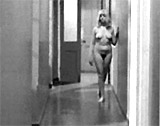
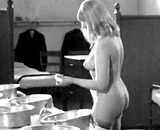
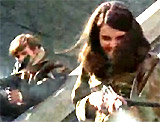
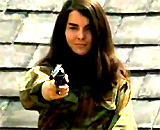
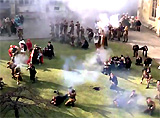
About three quarters of the way through the film (a dream fantasy of the boys?), the meek young wife of the House Master, Mrs. Kemp (Mary MacLeod), wandered down a hallway stark naked (seen in long-shot), and entered the empty washroom area where she was seen naked from a side-view; she fondled and caressed soap, towels and other objects the boys had carelessly strewn about [Note: it was reportedly the first instance of a full-frontal female nude passed by the British Board of Film Classification. In exchange for allowing the stark female nudity, the male frontal nudity in the earlier shower scene was excised.] During a paramilitary exercise in the woods near the school, Mick, Johnny, and Wallace played a practical joke on the Whips and other adult supervisors by planting explosive paint bombs. The Headmaster (Peter Jeffrey) was called upon to punish the offending students. He delivered a reprimanding speech, offering them an opportunity and "privilege" to serve by performing work as punishment: "Now you boys are intelligent. You're too intelligent to be rebels. That's too easy. And it would be easy to punish you in the normal way. But I'm going to give you a privilege. Work. Real work. And I want you to think of this not as a punishment, but as an opportunity to give, to serve." While cleaning the church's basement, the boys shockingly discovered a fully-developed fetus in a large jar, and a stock pile of WWII-era armaments, ammunition, weaponry, machine guns, mortar tubes and bombs. Mick decided to seek deadly revenge with the large cache of weapons against those who had abused and wronged him. The film's most notable segment was its controversial finale - a violent, vengeful bloody revolt, uprising, anarchistic attack and armed shoot-out at the conformist British public school (a symbolic microcosm of a repressive Establishment-oriented society) during Speech Day ceremonies; the attack was conducted by rebellious, revolting students (including the coffee-house Girl), known as the Crusaders, from the rooftop of the school. After the church was smoked out to send everyone outdoors, the students opened fire with machine guns and explosions were set off; but then some in the crowd that were being fired upon acquired rifles and shot back, including the General, police officers, a mother, and some of the other students; when the Headmaster walked out into the open and called for a cease-fire, Mick's Girl coldly shot him between the eyes with a handgun while he pleaded: "Boys, boys, I understand you. Listen to reason and trust me, trust me!" The film's concluding "THE END" was substituted with "IF..."
|
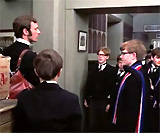 British Public School Hierarchy: Younger Boys Bullied by Senior Prefects   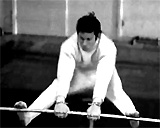 Homoerotic Gymnastics Scene 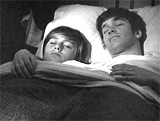 Bobby and Wallace Sleeping Together    Fantasy: Animalistic Sex Between Mick and The Girl 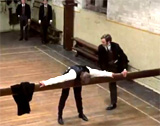 Mick's Brutal And Excessive Whipping by Head of House Rowntree 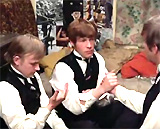 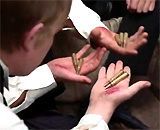 Blood-Brother's Oath Ceremony 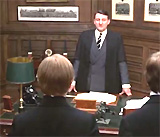 The Headmaster's Reprimanding Speech 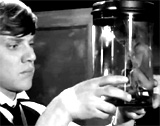 In Church Basement - The Discovery of Fetus in Jar and a Large Cache of Weapons |
||||||||||||||||||||||||
|
Inga (1967, Sw., US release in 1968) (aka Jag - en Oskuld (I, a Virgin)) Director Joseph Sarno's daring, X-rated soft-core film (and box-office smash) for the late 60s was a pretentious foreign film art-house import that was a milestone in erotic cinema, although most of its sexuality was implied through facial expressions and cut-aways to off-screen. It was a sexual coming-of-age, soap opera tale that starred beautiful ex-ballerina and star Marie Liljedahl (in her film debut) as an orphaned, nubile 17 year-old virgin named Inga Frilund. The film told how the orphaned teenager was forced to live with her scheming 36 year-old Aunt Greta Johansson (Monica Strommerstedt) in Stockholm - and eventually stole away her expensive, live-in young lover Karl Nistad (Casten Lassen) for her own love-making. Its scenes of nudity, masturbation, and intercourse are considered tame today. Liljedahl also starred in the erotic drama Ann and Eve (1970, Swe.), and in director Jess Franco's Eugenie (1970, Swe.) (aka Eugenie...the Story of Her Journey Into Perversion), based on one of Marquis de Sade's novels titled Philosophy in the Boudoir, in which she was systematically degraded (drugged, raped, and tortured) and corrupted by her father's mistress/older lover Madame Marianne de St. Ange (Maria Rohm). Due to the successful exploitation of the sex star, a color Inga sequel was made by Sarno, The Seduction of Inga (1971) (aka Inga 2), and released in the US in 1972. Soon after, Liljedahl retired from making films.
|
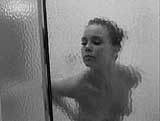    
Inga (Marie Liljedahl) |
||||||||||||||||||||||||
|
Director Robert Aldrich's milestone 'lesbian' film - a groundbreaking and sensational melodrama, was noted as the first X-rated film by a respected director and actors, and the first film to openly depict a lesbian love scene in a mainstream feature film.
This black comedy was subsequently banned, but re-rated a few years later as "R," like most X-rated films in the late 60s. The main lesbian relationship in the story was between:
Their butch-femme and the master-slave relationship was depicted during a repugnant scene in which George forced Childie to eat the butt of her cigar. Childie was compelled to recite: "I show my contrition...I eat the butt of your cigar." Although Childie first regarded the cigar as disgusting, she soon appeared to be sexually excited by it, aggravating George who yelled out: "Stop it! Stop it!" Childie acted disobediently: "I don't have to do anything I don't want to." The main conflict emerged when George was being eased out of her occupation because of her scandalous, alcoholic-fueled personal lifestyle. She played the BBC-TV soap-opera character of cheerful and beloved nurse "Sister George" in the popular BBC-TV series show Applehurst. She was being oppressively threatened with being "killed off" by the nervous station owners (aka 'The Killing of Sister George'), led by closeted, well-dressed, TV producer/executive Mercy Croft (Coral Browne). Mercy arrived at the gay bar where Childie and June were dressed as Laurel and Hardy for a costume ball. The two performed a dance-skit tribute in front of an all-girl band and large audience of real clientele. (It was a controversial and quite authentic scene filmed in a real-life lesbian bar - the local Gateways Club in London). Mercy took them aside and announced to June that she was about to lose her job; she coldly told her that her character was being killed off in a week: "I'm sorry, Miss Buckridge, it is the end of Sister George...Believe me, Miss Buckridge, this decision is no reflection on your ability as an actress. You helped to create a character that has become a nationwide favorite." In the TV series, Mercy explained that Sister George would die after being struck by a delivery truck on her motor scooter. The situation came to a head with the rivalry between June and Mercy. The predatory Mercy began to take an interest in Alice and made advances toward her. June called Mercy "a mealy mouthed old boot." June caught Alice in a lie about her whereabouts when she snuck off to meet with Mercy. June was offered a consolation prize by Mrs. Margaret Coote (Cicely Walper) - the title role (voice only) in a new show - a children's TV program: "The World of Clarabelle Cow." The character of Clarabelle Cow, an animated marionette, was described to June: "A very human one, I assure you. Full of little foibles and prejudices"; June reiterated: "A flawed, credible cow" and became very upset - she objected to the downgraded position: "You mean you want me to play the part of a cow?... Mrs. Coote, I have no intention of playing the part of a cow in any manner, shape or form! Is that absolutely crystal bloody clear?" Afterwards, the drunken June openly admitted to Childie that she was an alcoholic: "Drunk? Appearing to be drunk happens to be one of the easier ways of getting through some of life's most embarrassing situations. You should know that." June also made an unrestrained insults toward Mercy, in regards to her attention toward Alice: "Would you like to examine her? She's all there. Not exactly untouched, as we might say, by human hands but quite serviceable." After Alice and Mercy went off together, June was notified by rival actor Leo Lockhart (Ronald Fraser) that Mercy and Alice had left: "I think you'll find your bird has flown." The most sensational and controversial scene was the notoriously raw, extended lesbian love-making seduction scene between Alice and Mercy in Alice's apartment bedroom. Alice was lying on her back next to two of her favorite dolls, Emmeline and Jane. Mercy persisted in touching and caressing Alice's left nipple, first through her blouse, and then after Alice obliged by opening the front of her blouse to expose her breasts. Mercy then leaned forward and kissed Alice's neck (with her nipple still exposed), and moved down to her left nipple to kiss it and the rest of Alice's bare chest. It appeared that Alice experienced an earth-shattering orgasm, then they fervently kissed each other.
Soon after, an enraged June's discovered both of them in a mutually-seductive position - and cried out: "What a perfect little gem for the Sunday press. Did it have to be here?" June accused Mercy of having her purposely fired, in order to be with Alice:
June was devastated by the impending loss of Alice, and implored her to stay: "But you can't just - I mean, after all this time. What's gonna happen? Do you think you can live with her? I mean, you know, together, like we've been? We can't just throw everything away because you...Don't go, Childie" As Alice was about to leave, June impulsively slapped her across the face: "You cruel little bitch!" Mercy witnessed the slap and judged June as violent, indecent and uncivilized. June tore into Mercy for judging her and for seducing the younger Alice: "Why don't you save your lectures for the office, you sanctimonious slut?" Mercy shot back:
June refused to let Childie walk out on her, and couldn't hold back when Mercy called Childie a "poor child" - she divulged all of Childie's sordid past:
Childie left with Mercy, never to return. In the heartbreaking and tragic conclusion on the deserted set, she destroyed the darkened BBC-TV set (including her own fake bloody coffin that she criticized: "Even the bloody coffin's a fake!") by pushing over equipment, and then sank down on a bench in despair. She wailed or moaned out three cow "Moos" -
The camera moved away with each successive utterance - she was practicing for her next job as a voice artist for a cow named Clarabelle Cow. |
 Alice ("Childie")  June Buckridge (aka 'Sister George') 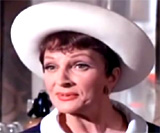 The Predatory Mercy - Interested in Alice 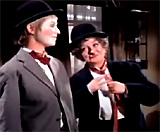 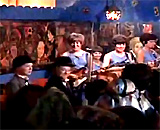 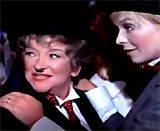 Lesbian Bar: Dressed as Laurel & Hardy in Gateways Club 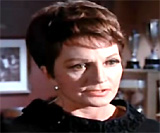 Mercy to June: "It is the end of Sister George" 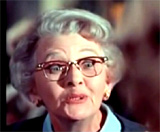 Mrs. Margaret Coote Announcing June's New Role - the voice of Clarabelle Cow 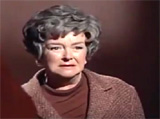 Catching Them in the Act: "Did it have to be here?" 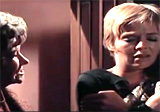    June's Ultimate Confrontation with Mercy About Alice: "She had an illegitimate child when she was 15..."  "Even the bloody coffin's a fake!" 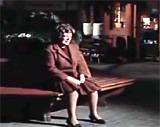 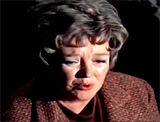 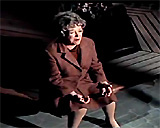 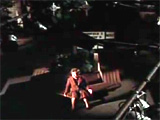 "Moo. Moo! MOOOOOO!" |
||||||||||||||||||||||||

|
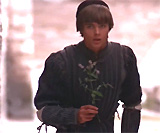
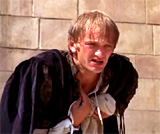
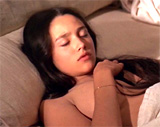
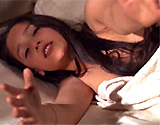
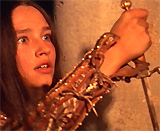
Romeo and Juliet (1968, UK/It.) Director Franco Zeffirelli's Shakespearean enduring classic romance-drama - a tragic love story of "star-crossed lovers" filmed on location in Italy, was the most commercially successful Shakespeare film. It was the most entertaining, refreshing and natural rendition - a passionate celebration of young love. Franco Zeffirelli-directed Shakespearean adaptation Romeo and Juliet (1968) appealed to the youthful, counter-cultural generation of the late 60s with its realism, the unequivocal sexuality and passion of the two teenaged, star-crossed lovers, the brief nudity of the couple on their wedding night (morning), and its contemporary feel. The film's prologue (a voice-over by narrator Laurence Olivier, uncredited) - told about the ongoing, bloody feud between two important families in Renaissance Verona and the poignant premonition that "star-crossed lovers" [Romeo - son of the Montague family, and Juliet - daughter of the Capulet family] would die by the tragedy's end, finally bringing about the reconciliation of the two bitter, warring families. As the film opened, preparations were being made for the evening's costume dance and feast among the Capulets, when Count Paris (Roberto Bisacco) mentioned his intentions to marry Juliet (16 year-old Olivia Hussey), the 14 year-old daughter of Lord Capulet (Paul Hardwick). Meanwhile, Romeo Montague (17 year-old Leonard Whiting), a sad, love-sick son was walking by himself through the city streets, holding a flower.
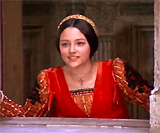
On their way to the Capulet's evening ball, Romeo and some of his friends were planning to crash the festivities wearing disguises. During a marvelously-choreographed sequence of dance at the ball, Romeo was immediately startled, entranced, and smitten by the lady Juliet engaged in a hand dance - he exclaimed: "Forswear it sight, for I ne'er saw true beauty till this night." Romeo circled around the perimeter of the crowd during the song, took Juliet's hand from behind a pillar, and spoke his first words to her about his passion - she responded equally as they sensually pressed their hands together in the famous scene. After interlocking palms and hands, they also dared to kiss each other (Romeo: "Sin from my lips! O trespass sweetly urged! Give me my sin again"); separately, both Romeo and Juliet realized that they had fallen in love with someone in their family's enemy camp. In the classic balcony scene set in the secluded Capulet garden later that evening, Romeo saw Juliet upon her balcony in front of her illuminated windows - he began to utter his famous soliloquoy: "But soft, what light through yonder window breaks? O...it is my lady, oh, it is my love. O that she knew she were...."; and then he heard Juliet thinking to herself: "Ah, me! O Romeo, Romeo, wherefore art thou, Romeo?" They hugged and kissed passionately, and Juliet wished to say good night (and she sweetly kissed Romeo good-night) while fearing for his safety, and also so that the bud of their blossoming love would have time to bloom and grow into a "beauteous flower," but Romeo wished for her to remain a bit longer so they could exchange loving vows; she pleaded that she had already given her vows from her boundless bounty. At the end of their evening, Juliet whispered that if Romeo wished marriage, he should send word (of where and when) the next day by messenger; he climbed the tree one more time to kiss her - and they were still kissing as dawn's light arrived. A wedding scene occurred at the altar of the chapel the next day, arranged secretly by Romeo's confessor and father figure, Friar Laurence (Milo O'Shea), with the assistance of Juliet's bawdy Nurse (Pat Heywood). However, on the afternoon of his marriage, a violent altercation arose in the street between Tybalt (Michael York), Lady Capulet's fiery nephew (and Juliet's cousin) and Romeo (with his best friend Mercutio (John McEnery)), leading to Mercutio's accidental death; in retaliation, Romeo fought against Tybalt and killed him. The Prince (Robert Stephens) banished the newly-wed Romeo from Verona, forever to be exiled and never to return.
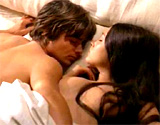
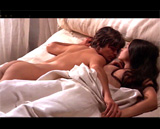
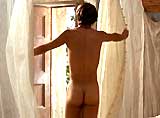
Before Romeo's flight from Verona to the nearby town of Mantua, there was the controversial scene of the brief nudity of the couple on their wedding night (the next morning) in Juliet's bedchamber. In a few long-held shots, Romeo lay naked in bed with Juliet, and then stood by a sunlit window. There was a split-second instant of topless Juliet hastily rolling out of her shared bed.
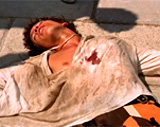
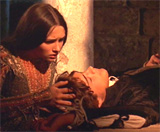
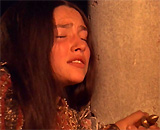
Juliet's parents remained unaware of the secret marriage between Juliet and Romeo. She and Friar Laurence (Milo O'Shea) schemed to have Romeo and Juliet meet after a daring hoax; Juliet was to assent to an arranged marriage to Paris, but then the day before, she would swallow a potion that would make her appear in a death-like sleep for 42 hours; then, following her burial in the Capulet family tomb, the plan was for her to escape with Romeo. Due to bad timing, Romeo was not alerted to the Friar's hoax by his servant courier Balthasar (Keith Skinner), and he rushed back to Juliet's tomb and discovered his 'dead' Juliet. In a very dramatic sequence, he sobbed, took one last look, gave her one last embrace, and a final kiss to seal his "dateless bargain to engrossing death." Shortly later, Juliet slowly awakened from 'death'. She saw Romeo's body on the floor and the poison vial in his hand; she chided Romeo for not leaving enough poison for her; when she kissed his lips to see if there was any remaining poison left on them, she found that his lips were "warm." Juliet came to her own triumphant, tragic and fateful end; faithful till death, she picked up Romeo's dagger, stabbed herself in the chest, and inevitably joined her love in marriage-death.
The final somber and climactic epilogue included the double funeral procession of the corpses of the two dead teens, who were carried up church steps to be laid in front of the Prince, who chastised everyone and pronounced judgment on the two feuding families. |
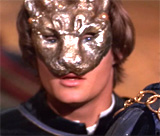 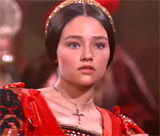 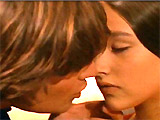 Love at First Sight at the Dance 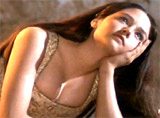 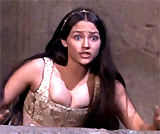 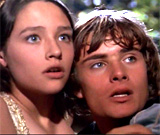 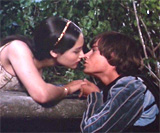 Classic Balcony Scene 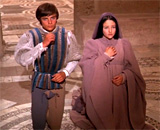 The Wedding 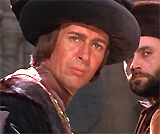 Romeo Banished by the Prince 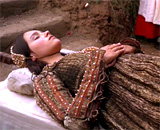 Juliet's Faked Death and Funeral 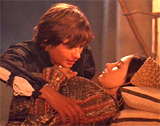 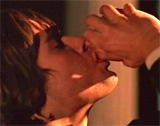 Romeo's Speech and Self-Poisoning 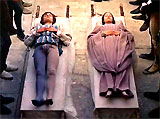 The Double Funeral Ceremony |
||||||||||||||||||||||||
|
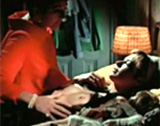
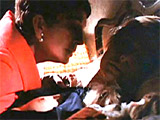
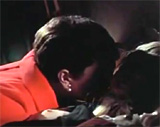
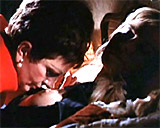
Rosemary's Baby (1968) Polish director Roman Polanski's definitive first American feature film Rosemary's Baby (1968), his second, scary horror film told about a young newlywed couple who moved into a large, rambling old apartment building in Central Park West, and began a loving, post-honeymoon period. The young, newly-married 60's couple included:
"Dizzy," woozy and disoriented after eating some tainted chocolate mousse (laced with sleeping powder), Rosemary hallucinated a Black Mass, imagining herself on a mattress drifting on the ocean, and then as a passenger on a presidential yacht. Undressed, shivering and naked, and then abruptly wearing a bathing suit, various images assaulted her:
She was surrounded by many chanting, overweight, elderly naked figures (of the Satanists' coven), including Guy and neighbors Roman (Sidney Blackmer) and Minnie (Ruth Gordon) Castevet. A bloody-red liquid was painted with rune designs on Rosemary's bare chest. A person resembling Mrs. John F. Kennedy (Patricia Ann Conway) who wore a white diaphanous gown descended a staircase and suggested tying her legs down in case of convulsions. Attendants spread her legs apart and bound them. In her dream-like sleep, Guy began making love to her, but then his appearance changed into a grotesque beast-like figure resembling the Devil, with yellowish eyes and clawed, scaly hands. He stroked the length of her body with his hairy claw. While being 'raped' during this horrific ritualistic copulation scene, as everyone watched her having intercourse with the Beast, she realized:
After a nightmarish dream of making love to a Beast, the paranoid, haunted, and hysterical bride believed herself impregnated so that her baby could be used in evil cult rituals. The next morning, Rosemary questioned mysterious scratches she found on the side of her body. She was appalled that Guy admitted making love to her while she was passed out - supposedly from mixing alcohol - "It was kind of fun in a necrophile sort of way." She remembered something quite different from Guy's recollection - a demonic, inhuman rape:
|
  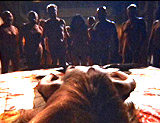 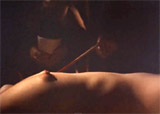  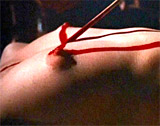 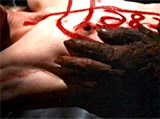 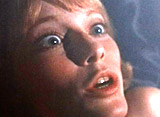 Rosemary's (Mia Farrow) Hallucinatory Fantasy-Dream - and Rape 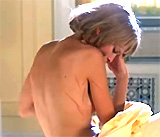 Scratches on Rosemary's Back The Next Morning |
||||||||||||||||||||||||
|
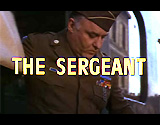
The Sergeant (1968) Director John Flynn's controversial, R-rated, sexually-frank and socially-relevant debut film provided an insightful view of repressed homosexuality, in an era when intolerant views were rampant. It was set on a US military base (a petroleum supply depot) in rural post-war France in 1952, where strict Master Sergeant Albert Callan (Rod Steiger) was in charge of the camp. The self-despising, predatory closeted homosexual Sergeant Callan (with "just one weakness, just one" as the trailer put it) became attracted (almost subconsciously) to one of the recruits - handsome young heterosexual PFC Tom Swanson (John Phillip Law). To keep him close, the self-loathing and tormented Sergeant made Swanson his private orderly room clerk, and jealously refused him passes to date his French girlfriend Solange (Ludmila Mikael). He also was insulting to Swanson about his relationship: "If you want to get laid, why don't you get one of the whores in the meadow?" At one point, half-drunk in a public bar, the Sergeant came up to Swanson, begging:
As Swanson departed the bar, the Sergeant grabbed him in a bear hug and boldly and forcefully kissed him on the lips. Swanson punched him in the stomach and pushed him to the floor. The rejection led to the tortured and miserable title character's further alcohol abuse and suicide with a bullet to his head (with a rifle) in the woods, after he was relieved of his duties. |
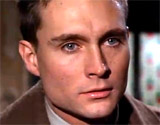 Tom Swanson (John Phillip Law) 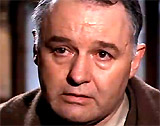 Sergeant Callan (Rod Steiger) 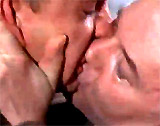
Bold and Forceful Kiss Between the Sergeant and Swanson |
||||||||||||||||||||||||
|
Therese and Isabelle (1968, W.Ger./Neth./Fr.) Radley Metzger's atmospheric, soft-core, black and white German language tale of self-discovery was based on the racy memoirs of French author Violette Leduc, an admitted lesbian. The film was composed of flashbacks by an older Therese to twenty years earlier during a visit to the school. This was the first and still one of the most realistic treatments of an adolescent lesbian love relationship - between two French boarding schoolgirl classmates (two adult females):
In addition to the love-making scenes between the two of them, there was one auto-erotic scene and one unpleasant heterosexual experience, both for Therese. The girls' first sexual experience together occurred clothed in a toilet stall and then in the school chapel, where Therese remembered how they clutched at each other's uniforms, sobbed and grabbed at each other on the floor:
Isabelle described her own rising passion before experiencing an overwhelming orgasm and confessing "I love you" to Therese. They also made love naked in bed (when Isabelle delivered oral sex to the reclining Therese) which the narrator described (in voice-over):
Outdoors in the woods, when they both vowed their steadfast love and undying devotion to each other, Therese's voice-over recalled their "irresistible forces."
|
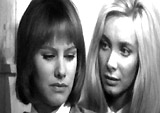 (l to r): Therese (Essy Persson) and Isabelle (Anna Gael) 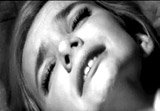 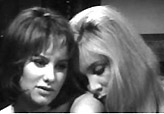     Isabelle with Therese |
||||||||||||||||||||||||
|
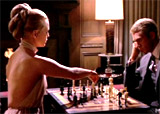
The Thomas Crown Affair (1968) Director Norman Jewison's caper plot abounded with sexual chemistry, completely overshadowing the modernized remake by director John McTiernan that was attempted in 1999 with Pierce Brosnan and Rene Russo. The original film was noted for its over 6-minute, erotic, sophisticated, almost wordless chess game (a metaphor for seduction) between the two main characters:
The game began with the lines:
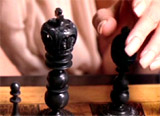
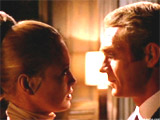
With long pauses between moves during the heated and exciting game (with obvious sexual imagery), they both touched their lips (in close-up), capped with a closeup of her slow fingering of the length and tip of the phallic-shaped bishop chess piece (he smiled knowingly at her). When she had him cornered and in "check," he stood, hesitated, considered his next move, then grabbed her arm and proposed: "Let's play something else."
Their seduction scene was filmed with a circling and overhead camera (representing her investigative circling of him), ending with a 70 second kiss that dissolved into a blur of colors, although they eventually double-crossed each other.
|
The Chess Game |
||||||||||||||||||||||||
|
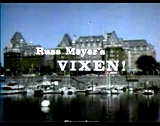
VIXEN! (1968) This over-the-top, definitive Russ Meyer ("King of the Nudies") soft-core sexploitation skin-flick was typical of his independent underground films with aggressive, big-breasted starlets. It was the first of Meyer's films with VIXEN in the title, followed by:
Its various themes included incest, lesbianism, promiscuity, violence, inter-racial rape, and racism - all in one film. This highly profitable, low-budget film from the independent film producer/director was one of the first US films to receive the newly-formed MPAA's 'X' rating, for its many sex scenes (including Vixen's erotic dance with a dead fish). The film asked about Vixen: "Is She Woman...or Animal?" and provided the tagline: "No trap can hold her...this predator on the loose," while the trailer described its plot:
It featured dark-haired brunette Erica Gavin as the sexually-voracious, racist, bisexual title character Vixen Palmer, married to naive Canadian bush pilot Tom Palmer (Garth Pillsbury) and living in a remote cabin. In her first sequence on-screen, she was frolicking in the woods with a Royal Canadian Mountie (Peter Carpenter), and complaining to him as she ripped off the top of her yellow bikini: "Come on, you're taking too damn long." After they had sex and she had to run off, he called her a "cold bitch." When asked what he would do to her if he had the freedom, he replied: "I'd turn you over my knee and spank your bare butt." Illustrative of her sex-crazed, promiscuous, frustrated and incestuous character, Vixen also seduced husband David King (Robert Aiken) who was visiting with his redheaded wife Janet King (Vincenne Wallace), one of the couples who came to their cabin in the woods. On a fishing trip, Dave also had sex with Vixen in the great outdoors after she urged him on: "Well, what are you waiting for?", followed by a nude romp through a stream and more coupling in the water. Later, a drunk, unhappy and depressed Janet (knowing that she was being cheated upon) was also one of Vixen's conquests. When Janet viewed Vixen undressing, she remarked: "So that's what my husband was after. Not bad, not bad, I gotta admit, that’s not bad at all." Vixen replied: "What you need is some cheering up." As Vixen massaged Janet's breasts, she remarked: "Your skin is so soft. How do you keep it that way?" Janet replied: "I don't use anything special." Vixen was becoming visibly aroused: "I know it's strange, but your body really turns me on" - a prelude to them having lesbian sex. She also showered with her own motor-cycle riding younger brother Judd (Jon Evans) and dared him to have sex with her. But she expressed derogatory attitudes toward his black friend Niles (Harrison Page), a Vietnam War draft-dodger, by often calling him "Rufus" and refusing sex with him. The film ended with an action-packed hijack attempt to Cuba (using Tom's plane) involving communist Irishman O'Bannion (Michael Donovan O'Donnell) and Niles, although it was aborted. |
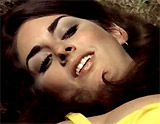 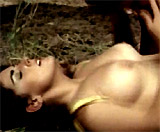 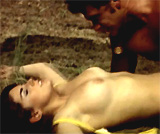  Vixen (Erica Gavin) - Sex with Mountie  Janet King (Vincenne Wallace) 
|
||||||||||||||||||||||||














 Greetings (1968)