|
History of Sex in Cinema: 1969 |

|
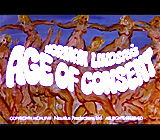
(Norman Lindsay's) Age of Consent (1969, Australia) UK director Michael Powell's last theatrical feature film (after he was scandalized and blacklisted for his voyeuristic film Peeping Tom (1960)) was this erotic, escapist romantic comedy-drama that was similar, in part, to Shakespeare's play The Tempest. The screenplay by Peter Yeldham was based upon Norman Lindsay's 1938 autobiographical novel of the same name. With gorgeous cinematography, including some stunning underwater photography, the film was shot on the small, remote and peaceful Dunk Isle in Australia's Great Barrier Reef area in North Queensland. It was advertised with the taglines:
The film appeared at a time when a new MPAA ratings system had just been adopted, and the floodgates were opened to more liberated cinematic works. During the opening credits, a nude painting of an island girl (identified later as Cora) stood in for Columbia Pictures' familiar lady with a torch logo. The plot was about bearded oil painter Bradley Morahan (James Mason) who had become disillusioned and unfulfilled in New York City and decided to return to his native Australia to paint and live an idyllic life in a shack on an offshore island. [Note: Morahan was modeled after real-life, sexually-frank Bohemian artist and writer Norman Lindsay who was the subject of the later film Sirens (1994). Mason's positive role here with an underaged female was in sharp contrast to his appearance as a perverted older man opposite a young nymphette in Stanley Kubrick's Lolita (1962).]
The main co-star was young Helen Mirren (22-23 years old at the time of filming) who was appearing in her first major film role. She took the role of teenaged, full-bodied, free-spirited orphan and granddaughter Cora Ryan. The non-pornographic film was not the first major studio feature film to have nude scenes (with full-frontal female nudity), but it was definitely one of the earliest examples.
[Note: In the closing credits, Helen Mirren was rightfully identified as a "member of the Royal Shakespeare Company" - she had appeared in its earlier 1968 film production of A Midsummer Night's Dream.] The film's distributor Columbia Pictures edited out most of the topless nudity, and also replaced Peter Sculthorpe's original score, although the film was restored to its original form in 2005 (and released on DVD in 2009). The half-wild, conniving, uninhibited Cora met Bradley at his shack - and offered to sell him fish she had caught. Later, he caught her stealing (from him and others) and compelled her to promise not to steal anymore ("I want you to promise not to steal anymore!...If you stick to your word, I'll try to help you...I might even get you to pose...half a dollar an hour, take it or leave it") - by suggesting that he would pay her to be his artistic model. His first creative work with her was a sand sculpture of Cora, complete with reddish seaweed pubic hair and coral-shell nipples. The unabashed Cora posed as his inspirational artistic muse, and was featured in several revealing nude scenes. When she was swimming with her dress on in the ocean - snorkeling (and spear-fishing), Bradley bargained to increase her pay to "a dollar and a half an hour" to strip down while swimming. He painted her nude figure as he watched her from the boat through a square glass viewing box.
Later, when she was standing in waist-deep water first with her purple dress on, he was dissatisfied with her pose and commanded: "It's the dress. Take it off" - she stripped off her dress to comply and was completely naked as she posed for him. He responded: "That's better. That's good." He was very pleased with the finished painting: "It's better than good, it's alive - and it's all you. You're a great girl, Cora. It's all on account of you." He claimed it was the "best work" he ever did.
In the story, Bradley ran into trouble with Cora's controlling and often gin-swilling, drunken and witchy grandmother Ma Ryan (Neva Carr-Glyn), who accused him of posing the 'underage' Cora in the nude and secretly having Cora prostitute herself. He rightly claimed that it was all innocent: "She posed for me and nothing else" although she threatened blackmail and vowed to turn him into the authorities. Cora's ultimate dream goal was to finance her escape to Brisbane to become a hair stylist, but then found that her grandmother had located her cache of money's hiding spot and stolen it. As Cora struggled with her drunken grandmother to get her money back, Ma Ryan fell off a cliff and broke her neck. Her death was officially regarded as an accident. Now without her guardian and believing that Bradley was broke, Cora offered him her entire savings ("You need it, it's for you, you've got none left"), but he rejected her liberal offer of both herself and the money: ("You earned it, you're the best model I've ever had - it's got to be the best work I ever did too"). She was upset: "You only want me for the pictures!" - and ran off. He pursued her as she dove into the nighttime surf and screamed out to her:
She popped out of the water, lunged at him to embrace him, and took him under the water with her, as they rolled around together - the film concluded. |
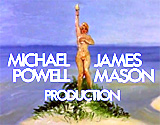 Columbia Pictures' Lady With Torch - a Nude Painting  Painting of Nudes Under Title Card 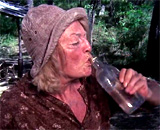 Cora's Drunken Grandmother Ma Ryan 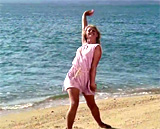 Cora Playfully Posing on the Beach   Sketches of Cora Swimming Naked 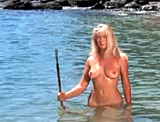  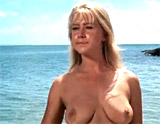   Cora (Helen Mirren) 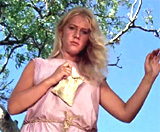 Cora With Her Stolen Money Bag Taken Back From Her Now-Dead Grandmother 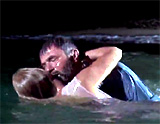  Film's Conclusion |
|||||||||||||||||||||
|
(Andy Warhol's) Blue Movie (1969) (aka F**k) During Andy Warhol's heyday in the 1960s and early 1970s (an era sometimes dubbed as "The Golden Age of Porn" and known for the rise of 'porno chic'), this controversial film was a prime example. The low-budget feature (at about $3,000) was the first erotic, adults-only film with explicit, unsimulated sexual scenes that played in mainstream US theatres. When it was projected in mid-1969 in Warhol's own Garrick Theatre in Greenwich Village for its debut theatrical release, it was seized by police authorities (and charged with being obscene), and three of the staff were arrested. "Blue Movie" was followed by a second erotic adult film, producer Bill Osco's Mona (1970) (aka Mona: The Virgin Nymph) (see later entry) with a more distinct storyline. Warhol considered his film an inspiration for Bernardo Bertolucci's Last Tango in Paris (1972), another controversial film with a similar plot about a couple who often met for dialogue and sexual intimacy. The film's title "Blue Movie" had two connotations:
The basically plotless film (with improvised dialogue interrupted by sex scenes) was shot in one locale (a NYC apartment's bedroom, bathroom, and kitchen during one afternoon). It starred two of Warhol's followers, playing themselves:
Random topics discussed by the two protagonists included the on-going Vietnam War, air pollution, President Nixon, the police, campus reform, NYC's mayor John Lindsay, and even obtuse subjects such as the use of strychnine in drugs, Franz Kline's paintings, oral sex, praying mantises, vivisection, termites, stamp collecting and the causes of athlete's foot (and gonorrhea). The heterosexual sex scenes were undoubtedly considered a form of political (and cultural) protest - a sign of the times. They also showered, shared a hamburger meal, horse-played in a bathtub, and watched TV. The film ended with a profile of Waldron repeating an affirmation of love to Viva (who was in the background): "I love you, I love you, I love you." |
    
|
|||||||||||||||||||||
|
Bob & Carol & Ted & Alice (1969) Co-writer and director Paul Mazursky's social comedy (his directorial debut film) with witty dialogue reflected the 'free love' era of the late 60s sexual revolution. The satirical film was noted for its publicity - a view of couples in bed together readied to experience group sex. Budgeted at $2 million, it was both a critical and commercial success at the box office. Its four non-winning Academy Award nominations were Best Supporting Actor (Elliott Gould), Best Supporting Actress (Dyan Canon), Best Original Screenplay, and Best (Color) Cinematography. The tagline "Consider the Possibilities" referred to its literate story of:
At first, the forward-thinking, upper-middle-class married couple of Bob and Carol attended an Esalen-type 'sensitivity training' weekend workshop (along the California coast) and were enlightened by its free and liberated approach to life and sex. With their best friends, another more stable, uptight and staid married couple (Ted and Alice), they began to challenge their marital vows of fidelity (and monogamy) during a weekend swinging trip to Las Vegas:
Once they arrived in a shared hotel suite, the two couples decided to have a lengthy discussion about love and sex, and break down their barriers. Although urged not to, Alice drunkenly stated as she started to undress down to her pink bra and bikini panties in the living room - to carry everything to its logical conclusion - that they would have an orgy and sleep together:
However, Carol noted that they were hindered by being best friends: "Alice, listen, I don't want to sleep with Ted, and Bob does not want to sleep with you." Taking the dare, Alice directly challenged Bob to make love to her: "Would you like to go to bed with me?...Do you want to go to bed with me?...Bob, Bob, could you make love to me? Don't cop out. Can you? Could you?" Ted was also challenged by Bob to take his wife Carol to bed - but he refused: "Absolutely not! Absolutely not! Under no condition!...Of course I find her attractive, and I love her very much, but like my sister." Carol began to get herself undressed and urged them to pursue their sexual inclinations, arguing that she was getting aroused: ("Alice is absolutely right. We have to be straight about this. Now, I'm beginning to feel something. I'm beginning to feel excited. Now, do you want me to deny that?"). She urged her husband Bob to show his own sexual desire for Alice, as they continued to discuss their anxieties and hopes before proceeding further - but soon were all down to their underwear:
In the bedroom, Bob had the two women to himself on the bed for awhile, as Ted slowly and nervously prepared himself in the bathroom with mouthwash and deodorant. After he joined the others, the foursome sat quietly in bed, all naked under the covers (after Ted spent a lot of time shedding his black socks and underwear). They appeared awkwardly nervous and very hesitant, as the camera slowly zoomed in. After a long pause, Ted asked Bob about a financial investment and stock market prices: "Did you put any money into Pitston, Bob?" But then, Bob tentatively kissed Alice, and Ted kissed Carol - although after a few moments of preliminary kissing, both men lost interest and stopped. They were unable to proceed with their mate-swapping plan - and basically admitted by their actions that they were not very liberated or as 'modern' as they thought. Abruptly, the camera cut to the couples leaving the hotel room.
Repercussions resulted from the liberated sexual experimentation (more disenchanting than genuine), and in the film's much-criticized sappy ending, the couples didn't trade partners or have sex after all, following an abortive attempt (with only brief kissing). The ensemble film ended with the very familiar Burt Bacharach song: "What the World Needs Now (Is Love, Sweet Love)." |
 Alice (Dyan Cannon) 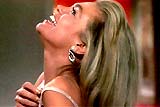 "Orgy, have an orgy" 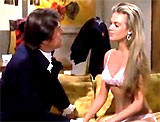 Alice Propositioning Bob 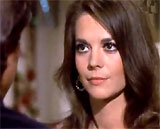  Carol (Natalie Wood) 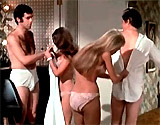  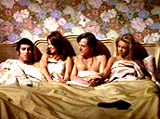 The Foursome in Bed Together |
|||||||||||||||||||||
|
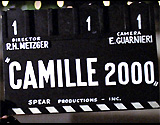
Camille 2000 (1969) 'Porn chic' director Radley Metzger's colorful, glamorous and arty, wide-screen Panavision, sexploitation feature (dubbed, without subtitles), his sixth feature, was an updated, futuristic soft-core version of Alexandre Dumas' 1948 novel and 1852 play -- "The Lady of the Camellias", using the character's names. The nudity in the film did exist, but was mostly tasteful and not explicit - and over-stylized. Metzger's other well-known 'adult' films included:
This steamy, highly-stylized romance was set in the year 2000 in the hedonistic world of the wealthy in the Italian Mediterranean (in the city of Rome) and involved two lovers:
In the film's most iconic sequence, after a jet-setter party, Armand and Marguerite began to make love on her circular bed in her mostly-white bedroom with mirrors and clear plastic, inflatable furnishings. The view changed to a top, mirrored-ceiling, reflective vantage point, as the two lay motionless after kissing and making love - possibly metaphorically suggesting her duplicity. When Armand woke up, he slithered over onto Marguerite's naked body and began to pleasure her with oral sex. The camera began with the focus on her face only (on the left side of the screen in the background). This was juxtaposed with the view of a nearby bouquet of blooming whitish camelias (on the right side in the foreground). The two images went in and out of rack-focus - expressing her delirious, pulsating sexual response (along with the sounds of her heavy, rhythmic breathing).
Problems arose for the couple when bachelor Armand demanded a monogamous and faithful relationship from the 'kept', evasive and non-committal courtesan Marguerite. He sent her a threatening message written in lipstick on a female Messenger's (Dominique Badou) naked back-side:
The film also featured a very elaborate S&M party, with bedrooms set up as dungeons or jailrooms, and men and women chained to each other.
Marguerite met her end in the film's tragic conclusion in a white hospital room within an oxygen tent. |
 Marguerite Gautier (Daniele Gaubert)  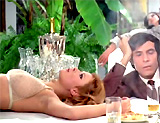 Olympe (Silvana Venturelli) at Decadent Jet-Setter Party 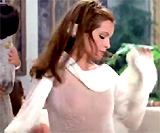   Marguerite Before and During Love-Making Scene  Marguerite Discovered by Armand Cheating with Someone Else  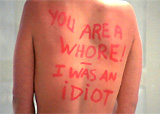 Message For Cheating Marguerite: "YOU ARE A WHORE! I WAS AN IDIOT" |
|||||||||||||||||||||

|
The Damned (1969, It./W.Germ.) (aka La Caduta Degli Dei, or Fall of the Gods) Director Luchino Visconti's controversial film (originally rated X due to its subject matter) told a melodramatic story, with many allegorical historical connections to sexual perversions and destructiveness (incest, pedophilia, immorality, homosexuality, murder, drug addiction and suicide). The drama told its story through a soap opera chronicling of the moral disintegration and dysfunctionality of one wealthy, upper-crust industrial family during the Nazi's rise to power in the early to mid 1930s. The main characters related to the Von Essenbeck family were:
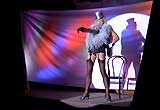
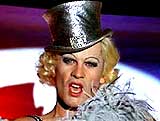
When Sophie made love to Frederick, she expressed her wish to get married very soon: "You and I together, forever." Martin molested a poor young Jewish girl named Lisa (Irina Wanka) after kissing her (off-screen) (ahd she tragically hanged herself). He also incestuously raped his own mother Sophie after telling her of his tremendous hate for her: "I will destroy you, Mother." He threw off his own clothes, then ripped her dress from her body. Afterwards, they laid in each other's arms and caressed each other. The centerpiece of the film was the restaging of the historical bloodbath massacre of Brown Shirt SA soldiers (in June 1934) called "Night of the Long Knives." It occurred after a surreal drunken orgy (equated with Nazi evil) of the homosexual soldiers - who had been skinny-dipping in the lake during the day, wildly carousing with naked women, dancing in female underwear at a lakeside resort, and then retiring to various bedrooms to sleep naked together. The soldiers were dragged from sleep and gunned down in large numbers.
|
  Martin (in drag) (Helmut Berger) 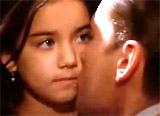 Martin (with young Lisa)   Sophie (with Frederick)  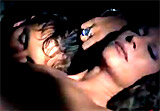 Sophie (with Martin) |
|||||||||||||||||||||

|
Easy Rider (1969) The generation-defining, youth-oriented, counter-cultural road film classic Easy Rider (1969) by director Dennis Hopper (his debut film) was a late 1960s tale of a search for freedom (or the illusion of freedom) in a conformist and corrupt America, in the midst of paranoia, bigotry and violence. The story contained sex, drugs, casual violence, a sacrificial tale (with a shocking, unhappy ending), and a pulsating rock and roll soundtrack reinforcing or commenting on the film's themes. It told about two motorcyclist biker outlaws (drug-dealers), who embarked on a coast-to-coast odyssey across America:
The film featured many views of alternate or radical lifestyles:
|
Commune Members 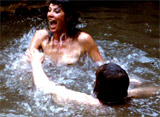 Sarah (Sabrina Scharf) 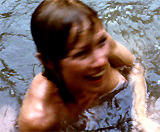 Lisa (Luana Anders) 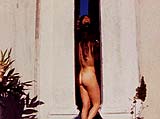 New Orleans Prostitute Mary (Toni Basil) 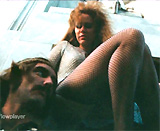 Karen (Karen Black) |
|||||||||||||||||||||

|
The Gypsy Moths (1969) Director John Frankenheimer's and MGM's fairly-slow action-melodrama was titled for its trio of amateur barn-storming skydivers, in a tale based upon James Drought's novel. The tagline emphasized the danger and risk of the sport for the troupe of 'gypsy moths' - allegorically drawn to a burning flame:
During a Fourth of July weekend during a hot summer (with plentiful thunderstorms), a daredevil acrobatic troupe entertained and thrilled residents of the small Midwestern town of Bridgeville, Kansas with a spectacular air-show (filmed with dazzling aerial cinematography). It was reported that traditional English star Deborah Kerr decided to go topless in this film, during the era of "The New Hollywood" - (with greater permissiveness), to allegedly compete with younger actresses who were willing to bare it all. Her disrobing was remarkable and notable -- it was the first feature film in which an established and respected actress nearly 50 years of age was performing a nude scene.
In the sex scene (after a long meandering walk through town to a playground), brooding, stoic and quiet lead skydiver Mike Rettig (Burt Lancaster) ended the evening with a one-night stand on the sofa in the living room of Elizabeth Brandon (Deborah Kerr). The repressed, bored middle-aged woman was stuck in a loveless and unhappy marriage with her cold-hearted husband John Brandon (William Windom). She was also the married Aunt of the youngest skydiver in the group, a 22 year-old local boy named Malcolm "The Kid" Webson (Scott Wilson). She told how 12 years earlier, she had reluctantly given Malcolm up for adoption when his parents died in a car crash - Elizabeth had wanted to keep Malcolm, but her husband refused ("John didn't want him"). Slightly earlier in the film, the skydivers' talkative business manager Joe Browdy (a young Gene Hackman) was at the local Paradise Club with his two buddies having beers, and flirting with the waitress Mary (Sheree North). Then after she ascended onto the stripper stage and began performing a Go-Go Girl number topless (with pink pasties on her busty figure), he watched her intently. Afterwards, they had a quickie in a motel, although she fell asleep after sex when he began talking about his future:
The film's startling and unsatisfying conclusion was ambiguous, unclear, and unexplained - there was no reason for Mike Rettig to fall to his death when he opted to not open his chute during the Cape Stunt on Sunday, July 3rd, in full view of the stands of spectators, except that he possibly had an inexplicable suicidal 'death wish' or became delirious and thought he was flying. In Rettig's honor during a memorial show the next day on the July 4th holiday, "The Kid" performed the same stunt in front of the crowd, and scared audiences when he pulled his rip-cord at the last possible moment. In the film's denouement, Mike's two partners decided to part ways - Malcolm was awaiting a train at the station, while Browdy was headed westward: ("I thought I might head west"). Elizabeth had been unwilling to forsake her life and marriage to 'fly' away with Mike during their affair as a way out of her life, and in the last scene (in the film's final lines) confessed to her husband:
|
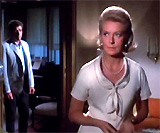 Elizabeth (Deborah Kerr) with Mike (Burt Lancaster) 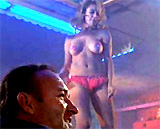   Go-Go Girl Stripper (Mary) (Sheree North) with Browdy (Gene Hackman)   Death of Mike Rettig - Accident or Deliberate?  Elizabeth: "He wanted me to go with him...The thought terrified me" |
|||||||||||||||||||||

|
Language of Love (1969, Swe.) (aka Ur Kärlekens språk, or Swedish Marriage Manual) This 80 minute long European film by director Torgny Wickman, a subtitled X-rated pornographic film, was an educational 'sex documentary.' It was part of a trend in the late 1960s to circumvent censorship laws by presenting explicit sexual content in the guise of a documentary or science-oriented educational film. However, it was a very controversial film (judged as obscene) when it was banned and protested against worldwide, and seized by US Customs officials in October of 1969. The Swedish-made film featured a panel of well-known serious sex-experts or sexperts (modeled after researchers Masters and Johnson):
They directly spoke about a number of explicit but educational sexual matters, including male and female sexual organs (and their functioning), petting, masturbation, reproductive contraceptives, and more (some scenes in split-screen). Willing volunteers (filmed discreetly with hidden cameras) provided views of the experts' dialogue - some very hard-core. There was a lengthy segment about a gynecologist's normal practice, and some preaching about the role of sex in society and how a healthy sex drive shouldn't be considered prurient. The vilified film became noteworthy, because it was the film that Robert De Niro inappropriately chose for his date with Cybill Shepherd in Taxi Driver (1976). |
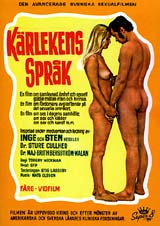  Ur Karlekens Sprak (aka Language of Love, or Swedish Marriage Manual (1969)) |
|||||||||||||||||||||

|
Last Summer (1969) Director Frank Perry's insightful, probing, and realistic beach film (unlike the Beach Party films earlier in the decade) was about angst-ridden, self-doubting adolescent youth. The tagline described:
The film daringly explored teenage interest and curiosity about sex (and petting), pot experimentation, and revealing games of 'absolute truth or dare.' It was originally rated X by the MPAA when it was first released, but after some cuts were made to the infamous rape scene, the film's rating was changed to an R. It told about three affluent teens (a teen love triangle) who first met during a Fire Island, New York summer vacation, while the female was tending to a wounded, half-dead seagull:
In one scene while relaxing on a boat out on the water, frustrated Sandy chided Peter - annoyed with his sexual obsession over her breasts and how he incessantly stared at them:
He asked her to take off her top - she obliged - and then after getting a brief glimpse of her breasts, he told her to put the top back on. The trio was forever altered with the arrival of a troubled late-comer, 15 year-old outsider Rhoda (Oscar-nominated Catherine Burns), a slightly plump, homely and self-conscious awkward teen. During the film's best acted scene, Rhoda delivered a monologue recalling her mother's death by drowning.
During a scene of sexual challenge and coming-of-age after Rhoda was tested to buy and wear a new bikini, everyone was in a forest clearing drinking Heineken beer. Bikinied Sandy poured beer over her breasts (exclaimed: "That's better"), and then defiantly removed her bikini top and took another swig of beer. Her subsequent conversation with rival Rhoda was combative and daring:
The group held her down, completely ripped off her bikini, and Rhoda (who vainly begged Peter to stop them) was forced to endure a collective rape by Dan. Afterwards, as Rhoda laid motionless on the ground, the other three dressed, and stood facing away from their victim. The film ended ambiguously and abruptly, with the group walking up the beach - during their last summer of innocence. |
    Sandy (Barbara Hershey)      The Collective Rape of Rhoda (Catherine Burns) |
|||||||||||||||||||||

|
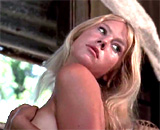
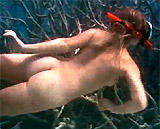
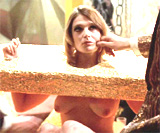
This sleazy "women in prison" sexploitation film by director Lee Frost, inaugurating a new subgenre of Nazi prison camp sexploitation films, emerged in the era of greater permissiveness after the abolition of the Production Code in the late 60s. This film inspired other WIP films of the next decade, all taking the perversions to greater heights:
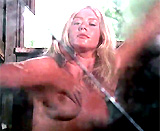
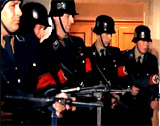
Supposedly based on fact, the movie told of a Nazi concentration camp during WWII with a sadistic Commandant (the film's producer Bob Cresse). The film's marketing described the love camp: "A Place of Total Despair. All the Youthful Beauty of Europe Enslaved for the Pleasure of the Third Reich." It was replete with full frontal female nudity (advertised as "the film that goes beyond X"). The story told about an attempted rescue mission by two big-busted WAC officers, Lt. Grace Freeman (Kathy Williams) and Lt. Linda Harman (Maria Lease). The duo volunteered to become inmates, suffer the indignities and horrors of the prison, and help break Jewish prisoner - female scientist Dr. Martha Grossman out of the camp, and then be rescued by the French Resistance. When new female prisoners were inducted into the prison, they were forced to strip, then medically inspected and humiliated. They were held down and spread-eagled, as the commandant sarcastically asked the newest inmate, before whipping her:
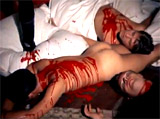
Its sensational content included orgies, bondage, S & M, rape, floggings (Linda was ferociously strung up by her wrists and whipped with the Commandant's (Bob Cresse) riding crop), brutalities with a fire hose in the shower, and forced lesbianism, due to the fact that the inmates were made to be prostitutes for off-duty German officers of the Reich's Front Line. They were also tortured and compelled to engage as unpaid sex slaves in perverse experiments and sexual depravity, including engaging in a nude, lesbian-love orgy for the officers' entertainment.
The film ended with the inmates' escape, as they brutally killed their captors by stabbing, blinding by broken glass, bashing by liquor bottle, and gunshot. |
    WAC Lts: Linda (Maria Lease) and Grace (Kathy Williams) |
|||||||||||||||||||||

|
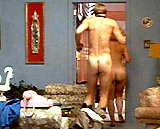
Director Haskell Wexler's fictional, experimental, and groundbreaking cinema verite docudrama film told about John Cassellis (Robert Forster) - a jaded news cameraman who worked against the backdrop of the actual 1968 Democratic Convention in Chicago. The absorbing political drama about current events (at the time) and the role of the media was originally rated X (later re-rated to R a year later) because of violence, language and brief nudity. It was the first mainstream American feature film to show full male and female nudity - although the director battled Paramount and the censorship board. He allegedly believed the film was Rated X for its controversial political tone and frequent obscenities rather than specifically for its nudity. In the frequently-noted scene with very brief full-frontal nudity, John romped and ran nude around an apartment with sultry nurse and girlfriend Ruth (Marianna Hill). Later, he became involved with widowed Eileen (Verna Bloom), a single mother from Appalachia who lost her husband in the Vietnam War, and soon was transformed from complacency to socially-conscious and aware. |
    Ruth (Marianna Hill) |
|||||||||||||||||||||
|
Director John Schlesinger's film Midnight Cowboy (1969) was a major milestone - this was the first (and only) X-rated (for adult-oriented, not porno) mainstream film (later reduced to R) to be voted Best Picture, with its A-list stars. Its adult-themed story told of a naive, swaggering, transplanted male Texan named Joe Buck (Jon Voight) who struggled in the sordid 42nd Street area of NY to become a successful hustler or gigolo. Upon his arrival in the big city, he vainly posed shirtless in front of his hotel room's mirror, and pasted up a beefcake poster of Paul Newman from Hud and a picture of a topless woman.
His first 'trick' was fast-talking society girl Cass (Best Supporting Actress nominee Sylvia Miles) in a comedic sex scene in which they humorously activated channels with the TV remote control beneath their bodies - the climax came with the closeup view of the winning results of a slot machine jackpot - spewed-out coins. The Texas stud was befriended by a limping and coughing homeless thief named Ratso Rizzo (Dustin Hoffman) and they experienced an unspoken homosexual relationship together which included frequent bickering. Joe's first homosexual client was a religiously fanatical and homosexual Jesus-freak Christian named Mr. O'Daniel (John McGiver) - during the encounter, Joe flashbacked to his boyhood when he was baptized in a river, and an incident when rednecks viciously assaulted him and his former girlfriend Annie (Jennifer Salt) - he was held down (and anally raped?) as his naked girlfriend was also attacked. Another homosexual client was a bespectacled young student (Bob Balaban) in a movie theatre. While experiencing oral sex from the client, Joe had memories of kissing and making love with Annie ("You're the only one, Joe...Kiss me, Joe, kiss me"). In another nightmare regarding Annie, he also remembered her saying - as the authorities arrived: "He's the one. He's the only one" - implying something more sinister.
Joe took stoned socialite Shirley (Brenda Vaccaro) to bed for his first successful heterosexual score with a paying female client ($20). At first, though, he suffered sexual inadequacy until angered when she teasingly suggested that he was gay: ("Gay, fey. Is that your problem, baby?") - and then he performed vigorously. Afterwards by phone, she recommended his studly services to an unhappily-married female friend. |
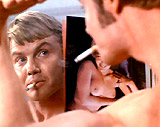 Joe Buck (Jon Voight) 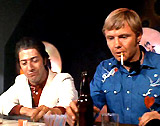 Joe with Ratso 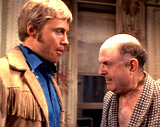 Joe with Mr. O'Daniel    Annie (Jennifer Salt)  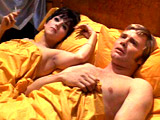 Joe with Shirley (Brenda Vaccaro) |
|||||||||||||||||||||

|
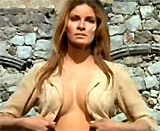
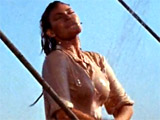
100 Rifles (1969) This late 60s western from director Tom Gries featured a strikingly-beautiful star - Raquel Welch as rebellious Yaqui Indian guerrilla leader Sarita. The curvaceous sex-star was featured in a steamy inter-racial love scene (reportedly the first of its kind) - a 60's era issue brought to the screen, with former National Football League player/Hall-of-Famer Jim Brown as Arizona lawman Lyedecker. In another scene, she showered from a railroad water tank through her skin-tight, bra-less clothing to create a diversion during an ambush upon a trainload of distracted Mexican soldiers. |
Sarita (Raquel Welch) |
|||||||||||||||||||||

|
Ride a Wild Stud (1969) This 'adults-only' sexploitation western set in the Civil War era, directed by Revilo Ekard (reversed as Oliver Drake) was an odd cult film that was one of only three-produced films from the short-lived studio Vega International. Its well-distributed poster showed the naked backside of a woman (with garter belt and stockings) who was being carried by cowpokes and forcibly placed on a table. It was advertised with the tagline:
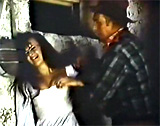
The graphic, soft-core film told about how Confederate outlaw bandit William "Colonel" Quantrill (Bill Ferrill) and his raiders in Kansas and Missouri during the Civil War kidnapped, forcibly raped and imprisoned women in a brothel (the infamous "Pleasure House of Quantrill"). In the opening scene - a pursuit and shoot-out, Quantrill cornered gang traitor Burt Wilson (Chuck Alford), then kidnapped his virginal young daughter, heroine Marsha Wilson (Josie Kirk). After Wilson was shot dead, Marsha's older sister (Helga Hanshue) was stripped, assaulted and held down on a bed and raped. When she resisted, she fled outside to mount a horse and escape, but was shot in the back and killed. The gunslinger calmly told his gang: "All right, men, the fun's over. Let's go!"
Nightly in the whorehouse, there were exotic dancers, wild parties, and orgies. In the brothel, Marsha was told what was to be expected by Quantrill's madame Irene (C. C. Chase) and one of the other abductees:
Those girls who wouldn't 'adjust' would be taken out to the desert and "they just never came back." In the middle section of the western in a very lengthy and gratuitous sequence, Quantrill pursued a busty female in the desert, eventually forcing her to succumb to his rape-attack. At one point, she appeared to be enjoying his man-handling, until he strangled her to death, and left her nude body on a blanket. Shortly later, Marsha suffered a vicious and threatening sexual attack by one of Quantrill's gang members, Bill Doolen (Frenchy Le Boyd) at the Pleasure House. When Irene intervened to save her, Irene was murdered. After being raped, Marsha was able to steal and horse for her escape. During the film's most publicized rape scene, Doolen again pursued Marsha on horseback, caught up to her, and raped her in a mountain stream.
Eventually, she was rescued by her cowboy boyfriend Mike McDermott (Hale Williams) and the females were able to fight off Doolen and stab him to death in the abdomen, before Marsha ended up in Mike's arms. |
 Kidnapping of Marsha Wilson (Josie Kirk)  Whoring in Quantrill's Pleasure House       Gratuitous Nudity and Rape-Murder Sequence  Ending: Marsha Rescued by Mike |
|||||||||||||||||||||
|
Satyricon (1969, It./Fr.) (aka Fellini Satyricon, or The Degenerates) Best Director-nominated Federico Fellini's R-rated fantasy epic was a colorful, visually-rich, and bizarre depiction of pre-Christian, 1st Century Rome and its pagan debauchery and sexual decadence (based on a satirical, degenerate and bawdy work by Petronius). Events and individuals were depicted in a series of fragmented mythical tales. The opening image was of a wall covered with ancient Roman graffitti and crudely drawn naked women. The visually-excessive story (told in a fractured series of episodes) was essentially the detailed homoerotic and contentious adventures of two young Roman men (who were students and roommates) - and both sexual rivals for their slave boy as they traveled across the Mediterranean (Roman Empire). The love triangle was composed of:
As it turned out, Ascilto had sold Gitone to a famous actor named Vernacchio (Fanfulla) and his theater company, and Gitone was performing in a play titled "Emperor's Miracle." In the play, a real life slave had his hand cut off with an axe, fortunately replaced with a golden one. The fragmentary film was filled with repulsive and often grotesque characters and images during Encolpio's odyssey, including:
The film's last voice-over ended mid-sentence followed by a freeze-frame, and a pull-back shot to view frescoes-paintings of the film's major figures on large vertical fragmented and crumbling slabs of rock.
|
 Actor Vernacchio (Fanfulla) with Gitone 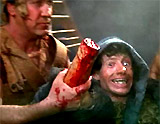 Amputation of Slave's Hand in Staged Play 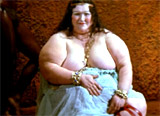 Obese Prostitute in Brothel 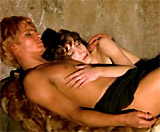 Homosexual Love-Making Between Encolpio and Gitone 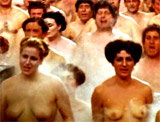 Revelers in Bath in Banquet Feast Scene 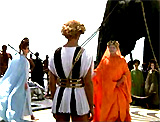 Ship-Board Wedding 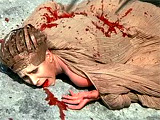 Death of Caesar 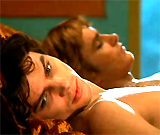 Homosexual Love-Making After Romp With Slave Girl 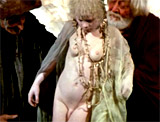 The Hermaphrodite   The Minotaur Gladiator   Young Cursed Woman With Genitalia That Kindled Fires and Encolpio's Virility  Earth-Mother Sorceress Oenothea  Giant Phallus |
|||||||||||||||||||||
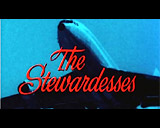   |
The Stewardesses (1969) This gimmicky sexploitation film from writer/director/producer Al Silliman Jr. was the first soft-core (actually hard-core adult film) 3D (Stereovision) feature film. In some cases, body parts (often breasts) literally jutted off the screen. It was followed by the sequel The Naughty Stewardesses (1975). Its tagline was:
The comedy was an instant success and even had mainstream appeal for mixed audiences. The sketchy plot was about an 18-hour layover of a 747 crew after a Los Angeles-Honolulu trip. It mostly featured the sexual activities (partying, sleeping around promiscuously, taking drugs, etc.) of various perky actresses in often poorly-acted scenes. First shown in 1969 and unique for any film, it was reshot and edited as it was shown for a few more years.
It became the most profitable 3-D film in history (a budget of about $100K brought in box-office of approx. $25-30 million), although eventually superseded by Avatar (2009). It was originally released with a self-imposed X-rating (although it was actually only soft-core), then re-cut for an R, and finally released again in 1981 as a porno film with hardcore inserts of completely different actors. With the requisite heterosexual love scenes and gratuitous nudity, as well as acid-dropping and nude yoga, there was also one steamy lesbian scene between head stewardess Jo Peters (Angelique De Moline) and Cathy (Kathy Ferrick), and blonde stewardess Karen (after a shower and while under the influence of acid) made love to a Greek god bust-headed lamp! The film had a startling moralistic ending -the murder-suicide of aspiring actress Samantha (Christina Hart) who believed abusive ad executive Colin Winthrop's (Michael Garrett) false promises about a career as a model for toothpaste. She smashed in his skull with a statuette while he slept and then jumped to her death from his high-rise balcony. The conclusion saw the group of stewardesses back at work. |
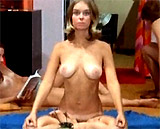 Ursella (Monica Gayle) - Nude Yoga  Cathy (Kathy Ferrick) - Nude Lesbian Massage and Seduction by Jo (Angelique De Moline) 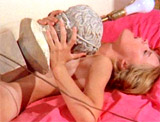 Karen (Patricia Fein) - Sex with a Lamp |
|||||||||||||||||||||

|
Venus in Furs (1969, UK/W.Germ./It.) (aka Paroxismus) Trashy director Jesus Franco's erotic, campy thriller/horror film was a lushly-visualized, dreamlike, psycho-sexual film noted as "A Masterpiece of Supernatural Sex." The bizarre film told about a vengeful and malevolent femme fatale in a zone between life and death who came back from death to avenge her own murder - a film that undoubtedly had a great influence on David Lynch: The opening bookending sequence was set on an Istanbul Black Sea beach, where jazz musician trumpeter Jimmy Logan (James Darren) was searching for his buried musical instrument case in the sand. In voice-over, he told his story:
After he found his trumpet and began playing it, he discovered in the surf the naked, mutilated blonde female corpse of Wanda Reed (Maria Rohm), wearing only panties and purple garters. He dragged her to the sand from the water and noted: "She was beautiful, even though she was dead." He observed a deep slicing cut above her left breast. He tried to recall when he had last seen her:
He remembered a jet-set party in a hotel lounge where he had regularly played in the band. He recalled that he was mesmerized by her when she arrived in a fur coat with a sexy red dress underneath ("I really dug that chick") but she was out of his league, and was involved with a trio of bourgeois individuals. During a decadent rough party and sex game held in the basement, he watched at a distance as the unwilling Wanda was stripped and mercilessly whipped. Jimmy thought to himself in voice-over: "Man it was a wild scene, like if they wanted to go that route, it was their bag. I told myself it was none of my business but maybe I split because I was just as sick as they were, but couldn't face up to it." He realized that he had seen the prelude to her murder. Ahmed first cut her with a long dagger, vampiristically drank her blood, and then stabbed her to death. Her sadistic killers and brutalizers, three of the hotel's glamorous guests, were:
Jimmy even pondered as he played his trumpet on the beach that he himself might be dead - because he hadn't stepped in to save Wanda: "How can you run from a dead person unless you’re dead yourself?" He escaped, wandered about with the thought of the murder on his mind, and traveled to Rio de Janeiro (during Carnivale), to play a gig in a nightclub and to be with his dark-skinned, soul singer girlfriend/lover Rita (Barbara McNair). There, he became entranced after he witnessed the mysterious, supernatural return of a doppelganger who resembled Wanda - she appeared naked under a mink coat ("Venus in Furs"). He made love to her, and spoke about her strange behavior when she said she didn't know who or where she was: "Oh, I see. No names, no dates, and no stories. This is the beginning of the end." She responded: "For me, everything ended a long time ago" - referring to her murder in Istanbul. Jimmy asked himself: "Was I dead or was I alive?"
It was revealed in the supernatural sub-plot that the ethereal Wanda - "Venus in Furs" (wearing a dark wig and fur coat, but at times reverting to her true, dead and mangled, mutilated post-mortem state), was a lethal, 'avenging angel.' Three appearances of Wanda seeking revenge were envisioned:
|
 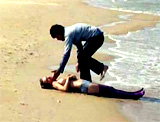  Jazz Trumpeter Jimmy Discovered Wanda Reed's Corpse on Beach Near Istanbul 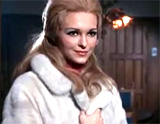 Wanda in Fur Coat - At Jet-Set Party Before Her Murder  Jimmy Witnessing Wanda's Stripping, Whipping & Murder by Olga, Percival, and Ahmed 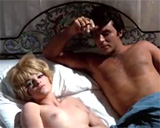 Wanda's Love-Making with Jimmy  Wanda Appearing to Percival  Wanda's Photo-shoot with Lesbian Fashion Photographer Olga  Wanda as Avenging "Venus in Furs" After Olga's Death  Wanda as Slave Girl  
Ending: Red-Lined Room Where Wanda Was Dead on the Floor |
|||||||||||||||||||||

|
Women in Love (1969, UK) Ken Russell's landmark, breakthrough film was adapted from D.H. Lawrence's 1920 novel by Larry Kramer. This romantic drama featured the first explicit scene with a homoerotic context that revealed male genitals (full-frontal male nudity) in a commercial mainstream film - extremely daring for its time. The infamous sequence was an extended wrestling match, exhibiting nude male strength, in a locked room before a roaring fireplace between:
After their match in which Gerald's strength overcame Rupert, the two sweaty men reclined on the floor side-by-side and talked:
Their relationship was contrasted by their involvement with two sisters:
The film was notable because Glenda Jackson became the first performer to win an Academy Award for Best Actress for a role in which she appeared significantly nude (with full and firm breasts).
One of the film's most memorable sexually-tinged monologues was in the outdoor picnic scene, when Rupert described how to eat a fig - fully describing the fig's vaginal symbolism:
|
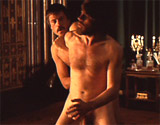 Gerald and Rupert - Nude Wrestling  Ursula Brangwen (Jennie Linden) 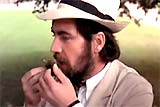 Rupert's Fig Speech |
|||||||||||||||||||||












 Love Camp 7 (1969)