|
|


|
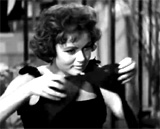
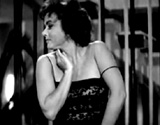
La Dolce Vita (1960, It.) (aka The Sweet Life) Federico Fellini's landmark masterpiece, semi-controversial and sensational, was about middle-class depravity and decadence. The episodic tale of a journey of seven days was a search to discover "the sweet life" by a frustrated, shallow, gossip and publicity-seeking, celebrity writer. Most of the film's activities occurred over seven nights (either consecutive or disconnected), and were always followed by a disappointing, dawning morning. The main protagonist was playboyish gossip writer Marcello Rubini (Marcello Mastroianni) who regularly attended parties, seduced socialites, and sought celebrity scandal for his tabloid stories. He had a decadent and hedonistic lifestyle of night life at clubs, orgies, and paparrazi-fueled events. One night, he was charmed and smitten by bosomy, sexy, and seductive Amazonian blonde Hollywood starlet Sylvia (Anita Ekberg) in a low-cut black evening gown, who was dancing through the night streets with a white kitten in her arms. Then, she spontaneously waded, danced, cavorted and cooled off in the water of Rome's Trevi Fountain - to tempt him and seek his attention by her dampened, form-fitting clothing. She called out to him: "Marcello, come here, hurry up." Near the film's end in the beach-house sequence, recently-divorced, exhibitionist Nadia (Nadia Gray) performed a de-personalizing, modified strip-tease to the cha-cha musical sound of Patricia - she removed her fur stole, pearl necklace, and bra (from under her dress), and then her dress, shoes and stockings as she laid on the floor. Under the fur stole, she removed her black slip - with only her black panties remaining on her nude body. However, after being mostly ignored by her disinterested and jaded guest audience, she covered herself up and ran off. Soon after, Marcello unsuccessfully attempted to instigate an orgy (he rode horse-back on a young blonde woman crawling on all fours; he struck her butt a few times, then grabbed her hair, slapped her face, doused her with a pitcher of water, and threw pillow feathers onto her).
|
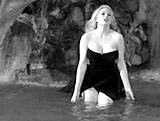 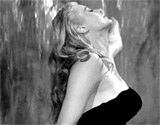 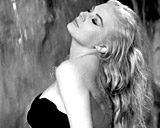 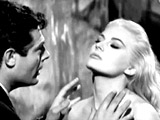 Sylvia (Anita Ekberg) in Trevi Fountain |
|||||||||||||||||||||||||||

|
Elmer Gantry (1960) Director Richard Brooks' drama Elmer Gantry (1960) was derived from the title character in Sinclair Lewis' 1927 novel, regarding hellfire and brimstone charismatic preacher Elmer Gantry (Best Actor-winning Burt Lancaster). The fiery, flamboyant, high-energy revivalist evangelist was set up and framed by one of his old (and wronged) girlfriends - minister's daughter-turned-prostitute Lulu Bains (squeaky-clean, Supporting Actress Oscar-winning Shirley Jones in an against-type role). She invited him to her place hours before being cast out of town by the law, following a brothel raid that he had sponsored to rout out sin. She had vengefully set him up and framed him, by having photographers positioned to take pictures from outside her window, so that they would be caught in a compromising situation - to ruin his reputation. When he arrived, she angrily criticized him for his hypocrisy:
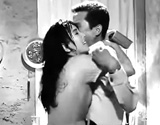
He admitted that he had been wrong to run out on her back in Kansas, after having an affair with her that discredited her in the eyes of her puritanical father. When he offered a charitable handout of cash to "sort of tide you over," she instead asked for a kiss goodbye before she left for Paris: "Just kiss me goodbye, just once." She awaited his kiss - with her eyes closed - and when he hesitated, she placed her arms around his neck and approached his lips. The longer they kissed, the more passionate it became, and she rekindled her feelings for him. She realized that she had accomplished what she wanted, dimmed the lights, and then asked:
But Gantry declined, because he had feelings for dedicated Sister Sharon Falconer (Jean Simmons) instead - detestfully called "that Bible broad" by the jealous Lulu. When he went to the door to leave, she apologized and admitted: "I could use some of that cash after all" - and sexily placed his charitable contribution in her garter. |
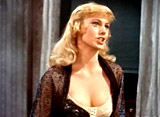 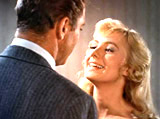 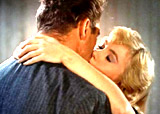 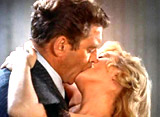 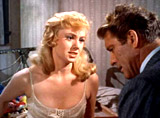 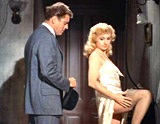
Elmer Gantry (Burt Lancaster) with Lulu Bains (Shirley Jones) |
|||||||||||||||||||||||||||
|
The Housemaid (1960, S. Korea) (aka Hanyeo) Writer/director Ki-young Kim's psychological horror thriller was set in post-war Korea, with the themes of marital infidelity and predatory sexual obsession exhibited by the title character - the 'housemaid'. The lurid domestic melodrama was mixed with a critique of traditional and materialistic bourgeois values. In a pre-credits sequence, a husband was speaking to his wife while reading a newspaper account about a businessman who committed adultery with a housemaid and brought terrible consequences upon his family - a clue to the film's framing device (with a surprise ending) and a premonition of what would happen:
The main characters, a family of four, lived in a claustrophobic, two story western-style, South Korean house:
To keep up their lifestyle, they hired an unstable, pig-tailed, chain-smoking, "not too bright" textile factory worker Myung-sook (Lee Un-shim) as the family's housemaid. Almost immediately, she began behaving unpredictably, erratically, capriciously and strangely -- she chased and caught a rodent with her bare hands in the kitchen and had an unusual smile on her face as she held up its corpse by the tail. She also developed an obsession with rat poison kept in the kitchen cupboard, voyeuristically spied on Kim giving piano lessons through a sliding glass door, and taunted the children.
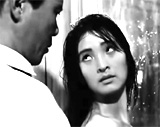
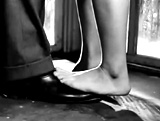
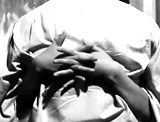
The pivotal event was when the seductive Myung-sook forced herself on Kim in her bedroom by letting her top drop at her balcony door. Not able to resist her half-nakedness, he grabbed her breast from behind, and she stood barefooted on his shoes. She locked her hands around his back before they had sex (off-screen, and symbolically, a tree was struck outdoors by lightning!) - and afterwards she became pregnant. The housemaid used many techniques to insinuate herself between Kim and his wife. The scheming Mrs. Kim learned of her husband's infidelity when he confessed to her, and she assured him: "I'll beg the girl on my knees...We can't let our precious lives be destroyed now." Moments later, she suggested that the housemaid throw herself down the tall stairway to induce a miscarriage and abort the baby (the incident was heard off-screen). The same stairway caused the death of the younger son. Remarkably, the jealous housemaid coerced the couple to agree that the husband could sleep in her upstairs bed: ("I want the father of my child"), so that she could bear him another son! In the film's unforgettable climax (a memorable death scene), the crazed housemaid urged Mr. Kim to commit a double-suicide with her by ingesting rat poison dissolved in glasses of water: ("That'll make the living happy - Die with me! Make me the happiest woman!"). As they were dying from the poison, she gave a deranged speech: ("Don't worry. I'll be with you for eternity. I'll ask God to perform our wedding ceremony. The flowers will never wither, while the paths will glitter with jewels. And nobody will ever take you away from me" - lightning struck ). Mr. Kim decided to climb down the stairs to die by his wife's side: ("You can take my body, but not my soul"), but the housemaid resisted his last request: ("If I lose you now, I'll never find you again in heaven"). She grabbed onto his left leg and ankle and was dragged down each step - with her head pounding or thumping into each stair-step. When he crawled into his wife's sewing room and collapsed dead at her feet - she spoke regretfully: "Oh, if only I hadn't wanted the new house." In the stunning and jarring plot twist ending -- the camera pulled back to find both husband and wife alive. The scene returned to the opening pre-credits sequence. The entire 'housemaid' story was a cautionary "what if" tale between the husband and wife:
Suddenly, the sliding door opened, and the housemaid delivered a tray of tea to the family! and then the husband broke the fourth wall and addressed the camera and audience, before ending with a laugh:
|
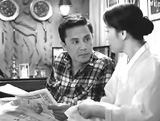 Mr. and Mrs. Kim 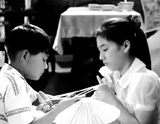 Kim Children 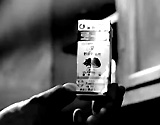 Obsession with Rat Poison 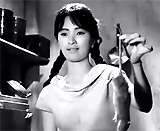 Pig-Tailed Housemaid - Caught Rat by Tail 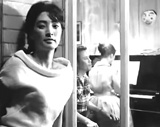 Voyeuristic Spying 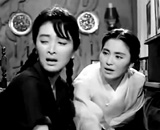 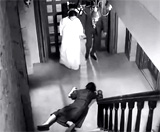 The Wife's Plotting of the Housemaid's Miscarriage 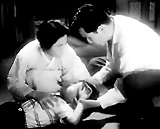 The Younger Son's Death at Foot of Stairs 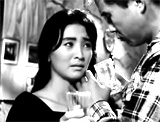 The Double-Suicide Poisoning 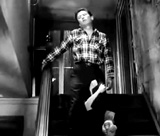 The Housemaid's Death on the Stairs 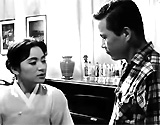 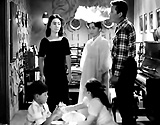 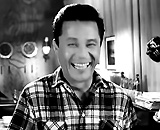 The Plot-Twist Ending |
|||||||||||||||||||||||||||
 Trailer |
Pagan Island (1960) Exploitational cinema, outside the bounds of Hollywood, began to further push the limits of censorship. The film's trailer about an idyllic shipwrecked sailer on a pagan island advertised that one could "watch these girls dance and make unashamed love in this tropical paradise." This exotic, teasing and cheesy B-grade tale was cast by famous cheesecake photographer and model Bunny Yeager, who had taken some of the best-known Bettie Page photos. The story was an improbable tale about marooned-shipwrecked sailor William Stanton (Edward Dew) on a small, uncharted South Sea island after floating for nine days in a life raft after his oil tanker exploded. It was populated only by beautiful but white-man-hating semi-naked native females, including:
The native women (all white!) were topless except for flower leis (although with very little explicit nudity) - who spoke broken English. The sailor taught Princess Nani Maka how to kiss, and fell in love with her, but her irate mother Queen Kealoha (Trine Hovelsrud) thought she had been violated. Unfortunately for Nani Maka and Stanton, the Princess was about to be sacrificed as "the future bride of the gods." Stanton decided to rescue his lover and join her in a sacrificial rite together to the angry, all-powerful Sea God after he was hung upside down. They jumped, hand-in-hand, into the God's golden temple under the lagoon, where they came upon a giant clam. |
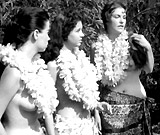 (l to r): Malia, Princess, Luana 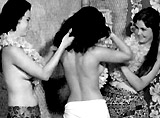 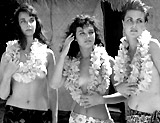 The Native Girls 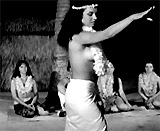 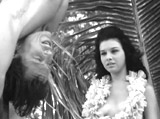 Princess Nani Maka (Nani Maka) |
|||||||||||||||||||||||||||
|
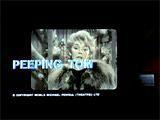
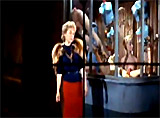
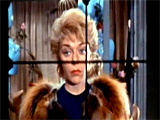
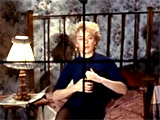
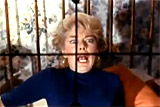
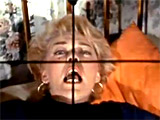
This highly disturbing, British psychological horror film from director Michael Powell was a variation on Psycho (1960) - see below. The notorious film nearly destroyed director Michael Powell's film career, and most critics loathed it, forcing the picture to be withdrawn from screens for almost two decades. When it was released, many shots in the film (including brief nudity) were cut, edited, or shortened. This was the twisted, 'voyeuristic' chilling story of shy, reclusive and disturbed young studio cameraman (and psychopathic, morbid serial killer) Mark Lewis (Karl Boehm) who filmed call girls (mostly). He murdered them with a phallic weapon - his 16mm camera (with a cross-haired viewfinder creating a POV shot) at the time of their deaths with an ingenious mirror device attached so that his screaming, red-headed female victims could watch themselves die (after being impaled by the sharp metal-spiked leg of his hand-held camera tripod that was plunged into their throats). He was also perversely obsessed with voyeuristically capturing the moment of death and the fear it caused (the look of distorted, fearful faces in a mirror); it was an affliction termed scopophilia, the morbid urge to gaze.
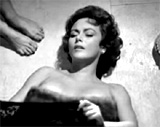
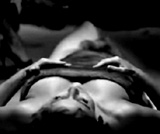
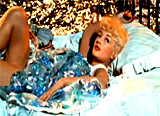
In the film's shocking pre-title credits opening sequence, filmed from the point-of-view of the voyeuristic camera's cross-haired viewfinder, Mark (concealing his camera within his coat) came upon a call-girl prostitute named Dora (Brenda Bruce) on a dark London street corner, who propositioned him for two quid ("It'll be two quid"). Without saying a word, he followed her to her nearby cheap upstairs apartment, where she disrobed, and then gave a look of horror as she was being murdered. She backed up in terror and screamed when she realized that she was going to be impaled. Later, the photographer Mark would then watch the projected grisly footage over and over in the darkness of his lab-studio. His viewing of this particular death was accompanied by the film's opening title and credits. On the side, he sold photographs ("views") of his soft-core, nude pin-up photo shoots to a round-faced neighborhood store-owner (Bartlett Mullins), who pedaled the pornography to elderly male customers (Miles Malleson). Mark viewed b/w home movies with red-haired female friend Helen Stephens (Anna Massey), his downstairs neighbor/tenant who lived with her blind mother Mrs. Stephens (Maxine Audley) - they included films of Mark's abused childhood when he was mentally tormented by his professor-father (director Michael Powell himself in a cameo) and experiments about fear were conducted on him to observe his reactions (e.g., his responses to the lizard dropped on his bed, his mother's corpse, or his father's new young wife). It masterfully told the back-story of how the monstrous killer had a very troubled and abused childhood with a sadistic father who filmed him for his studies on the physiology of fear in children. He had contributed to his son's violent and conflicted subconscious. The film presented an unsavory view of the perverted and morbid crimes perpetrated (and witnessed almost as "snuff films") upon unsuspecting female victims: (1) Dora (Brenda Bruce), a prostitute, (2) Vivian (Moira Shearer), an actress-dancer and studio stand-in, and (3) Milly (Pamela Green, a real-life 50s pin-up), a model. In the final murder scene, model Milly asked herself as she reclined backward (while Mark closed the blinds): "I might as well talk to a zombie. Is it safe to be alone with you, I wonder? It might be more fun if I wasn't." His shadow covered her face, as he moved and stood above her nude body. [Note: It was reportedly the first nudity in British film history, according to some reports, although Nudist Paradise (1959, UK) was released earlier. She displayed, momentarily, one nude breast.] The film faded to black with loud piano chords on the soundtrack, before she was murdered (off-screen).
The much vilified film ended with Mark Lewis' own suicidal death. Although Mark's female friend and downstairs lodger Helen Stephens discovered his horrible secrets, he spared her life and took his own, suicidally (in the same horrific manner that he often used) as the police arrived. He impaled himself in the neck with his own spiked device, as he spoke to Helen:
Then, he slumped dead to the floor. The words of a tape recording of his childhood made by his father ended the film:
|
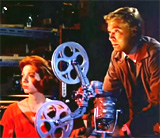 Viewing B/W Home Movies with Helen 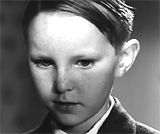 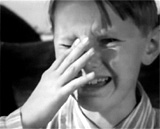 Mark's Abused Childhood 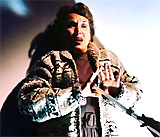 Mark Threatening Blind Mrs. Stephens 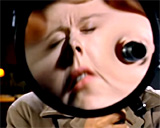 POV of Threatened Victim: "I made them watch their own deaths" 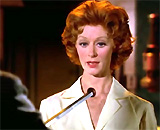 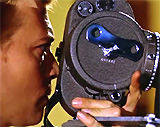 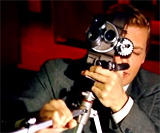  The Second of Mark's Spiked Tripod Leg Murders: Red Haired Vivian (Moira Shearer) 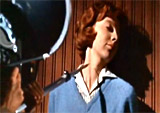 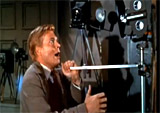 Threatening but Sparing Helen - Then Mark's Own Suicide |
|||||||||||||||||||||||||||

|
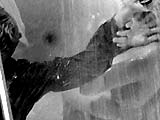
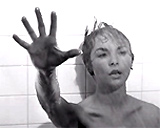
The classic Hitchcock horror/slasher film Psycho (1960) marked the decline of the Production Code. It was not rated until 1968, when an early version of the MPAA ratings system rated it M, for mature audiences only. A 1984 reissue re-rated the film R. Most of the horror and suspense in the film was created in the mind of the audience, although the tale did include such taboo topics as transvestism, implied incest, and hints of necrophilia. The nightmarish, disturbing film's themes of corruptibility, confused identities, voyeurism, human vulnerabilities and victimization, the deadly effects of money, Oedipal murder, and dark past histories were all realistically revealed. It was heavily censored (and edited) in some locales for repeated views of its main protagonist in a bra - both in the first scene during a lunchtime dalliance, and also twice later.
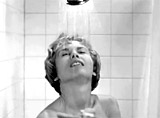
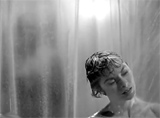
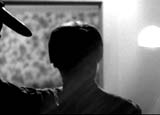
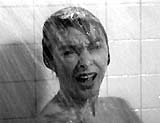
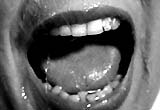
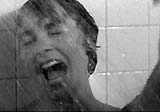
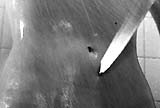
However, the film was most noted for the voyeuristic scene of Bates Motel manager Norman (Anthony Perkins) peering through a peep hole at motel customer Marion Crane (Janet Leigh) as she undressed and revealed a black bra - shot from his POV to implicate the audience in the viewing. Hitchcock's most unconventional choice was to kill off its major 'star' Janet Leigh (as Phoenix real estate office secretary Marion Crane) a third of the way into the film (in a shocking, brilliantly-edited shower murder scene accompanied by screeching violins). Violence was present for about two minutes total in only two shocking, grisly murder scenes, the first about a third of the way through (the shower scene). Actually, the shower victim never really appeared nude (although the audience was teased by a body double) and there was only implied violence - at no time did the knife ever penetrate deeply into her body. In only one split instant, the knife tip touched her waist just below her belly button. Chocolate syrup was used as 'movie blood', and a casaba melon was chosen for the sound of the flesh-slashing knife. The horrific scene commenced when a figure with dark face, faint white eyes, and tight hair bun entered the bathroom and whipped aside the shower curtain. The killer wielded a menacing, phallic-like butcher knife high in the air - at first, it appeared to be stab, stab, stabbing us - the victimized viewer! The piercing, shrieking, and screaming of the violin strings of Bernard Herrmann's shrill music played a large part in creating sheer terror during the horrific scene - they started 'screaming' before Marion's own shrieks. Marion turned, screamed (her wide-open, contorted mouth in gigantic close-up), and vainly resisted as she shielded her breasts, while the large knife repeatedly rose and fell in a machine-like fashion. The murderer appeared to stab and penetrate into her naked stomach, shattering her sense of security and salvation. The savage killing was kinetically viewed from many angles and views. The only blood was seen washing down and circling into the shower drain - paired to a dissolving, rotating, zoom-out closeup of Marion's unblinking eye.
To his horror, Norman discovered the murder and meticulously cleaned up any evidence of the blood and her possessions, by dumping everything in the trunk of Marion's car, and sinking it in a nearby swamp. The film was also noted for having a view of a toilet -- something unusual at the time. |
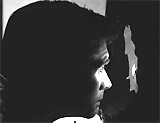 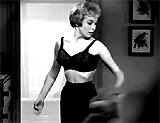 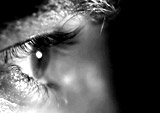 Norman Bates (Anthony Perkins) Voyeuristically Spying on Bates Motel Customer Marion Crane 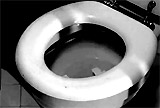 View of Toilet |
|||||||||||||||||||||||||||

|
Stanley Kubrick's big budget studio film told about rebellious, slave-born Thracian Spartacus (Kirk Douglas) who eventually led a rebellion of slaves against Rome. The film was severely criticized for its infamous bathing-seduction scene (originally cut from the film, although restored to the theatrical release version in 1991) in a sunken tub (dark and partially veiled by see-through netting), between:
They engaged in a notorious, double-entendre conversation about bi-sexual experimentation and sexual preferences with their veiled culinary talk about the morality of eating oysters (females?) and/or snails (males?). Crassus expressed an affinity for sexual variety:
Also the film was noted for the near-nude scenes of buxom slave girl Varinia (Jean Simmons), Spartacus' love interest. Knowing that enslaved Spartacus had never had a woman, he was watched from a grate above his cell as Varinia stoically lowered her gown for him. Laughter from observers disgusted Spartacus, and he refused to take and mistreat the young woman.
During a bathing scene, Varinia swam (partially obscured by an overhanging fern). In an earlier love scene, Spartacus told Varinia:
|
  Controversial Bathhouse Scene Between Crassus (Laurence Olivier) and Antoninus (Tony Curtis): "My taste includes both snails and oysters"  Spartacus With Varinia: "I want to know all about you..." |
|||||||||||||||||||||||||||
|
The Adventures of Lucky Pierre (1961) Director Herschell Gordon Lewis' first fully-fledged and financially-successful, sexploitative "nudie film" (produced by David F. Friedman) was a blatant copy of Russ Meyer's successful The Immoral Mr. Teas (1959). It was advertised with the tagline:
This one-hour long comedic film, made on a budget of $7,500 and shot in four days, consisted of nine short skits (some a film-within-a-film) each involving the beret-wearing title character Pierre (Billy Falbo) with nude ladies and amusing misadventures:
|
||||||||||||||||||||||||||||
|
Breakfast at Tiffany's (1961) Blake Edwards' groundbreaking romantic comedy, based on Truman Capote's 1958 novella, reportedly inspired director Radley Metzger to make a series of critically successful and overtly sexual films, such as The Dirty Girls (1964), Carmen, Baby (1967) - an erotic updating of Bizet's opera with voluptuous sex kitten Uta Levka as the title character, and his most successful feature Therese and Isabelle (1968). With the release of the film, it signaled that it was alright to be a single woman with an active sex life. Paramount Pictures' romantic comedy featured an against-type portrayal ("as you've never seen her before") by pristine, squeaky-clean, skinny Audrey Hepburn as Holly Golightly. [Capote had originally wanted curvy Marilyn Monroe for the role.] She portrayed a raunchy Manhattan socialite, noted also for her luxurious image - sunglasses and black Givenchy gown. The compromised, desexualized film omitted most of the novella's references to Holly's sexual promiscuity and life of semi-prostitution. It had no explicit sex of any kind, although there was some frank sex talk. She was a free-wheeling, daring, sexually-active and flighty call girl (who lived, partially, on weekly payments in exchange for visits to ex-mob boss Sing Sing prisoner Sally Tomato (Alan Reed)). Her upstairs neighboring tenant and eventual boyfriend was Paul Varjak (George Peppard), a struggling writer. He was the one who was sexually promiscuous - he was a "kept man" (gigolo) by icy and rich older NYC socialite "decorator" Emily Eustace Failenson (Patricia Neal), nicknamed 2E. However, the film basically followed a stereotypical and traditional gender love story between Holly and Paul as they became better acquainted. The final scene, a typical Hollywood happy ending, began with a taxi ride to New York's Idylwild Airport by Holly, on her way to Brazil (to find a rich husband), accompanied by Paul who was trying to persuade her to stay. He professed his love for her ("Holly, I'm in love with you... I love you. You belong to me"). She told Paul that she didn't belong to anyone ("People don't belong to people...I'm not gonna let anyone put me in a cage"). Paul expressed his true love again ("I don't want to put you in a cage. I want to love you"), though she continued to call herself a "no-name slob." He gave her an ultimatum and then got out of the taxi:
She decided to curtail her plan and pursue him. The film ended, following traditional Hollywood norms, with them breathlessly kissing and embracing in the pouring rain in an alleyway, as the theme from "Moon River" played. Her rescued Cat was squished between them, as the camera zoomed in for a closeup, and then pulled away for medium and far shots. |
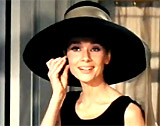 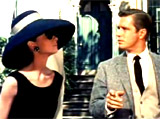 Holly Golightly (Audrey Hepburn) 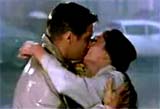 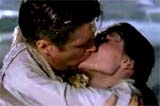 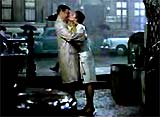 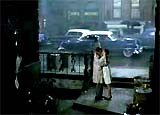 The Ending Kiss: Paul and Holly |
|||||||||||||||||||||||||||

|
The Children's Hour (1961) This film was based upon Lillian Hellman's hit Broadway play The Children's Hour - and was first filmed by William Wyler as These Three (1936). It was extremely bowdlerized due to restrictions imposed by the Hays Office. However, this forward-looking film helped to contribute to the eventual breakdown of the Production Code and its strict censorship. In the earlier drama of 1936, the rumor and accusation of a lesbian relationship between two teachers was changed to an illicit, though heterosexual, love affair (and romantic triangle) between one of the teachers and her colleague's fiancé. This 1961 film remake by Wyler also had to avoid the word 'lesbian.' It told a serious story of female attraction between two headmistress-teachers at the Wright-Dobie School for Girls:
Their 'affair' was witnessed (during eavesdropping outside their door) and reported by mean-spirited, vindictive, and manipulative 12 year-old student Mary Tilford (Karen Balkin) - the act was seen as unnatural, "bad things." Mary's scandalous lie, to remove herself from a school where she was disliked, had devastating after-effects for the school and its administrators. It even created doubts in the mind of Dr. Joe Cardin (James Garner), Karen's fiancee who was planning on marrying her. Karen suggested to Martha that they go away somewhere to make new lives for themselves ("Let's pack and get out of here. Let's take the train tomorrow...There must be someplace we can go"). In a heart-rending, devastating, and overacted "coming out" scene, self-loathing Martha realized that the child's lie had uncovered her own suppressed lesbian-tinged emotions, although she tried at first to deny them. She broke down and hysterically confessed how 'guilty' and 'sick and dirty' she felt about her love feelings toward Karen:
In the somber and despairing ending, she committed suicide (by hanging herself in her room - her dangling feet seen in shadowy silhouette) when she realized that the lesbian rumors about herself were true.
|
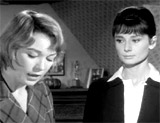 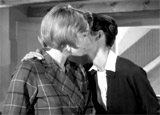 Martha (Shirley MacLaine) and Karen (Audrey Hepburn) 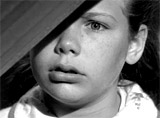 Mary (Karen Balkin) 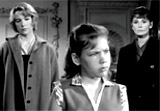 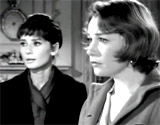 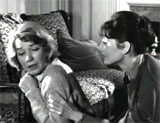 The "Coming Out" Scene |
|||||||||||||||||||||||||||
|
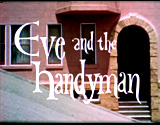
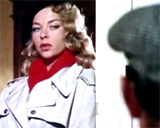
Eve and the Handyman (1961) Russ Meyer's comedy film (without synchronized sound, but only voice-over) advertised itself as "Sex-sationally Different!" It was the skin-flick director's second feature - and the middle film in his early trilogy of exploitational, low-budget, color 'nudie-cuties,' beginning with The Immoral Mr. Teas (1959) and ending with Wild Gals of the Naked West (1962). Although it was intended to draw in audiences for its nudity, there were only a few instances of female nudity exhibited. The most sexually-explicit the film ever became was a view of a nude model posing for a sculpture. Meyer's own statuesque 2nd wife Eve Meyer was the titular 'Eve' of the film (and she also portrayed other characters), composed of loosely connected humorous sex-related vignettes. The reason that Eve was following a Handyman for the entire film was finally revealed in the brief gag at the conclusion. The film opened in San Francisco with beret-wearing, long-trenchcoated gumshoe Eve (Eve Meyer) stalking and spying through the bedroom window of a bespectacled, cap-wearing handyman (Anthony-James Ryan) at 6 AM, as he awoke and prepared to go on his work rounds. She identified her mission (in voice-over by Lee Merrin) with a long droning monologue - with numerous double-entendres:
She watched him (and participated by materializing in his presence) in a number of strung-together, menial yet risque adventures as the prudish, nerdy Handyman encountered beautiful, large-breasted women displaying lots of cleavage (most of whom were also portrayed by Eve Meyer) - she seemed to make a game of tempting him with semi-naked females:
It was finally revealed in the silly, long-awaited final sequence set in the Handyman's bedroom, where Eve finally closed in and cornered him: (voice-over)
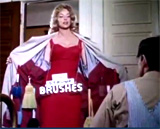
After a min-strip tease to remove her beret and red scarf, Eve undid the belt and buttons of her trenchcoat and opened it to flash him - a close-up of his responsive expression suggested he was pleasurably turned on by viewing her nakedness - but instead, she was fully clothed and showing off advertising for 'Strump' Toilet Brushes - a flashing neon sign that hung around her neck. She removed a brush from her coat pocket and began brushing the Handyman's hair. She had finally found a man with the ultimate of temptations for him. He closed his eyes in ecstasy and smiled. A pot boiling on the stove overflowed. Harp music, a jazzy saxophone, and drums began to play.
Symbolically sexual, two train cars coupled together. An oil well plunger moved up and down, and a phallic-shaped rocket ship blasted off. A candle flame was extinguished - they were blissfully satisfied. The Handyman dressed for work - wearing Eve's red scarf, as she intoned (in voice-over) about now enjoying "a happy ending":
|
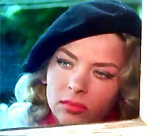 Eve (Eve Meyer) 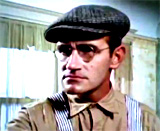 Handyman (Anthony-James Ryan)  In Laundromat   Washing Windows in Office Near Secretary (Eve Meyer)   Ice-Cream Waitress (Eve Meyer)  Pin-Ball Machine Player (Eve Meyer)  Skinny-Dipper in the Country  Topless Nude Model (Jacqueline Stevens) Posing For Sculpture |
|||||||||||||||||||||||||||
|
Last Year at Marienbad (1961, Fr/It.) (aka L'Année Dernière à Marienbad) This enigmatic, cinematically puzzling, and ambiguous New Wave film from Alain Resnais - a black and white expressionistic film and fragmented tale about dreamy seduction - mixed time (past and present), and reality (fantasy vs. memory). [Note: in the original screenplay by Alain Robbe-Grillet, there was an explicit forceful rape, but it was not fully pictured in the film.] The setting after the opening credits, was revealed to be an opulent, enormous but empty European hotel or resort chateau in Marienbad (in the Czech Republic) - described by an atmospheric, deathly, ominous voice-over guided tour with lengthy tracking camera shots (slightly tilted upwards) - viewing the expansive hallways and long dark corridors, mirror-lined walls, statues, high ceilings with ornate chandeliers - and outdoors, geometric gardens, often with repetitive wording. Eventually the tour entered the hotel's theatre for a play-within-a-film being performed, and attended by the hotel guests (impassive, unmoving, and coldly-still). The statuesque, immobile guests at the hotel appeared to be either trapped or automatons, or were they ghosts or dead souls existing in purgatory (including the main characters)? The characters were nameless in the original screenplay. A traditional love triangle existed between a man (hero), woman (heroine), and husband:
X/Stranger made endless and obsessive attempts to persuade and convince A/Woman-Lover that they had met before and had past associations (last year at Marienbad?), including having had sex at the hotel - his beliefs were seen in subjective imaginings (possibly his, possibly hers); the entire object of his intense, but flat and sometimes creepy, pushy questioning was to prove his delusional point, and persuade the woman of his account of the past, while she continued to protest his assertions. The two might not actually know each other, exist together, or even be alive. When he caressed her breasts in the garden, she responded:
In an existential dance of seduction, the two 'lovers' recounted a fragmented tale of their perceived reality and unrealized love affair. X's treatment of the details of the previous year's events at Marienbad were as if they were fictional segments of a conventional movie drama; he believed that A had previously promised to elope or run away with him when they again met, and that they had an unrealized love affair, but she claimed that she couldn't remember, made repeated attempts to rebuff and recoil from him, and became weary by his assertions
Whether X was lying, experiencing a nightmare, or only confused about A's identity was open to question. One incomprehensible premise was that A had been murdered by M because of the alleged talked-about affair (there was a brief sequence of M firing on A on her bed with a silencer-gun, and she fell back onto the floor, with her feet still on the bed) - and then it was possible that X had developed this fuzzy story in his imagination to assuage his guilt, by thinking of her as alive? There was also a 'rape' scene - only viewed as fragmentary and incomplete - the short bedroom scene commenced when A was started by X's advance toward her on the bed; she backed up in fear against the bed's headboard - followed by another of the over-exposed (hallucinatory), feverishly-swift tracking shots (also seen earlier), down a long corridor towards A who was standing in the middle of a room with outstretched arms; separate takes of the same camera movement, but with minor or slight changes, were frantically repeated.
By film's end, X's ambiguous allegations about what had happened were completely uncertain, although it appeared that the protagonist had gradually succeeded in readying A to leave the hotel one night for an unknown destination, as M watched them depart from a staircase. However, X's voice-over account was unreliable and described in the past tense:
|
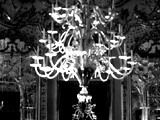 The Marienbad Hotel 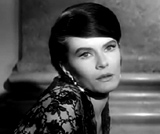 A/Woman-Lover (Delphine Seyrig) 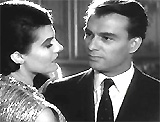 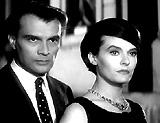 X/Stranger (Giorgio Albertazzi) With A/Woman-Lover 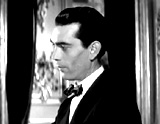 M (Sacha Pitoeff) 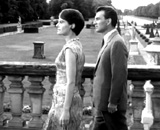 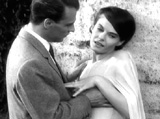 In the Garden 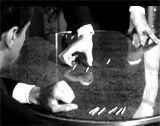 The Game of 'Nim'  Washed-Out Tracking Shot 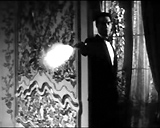 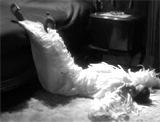 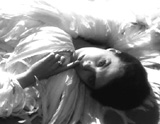 A's "Murder" by M |
|||||||||||||||||||||||||||
|
The Misfits (1961) Director John Huston's film The Misfits (1961) was derived from a screenplay by playwright Arthur Miller, Marilyn Monroe's husband in a troubled marriage. It was believed that Marilyn was deteriorating in health, from overuse of prescription drugs, depression and alcoholism. Gable was also in poor health and drinking heavily. Overexertion on the set led to a heart attack two days after the end of filming and his subsequent death. It was the final, haunting, fully-completed film for the two major, yet aging, sex screen legends:
[Scenes of Roslyn's face were mostly in soft-focus, while the harsh light of the black and white film accentuated the crags and wrinkles on the faces of the cowboys.]
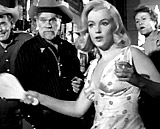
In the opening scene set in Reno, Nevada, Roslyn practiced her lines for a quickie divorce with her experienced, wisecracking, spinster landlady Isabelle Steers (Thelma Ritter), to rid herself of husband Raymond (Kevin McCarthy). Through Isabelle, she was introduced first to ex-mechanic, former WWII pilot, and widower Guido Racanelli (Eli Wallach) and then in a local bar to aging, washed-out 'real-life' cowboy Gay Langland (Clark Gable), a rugged individualist. Langland told her: "You're a real beautiful woman. It's almost kind of an honor sittin' next to ya. You just shine in my eyes. That's my true feeling, Roslyn. What makes you so sad? I think you're the saddest girl I ever met." He suggested that he could be a "good friend" to her. The two men were interested in the young voluptuous blonde woman, although she eventually fell in love with the gallant Langland - who was old enough to be her father. They were offered an unfinished house in the desert, abandoned by heartbroken Guido after the death of his wife, and they moved in together. Roslyn was exhilarated by the freedom and danger of the wide open spaces, and a new, growing passionate relationship with Langland. In one of the earlier scenes in a crowded bar, Roslyn (wearing a trademark low-cut white dress with polka dots) surprised the wagering crowd with her expert paddle-ball skills, voluptuously shaking her chest and rear end with body English - causing one cowpoke to irresistibly spank her backside in rhythm. She also met Langland's comrade - reckless, worn-out, injured 'rodeo cowboy' rider Perce Howland (Montgomery Clift). The three men planned to round up wild, misfit mustangs and sell them for dog food, an idea that appalled Roslyn. Like the mustangs themselves that were eventually allowed to run free, she also chose to be with Langland. In the film's final scene in the front seat of a pick-up, the two made a new start together. She asked him about raising a family together and taking the right path:
|
 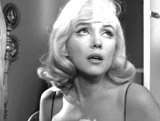 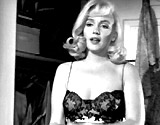 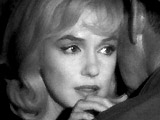 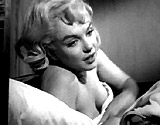 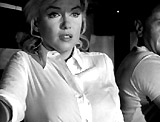 Roslyn (Marilyn Monroe) 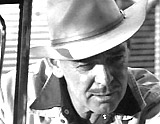 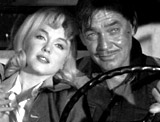 Roslyn with Gay Langland (Clark Gable) |
|||||||||||||||||||||||||||
|
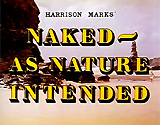
Naked - As Nature Intended (1961, UK) (aka As Nature Intended or Just as Nature Intended) Since the late 1950s, the 'nudist colony' documentary film successfully challenged previous limitations on First Amendment protections for films. This one, with a working title of "Cornish Holiday" of only one hour in length was made by glamour photographer and UK sex film pioneer George Harrison Marks. The film displayed some nudity (no private parts) and now functions only as a curiosity item. It claimed that it was "actually shot at Trewyn Sun Club" in revealing Eastman Color. A group of three professional females (all using their real first names) from London were introduced, before they went on a short weekend trip in the summer:
In the teasing travelogue, the trio first visited the monoliths of Stonehenge, then the fishing village of Clovelly, Porthcurno (on the southwest coast) and its Minack Open Air Theatre, the ancient ruins of Tintagel Castle, and Land's End (with the tourist site of "First and Last House in England"). Meanwhile, two other blonde females were also introduced at their place of work, a petrol station, where they pumped fuel, before leaving town:
The two were described as outdoor types who liked to rough it, and they were members of a nudist colony (or sun club). For the weekend, they were also on their way to escape the city and bask nude in the sun by the beach. After about 35 minutes of the film had elapsed, the trio finally visited the nearby beach in Cornwall, England, changed into their bathing costumes, and came upon Trewyn Sun Club's Private Beach owned by a local nudist club. There on the oceanside, they met up with the other two girls who were nude sunbathing.
Soon, all five were cavorting nude (there were many views of breasts and buttocks, but no genitalia), and playing a game of 'football' with a large beach ball. Eventually, after posing and running in the surf, the two nudists invited their three new converts to their nudist park sun-club, where they were members. All of them enjoyed socializing and walking around in the nude, meeting naturist families, taking a tour, swinging on a swing and hammock, and playing ping-pong. The film ended with narrator explaining how the girls had one regret - not discovering the club many years earlier:
|
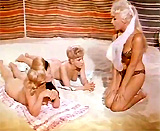 Pam's Meeting With Angela and Bridget 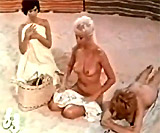 At the Beach 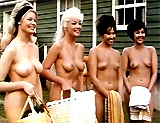 At the Nudist Club (l to r): Bridget, Pam, Jackie, Petrina 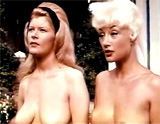 Bridget and Pam  Bridget  Pam  Angela  Jackie |
|||||||||||||||||||||||||||
|
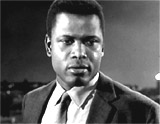
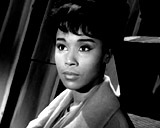
Paris Blues (1961) This melodramatic Martin Ritt film, shot on location in Paris, was noted as being the first to star an African-American actor (Sidney Poitier) as a romantic lead character. The story's themes were music, love, and racism. It was subtitled as "A Story of Young Lovers," and featured music by Duke Ellington and a guest appearance by Louis Armstrong. In racially-tolerant Paris, two male characters (who both worked in a Left Bank nightclub) romanced two vacationing American tourists, there for a two-week holiday in the autumn:
Eddie decided to marry Connie and return to the US, despite knowing the racial discrimination he was bound to face. Ram fell in love with Lillian, but was reluctant to marry her ("What do you want to do? Wrap me up and take me home? We had a good thing going. What do you have to spoil it for?"), and join her in the US as a second-rate trombonist. |
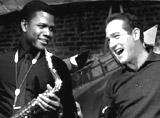 Eddie and Ram 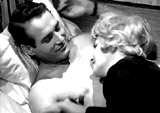 Ram with Lillian 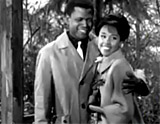 Eddie with Connie |
|||||||||||||||||||||||||||
|
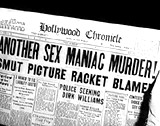
The Sinister Urge (1961) (aka The Young and Immoral) Writer/director Ed Wood Jr.'s campy, low-budget crime drama was notable for Wood's usually cheesy and silly dialogue, poor pacing, and wooden performances. This was, ironically, Wood's last "straight" or mainstream film, as the B-director of schlock films would turn to creating soft-core porn in the future. It was partly inspired by the earlier success of Hitchcock's Psycho (1960). The film's outrageous cautionary claim was that pornography ("the smut picture racket") was directly responsible for "dope peddling" and the murder (!) of young aspiring starlets - all pornography models. The film opened with a terrorized half-dressed female named Shirley (Betty Boatner) running on a deserted dirt road and finding a pay phone booth in a city park. She was attempting to make a distressed phone call to the authorities when she was attacked. Her brutalized corpse was found by park visitors.
In the next scene, the police authorities, led by Police Lieutenant Matt Carson (Kenne Duncan) and his subordinate Officer Kline (Fred Mason), were muttering that it was latest in a string of murders with the same M.O. Lieut. Carson and his associate Sergeant Randy Stone (Duke Moore) went to the park to look at the victim's body. They suspected that her half-clad body hinted that she was part of the "smut" business (pornography). The police officers complained about how the "smut" business (a "girlie/dirty pictures" racket peddling bondage photos and other smut) was responsible for instigating killers to imitate the pictures with sex crimes:
In the next scene, elderly photographer/director Jaffe (Harry Keatan) in his porn studio was snapping photos of a panel of scantily-clad starlets wearing swimsuits when there was an unexpected vice raid. Dozens of metal film cans with smut reels were seized ("It's look like we hit the jackpot this time!") and the females were apprehended. The main characters were soon introduced:
The unstable Dirk proved his proclivity to become aroused by smut and to commit murder. Johnny clearly recognized his sociopathic behavior: "You know what he gets like with that knife of his!" Dirk returned to the park where he flirted with a female, but then lustfully stripped off some of her clothes and stabbed her with his knife as she helplessly lay on the ground.
In the film's plot, a naive and innocent Midwesterner, an aspiring actress named 'Mary Smith' (Jeanne Willardson) had come to Hollywood like so many others, but Ryde and Gloria tricked her into becoming indebted to them - and then blackmailed her into making a porn flick. Dirk viewed more "dirty" semi-clad photographs - including those of Mary, lost control of himself, returned to the park and found her feeding the ducks. He also murdered her. Police Lieutenant Carson used a transvestite cop to patrol the area, track down the murderer and smash the smut picture racket. Dirk was identified as the serial killer, and his name was leaked to the press - his name was printed in the Hollywood Chronicle. The film's climax came when the targeted suspect Dirk was to be smuggled out of state (by Ryde and Gloria) - but in actuality, their plot was to eliminate him by sabotaging his car's brakes - however, their plan failed. Dirk survived the 'fatal accident" by jumping out of the car, vengefully returned and ambushed Ryde - shooting him to death. Gloria shot and killed the remaining dark figure on her patio. She thought she was murdering Ryde, but she actually shot Dirk. She called the police to report the killing: "Dirk Williams just shot Johnny Ryde here in my home....He took off right after the shooting," and then she hid her murder weapon under her couch cushion. When the police arrived, she was ultimately shocked to learn that her story wasn't corroborated by the evidence. Dirk was the dead murder victim on her patio. She had claimed that Dirk shot Ryde and then fled, but Dirk was lying dead:
When she was shown the victim's face, she exclaimed: "Dirk, no, that can't be Dirk! Uh-huh. No, that's not Dirk!" And then, Ryde's body was also discovered behind some bushes on the patio ("Looks like Johnny's here after all!"). Gloria was suspected of murdering Dirk: ("You're gonna have a lot of explaining to do down at headquarters"). Knowing that she was trapped in a lie, she reached for her gun under the sofa cushion - but was prevented from grabbing it. It appeared that Gloria would be arrested and put away, and the end of the smut ring had finally come:
|
|
|||||||||||||||||||||||||||
|
Splendor in the Grass (1961) Youthful sexuality, sexual repression, and neurosis were the themes of director Elia Kazan's daring, controversial, and hyperbolic melodrama Splendor in the Grass (1961). The time period of the plot occurred during the late 1920s and early 30s at the start of the disastrous Depression in a rural, SE Kansas town, coinciding with the intensity of a first love and the devastating consequences of repressed sexuality upon a pair of love-struck teenagers. The film's tagline expressed this theme: "There is a miracle in being young...and a fear." A poster also described the reality of a 'first love' when feelings that were new and somewhat frightening were heightened by a constricting society. The mood and story line of the stormy relationship between two star-crossed, teenaged lovers paralleled William Wordsworth's poem: "Though nothing can bring back the hour, Of splendor in the grass, of glory in the flower, We will grieve not, but rather find, Strength in what remains behind." The two Kansas senior high-schoolers from Commerce HS who met and fell obsessively in love were:
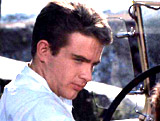
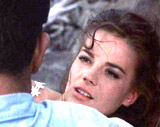
They became sexually awakened, faced repressed sexual attitudes, parental pressures, turmoil, social constraints and class differences, and ultimately broke up and were traumatized without consummating their love. In the film's opening scene, the young teenaged couple were making out in an open, yellow roadster convertible after school in the early evening - on a lover's lane a short distance in front of a raging waterfall. The attractive couple were passionately kissing and breathing heavily - their raging hormones were symbolized by the flow of churning water over the falls behind them. He begged her to go further, but she resisted expressing her physical needs. Angry at her, sexually frustrated and slightly humiliated, Bud left the car and stood by the waterfall, stating: "I'd better take you home," as she slipped on her boyfriend's striped letter sweater. Throughout the film, Deanie's body language exhibited tremendous sexual longing. After returning home, she leaned backward as she stroked her hair and neck. She hugged a pillow as she reclined on a sofa with her legs extended. Her domineering and controlling mother Mrs. Frieda Loomis (Audrey Christie) tried to instill her own sexual fears into her. Her rigid, puritanical mother vowed that boys never respected a girl who went all the way - love-struck Deanie was troubled by her own emerging, raw physical feelings. Prudish Mrs. Loomis asserted that women don't enjoy sex or have sexual urges, and that they dutifully have sex with their husbands only to have children. She was always physically repelled by her husband and men's aggressive tendencies. But a virginal Deanie was already experiencing (and repressing) strong, out-of-control physical drives, although she struggled with wanting to be 'a good girl' and worried about staying pure until marriage. Deanie threw herself onto her bed, cast away her brown bear in disgust, grabbed her pillow, and thrust her chest into it. Her sexual longings burst forth as she imagined hugging her sweetheart while glancing at Bud's many pictures plastered above her dresser. The next day in an overheated love scene, head-over-heels in love Deanie showed her sacrificial devotion to Bud after he had shown interest in someone else. She peppered him with kisses all over his face - and then when they heard voices, they retreated into the side dining room. Through a framed doorway, the camera eavesdropped on them. Deanie pressed her groin into his as they leaned against a door. Bud forcefully grabbed her shoulders and pressed her down to her knees to make her confess her utter obedience to his will. She confessed:
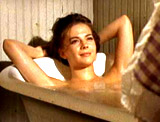
After her vow of complete submission, she rolled over onto her back on the floor in a sublime, vulnerable state of passionate surrender, moaning orgasmically and begging for "anything" to happen: "Oh Bud. - Bud! - Bud." In the film's most emotionally-raw sequence, Deanie was soaking and sweating in a bathtub full of steaming hot water - attempting to relax and purge herself of poisons and anxiety about Bud's new relationship with flapper-styled, not-so-innocent, slutty Juanita Howard (Jan Norris). She rocked her head left and right (with her eyes shut) as she sighed feebly and told her mother that she felt better. But the tension visibly mounted when she was quizzed by her mother about Bud. Their bickering and argument soon rose to a feverish pitch when her mother threatened to call Bud and she screamed: "Don't you dare!" - and she was questioned about the spoiling of her virginity:
After confessing her prudish celibacy and that she had been 'a good little girl," she screamed invectives of hate at her mother and ran naked toward her room.
When Deanie met up with Bud a few months later at the Bon Voyage Grads dance (held in the school gym) in a red, slinky outfit, with the objective of seducing and warming up her cold-hearted ex-boyfriend Bud -- she made desperate sexual advances toward him - to consummate her feelings for the greatest love of her life, and lustfully risked everything when she begged him to make love to her - again, Bud rebuffed and rejected her during the failed reunion - for not being 'herself' ("a nice girl") and for denying her pride (Deanie: "My pride? MY PRIDE!!...Oh, God. I haven't any pride. I HAVEN'T ANY PRIDE!...I haven't any pride. I just want to die. I just want to die"). As a result of the rejection, Deanie's emotional frailty caused suicidal thoughts and her tortured madness to resurface; she made a drowning suicide attempt at the waterfall when she jumped into the river while despairing over Bud - she was rescued by onlookers, and subsequently hospitalized in a sanitarium. Years later, the final closing sequence chronicled her bittersweet and awkward reunion with Bud at his ramshackle farmhouse (he had since become a local farmer and married black-haired Italian waitress Angelina (Zohra Lampert), with one child and another on the way). Deanie was driven to Bud's home by girlfriends Hazel (Crystal Field) and June (Marla Adams). She was wearing a virginal white dress outfit, white pearls, white gloves and a broad-brimmed white hat; their conversation was brief and revealing when she realized that the affection that they once had could never be recovered.
After the visit, her girlfriends asked: "Do you think you still love him?" - she was calm and newly aware, and able to put aside youthful exuberance, grieving, and denial of love to move forward. She recalled the Wordsworth poem (in voice-over), knowing she could gain strength from what remained - the memories of her "splendor in the grass" were now more maturely realized as she was driven away - with a close-up on her face -- "Though nothing can bring back the hour Of splendor in the grass, of glory in the flower We will grieve not, rather find Strength in what remains behind." |
  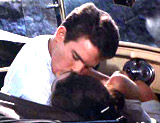 Bud with Deanie 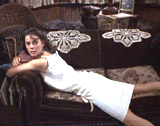 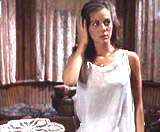 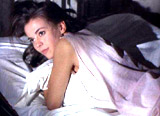 Deanie (Natalie Wood) 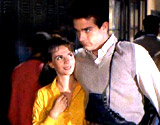 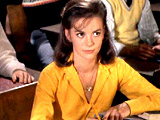 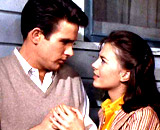 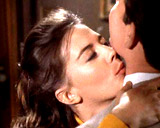 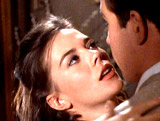 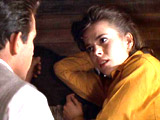 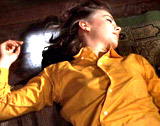 Deanie Submitting Herself to Bud 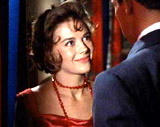 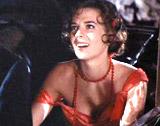 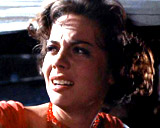 Deanie Desperate to Make Love |
|||||||||||||||||||||||||||
|
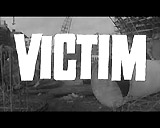
Director Basil Dearden's non-judgmental, ground-breaking film-noirish thriller was a daring landmark film with its head-on presentation of the 'un-talked about' topic of homosexuality in the early 60s, when Britain still had anti-sodomy statutes as law. The controversial film was denied a seal of approval from the MPAA as a result of its subject matter and explicit use of the word 'homosexual.' Six years after the film's release, the UK's Sexual Offenses Act of 1967 finally decriminalized homosexuality between consenting adults over the age of 21 (with a number of exceptions). It was reportedly the first film in Britain to use the word "homosexual." The film was advertised with the tagline:
Its story involved a self-confessed, beleaguered, non-practicing homosexual and wealthy lawyer named Melville Farr (Dirk Bogarde, in a role as the screen's first gay hero). He risked his marriage and career to track down a creepy, slimy blackmailer (Derren Nesbitt) over accusations of closeted homosexuality.
Peter McEnery co-starred as Jack "Boy" Barrett (Farr's chaste 'boy friend' from his past as a Cambridge student with whom he shared a romantic relationship). Barrett was incarcerated for embezzling money from his employer to silence the blackmailers regarding his homosexual relationship with Farr. When he felt he was about to be outed, Barrett committed suicide by hanging himself in a police jail. In one of the film's most tense moments, Farr's stressed, estranged, but supportive wife Laura (Sylvia Syms) found out about Barrett's suicide and asked her husband about his feelings for him -
Although Farr maintained that he was no longer indulging himself with homosexual feelings or relations, he burst out to her an admission of his past indiscretions (with Barrett), after which she decided to leave him:
To pressure Farr, the blackmailers vandalized Farr's property, painting "FARR IS QUEER" on his garage door. Undeterred, Farr promised to cooperate with the police in their investigation and pursue the blackmailers, knowing that the publicity would inevitably ruin his public career. |
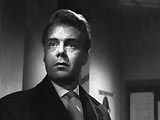 Melville Farr (Dirk Bogarde) 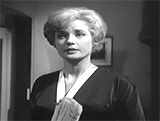 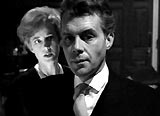 Farr Confronted by His Wife Laura About His Homosexual Feelings For Barrett 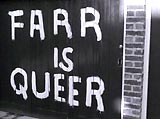 Vandalized Door |
|||||||||||||||||||||||||||
|
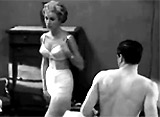
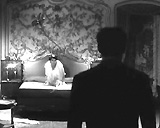
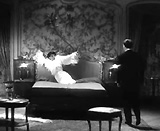
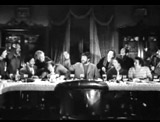
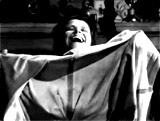
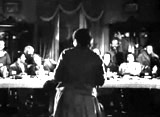
Luis Bunuel's subversive masterpiece, winner of the Grand Prize (Palme d'Or) at the 1961 Cannes Film Festival, was originally banned in his home country and condemned by the Catholic church for its perceived indictment of Catholic self-righteousness, blasphemy and obscenity, and for its hinted themes of incest, rape and necrophilia. In the plot, devout Spanish convent novice Viridiana (Silvia Pinal) was compelled to visit her reclusive, lecherous widower uncle Don Jaime (Fernando Rey). He was still mourning the death of his wife due to a heart attack on their wedding night in his arms - without consummation. The first view of the uncle's estate was actually the legs and feet of jump-roping young Rita (Teresa Rabal), the daughter of Don Jaime's maid Ramona (Margarita Lozano) - the lonely, admiring Don Jaime was watching her innocent activity, and offered her a new jump rope. The initial meeting between Viridiana and her uncle was somewhat chilly. As Don Jaime played the organ, in Viridiana's bedroom, she partially disrobed and revealed her shapely legs when she removed her dark stockings. She also unpacked her suitcase, carrying a small wooden cross and a crown of thorns. In the secretive privacy of Don Jaime's bedroom (with a veil draped over his dressing chest), he was seen admiring his wife's wedding clothes - he slipped her white, high-heeled satin shoe over the top half of his right foot. He also modeled her corset in front of a mirror. When Viridiana appeared, he was entranced by the sight of her bare legs in front of the fireplace. Don Jaime had one last favor of the reluctant Viridiana - to satisfy his obsession with her similar looks to his deceased wife ("You look just like her"); he clothed his niece Viridiana in his wife's wedding gown. He admitted: "I can't keep my eyes off you" and reluctantly confessed ("You must think I'm mad") that he would like to marry her ("I never want you to leave this house"). She was repulsed: "You can't be in your right mind. I've been so happy here, and now you've spoiled it all." Don Jaime promised to drop the subject, but then after his servant Ramona secretly drugged her tea drink, Don Jaime carried Viridiana into the bedroom, reclined her on the bed, kissed her, loosened the top of her dress, buried his head in her breasts, and was tempted to rape her. The next day, he falsely confessed to her that he had taken her virginity to keep her from returning to the convent for her final vows. When she was still determined to leave, he admitted that he lied ("I only possessed you in my thoughts") - but the ultimate result was his own guilty self-humiliation and a suicidal hanging with a jump rope. In his will, he had left his property to her and his illegitimate son Jorge (Francisco Rabal). Another of the film's most controversial scenes was a drunken parody and re-enactment of Da Vinci's 'The Last Supper' by a destitute group of thieves, beggars, drunks, lepers, cripples, and whores who were being supported by the virtuous and idealistic Viridiana. They took over the house after she had invited them to live at her uncle's crumbling estate, and she had briefly left to formalize inheritance of the property. While she was absent, they invaded the house and nearly destroyed it. They killed goats for a feast, dirtied the tablecloth, and broke expensive china and furniture.
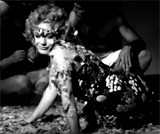
They 'freeze-framed' for a mock group portrait at the table - it was pictured to the sounds of the "Hallelujah Chorus" in Handel's Messiah. At that moment, one of the filthy female beggars, Lola Gaos (Enedina), pretended to be the 'photographer' and metaphorically suggested snapping the picture by lifting her skirt. The celebration reverted into an orgiastic riot, with dancing, ribaldry, violence, food-fighting and cross-dressing. Anachronistically, a syphilitic beggar clothed himself in the dead wife’s corset and her veil and performed an obscene dance, while another couple had sex behind the living room sofa. One of the celebrants even attempted to molest and rape Viridiana when she returned to the house.
Totally disillusioned or maybe more sexually aware of herself (after two attempted rapes), Viridiana submitted to playing a game of cards, to the sounds of the early 60s pop tune Shimmy Doll ("Shake Your Cares Away") - as the camera retreated backwards through a closeted doorway. The film ended with a suggested possible menage a trois scene between ex-nun Viridiana, servant Ramona, and her lothario, rakish cousin Jorge. |
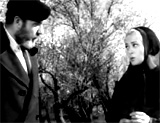 Viridiana Meeting Her Uncle  Viridiana's Shapely Legs 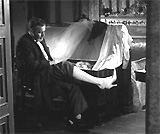 Uncle Don Jaime Wearing His Wife's High-Heeled Shoe 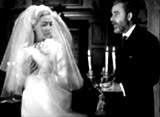 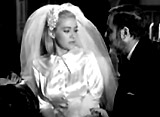 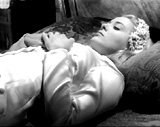 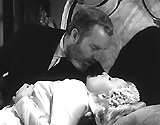 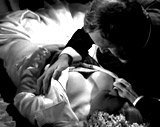 Viridiana (Silvia Pinal) with Perverted Uncle Don (Fernando Rey) |
|||||||||||||||||||||||||||




 Peeping Tom (1960, UK)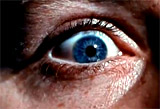











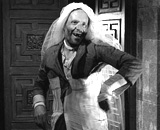 Beggar Dressed in Corset and Performing Obscene
Dance
Beggar Dressed in Corset and Performing Obscene
Dance