|
History of Sex in Cinema: 1965-1966 |

|
The Collector (1965, UK) (aka The Butterfly Collector) Director William Wyler shot this claustrophobic yet absorbing psychological thriller - based upon John Fowles' 1963 novel of the same name. It was basically a one-situation, two-character work, told from the POV of a kidnapper. Its tagline stated:
The main character, identified by his amateur hobby-occupation (lepidoptery), was a reclusive individual who was obsessed with butterfly collecting. Freddie Clegg (Terence Stamp) was a mentally-disturbed, shy, introverted, obsessed young London bank clerk. In a flashback, it was shown that his Aunt Annie (Mona Washbourne) informed him that he had won a football betting pool with a prize of $200,000 (71,000 pounds). With the money, he bought and renovated a huge rural Tudor country estate in Sussex. For a long time, he had been stalking and spying upon a pretty London art student on a scholarship at the Blake School of Art - to make her part of his 'butterfly' collection in his home's ornate underground cellar. He at first thought that he couldn't carry through with his plan:
Finally, he acquired the courage to chloroform and make her captive as a female hostage (or "specimen"):
He cornered her in a narrow alleyway, placed a chloroformed cloth over her mouth until she passed out, then gagged and bound her hands before driving her in his black van back to his manor home. She was imprisoned in the manor's underground, stone-lined basement adjoined to the main house but with a separate entrance. It was a padlocked lower room hidden by a fake wall with a bookcase. During his first visit with her, when he brought her food on a tray, she demanded release: "I demand to be released at once," but he refused. He bragged: "I know a lot about you, more than you think." He had been attentive to her and had studied her over a long time, knowing her father's name and her clothes' basic sizes, plus he had supplied her 'prison' with art books. He was pleased with himself in town when he saw a newspaper article about a "BEAUTIFUL ART STUDENT MISSING." During a second visit with her, she asked defiantly: "I'm your prisoner, but you want me to be a happy prisoner. Why?" Not intent on sex, rape, molestation, ransom or murder, he said that his main (pathological motive) was to make her his "guest" - to "collect" and dominate her and add her to his set of pretty objects - and hoping that she would eventually reciprocate his feelings of love. He grabbed her - but with the sensation of physical contact, it incited him to whisper into her ear: "I love you" - a shocking revelation. He basically replied that he would respect her and only become acquainted: "Funny thing is - I told myself a dozen times, I wasn't going to tell you. I was going to let it come natural on both sides. But I touched you just then, it came out....I want you to get to know me." She tried to reason with him ("But you don't kidnap people so they'll get to know you. Don't you realize the trouble that you could get into?"), and told him that if she was released, she wouldn't tell anyone.
Although she gave the pretense of being cooperative, her many attempts and ploys to escape were unsuccessful. Once, she thought she could escape through a second locked door, but he had anticipated her flight and stopped her. She dared to slap him, causing him to be open to negotiating for her release. He implied that the length of her stay depended upon how soon she would get to truly know him and love him back - at least a minimum of a month more. He seemed to finally agree that he would release her in 4 weeks. She couldn't get him to listen to her distaste for him: "Don't you see that four months, four years, won't get what you want?" But in the meantime, she bargained for concessions: a letter to her parents, fresh air and light, a bath, some drawing materials, medications, and fresh fruit and salad. After about a week went by, he allowed her out of the dungeon for fresh air and the promise of a bath. With her hands bound, he creepily and lovingly touched her hair - causing her to instinctively and defensively yell for help before he covered her mouth. She forced him to promise to never again touch her in the same way, but if he did, she made a bold request and ultimatum that he not abuse her:
[Note: After the public acceptance of nudity in The Pawnbroker (1964) in the previous year, released without an MPAA Production Code seal, a slim pathway was opened for this thriller to exhibit the mild and brief nudity of the captive female portrayed by Samantha Eggar. Shortly later, the MPAA was forced to abandon the Production Code altogether by 1967.] In one of the more tense scenes in the film between captor and captive, Freddie allowed Miranda to take a bath on the second floor of the main house, and vowed that he would respect her privacy, although he would guard the unlockable door from the outside. She was almost discovered by an unexpected visit at the front door from neighbor Colonel Whitcomb (Maurice Dallimore). Freddie gagged her to prevent screaming, wrapped a robe around her, and lashed her to the pipes. Then, Freddie went downstairs where the neighbor greeted him as "Franklin," and complained that electrical modifications he had made to the basement would upset "the Ancient Monuments people" - who regarded it as an historical edifice that needed to be preserved. She tried to alert the neighbor before he departed by using her outstretched foot to turn on the water flow into the tub - to create the sound of running water. The neighbor did ask about it, but Freddie covered up by claiming his male cousin was visiting. However, when water in the tub began to overlow out of the tub and down the stairs - it was noticed by both of them. Freddie ran upstairs to deal with the situation (and to tie up Miranda more tightly), while again lying that it was really his girlfriend who was visiting - and that she had a reason to not call out to alert him about the faulty water faucet: "She was embarrassed. You know how it is."
After the incident with the tub before she was imprisoned again, Miranda requested that her bindings be tied in the front to avoid pain. Freddie proudly showed her his hobby's collection of butterflies (some raised from larvae, while some other aberrations were bred by him) - while she made the obvious connection between his beautiful insect collection (of dead specimens) and her own entrapment as his latest collectible item that he had become infatuated with - the image of her face was reflected on the glass, implying that she was also caught and pinned for his enjoyment:
She recognized that he was the recent winner of a fortune - and that he had many opportunities available to him - other than death: "You could do so much. You could travel, learn, meet people. You could have a wonderful life. But this is death, don't you see? Nothing but death. These are dead. I'm dead. Everything here is dead. Is that what you love - death?" Many days later, she was allowed to write a dictated letter to her parents, as he had earlier promised, but then she was caught attempting to put a second note of distress in the envelope: ("Kidnapped by madman. Gerald Franklin. Pools winner. Prisoner in cellar, old Tudor house, near Reading. So far safe. Frightened."). After an argument, he stated how she still detested him: ("I'm a nobody still, aren't I?") - along with her friends and people of her type: ("Your friends would look down on me like you do...I've seen you with your friends. I know what they're like. You'd be ashamed of me in front of them"). As he departed, he ripped up the notes. On the day that she was supposedly to receive her "freedom" (June 11th) with release at midnight, they discussed their different views of Holden Caufield in J.D. Salinger's "The Catcher in the Rye" and a Picasso painting. Freddie accused her of being patronizing and condescending: ("Don't patronize me...You see, you won't really talk to me"). He feared that he would be seen as ignorant and that he would be incompatible in the real world with people who held opinions like her and her friends:
Fearing that she had lost her chance at freedom, Miranda was slightly encouraged when he presented her with a gift - an evening dress in a box, to be worn that evening during a private dinner with him. At a candlelit table complete with champagne and caviar, he gave her a ring box - and proposed marriage (in name only). There would be certain conditions - she could live in the house in her own lockable bedroom if she wanted. Although she replied it couldn't be considered a real marriage ("I couldn't marry a man I don't belong to - in every way"), to comply, she agreed to marry him, but then he immediately expressed reservations - marriage would require outside witnesses ("Don't you think I know you need witnesses to get married?"), and asserted with a sinister stare that he could change his mind: ("I can do what I like!").
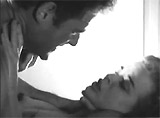
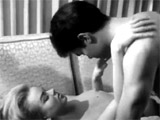
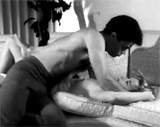
When she tried to escape from him and fled to his butterfly room, he chloroformed her and carried her to his upstairs bedroom, where he placed her on the bed and caressed and embraced her body and face. The next day in the basement, Freddie asserted that he hadn't taken advantage of her when she was unconscious, and since she hadn't fallen in love with him yet, he had no choice but to keep her longer. Later inside the main house, Miranda expressed how she wanted them to be friends again: ("I'd like us to try and be friends again"). She sat on his lap and requested a kiss - and then after her hands were untied, she slowly let her hair down and undressed and let her nightgown fall to the ground: ("Would I be doing this if I were only pretending?"). He laid on top of her and began to kiss her, but then pulled back and accused her of pretending and manipulating him to let her go: "You think if I make love to you I'll have to let you go." And then he threw her clothes back at her, ordered her to dress, and shouted out that he no longer respected her - he compared her to a whore:
He threw her sketched and framed self-portrait in the fireplace, and rebound her hands, as she suddenly realized: "I'm never getting out of here alive, am I?" As they approached the cellar on a cold and rainy night, she hit him in the head with a shovel and bloodied him before running off. But he was still conscious and able to chase and grab her, drag her back and imprison her again. As he locked the door, she accidentally knocked over an electric heater and it shorted out. He went for medical attention to get treatment, unknowingly leaving her wet and cold in the cellar without heat. She worried that he would die and leave her imprisoned without any means of escape: "Please don't die!" In the chilling finale three days later, he returned and found her extremely ill - probably suffering from pneumonia. After she begged for help and collapsed, he realized she was seriously ill when she entreated: "I don't want to die." He rushed off again to get a doctor for her, leaving the doors wide open, but she lacked the strength to escape.
In town, he realized he couldn't contact a doctor, and instead bought some over-the-counter medicine from a local pharmacy. When he returned, he found that Miranda had already died. He recollected his time with her through a voice-over: "I sat there all the rest of the afternoon, remembering." After burying her in a homemade coffin, he concluded that he had failed with Miranda (and it was mostly her fault), because he had set his sights too high on a higher-class female:
He drove off to stalk after his next target - a nurse (Edina Roday) who had treated him in the hospital. |
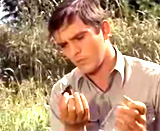 The 'Butterfly' Collector: Freddie Clegg (Terence Stamp) 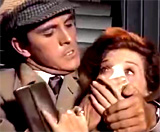 Kidnapping of Miranda Grey (Samantha Eggar)  Unconscious 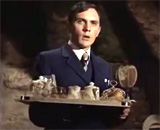 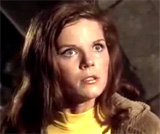 Bringing His Prisoner Food in the Stone-Lined Crypt 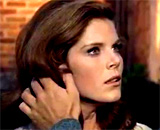 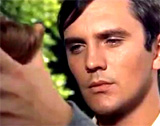 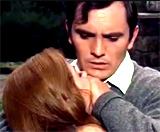 Freddie Touching Her Lovingly - Causing Her to Yell For Help 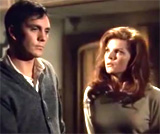 Miranda's Bold Ultimatum 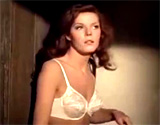 Miranda Preparing for Bath in Upstairs of House 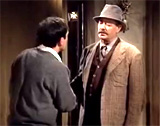 Arrival of Nosy Neighbor Colonel Whitcomb 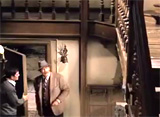 Water Flowing Down the Stairs From 2nd Floor Tub 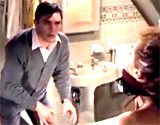 Freddie Turning Off the Tub Faucet in Bathroom 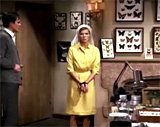 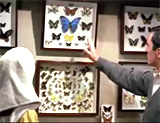 Freddie's Dead Butterfly Collection 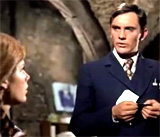 Freddie Discovering Her "Frightened" Note For Help 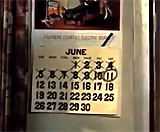 "Freedom" Day - June 11th 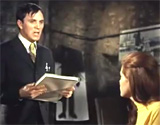 Freddie Feeling Inferior During a Discussion of Picasso and 'The Catcher in the Rye' 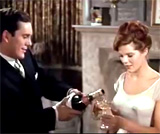 Candlelit Dinner with Champagne 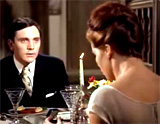 Proposal of Marriage 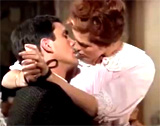 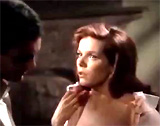 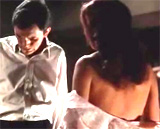 Kissing and Undressing In Front of Him 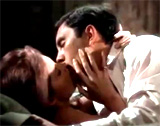 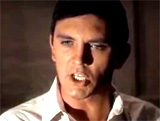 "You're No Better Than a Common Street Woman" 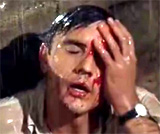 Clobbered in the Head With a Shovel 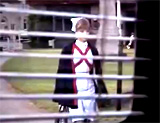 Freddie's New Target |
||||||||||||||||||||||||||||||
|
Darling (1965, UK) Director John Schlesinger's film was shocking and cutting edge in its day with scenes involving loose sexuality, betrayal, bisexuality/transvestism, serial bed-hopping and infidelity, age difference, pregnancy and abortion. In a flashbacked life story titled "My Story" told (in partial voice-over) during an interview for an article being prepared for IDEAL WOMAN, a women's magazine, jet-setting Italian princess Diana Scott (Best Actress Oscar-winning Julie Christie) described how she had an upper middle-class upbringing, and grew up spoiled because she was always considered a beautiful "darling." She was currently living at an Italian villa after marrying a prince. When she was younger, she had a failed marriage, various sex partners and a number of affairs: Earlier in her life in the 1960s, the carefree, hedonistic London Swinging 60s amoral fashion model and playgirl Diana was first discovered on the street by a TV reporter. The cool, emancipated beauty was involved in a failing marriage to immature Tony Bridges (Trevor Rowen). He sought an official divorce in the midst of her infidelities. She became involved in affairs or flirtatious flings with two older men, one of whom was the TV reporter:
During Diana's secretive affair with Robert, they arranged to book a hotel room together. She felt breaking up his family was "repellent," although she went ahead with it. She pondered: "It should be so easy to be happy, shouldn’t it?" He told her before they had sex: "It's the first time I've felt real for a long time." Robert left his wife Estelle (Pauline Yates) and children and moved into a London apartment with her to live together for some time. After awhile, Diana became enamoured with Miles Brand, who first discovered her and named her the "Honeyglow" Girl. He helped her to get an audition with the Glass Corporation, and she was selected to play the title role in a trashy B-horror film titled Jacqueline. While she was involved with Miles Brand, Diana became pregnant with Robert's child - and quickly decided to abort: ("I realized it was going to be the ruination of my career, messing up people's lives: you know, mine, Robert's, everybodys. I just began to realize I couldn't go through with it"). Rather than return to the apartment with Robert, she separated from him briefly while recuperating in the country with relatives, and then returned to him, due to boredom. But the vain, narcissistic and self-centered Diana also found herself unfulfilled in her relationship with the detached and depressed workaholic Robert. She told him: "I don't want anything to do with sex again as long as I live." To relieve her boredom, Diana left the apartment when Robert expressed how he didn't want to be distracted from his work. She looked up playboyish Miles and promptly had sex with him in his apartment (although appeared to take discomfort as he performed oral sex on her). Juxtaposed to her slight distaste was her overdue car parking meter outside registering "EXCESS CHARGE" and "PENALTY." Upon her return, she lied to Robert about how her car was towed away, causing her delay.
Soon after, she accompanied Miles as a jet-setter to Paris for one of his wild decadent parties with his weird and slightly repellent transvestite cross-dressing friends (the participants played a wild strip-dance "truth game" - dancing in a circle in the light of a projector, while disrobing). When she returned to London, possessively-jealous Robert was angered by her lying and infidelity, and told her in the film's most famous line:
He also insultingly demeaned her: "You bitch, you filthy little bitch!...I have every right to call you everything." She shouted back that he didn't have any rights over her, since they weren't married. He retorted that she was "trivial and shallow." She admitted: "I've stuck it out just about as long as I can," and he quipped: "And yes, just about as often as you can." She claimed she felt like a prisoner in the apartment, and also violated when he spied on her goings-on. Shortly later, he packed a few things and walked out on her. Diana was not emotionally prepared for Robert to break up with her and move out.
She platonically partnered with homosexual photographer Malcolm (Roland Curram), becoming the "Happiness Girl" - promoted by Miles for a Glass Corp. advertising campaign for a chocolate company. Soon, she was traveling to Italy, filming candy company commercials at the villa (palazzo) of refined Italian widower Prince Cesare Della Romita (José-Luis de Vilallonga), a rich yacht owner with seven children.
During her stay in Italy, she went on a brief holiday to Capri with Malcolm, and cautioned him after they both glanced at a handsome male waiter at an outdoor cafe: "We are not complicating our holiday with any disgusting sexcapades." She also confided in Malcolm: "I could do without sex. Don't really like it that much. If I could just feel - complete." However, they both had separate one-night flings with the waiter who picked each of them up on his Vespa. While on vacation at Capri, the widowed Prince arrived on his yacht and vainly proposed marriage to her, but she declined ("I can't give up my life"). After her return to London, she quickly became disillusioned by her past life there - she broke her sleazy association with the promiscuous Miles and his friends (after calling him a "bastard" and telling him: "I just hate your guts"). She also insulted him as "impotent in every way except in bed." In the middle of things, Robert arrived to see Diana at an inopportune time and left ("If only Robert had come a half hour later" - she mused). She backtracked and decided to accept the Prince's marriage proposal. She became a "NEW ENGLISH PRINCESS" - but it was ultimately an unfortunate decision. After her marriage, the Prince announced a banking-related business trip to Rome (he would stop to see his mother the night before - a mistress perhaps), and she felt abandoned and alone. She found her loveless, affluent and lonely married life in his vast villa utterly boring and frustrating - she walked through the many rooms of the palazzo to her bedroom, tossing off her clothes and stripping as she went (viewed nude from the backside), and unhappily threw herself bare-naked on her bed. [Note: It was the first Oscar-winning performance for an actress that included a nude scene.]
Diana contacted Robert and returned to London one last time to sleep with the "easily seduced" love of her life. She fancifully told him after love-making:
She proposed moving to the country to reestablish themselves. But he dashed her dreams of reuniting - and admitted it was slight revenge for the past: "We're not going back to anything, you know. This was just for old times' sake." He rejected her profession of love and her request for "one more chance." He phoned to purchase a ticket to Rome for her that afternoon, insisting: "You are going back to Rome."
She begged him to reconsider and vowed her love for him, but he was indifferent to her entreaties to just spend a week together as a trial. As he drove her back to the airport to return to her life as a Princess in Rome, she half-heartedly threatened to commit suicide by throwing herself from the moving car: "If I can't be with you, I don't want to be alive," but then, she resumed her princessly-duties upon arrival at the airport and afterwards. Robert watched her from an observational walkway as she posed and smiled for cameras before boarding her plane back to Rome. The film ironically ended with a return to the film's beginning - her life story on the cover of IDEAL WOMAN magazine, seen on sale at corner news-stands in London. |
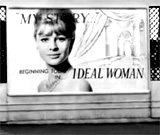 "My Story" An Interview: For 'Ideal Woman' Magazine 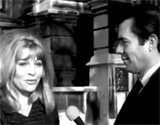 Street Interview with TV Reporter Robert Gold (Dirk Bogarde) 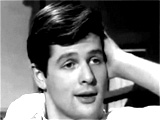 Diana's Early Failing Marriage to Young and Immature Tony Bridges - Ending in Divorce 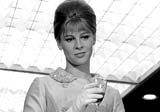 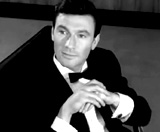 With Playboyish PR Agent Miles Brand (Laurence Harvey) 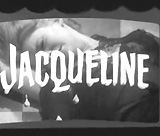 Movie Role: Jacqueline 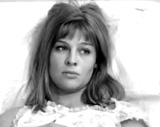 Recuperating From Out-of-Wedlock Pregnancy and Abortion 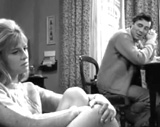 Diana Bored After Returning to Apartment and Detached Workaholic Robert   Diana's Participation in Decadent Strip-Dance Party Game with Cross-Dressing Males in Paris  Kissing Miles During Party in Paris   Diana as the "Happiness Girl" with Photographer Malcolm (Roland Curram) 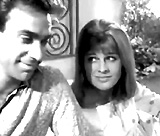 To Malcolm - Diana Admitted About Sex: "Don't really like it that much." 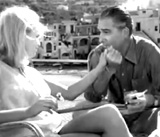 Marriage Proposal from the Prince 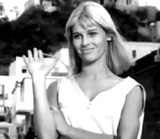 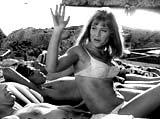 Saying Goodbye to the Prince After Declining Marriage   Diana - the New English Princess 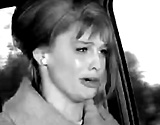 Threatening Suicide on the Way to the Airport with Robert 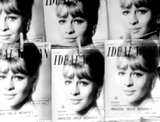 End of Flashback - Cover Story for IDEAL WOMAN |
||||||||||||||||||||||||||||||
|
The Defilers (1965) Director-cinematographer R. Lee Frost's disturbing, low-budget, definitive grindhouse "roughie" film (by producer David F. Friedman, now split from Herschell Gordon Lewis) was deliberately made to counter the "nudie-cutie" films of the time - with some nudity, but mostly added violence and griminess. The 68 minute film was reportedly based on a true story - about two wealthy, immoral, spoiled, and hedonistic men:
In the opening credits sequence while cruising in their convertible, they picked up four sex partners/dates and spent the day at the beach. While lying on a towel, the misogynistic Walker asserted to Jim:
When the sun went down, Marsh began to make out with well-built blonde date Ellen (Carol Dark), and untied the straps on both parts of her bikini as he kissed her. She asked about what he was doing:
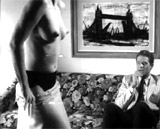
While Walker was with a second female, the two others who were left alone went topless for skinny-dipping. There were close-ups of them drying off with towels. Known for being creepy and cruel at times, on another occasion, Walker led brunette Kathy (Linda Cochran) down into a dark basement of an abandoned warehouse (a "secret dungeon"). Walker joked with Kathy that he kept "love prisoners" in the dungeon, and downplayed the less than romantic, dingy accommodations. He boasted: "It ain't the setting, chick, it's the lead actor's performance that gets all the rave reviews." He slapped and assaulted her when she talked back to him and asserted that he should "lay off the rough stuff." Although she valiantly fought him off, he ripped off her clothes, telling her that she needed "old-fashioned discipline" (a vicious spanking of her bare bottom that left welts after he pulled down her black panties). And then surprisingly, she surrendered: "Don't stop," and kissed him as the camera panned upwards before they had sex. In only a few moments, she had become his loving girlfriend - after sex, she was stretched out on a mattress in the basement, prominently showing off red welts (in the shape of his hand) on her bare bottom. They continued to get together for sex.
At the same time (intercut with the basement sequence), in the back of his convertible parked outside, Marsh made out with busty blonde Ellen again. He instructed her before she removed her bra: "I'm gonna start laying the foundation for your sexual education. You need a course on the subject." She joked back: "What kind of course, lover boy?" After removing her bra, he asked: "Wanna feel my muscle? Start the countdown" - before they stretched out and had sex in the back seat. After sex as she redressed herself, Ellen asked Marsh: "Well, ever-ready, ever-loving 100% American stud, how was that?" She told him: "Jamie, you know I'm crazy about you." In another sequence, the two male creeps were introduced to young, naive yet sexy blonde Los Angeles newcomer (from Minnesota) and aspiring actress/model Jane Collins (Swedish actress Mai Jansson) by their creepy apartment manager Mrs. Olson (Mimi Marlowe). To satiate their cravings for kicks during a "scouting trip," the two first spied on Jane as she undressed and took a bubble bath in her apartment. Almost immediately, they kidnapped her (they told her they were going to a "real Hollywood-style party") and held her prisoner in the basement where they made the defenseless woman their sex slave. They psychologically and physically abused her, and talked about her as enslaved: "You belong to us now, dig? We own you body and soul, to do with as we like, when we like. And you're gonna be here for a long, long time, maybe forever. So you might as well start getting comfortable." Trapped, she was stripped of her dress to reveal her underwear, and then viciously slapped to comply. Degraded and abused over a period of time, Jane was imprisoned in the basement, where she was raped, almost starved and beaten. At one point, when Marsh was put off by his girlfriend, he visited Jane for sex - and she was forced to submit to him (off-screen).
With pressure from an increasingly-squeamish Marsh, however, Walker agreed to "spring our little jailbird." In the basement, Marsh promised Jane freedom, and a new dress and dinner, to forgive them for their mistreatment (he called her imprisonment "a game...it's sort of like acting out a movie"). Walker had a different idea - he tied up Jane, and thrashed her with his belt, while Marsh pleaded and stood up to Walker's brutality: "Stop, you'll kill her...It's not fun anymore. Look, she's bleeding...Carl, you're sick." The two engaged in a no-holds-barred fist-fight, falling at one point onto the bed where Jane laid motionless. The struggle ended when Walker was accidentally pushed into a projecting sharp nail in the wall, and it went straight into his forehead. Marsh promised an unconscious Jane he would go get help, as he raced from the basement - and the downer film abruptly ended. |
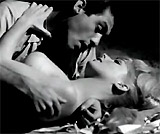 Marsh Making Out at the Beach with Ellen (Carol Dark)  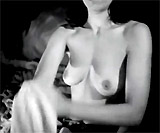 Others At the Beach Who Were Skinny-Dipping and Drying Off 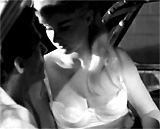 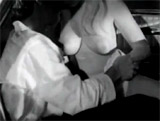  Later, Marsh in the Back of the Convertible For Sex with Blonde Ellen 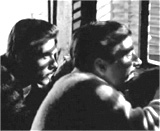 Peeping Toms: Marsh and Walker 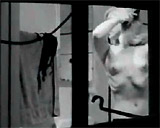 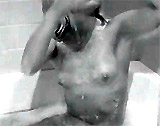   Jane's (Mai Jansson) Bubble-Bath - Spied Upon   Jane Held Captive and Thrashed With Belt by Walker  Fight Between Marsh and Walker - Ending With Death of Walker |
||||||||||||||||||||||||||||||

|
Doctor Zhivago (1965, US/UK) Director David Lean's magnificent epic and romantic drama featured a number of potent early scenes with far-reaching repercussions. In the plot (before a flashback) in the late 1940s or early 1950s, KGB Lieut. General Yevgraf Zhivago (Alec Guinness), an ex-Bolshevik Police Commissar, was introduced as the half-brother of the title character, Doctor Yuri Andreyevich Zhivago (Omar Sharif). He was searching for his own possible niece, a young girl named Tanya Komarova (Rita Tushingham) - Tanya was potentially the offspring of a pairing between Doctor Zhivago and Larissa 'Lara' (Julie Christie). Yuri was known for a printed edition of poems he had composed and dedicated to the love of his life - Lara.
In the early part of the film during a flashback, Lara was presented as a beautiful 17 year-old teenager. Lara's dressmaker mother Amelia (Adrienne Corri) was the lover/mistress of womanizing, brutal lawyer Victor Komarovsky (Rod Steiger) - a well-connected government official, and a friend of Amelia's late husband. On his way to see Lara's mother, the manipulative Komarovsky became lustfully interested in Lara and advanced upon her when she was just a teenager - she was flattered by his romantic attentions when he placed a sheer veil onto her head, but also she seemed repulsed. He noticed that she was full-figured when he stared at her breasts. At first, Lara's mother seemed unaware of Komarovsky's seductive intent with Lara, going so far as to allow Lara to accompany Komarovsky to a fancy restaurant dinner and dance party to take her place when she wasn't feeling well. On their way back home in an open sleigh, Komarovsky kissed Lara as she slightly resisted.
Privately with Lara during another encounter or date the next evening, he bought her a striking red dress to wear and then commanded her to turn around so he could admire her shapely form. He commented: ("You've grown up a lot, haven't you?"). He wished to seduce her to enter into an illicit affair with him as his mistress, by plying her with a drink. He tormented her, knowing that she was tempted or dependent upon him: "You see, you'll always come back" - and convinced her to stay longer with him (for sex) - during a fade-out. In the first of two instances, Yuri (as a young general practitioner-doctor) came into contact with Lara. After hearing of Komarovsky's affair with her daughter, Lara's mother Amelia attempted suicide by poisoning herself. Yuri was summoned by Komarovsky (having a "bad scare") to care for her by relieving her fever and draining her stomach. He helped to revive her, but also was stunned when he saw the young and beautiful Lara thankfully kissing Komarovsky for saving her mother. Yuri immediately realized the reason for the mother's suicide. While Lara's mother was recuperating in the hospital, Lara urged Komarovsky: "She wants you to go and forgive her. For her suspicions." Komarovsky replied: "You can tell her the truth if you like, Larissa." And then at the same time, Victor met Lara's fiancee - idealistic young 26 year-old Bolshevik revolutionary Pasha Antipova (Tom Courtenay), who knew nothing about Lara's affair. Victor tried to politely dissuade Pasha, who was committed to the Revolution, from marrying Lara in the next year. Later in private, Victor sternly insinuated to Lara that she not marry Pasha and avoid a "dreadful error" - in his view, Pasha was too inexperienced as a "young crusader" - both "high-minded" and "pure." He stressed: "He is the kind of man who breeds unhappiness, particularly in women." He described himself as a different kind of man: "There's another kind. Not high-minded. Not pure. But alive." He carried on with a personal insult - and a slap across her face:
She protested: "I am not!" but he answered: "We'll see." He violently forced himself on her and threw her onto a bed before raping her. She resisted for a few moments but then capitulated to his greater strength. Victor snidely commented after he had assaulted her and was striding out:
Soon afterwards, the guilt-ridden but vengeful Lara took the gun that Pasha had asked her to hide for him that he had acquired during a peaceful protest march. Single-minded and with steely determination, she tracked Victor down and shot and wounded him in the left wrist in the midst of Sventytski's Christmas Eve party, while he was playing cards with other gentlemen. Victor refused to have the police notified: ("I do not want the police. I just want you to get her out!"). Her violent outburst was witnessed by Yuri, who was in attendance as a party guest with his fiancee Tonya (Geraldine Chaplin). Pasha arrived to escort Lara out of the party, leading to tremendous gossip and discussion among the attendees. Shortly later, while Komarovsky's gunshot wound was being treated by Yuri, Komarovsky asked that the incident with "that girl" be treated with confidentiality: "I suppose I may continue to rely on your professional discretion?" Yuri agreed to comply, but then asked: "What happens to a girl like that when a man like you has finished with her?" As a sick joke, Komarovsky suggested: "Interested, I give her to you...I give her to you, Yuri Andreyevich. A wedding present." |
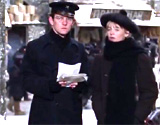 Young Lara with Boyfriend-Fiancee Pasha Antipova (Tom Courtenay) 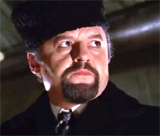 Victor Komarovsky (Rod Steiger) 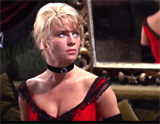  The Infamous Red Dress  Convincing Lara to Stay and Have Sex (off-screen)  Lara's Feverish and Suicidal Mother - Over Her Knowledge of Lara's Affair with Komarovsky   Lara Thankully Kissing Komarovsky for Saving Her Mother - Viewed by Yuri  Komarovsky's Meeting with the Young Couple - Lara and Pasha  Lara's Reaction After Victor's Rape  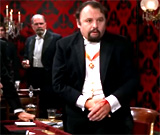 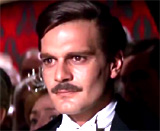 Lara's Vengeful Attempt to Shoot and Kill Victor at Christmas Party - Witnessed by Yuri |
||||||||||||||||||||||||||||||
|
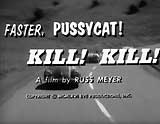
Faster, Pussycat! Kill! Kill! (1965) 'King of Nudies' director Russ Meyer's hard-core, low-budget, sex-ploitational cult film was his best and most popular work popular with male audiences in grindhouse theatres - it has been reassessed and re-interpreted by some as a pro-feminist 'female empowerment' short epic, for its overly dramatic, trashy, semi-fantastical violent content (although without overt nudity or extreme bloodshed!). It featured fast cars, catfights, shapely outlaw females, go-go dancing, murder, and karate. Its tagline was:
In its gender reversal, the female characters were seen as fierce, cunning, powerful, supercharged, aggressive and sexually predatory, while the males were either weak, decrepit, sexually impotent or mindless brutes. The cult favorite was considered hard-core in its day, and originally failed at the box office. The very nasty, trashy crime thriller opened with the narrator's (John Furlong) (voice-over) monologue:
The three main stars were buxom go-go dancers by night, who went on a murderous California desert rampage by day in their drag-racing hot-rod sports cars:
The trio encountered a young couple on the salt flats: All-American clean-cut Tommy (Ray Barlow) and his timid, naive "cutie pie" bikini-clad girlfriend Linda (Susan Bernard, December 1966 Playmate); Billie instantly flirted with the racer by asking: "Would you like to look under my hood?" Tommy was compelled to compete in a "friendly" drag "chicken race" once around the circular salt flat race track against Varla and the others, when Billie taunted him: "I'll bet you're a real tiger in disguise"; Tommy lost when she cheated and he was run off the track and spun out); afterwards, when Tommy objected and Varla suggested they fight, Varla karate-chopped him in the side and then in the neck and lethally back-crunched and spine-cracked him; Linda fainted from shock after witnessing the murder - and then was taken hostage-captive and kidnapped, drugged and gagged.
At a gas station in town, while the dumb attendant (Mickey Foxx) cleaned Varla's windshield, he said he wanted to 'see' America - as he stared down at Varla's bounteous chest: "Just passing through, huh? Boy, that motor's sure hot! You gals really must have been moving on these little machines. Yes, sir, the thrill of the open road. New places, new people, and new sights of interest. Now that's what I believe in, seeing America first!"; Varla memorably growled back: "You won't find it down there, Columbus!" As they waited to have all three cars filled with gas, Varla threatened her evil companions, claiming that they were not only witnesses but accessories to Tommy's criminal murder, when Billie retorted back to Varla: "Oh, you're cute. Like a velvet glove cast in iron. And like the gas chamber, Varla, a real fun gal!" Nearby, Billie noticed a hunk of a man loading his truck, and carrying his crippled father who had suffered a railroad accident; according to the gas attendant, the nutty, hateful father had received "a big hunk of money for a settlement," but the funds hadn't been deposited in a bank and were hidden somewhere at his property. The group (with hostage Linda) followed the truck to the dilapidated ranch of the crippled, wheel-chair bound rich "Old Man" (Stuart Lancaster), the lecherous father of muscle-bound, dim-witted Vegetable (aka "Veggie") (Dennis Busch) and his more normal older son Kirk (Paul Trinka); their scheming intent was to steal the lascivious old man's alleged inheritance money stashed somewhere at the ranch.
Upon seeing Varla trespassing with her two friends, the Old Man with a shotgun denounced the female: "They let 'em vote, smoke, and drive, even put 'em in pants. So what do you get? A Democrat for President. A lot of smoke up your chimney, Russian roulette on the highway. You can't even tell brother from sister 'less you meet 'em head on"; when Varla left to finish up borrowing water for their sports-cars, the "Old Man" remarked about her: "Boy, she's a cold one alright. More stallion than mare. It's too much for one man to handle." Shortly later, the voyeuristic, dirty "Old Man" was wheeled up to Varla and Rosie by Vegetable, and he asked: "You girls a bunch of nudists or are you just short of clothes?" With the "Old Man's" encouragement, Billie attempted to seduce the shirtless and clueless Vegetable, who was lifting weights, and she became increasingly frustrated at him: "You got yourself quite a playroom here, buster. What you need now is a playmate. I may not be much in the muscle department, but I got a few things goin' for me too, you know. What you need is a manager. Yeah! Ten percent of your action be enough for anyone. I never took no course in anatomy, but from what I can see, you got two of everything - and some left over. I don't know what you're trainin' for, but as far as I'm concerned, you're ready. Look, me Jane, you Tarzan. Now why don't you drop that tree you're holding and let's grab a vine and swing a little, huh?" Meanwhile, Linda ran off from the "Old Man" (who tried to molest her) and tried to escape with Kirk's help; after she explained how the other girls had murdered her boyfriend as she begged: "Just get me out of here before they get me, please!...They're murderers! They kidnapped me, and killed my boyfriend! They're vicious killers!", to her anguished surprise, he drove her back to the ranch. At the lunch table inside the ranch, the "Old Man" encouraged the three pussycats to eat the fried chicken: ("Alright son. Start passin' that chicken 'fore it loses its juice!"), as Billie offered Vegetable a choice on a plate: "Breast or thigh, darlin'?"; the "Old Man" added: "Why don't you take one of each, son? They, uh, both look tender." After lunch, Varla invited older son Kirk to join her outside so that he could be seduced - as a means to finding the hidden money; to irritate Varla's lesbian lover Rosie, the very soused Billie taunted her about how Varla was cheating on her: "You've only got one channel. And your channel's busy tunin' in outside. You really should be AM and FM, you one-band broads are a drag." Kirk was receptive to big-busted Varla's seduction: ("You're a beautiful animal, and I'm weak, and I want you. Badly I want you!"), and she led him to some straw on the ground to lie down for sex: "Right now you're first on my list and I always start at the top. You did want. You wanted big, real big....Whatever you want. Your cup to fill. To overflow....Don't talk it, do it. Just do it"); they were interrupted by Rosie, who informed them that Billie had drunkenly passed out in the house, and Linda had again escaped.
Both Varla with Kirk, and Vegetable with the vengeful "Old Man", raced out to look for Linda in separate vehicles [Note: In the backstory, the "Old Man's" spine had been seriously injured years earlier on a train platform when he helped a young girl (resembling Linda) onto a moving train, and ever since, he had been motivated to exhibit "hatred for women."] The "Old Man" and Vegetable were the first to catch up to Linda; Vegetable tackled her, and then with his father's encouragement, he approached Linda to rape her - but then he apologized and backed off from assaulting her; Kirk arrived and announced that he would take Linda home (on foot), and then promised that he would take care of the two "kooks" (his degenerate brother and father); Varla was incensed that Kirk was showing protective and loving behavior toward Linda as he walked her away. Once Varla drove back to the ranch in her car, she told a revived Billie and Rosie: "Everybody's gotta go. This way we're all safe and we can all go back to our gigs. This'll be just another deserted ranch house"; Billie disagreed with the plan to kill the "Old Man," Kirk, Vegetable, and Linda, to cover their tracks, and vowed to leave them: ("Well, I hate to break up the act, girls, but I always did want to do a single. See you in church, huh?"); as she was walking away, Varla threw Rosie's switchblade knife a long-distance into her back as she cried out: "Much later, filly!" - Billie staggered and arched backward before falling dead to the ground.
In the film's violent conclusion, with Varla in the car, Rosie ran down and killed the crippled "old man" in his wheelchair (revealing the hidden money that flew out of the seat of the capsized wheelchair), because he was a witness to Billie's murder. When Rosie went to retrieve her knife from Billie's back, the traumatized Vegetable assumed that she was responsible for Billie's death and he knifed her to death: ("I'll give you the knife") - with three vicious stabs to her abdomen - and she fell dead at his feet ("Your knife is yours to keep now") near Billie's dead body. When Varla saw her girlfriend Rosie dead with stab wounds, she vengefully ran down Vegetable and partially pinned and crushed him with her car against a wooden fence. Out in the desert, Kirk and Linda were confronted by Varla driving the "Old Man's" jeep-truck and pursuing them on railroad tracks; she caught up to them and told them that they were the only ones left: "Your old man's been blasted out of his wheels. And your king-sized brother's been twisted like a pretzel. You're all that's left, lover, and you ain't gonna be around for long"; during hand-to-hand combat between Varla and Kirk, Varla was gaining the upper-hand until Linda smashed into her with the ranch's jeep-truck and she soon died (with a clenched fist in the air about to strike). Afterwards, Linda cried out hysterically: "I killed her like she was an animal. Like she was nothing!" - Kirk responded: "She was nothing, nothing human! A real Jekyll and Hyde. You saved my life, so stop cryin', huh?" As they were leaving, Linda asked: "Are you gonna just leave her there?", Kirk coldly replied: "Well, she's not goin' anywhere" - the film's last line. |
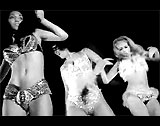 Go-Go Dancers by Night 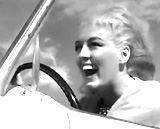 Fast Sports-Cars by Day 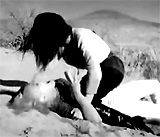 Billie and Rosie's Vicious Cat-Fight At a Lake 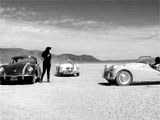 Drag Racing on the Salt Flats 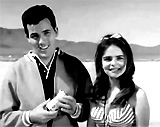 Tommy (Ray Barlow) and Linda (Susan Bernard) on Salt Flats 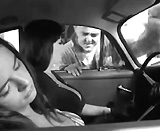 Gas Station Attendant: Staring at Varla's Chest 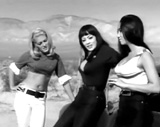 The Three Scheming "Pussycats" 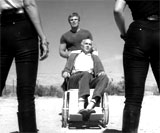 Varla and Rosie Confronted by the "Old Man" with Vegetable 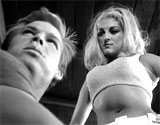 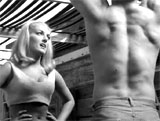 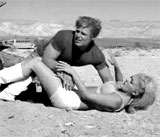 Billie Attempting to Seduce Vegetable - As He Lifted Weights, and Later In the Desert 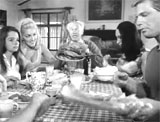 Lunch (Billie to Vegetable: "Breast or thigh, darlin'?")  Varla's Jealous Lover Rosie 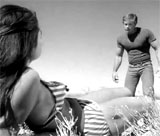 Vegetable's Threatened Rape of Linda, Egged on by the "Old Man" 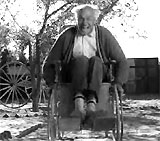 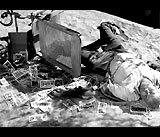 Rosie's Murder of the Wheel-Chaired "Old Man" 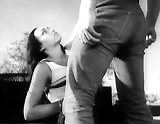 Vegetable's Knifing of Rosie 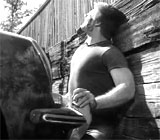 Varla Pinning and Crushing Vegetable Against Wooden Fence 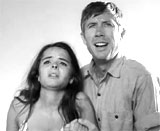 Linda and Kirk Out in the Desert 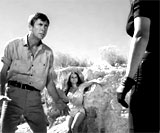 Varla's Stand-Off and Fight Against Kirk and Linda 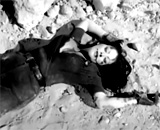 Varla Left Dead in the Desert |
||||||||||||||||||||||||||||||

|
Juliet of the Spirits (1965, It./W.Germ/Fr.) (aka Giulietta Degli Spiriti) Italian director Federico Fellini's first feature-length color film - a surrealistic, garish Italian-French fantasy comedy-drama about marriage, starred his own wife Giulietta Masina as the title character of Juliet. The visionary and over-indulgent film symbolically conveyed or reflected Fellini's own personal life and specifically his marriage to his wife. There were three significant dreamy segments throughout the film, with striking images or visions, that provided meaning for Juliet's main life issues and problems:
Middle-aged, frumpy, understated, naive, chain-smoking and neglected wife Juliet Boldrini (Giulietta Masina) with a short haircut bob, was celebrating her marriage of 15 years to her businessman-husband, Giorgio (Mario Pisu) - he was her "first love." In the opening scene, although Juliet had planned an intimate romantic dinner to celebrate, her husband threw a surprise anniversary party and had invited lots of weird spiritualists and psychic seers, including Genius (Eugenio Mastropietro) and his lover/assistant Valentina (Valentina Cortese). During the party, a clairvoyant held a seance - and Juliet heard otherworldly voices from the other side, and promptly fainted. For the remainder of the film, a spirit named Iris (Sandra Milo) became Juliet's guide in the form of a whisper.
At the beach the next day, the superstitious and "very gifted" Juliet ("who sees magic everywhere") experienced fanciful and surreal images, elaborated upon by her own subconscious. She was uncertain as to why her boring life and marriage weren't going well, why she didn't feel close to her husband, or why she had fanciful hallucinations. Juliet began to suspect that her husband of 15 years was a philanderer. She overheard him in his sleep mentioning a woman's name - Gabriella Olsen - a 24 year-old fashion model mistress with whom he was actually committing adultery, although he denied it ("I don't know any Gabriella"). A few days later, upon the urging of Valentina, Juliet sought the advice of another spiritual guide or mystic (described as "a fabulous clairvoyant. A man-woman with the secrets of both sexes!") - ancient wiseman or guru Pijma (72-year old lesbian androgyne Valeska Gert), who offered his services at the Plaza Hotel. Channeling through a female medium, Pijma told Juliet that it was her fault that she was experiencing marital problems and discord: "Love is a religion, Juliet. Your husband is your god. You are the priestess of this cult. Your spirit must burn up like this incense, go up in smoke on the altar of your loving body....Why don't you learn to please your husband more?" It was suggested to her that she must follow the approach of the sex trade in order to be happy: "Women want to be treated like sirens, but they don't know the trade." Juliet reacted: "Love is a trade?...A prostitute then - great advice!" She also sought help from a private detective and psychiatrist Dr. Valli in order to confirm her suspicions. They bragged about their investigative services: "In one week, you'll know everything your husband does during the day. Our zoom lenses makes secrecy an outdated concept. Doors and walls mean nothing to us. We'll show you your husband as you've never known him. Come with us, you'll participate in his most secretive moments. You'll penetrate those shadowy areas you've never been able to enter. Are you really sure you want to know?" Juliet replied:
Later, they had film and photographic evidence of Giogio's repeated dalliances with the model Gabriella, at a cost of 100,000 lira charged for expenses. She viewed the evidence with tears in her eyes. Juliet also consulted with her polar opposite - her hedonistic, glamorous, sensual, and buxom blonde party-girl neighbor Suzy (Sandra Milo, allegedly Fellini's own mistress) wrapped in white fur with a choker - ostensibly a high-class prostitute. When Juliet entered Suzy's ornate mansion, she was confronted with many worshippers or sexualized guests, including a suicidal Arlette in a back bedroom, described by Suzy as "unlucky in love." Juliet remembered how she also had a friend named Laura, who suicidally died at the age of 15 by drowning ("She killed herself for love"). Suzy showed off her bordello-styled, ceiling-mirrored bedroom: ("Sometimes you think there's another couple"). Naked, she demonstrated a chute-slide next to her bed that led down to a nearby underground, giant heated pool or bath ("Come and join me, the water's hot. It's another one of my ideas. We slide in after we make love"). In the wooded garden area surrounding the mansion, Suzy also showed Juliet her secret tree-top house (or pleasure dome). There was also a kettle-shaped wicker basket for entry of herself and lovers with an electric pulley-hoist mechanism. She told Juliet about its purpose: "I eat and dance and play." She also regularly sunbathed nude up there: "It's much better up there than on the beach."
After viewing the detective's evidence about her husband (including videos of their secret rendezvous), Juliet returned alone for an evening's party at Suzy's place. The free-spirited, promiscuous temptress Suzy boasted about her parties: "We simulate the atmosphere of a brothel." She offered Juliet an option to her imprisoning marriage - a costumed orgy of sexual passion and temptation with her studly, yet androgynous, part-Arab godson/nephew, a boy-toy, but Juliet became feverish and nervous. The wronged Juliet denied herself the pleasures of the flesh. Terrorized, she had a fleeting glimpse of an image from the spirit world and of her past - a frightening and fiery view of being martyred in a school play. Juliet fled back to her own villa to await her husband's arrival. She began to hear voices advising her with contradictory prescriptions: "Get revenge." "Forgive."..."Make yourself beautiful." "Life is a sacrifice." "Be more feminine. We'll teach you. You're no good." She became confused about what to do, and which way to go in life. A psychodramatist (Anne Francine) lectured about how to deal with her troubled marriage: "I think I know what's tormenting you and I might be able to help. You identify too much with your problem, that's your error." She added: "This is the great and simple secret you must learn - Be yourself, spontaneously. Don't fight your passions and desires." She continued by explaining the real reason for Juliet's fears:
Juliet also went to the home of Giorgio's mistress in hopes to confront her, but was unable to. She returned home and found her husband leaving for a trip to Milan. She sat quietly and solitarily in her house - haunted by the voice of her dead friend Laura, urging her to kill herself: "Everything's grey here, nothing moves, it's all silent. Come with me. A long sleep without suffering anymore." She imaginatively began to hallucinate images, demons and voices from her past, that had urged her with endless advice. Juliet was at a crossroads in her life - what should she do? Kill herself, live on as usual, or leave her cheating husband. She sought help from her icy and demanding mother (Catarina Boratto) - seen as a ghostly apparition. Juliet confronted her mother: "You don't frighten me anymore." Through self-discovery and self-realization and an examination of her own emptiness by the film's ambiguous ending, however, Juliet found emancipation, freedom and independence (or interpreted differently, loneliness and abandonment). She freed herself from her fiery martyrdom (the church pageant), let go and said goodbye to her past, and departed from her home - she opened her front gate and walked off toward the nearby woods.
|
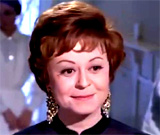 Juliet (Giulietta Masina, Fellini's Wife) 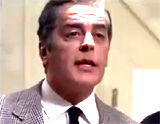 Juliet's Neglectful Husband Giorgio (Mario Pisu) 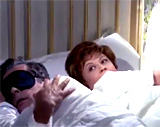 During Sleep, Juliet's Husband Spoke the Name: "Gabriella" 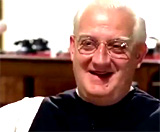 Juliet's Detective 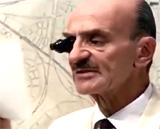 Juliet's Psychologist Dr. Valli 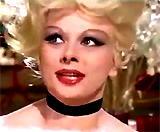 Suzy (Sandra Milo) - Juliet's Next-Door Neighbor 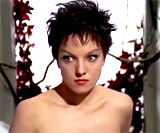 At Suzy's Place - Suicidal Arlette 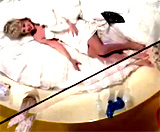 Suzy in Her Ceiling-Mirrored Bedroom 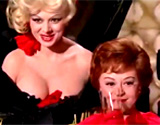 Attending a Party/Orgy at Suzy's Place  Suzy's Cleavage  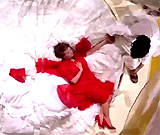 Suzy's Offer of a Boy-Toy in Her Bedroom to Juliet  Psychodramatist Offering Juliet Advice 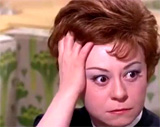 Juliet Sitting in Her Empty House - Contemplating Suicide 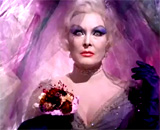 Asking For Help From Her Ghostly Mother 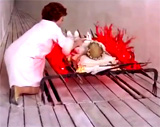 Juliet Freeing Herself From Her Own Fiery Martyrdom |
||||||||||||||||||||||||||||||
|
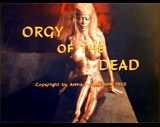
Orgy of the Dead (1965) Schlocky scriptwriter Ed Wood's notoriously bad, campy, sexploitational, low-budget 'nudie cutie' horror film, directed by cult movie maverick Stephen C. Apostolof (aka A.C. Stephens), was advertised as being shown featuring NAKED Spirits and TOPLESS Dancers, and presented "In Gorgeous Astravision" and "Shocking Sexicolor." The very outrageous and unusual film provided absurdist dialogue, perverse goings-on in a cemetery, and numerous burlesque-styled stripteases (a peep show revue of toplessness, with G-strings and panties) performed by attractive dancers - all damned and dead spiritual creatures (or ghouls) of the night, and each of them with a theme and backstory. In the opening prologue, two muscle-bound strong-men with silver head and arm bands and skimpy shorts, removed the coffin lid of a stone casket inside a cemetery's crypt - the corpse sat up. It was the film's rambling narrator Criswell (scripter Ed Wood's buddy in his last film) - the Emperor of the Dead, aka the leader of the 'twilight people.' Throughout the film, Criswell as the Emperor served as the emcee and provided absurdist and odd commentary. Wearing a Dracula-styled cape used in Abbott and Costello Meet Frankenstein (1948), he spoke as dramatic music played: [Note: the dialogue was almost verbatim borrowed from the opening of Ed Wood's own Night of the Ghouls (1959), unreleased until 1984]
Under the opening title credits, an immobile image of a Gold Girl (Pat Barrington in a dual role) was presented (referencing the film Goldfinger (1962)). The story really began when California hack horror book writer Bob (William Bates) and his buxom red-haired bimbo girlfriend Shirley (Pat Barringer or Pat Barrington) were driving to a cemetery late one night in his Chevrolet Corvair. Bob claimed a graveyard would help to serve as an inspiration for his lucrative writings on the topics of necrophilia and ghost stories: ("It's on a night like this when the best ideas come to mind... stir in the mind the best ideas for a good horror story"). The two suffered a car wreck in their Chevrolet in the fog - fortuitously, they crashed next to a cemetery, and they were flung from the car. The demonic Emperor Criswell again described the circumstances in voice-over:
In the moonlight while he sat at the exterior of a marble crypt, he summoned his undead consort, the Black Ghoul (Fawn Silver) or Ghoulita, a Vampira/Elvira clone known also as the Princess of Darkness, who was sporting a black beehive hairdo. She took his hand and bowed before him, to join him for the festivities. He threatened the ghouls that were about to appear if he was displeased with the "entertainment":
The ghouls that the two were commanding included a bevy of ten topless, zombie-like, graveyard 'creatures of the night' (hired LA strippers), who were about to perform ten interminable stripteases (with uncoordinated shimmying) in the fog.
Meanwhile, Bob and Shirley revived, heard chanting and music nearby in the cemetery, and decided to investigate. As they observed the dancing, Shirley hypothesized that it was some sort of college initiation, but Bob doubted her theory ("Nothing alive looks like that").
Before more dancing, two other characters were introduced: a Werewolf (John Andrews) and a Mummy (Louis Ojena), who seized the two "live ones" or interlopers Bob and Shirley, and tied them to gravestone posts - forcing them to watch throughout the entire proceedings.
After the 5th dance, the Black Ghoul threateningly approached toward Shirley with a knife to kill her, but she was ordered by the authoritarian Emperor to hold off.
The ancient Egyptian Mummy reacted negatively to the snake as he recalled the death of Cleopatra. After 7 dances, the Emperor expressed his boredom with the entertainment.
When the tenth and final breast-jiggling and hip-swiveling dance ended, the Emperor offered Shirley to the Ghoul: ("You may take her now...Now hurry, hurry, I will watch! Your desires may be my pleasure also, our fitting climax to an evening's entertainment"), but the arrival of the bright sun of dawn interrupted her stabbing of Shirley. The Black Ghoul sank to the ground - as well as all of the other dancers and ghouls, as they were turned to skeletal dust.
In the film's twist ending revealing that everything was a dream (Bob: "It was all a dream"), Bob and Shirley woke up at the crash site as they were being treated by paramedics. Shirley asked: "Where are they, where did they go?...They tried to kill me." They were reassured that they were lucky to be alive before being loaded into an ambulance.
Criswell ended the film with a partial voice-over warning about visiting graveyards at night - and then laid back into his crypt's coffin:
|
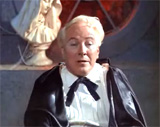 Criswell - The Narrator (The Emperor of the Dead) 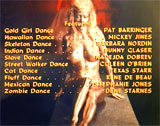 Image of Gold Girl Under the Opening Title Credits 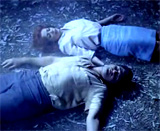 California Car Crash Victims On Their Way to a Cemetery - Horror Book Writer Bob (William Bates) and His Girlfriend Shirley (Pat Barrington) 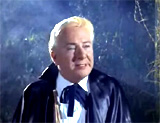 Criswell Inviting His Consort, The Black Ghoul, to Join Him 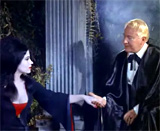 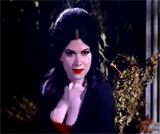 Ghoulita (Fawn Silver) - The Black Ghoul (Princess of Darkness)   Bob and Shirley - Revived From Car Crash and Spying on Dancing  Gold Girl Dipped in Gold And Made into Golden Statue  Werewolf and Mummy  Shirley and Bob Tied on Posts and Forced to Watch  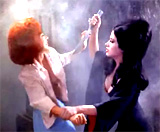 At the End of the Dances, Shirley Was Given to the Black Ghoul |
||||||||||||||||||||||||||||||
|
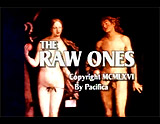
The Raw Ones (1965) Producer/director John Lamb's nudist film (with a narrator who extolled the virtues of a naturist lifestyle) was the first to openly show genitalia -- now allowed after a 1957 legal decision in the Supreme Court that ruled such displays of private parts were not in and of themselves obscene.
Its first screen announced:
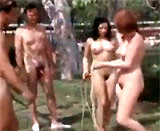
This was an essential linkpin between the non-genital 'nudie-cutie' films of the late 50s, and the hard-core porn films of the 70s. Unlike most nudist camps, most of the participants at a Florida nudist facility were shapely male and female models. The film was the first major nudist film to show extensive full male and female nudity, although all of the settings were non-sexual:
The film, narrated by preachy Ron Gans, described the attitude of the nudist participants:
The narrator emphasized:
|
       |
||||||||||||||||||||||||||||||
|
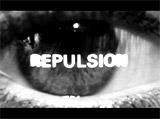
Roman Polanski's first English language film, a psychological horror film, starred Catherine Deneuve as Carol Ledoux - a virginal, 18 year-old, fragile and repressed young Belgian beautician working in an all-female beauty salon/spa in London, who was left alone in her claustrophobic apartment for two weeks as she madly descended into schizophrenia. During the title credits, there was a closeup of an eyeball, and then a slow pull-back from the female's dead-eyed stare (paralleled at film's end with a zoom-in). Carol lived in Kensington with her older sister Helen (Yvonne Furneaux). Carol was dependent upon her sister, but experienced continual unease with Helen's affair with married boyfriend Michael (Ian Hendry), including his intrusive toothbrush and razor left on the bathroom shelf. She began to have psychosexual hallucinations, while assailed by nerve-wracking sounds. Reportedly, the film was the first to feature an orgasm heard on-screen (in a scene in which Carol overheard her sister Helen's love-making to married lover Michael through her thin bedroom wall). The night sequence lasted over a minute, at around the 17 minute mark in the film, as she became more and more discomforted, frustrated and aggravated - tossing and turning in bed as she listened to the increasingly-excited, pleasurable moans of the lovers nearby as they climaxed. The next night, she experienced the same unpleasurable sounds of them having sex. The film followed the progression of Carol's increasing insanity (when Helen and Michael left for a fortnight vacation to Italy), accompanied by troubling daydreams and the disquieting sounds of a ticking alarm clock on the soundtrack, and dripping kitchen faucet, and other nerve-wracking aural effects (the doorbell and ringing telephone, keys plunking musical scales on a piano, etc.). She was also repulsed by the equally-startling hallucinatory image of a crack appearing in the wall (she mused: "We must get this crack mended"). Carol also had a disturbing, hallucinatory and seriously delusionary imagining of suspicious footsteps in her apartment, and the appearance of a hairy, brutish man breaking in to her bedroom, grabbing her hair, holding her down, and raping her from behind in her bed.
There were numerous shots of plates of rotting food with buzzing flies (an uncooked and skinned rabbit rapidly deteriorating), and three sprouting potatoes on the kitchen counter.
She eventually brutally lashed out at threatening males while suffering severe delusions. In the first of two murders: (1) her insistent and demanding Brit suitor Colin (John Fraser) burst into her apartment; when he first asked: ""I'm sorry. I'm sorry. It's all so sordid. What's the matter? I'm sorry. I just, I had to see you, that's all. Honestly, it's been so, so miserable without you. I phoned and phoned! The ringing tone nearly drove me mad. Is it, uh, is it something I've done? Carol! Please, tell me. I'm not really like this, you know? I wish I could find the proper words to say. They just keep going round and round in my head. I just - I want to be, to be with you, all the time", she responded only catatonically; when he turned to close the apartment door (upon a neighbor preparing to walk a dog), she beat the threatening male multiple times on the head with a heavy candlestick and then immersed his body in a bathtub already full of water. In one of the film's most famous sequences, a set of grasping phantom hands reached out to grope at her, and then numerous disembodied hands broke through both sides of her hallway, reminiscent of Jean Cocteau's La Belle et La Bete (1946).
In the second of two murders - after the real threat of rape: (2) the apartment's middle-aged, creepy, sweaty, and lusty Landlord (Patrick Wymark) barged in to collect Helen's rent; he complained about the filthy and dark condition of the place and the "pigsty" look and smell of the apartment (with the decaying rabbit carcass with buzzing flies and the damaged, barricaded front door); after the Landlord called her a "poor little girl all by herself" and a "frightened animal," he proposed a sexual bargain to lessen her loneliness during her sister's absence: ("I could be a very good friend to you, you know. You look after me and you can forget about the rent. Come on. Come on. Just a little kiss between friends, huh, come on"); when the lecherous Landlord forced himself upon her on the sofa and attempted to sexually assault Carol, she fought him off; when he persisted and approached her for a kiss, she slashed out in a retaliatory way with Michael's straight-edged razor; she first cut him across the back of his neck, then hacked away at him when he fell back onto the sofa, spraying blood onto him and herself; she overturned the sofa to hide his bloody corpse. When Helen and Michael returned, they discovered Carol in the apartment - lifelessly lying catatonic under her bed on the floor amidst carnage; surrounded by inquisitive neighbors, Michael carried Carol away for treatment (or arrest?) - after being warned not "to touch her", and he gave her a strange glance as he held her in his arms The ambiguous ending was highlighted by a slow panning camera motion, and then a thematic slow zoom (a reversal of the opening zoom out) into the partially-obscured, sinister, old family photograph with a view of the young, mad-looking Carol staring angrily away; the zoom ended with an extreme close-up of her eye; in an earlier image of the full photograph, she appeared to be glaring at her father (abusive?) seated to her left
|
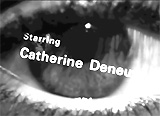 Opening Credits: Closeup of Eyeball Criss-crossed by Lettering 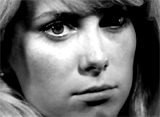 Carol (Catherine Deneuve) 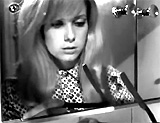 Carol Disturbed by Michael's Items in Bathroom   Nerve-Wracking Sounds Including Orgasmic Love-Making: Overheard by Carol Twice 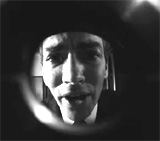 Colin Appearing Through Carol's Door Peekhole  Carol's Brutal Bludgeoning of Colin from his POV 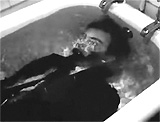 Colin's Body in Bathtub 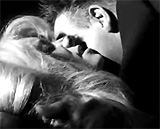 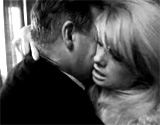 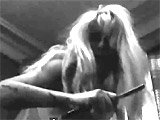 Real Rape Attempt - and Slashing Murder of Her Lecherous Landlord 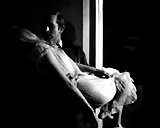 Michael Carrying Carol Away |
||||||||||||||||||||||||||||||
|
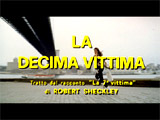
The 10th Victim (1965, It.) (aka La Decima Vittima) Marcello Mastroianni and Ursula Andress (famous for her appearance as the first "Bond girl" in Dr. No (1962)) were paired in this futuristic satire and science fiction cult film from director Elio Petri. The 60's pop-art film's main claim to fame was for initiating the reality TV 'elimination or survival to the death' game-show theme, found earlier in The Most Dangerous Game (1932), and obviously repeated in films such as The Running Man (1987), Death Race 2000 (1975), or in The Hunger Games franchise. The satirical sci-fi plot, set in the 21st century, told about a government-sanctioned and organized murder hunt-game called "The Big Hunt." The worldwide event that "legalized violence" was televised and attracted contestants from around the world to participate as "hunters" and "victims" (assignments were chosen at random by a computer in Geneva) - in order to obtain prize money and additional fame. The benefits of the hunt were described later in the film:
The game consisted of each contestant being required to participate in a series of 10 rounds or hunts (alternating with 5 as hunted, and 5 as the hunter). The winner of each round was the one who killed his/her opponent. The survivor after ten rounds or hunts, a perfect score, was the winner of the grand prize of $1 million. The film's tagline was:
The tagline referred to the two most prominent and successful players:
In the film's opening set in New York City, a Chinese Hunter (George Wang) chased after his black-wigged female prey with a gun, but then found himself inside the Masoch Club where she had fled. There, a striptease was being conducted by a blonde Caroline ("the top attraction of the evening") with the help of the patrons - she slapped a couple of the masochism-loving male customers after they provided assistance or ogled her as she performed. The striptease artist came up to the Chinese Hunter, now seated in the audience, and asked him to take off her mask from behind. He was unaware that her double-barrelled brassiere concealed twin guns - which she then fired at him. She killed him with two shots, first with the gun over her right breast, and then after swiveling, hit him a second time with the weapon hidden over her left breast. It was officially declared that she had now killed her ninth victim.
She only needed one more kill. Her 10th victim would be heralded as a big media showcase. She accepted the proposal of the hunt's sponsor, the Ming Tea Company (of San Francisco) - to agree to film her 10th kill w near Rome's Colosseum at the Temple of Venus for a TV program in which their product placement would serve their commercial purposes ("You could kill your 10th victim right on camera"). The computer in Geneva selected Caroline's next target or victim - Marcello. He had already accomplished six kills after six rounds. As per the game's rules, he only knew that he had been designated as someone's prey, and was not informed that Caroline would be his Hunter. Marcello's mistress Olga (Elsa Martinelli) and his divorced ex-wife Lidia (Luce Bonifassy) were liberally spending his winnings so far and bankrupting him. Lidia had illegally picked up his winnings after his sixth kill without his permission. He didn't have enough funds to organize a defense to help him from getting killed. And he ultimately decided to not get married to Olga - he realized that he didn't love her. Both hunter Caroline and hunted Marcello (not knowing that she was out to hunt him) maneuvered during a 'cat-and-mouse' game to trap, evade, tempt, entice, fool, escape or kill each other. Caroline posed as a television reporter in Rome, Italy, while he assumed the part-time role of the leader of a cult of sunset worshippers. She wanted to have him participate in the filmed TV interview at the Temple, while claiming that her main goal was to inform her reading public (sexually-unsatisfied women in the US) about the sexual behavior of Italian men.
In the film's conclusion, the duo's romantic infatuation and sexual attraction interfered in the game. She seemed to truly fall in love with him and told him: "I want to have a baby, maybe two or three!" and he agreed although he wouldn't assent to marriage. They kissed and presumably made love on the beach. The next morning, he suggested: "Why don't we go away, just the two of us? Go to a little island somewhere...I have no wish to kill you. I love you, I want to live with you." And then she admitted to him his already-presumed suspicion that she was his Hunter. As she pointed his stolen gun at him, the choreographed TV ad for Ming Tea began filming.
Marcello was shot by Caroline, but then his body disappeared - he survived because he had loaded his gun with blanks. He pursued her a short distance away where she apologized: ("I love you very very much"), but he said that it was too late for sympathy: ("No, no dear, no. It's too bad darling. You're the only woman that I might have loved, and you ruined it, Caroline. I'm very very sorry"). He shot her while embracing her - point-blank, and she crumpled at his feet as the Ming Tea ad was again filmed with his endorsement. But then Caroline also survived - she approached Marcello as she fired her shotgun at him, but deliberately missed him. She explained that she had been saved due to her bulletproof, skin-colored armor plate, a personal invention. They wrestled each other to the ground, but then faced gunfire from Marcello's spiteful ex-wife and mistress. Caroline took the shotgun and helped to defend the two of them. They both drove in a jeep toward the airport, to leave the Big Hunt together on a Pan Am jetliner that was being prepared for immediate departure. On the plane (filled with couples being wed by a priest - "a matrimonial airplane"), the two were compelled to be married: (The Priest: "What better way to come to the end of your story with this lovely signorina?") - it was the most dangerous game of all. Although Marcello realized that he had been set up, he felt he had no choice but to agree to tie the knot. In the film's final line of dialogue, Marcello turned to Caroline and asked:
As they kissed to seal their marriage, Marcello and Caroline looked up at the large barrel of a gun pointed at them - the film ended with the gun firing flowers at them.
|
|
||||||||||||||||||||||||||||||
|
Agony of Love (1966) (aka From Lady to Tramp) Director/writer William Rotsler's soft-core B-movie - a grim, soap-opera-ish sexploitation film that pre-dated Luis Bunuel's Belle De Jour (1967, Fr/It.) starring Catherine Deneuve, had a similar tawdry plot. It was advertised as
A poster also described its plot:
This Harry Novak-produced 'nudie-roughie,' told in flashback, opened with a film-noirish sequence during the title credits - a frightened, stylishly-dressed and high-heeled black-wigged woman (called out by name as Barbara) was seen running down Hollywood Boulevard, along a stretch of the Hollywood Walk of Fame. A narrator intoned:
The lady paused and asked herself, in voice-over:
The film returned to an earlier time - to survey the life of lonely and frustrated, affluent, black-wigged suburban housewife Barbara Thomas (Pat Barrington in her signature film with a lead role). She was bored, neglected and desperate for sex and affection from her handsome, workaholic businessman husband Barton (Sam Taylor), of Barton Thomas Investments. Later, she told her psychiatrist that her husband was always too busy to pay attention to her: "He's very generous. He gives me everything I want except time." She drove to her private city apartment that she had secretly rented, where she expressed her thoughts with a voice-over: "What good are you? What have you ever done that's worth anything, except on your back? You've had everything handed to you." The self-loathing Barbara considered herself a "poor little rich girl." It was revealed that she had secretly turned to prostitution as a call-girl - renaming herself "Brandy" - to be paid in order to indulge in (and reciprocate) with her own cravings for sex, money and loving attention. Her first nervous, heavily-sweating and overweight male client (Ben Johns) in the film entered her apartment, paid her, and then was led into her bedroom. After halfway undressing herself, she asked two questions: "Do you like me?" and "What would you like me to do?" After rolling around on the bed for awhile with him (with very unexplicit sex), she got up to take a shower - after calling herself a "Whore!" in front of the bathroom mirror. She quickly cleaned up, slipped on her clothes, and left the client in bed: "Just close the door behind you when you leave." She also paired up at different times with two other callgirls, including:
In an erotic fantasy nightmare-dream sequence (a "money dream") one night in her own home, Barbara heard someone repeatedly calling out her name. She entered a previously-locked door and reached out for a long string of bills like a ribbon. She found herself entangled and wrapped by the bills (later copied by other filmmakers, including Fellini), but then found the chains of money ripped and stripped off her body by grasping hands (from men without faces). She related the details of the lurid dream to her psychiatrist R.A. Silverberg (James Brand): "I begged them to stop. I tried to tell them that the money was mine, that it was love money, but I couldn't. Their hands, all I could see was their hands."
Her next two clients were a pair of rowdy political conventioneers (Al Ward and Morton Smith) from Utah, ready for a foursome with the Conventioneer's Girl and Barbara in a room with two double-beds. As always, Barbara asked her male john her usual opening line:
During her next session with her psychiatrist, the self-hating Barbara admitted she would kill herself if her husband ever found out about her sleazy prostitution business on the side - a foreshadowing. She also divulged that when she was a child, if she was bad, she would get more attention from her 'Daddy' with a spanking punishment. The next scene segued into a scene of S&M, as Barbara was slapped, and then encouraged her male partner (Owen Hannifen) to be rough with her: ("He gave me all his attention and his love"). The next male client was credited as "The Eater" (Jay Edwards) who stuffed his face to gorge himself with food (a sandwich, a banana, fruit, and more) as he non-chalantly watched her undress. She vainly tried to get the glutton's attention, but to no avail. When he was completely exhausted after satiating himself, he told her: "Thank you for a very enjoyable dinner" - and left. That night, she had a reprise of her "Money Dream" that included both the S&M Client and the Eater who stuffed his face with bills. With her psychiatrist the next day, Barbara ultimately admitted why she was a hooker - to satisfy her needs:
The psychiatrist concluded that her desire for money was obviously not a very satisfactory "substitute for love." In the conclusion, Barton called to cancel dinner plans with Barbara. After hanging up, she spitefully said to herself: "Mr. Barton Thomas, if you don't have time for me, someone else will." It was revealed that Barton had been reluctantly pressured by his horny business client Jim Osbourne (Parker Garvey) to join in a six-person orgy. He had arrived as one of the escort service clients. When the topless Barbara turned around in bed after kissing another male, she was shocked by Barton's appearance and she screamed. She fled to the bathroom, hurriedly dressed, and attempted to leave the apartment, when Barton grabbed her and asked: "Why? For God's sake, why?...What's the matter with you" - because he knew that she didn't really need the money ("You doing it for kicks? You can't need the money"). Before running off, she replied:
The film had an unexpected but predictable tragic ending when he began pursuing her in a nighttime chase through Hollywood - a return to the film's opening sequence. As she ran into the street and oncoming traffic, she was struck by a vehicle and killed. Her discarded purse was overflowing with bills fluttering in the wind. He grabbed her limp body and embraced her in his arms, as he piteously proclaimed: "I love you, Barbara, I love you" - but it was too late. |
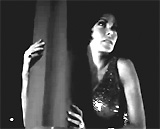 Barbara Thomas (Pat Barrington) in Opening: "How did this happen to me? Why?"  Barbara With Her Busy Businessman Husband Barton (Sam Taylor)  Barbara as Prostitute 'Brandy' Stripping for First Client   Showering After Sex  Barbara With the Conventioneers    Barbara With "The Eater"  Final Sequence: Barton with Hooker   Barbara's Reaction to Barton's Presence at Orgy  Barbara's Discarded Purse with Money Blowing Away  Barton with His Dead Wife Barbara In His Arms |
||||||||||||||||||||||||||||||
|
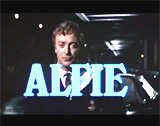
Alfie (1966, UK) This was the original Alfie film - Lewis Gilbert's sex-comedy/drama about a hedonistic, misogynistic, Cockney ladies' man title character (Michael Caine in his first major lead role, an Oscar-nominated one). The romantic drama/comedy was reflective of the spirit of the Swingin' 60s in England, along with other similar films including A Hard Day's Night (1964), Darling (1965) and Blowup (1966). It was also unusual that Alfie often candidly and amusingly addressed the audience directly (breaking the so-called 'fourth wall') - beginning with the opening title.
Alfie Elkins (Michael Caine) was portrayed as a smug, working class anti-hero playboy/Casanova who was employed as a chauffeur, and considered himself an uncommitted "free agent." Although the film was a wall-to-wall compilation (with a running commentary) of Alfie's many amorous affairs and one-night stands (with lots of sex-related dialogue), there was no nudity in the film.
He bedhopped, loved (and left) many women (or "birds") throughout the course of the film, including:
It was considered daring and shocking in its time, with an examination of taboo subjects and the consequences of the sexual revolution in the swinging 1960s. Some of Alfie's romantic and physical setbacks included his bout with tuberculosis, his slight mental breakdown following his permanent separation from Gilda, his abrupt breakup with Annie, and the revelation that Ruby had taken another younger lover (or "bloke") - she told him: "He's younger than you are" - devastating to his ego. The most controversial and devastating scene for Alfie was Lily's illegal (post 28 days) abortion, performed by an 'Abortionist' (Denholm Elliott) (the word was never explicitly mentioned in the film) in Alfie's apartment for 25 pounds. Alfie tried to explain the reason for the end of the pregnancy as a "moral lapse," since Lily was married and he was single: "She needs helping because her marriage would look very dodgy if her husband came out at this stage of the game. Got me? And she's got three other kids as well." Alfie expressed his concern (to the camera) for the predicament he found himself in:
After the abortionist left, Alfie was forced to slap Lily across the face when she began to scream in pain. Alfie briefly left and discovered that Gilda had been officially married to her long-time beau - bus conductor Humphrey (Graham Stark) (he had assumed adoptive custody of young Malcolm Alfie) in order to establish a normal family life - and he watched in a church as they baptized their newborn baby daughter together. When he returned to his apartment, he viewed the stillborn child's fetus in his kitchen (off-screen) - the unexpected shock caused tears and sobbing. Shortly later, he described his surprise at the sight to his pal Nat (Murray Melvin) - and felt self-pitying for his wasted opportunities:
In the final scene after all of Alfie's earlier conquests had now moved on (including recent revelations by Ruby and Siddie), Alfie spoke these last words - asking the viewer at the end of his reflections: "What's it all about?" when he began to seriously consider the consequences of his artificial existence and the trail of emotional devastation he had left behind - and he decided to befriend a stray dog next to him:
His monologue was followed by the title song performed by Cher (Cilla Black in the UK release) during the end credits (without a title), beginning with the catchphrase words: "What's it all about, Alfie?" |
 Siddie (Millicent Martin)  Gilda (Julia Foster)  Carla (Shirley Anne Field)  Lily (Vivien Merchant)   Annie (Jane Asher)    Ruby (Shelley Winters)  Alfie Addressing the Camera - His Reaction to the Abortion   After the Abortion Procedure, Alfie's Slap of the Pained Lily to Silence Her  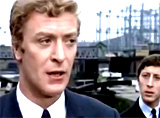 Alfie's Reaction to Aborted Fetus  Ruby's Revelation to Alfie About Her New Love: "He's younger than you are"  Alfie's Final Monologue to the Camera |
||||||||||||||||||||||||||||||
|
Aroused (1966) Director Anton Holden's horror/thriller was a black and white 'roughie' (with superb cinematography by Gideon Zumbach, and a jazzy soundtrack) that told of a misogynistic psycho-serial killer on the loose in Manhattan. The rationale for his violent and murderous impulses: an abusive domineering prostitute mother from his past. The noirish film was well-written and photographed, with taut set-pieces, close-ups, freeze-frames, and a twist ending, although it was tedious and drawn-out in places. The grindhouse feature obviously inspired the later exploitation classic by William Lustig, Maniac (1980). In the film's opening scene, short-haired blonde professional prostitute Pat Wilson (Marlene Stevens) was servicing a client in a bed with satin sheets. She did not know that she was being spied upon from a fire-escape outside the apartment's bedroom window. She was seen both topless in bed and also in front of her mirror. She was killed after being attacked in the shower. Pat was grabbed and wrapped in the shower curtain, thrown onto the bathroom floor, and then asphyxiated. It was a Psycho-like scene, accompanied by a freeze-frame and an audio flashback of the killer's "whore" mother (as a prostitute who was servicing a 'john' with her bothersome young "brat" or "bastard" son in the room, as the man asked: "What's that kid doin' here? ...I didn't pay $10 bucks to have a kid watch me. Get him out of here!"). Then the killer kissed the dead corpse and made necrophiliac love to her, before kneeling over her dead body.
Pat's lesbian lover ("buddy") Ginny Smith (Janine Lenon, or Djanine Lenon), a blonde free-lance model, later opened the door with her own key and almost knifed a man (thought to be the killer) hovering over Pat's body, but she was grabbed just before striking. She learned that the two men in the apartment were cops investigating the case of the "sex killer." Sharp-jawed and reckless handsome rookie detective Johnny (Steve Hollister), married to young wife Ann (Joanna Mills), was one of the officers there with his boss Artie. Johnny was dedicated to the case and intent on bringing in the killer, who was believed to be targeting hookers, call-girls, and streetwalkers. While Johnny questioned Ginny the next day, she confessed that she and Pat were lovers, and that the killer was a maniac who was probably very timid and "scared of sex" unless a female advanced on him. With Ginny's help of procurement, Johnny decided that he would use a streetwalker as 'bait' or as a "decoy" to lure and catch the killer. Meanwhile, Ginny did some sleuthing on her own. From the local bar where she often sought clients through the bar owner Gus (Ted Gelanza) (one of her pimp-procurers), Ginny stealthily followed the creepy bartender Louis (Tony Palladino) - after he was abruptly fired by Gus. She pursued him as he meandered through the NYC streets to his walk-up apartment on W. 71st St. A few minutes later after he left, she entered and became disturbed when she saw that his run-down, city apartment was filled with mannequin body parts, photographs of nude prostitutes, and a stuffed teddy-bear on a hard bed or massage table. That same night, as streetwalker Angela (Fleurette Carter), one of Ginny's bar friends that Johnny had privately hired, prowled the streets for clients (with Johnny providing protection and following close behind), her ploy to entrap the killer didn't seem to work. At the end of the night as she took an elevator up to her high-rise apartment, the ex-bartender entered the elevator from the 3rd floor. She recognized him, but didn't suspect that he had been stalking her. When she invited him to have sex: ("I was looking for some company tonight"), she met her demise during a french-kiss. He impaled her through the stomach with a sharp stiletto knife as she screamed. Then, as he ripped off her clothes and sexually assaulted her dead corpse, the image freeze-framed and he again heard voices from his past when he was an abused young boy witnessing his hooker-mother with male clients. On the ground floor, Johnny suspected that something was wrong when he heard the emergency bell ringing. He rushed up the stairs and climbed down the elevator shaft from the rooftop to enter at the top of the elevator, where he found Angela's topless and bloodied corpse on the floor - but the killer had already disappeared. After failing miserably, Johnny was reprimanded by his boss Artie for being reckless. He met up with his wife Ann on the street, and unwittingly sent her home with Louis (whom he knew from the bar) as her night-time escort. Meanwhile, when he went to speak to Ginny about the recent killing - he cheated on Ann. The bi-sexual prostitute provided him with oral sex. While they laid naked together, he non-chalantly told her that Ann had been taken home by the bartender. She reacted: "I think he's the killer!" - and they rushed to save her. At the same time, Ann was being endangered by the butcher knife-wielding psycho-maniac in her kitchen - she fought him off, but was partially stabbed in the side before he was scared off by Johnny's and Ginny's arrival. In the end, a group of assembled "whores" led by Ginny confronted Louis inside his apartment. With a knife to his throat, Ginny first threatened: "You're just in time, Louis. We're going to have a party...You're the guest of honor." They vengefully stood over him and held him down. As he struggled, they stripped him of his pants and then Ginny castrated him with his own stiletto knife, to transform him into "a boy soprano." As blood spurted from his groin area between his legs, Louis screamed out: "Mama, Mama." Johnny and a contingent of police arrived on the scene and found Ginny holding the bloody knife.
|
 Detective Johnny Over Pat's Dead Corpse  Ginny in Pat's Apartment After Her Murder  Detective Johnny's Young Wife Ann (Joanna Mills)  The Bartender Louis (Tony Palladino)  Pat's Lesbian/Bisexual Lover: Ginny Smith (Janine Lenon)  Ginny in Louis' Creepy Apartment    The Second Victim - Streetwalker Angela (Fleurette Carter)  Johnny Cheating on Ann and Having Sex With Ginny  Ann Attacked by Louis in Her Kitchen |
||||||||||||||||||||||||||||||

|
The Bible...In the Beginning (1966, US/It.) John Huston's epic Old Testament film didn't cover the entire Bible - just the first 22 chapters of the Book of Genesis, including the creation story (Adam and Eve) and the expulsion from Eden, Cain and Abel, Noah and the Ark/the Flood, and the story of Abraham (wife Sarah, handmaiden Hagar, and son Isaac). The story of the Nimrod and the Tower of Babel and Sodom and Gomorrah were also featured. It included a highly-anticipated, 20-minute opening sequence detailing the story of Creation of 'mankind' from reddish-brown dirt in the golden-lighted Garden of Eden with two fair-skinned humans:
Both characters were modestly and prudishly nude, one of the first instances in a mainstream US feature film in which there was full-frontal nudity from both sexes) - although they were discreetly and strategically photographed with long shots and out-of-focus buttocks. To avoid outright nudity, knees were often bent to cover the genitals, and Eve's hair always covered her breasts. They were positioned behind bushes or tropical leaves to shield their private parts. After the pair ate the forbidden fruit from the Tree of Knowledge (tricked by the serpent), they were banished - clothed and no longer innocent. |
   Adam and Eve |
||||||||||||||||||||||||||||||
|
Michelangelo Antonioni's first English-language film Blow-Up (1966) was set in mod-Swinging 60s London. When Antonioni refused to cut the few glimpses of female nudity in the film, it was released without the MPAA's seal of approval, and engendered even greater popularity for the arthouse film. It received Academy Award nominations for Best Director and Best Original Screenplay. This breakthrough film was often noted for introverted fashion-glamour photographer Thomas' (David Hemmings) orgasmic, frenzied camera-shoot scene with various 'birds' including skinny, writhing model Veruschka as he straddled her on the floor and pointed his phallic camera at her:
The film also featured Vanessa Redgrave as the Girl, persistently begging (and eventually offering sexual favors when she went topless - more revealing in some full-frame video versions) and bargaining for Thomas' roll of incriminating film that he had shot of her in a public park with an unidentified, middle-aged man. The enlarged photos eventually showed possible evidence of a murder - a shadowy figure and a hand holding a gun in the bushes behind a fence, and possibly a dead body.
The most notorious scene was Thomas' teasing sex with two naive, teenaged groupies or "dolly birds" (blonde Jane Birkin and brunette Gillian Hills) who stopped by his studio on their second visit. While trying on clothes, the skinny blonde was stripped of her clothes by Thomas, and then she wrestled her dark-haired friend and she was stripped too, claiming: "She's got a better figure than me." They ended up in a threesome orgy with him on a extended roll of purple backdrop paper. The scene featured the first fleeting views of pubic hair in a mainstream film for American audiences.
In another love-making scene, he watched as his unhappily-married next-door neighbor Patricia (Sarah Miles) was underneath her husband Bill (John Castle), Thomas' artist friend, who was on top making love to her. She wordlessly entreated Thomas in their flat to position himself and stay in view nearby so she could achieve orgasm - his presence aroused her passion. When he next saw her, he asked: "Do you ever think of leaving him?" and she responded: "No, I don't think so." Before leaving, she also inserted another request: "Will you help me? I don't know what to do," but the subject quickly changed. The final enigmatic scene was of a group of mimes playing a mute game of tennis with an invisible, non-existent tennis ball on a tennis court (the soundtrack picked up the sound of the tennis ball however) - Thomas joined in the game (and threw the imaginary ball back to them). the film ended with an aerial view of Thomas standing at a distance in the middle of a grassy field in the park near the tennis court, with his camera in his hand; he faded from view just before the words THE END zoomed forward. |
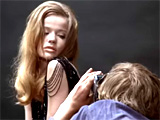 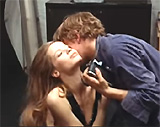 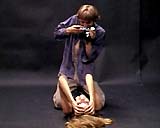 Model Veruschka (Herself)  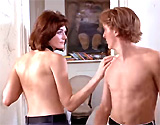 The Girl (Vanessa Redgrave) 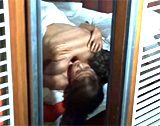  Patricia (Sarah Miles) 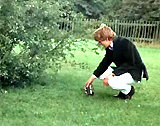 Missing Body the Next Day  Muted and Pantomimed Game of Tennis  Aerial View Ending |
||||||||||||||||||||||||||||||
|
Closely Watched Trains (1966, Czech) (aka Ostre Sledované Vlaky) Jirí Menzel's war-related, coming-of-age romantic drama, a Czech New Wave film, was the 1968 winner of the Academy Award for Best Foreign Film of 1966 - with the intriguing tagline:
The main protagonist was Milos Hrma (Vaclav Neckar) - the naive, newly-hired local assistant train dispatcher at Kostomlaty station near Prague during WWII, who was to 'closely watch' the trains so they wouldn't crash. His main issue was a continuing over-sensitivity problem with premature ejaculation. A love-making attempt with seductive, nubile conductress Masa (Jilka Bendova) failed, although she was understanding. He followed up with a near-fatal suicide attempt (by slitting his wrists in a steamy hot hotel bath tub) due to his adolescent anxiety and angst. During his recovery, Milos told Doctor Brabec (Jiri Menzel, the film's director): "So you see, doctor, I am not a real man, and I don't even want to be one. Everything is so difficult in life, for me. While for others it's all child's play. In other words, when I was to act, I flopped." The doctor recommended that he "choose an older, experienced woman to initiate love-making." He followed up with an awkward encounter with stationmaster Max's older wife (Libuse Havelková), whom he told about his raging hormonal problems with premature ejaculation and impotency:
As they talked and he hinted at having sex with her, she was stroking a goose's long neck that simulated the masturbatory, up-and-down phallic motion of male stimulation. By film's end, Milos was sexually fulfilled by beautiful Resistance follower Viktoria Freie (Nada Urbánková), who had delivered a homemade bomb to the station, to be used to destroy a German Nazi ammunition train shipment. Before the plan was carried out the next day, when Milos was alone with her and told her of his sexual issues, she urged him as she undressed and caressed his face:
Sadly, Milos lost his life after he dropped the bomb from a train tower onto the loaded flat car of a freight train as it passed by below. The film's most memorable tryst, however, was between Milos' womanizing mentor/superior - the bespectacled, short, and balding Ladislav Hubicka (Josef Somr), and young station telegraphist Zdenka (Jitka Zelenohorská). During a comic sexual horseplay scene, Hubicka chased her around the station office at midnight (Hubicka: "I told you I'd spank you").
He stamped her bare thighs and bare buttocks (she voluntarily pulled her own panties down) with the State's official bureaucratic ink stamp seal, causing embarrassment to her mother and other officials who learned of the strange offense. |
  The Phallic Stimulation of a Goose's Neck  Viktoria Freie (Nada Urbánková)  Fulfilling Sex with Viktoria |
||||||||||||||||||||||||||||||
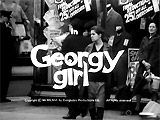
|
Georgy Girl (1966, UK) Originally considered bold and ground-breaking (but now only self-conscious, tame, and dated), this Swinging 60s "free love" comedy film from the UK starred Best Actress-nominated Lynn Redgrave. It was notable as the first film to carry the label "suggested for mature audiences" - or M rating, only a month after the Production Code was revised. Its subject matter of adultery, promiscuity, illegitimate birth and abortion were undoubtedly responsible for the rating. Many reviewers have noted the similarities between this film and the Bridget Jones' franchise of films. The film was boosted by The Seekers' hit theme song "Georgy Girl", with a catchy tune and lyrics:
Its bittersweet, adult-oriented tale told of the morally-ambiguous title character Georgina "Georgy" Parkin (Lynn Redgrave) - a plump, naive, homely, and childish misfit who was mostly unattractive and past youthful prime at age 22. A children's dance teacher, she was the daughter of parents who were in England's servant class. However, Georgy found herself propositioned (with an official contract) to be a mistress when she was advanced upon by rich, paternalistic and older benefactor - a wealthy and unhappily-married Mr. Leamington (James Mason) who was the boss of her parents (Bill Owen and Clare Kelly). Learnington was stuck in a loveless marriage to sickly wife Ellen (Rachel Kempson). At the same time, Georgy was living in an apartment with her pretty yet amoral, trampish and self-interested roommate Meredith Montgomery (Charlotte Rampling), a concert violinist. After two previous abortions, Meredith was bitchy about her current pregnancy although she had decided to marry her randy, Cockney slacker boyfriend - Jos Jones (Alan Bates), a lazy bank clerk, and keep the child:
Jones moved in with the two women - creating a love triangle. One evening after a bitter argument between Meredith and Jones, he suddenly kissed Georgy - initiating a secret love affair between them. After Meredith gave birth - she wanted to put the child up for adoption and divorce Jones. Georgy opted to care for and serve as the unwanted baby's mother with Jos, but soon after, Jones wanted no part in fathering the child. Georgy's affair cooled with him and he moved out, abandoning both of them. Georgy manipulatively brought conveniently-widowed Leamington to the rescue to marry her (so that the baby wouldn't be taken from her by Social Services), help provide financial support, and adopt the child as their own. |
 Georgy (Lynn Redgrave) with Mr. Leamington (James Mason) 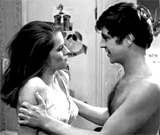 Meredith with Jos Jones (Alan Bates) 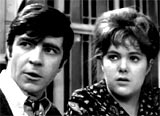 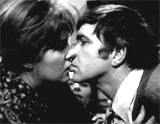 Georgy with Jos Jones |
||||||||||||||||||||||||||||||

|
Hawaii (1966) Only part of James Michener's best-selling, epic 1959 novel Hawaii (both fictional and non-fictional) was the basis for the lengthy film adaptation, directed by George Roy Hill. Former blacklisted screenwriter Dalton Trumbo penned the script with Daniel Taradash. The movie basically concentrated on the settlement at Lahaina (Maui) in the early 1800s. It began with a rousing and inspiring sermon by a native Hawaiian islander named Keoki Kanakoa (Manu Tupou) (in history: Henry Obookiah) at Yale University in New England. One of the missionaries who was compelled to journey to Hawaii around 1820 was Rev. Abner Hale (Max Von Sydow) with his new wife Jerusha Bromley (Julie Andrews) (in history: Reverend Hiram Bingham). Their efforts were to bring Christianity to the "heathen" natives - Malama, the Queen, the Alii Nui, (Jocelyne LaGarde) (in history: Queen Ka'ahumanu), and to end pagan idolatry worship of totem rocks (phallic symbols) at shrines (heiau). One of the things immediately encountered when the stiffly-dressed New Englanders sailed into Lahaina port was that many of the islanders removed their sarongs or loin cloths, and swam out to the ship or rowed in outrigger canoes - waving sexily and happily greeting the repressed newcomers. In the film, there was very discreetly-filmed (or darkened) topless female nudity, mostly from the wahine housemaid provided by Malama for the Hales - Iliki (Lokelani S. Chicarell). However, in terms of historical authenticity, in traditional Hawaiian culture at the time, female breasts were not covered, and there were no bathing suits for swimming. The nude 'entertainment' provided by topless young girls during an evening's dancing and drinking with whalers who docked in Lahaina was particularly frowned upon by the well-intentioned, but viciously-intolerant Rev. Hale who sternly objected: "How can you do this to this innocent child? Have you no mothers at home, no sisters? May God in his mercy forgive you" - he vehemently chastised the men as he dragged Iliki away. He called her a "wicked creature" although she innocently objected: "I didn't do nothing bad." Hale was adamant about forbidding nudity, and open sexuality. Later, the whalers, led by Captain Rafer Hoxworth (Richard Harris), Jerusha's ex-suitor, burned Abner's church in protest after they were prevented from sleeping with the young island women. |
 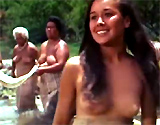   Iliki (Lokelani S. Chicarell)  Rev. Abner Hale (Max Von Sydow) Attempting to Destroy Phallic Totem Stone at Heiau |
||||||||||||||||||||||||||||||
|
A Man and a Woman (1966, Fr.) (aka Un Homme et Une Femme) French New Wave director Claude Lelouch's simple and pleasant romance was the Palme d'Or winner at Cannes and Oscar-winner of Best Foreign Language Film. It was a beautifully-filmed, impressionistic story of the slow-building affair between two single parents who had both lost their spouses. They happened to meet when visiting their children at a Deauville boarding school:
Eventually by film's end, they consummated their love in a non-explicit, bitter-sweet scene that alternated between B/W and color images (including flashbacked, haunting guilt-ridden, melancholic memories of Anna's husband of her past). She could not fully give herself and thought that would be the end of their relationship when they silently parted. But then, in the open-ended conclusion, they joyously met again at the train station in Paris when she arrived there. |
   Anne Gauthier (Anouk Aimee) |
||||||||||||||||||||||||||||||

|
Mondo Topless (1966) (aka Mondo Girls, Mondo Top) Russ Meyer's pseudo-documentary (or mockumentary) was notable as the "nudie" sleaze king's first color film, advertised with the tagline:
Throughout, an off-screen narrator (John Furlong) would hilariously comment upon the titillating action of the "unrestrained female anatomy" and "the world's loveliest buxotics." The thrown-together film included screen-test footage of Lorna Maitland, the title character of Meyer's previous film Lorna (1964). The sexploitation film began as a travelogue in San Francisco (where the phenomenon of gyrating toplessness first appeared, supposedly, before sweeping across the country), led by naked 44" stacked Babette Bardot driving around stark naked. Even Coit Tower was photographed to look like a phallic symbol.
Ultra-buxotic females spoke about their lives as topless go-go girls/strippers, along with many topless dances amd swinging breasts, performed in various locales, and usually gyrating to the wild beat of a nearby radio or tape player:
The sights were also viewed in various strip-joints in Europe (footage from Meyer's long-unseen documentary Europe in the Raw (1963)), in Belgium, Hamburg, Copenhagen, and Paris, where strippers performed on indoor stages. Some of the dancers spoke about their views of men, about disrobing, bra sizes and about the difficulty of buying clothes for the big-busted woman, etc. |
    Lorna Maitland (Herself) ("That Girl From Lorna") Europe in the Raw footage (below)  Denice Duval (Herself) - Paris  Gigi
La Touche (Herself) - Paris Gigi
La Touche (Herself) - Paris  Veronique Gabriel (Herself)
 Abundavita (Herself) - Berlin
 |
||||||||||||||||||||||||||||||

|
Co-author and director Mai Zetterling's second feature film was this controversial, ponderous, B/W, 90-minute Swedish drama about a young boy's development of sexual neurosis, with obvious Oedipal themes, that debilitated him as an emotionally-sterile man-child adult. In some ways, it paralleled various surreal Fellini movies (i.e., La Dolce Vita (1960, It.)), and the same year's Persona (1966, Swe.) by director Ingmar Bergman, and was thematically similar to Bergman's Wild Strawberries (1957, Swe.) and to parts of Roger Corman's The Masque of the Red Death (1964). The emotionally-cold and humorless arthouse film immediately caused waves of protest. Its premiere at the Venice Int'l Film Festival was forced to be viewed in private by the jury. It was also well-publicized that former child star Shirley Temple Black, who was part of the San Francisco Int'l Film Festival, protested its showing as pornography by resigning. The daring, decadent and shocking, somewhat exploitative film was mostly told in flashback, seamlessly switching or alternating often from the present to the past and then back again. The film opened on the eve of his marriage, in the middle of winter, when bearded Jan (Keve Hjelm as adult) and his long-haired, blonde fiancee Mariana (Lena Brundin) returned to his childhood country home. It was a gloomy, cavernous, unoccupied, but furnished and ominous medieval castle (with one female servant, Melissa (Lissi Alandh)), where he had spent his troubled, growing-up years, 20 years earlier, as a young boy (Jörgen Lindström at age 12). His journey was one of self-discovery - to determine the cause of his corrupted and maladjusted life, his cruel streak and game-playing, his problems with growing up, his unusual sexual fantasies, and his lack of sexual drive with his fiancee. He had been raised in a perverse way by his strangely insane, dotty white-haired great-aunt Astrid (Naima Wifstrand) (with whom he spent much of his spare time) and his hedonistic, neglectful, and upper-class aristocratic parents: his sadistic, sexually-abusive and self-centered mother Irene (Ingrid Thulin) and father Bruno (Lauritz Falk). Jan recalled various strange experiences and perversions that he had been subjected to, seen in the many flashbacks including:
In the film's catharctic conclusion, guests were invited for a climactic party after the couple determined that they would hire a company to dynamite the castle in order to purge, banish and obliterate Jan's disturbing memories that stemmed from his home, and to find ultimate "freedom" for him. The anarchic destruction would help begin the process of healing Jan from his sexual hang-ups, and have him forget the past. Jan announced to everyone:
Valuables were stuffed into bags or other cases (candelabra, a fur coat, religious iconography and jewelry, a tapestry, furniture, statues, vases and more) as guests looted the castle while they hurriedly evacuated and loaded up their vehicles outside. The playing of the national anthem and Jan's flare-gun signaled the start of the demolition. Together, Jan and Mariana playfully danced and embraced outside in the snow. |
 Jan (Keve Hjelm) Leading His Fiancee Mariana (Lena Brundin) During a Guided Tour Through His Childhood Home - a Castle  Jan as a 12 Year Old Boy (Jorgen Lindstrom)  Jan's Mother Irene (Ingrid Thulin)  Jan Under His Mother's Skirt  Jan Trying On His Mother's Makeup and Fake Eyelashes, Plus a Wig  Nurse's Bath  Tickling Naked Jan on the Bed  "What a nice little thing you have?"  Kissing Him Repeatedly   Catching Him Masturbating Under the Quilt - Angry at First, But Then Ordering Him to Continue, To Humiliate Him Further 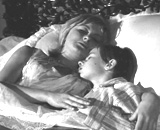 Jan in Bed with a Young Relative After His Mother's Death 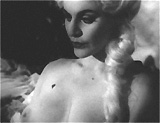  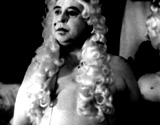 Bawdy Home Movies of Jan's Mother and Father Having Sex Shown During Jan's Honeymoon Party |
||||||||||||||||||||||||||||||

|
One Million Years B.C. (1966, UK) This British-made adventure sci-fi film (shot in the Canary Islands) by director Don Chaffey and Hammer Films was a remake of the earlier Hollywood film, One Million B.C. (1940), starring Victor Mature and Carole Landis, two love interests during caveman times (an anachronism since dinosaur creatures and humans never co-existed). The film's realistic prehistoric creatures (created with stop-motion animation and enlarged live specimens) were the work of Ray Harryhausen: a giant lizard and spider, brontosaurus, an Archelon (giant turtle), an Allosaurus, a battle between a Ceratosaurus and Triceratops, and a flying Pteranodon.
At one point, Loana (who had only a few sparse lines of dialogue) had to fight off the advances of competing love-interest, Tumak's ex-lover Nupondi (Martine Beswick). The reigning sex queen's 'primeval woman' poster was a major best-seller at the time, and adorned many college room walls. |
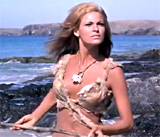 Loana (Raquel Welch) 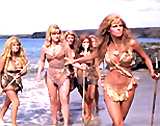 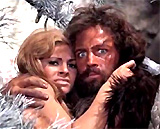 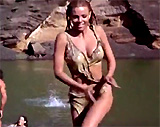
|
||||||||||||||||||||||||||||||

|
Persona (1966, Swe.) Ingmar Bergman's psychological, dramatic thriller, a film-within-a-film, was about illness, insanity, personal identity and death. The abstract film told about two women who both experienced life-changing events involving motherhood, abortion and childbirth. The two women who became associated with each other were a nurse and her patient:
Treatment would be conducted in a doctor's seaside cottage or summer vacation home. Elisabet's condition was diagnosed by a Doctor (Margaretha Krook) who declared that the patient had deliberately decided to remain silent and immobile: ("The result is clear: She's perfectly healthy, both mentally and physically. And it's not a question of some hysterical reaction either"). During treatment, Alma self-therapeutically described to Elisabet about how no one ever listened to her before. She expressed her growing affection and idolizing attachment to her famous patient:
During a vivid confessional monologue (one of the most explicit verbal descriptions of sex ever heard on screen), Alma (who was engaged to fiancee Karl-Henrik at the time) described a private and secret sexual experience to Elisabet that she had had at the beach with a friend named Katarina when they were sunbathing in the nude, completely naked. Two boys came up to them and Katrina encouraged one of the boys to have sex with her:
Feeling left out, Alma also asked for sex too:
A second boy named Peter was also invited to participate in the orgy:
That evening, although she felt guilty, Alma had sex with Karl-Henrik after dinner ("Then we had sex. It's never been as good, before or since. Can you understand that?"). However, she became pregnant, was forced to abort the baby, and afterwards suffered a "guilty conscience."
As the film proceeded forward, there was the growing realization that the two women (often seen in doubled or overlapping profiles) were interchangeable and very much alike, but it was an increasingly harmful relationship and a destructive merged identification between the two, when Alma specifically stated: "Is it possible to be one and the same person at the very same time? I mean, two people?"; when Alma began crying, Elisabet comforted her; Alma continued: "...We're alike somehow. I think I could turn into you if I really tried. I mean inside. You could be me just like that, though your soul would be far too big. It would stick out everywhere!" Then, Alma made the shocking discovery, when reading one of Elisabet's unsealed letters for delivery to her doctor, that Elisabet was feigning illness, and actually 'studying' her: (excerpt from the condescending letter: "It's a lot of fun studying her. Sometimes she cries over past sins - an orgy with a strange boy and a subsequent abortion. She complains that her notions about life fail to accord with her actions"). In the film's conclusion - Alma spoke to Elisabet about the picture of her son that she had torn up at the hospital: ("What are you hiding under your hand?...It's the picture of your little boy. The one you tore up. We have to talk about this"). During the scene, the camera was on Elisabet's face as she listened to Alma (off-screen) narrating Elisabet's life story back to her. Elisabet had become pregnant, but fearing loss of her acting career, failed in two self-induced abortion attempts to rid herself of an unwanted and unloved son. The same scene was repeated, but with the camera on Alma's face. At the conclusion of the repeated scene, Alma feared that they had become too identified with one another, and asserted her identity as Alma. She realized that, unlike Elisabet, she had truly wanted a baby to love, and that she would never be like Elisabet:
Next was a striking image of their two faces juxtaposed (or spliced together) to appear as one face (half of Alma's face, on the left, and Elisabet's half visage on the right). In a hospital room, Alma persuaded Elisabet to say the word "nothing" - the film's final lines of dialogue (Alma: "Try and listen to me now. Repeat after me. Nothing... Nothing. No, nothing... " Elisabet: "Nothing."). In the concluding scene, the two packed up and only Alma was seen departing by bus from the cottage (there was a striking mirror-image dissolve of Elisabet touching Alma's head). As the film ended, the crew and director were seen filming their exit. There was a brief reprise of the prologue image of a boy (presumably Elisabet's son) touching large blurry images of the two women, before the film broke away from its projector sprockets and self-destructed - again. |
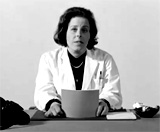 Doctor (Margaretha Krook)  Sister Alma (Bibi Andersson)  (l to r): Alma and Mrs. Elisabet Vogler (Liv Ullmann) Close-Ups of the Two During Beach Monologue:   Alma (Bibi Andersson)  Elisabet Vogler (Liv Ullman)  
Alma's Shocking Discovery That Elisabet was Faking: ("It's a lot of fun studying her")  The Famous Shot of Juxtaposed Faces 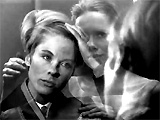 Mirror-image Dissolve of Elisabet Touching Alma's Head  The Director and Film Equipment |
||||||||||||||||||||||||||||||
|
A Smell of Honey, a Swallow of Brine (1966) Director B. Ron Elliott's dramatic, bad-tempered, gritty, decadent, trashy and sleazy exploitation "roughie" film (with a script by veteran road-showman and producer David Friedman) offered lots of topless nudity without any actual scenes of sex (only foreplay). It was taglined:
The main character in the low-budget black and white production was a temptress-female named Sharon Winters (Texas-born Stacey Walker, aka Barbara Jean Moore) who would purposely seduce men and then loudly protest rape. In the opening sequence in the front seat of a car, voluptuous blonde tease-bitch Sharon seduced two-month boyfriend Roy Bradley (Michael O'Kelly). On the verge of intercourse with him, she screamed rape to attract a police officer - and after a quick jury trial, Roy was imprisoned for two years for rape and assault. In a conversation with her lesbian roommate Paula Mann (Sharon Carr) about six weeks later, Sharon was brazen about continuing to date other men:
As Paula was departing (and Sharon had finished a bath), they had another short and snippy exchange about their respective sexual orientations:
When Sharon's shy and nervous date, mama's boy and co-worker Dick Owens (Tom Hughes) arrived at the house, she flirted with him and offered him a drink. Upstairs while dressing to go out, she had an enticing idea - she invited Dick, with a beckoning finger, to climb up the spiral staircase to her bathroom. In front of a mirror with her robe exposing her breasts, she provocatively combed her hair - letting Dick have naked views of her when she removed her panties and entered the shower stall's bathtub for a second bath. Afterwards, she stood stark naked in her bedroom to non-chalantly dress in front of him. Then, she approached him to stroke and kiss his face. He followed her into the bedroom and climbed on top of her, while she encouraged him to caress and kiss her. He removed her bra, and then began to unclip her garter and remove her panties - and that's when she began to protest:
Dick hastefully fled the room, and she chuckled when she heard the door slam. Shamed forever, Dick did not report for work the next day, and was soon replaced by Assistant Controller Lowell Carter (Neville Coward/Sam Melville), Sharon's next male target. In her second conversation with Paula in their bedroom, seductress Sharon apologized for her rude bitchy behavior toward her:
Paula offered to give Sharon a nude back massage to make her feel better. Paula went topless when she became overheated and then laid down next to Sharon while continuing to stroke her. Then, her lesbian overtures were suddenly and cruelly rejected by Sharon: "Cut, Paula, that's as far as we go....Get away from me, you, you pervert. Get out! Get out! Get out of this apartment before I call the police. You belong in an institution, you and all the rest of your kind...I only want never to see you again." Later, Sharon directly insulted her lesbian roommate: "Paula, I may be a bitch, but I'll never be a butch."
Lowell Carter began dating and spending a lot of time with Sharon, but didn't pressure her for sex, although they often kissed and petted with her clothes off - without going all the way. He accepted the fact that they would have to wait. Hot and bothered, though, Carter's dreams were affected by his pent-up sexual energy - he erotically fantasized that she was tied half-naked at a stake, while he wielded a whip against her (drawing blood from her thighs). He also dreamed that he had become her sexual slave, and that she toplessly threatened him with a sharp knife.
When she finally decided to have sex with Lowell Carter, she strip-teased in front of him ("You like?"). They showered naked and then got in bed together after she led him on, but then she accused him of rape like all the others. He called her a "tease" - "I wouldn't touch you, you're worse than a disease." He left her for good as he threatened: "Get the hell out of here, tease! I'm gonna get a real woman tonight." She called after him: "Are you gonna rape her too?" He ran away from her and hurried down a dark street - haunted by many erotic images of her sexy body. Carter lustfully attacked another unidentified female as she entered her apartment. There, her screams came to the attention of her male partner (Larry Jones) in the next room, who reached for a gun and shot Carter to death. The film ended with Sharon soon finding another victim, slick-haired band singer Tony (Bob Todd). While they were making out on a sofa, when she began to tease him and then abruptly claimed that they shouldn't go any further: ("Not now...I'm a virgin!"), she also threatened rape and screamed. The chauvinistic male objected ("Are you putting me on, doll? I don't like it when chicks put me on"). When she further protested, he violently assaulted her - he slapped her, grabbed her head, beat it against a table, and then punched her face until she was bloodied:
He forcefully kissed her - the camera pulled back and the screen turned black, as Tony presumably began to rape Sharon. In the final image, Sharon stood on a street-corner as a hooker, with a cigarette hanging from her mouth. |
|
||||||||||||||||||||||||||||||
|
Mike Nichols' acclaimed debut film Who's Afraid of Virginia Woolf? (1966) was an adaptation of Edward Albee's Broadway play, with a screenplay by writer/producer Ernest Lehman. It acquired an astounding 13 Oscar nominations and 5 wins - including its entire Oscar-nominated cast of four (also including George Segal and Sandy Dennis). In addition, it was a direct challenge to the anti-profanity clauses of the Hays Code. The drama contained lots of things that the Production Code felt were violations:
The MPAA ratings board gave the film a seal of approval after Warner Bros. appealed and made a few cuts of the most extreme profanity (such as "screw you"). It was the first film to be released with a "Suggested for Mature Audiences" warning, at a time when the new president of the MPAA, Jack Valenti, was implementing a new ratings system - to help handle sensitive and "mature" subjects. It displayed brutal sexual tensions between its four characters in an all-night drinking fest, especially its sado-masochistic, loving-hating, vulgarities-spewing couple and their two dinner guests:
|
 George (Richard Burton)  Martha (Elizabeth Taylor)  Nick (George Segal) and Honey (Sandy Dennis)  The Ensemble |
||||||||||||||||||||||||||||||




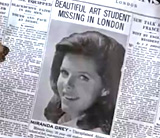
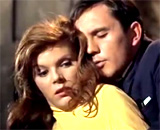
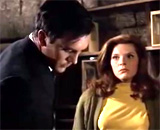
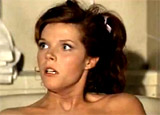
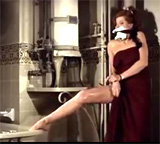
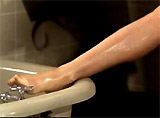
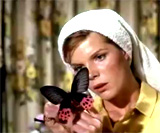
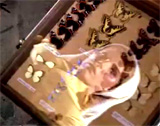
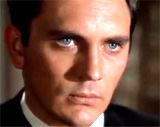
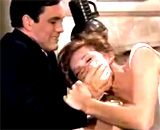
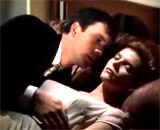
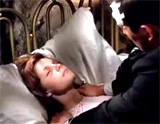
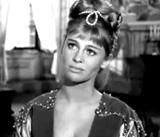
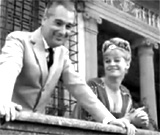
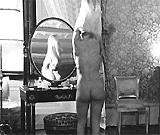
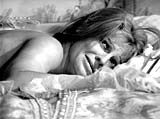
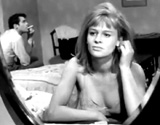
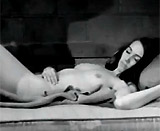
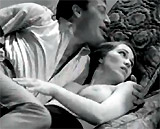
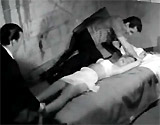
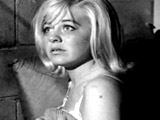
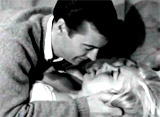
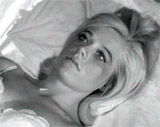
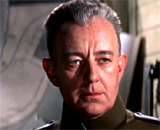
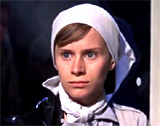
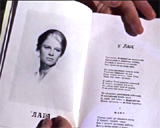
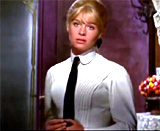
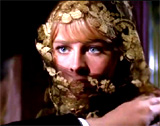
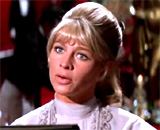
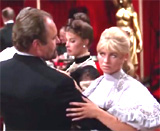
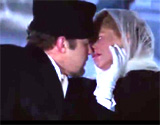
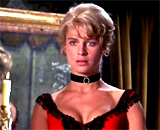
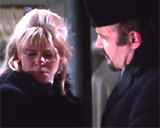
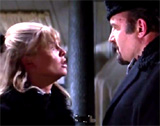
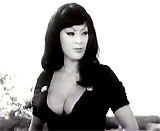
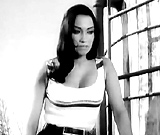
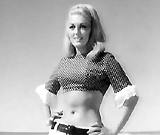


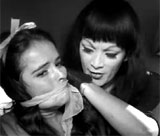
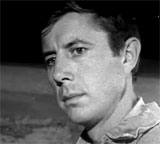
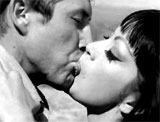
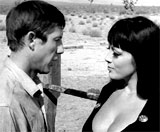
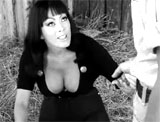
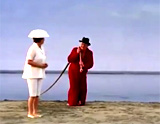
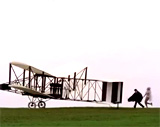
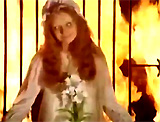
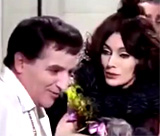





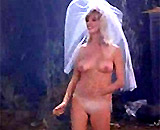
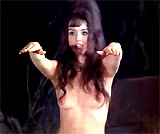
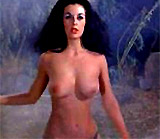
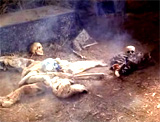
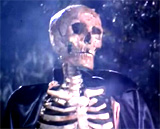
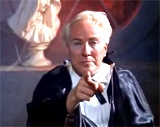
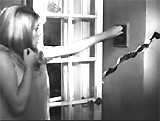
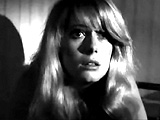
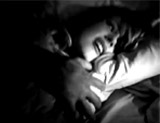
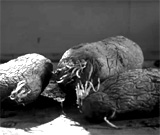
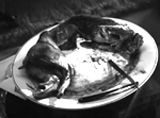
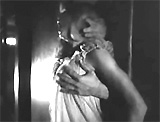
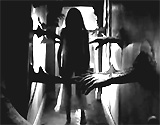

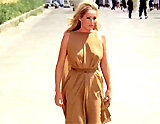
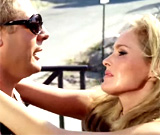
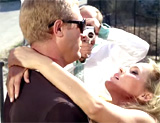
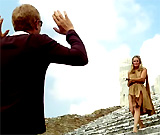
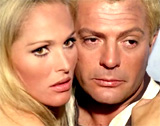
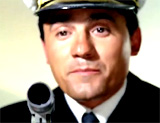

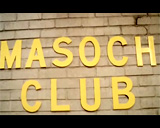
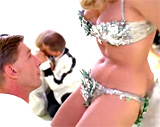
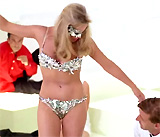
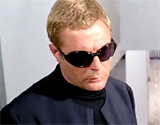
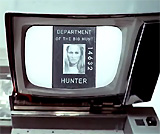
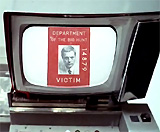
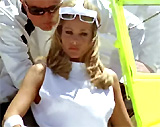

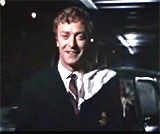
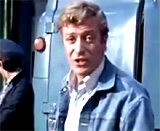
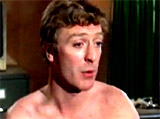


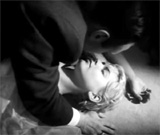
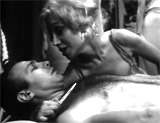
 Blowup
(1966, UK/It.)
Blowup
(1966, UK/It.)
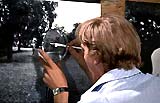
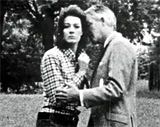






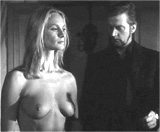
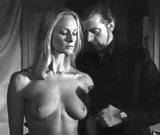
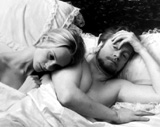
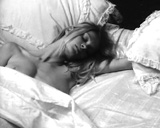
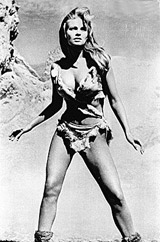 Likewise, this one conjured up the iconic image of a shapely, white-skinned, Amazonian cavegirl
and a caveman:
Likewise, this one conjured up the iconic image of a shapely, white-skinned, Amazonian cavegirl
and a caveman: