|
History of Sex in Cinema: 1938-1939 |

|
Bringing Up Baby (1938) Howard Hawks' famous screwball comedy Bringing Up Baby (1938) was purported by many commentators to contain the moment in film when the meaning of the word 'gay' changed. Fluffy, boa-collared, negligee-wearing David Huxley (Cary Grant) gave an uncensored, emasculated exclamation while jumping up in front of Aunt Elizabeth (May Robson), relative of Susan Vance (Katharine Hepburn):
|
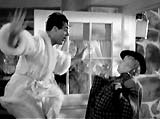 David Huxley (Cary Grant): "I Just Went Gay..." |
||||||||||||||
|
The film's exploitational taglines: "A throbbing drama of shackled youth!" and "Where Lust was called Just!" hinted at its 'educational' plot contents designed to circumvent the Production Code restrictions. This independent film was 'road-showed' by legendary roadshowman Kroger Babb, although it was banned in many locations due to its infamous underage nudity. The film supposedly had a positive purpose - to warn against underage marriage: "...if our story will help to abolish Child Marriage - it will have served its purpose." It told about the door-to-door moral crusade of schoolteacher Miss Carol (Diana Durrell) to rid the Ozark rural community of Thunderhead Mountain of hillbillies (especially Warner Richmond as Jake Bolby) who courted and married underage girls. The film's most notorious and gratuitous sequence was at the 30 minute mark -- a 4 minute undressing and nude skinny-dip in a pond surrounded with woods by Jennie Colton (nubile young 12 year-old actress Shirley Mills (not Miles) in her screen debut), accompanied by young friend Freddie Nulty (Bob Bollinger in his sole film role). As she disrobed, she told him not to undress but to stay onshore, and they discussed how their physical differences were beginning to show:
At the end of her long and playful swim, she was leered at by Jake from a nearby ridge, and an old women startled the voyeuristic Jake by asking: "Pretty, ain't she?" When Freddie noticed, he alerted Jennie and she swam for cover. |
 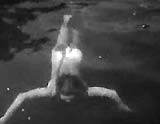 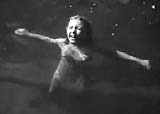 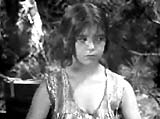 Jennie (Shirley Mills) |
||||||||||||||
|
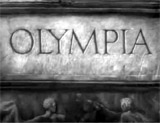
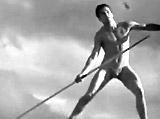
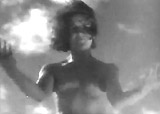
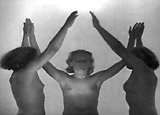
Olympia (1938, Ger.) Hitler commissioned photographer Leni Riefenstahl to make this documentary film (in two parts) about the XI Olympic Games in Berlin in 1936. It opened with a beautiful, silent prologue sequence with views of:
The images artistically captured the movement of beautiful human bodies to perfection. |
|
||||||||||||||

|
Sex Madness (1938) (aka Human Wreckage, They Must Be Told, Trial Marriage, and About Trial Marriage) This Dwain Esper-directed film was a typical sex-ploitation melodrama of the period often shown in skid-row theatres - purportedly it was educational to warn about the perils of sexual contact (venereal disease, especially syphilis and gonorrhea). The shoddy propagandistic film was banned by the Legion of Decency for its taboo subjects strictly forbidden by the Production Code, such as implied lesbianism, wild house parties (with drinking), sex out of wedlock ("promiscuous relations"), and other similar 'sex madness' evils. In the scrolling foreword, it was stated:
In a tearful flashback (told to her doctor), innocent Millicent Hamilton (Vivian McGill) explained how she had won a beauty contest in her small-town home. She came to New York where she became desperate for a job and begged a theatrical manager: "I'm willing to do anything. I'm ambitious." After hiking up her skirt to show her legs to him, she spent a "social" weekend at a wild party hosted on Long Island. She painfully admitted that she drank champagne and then "gave myself" to one of the men - it was "a terrible dream." It was conjectured that Millicent had acquired syphilis due to her single act of unwed sex. She was "unclean" and needed money for medical attention, and thereafter entered the big-city world of burlesque shows as a chorus girl. The scantily-clad stage performers were seen in their dressing room after a performance. Her co-performers attended an after-hours house party with libations, and soon were paired up with men who escorted them to various upstairs bedrooms. It was later confirmed that some of the sexual associations led to VD infection (and "months of misery"). After treatment, Millicent returned by train to her hometown boyfriend Wendel Hope (Stanley Barton) (she thought to herself, regretfully: "Oh, why did I ever leave you?") with her "dreadful" disease. She continued treatments in a nearby town (in secret) for over half a year, and was told she could safely marry Wendel. She hadn't been treated properly, however, when a headline in the paper revealed that her doctor was a "quack" who offered fake cures for large sums of money. Their newborn baby was unhealthy and pronounced "syphilitic," and Wendel also had become infected (with symptoms of feeling poorly and failing eyesight). Millicent realized she had played a 'murderous' part in spreading the social disease to her family as a wife and mother. She was on the brink of suicide (and about to take a fatal dose of poison) at her ailing husband's bedside, when she learned by telephone that there might be a real cure for the horrible condition. |
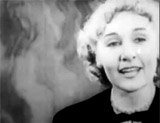 Millicent (Vivian McGill) 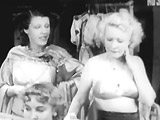 Chorus Girls Backstage 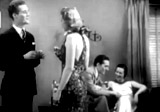 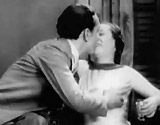 After Hours House Party 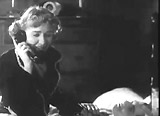 Suicidal Millicent Receiving Hopeful News by Phone |
||||||||||||||

|
Suez (1938) Director Allan Dwan's romantic drama was nominated for three Academy Awards: Best Score, Best Sound, and Best Cinematography. Its most spectacular sequence was of a massive, tornado-like sandstorm, toppling tents, timbers, cranes and water storage tanks. The historical romance starred Tyrone Power as Ferdinand de Lesseps who directed the building of the Suez Canal in the Isthmus in the mid-1800s. However, its historical veracity was questioned as it was a semi-fictionalized account of the monumental creation of the canal. In the controversial sex scene in question, de Lesseps first met tomboyish love interest Toni Pellerin (Annabella) in Alexandria, Egypt, the daughter of a French sergeant. She was introduced in a shot showing only her bare legs and feet as she emerged and ran from a pool of water, ushering commands to her donkey to stop pulling her dressing booth away. She quickly returned to the water and hid naked behind a large rock, as de Lesseps approached and flirted with her. Although she discreetly re-clothed herself when her dressing booth was reversed to the edge of the water, the booth was jerked and the two fell into the water - and she emerged with a wet T-shirt effect, clearly and prominently revealing her erect nipples underneath her wet top. In an interview many years later, 95 year-old director Allan Dwan described his fight with Joseph Breen and the Hays Office at the time, which forbade nudity or nipple baring - even innocently.
The matter was dropped when it was clear the scene couldn't be reshot. |
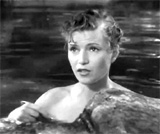 Toni Pellerin (Annabella) - Hiding Nakedness in Water 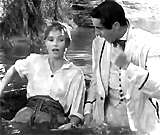 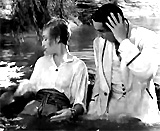 Wet T-shirt Effect |
||||||||||||||

|
Gone With the Wind (1939) The Civil War-era Best Picture blockbuster Gone With the Wind (1939) included a scene in which drunken Rhett Butler (Clark Gable) confronted his wife Scarlett O'Hara (Vivien Leigh). He berated her for her constant attentions to Ashley Wilkes (Leslie Howard). He threatened to tear her to pieces with his hands "if it'd take Ashley out of your mind forever. But it wouldn't. So I'll remove him from your mind forever this way." He said he would smash her skull between his crushing hands "like a walnut" to block him out. She claimed he could never corner or frighten her, and stated: "You're jealous of something you can't understand." As she left and said goodnight to him, he claimed he wasn't jealous because he knew that Ashley was honorable and had not had sex with her to make her unfaithful. Rhett told her that they were different from Ashley: "We're not gentlemen, and we have no honor, have we?" As she walked away to the foot of the stairs, he bent her over and kissed her as she resisted:
He dramatically carried the resistant and protesting Scarlett up the long flight of stairs after the kiss - it has often been referred to as the 'conjugal rape' scene - a night of forced passion between the married couple (off-screen). After a black fade-out, the next scene was the morning after - with a view of Scarlett's fulfilled face in bed, as she stretched out her arms. She had been furious the previous night, although she had clearly enjoyed their sexual experience. Her smiling, purring, happy face when she awakened the morning after betrayed her pleasure. However, they were both unable to really express their open feelings toward each other. The most controversial, much-debated scene in the film was not the "conjugal rape" scene, but the one of Rhett Butler's declaration to Scarlett at the film's conclusion: "Frankly, my dear, I don't give a damn." |
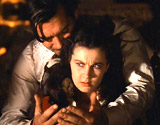 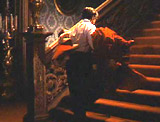 The Conjugal Rape 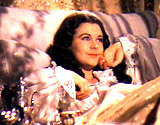 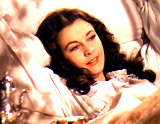 Scarlett O'Hara (Vivien Leigh) - The Morning After |
||||||||||||||
|
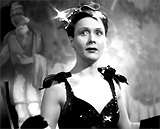
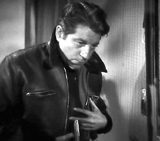
Daybreak (1939, Fr.) (aka Le Jour Se Lève) This psychological, noirish melo-drama and romance film was one of the great works of 1930s poetic realist cinema (a precursor to film noir). Director Marcel Carné's film was banned by the Vichy government in France after its theatrical release, for its dark and demoralizing pessimism and political commentary. It was remade by RKO as director Anatole Litvak's The Long Night (1947) with Henry Fonda. The story was about a deadly love quadrangle of sorts that had developed between the four main characters:
The film opened (behind closed doors, off-screen) with the gunning down and murder of the Machiavellian Valentin by François in a jealous rage in his apartment. Valentin emerged from the apartment and tumbled down the stairs dead. The body was discovered by a blindman who couldn't understand what had happened. Afterwards, François refused to open his door to speak to investigating police. He scared them away by shooting through his door, and then emerged briefly with his gun. The desperate and doomed working-class man decided to lock and barricade himself inside (surrounded by police awaiting daybreak with the building under siege). Through a series of slow dissolves as he awaited dawn during a sleepless night while chain-smoking and awaiting his fate, he experienced three flashbacks to recall and reflect upon why he was led to murder. The three flashbacks of memories were interwoven with three efforts of the police to assault and surround the building. The first flashback was prefaced by snipers shooting from rooftops at François' window. First Flashback:
François quickly fell in love with her within three weeks and expressed marital interest. He was impressed in her bedroom when he saw postcards postmarked from the Riviera and a strip of photographs taken of him. She talked about her dreams about magical places like the Riviera (and Nice), to escape from the drabness of everyday life: ("The sun shines and there are flowers even in winter"). Because of his poor status in life, François could only offer her a bicycle and strolls in the countryside to pick lilacs at Easter time She denied him permission to spend the night (suspiciously she had just ironed a collar for her special dress) because of an "appointment." To appease him, the demure young girl gave him her one-eared teddy bear as a keepsake that he then attached to his bike. He followed her late one night as she walked to an "appointment" to watch a dog show performance by the older, sleazy showman Valentin at a music hall nightclub, a man whose spell had seemed to overcome and enthrall her.
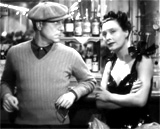
At the nightclub's bar during the dog show, François casually met Valentin's dog show assistant Clara, who had just left the stage mid-show. The disgruntled assistant had decided to immediately quit for mistreatment and for Valentin's weaving of a spell over her, and she was expressing happiness with her newfound freedom:
François suddenly realized that the seductive and jaded Valentin was exploitatively weaving his same spell over the unsophisticated and guileless Françoise. The sexually-provocative and flirtatious Clara came onto François, telling him she already liked him. After Valentin's show, the two watched as he escorted Françoise out the front door, but then returned to speak to Clara, who gave him her official resignation: ("I'm through. The act's over for me"). François backed up her decision. The first flashback ended. Second Flashback: In a bedroom scene when she complained about being alone at night, he described how his worker status and continual life of drudgery didn't allow for nightly sentimental romance:
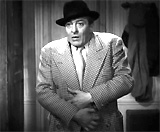
They were interrupted by the unexpected drop-in arrival of Valentin who proclaimed that he was an uncommitted romantic who - as an intellectual and upper-class educated man - could live a life of seducing and abandoning females: ("I'm a nomad, here today gone tomorrow"). In a nearby bar where François and Valentin retreated, the manipulative, "muddle-headed," and dishonest showman made the dubious, absurd and creepy claim that Françoise was his long-lost daughter. He vowed it was his duty and responsibility to be interested in "the child's happiness," and that François should cease his relationship with her ("You have no money, no future, and bad health. You have an unhealthy job"). However, François continued to date Françoise in a chaste relationship. During the sequence of their visit to her florist's lush and abundant greenhouse, she stated emphatically that Valentin was not her father: ("He loves making up stories").She affirmed to François: "I won't see him again if you want," and François reciprocally promised to break off with Clara: ("And I won't see Clara again") - and they kissed. As she reclined back, he expressed his love for her and how they could be truly happy together, but also how weary, unlucky, and terrible his life had been:
She told him that she loved him too and gave him a brooch as a keepsake. He soon broke the news of his love for Françoise to Clara who stoically accepted his decision. She described how Valentin had been a despicable and cruel animal trainer - and at times had trained his animals by torturing them with a red-hot iron:
She knowingly showed him a collection of identical cheap brooches that Valentin had given her over time: ("All his mistresses get one - she has one too, hasn't she?") - they were similar to the one Françoise had just given to him as a token of their love. The second flashback ended. In anger and frustration, François opened his upper-floor window and yelled at the blood-lusting crowd of onlookers on the street below (some of whom regarded him as crazy, or alternatively as a hero): "I'm a murderer, yes! But killers can be met in any street, everywhere! Everyone kills, everyone! Only they kill by degrees, so it's not included. Like the sand that gets into you! Beat it! Go home and read about it in the papers!...All I ask is to be left in peace!" Some of his co-workers and Françoise herself begged for him to surrender (and then fainted), but he ignored their pleas. The crowds were ordered to disband and leave the square by reinforcements of police officers. Third Flashback: Valentin also made fun of Françoise' gift of a teddy bear to him (with the brooch trinket pinned onto its chest), and intimated that the simple-minded laborer had been blinded by love. The lecherous Valentin also inferred that he had manipulated the youthful and naive Françoise into having sex - and was about to describe the details:
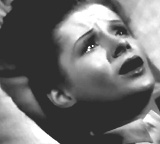
Exasperated with the slimy con artist Valentin who had undoubtedly used 'magic tricks' to exploit her romantic fantasies, François shot him once in the abdomen. The third flashback ended. François was unaware that Françoise (who had fallen in the street and injured her head) was being cared for by Clara. She seemed deliriously confused but affirmed her loving commitment to François, and forgave him for loving Clara: "I shouldn't have said I loved him. He's changed, he's not the same. We love each other....He doesn't love Clara, that's all. He can't help not loving her. You love me, François." Clara wept quietly at the window as she looked out at the 6th story window nearby.
In the end, it appeared that the police were about to throw tear gas through his window from the roof. However, before they could, the despairing François felt his heart with his fingers, aimed his gun at his chest, and suicidally fired. The police's tear gas filled his apartment as his alarm clock ironically rang. |
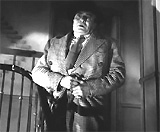 Death of Valentin Outside Francois' Apartment 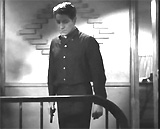 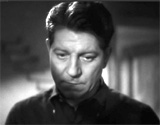 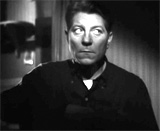 François (Jean Gabin) Barricading Himself Inside His Apartment 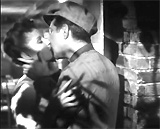 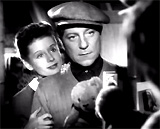 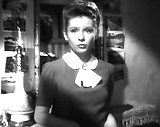 François In Love with Françoise 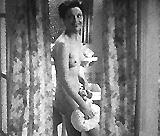 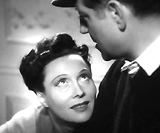 Clara Emerged Naked From the Shower 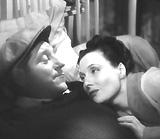 Bedroom Scene: François with Clara 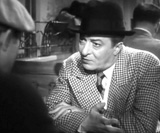 Valentin's Dubious Claim - Françoise Was His Daughter 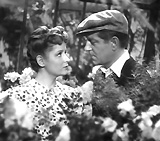 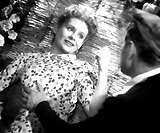 The Greenhouse Scene: Françoise with François 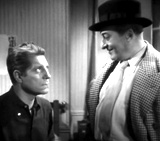 The Final Confrontation Between François and Valentin |
||||||||||||||




 Child Bride (1938) (aka Child Bride of the Ozarks)