|
Films of All-Time 1972 |


|
Deep Throat (1972)
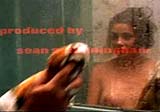
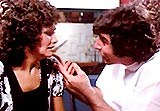
Unintended for mainstream audiences, this notorious X-rated porn flick from writer/director Gerard Damiano became one of the decade's top-grossing films, and the most influential and successful (and profitable) of all films of its kind. Deep Throat was filmed in 6 days for $25,000 (some sources reported $50,000) and was subsequently banned in 23 US states. It was an 'event' film - a hard-core stag film that was OK to see on a date or in mixed company, yet it was banned in many localities as obscene. It inaugurated a period known as "Porno Chic" - it was the first cross-over adults-only film that became a hit. After its initial period of release (at a time of sexual revolution), it became a cultural phenomenon and it was fashionable to talk about the film (and its educationally feminist theme of female sexual gratification) or make references to it (such as Watergate's 'Deep Throat'). It brought adult movies into the popular culture. This hour-long, revolutionary X-rated film (shot in about a week's time, with graphic enactments of oral, vaginal and anal sex, group sex, and masturbation in a dozen and a half sex scenes) told a simplistic plot (with some comic elements) about a sexually frustrated woman (Linda Lovelace, born Linda Susan Boreman) who wanted to "hear bells" during sex. Her doctor, Dr. Young (Harry Reems, born Herbert Streicher) discovered that her clitoris was located in her throat, and that she would have to experiment with various clients before experiencing orgasm -- this ultimately led to her sexual fulfillment accompanied by fireworks, rockets blasting and ringing bells. Years after the film was screened, Lovelace denounced the film, claiming that she was drugged, coerced and raped during filming and that "there was a gun to my head the entire time". In the mid-70s, actor Reems was prosecuted by the federal government (under the Nixon administration) on obscenity charges - a first - although later overturned, and the film was championed by Hollywood and other intellectuals for its liberated defense of First Amendment rights. An R-rated documentary film titled Inside Deep Throat (2005) examined the film's production history and impact on American culture, including interviews with both the director and male star Harry Reems. Another dramatic production, titled Lovelace (2013), portrayed the dual perspectives that adult star and sexual freedom icon Linda Lovelace (played by 27 year old Amanda Seyfried) (later known as Linda Marchiano) brought to the film. Depending on the time period of her life, she either embraced the porn film - or rallied against it and became an activist leader in the anti-pornography movement. |
|
|||||||||||||||||

|
The Last House on the Left (1972)
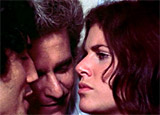
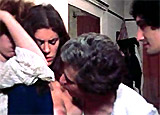
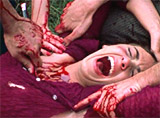
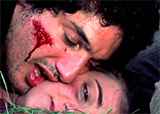
This low-budget, crude, taboo-breaking and often revolting 'snuff'-type horror film was Wes Craven's debut feature film and a loose remake of Ingmar Bergman's Oscar-winning The Virgin Spring (1960, Swe.). A toned-down version of the film was remade in 2009 by director Dennis Iliadis, with Craven as producer. The film faced censorship difficulties everywhere, but especially in the UK, where an uncut version of the DVD is still unavailable. The grainy, hand-held 16 mm footage accentuated the realism and horror without glamorization - and led to intense criticism for its graphic depiction of violence and disquieting, exploitative nature (the film tried to defuse the horror by claiming: "It's only a movie"). Craven insisted that the film's painful and protracted violence was "a reaction on my part to the violence around us, specifically to the Vietnam War." It told about the long and upsetting ordeal of two teenaged girls who were raped and tortured in backwoods - including chest-carving with a knife, forced lesbian sex and disembowelment (with bloody intestines pulled out):
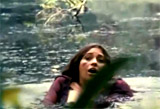
Both females were searching for pot on their way to a Blood Lust rock concert when kidnapped by a group of escaped and degenerate convicts led by Krug Stillo (David Hess). In one disturbing and humiliating scene after they were taken to a woodsy area, blue-wearing Phyllis was forced to urinate with her clothes on ("Piss (in) your pants...Do it!"). The camera panned down, showing her wettened blue-jeans. Then, they was stripped naked and forced to have oral sex with each other ("Make them make it with each other!"). The girls went ahead, rationalizing: "lt's just you and me here. Nobody else. Just you and me, okay?" Psychopathic, sadistic gang member Sadie (Jeramie Rain) also performed oral sex on Mari. Phyllis made a run for it, but was cornered, stabbed in the back by deviant Fred "Weasel" Podowski (Fred Lincoln) and then dis-emboweled (after repeated stabbings) and butchered, after which Sadie reached in and pulled out her gooey intestines to examine them. Phyllis' left hand and half of her forearm were amputated (off-screen). Meanwhile, red-wearing Mari had Krug's name carved into her upper chest and was then brutally raped (as he drooled onto her face). She vomited and then walked dazedly into a nearby pond to half-submerge and cleanse herself. Krug shot and killed her there, and she floated on the water's surface.
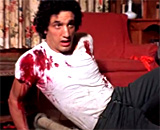
This ugly scene was intercut with views of 'surprise party' preparations for Mari by her parents John and Estelle Collingwood (Gaylord St. James and Cynthia Carr). Ironically, in a later scene, the escaped convicts took refuge in the home of the upscale small-town parents, the hospitable Collingwoods - where there was animalistic payback revenge/slaughter of the gang.
In grotesque sequences of ultra-violent revenge, the father semi-electrocuted Krug, chipped out his teeth out with a chisel (in a dream sequence) and pursued him with a chainsaw and killed him (off-screen, evidenced by blood splatter). Meanwhile outdoors, the mother cleverly enticed gang member "Weasel" to have sex (she had also convinced him to have his hands tied behind his back) - he told her: "Now you just unzip me, and that's all l'll need you for." At first, his penis ("little thing...poor little fellow") became caught in his zipper and he was unresponsive, but as she touched him more and more, he warned: "lf you don't watch it, l'm gonna come." She urged: "Please come then, sweetie." He asked: "Don't you want me to do you good and proper?" - she replied: "You can do both, can't you?" - he boasted: "Hell, yeah! I can come five or six times if you want me to." She sank down to crotch-height, and as he was climaxing, she viciously bit off and dismembered his penis. After returning home, she fought off Sadie with a knife, and then was able to slash her throat with the weapon in the pool. |
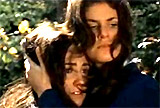 Mari and Phyllis 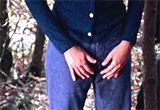 Phyllis Ordered to Piss In Her Pants    Forced Oral Sex 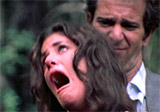 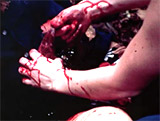  Phyllis Stabbed in Back and Disemboweled; Left Hand Amputated   Weasel Fellated and Then Castrated  Sadie Slashed to Death with Knife in Pool |
|||||||||||||||||

|
Last Tango in Paris (1972,
Fr./It.) (aka Ultimo Tango a Parigi)
Bertolucci's film was a landmark, controversial erotic film that contained raw (yet simulated) sexual scenes with primitive force - critics and audiences alike asked - was it erotic art or pornography? It was noteworthy as the first "mainstream" film to carry the dreaded "X" rating, due mostly to the fact that the film featured a major star who had sex throughout the entire movie. Brando and director Bertolucci were both nominated for Oscars in the highly-acclaimed and debated cinematic work - a classic piece of art-house cinema. In 1974, it became the first film to be prosecuted under Britain's Obscene Publications Act - and the sodomy scene was ordered deleted. The film was available in a censored R-rated version in 1981 (with modifications mostly to the anal-sex butter scene), and as an uncut X-rated (or NC-17) version. [When re-released in 1997, the MPAA re-rated the film as NC-17.] In the director's own country, the film was seized and banned, and charged for its "obscene content offensive to public decency." In the mid-70s, it was permanently banned in Italy (with all prints seized), its stars and director were condemned, and Bertolucci was given a 4-month suspended prison sentence. In the film's story, a distraught, confused, grieving widower and middle-aged (45 years old), overweight American exile Paul (Marlon Brando) - after his wife's recent suicide - plunged into a sado-masochistic, physical (yet impersonal and basically anonymous) relationship with young, full-breasted 20 year-old Parisienne ingenue Jeanne (Maria Schneider). She was a proper bourgeois, yet free-spirited female who was engaged to be married, but nonetheless accepted his prurient sexual demands. Paul's gutter-language and set of 'no questions asked' rules was notable for the time: "We are going to forget everything we knew - everything" - and their relationship became increasingly more vile, slavish, empty, humiliating, and unromantic (i.e., "You know in 15 years, you're going to be playing soccer with your tits. What do you think of that?") In their first coupling in the apartment, he picked her up (clothed), carried her to a window with closed venetian blinds, and forcefully made love to her standing up, without saying anything. Afterwards, they both collapsed to the floor still embracing. They had frequent, controversial, carnal and raw sexual scenes but then everything between them became increasingly more vile, empty and unromantic.
Paul insisted on having a sexual affair - conducted anonymously without names. He demanded 'no questions asked' and 'no names' rules:
In another sequence when they were hugging each other naked and coupled together, she proposed that they concentrate - and "Maybe we can come without touching," but they were unsuccessful; then she suggested that they invent names for each other; he countered: ("Oh, God, I've been called by a million names all my life. I don't want a name. I'm better off with a grunt or a groan for a name. Do you wanna hear my name?"); after he made animal sounds, she complimented him: ("It's so masculine"), and then she made her own barnyard sounds ("Listen to mine") - and he joked: "I didn't get the last name" and they continued speaking in grunting moans and sounds. The film outraged some viewers for Paul's scatological monologues, a full-body panning shot up Jeanne's body in an elevator, including a full-frontal closeup shot of Jeanne's pubic hair. Also, it was notorious for its lengthy bathroom and bathtub washing scenes and the disturbing and explicit anal sodomy scene on the floor using butter as a lubricant during intercourse (with his command: "Go get the butter").
She passively acquiesced to rape and forced sodomy in the empty, rented apartment, as he forced her to repeat phrases such as: "the will is broken by repression." His emphasis was on pure sex, basically anal - a reversal of conventional romantic love. Later, Paul reciprocated by letting Jeanne penetrate him anally with her fingers - part of his objective to "look death right in the face...go right up into the ass of death... till you find the womb of fear." His set of rules was notable for the time: "We are going to forget everything we knew - everything." But then she abandoned the apartment and they broke up. Their previous secretive and mostly sexual affair was over, but when he found her on the street, Paul insisted that a new one was beginning, although she wished to break off their relationship and didn't want to see him again. He wanted to resume everything, since he had fallen in love with her: "There's nothing to understand. We left the apartment, and now we begin and love all the rest of it." He shattered the anonymous nature of their relationship by telling her some details of his brutalized life, things that he had withheld from her in the past: "Yeah, listen. I'm 45. I'm a widower. I own a little hotel. It's kind of a dump, but not completely a flop house. Then I used to live on my luck and I got married, and my wife killed herself." Their original relationship had lost its anonymity, which she thought had been preferable. The film ended when he chased her back into her mother's Parisian apartment. He playfully donned her late father's Army cap (he was a colonel in French North Africa). When he removed it and confessed his love for her while approaching: ("And now I've found you. And I love you. I wanna know your name"), she was horrified and fearful. Suddenly a shot rang out - she spoke her name "Jeanne" at the same moment he was shot point-blank in the stomach. Paul staggered to the balcony where he collapsed and died in a fetal position. The camera tracked backwards to reveal the skyline, and Jeanne standing there with a revolver in her hand (her father's Army pistol from his military days). Dazed, Jeanne muttered the last lines of the film to herself (in French, translated below), rehearsing her lines that she would have to deliver to the police to explain his death (rationalizing and reassuring herself that it was self-defense when the stranger attempted to rape her):
|
 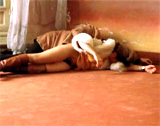 First Physical Encounter in Apartment 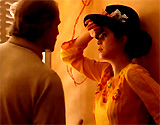 Another Meeting: "No Names Here...I Wanna Know Nothing..."   "Maybe we can come without touching"  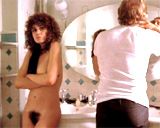  Bathroom Sequence   Bathtub Washing Sequence  The Full-Frontal Scene in Elevator 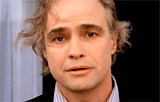 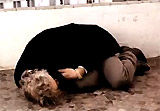 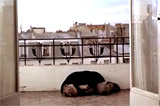  Paul's Death on Balcony |
|||||||||||||||||
|
Pink Flamingos (1972)
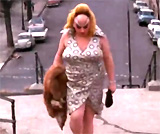
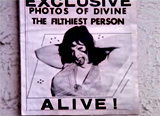
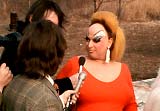
Director John Waters (known as the "Prince of Puke" or "Pope of Trash") produced a unique crop of intentionally bizarre, crude, sexually-grotesque, trashy and bad taste-laden cult films with eccentric oddball characters and harshly-vivid language. Almost his entire filmography is laced with unusual plot lines, freaky casts, larger-than-life performances and extremely grossed-out scenes that could be found nowhere else. Waters' unrated seminal film Pink Flamingos was one of the most outrageous and ultimate examples ever of 'poor-taste.' Waters faced criticism for pushing conventional boundary lines and exhibiting full-frontal nudity, and his outrageous films led to calls for censorship and outright banning. The sheer repulsiveness and infamy of Waters' films (this film was part of a "trash trilogy" composed of Pink Flamingos, Female Trouble (1974), and Desperate Living (1977)), however, made them campy midnight movie hits, and led to more mainstream future successes such as Polyester (1981) and Hairspray (1988). When this film was re-released in 1997, it was rated NC-17 by the MPAA. Its main story was about an unusual overweight transvestite trailer park matron-diva named Babs Johnson (played by Divine or Harris Glen Milstead). Other characters in her mobile-home trailer included Crackers (Danny Mills), Cotton (Mary Vivian Pearce) and her half-dressed, mentally-ill, brain-damaged, corpulent, and gap-toothed over-weight mother Edie (Edith Massey) who sat in a playpen crib, dressed like a baby and ate hard-boiled eggs all day long. Tabloids had named 'Babs Johnson'/Divine as "the Filthiest Person Alive"; one early example was her public urination.
An illegal black-market adoption ring was run by a rival couple ("two jealous perverts"), along with their manservant Channing (Channing Wilroy):
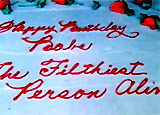
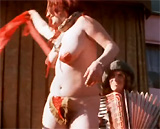
The perverted money-making scheme was complete with kidnapped (chloroformed) women locked and caged in a basement during their forced pregnancies. They were artificially inseminated with Channing's sperm into their vaginas via a dispenser tube syringe), and then forced to wait nine months to sell their babies (in their "adoption clinic") to lesbian couples. The clown-masked, tall Raymond showed how perverse and devious he was by exhibiting and exposing himself to two females lunching in a wooded park, after tying and attaching a very long kielbasa sausage to the end of his penis, and then stealing a left-behind purse. There was also bestiality rape-sex with two live chickens crushed between Babs' delinquent son Crackers (Danny Mills) and Marbles' spy Cookie (Cookie Mueller) as voyeuristic Cotton (Mary Vivian Pearce) looked on from a nearby trailer window. Animal activist groups protested the revolting film for its treatment of chickens. Other shocking sequences included Babs' over-the-top birthday party scene with a cake decorated with the words: "Happy Birthday Babs The Filthiest Person Alive", featuring bizarre sex acts, including a topless woman (with pasties) dancing with a snake around her neck, and especially the close-ups of a gay male contortionist (anonymous, uncredited as the "Singing Asshole") who ascended onto a performance stage, laid down on his back with his legs in the air, and musically sang or 'lip-synched' to the tune of The Trashmen's "Surfing Bird (Bird is the Word)" ("Mau-mau-mau") by flexing - opening and closing - his anal sphincter!).
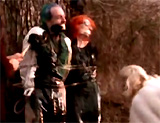
Disgusted by the party as they spied upon it, the Marbles summoned the police - followed by the killing and cannibalistic eating (simulated) of a quartet of policemen (reminiscient of Night of the Living Dead (1968)) after being axed into pieces. Next was the scene of the surprise revelation of a Trans-sexual's (Elizabeth Coffey, credited as "Chick with a Dick") breasts and male genitals in an outdoor park to thief Raymond, when he selected his next victim and 'she' flashed her penis at him. There was also an outrageous scene of mother-son incestual sex (fellatio) between Babs and Crackers, after they vandalized the Marbles' home and licked all the furniture. Channing, who had kidnapped, held, and impregnated the women with his sperm in the basement as part of the Marbles' scheme, was castrated by one of the freed pregnant women in the basement ("I'm gonna cut that big fat worm right off you") (off-screen). Shortly later, Connie screamed when she saw that he had bled to death ("He's been castrated. His penis is gone!"). Babs vengefully kidnapped and held a trial (kangaroo court) of the Marbles for burning down her trailer, and for "first-degree stupidity" and "assholism." Babs delivered a stunning "filth politics" speech to TV and tabloid reporters, including Mr. John Vader who asked if blood was a turn-on:
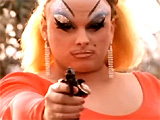
The bound-and-gagged couple were tied to a tree, coated in tar and feathers, and gunned down one-by-one in the head by Babs/Divine in front of the press - it was a 'live homicide.'
In the climactic ending scene, a scatological, disgusting gross-out scene, Babs literally ate real (and fresh, recently-defecated) dog feces (a practice termed coprophagia) in a competition to become the 'World's Filthiest Person Alive' - among other things. S he gagged and then smiled at the camera in a close-up - finally succeeding in attaining the title. |
 The Trailer (with Pink Flamingos) 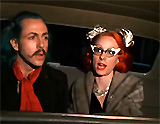 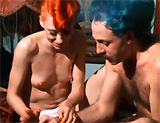 Raymond and Connie Marble 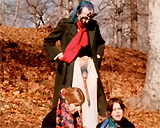 Transgender Raymond Marble: Exhibitionism in the Park - A Ploy for Purse-Snatching 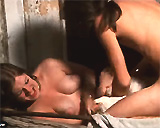 Copulation Between Crackers and Cookie (with Two Live Chickens) 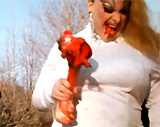 Cannibalism of Policemen at the End of the Birthday Party    Trans-sexual in a Park 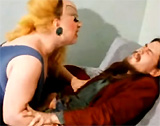 Incestual Oral Sex: Babs and Crackers 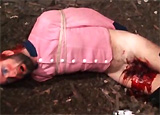 Channing Castrated  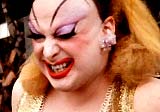
Eating Dog Feces (Coprophagia) |
|||||||||||||||||
 The
100+ Most Controversial Films of All-Time The
100+ Most Controversial Films of All-Time(chronologically, by film title) Intro | Silents-1930s | 1940s-1950s | 1960-1961 | 1962-1967 | 1968-1969 1970-1971 | 1972 | 1973-1974 | 1975 | 1976-1977 | 1978 | 1979 1980-1982 | 1983-1986 | 1987-1989 | 1990-1992 | 1993-1995 | 1996-1999 2000-2002 | 2003-2005 | 2006-2009 | 2010-present |




 The
dirty movie that ushered in "porno chic," Deep Throat sparked heated debate and precedent-setting court cases that challenged
assumptions about obscenity.
The
dirty movie that ushered in "porno chic," Deep Throat sparked heated debate and precedent-setting court cases that challenged
assumptions about obscenity.