|
Best Film Speeches and Monologues
|
|
Title Screen
|
Film Title/Year and Description of Film Speech/Monologue |
Screenshots
|
|
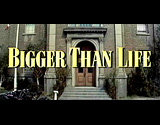
Bigger Than Life (1956)
Screenwriter(s): Uncredited Nicholas Ray, James
Mason, Gavin Lambert, Clifford Odets
 Rant Against 50's Education in the Schools Rant Against 50's Education in the Schools
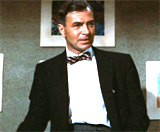
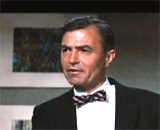
Ill, underpaid and frustrated schoolteacher
and middle-class family man Ed Avery (James Mason) deliberately
delivered offensive
and haughty criticisms of every tenent of 50s life in a rant-filled
denouncement of the school and its failed educational policies
during a PTA meeting where the walls displayed children's artwork.
As a result of his inflammatory and demagoguery, some were admiring:
"That young man ought to be the president of this country!...(or)
the principal of this school":
Every year whole forests are cut down
to supply the paper for these grotesque daubs. And we coo over
them as though they were Van Goghs or Rembrandts....Childhood
is a congenital disease and the purpose of education is to cure
it. I see my point of view is new to many of you. But ask yourselves,
how do we describe the unfortunate individual who carries his
unspoiled childhood instincts into adult life? We say he's arrested.
We call him a moron.
(Parents gasped, one with a daughter
named Louise)
My dear lady, your Louise is a charming little
creature, but we must try to examine the problem without prejudice
or sentiment. The hard fact remains that your daughter, at
her present stage of development, is roughly on an intellectual
par with the African gorilla.
(More gasps)....
What, after
all, from the Stone Age to the present day has been the greatest
invention of mankind? Has anybody got a match?...(He lit his
cigarette) Fire? The wheel? Safety pin? The hydrogen bomb?
No, ladies and gentlemen, the alphabet. And persons like myself
are required to teach these poor, bewildered kids to read by
a system of word recognition as though the mighty English language
were a collection of Chinese ideograms. And then we're surprised
when Junior can't even wade through the comics...."The
three Rs" - that's just a catchphrase. Before it's too
late, we ought to get back to the real fundamentals.
And I'm not just talking of primary education now. We're breeding
a race of moral midgets.
(Even more gasps)
All this hogwash
about 'self-expression', 'permissiveness', 'development patterns',
'emotional security'. Security - with the world ready to blow
up. If the republic is to survive, we've got to get back to
teaching the good old virtues of hard work and self-discipline
and a sense of duty! My friends, I tell you, we're committing hara-kiri every
day right here in this classroom.
|
|
|
Invasion
of the Body Snatchers (1956)
Screenwriter(s): Daniel Mainwaring
Haunting
Voice-Over Narration
Play clip (excerpt): 
Dr. Miles Bennell's (Kevin McCarthy) haunting
opening voice-over about how the town had changed, and how
his office had been besieged by patients in a near epidemic
during his absence:
"Well, it started - for me, it started
- last Thursday, in response to an urgent message from
my nurse. I'd hurried home from a medical convention I'd
been attending. At first glance, everything looked the
same. It wasn't.
Something evil had taken possession of
the town. Sick people who couldn't wait to see me, then
suddenly were perfectly all right. A boy who said his mother
wasn't his mother. A woman who said her uncle wasn't her
uncle"
|
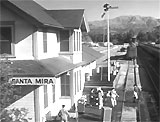
Dr. Bennell's Opening Voice-Over
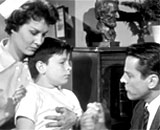
Treating a Distressed Boy Who Claimed His Mother Wasn't His Mother
|
|
|
Invasion
of the Body Snatchers (1956)
Screenwriter(s): Daniel Mainwaring
Frantic
"You're Next!" Warning
Play clip (excerpt):
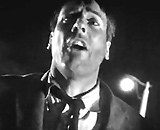
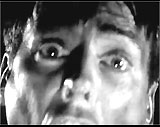
The doctor's equally haunting
frantic, panicked highway rant as he desperately tried to warn
motorists of the omnipresent danger -- especially after seeing
a flatbed truck loaded with alien pods:
Help, help, wait. Help! Help! Wait!
Wait! Wait! Stop! Stop and listen to me! Listen to me!...Those
people that are coming after me! They're not human! Listen
to me! We're in danger!... They're after all of us! All
of us!....Listen to me! There isn't a human being left
in Santa Mira!... Stop! Pull over to the side of the road!
I need your help! Something terrible's happened!...Look,
you fools. You're in danger. Can't you see? They're after
you. They're after all of us. Our wives, our children,
everyone. They're here already. YOU'RE NEXT!
|

|
|
It Conquered the World (1956)
Screenwriter(s): Lou Rusoff
Eulogy
About Man's Place in the Universe
Play clip (excerpt):
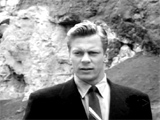
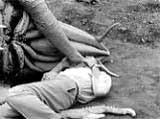
In Roger Corman's sci-fi/horror B-movie, Dr.
Paul Nelson's (Peter Graves) surprisingly potent eulogy for
Dr. Tom Anderson (Lee Van Cleef) and his thoughts on Man's
place in the universe in a closing montage:
He learned almost too late that man is a
feeling creature... and because of it, the greatest in
the universe. He learned too late for himself that men
have to find their own way, to make their own mistakes.
There can't be any gift of perfection from outside ourselves.
And when men seek such perfection... they find only death...
fire... loss... disillusionment... the end of everything
that's gone forward. Men have always sought an end to the
toil and misery, but it can't be given, it has to be achieved.
There is hope, but it has to come from inside, from Man
himself.
|

|
|
Moby Dick (1956)
Screenwriter(s): Ray Bradbury, John Huston
The
Battle of Good vs. Evil
Play clip (excerpt):
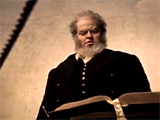
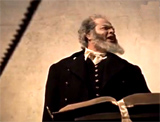
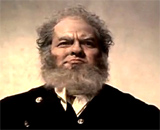
In Nantucket before sailing, Father Mapple's
(Orson Welles) long, stirring, ranting sermon about the battle
of good vs. evil in the soul of man, with nautical metaphors,
reference to St. Paul, and inspired by the Jonah and the whale
tale:
And God had prepared a great fish "to
swallow up Jonah." Shipmates - the sin of Jonah
was in his disobedience of the command of God. He found
it a hard command. And it was, shipmates, for all the
things that God would have us do are hard. If we would
obey God, we must disobey ourselves. But Jonah still further
flouts at God by seeking to flee from him. Jonah thinks
that a ship made by men will carry him into countries
where God does not reign. He prowls among the shipping
like a vile burglar, hastening to cross the seas. And as
he comes aboard, the sailors mark him. The ship puts out,
but soon the sea rebels. It will not bear the wicked burden.
A dreadful storm comes up. The ship is like to break. The
boatswain calls all hands to lighten her. Boxes, bales,
and jars are clattering overboard. The wind is shrieking.
The men are yelling. "l fear the Lord," cries Jonah, "the
God of heaven, who hath made the sea and the dry land."
Again,
the sailors mark him. But wretched Jonah cries out to them
to cast him overboard for he knew that for his sake this
great tempest was upon them. Now behold Jonah, taken up
as an anchor and dropped into the sea, into the dreadful
jaws awaiting him. And the great whale shoots to all his
ivory teeth. Like so many white bolts upon his prison.
And Jonah cries unto the Lord out of the fish's belly.
But observe his prayer, shipmates. He doesn't weep and wail.
He feels his punishment is just. He leaves deliverance to
God. And even out of the belly of hell, grounded upon the
ocean's utmost bones, God heard him when he cried. And
God spake unto the whale. And from the shuddering cold and
blackness of the deep, the whale breached into the sun
and vomited out Jonah upon the dry land. And Jonah, bruised
and beaten, his ears like two seashells, still multitudinously
murmuring of the ocean.
Jonah did the Almighty's bidding. And
what was that, Shipmates? TO PREACH THE TRUTH IN THE FACE
OF FALSEHOOD. Now Shipmates, woe to him who seeks to pour
oil on the troubled waters when God has brewed them into
a gale. Yea, woe to him who, as the Pilot Paul has it,
while preaching to others is himself a castaway. But delight
is to him who against the proud gods and commodores of
this Earth stands forth his own inexorable self, who destroys
all sin, though he pluck it out from under the robes of senators
and judges! And Eternal Delight shall be his, who coming
to lay him down can say:
- O Father, mortal or immortal, here I die.
I have striven to be thine,
more than to be this world's or mine own,
yet this is nothing
I leave eternity to Thee.
For what is man that he should live out the
lifetime of his God?
|
|

|
The Bridge on the River Kwai (1957)
Screenwriter(s): Michael Wilson, Carl Foreman
Welcome
to British POWs - "Be Happy in Your Work"
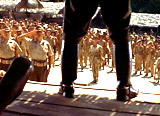
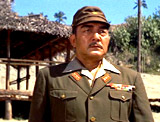
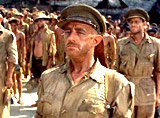
Japanese Colonel Saito (Sessue Hayakawa) delivered
a threatening, ominous address to recently-captured British
POWs in his jungle camp, instructing that officers would work
as well as the other prisoners, and warning everyone about
impossible escape:
I am Colonel Saito. (He stepped up on
a box to view the prisoners and address them.) In
the name of his Imperial Majesty, I welcome you. I am
the commanding officer of this camp, which is Camp 16
along the great railroad which will soon connect Bangkok
with Rangoon. You British prisoners have been chosen
to build a bridge across the River Kwai. It will be pleasant
work requiring skill, and officers will work as well
as men. The Japanese Army cannot have idle mouths to
feed. If you work hard, you will be treated well. But
if you do not work hard, you will be punished!
A word to you about escape. There is no barbed
wire, no stockade, no watchtower. They are not necessary.
We are an island in the jungle. Escape is impossible. You
would die. Today you rest. Tomorrow you will begin. Let me
remind you of General Yamashita's motto: 'Be happy in your
work.' Dismissed!
|
|
|
|
The Bridge on the River Kwai (1957)
Screenwriter(s): Michael Wilson, Carl Foreman
A
Personal Reverie About Years of Military Service
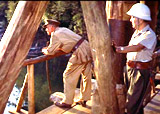
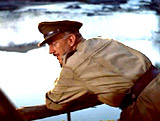
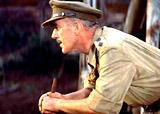
British Colonel Nicholson (Alec Guinness) and
Japanese Colonel Saito (Sessue Hayakawa) met mid-span on the
beautifully engineered, completed River Kwai bridge as the
sun set, exchanging views and reflecting on its magnificent
beauty ("a beautiful creation" and "a first-rate
job"). As Saito stood behind him, Nicholson leaned over
one of the guard rails and looked out over the river while
delivering a personal reverie about his years of military service.
He reflected on his "good life," particularly as
a regular officer in India (the ultimate destination of the
Japanese railroad route that he had helped to construct):
I've been thinking. Tomorrow it will be
28 years to the day that I've been in the service. 28 years
in peace and war. I don't suppose I've been at home more
than ten months in all that time. Still, it's been a good
life. I love India. I wouldn't have had it any other way.
But there are times when suddenly you realize you're nearer
the end than the beginning. And you wonder, you ask yourself,
what the sum total of your life represents, what difference
your being there at any time made to anything, or if it
made any difference at all really. Particularly in comparison
with other men's careers. I don't know whether that kind
of thinking is very healthy, but I must admit I've had
some thoughts on those lines from time to time. But tonight
-- tonight!
He accidentally dropped his stick into the river.
Blast! I must be off. The men are preparing
some sort of entertainment.
|
|
|
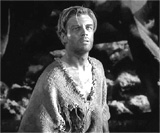
The Incredible Shrinking Man (1957)
Screenwriter(s): Richard Matheson
"I
Still Exist!" Speech

Play clip (excerpt):
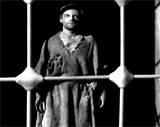
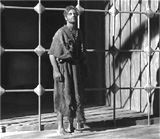
Scott Carey's (Grant Williams) final narrated
soliloquy, at the height of about one inch, as he was about
to shrink out of sight after fitting through a basement window
vent mesh-screen, but realizing that he was still important
in the scheme of the universe:
I was continuing to shrink, to become...
what? The infinitesimal? What was I? Still a human being?
Or was I the man of the future? If there were other bursts
of radiation, other clouds drifting across seas and continents,
would other beings follow me into this vast new world?
So close - the infinitesimal and the infinite. But suddenly,
I knew they were really the two ends of the same concept.
The unbelievably small and the unbelievably vast eventually
meet - like the closing of a gigantic circle. I looked
up, as if somehow I would grasp the heavens. The universe,
worlds beyond number, God's silver tapestry spread across
the night. And in that moment, I knew the answer to the
riddle of the infinite. I had thought in terms of Man's
own limited dimension. I had presumed upon nature that
existence begins and ends is man's conception, not nature's.
And I felt my body dwindling, melting, becoming nothing.
My fears melted away and in their place came acceptance.
All this vast majesty of creation, it had to mean something.
And then I meant something, too. Yes, smaller than the
smallest, I meant something, too. To God, there is no zero.
I STILL EXIST!
|
|
|
Sweet
Smell of Success (1957)
Screenwriter(s): Clifford Odets, Ernest Lehman
Hunsecker's
Degrading of Falco - "Match me, Sidney"
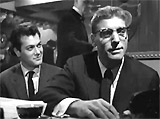
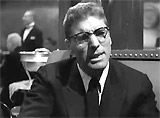
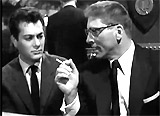
Powerful and unethical Broadway columnist J.
J. Hunsecker (Burt Lancaster) provided a critical, vitriolic
and degrading description of slimy press agent Sidney Falco
(Tony Curtis):
Mr. Falco, let it be said at once, is a
man of forty faces, not one. None too pretty and all deceptive.
You see that grin? That's the, uh, that's the charming
street-urchin face. It's part of his helpless act.
He throws himself upon your mercy. He's got a half-dozen
faces for the ladies. But the one I like, the really cute
one, is the quick, dependable chap - nothing he won't do
for you in a pinch. So he says! Mr. Falco, whom I did not
invite to sit at this table tonight, is a hungry press
agent and fully up to all the tricks of his very slimy
trade.
He then challenged him with the famous line,
holding out his cigarette:
Match me, Sidney.
|
|
|
|
Sweet
Smell of Success (1957)
Screenwriter(s): Clifford Odets, Ernest
Lehman
Farewell
to a Possessive Brother
Play clip (excerpt):
Susan Hunsecker (Susan Harrison) quiet, firm
farewell to her powerful but possessive brother J. J. Hunsecker
(Burt Lancaster), who tried to end her relationship with jazz
musician Steve Dallas (Martin Milner), before she walked into
the bright sun as an independent woman:
I'd rather be dead than living with you.
For all the things you've done, J.J., I know I should hate
you. But I don't. I pity you.
|

|


 Best
Film Speeches and Monologues
Best
Film Speeches and Monologues